
This letter was written by “Dora” who was probably a daughter of Martin Luther Eichelberger (1797-1855) and Maria Catherine Zimmerman (1804-1865). The family lived in Frederick county, Maryland, before moving to Jefferson county, Virginia. Dora’s brother Webster Eichelberger (1835-1886) attended the Academy of Charleston before graduating from Gettysburg College in 1856. He afterwards taught the Preparatory Department at Roanoke College in Salem, Virginia, until the start of the Civil War when he enlisted in Co. G, 2nd Virginia Infantry. He served with the regiment from 21 June 1861 to 21 July 1862. He was then ordained a minister and served the last year of the war as the chaplain of the 20th South Carolina Infantry. Dora’s other brother George F. Eichelberger (1843-1910) also served in Stonewall’s Brigade as a sergeant in Co. G, 2nd Virginia Infantry. He was wounded on 12 May 1864 but survived the war. Dora may have been a nickname for she does not show up in census records.
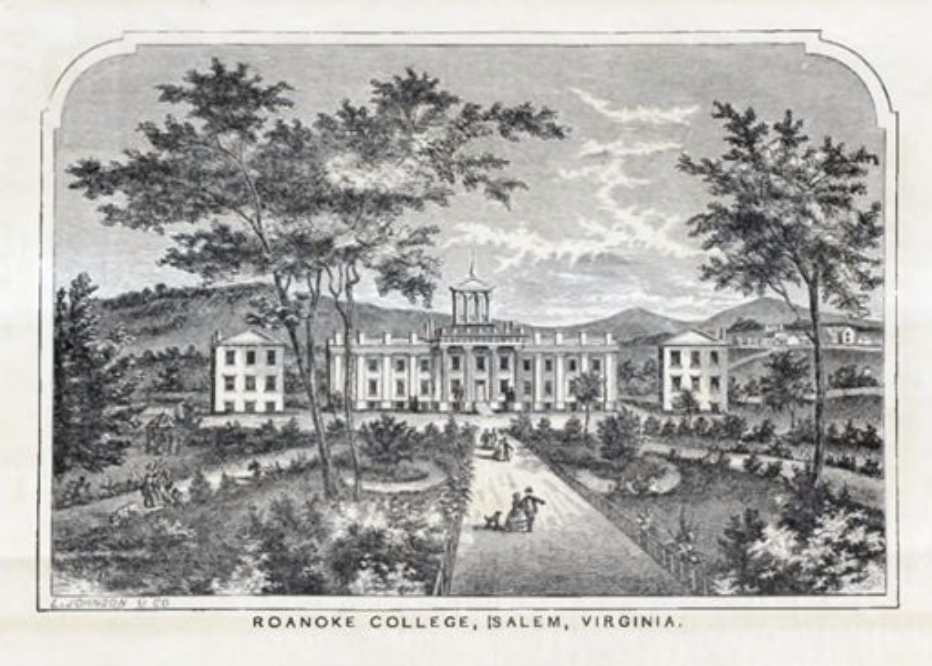
Dora wrote her letter to “Cousin Porte” with whom she must have spent some time with while attending Roanoke College in Salem, Virginia. He may have been a student there or lived in Salem. My hunch is that “Porte” was a nickname for Porter. It’s clear that he was serving in the Confederate army and that he likely had a sister named Minnie and possible another named Callie.
Despite the absence of confirmed identities, the letter offers valuable insights from December 1861, presented from the perspective of a young woman living in the Confederate States of America.
T R A N S C R I P T I O N
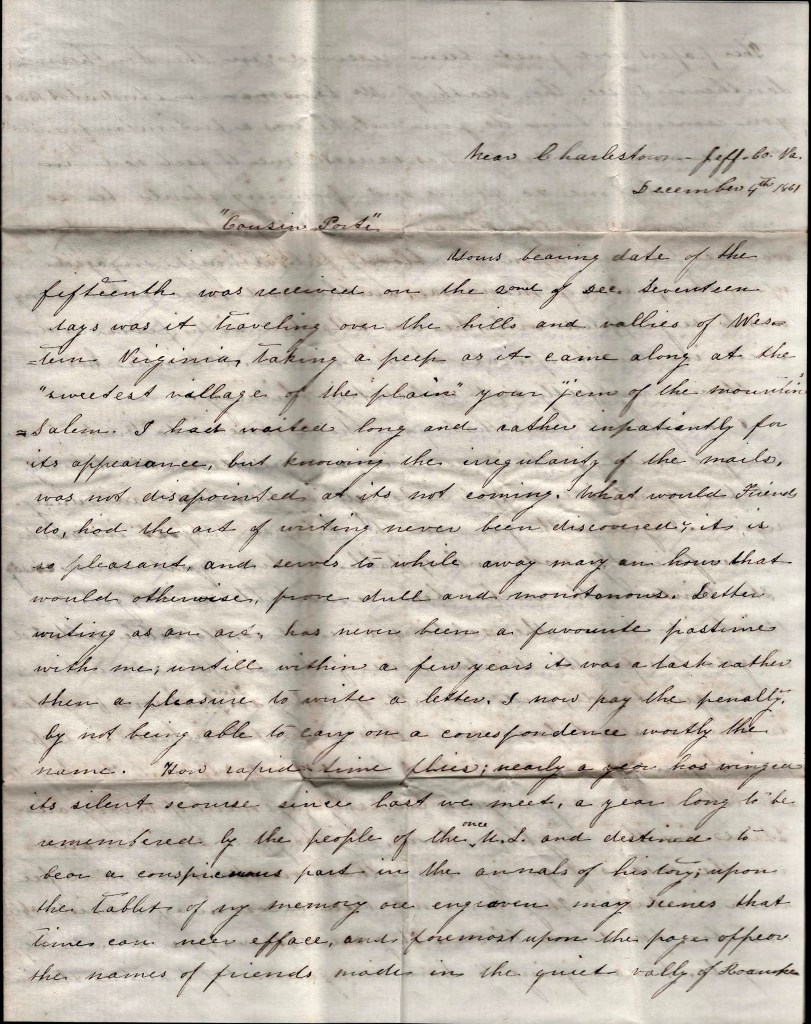
Near Charlestown, Jefferson county, Va.
December 4th 1861
“Cousin Porte”
Yours bearing date of the fifteenth was received on the 2nd of December. Seventeen days was it traveling over the hills and valleys of Western Virginia, taking a peep as it came along at the “sweetest village of the plain” your “gem of the mountain” = Salem. I had waited long and rather impatiently for its appearance, but knowing the irregularity of the mails, was not disappointed at its not coming. What would friends do had the art of waiting never been discovered? It is so pleasant and serves to wile away many an hour that would otherwise prove dull and monotonous. Letter writing as an art has never been a favorite pastime with me until within a few years it was a task rather than a pleasure to write a letter. I now pay the penalty by not being able to carry on a correspondence worthy the name. How rapid time flies; nearly a year has winged its silent course since last we met—a year long to be remembered by the people of the once United States and destined to bear a conspicuous part in the annals of history; upon the tablet of my memory are engraven many scenes that times can ne’er efface, and foremost upon the pages appear the names of friends made in the quiet valley of Roanoke.
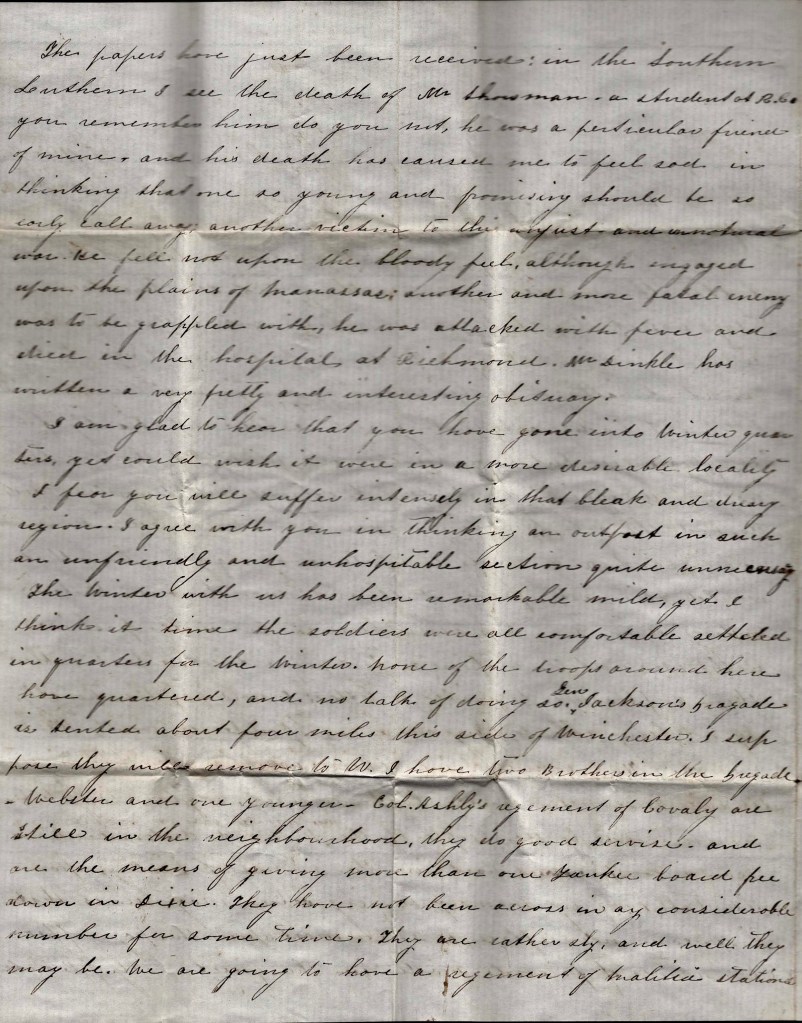
The papers have just been received: in The Southern Luther[a]n I see the death of Mr. [Otho J.] Showman 1 [of Washington county, Maryland]—a student at Roanoke College. You remember him, do you not? He was a particular friend of mine and his death has caused me to feel sad in thinking that one as young and promising should be so early call[ed] away; another victim to this unjust and unnatural war. He fell not upon the bloody field, although engaged upon the plains of Manassas; another and more fatal enemy was to be grappled with. He was attacked with fever and died in the hospital at Richmond. Mr. [W. H.] Dinkle [of Rockingham county] has written a very pretty and interesting obituary.
I am glad to hear that you have gone into winter quarters, yet could wish it were in a more desirable locality. I fear you will suffer intensely in that black and dreary region. I agree with you in thinking an outpost in such an unfriendly and unhospitable section quite unnecessary. The winter with us has been remarkable mild, yet I think it time the soldiers were all comfortable settled in quarters for the winter. None of the troops around here have quartered and no talk of doing so. Gen. [Stonewall] Jackson’s Brigade is tented about four miles this side of Winchester. I suppose they will remove to Winchester. I have two brothers in the Brigade—Webster and one younger. Col. [Turner] Ashby’s regiment of cavalry are still in the neighborhood. They do good service and are the means of giving more than one Yankee [his] board free down [here] in Dixie. They have not been across in any considerable number for some time. They are rather sly and well they may be. We are going to have a regiment of militia stationed in Charlestown for the winter. I am sorry they are going to be in there, so many of them are addicted to the disgusting habit of intemperance it makes it unsafe to go there.
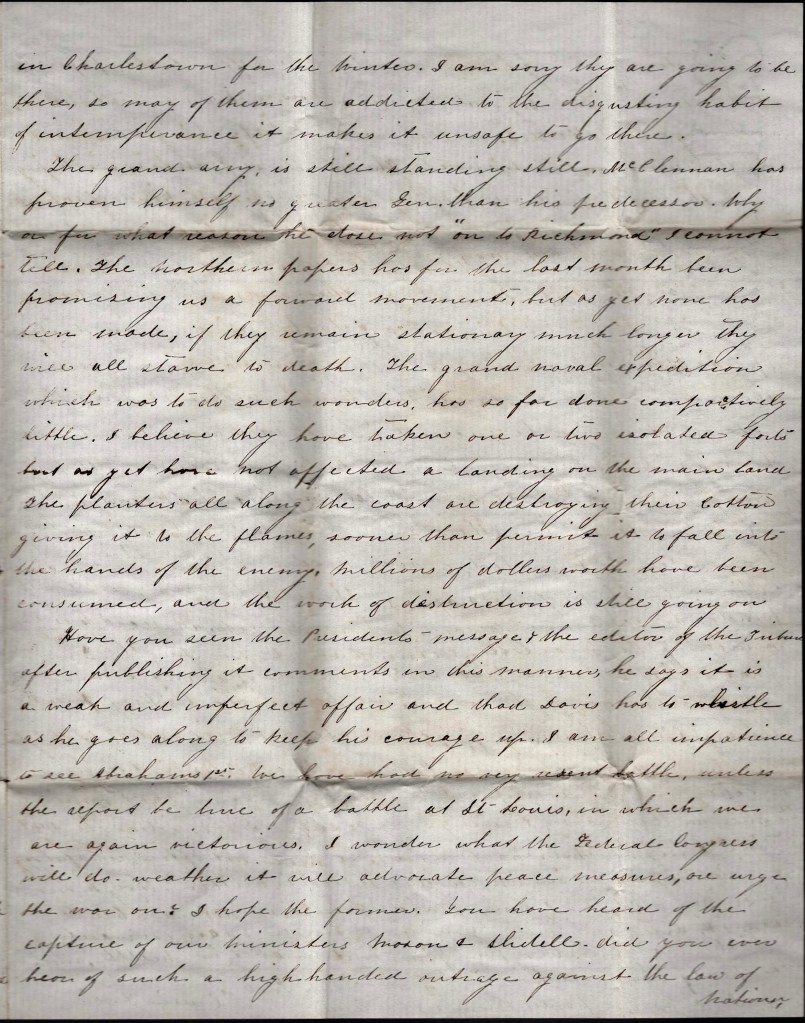
The grand army is still standing still. McClellan has proven himself no greater general than his predecessor. Why or for what reason he does not “On to Richmond” I cannot tell. The Northern papers has for the last month been promising us a forward movement but as yet none has been made. If they remain stationary much longer, they will starve to death. The grand naval expedition which was to do such wonders has so far done comparatively little. I believe they have taken one or two isolated forts but as yet have not effected a landing on the main land. The planters all along the coast are destroying their cotton, giving it to the flames, sooner than permit it to fall into the hands of the enemy. Millions of dollars worth have been consumed and the work of destruction is still going on.
Have you seen the President’s message to the editor of the Tribune after publishing it comments in this manner, he says it is a weak and imperfect affair and that Davis has to whistle as he goes along to keep his courage up. I am all impatience to see Abraham’s 1st [Message].
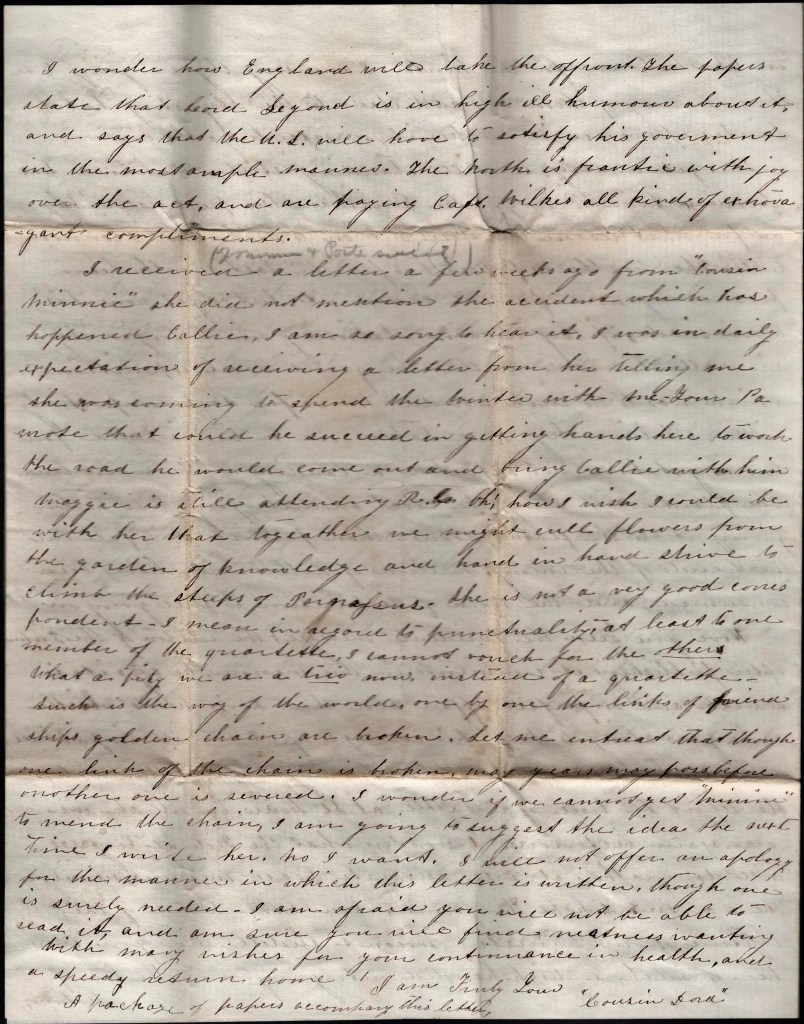
We have had no very recent battle unless the report be true of a battle at St. Louis in which we are again victorious. I wonder what the Federal Congress will do? Whether it will advocate peace measures or urge the war on? I hope the former. You have heard of the capture of our [Foreign] Ministers Mason & Slidell. Did you ever hear of such a high-handed outrage against the law of Nations? I wonder how England will take the affront. The papers state that Lord [Richard] Lyons is in high ill humor about it and says that the U. S. will have to satisfy his government in the most ample manner. The North is frantic with joy over the act and are paying Capt. Wilkes all kind of extravagant compliments.
I received a letter a few weeks ago from “Cousin Minnie.” She did not mention the accident which has happened [to] Callie. I am so sorry to hear it. I was in daily expectation of receiving a letter from her telling me she was coming to spend the winter with me. Your Pa wrote that could he succeed in getting hands here to work the road, he would come out and bring Callie with him. Maggie is still attending the Roanoke College. Oh! how I wish I could be with her that together we might cull flowers from the garden of knowledge and hand in hand strive to climb the steeps of Parnassus. She is not a very good correspondent—I mean in regard to punctuality, at least to one member of the quartet. I cannot vouch for the others. What a pity we are a trio now instead of a quartet. Such is the way of the world. One by one the links of friendships golden chain are broken. Let me entrust that though one link of the chain is broken, may years pass before another one is severed. I wonder if we cannot get “Minnie” to mend the chain? I am going to suggest the idea the next time I write her.
No, I won’t. I will not offer an apology for the manner in which this letter is writen, though wone is surely needed. I am afraid you will not be able to read it and am sure you. will find neatness wanting. With many wishes for your continuance in health and a speedy return home. I am truly your “Cousin Dora”
A package of papers accompany this letter.
1 Otho J. Showman (1839-1861) served in Co. I, 28th Virginia Infantry. He was the son of Peter Showman and Catherine Snavely who lived some six miles from Hagerstown in Washington county, Maryland.
 Spared & Shared 23