
The following letter was written by Bailey Martin (1805-1868) who was employed as the overseer of a plantation owned by Mrs. Emma Hopkins. Bailey was raised in Kershaw county, South Carolina, the son of Samuel and Mary (Bailey) Martin, but appears to have been a resident of Mississippi prior to 1840 and possibly an overseer for the Hopkins family even at that time. The Hopkins plantation was located along the Natchez Trace east of present day Canton, Madison county, Mississippi. The slave population in Madison county just prior to the Civil War exceeded 18,000 which placed it as the third highest county in Mississippi and the 16th highest in the U. S. The plantation was sited in one of the richest farming sections of antebellum Mississippi and ideally located near the Pearl River and later near the terminus of the New Orleans, Jackson, and Great Northern Railroad, providing a means for transporting cotton from the interior of the state.
Bailey wrote the letter to Emma Goodwyn Hopkins (1808-1868) who married her cousin William Hopkins (1805-1863) in 1833 and bore him at least nine children before his death in 1863. William was the grandson of John Hopkins—a delegate to the First Provincial Congress in South Carolina in 1775. Emma was the daughter of Lieut. Governor John Hopkins. William served in the South Carolina Militia and rose to the rank of Brigadier General. General Hopkins was a delegate to the Secession Convention on December 17th 1860, which convened in the Baptist Church in Columbia. Most likely the Hopkins family never took up residence in Mississippi but managed their plantation in absentia by hiring an overseer to management investments and interests. According to a list of Madison county slaveholders in 1860, Gen. William Hopkins owned 73 slaves in Mississippi.
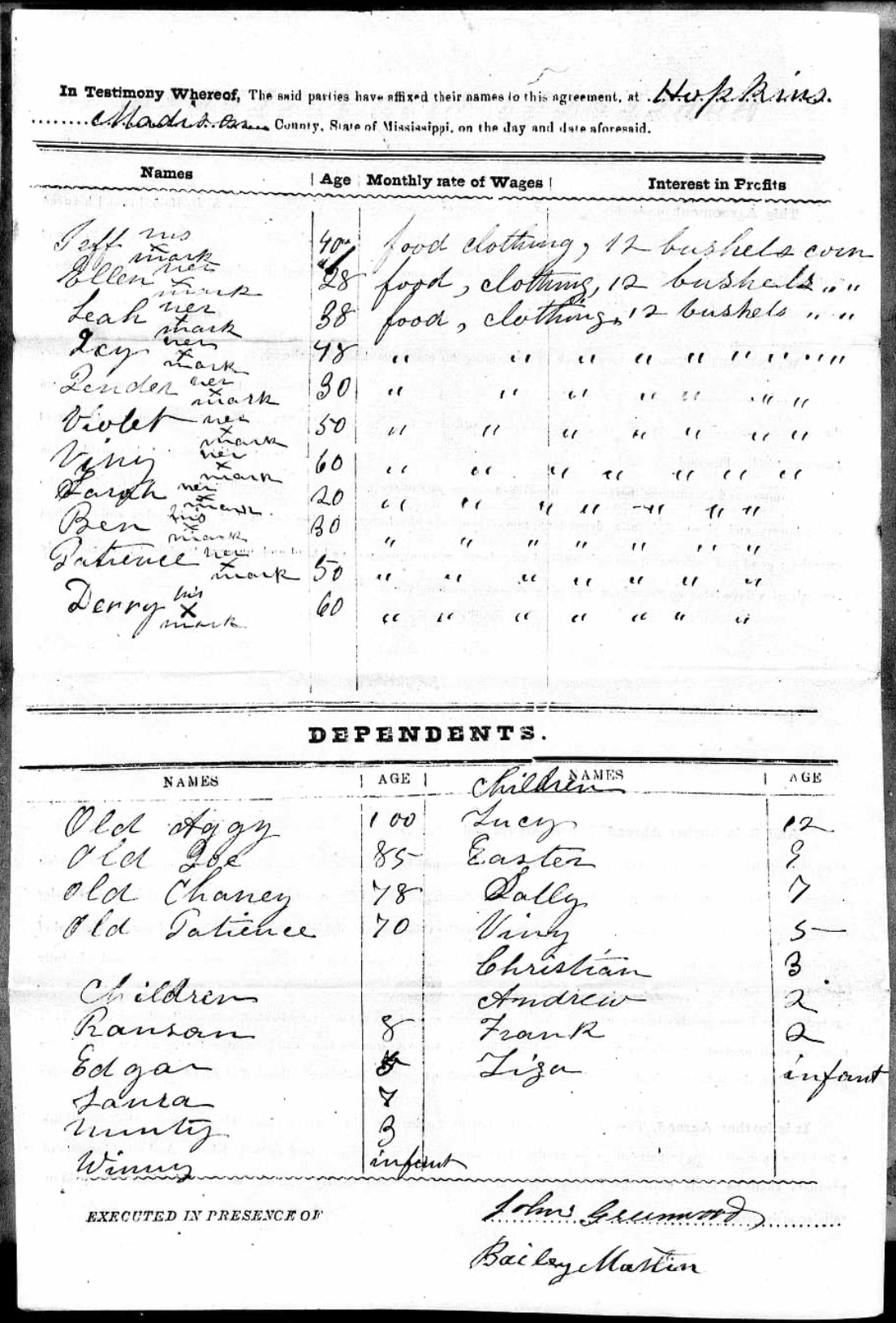
In his letter, Bailey mentions three slaves by name—Pender, Sas, and Ellen. I was able to find both Pender and Ellen in a post-war Freedman’s Bureau listing on the Hopkins plantation where Bailey Martin was still identified as managing the property. That list gives Pender’s age as 30 and Ellen’s as 28.
Note: This letter is from the private collection of Rob Morgan and was offered for transcription and publication on Spared & Shared by express consent.
T R A N S C R I P T I O N
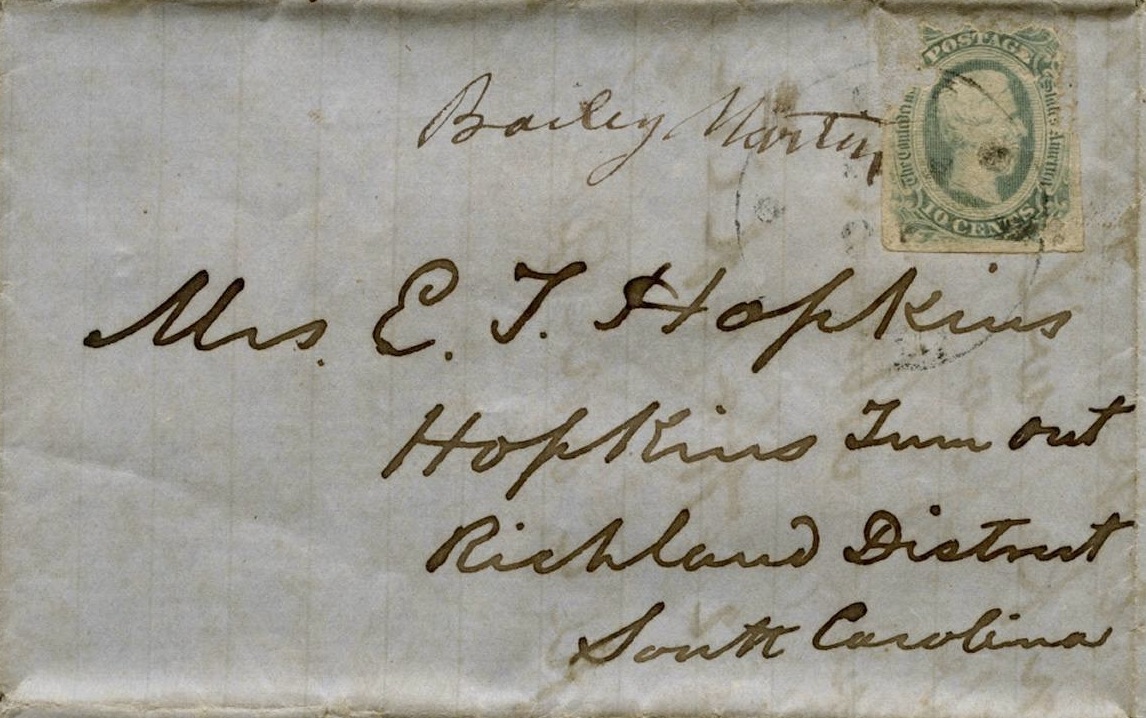
[Madison County, Mississippi]
May 15, 1864
Mrs. Hopkins—dear madam,
Have just received yours of April the 4th. I had written three letters to you. I sent them to Alabama to be mailed as there was no mail that came this far for some time. The Yankees was above us and below us. Three miles below us at Mr. [Hugh Washington] Hayes’ [plantation] 1; above us at Mrs. Carson’s about two miles and a half from us. The people from Mr. Hays’ to Canton have lost nearly all they possess—their negroes, horses, cattle, hogs, and some their house and kitchen furniture.
I had yours back in Pearl River swamp but there is danger. Below this they hunted the swamp but the negroes generally run off to the Yankees [who] carried them to their masters’ camp. I have known the negroes to use so much deception with their masters that I have no confidence in one at all. Your negroes made no attempt to betray me but I fear them. I shall try to keep the Yankees [from] getting anything that I have in charge. I shall [try] to keep the negroes from seeing the Yankees if I can.
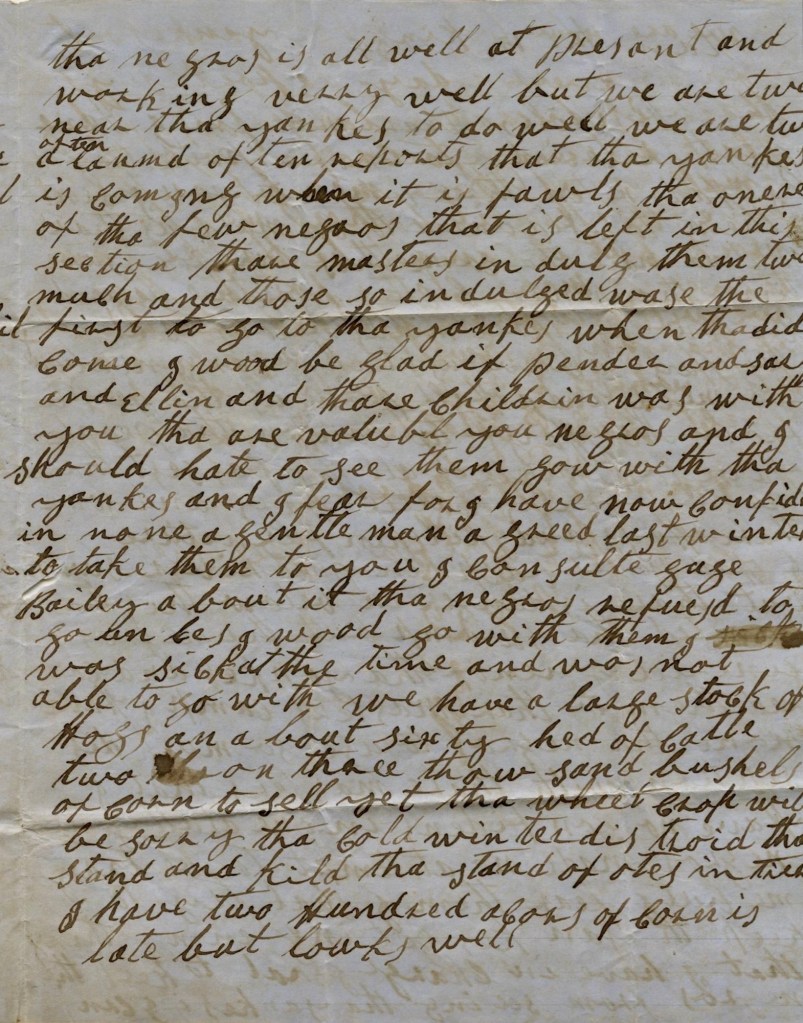
The negroes is all well at present and working very well but we are too near the Yankees to do well. We are too often alarmed. Often reports that the Yankees is coming when it is false. The owners of the few negroes that is left in this section, their masters indulge them too much and those so indulged was the first to go to the Yankees when they did come. I would be glad if Pender and Sas and Ellen and their children was with you. They are valuable. Your negroes and I should hate to see them go with the Yankees and I fear for I have no confidence in none. A gentleman agreed last winter to take them to you. I consulted Gage Bailey about it [but] the negroes refused to go unless I would go with them. I was sick at the time and was not able to go with.
We have a large stock of hogs and about sixty head of cattle, two or three thousand bushels of corn to sell yet. The wheat crop will be sorry. The cold winter destroyed that stand and killed the stand of oats in till. I have two hundred acres of corn—it’s late but looks well.
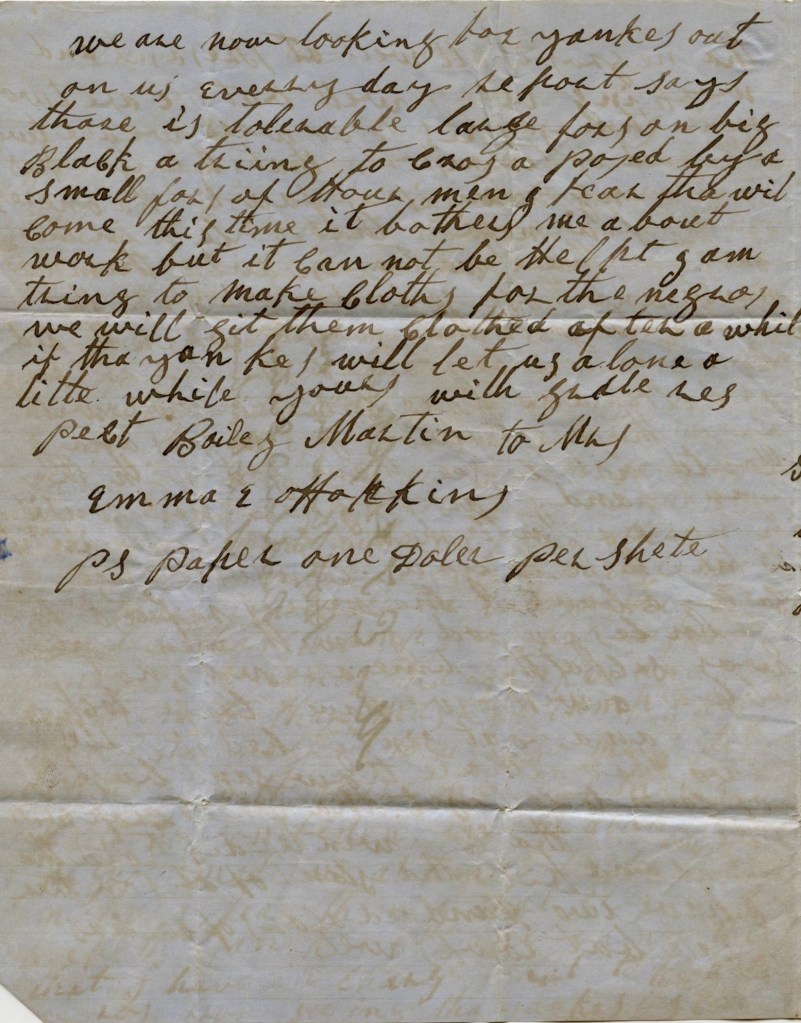
We are now looking for Yankees out on us every day. Report says there is tolerable large forces on Big Black [river] a trying to cross opposed by a small force of our men. I fear they will come this time. It bothers me about work but it cannot be helped. I am trying to make clothes for the negroes, We will get them clothed after awhile if the Yankees will let us alone a little while. Yours with [ ] respect, — Bailey Martin
To Mrs. Emma E. Hopkins
P. S. Paper [is] one dollar per sheet.
1 The plantation owned by Hugh Washington Hayes (1812-1873) was near unincorporated Farmhaven and we learn from Bailey’s letter that it was located “three miles below” the Hopkins Plantation. In 1860, Hayes had 60 slaves on his plantation.

 Spared & Shared 23