
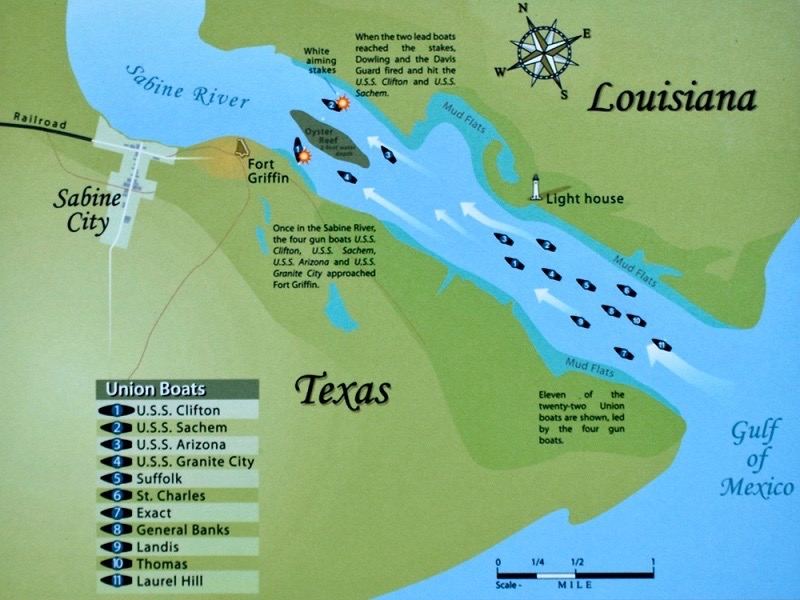
The following letter was written by Lewis Cass Irwin (1828-1889), one of the three steamboat captains in the Marine Department of the Military District of Texas, New Mexico and Arizona under Magruder’s overall command. Captain Irwin was assigned to the sub-quarters at at Sabine Pass, while Capt. Henry S. Lubbock and Capt. S. K. Brown were assigned to Galveston and Matagorda Bay, respectively. All three captains reported to “Commodore” Leon Smith.
Lewis was the son of Robert Irwin, Jr. (1797-1833) and Hannah Rees (1802-1886) of Portage, Columbia county, Wisconsin. Prior to the war, Lewis was a clerk in the US Indian Agent Office and as a railroad agent in Hempstead, Texas. After the war he worked as a correspondent of the Galveston News and Dallas Commercial and eventually moved to New Mexico. He died in December 1889 after a year’s residence in the Confederate Home in Austin, Texas.
Lewis wrote the letter to Miss Mary Stiles who was probably Mary Dudley Stiles (1843-1928), the daughter of William Woodbridge Stiles (1816-1889) and Ann Marie Bryan (1821-1895) of Houston, Texas. She married Augustus Norman Edmundson (1844-1912) in 1869.
T R A N S C R I P T I O N
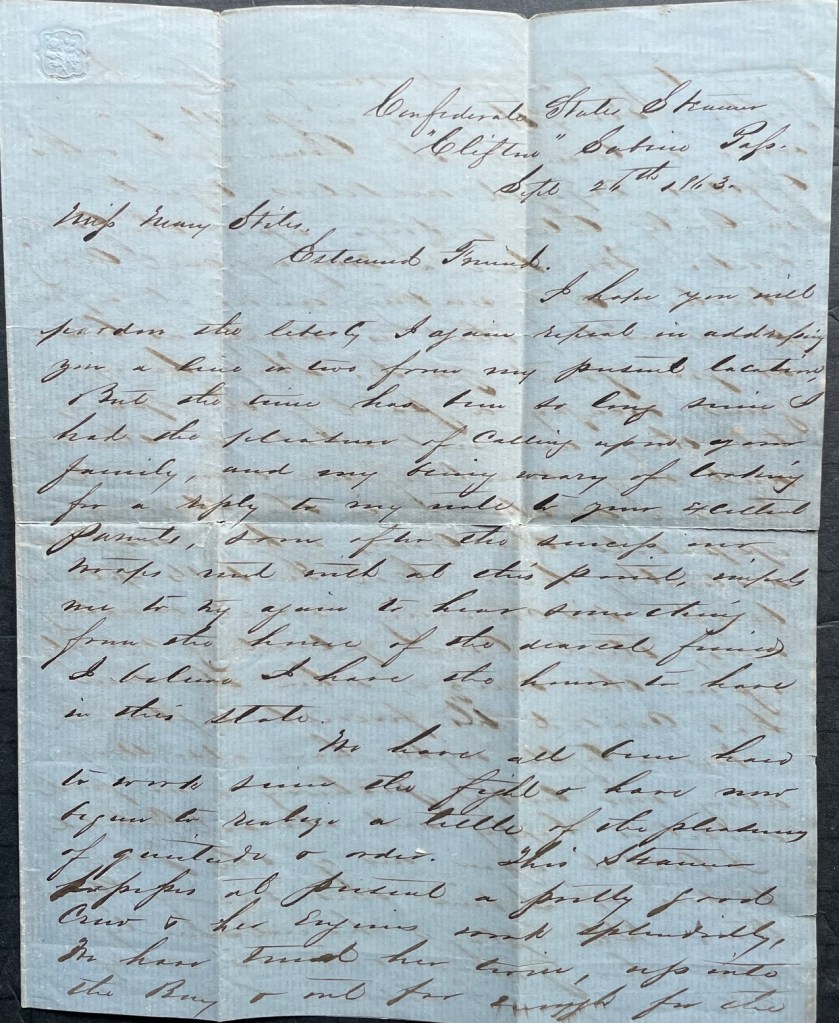
Confederate States Steamer “Clifton” 1
September 26th 1863
Miss Mary Stiles, esteemed friend,
I hope you will pardon the liberty I again repeat in addressing you a line or two from my present location. But the time has been so long since I had the pleasure of calling upon your family, and my being weary of looking for a reply to my note to your excellent parents, soon after the success out troops met with at this point, impels me to try again to hear something from the home of the dearest friends I believe I have the honor to have in this state.
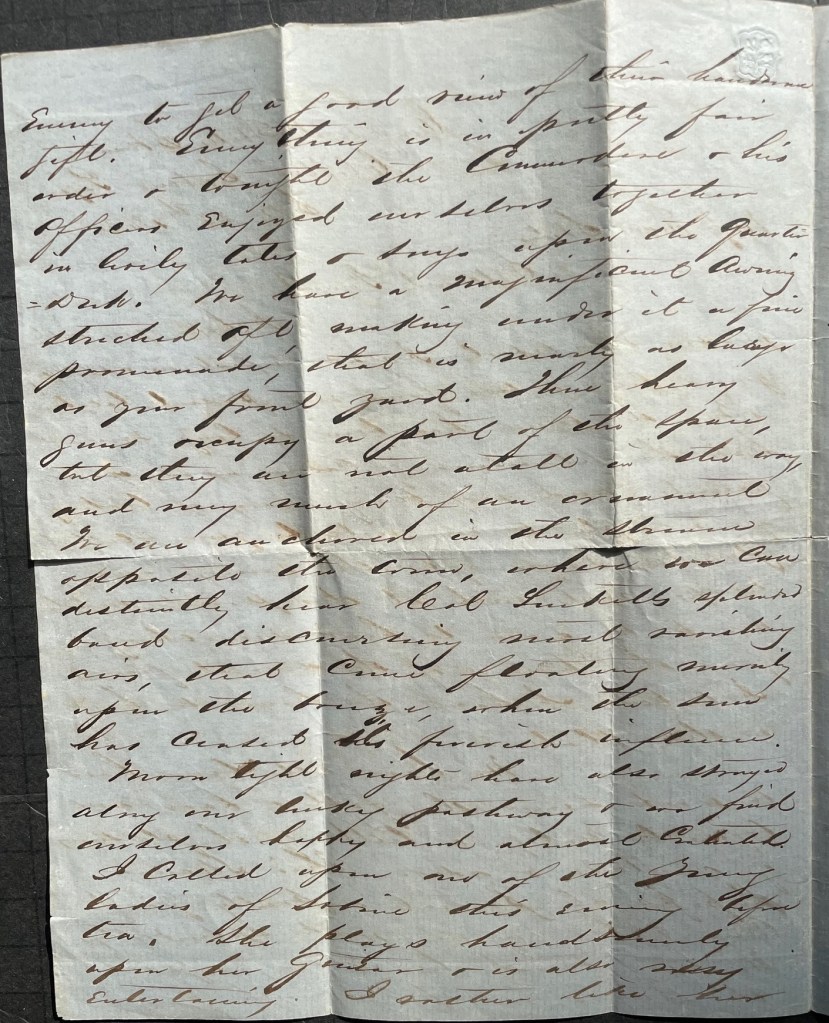
We have all been hard to work since the fight and have now begun to realize a little of the pleasures of quietude and order. This steamer possesses at present a pretty good crew & her engines work splendidly. We have tried her twice up into the Bay and out far enough for the enemy to get a good view of their handsome gift. Everything is in pretty fair order & tonight the Commodore and his officers enjoyed ourselves together in lively tales and songs upon the quarter deck. We have a magnificent awning stretched aft making under it a fine promenade, that is nearly as large as your front yard. These heavy guns occupy a part of the space but they are not at all in the way and very much of an ornament.
We are anchored in the stream opposite the town where we can distinctly hear Col. Lockett’s splendid band discoursing most ravishing airs that come floating merrily upon the breeze. When the sun has ceased its feverish influence, moonlight nights have also strayed along our [ ] pathway & we find ourselves happy and almost contented.
I called upon one of the young ladies of Sabine this evening before tea. She plays handsomely upon her guitar and is also very entertaining. I rather like her. She sings sweetly and talks sensibly & too she is very free of all extravagant formalities which carries with it an air of purity and amiability. I hope you are well also. Your kind and excellent mother & your father, also Laura and the little ones. Please give my regards to all and tell them not a day passes that I do not find myself desiring again to see you all.
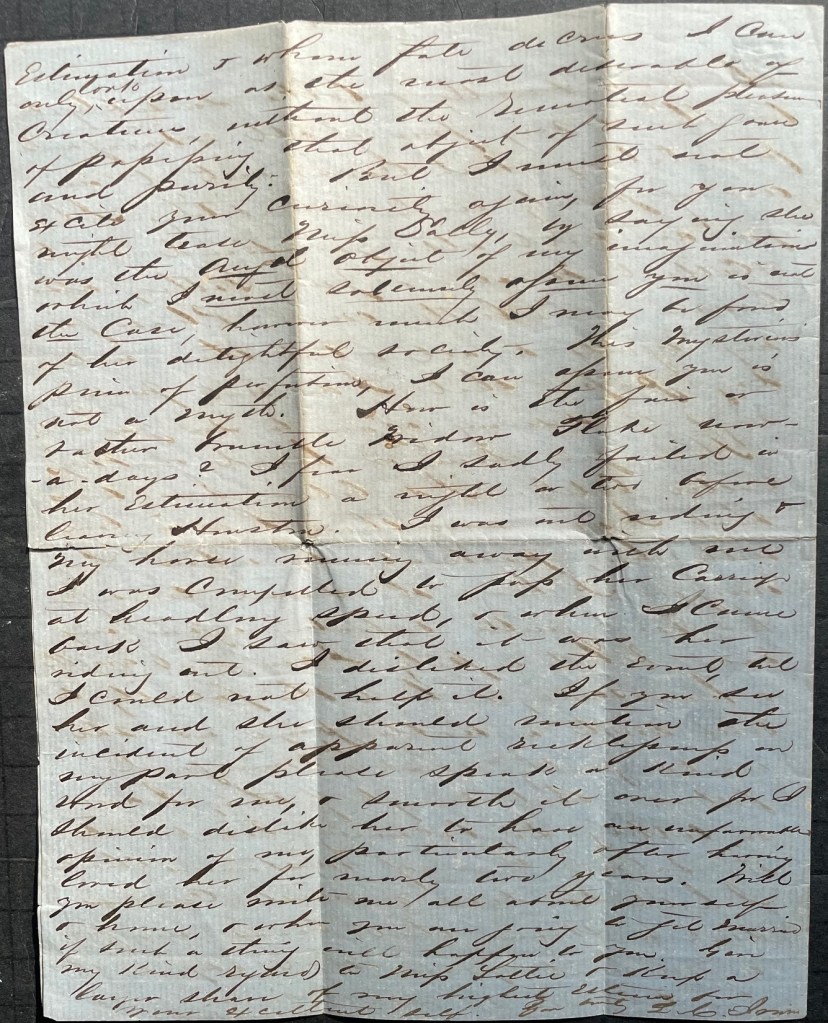
Have you seen or heard of Miss Lottie lately? I do believe sometimes that I am more than half in love with her, particularly when I imagine I hear the sweet tones of her voice gently vibrating upon my ear. What a pity I am not wealthy or handsome, and had the faculty to win such a noble prize as she would justly make for some good fellow. But enough of this. I am in talking so becoming traitor to the sacred love of mysterious character I hold so dear and must cease such a strain that bears me for a moment from that object who has become so samelike in my estimation & whose fate decrees I can only look upon as the most desirable of creatures, without the remotest pleasure of possessing that object of such good and purity. But I must not excite your curiosity again, for you might tease Miss Sally by saying she was the angel object of my imaginations which I most solemnly assure you is not the case, however much I may be fond of her delightful society. This mysterious prize of perfection I can assure you is not a myth. How is the fair or rather brunette widow Flake now-a-days? I fear I sadly failed in her estimation. A night or two before leaving Houston. I was our riding & my horse running away with me, I was compelled to pop the carriage at headlong speed, & when I came back, I saw that it was her riding out. I disliked the event but I could not help it. If you see her and she should mention the incident of apparent recklessness on my part, please speak a kind word for me & smooth it over for I should dislike her to have an unfavorable opinion of me, particularly after having loved her for nearly two years. Will you please write me all about yourself & home, and who you are going to get married, if such a thing will happen to you. Give my kind regards to Miss Lottie & keep a larger share of my highest esteem for your excellent self. Yours truly, — L. C. Irwin
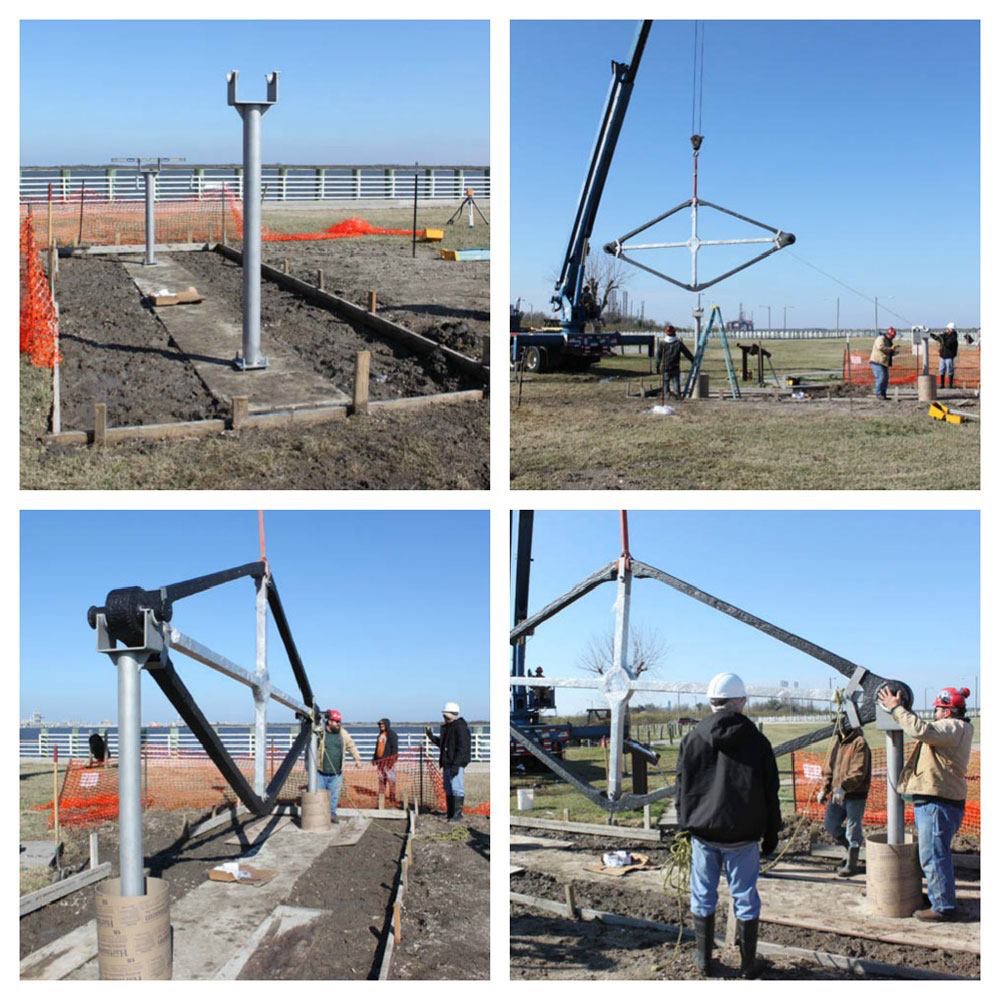
1 The CSS Clifton was a side-wheel steam ferryboat built in 1861 and launched at Brooklyn as the USS Clifton. She carried 8 guns and was assigned to the Mortar Flotilla in the West Gulf Blockading Squadron and engaged in the bombardment of Forts Jackson and St. Philip below New Orleans, the attack on Vicksburg in June 1862, the capture of Galveston in October 1862, and the July 1863 reconnaissance up the Atchafalaya and Teche Rivers. She was captured by Confederate forces on 8 September 1863 at Sabine Pass, Texas. She ran aground and was burned by Confederates on 21 March 1864 after an unsuccessful attempt to run the Union blockade. The Clifton remained a wreck, with portions of its stack and the walking beam visible landmarks for many years. The engine’s walking beam was removed in 1911 and installed in a park in Beaumont. Called a “walking beam” because of its steady rocking action, the 9-foot by 18-foot cast iron diamond-shaped beam pivoted in the center, transmitting vertical motion of the ship engine’s single large piston, which turned the shaft of the paddlewheel. In 2011, the walking beam was acquired by the THC for installation at the Sabine Pass Battleground State Historic Site as part of new interpretive exhibits. Prior to installation, the walking beam went through an extensive conservation process at the Texas A&M Conservation Research Laboratory. See photos from a staff visit to that lab a couple months ago: https://www.facebook.com/media/set/…. Learn more about Sabine Pass Battleground State Historic Site: www.visitsabinepassbattleground.com.

 Spared & Shared 23