

The following letters were written by Francisco (“Frank”) C. Park (1840-1932), the son of Harvey Hart Park (1815-1892) and Sarah F. Amidon (1817-1895) of Monson, Hampden county, Massachusetts. Frank enlisted in June 1861 to serve in Co. C, 10th Massachusetts Infantry. At the time of his enlistment he was described as standing 5 feet 7.5 inches tall, with blue eyes and gray hair. He remained in the service until 1 July 1864. I’m not certain who the first letter was addressed to but the second was his mother and younger sister Sarah E. Park (1846-1907) who married John Thayer b. 1835) in September 1863. John Thayer was probably the older brother of Josiah Thayer who served in the 10th Massachusetts with Frank.
Frank’s second and third letters unveil the brooding thoughts of a weary warrior disillusioned by the monotony of war and the drudgery of camp life.
Letter One
[Kalorama Heights or Camp Brightwood near Washington D. C.]
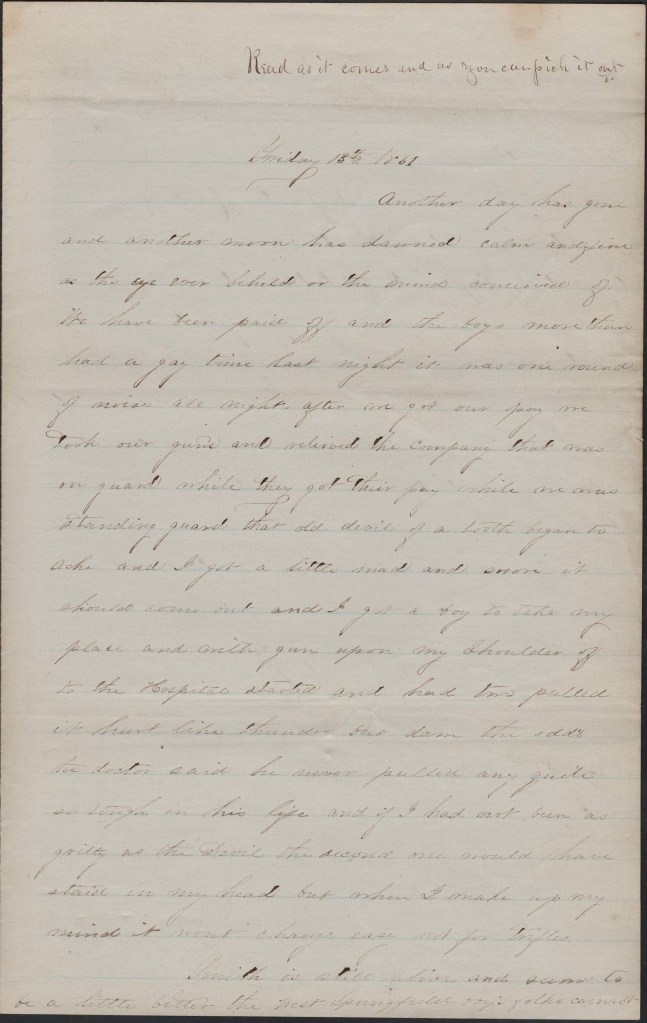
Friday [September?] 13th 1861
Another day has gone and another morn has dawned, calm and fine as the eye ever beheld or the mind conceived of. We have been paid off and the boys more than had a gay time last night. It was one round of noise all night. After we got our pay, we took our guns and relieved the company that was on guard while they got their pay. While we was standing guard, that old devil of a tooth began to ache and I got a little mad and swore it should come out and I got a boy to take my place and with gun upon my shoulder, off to the hospital started and had two pulled. It hurt like thunder but damn the odds. The doctor said he never pulled any quite so tough in his life and if I had not been as gritty as the devil, the second one would have stayed in my head. But when I make up my mind, it won’t change easy—not for trifles.
Smith is still alive and seems to be a little better. The West Springfield boy’s folks cannot be heard from so they have concluded to bury him upon the ground and the services will be performed at nine this morn.
As for the revolvers, we want a good rig, good sheathes. The money we are a going to send by Express the first time it comes up here so you may keep your eye open for the package. I still remain well. So does Josiah [Thayer]!
Tell Mrs. Morrison that when I come home, I will call and get some cider. Tell her that I am all right and hope she is the same. I have not time to write to them as I promised and said I would yesterday but I have no time so shall have to let it go for this time. So goodbye for now.
I remain your true friend and also the poor soldier boy in health and in happiness. Love to all, so farewell till my next which I shall send Monday. — Frank C. Park
Directions. I will send in the Express package for all the needful.

Letter Two
Harrison’s Landing
July 22nd 1862
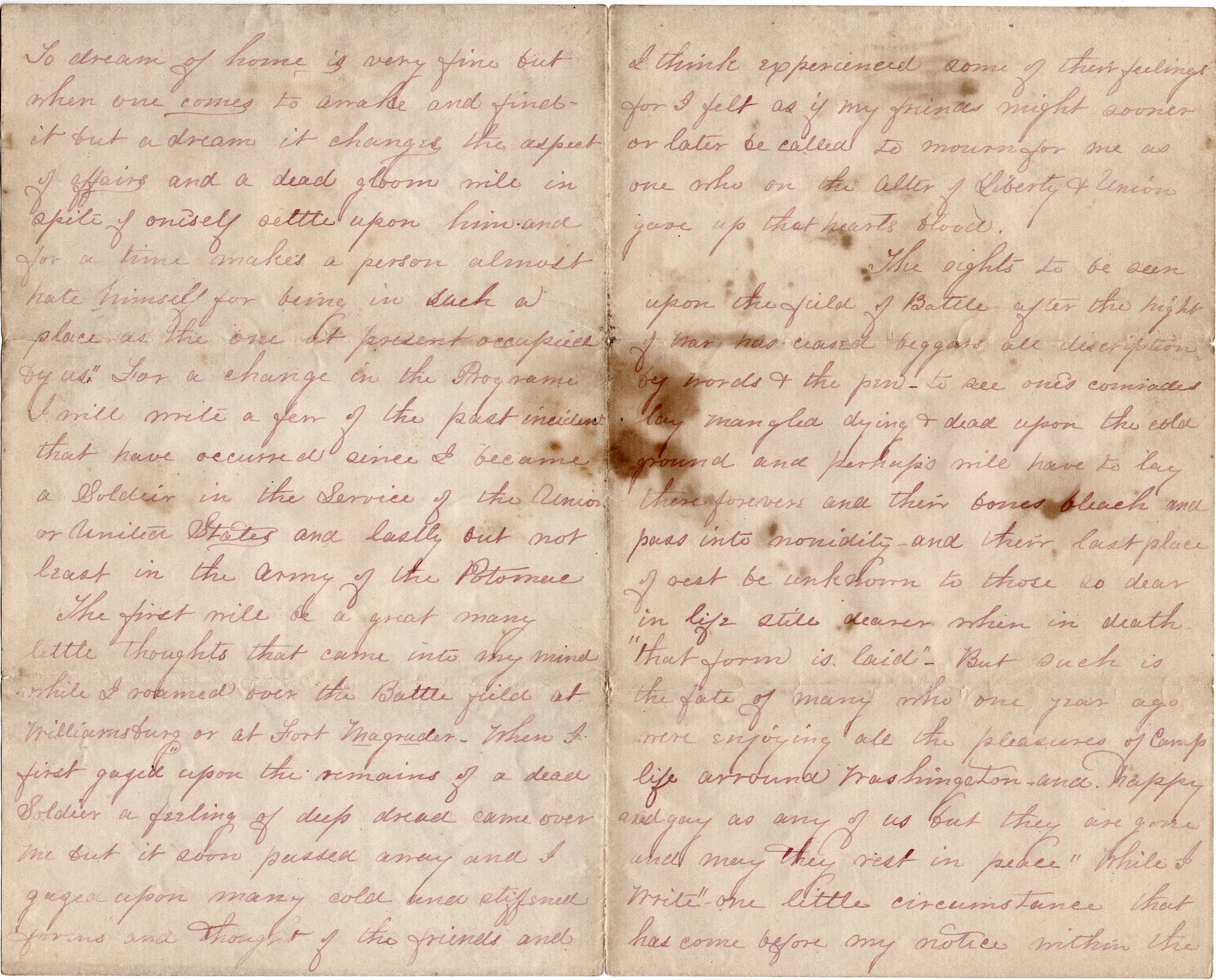
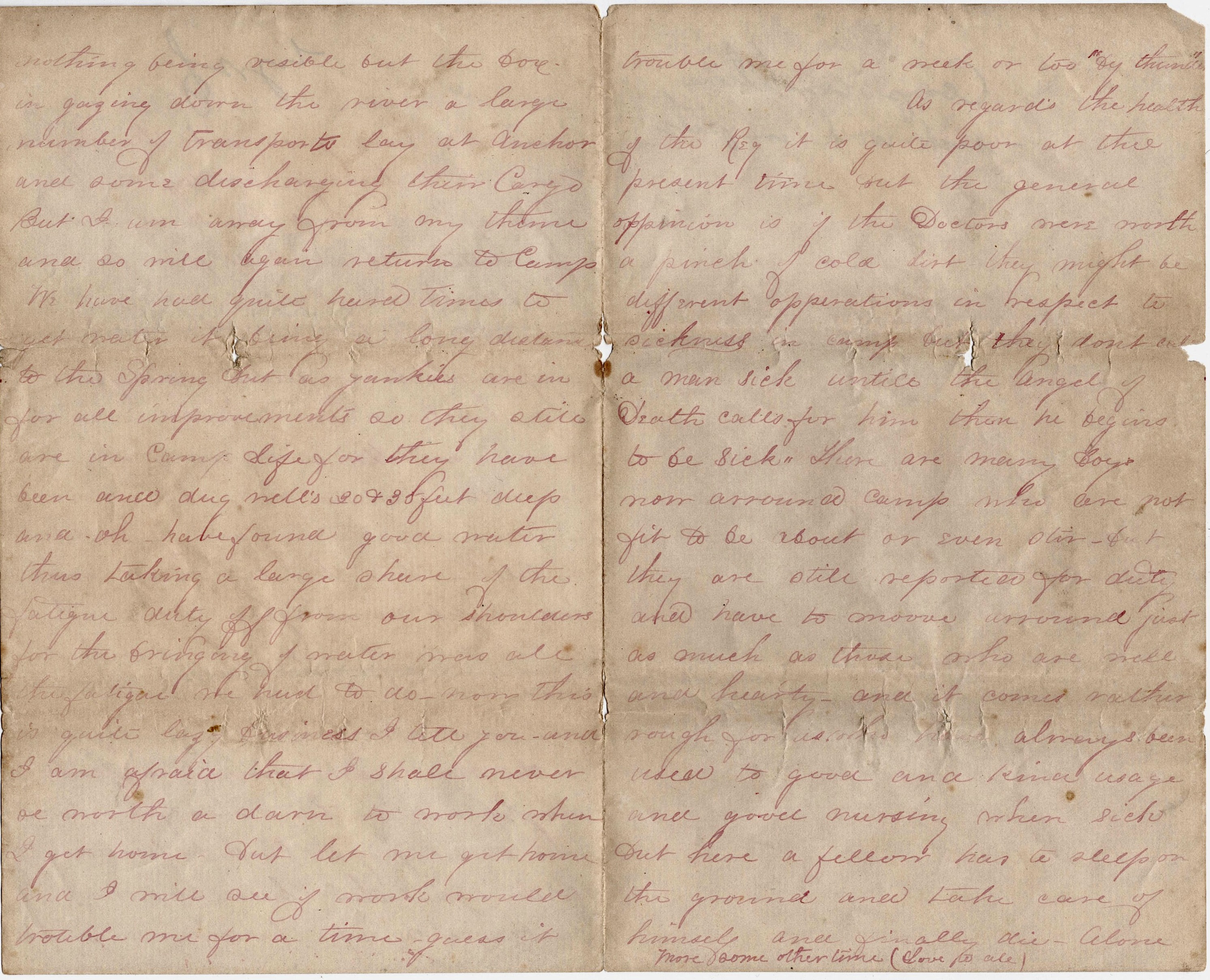
Stray thoughts. The day is fine still. The sun is hid most of the time. It is cool and nice—the most comfortable day I have seen for a long time. It is also very quiet. No guns are heard from the time the signal gun is fired at 4 o’clock, until sunset when another is fired and then, for as much as an hour, the bugle is heard in all directions and roll call has to be tended to before anything can be had for supper or “tea.” Then by the time supper is well finished, it is dark and off to bed (such as it is) and repose until morn and dream of that Haven of rest and that home long since left behind and those kind friends left for a long time unseen! To dream of home is very fine, but when one comes to awake and finds it but a dream, it changes the aspect of affairs and a dead gloom will, in spite of oneself, settle upon him and for a time makes a person almost hate himself for being in such a place as the one at present occupied by us. For a change in the program I will write a few of the past incidents that have occurred since I became a soldier in the service of the Union, or United States, and lastly but not least in the Army of the Potomac.
The first will be a great many little thoughts that came into my mind while I roamed over the Battlefield at Williamsburg or at Fort Magruder. When I first gazed upon the remains of a dead soldier, a feeling of deep dread came over me. But it soon passed away and I gazed upon many cold and stiffened forms and thought of the friends and I think experienced some of their feelings for I felt as if my friends might sooner or later be called to mourn for me as one who on the altar of Liberty & Union gave up that hearts blood.
The sights to be seen upon the field of battle after the night of war has ceased “beggars all description” by words & the pen. To see one’s comrades lay mangled, dying & dead upon the cold ground, and perhaps will have to lay there forever and their bones bleach and pass into nonidentity and their last place of rest be unknown to those so dear in life, still dearer when in death “that form is laid.” But such is the fate of many who one year ago were enjoying all the pleasures of camp life around Washington and happy and gay as any of us. But they are gone and may they rest in peace.
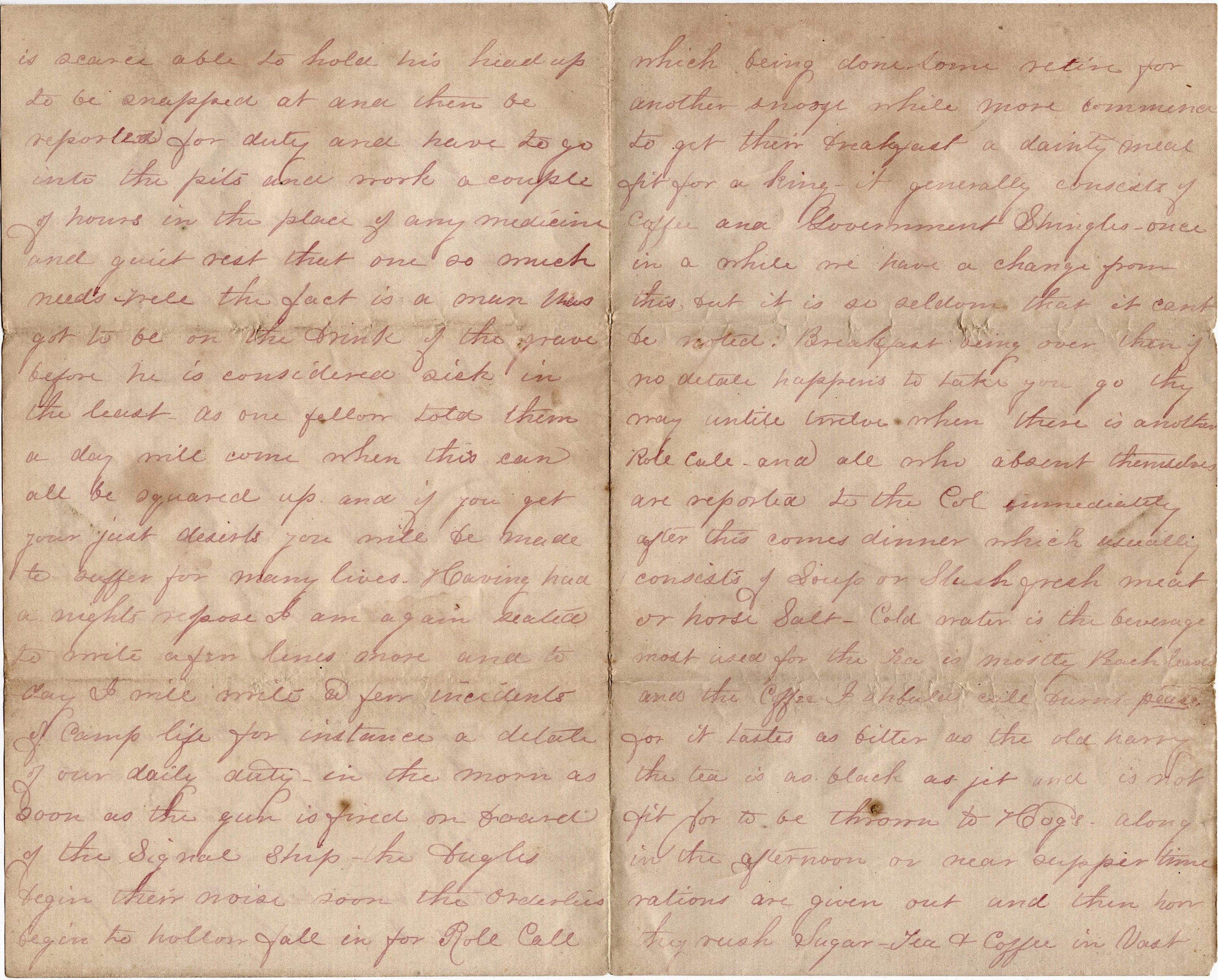
While I write, one little piece of circumstance that has come before my notice within the past few days, is the case of E. F. Wiley of Belchertown. Some three weeks ago it became visible that he was upon the decline, but still the doctors reported him for duty about every other day until three days before he got his furlough to go home. He started for home scarce able to stand and got as far as New York and there died, thus showing the great skill and knowledge of our doctors. The very morn he started, one of the hospital nurses said all that was the matter with him was he was run down and would be well enough in a few days if he took care of himself. He died and it is the talk of the whole regiment how our sick are treated, and the doctor is often asked how such a one is, he will snap up us short [by saying], “He is some better.” I tell you, it is devilish rough when a man is scarce able to hold his lead up to be snapped at and then be reported for duty and have to go into the pits and work a couple of hours in the place of any medicine and quiet rest that one so much needs. Well, the fact is, a man has got to be on the brink of the grave before he is considered sick in the least. As one fellow told them, “A day will come when this can all be squared up, and if you get your just deserts, you will be made to suffer for many lives.”
Having had a night’s repose, I am again seated to write a few lines more and today I will write a few incidents of camp life. For instance, a detail of our daily duty. In the morn as soon as the gun is fired on board of the Signal Ship, the bugles begin their noise. Soon orderlies begin to holler, “Fall in for roll call,” which being done, some retire for another snooze, while more commence to get them breakfast—a dainty meal fit for a king. It generally consists of coffee and government shingles. Once in a while we have a change from this but it is so seldom that it can’t be noted.
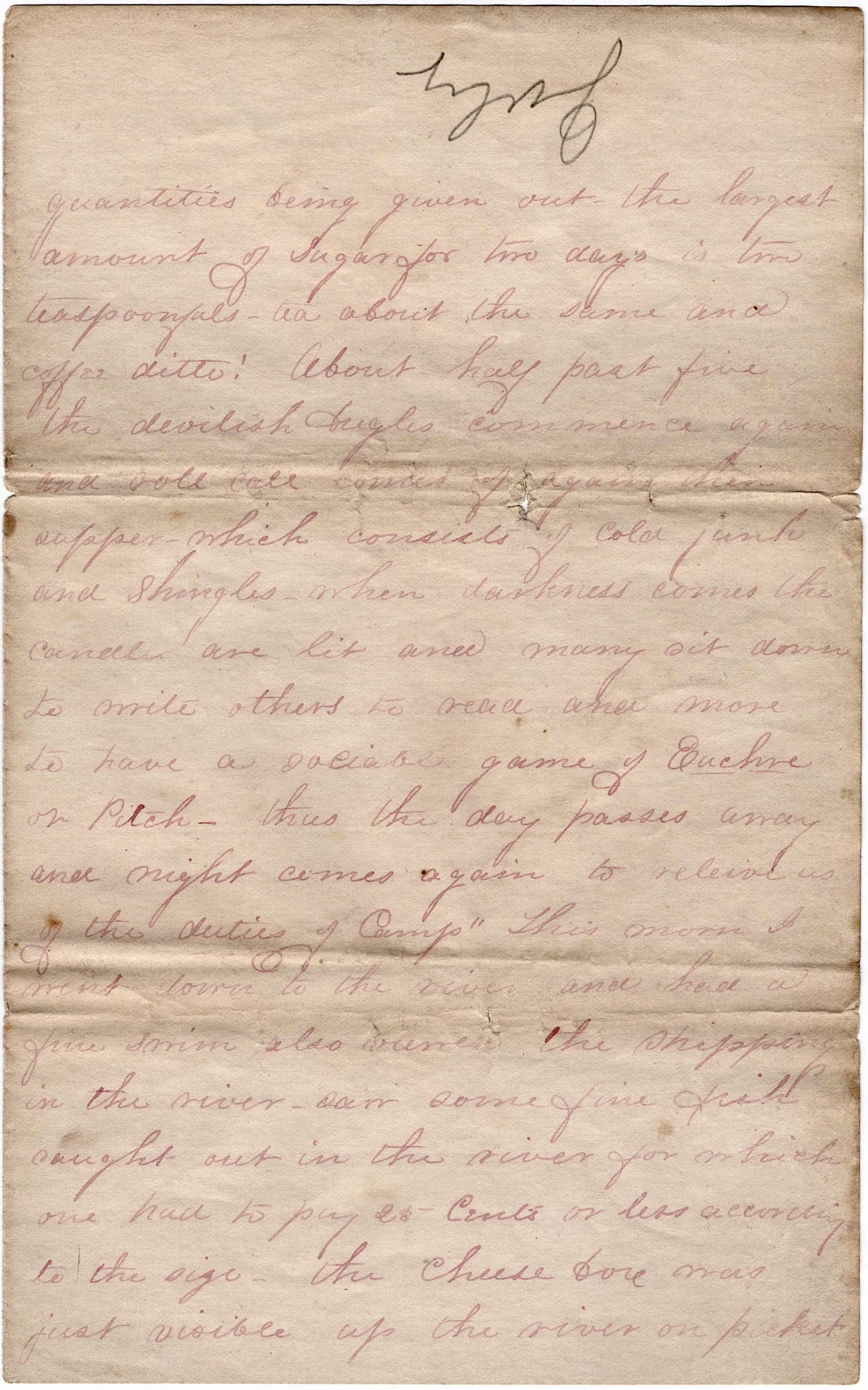
Breakfast being over, then, if no detail happens to take, you go thy way until twelve when there is another roll call and all who absent themselves are reported to the Colonel immediately. After this comes dinner which consists of soup or slush, fresh meat or horse salt, cold water is the beverage most used, for the tea is mostly peach leaves, and the coffee I should call burned peas, for it tastes as bitter as the Old Harry [Devil]. The tea is as black as jet and is not fit to be thrown to hogs. Along in the afternoon or near supper time, rations are given out and then how they rush, sugar, tea & coffee in vast quantities being given out. The largest amount of sugar for two days is two teaspoonfuls, tea about the same, and coffee ditto! About half past five, the devilish bugles commence again and roll call comes off again and then supper, which consists of cold junk and shingles. When darkness comes the candles are lit and many sit down to write, others to read, and more to have a social game of Euchre or Pitch. Thus the day passes away and night comes again to relieve us of duties of camp.
This morn I went down to the river and had a fine swim; also viewed the shipping in the river. Saw some fine fish caught out in the river for which one had to pay 25 cents or less according to the size. The Cheese box [U.S.S. Monitor] was just visible up the river on picket, nothing being visible but the box. In gazing down the river, a larger number of transports lay at anchor and some discharging their cargo. But I am away from my theme, and so will again return to camp.

We have had quite hard times to get water, it being along distance to the spring. But as Yankees are in for all improvements, so they still are in camp life, for they have been and dug wells 20 & 30 feet deep, and Oh, have found good water, thus taking a large share of the fatigue duty off from our shoulders for the bringing of water was all the fatigue we had to do. Now this is quite lazy business I tell you, and I am afraid that I shall never be worth a darn to work when I get home. But let me get home and I will see if work would trouble me for a time—guess it would trouble me for a week or two “by Thunder.”
As regards the health of the regiment, it is quite poor at the present time but the general opinion is if the doctors were worth a pinch of cold dirt, they might be different operations in respect to sickness in camp. But they don’t call a man sick until the angel of death calls for him. Then he begins to be sick. There are many boys now around camp who are not fit to be about or even stir, but they are still reported for duty and have to move around just as much as those who are well and hearty, and it comes rather hard for us have always been used to good and kind usage and good nursing when sick. But here a fellow has to sleep on the ground and take care of himself and finally die—alone. More some other rime. (Love to all)
I will bet that you dare not fill a box with some eatables and send them to me and put in some butter & sugar and some cake that will keep five or six days when well done up in paper. If you will send me, I will send the money when we get paid off. Put in some cookies and never mind the cost but send me the bill for I am half starved by thunder. Stamp it instead of Washington to Fortress Monroe, Va. Keyes Corps. Co. C, 10th Massachusetts Volunteers


Letter 3
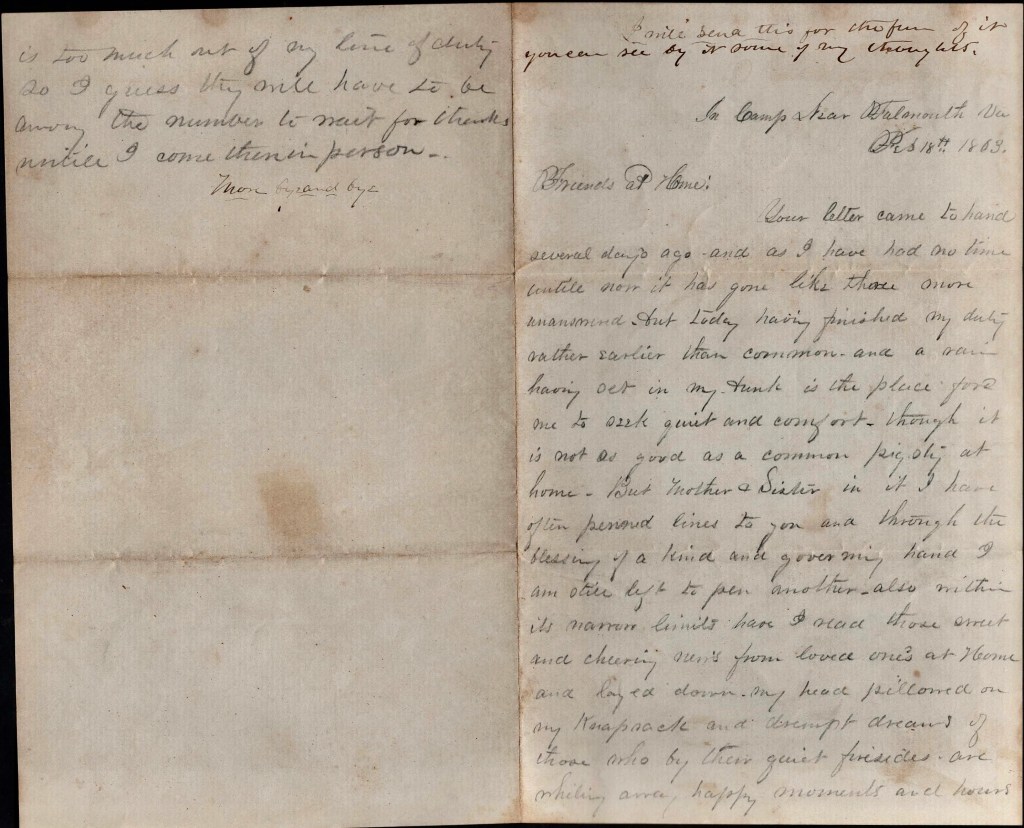
In camp near Falmouth, Va.
February 18, 1863
Friends at home,
Your letter came to hand several days ago and as I have had no time until now, it has gone like three more unanswered. But today having finished my duty rather earlier than common and a rain having set in, my trunk is the place for me to seek quiet and comfort, tough it is not as good as a common pig sty at home. But Mother & Sister, in it I have often penned lines to you and through the blessing of a kind and governing hand, I am still left to pen another. Also within its narrow limits have I read those sweet and cheering news from loved ones at home and laid down my head pillowed in my knapsack and dreamt dreams of those who by their quiet firesides are whiling away happy moments and hours scarcely casting one thought of those here living the life of privation and even suffering. How long shall this last is the question that I am unable to answer, but sincerely hope not long, for being worn out and tired of such a life it is but misery to stay here, even when ones thoughts are allowed to stray back to times of old when by a cheerful fire the family circle was complete. But how many of these bright circles are broken? How many are caused to morn a link gone, never to be replaced or filled by another? Alas, it is sad even for us to think of. We who have become hardened to all kinds of sights and toughened to all exposure. Memory will cling like the woodbine to an ancient house hard to be disengaged.
The dreams of a solder are all vanity. The reality is for others to enjoy—those who have been more wise and stayed at home. But let this suffice. We are as happy & contented as one can possibly be in this God forsaken country that we are sole inhabitants of at the present time. The principle notable features are wind and rain, snow and slush, back your wood a mile or more, live in burrows like the animals of the North, used like mules for all sorts of business, even to backing wood for shoulder straps. Then when it is fair weather, give us some of the most unearthly drills ever thought of. But there is no use of grumbling. They have the power and they exercise it. Darn me if they don’t. It is near dark and I must close for tonight.
February 19, 1863. This morn at roll call Josiah again answered to his name. He brought quite a number of things for me that were very handy said to have been sent by the Young Ladies Aid Society. You ask me to write a letter to be read before it. Well it is too much out of my line of duty so I guess they will have to be among the number to wait for thanks until I come there in person.
More by and by. I will send this for the fun of it. You can see by it some of my thoughts.

 Spared & Shared 23