

This letter was written by Pvt. John W. Morse (1843-Aft1900) of Co. A, 29th Massachusetts Infantry. John was a bootmaker when he enlisted at age 18 on 18 April 1861 in the 1st Battalion Massachusetts Infantry. At Newport News, Virginia, the original seven companies were combined with three new Companies (“F,” “G” and “H”) in December 1861. They were attached to the Department of Virginia at Newport News until May, 1862.
In 1855, 12 year-old John W. Morse was enumerated in the household of bootmaker George Washington May (1814-1885) and his wife, Hanna Fuller, in Stoughton, Norfolk county, Massachusetts. It appears he was apprenticed to George May learning the bootmaker’s trade. That census gives John W. Morse’s birthplace as “Pumbrook”, Massachusetts.
See also—John W. Morse to Friends & Relatives on Spared & Shared 5 published in 2017.
T R A N S C R I P T I O N
Afternoon Camp Butler
January 27th 1862
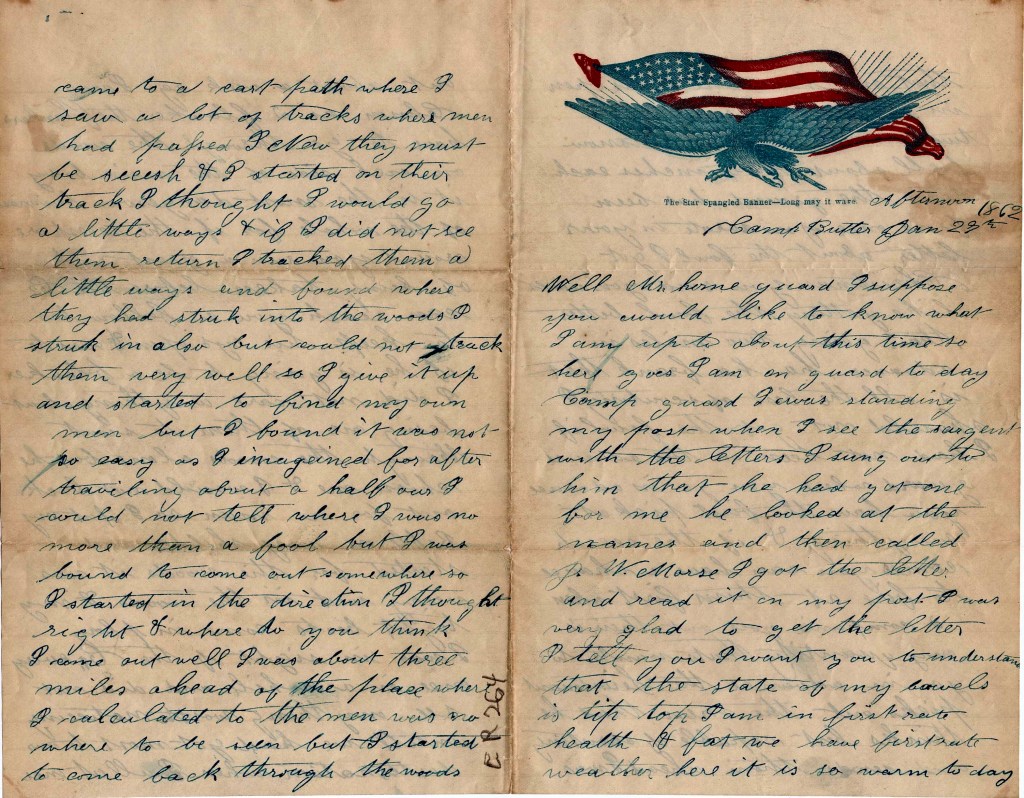
Well Mr. Home Guard, I suppose you would like to know what I am up to about this time so here goes. I am on guard today—camp guard. I was standing my post when I see the sergeant with the letters. I sung out to him that he had got one for me. He looked at the names and then called J. W. Morse! I got the letter and read it on my post. I was very glad to get the letter, I tell you. I want you to understand that the state of my bowels is tip top. I am in first rate health & fat.
We have first rate weather here. It is so warm today that we have the doors open in our houses. We have had two snow storms but the snow fell about two inches each time. The ground has been froze once.
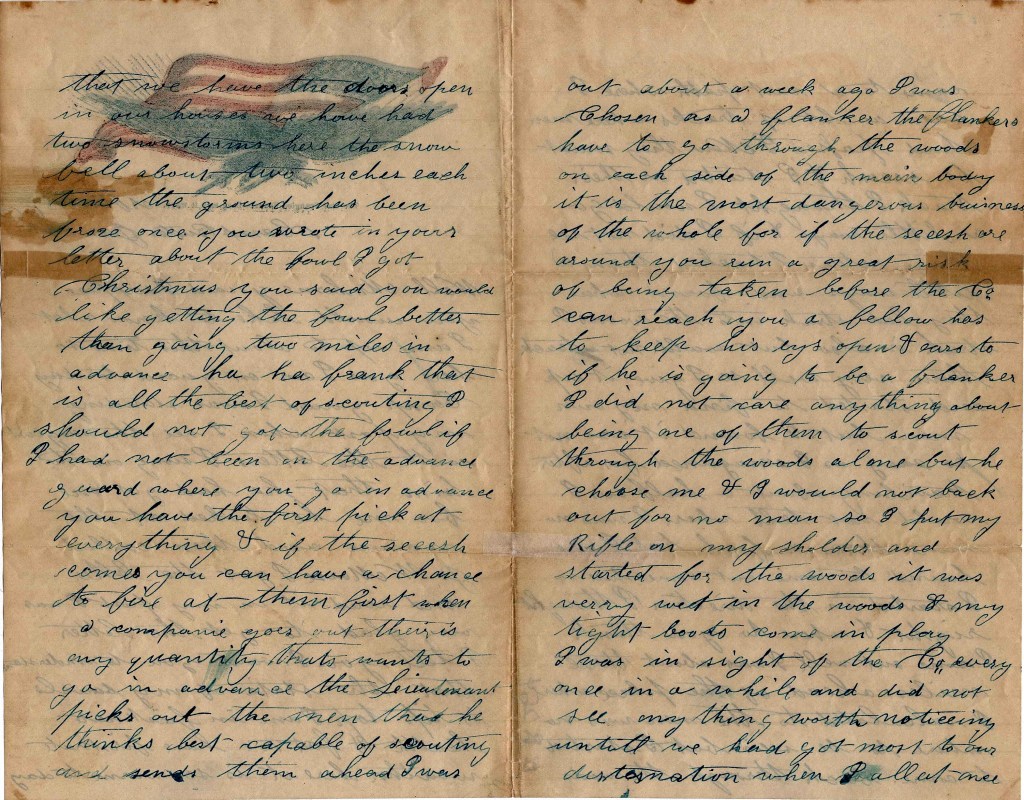
You wrote in your letter about the fowl I got Christmas. You said you would like getting the fowl better than going two miles in advance. Ha, ha, Frank. That is all the best of scouting. I should not [have] got the fowl if I had not been in the advance guard. When you go in advance, you have the first pick at everything. And if the secesh come, you can have a chance to fire at them first. When a company goes out, there is any quantity that wants to go in advance. The Lieutenant picks out the men that he thinks best capable of scouting and sends them ahead.
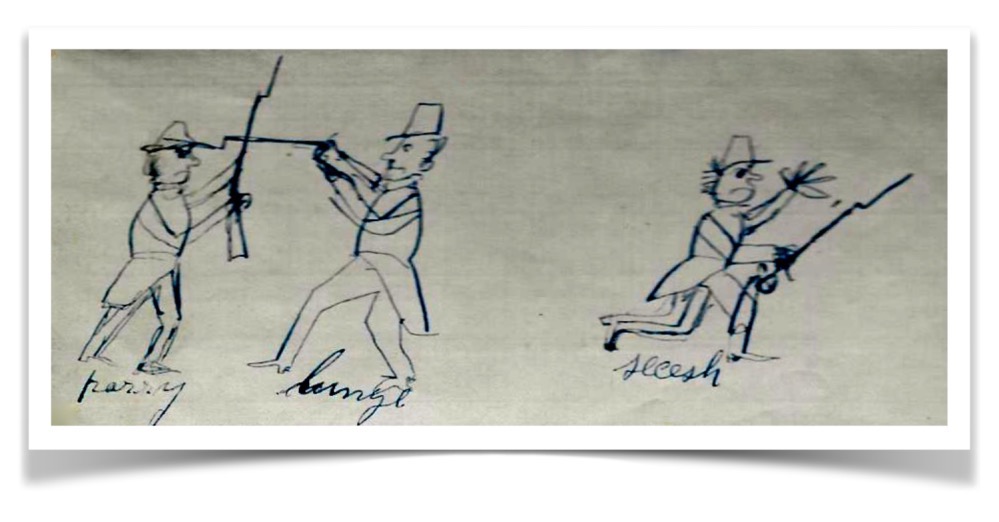
I was out about a week ago. I was chosen as a flanker. The flankers have to go through the woods on each side of the main body. It is the most dangerous business of the whole for if the secesh are around, you run a great risk of being taken before the company can reach you. A fellow has to keep his eyes open & ears too if he is going to be a flanker. I did not care anything about being one of them to scout through the woods alone but he chose me & I would not back out for no man so I put my rifle on my shoulder and started for the woods. It was very wet in the woods & my tight boots come in play. I was in sight of the company every once in a while and did not see anything worth noticing until we had got most to our destination when I, all at once, came to a cart path where I saw a lot of tracks where men had passed. I knew they must be secesh & I started on their track. I thought I would go a little ways & if I did not see them return.
I tracked them a little ways and found where they had struck into the woods [so] I struck in also but could not track them very well so I give it up and started to find my own men. But I found it was not so easy as I imagined for after traveling about a half an hour I could not tell where I was, no more than a fool. But I was bound to come out somewhere, so I started in the direction I thought right & where do you think I come out? Well I was about three miles ahead of the place where I calculated. The men was nowhere to be seen, but I started to come back through the woods and soon found them. I was on the right. The flanker on the left got lost and went close to the secesh guard before he found out where he was. He saw the secesh and came very near being taken prisoner.
When I found our men, they were just returning home. They had got their team loaded with boards. I was out yesterday scouting and got a pig and killed him with my bowie knife. I have got a first rate knife. I bought it off a Dutchman.
We had a great excitement last night. The news came that the secesh was going to take this place if they had to wade in blood knee deep. We were ordered to keep everything in readiness. We have forty rounds of cartridges in our box all of the time. We heard today they were going to run the blockade. They will have a nice time of it, I tell you.
It is getting most dark and I shall have to close. When you receive this, if you have not sent the box, I want you to write a letter the same time you send the box so I shall know when to look for it. Tom Mullen, I think, does not drink anything. I have never seen him touch any. I think this war must last a year longer. The rebels will hold out just as long as it is possible but I can’t write any more so farewell from your brother and protecter—ha, ha.
— John W, Morse, Camp Butler, Newport News, Va.
P. S. Please write soon. Tell Aunt Rhoda when I come home next summer. I shall want to sleep in the kitchen on the floor I shall forget all about a bed. It is getting so dark I cannot hardly [read] my writing. So good bye, J. W. Morse


 Spared & Shared 23