
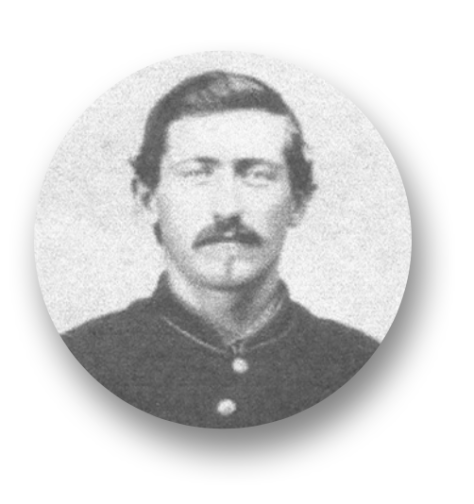
This letter was written by Cpl. Blydon H. Boyce (1836-1899) of Co. G, 25th Ohio Volunteer Infantry (OVI). Blydon was the son of William Boyce (1791-1858) and Hannah Rice (1795-1867) of Sharon, Schoharie county, New York.
Blydon enlisted as a private on 18 June 1861. Co. G was recruited from Seneca, Muskingum, and Jefferson counties in Ohio. During their service they saw action in such battles as 2nd Bull Run, Chancellorsville, Gettysburg, Fort Wagner, and Honey Hill. Blydon was wounded in the Battle of Chancellorsville but survived. He lived out his days in Arkansas after the war.
Blydon wrote the letter to his niece but does not state her name. He also does not give the location or date of his letter but based on the content and the patriotic stationery used, my hunch is that it was written in the fall of 1861.
T R A N S C R I P T I O N

My Dear Niece,
I acknowledge the receipt of a few lines from you enclosed in your mother’s letter which was gratefully received. We soldiers welcome every message which comes, as it were, from the outward world having (after the usual military plan) a cordon of sentinels around our camp which regulates our intercourse with the world outside. Our opportunities for seeing specimens of the fair sex are quite limited indeed, and when one makes their appearance in our midst, we gaze upon her with all the amazement and inquisitiveness that would do credit to a long haired celestial when a foreigner intrudes upon their sacred soil.
We had a call yesterday from a couple of ladies, the wife of one of our officers and a single lady who happened to come into our barracks as we were dining. We were taken entirely on surprise. You ought to have seen the flutteration it caused for we were after the usual nonchalance and negligee which characterize our sex when alone and uncontrolled by the fair sex, carelessly masticating our bacon and hard bread and rehearsing some warlike operations. Our table being nothing but two rough boards sustained on legs, our seats to match, and our table (minus) the porcelain and silver spoons; but in their places, tin plate, tin cup, knife and fork and pewter spoon comprising the sum total of our table furniture. And then the surroundings matched; which reminded one of the primitive ages. Our beds were steamboat fashion, one rising above the other on one side of our barrack, capable of reposing 18 men, with a hard board to lie upon with simply a blanket beneath and a blanket to cover us, and our door and windows to correspond, a space in front left sufficiently large for the egress and ingress of its inmates, and holes cut out the sides and ends to let in the sunlight and fresh air. And thus you have a miniature description of our barracks and condition of things when those ladies, aforesaid mentioned, called upon us.
We had nothing to do, however, but to make apologies and with all the courtesy and gallantry we were in possession of, let them depart, not forgetting to give three cheers for their patriotic and benevolent feelings in the way that they have provided for us, havelocks and other comforts. Hurrah! I say for the patriotic ladies of the present crisis, when in glorious and gallant imitation of the women of revolutionary memory, they make themselves useful by their efforts and labors to fit out the soldiers for war, when wives part with their husbands, lovers with their affianced mothers from their sons and their relatives and others who depart from the social circle with a “God be with you!” Who cannot be inspirited and encouraged when far away by such reflections?
Woman, though the first to yield to the tempter in the Garden of Eden, are now and have been from time immemorial the first to make amends for their transgressions, are always found, with few exceptions, upon the right side. I cannot wish them any better fate than I trust the war will be short, and they will all be permitted to return home ( the young and unmarried men) and that every unmarried lady will unite her fortune and heart to a husband who will ever love, cherish, and protect them in their position as wives.
If I mistake not, dear niece, you intimated to me some time ago in your letter that you had found a congenial companion who you thought could make you happy and in fact, I almost expected to have addressed you by another title by this time. Please write about the matter aforesaid. Consider me not, I entreat of you, intrusive upon this matter for such matters must be talked of and rehearsed as much as matters of food and clothing, for the Creator who first ordained a similar condition of things for all coming time until this world ceases to be. You may rely upon me as a confidant for separated as I am by a thousand miles, I shall not be apt to annoy by divulging any secrets.
I have, notwithstanding all the privations and hardships which have to be endured here, had excellent health and enjoyed myself excellently well, animated as I am by patriotism and the righteousness of the present cause, and as confident as I am of the approval of Almighty God in this present struggle, I feel as though I could wade through fire and sword, if necessary, for the redemption of our happy land to its wonted peace and quietness though unaccustomed to a soldier’s life and quite sensitive to pain and ingratitude on the part of my fellow man.
I now have so far entered heart and soul into this present struggle that I begin to handle the instruments of death as familiarly and as playfully as the child handles its toys, and I expect that the opened mouth canon belching forth its missiles of death and destruction have no terrors for me for I foresee such a procedure will have to be gone through before peace and quietness is restored, that God in his infinite mercy will make all these afflicting dispensations will make them redound to His glory and for the spread of His kingdom is my sincere prayer.
Please give my respects to all the friends and write all the important news from “Old Schoharie.” I will write my address on a separate slip of paper so you will know my address, Your affectionate Uncle, — Blydon H. Boyce


 Spared & Shared 23