
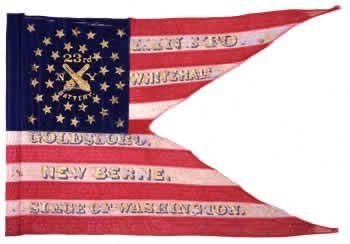
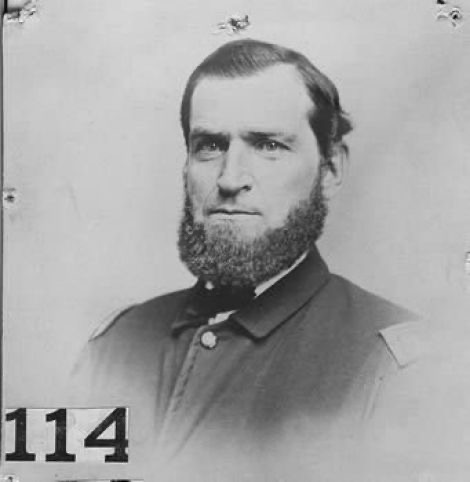
The following letter was written by Penuel Bobst (1839-1873), the son of Michael Bobst (1801-1866) and Elizabeth Wagner (1804-1862) of Pendleton, Niagara county, New York. Penuel enlisted on 7 November 1861 in Battery A, New York Rocket Battalion (later designated 23rd N. Y. Battery). At the time of his enlistment, he was described as a 5′ 9″ tall, brown haired, hazel-eyed single farmer. He began his service as a wagoner but was later reduced to a private and was promoted to corporal about the time of his reenlistment in January 1865. He mustered out of the battery on 14 July 1865 at Buffalo, New York.
The New York Battalion holds the distinction of being the first officially designated rocket unit and was uniquely positioned as the sole such entity within the Union army. Secretary of War Cameron sought the expertise of Thomas William Lion—an English soldier of fortune—to deliberate on the rockets developed by the British General Sir William Congreve in the early 1800s. Consequently, Secretary Cameron sanctioned the establishment of a “Rocket Battalion,” appointing Lion as its commander. The operational specifics were delegated to Brigadier General William Farquhar Barry, the newly appointed Chief of Artillery of the Army of the Potomac. The unit was aptly named “General Barry’s Battalion.” Both the rockets and the 160 soldiers recruited from upstate New York were untested, embodying a pioneering spirit. The first company consisted of Captain Alfred Ransom’s Battery from Niagara County, which would later be identified as the 23rd Independent Battery, New York Light Artillery.
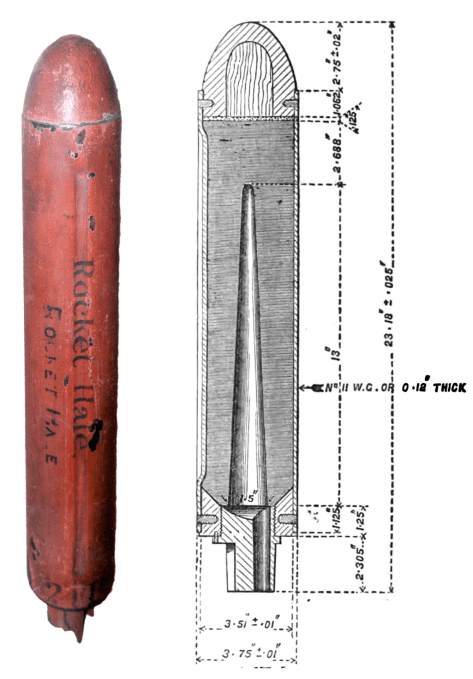
The New York Rocket Battalion departed from Albany, N.Y., arriving in Washington, D.C., on December 10, 1861. The unit was stationed at Camp Duncan, situated approximately a mile east of the unfinished Capitol, on the sodden terrain allocated for General Barry’s artillery. On New Year’s Day, 1862, Camp Duncan was officially renamed Camp Congreve. Major Lion was equipped with rockets engineered by the British civil engineer William Hale. These rockets varied in length from 12 to 20 inches, with diameters ranging from 2.25 to 3 inches. The launchers consisted of wrought iron tubes, measuring 8 feet in length and supported by tripods. They also tried firing using eight breechloading cannon designed to fire Hale rockets.
Testing revealed that Major Lion’s rockets were impractical for military use, however, so at New Berne, N.C., General Jesse Reno ultimately dismissed Major Lion and the “Rocket Battalion” was thereafter assigned 3-inch rifled Rodman steel guns. The Battalion fought valiantly with its artillery, particularly during engagements in North Carolina. It retained the designation “New York Rocket Battalion” until February 11, 1863, when Special Order No. 81 from Albany officially redefined the unit as the 23rd and 24th Independent Batteries of Light Artillery, New York Volunteers. It remained for future conflicts to enhance the development of rockets and launchers. (See: A brief history of Rocketry—Early Rockets to Goddard]
[Note: His given name is sometimes spelled Pennel in records.]
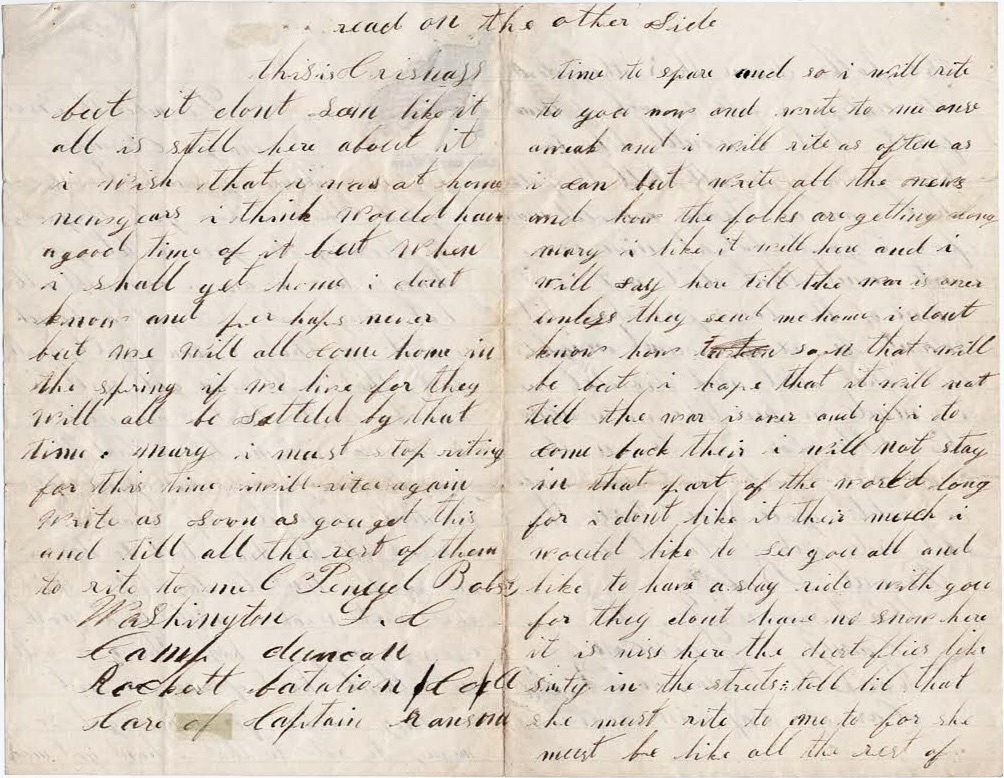
T R A N S C R I P T I O N
December 25, 1861
Merry Christmas
Dear Friends,
I am glad that I have got the privilege of writing to you to let you know how I am. I am well—all but my right [foot] has got a blister on it so that I can hardly walk but that will soon get well, I think. Besides that, I as well as I ever was in my life. I think that I will have to have it opened if it don’t break itself. I have been around all the time till today. I am in the tent today. but I think that next week I will be at work again. Mary, I hope that you will not think hard of me for not writing sooner for I have got so many to write to that I hant got much time to spare and so I will write to you now and [if you] will write to me once a week, I will write to you as often as I can. But write all the news and how the folks are getting along.
Mary, I like it well here and I will stay here till the war is over unless they send me home. I don’t know how soon that will be but I hope that it will not [be] till the war is over. And if I do come back there, I will not stay in that part of the world long ffor I don’t like it there much. I would like to see you all and like to have a sleigh ride with you for they don’t have no snow here, It is nice here [but] the dust flies like sixty in the streets.
Tell Lil that she must write to me for she must be like all the rest of the folks down there, They don’t write unless I write to each of them first. But I would like to hear from you all. Tell the folks that I am as steady [as] an old man for I go to bed at nine every night and that did not suit some of the boys for they did want to run around nights but that did not trouble me. I made a mistake in writing this letter for I wrote on the wrong side but that son’t make no odds. You must tear turn the best side out.
Direct to Penuel Bobst, Washington D. C., Camp Duncan, Rockett Battalion, Co. A, care of Captain [Alfred] Ransom
This is Christmas but it don’t seem like it. All is still here about. I wish that I was at home New Years. I think I would have a good time of it. But when I shall get home, I don’t know and perhaps never. But we will all come home in the spring if we live for they will all be settled by that time.
Mary, I must stop writing for this time. I will write again. Write as soon as you get this and tell all the rest of them to write to me. C. Penuel Bobst, Washington D. C., Camp Duncan, Rocket Battalion Co. A, Care of Captain Ransom

 Spared & Shared 23