
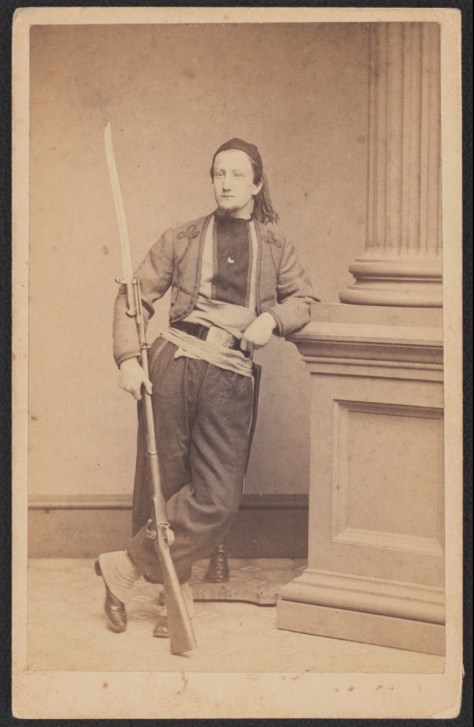
1st Lt. Joseph Langford Bennett (1838-1898) of Co. A, 10th Rhode Island Infantry wrote this letter following the death of William Frederick (“Fred”) Atwood (1845-1862), a corporal serving in his company. Fred was the 17 year-old son of William and Emeline Atwood, a recent graduate of the Providence high school. Fred was described by his comrades as having a “genial temperament and generous disposition, which drew around him a circle of personal friends.” Though the lieutenant pledged to “deposit your son’s remains in Rhode Island soil with our own hands,” it does not appear that ever occurred. According to the regimental history, his body remained buried “in a retired and beautiful spot near the Soldiers’ Home, overlooking the Capitol which his youthful footsteps had hastened to defend.” Strangely, Fred’s father enlisted a few months later in the 11th Rhode Island Infantry and he too sickened and died—buried in Arlington Cemetery across the Potomac river from his son.
The 10th Rhode Island regiment was mustered into Federal service for three months in the summer of 1862. It was sworn in at Providence on May 26, 1862 and then moved to Washington, D. C. from May 27 to 29 where it was attached to Sturgis’ Command as part of the Military District of Washington. It saw duty at Camp Frieze, Tennallytown until June 26. With Sturgis, the regiment marched across the Potomac into Virginia, but returned to Washington when Jackson’s threat to the city subsided.
After a few days, on Monday morning, June 30, the 10th was detached from Sturgis’ troops and ordered to relieve the 59th New York in the seven forts and three batteries it had been occupying. These defenses of Washington were north and west of the city.
Company A was sent to Fort Franklin. This position guarded the Baltimore and Ohio Canal, the Baltimore & Ohio Railroad, and the Washington Aqueduct—the new water supply for the city. the U. S. Army Engineers had designed Fort Franklin to protect the city’s receiving reservoir (as conveyed by the Aqueduct) as well as the Potomac river shoreline.
T RA N S C R I P T I O N
Fort Franklin
Headquarters Co. A, 10th Regt. Rhode Island Vol.
July 2nd 1862
Dear Sir,
Capt. Taber telegraphed you on Sunday, June 29th, that your son Wm. F. Atwood, (a member of our company) died on the said 29th of June and that his body would be sent home to you. Unfortunately circumstances occured which forbade us the melancholy pleasure of fulfilling our designs. Your son was buried on Monday, June 30th at 4 p.m. in the Soldier Retreat. Capt. Taber knows the precise spot in which he lies and we shall at the earliest opportunity bring his body to Providence.
In regard to your son’s death, he would say that it was one of perfect peace. He did not suffer at all, but on the contrary was perfectly free from pain. The Surgeon states that he died from inflammation of the bowels. During his stay in the General [Seminary] Hospital at Georgetown, he received the best of care. One of the most experienced nurses remained with [him] during the night previous to his death. His last request was that he might be buried at home. We did all that we could at the time but we could not get his body home short of five days and the government allows but seven dollars for the whole expense while the actual expense is over one hundred dollars. And unfortunately, while engaged in contriving some way to transport the body, Capt. Taber was ordered back to camp to move his company to this fort. He consequently had no alternative but to comply with said orders.
As a company, we shall see that the body is removed to Providence and interred with all the honors of a soldier and patriot. It may be pleasing to you to know that as a man and soldier, he had no superior. He was regarded by all of his company as an amiable and desirable companion. None mourn his loss more than me. Our company is thrown into the most profound gloom by the loss of our beloved companion. As officers, we feel that one of the ornaments of our company has been removed by the hand of divine Providence and although we mourn his loss, we know that God doeth all things well.
We should have notified you sooner but it was entirely beyond our power. Any questions you may ask, or any information you may desire, we will do out best to satisfy. Please direct to the Capt. at Washington, D. C. By order of Capt. Wm. E. Tabor, Jr., I remain, with much respect, yours to command, – Lieut. Bennett
P. S. If you will send a written order to Capt. Taber authorizing him to take charge of the effects of your son, he can and will do so, until such a time as he can forward them to you.
Our company have all desired to be remembered to you in this the time of bereavement. Rest assured we will do all in our power an we expect to deposit your son’s remains in Rhode Island soil with our own hands. Truly yours, — Bennett, 1st Lt. Co. A, 10th Regt. R. I. V.


 Spared & Shared 23