
This letter was written by William H. Dorsey (1819-1854), the oldest son of Richard Brooke Dorsey (1791-1869) and Anna Elizabeth Dorsey (1800-1884) of Elk Ridge Landing, Anne Arundel county, Maryland. By 1850, Richard and Anna had relocated to Baltimore where Richard was a merchant. William was yet unmarried and living with his parents in Baltimore at that time. It is presumed that William was named after his paternal grandfather, William Hammond Dorsey. The Dorsey family were slaveholders in the 1850s and the content of the following letter gives us some notion as to their opinion of Yankees and societal preferences.
I could not find a biographical sketch for William H. Dorsey but one ancestral record indicates that he was married on 21 December 1848 to Arabella Arthur (1828-1866) of Clay county, Missouri and that he died in New York City in August 1854. Arabella was the daughter of Michael Arthur (1800-1884) and Amanda Melvina Martin (1804-1889) who came to Clay county, Missouri, from Barren county, Kentucky in the late 1820s. Arabella’s father operated the first hemp factory in Clay county and he became a very wealthy businessman and real estate developer in Liberty. He operated a general store on the southwest corner of Water St. and Kansas St., and also was the proprietor of the Arthur House Hotel. Arabella died in Liberty, Missouri, in 1866 after a protracted illness of Consumption (tuberculosis). This record is probably accurate because there is nothing more in the family’s ancestral records despite a lot of detail regarding William’s siblings, one of whom—Richard Brooks Dorsey, Jr.—served in Co. H, 1st Maryland (Confederate) Infantry during the Civil War.
The post script of this letter suggests that William was engaged in some mercantile venture in St. Louis.

T R A N S C R I P T I O N
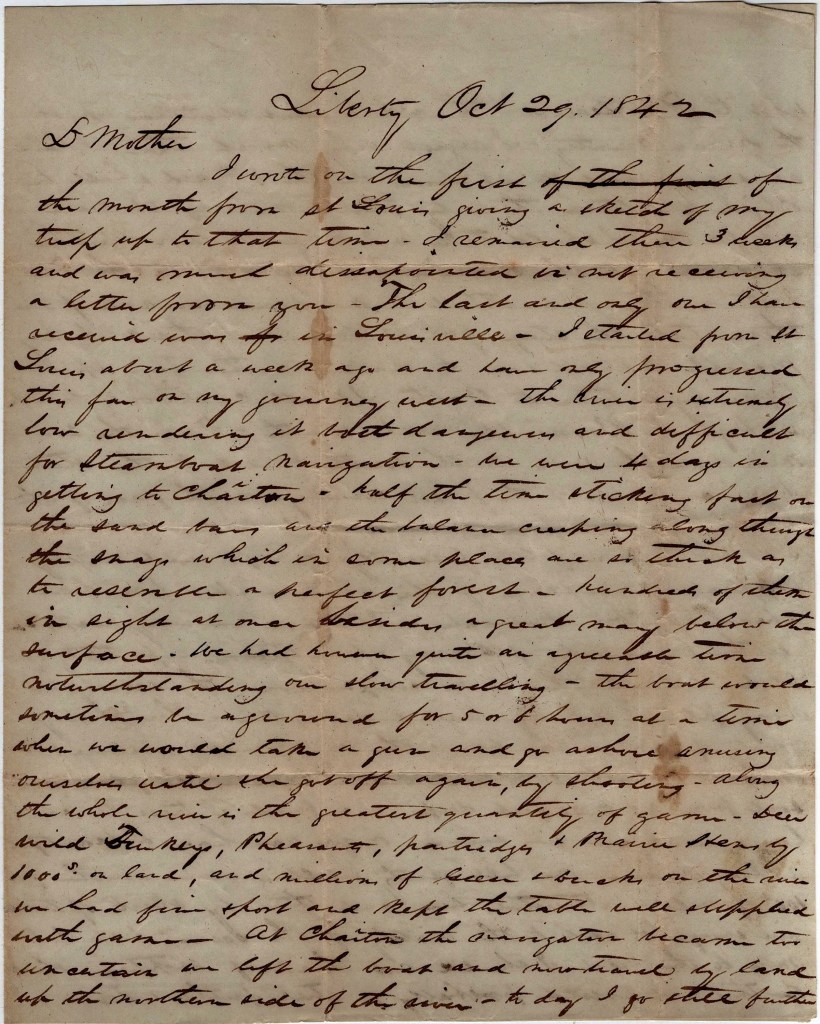
Liberty [Missouri]
October 29, 1842
Dear Mother,
I wrote on the first of the month from St. Louis giving a sketch of my trip up to that time. I remained there 3 weeks and was most disappointed in not receiving a letter from you. The last and only one I have received was in Louisville.
I started from St. Louis about a week ago and have only progressed this far on my journey west. The [Missouri] river is extremely low rendering it both dangerous and difficult for steamboat navigation. We were 4 days in getting to Chariton, half the time sticking fast on the sand bars and the balance creeping along through the snags which in some places are so thick as to resemble a perfect forest—hundreds of them in sight at once besides a great many below the surface. We had, however, quite an agreeable time notwithstanding our slow traveling. The boat would sometimes be aground for 5 or 6 hours at a time when we would take a gun and go ashore amusing ourselves—until she got off again—by shooting. Along the whole river is the greatest quantity of game, deer, wild turkeys, pheasants, partridges, & prairie hens by thousands on land, and millions of greenbacks on the river. We had fine sport and kept the table well supplied with game.
At Chariton the navigation became too uncertain [so] we left the boat and now travel by land up the northern side of the river, Today I go still farther west to Fort Leavenworth and a short distance up in the Indian country. I regret very much that I have an engagement in St. Louis on the 8th and shall be obliged to return by that time. If it were not for this, I should take a 2 or 3 weeks trip up the Missouri into the Indian country. From the Fort I return through Westport to Independence and from there take the stop for St. Louis. I think it is very probable I shall have to make another trip up here before my return to Baltimore. I shall certainly be up as high as Booneville next month.
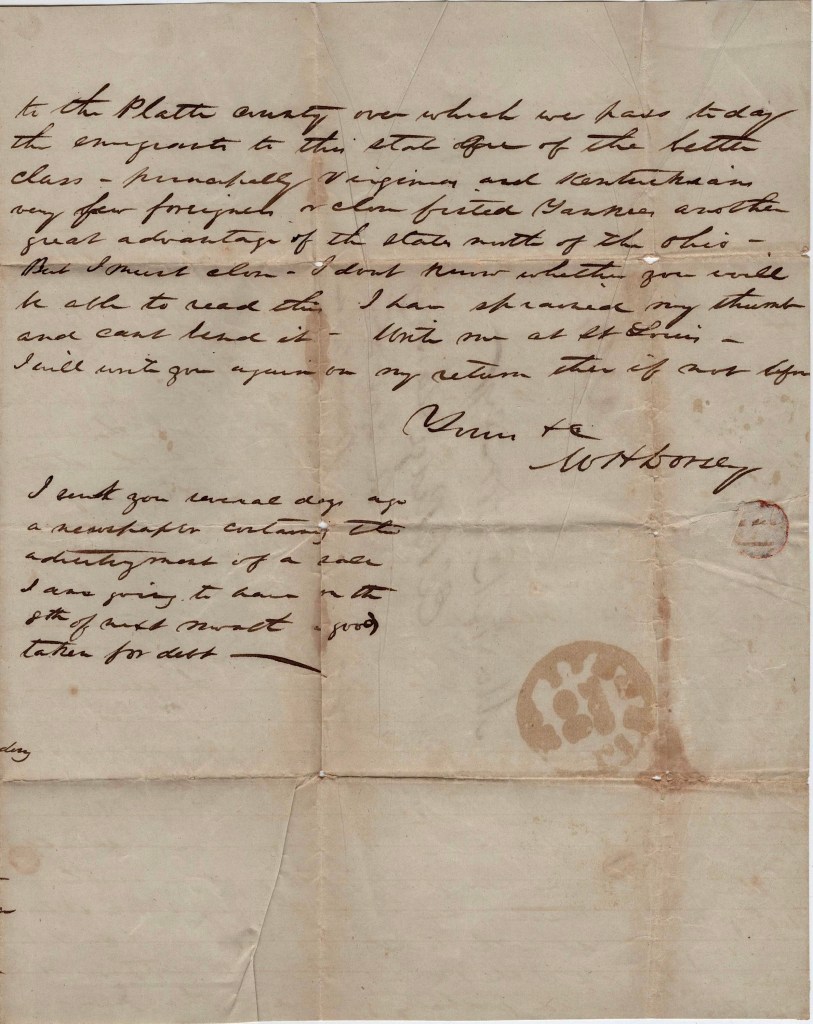
From the 200 miles down the river north, south and west to the state boundaries is one of the finest country on the face of the earth. You can form no idea of it unless you could see it. Eastern folks generally have formed a very improper conception of this state. It is far, far ahead of Ohio, Indiana, or Illinois in every respect either for beauty of scenery, fine streams, fertility of soil or society there is no comparison. The scenery in many places is lovely beyond description. There is every variety of it. You can have either a boundless prairie extending 40 or 50 [miles] without a tier and as level as the floor with soil from 25 to 30 feet deep, or a forest of trees twice as large as any you ever saw, or you can have a beautiful rolling prairie, one hill swelling above another for hundreds of miles, intersected here and there by skirts of timber just enough to add to the variety of the scene. Were I to move to the West, I should not think of stopping short of this and would probably go still further west to the Platte county over which we pass today.
The emigrants to this state are of the better class—principally Virginia and Kentuckians. Very few foreigners or close-fisted Yankees—another great advantage of the states south of the Ohio. But I must close. I don’t know whether you will be able to read this. I have sprained my thumb and can’t bend it. Write me at St. Louis. I will write you again on my return then if not before. Yours &c. — W. H. Dorsey
I sent you several days ago a newspaper containing the advertisement of a sale I was going to have on the 8th of next month. Goods taken for debt.

 Spared & Shared 23