

Bradford A. Hurd (1832-1863) of Somersworth, New Hampshire was a 25 year-old shoemaker when he volunteered on 2 September 1861 as a private in Co. B, 4th New Hampshire Infantry. Just six months earlier he had married Carrie F. Bailey. His parents were James Hurd (1796-1876) and Abigail Wadilla (1798-1848) of Sanford, York county, Maine.
Bradford died at a hospital on 21 June 1863 from wounds to his leg and ankle caused by a shell on the night of 17 June 1863 while on fatigue duty at the upper point of Folly Island, South Carolina. Bradford’s commanding officer, Lt. Fred Kendell, claimed that the fatigue party was in the process of preparing the ground to erect batteries for the purpose of shelling Morris Island when the enemy noticed the activity and fired at them, mortally wounding Bradford. He was carried back to camp and his leg was amputated in the regimental hospital but they were unable to save him.
Some of Bradford’s war correspondence is reportedly housed in the Georgia Historical Society of Savannah.
Bradford wrote this letter to his younger brother, Luther J. Hurd (1842-1881).

T R A N S C R I P T I O N
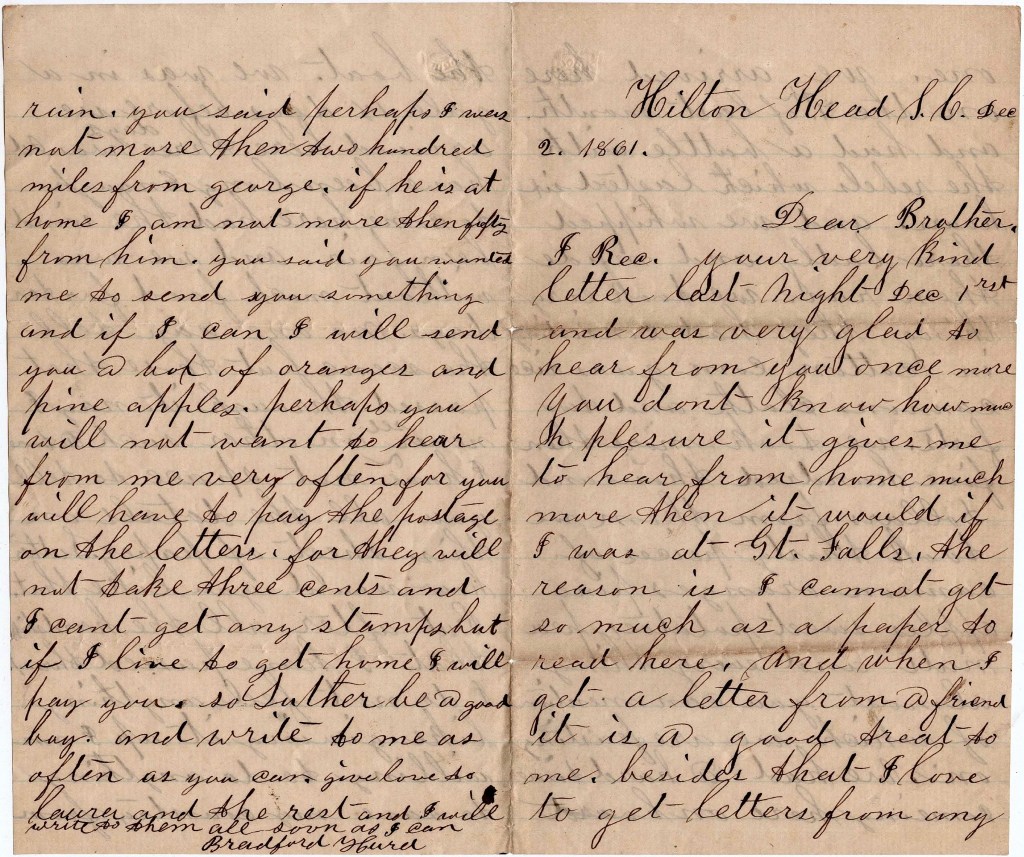
Hilton Head, South Carolina
December 2, 1861
Dear Brother,
I received your very kind letter last night, December 1st, and was very glad to hear from you once more. You don’t know how much pleasure it gives me to hear from home much more than it would if I was at Great Falls. The reason is I cannot get so much as a paper to read here and when I get a letter from a friend, it is a good treat to me. Besides that, I love to get letters from anyone.
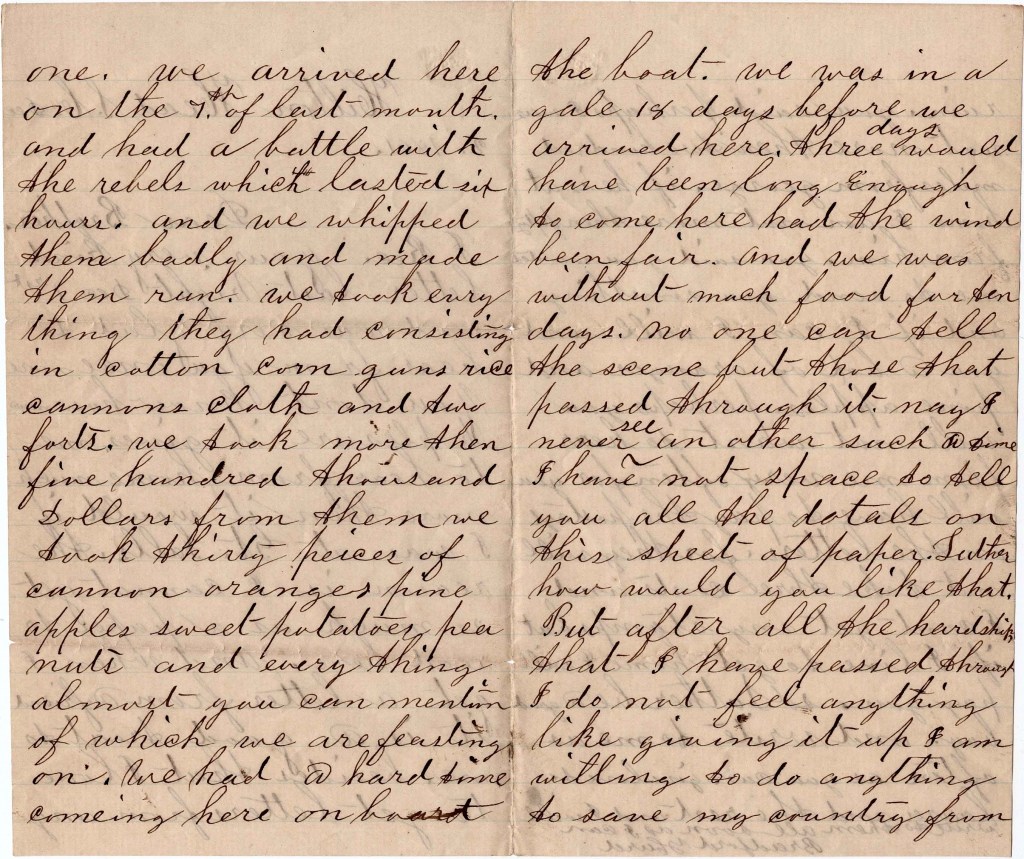
We arrived here on the 7th of last month and had a battle with the rebels which lasted six hours and we whipped them badly and made them run. [See Battle of Port Royal] We took everything they had consisting in cotton, corn, guns, rice, cannons, cloth, and two forts. We took more than five hundred thousand dollars from the, We took thirty pieces of cannon, oranges, pineapples, sweet potatoes, peanuts, and everything almost you can mention of which we are feasting on.
We had a hard time coming here on board the boat [USS Baltic]. We was in a gale 18 days before we arrived here. Three days would have been long enough to come here had the wind been fair and we was without much food for ten days. No one can tell the scene but those that passed through it. Nay, I never see another such a time. I have not space to tell you all the details on this sheet of paper. Luther, how would you like that? But after all the hardships that I have passed through, I do not feel anything like giving it up. I am willing to do anything to save my country from ruin.
You said perhaps I was not more than two hundred miles from George. If he is at home, I am not more than fifty from him. You said you wanted me to send you something and if I can, I will send you a box of oranges and pineapples. Perhaps you will not want to hear from me very often for you will have to pay the postage on the letters for they will not take three cents and I can’t get any stamps. But if I live to get home, I will pay you. So Luther, be a good boy and write to me as often as you can. Give [my] love to Laura and the rest and I will write to them all soon as I can. — Bradford Hurd
 Spared & Shared 23