

This letter was written by William Frederick (“Fred”) Atwood (1845-1862), a corporal serving in his company. Fred was the 17 year-old son of William and Emeline Atwood, a recent graduate of the Providence high school. Fred was described by his comrades as having a “genial temperament and generous disposition, which drew around him a circle of personal friends” who mourned his loss when he died on 29 June 1862 at the Soldier Retreat in Washington D. C.
The 10th Rhode Island regiment was mustered into Federal service for three months in the summer of 1862. It was sworn in at Providence on May 26, 1862 and then moved to Washington, D. C. from May 27 to 29 where it was attached to Sturgis’ Command as part of the Military District of Washington. It saw duty at Camp Frieze, Tennallytown until June 26. With Sturgis, the regiment marched across the Potomac into Virginia, but returned to Washington when Jackson’s threat to the city subsided.
After a few days, on Monday morning, June 30, the 10th was detached from Sturgis’ troops and ordered to relieve the 59th New York in the seven forts and three batteries it had been occupying. These defenses of Washington were north and west of the city.
Company A was sent to Fort Franklin. This position guarded the Baltimore and Ohio Canal, the Baltimore & Ohio Railroad, and the Washington Aqueduct—the new water supply for the city. the U. S. Army Engineers had designed Fort Franklin to protect the city’s receiving reservoir (as conveyed by the Aqueduct) as well as the Potomac river shoreline.
Fred’s death and burial was described by Lt. Joseph L. Bennett in a letter he wrote to Fred’s father on 2 July 1862. See—1862: Joseph Langford Bennett to William Atwood.
T R A N S C R I P T I O N
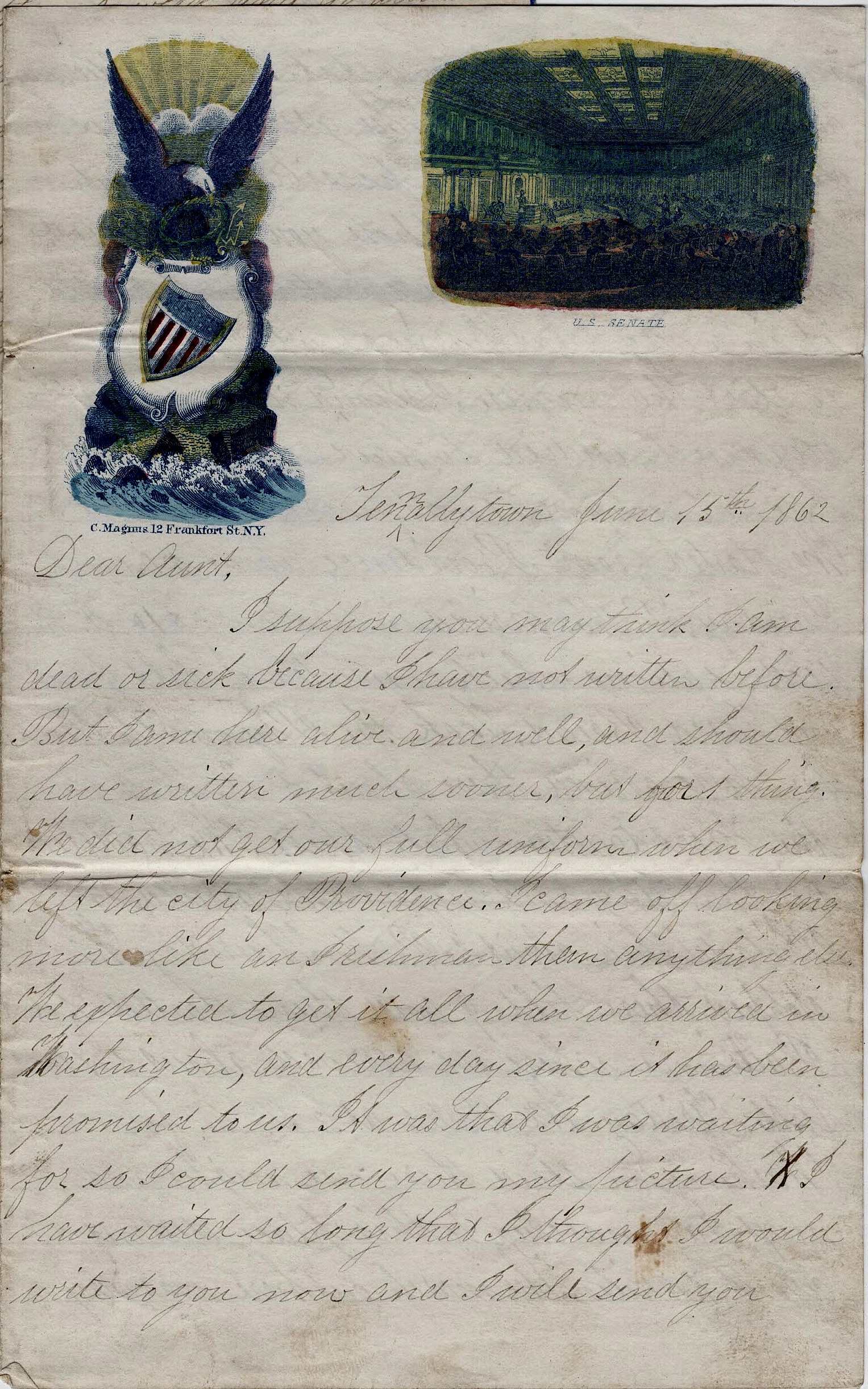
Tenleytown
June 15th 1862
I suppose you may think I am dead or sick because I have not written before but I am here alive and well, and should have written much sooner but for 1 thing. We did not get our full uniform when we left the City of Providence. I came off looking more like an Irishman than anything else. We expected to get it all when we arrived in Washington, and every day since it has been promised to us. It was that I was waiting for so I send you my picture. I have waited so long that I thought I would write to you and I will send you my likeness when I can get it.
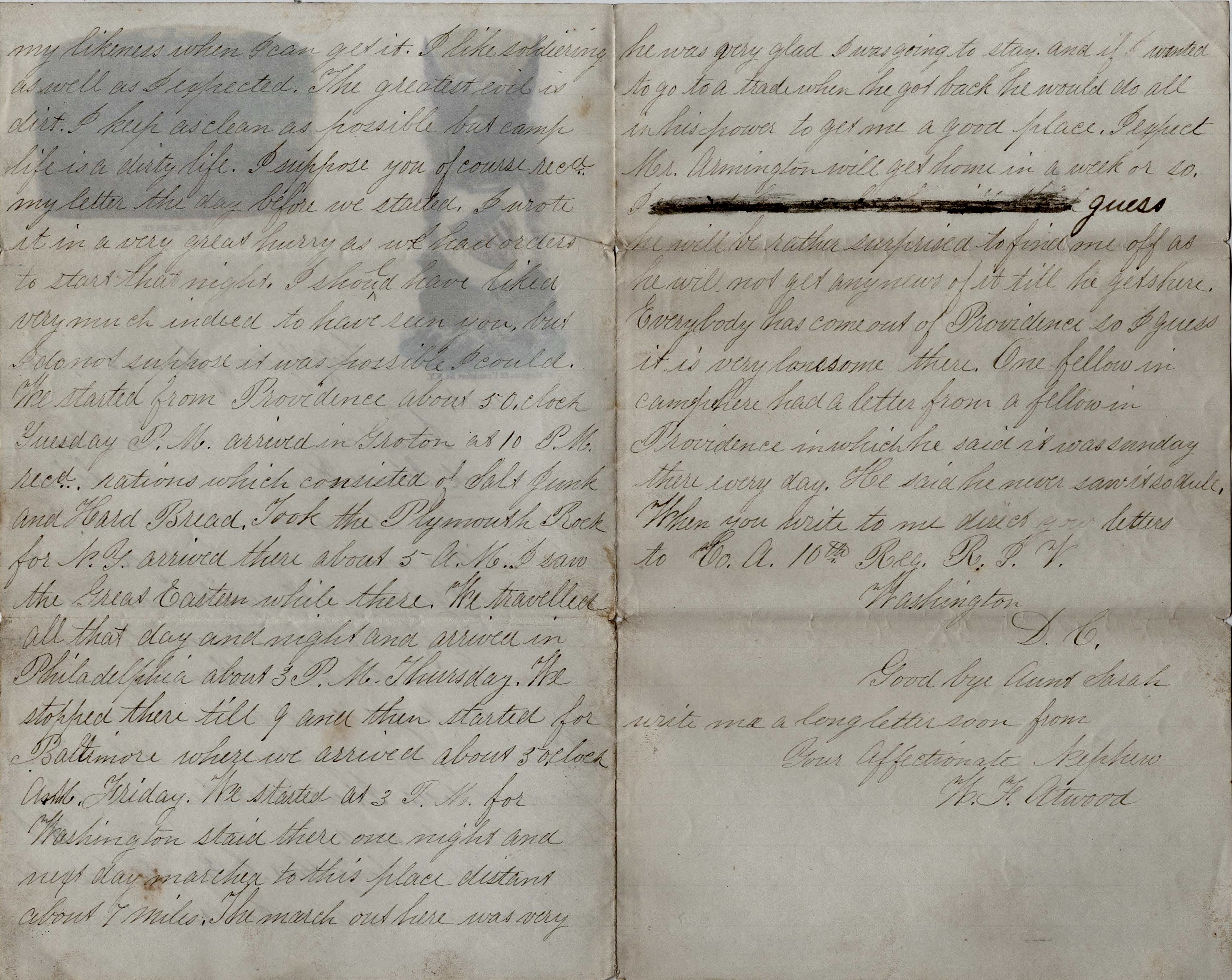
I like soldiering as well as I expected. The greatest evil is dirt. I keep as clean as possible but camp life is a dirty life. I suppose you of course received my letter the day before we started. I wrote it in a very great hurry as we had orders to start that night. I should have liked very much indeed to have seen you but I do not suppose it was possible I could.
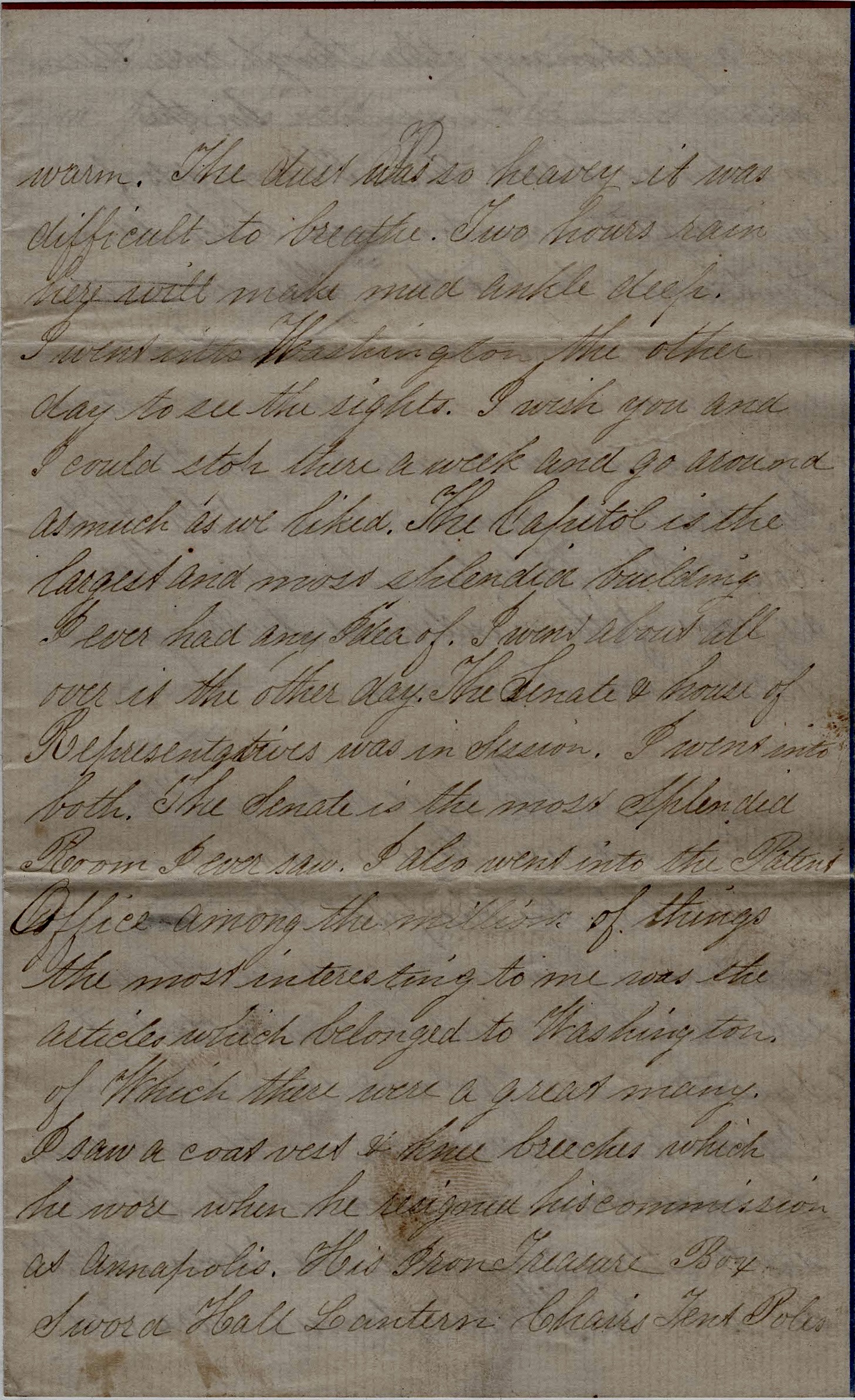
We started from Providence about 5 o’clock Tuesday p.m., arrived in Groton t 10 p.m., received rations which consisted of salt junk [salted beef] and hard bread. Took the Plymouth Rock for New York, arrived there about 5 a.m. I saw the Great Eastern [steamship] while there. We travelled all that day and night and arrived in Philadelphia about 3 p.m. Thursday. We stopped there till 9 and then started for Baltimore where we arrived about 5 o’clock a.m. Friday. We started at 3 p.m. for Washington, stayed there one night, and next day marched to this place, distant about 7 miles. The march out here was very warm. The dust was so heavy it was difficult to breathe. Two hours rain made mud ankle deep.
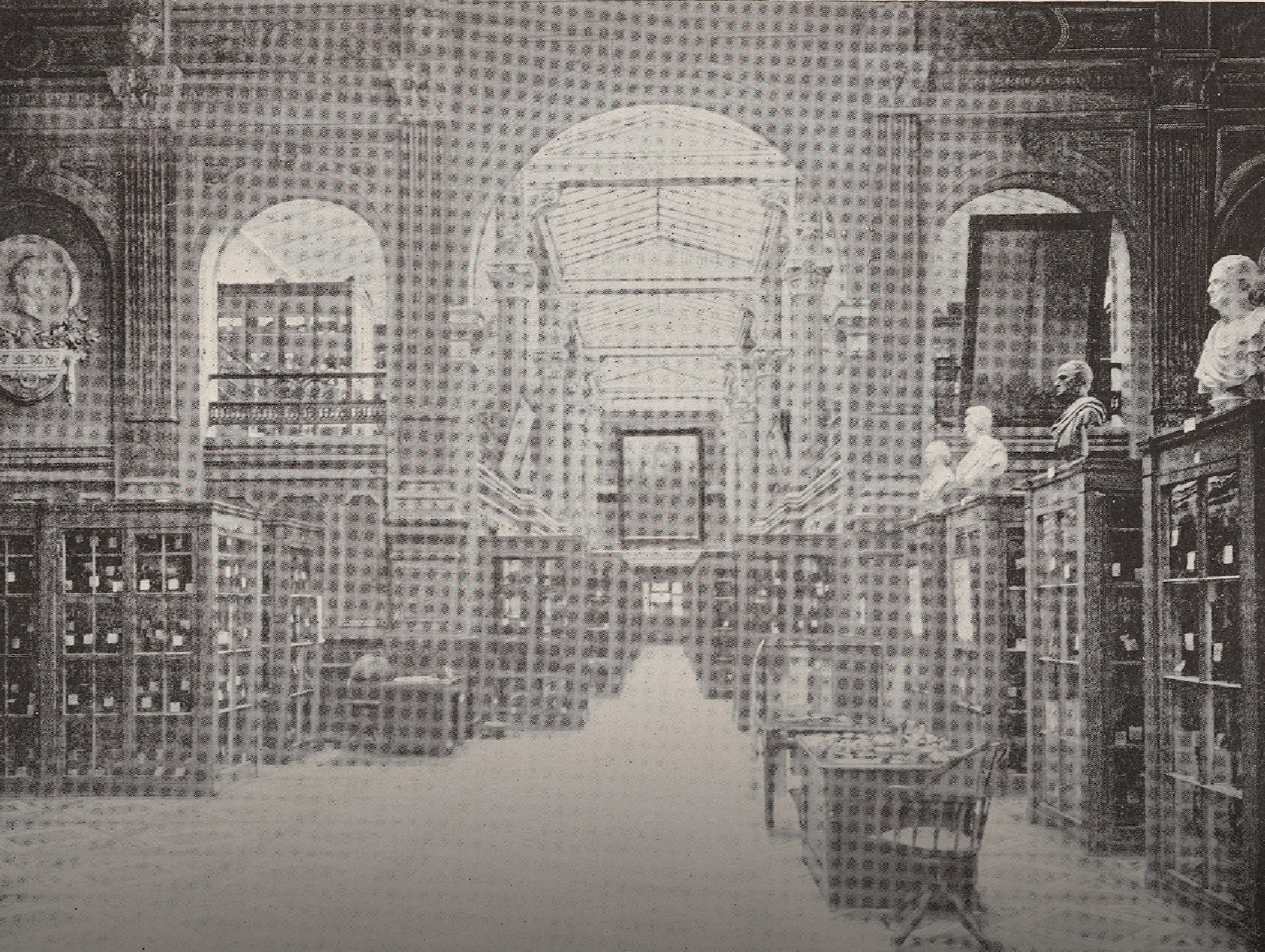
I went into Washington the other day to see the sights. I wish you and I could stop there a week and go around as much as we liked. The Capitol is the largest and most splendid building I ever had any idea of. I went about all over it the other day. The Senate and House of Representatives was is session. I went into both [chambers]. The Senate is the most splendid room I ever saw. I also went into the Patent Office, Among the millions of things, the most interesting to me was the articles which belonged to [General] Washington of which there were a great many. I saw a coat vest and knee breeches which he wore when he resigned his commission at Annapolis. His iron Treasure box, sword, hall lantern, chairs, tent poles, and a great many other things were there. I was very much disappointed in the machines I saw there. The models of some (a great many too) I should not think would be put there—they were made so cheap and common. But there was enough of interest in te room to interest me a month if I could only get there. I went into the reception room of the White House. It is furnished splendidly. There are some of the handsomest buildings in Washington I ever saw.
We have but very little sickness out here. There is but one man at present in the hospital from my company. I am in as good heath as I ever was. I have had but one attack of dysentery but I got over it in a day. I guess about every man in the company has been touched with it. The water they say brings it on. While we were in Washington, we were fed on bread, coffee strong without milk, and junk so salty you could hardly keep it in your mouth. The junk made me dry and I drank considerable of the spring water there. It went through me like Croton oil but I was not troubled but once.
We were sworn into service last Monday for three months from the 26th of May (three weeks tomorrow). How are things with you in Taunton and Berkley. I want you to write me a good long letter when you get this and let me know all the news, &c. We will have to give up the good times we were going to have for the present, but if I get back at the end of the three months, we will make up for the lost time. I asked Mr. Eddy if there would be any doubt about my getting my place again. He told me not to be uneasy about that for he would not lose me for anything. He had a letter from Mr. Armington a day or two before I came away in which Mr. A. said he was very glad I was going to stay and if I wanted to go to a trade when he got back, he would do all in his power to get me a good place. I expect Mr. Armington will get home in a week or so, I guess he will be rather surprised to find me off as he will not get any news of it till hr gets here. Everybody has come out of Providence so I guess it is very lonesome there. One fellow in camp here had a letter from a fellow in Providence in which he said it was Sunday there every day. He said he never saw it so dull.
When you write to me, direct your letters to Co. A, 10th Regiment R. I. Vols., Washington D. C.,
Goodbye Aunt Sarah. Write me a long letter soon. Your affectionate nephew, — W. F. Atwood

 Spared & Shared 23