
This letter was composed by John Boothe (b. 1825), a notable citizen and merchant in Gatesville, Gates County, during his tenure in the North Carolina General Assembly in January 1861, as the United States stood on the threshold of war. At that juncture, although South Carolina had already declared its secession, no other southern state had followed suit. Merely five days prior to the writing of this letter, the North Carolina General Assembly enacted legislation calling for a “secession convention.” This legislation stipulated that “the people” were to cast their votes for either “a convention” or “no convention” on 28 February 1861. The populace of North Carolina decisively endorsed the notion of “a convention.” Ultimately, North Carolina would delay its secession from the Union until 20 May 1861.
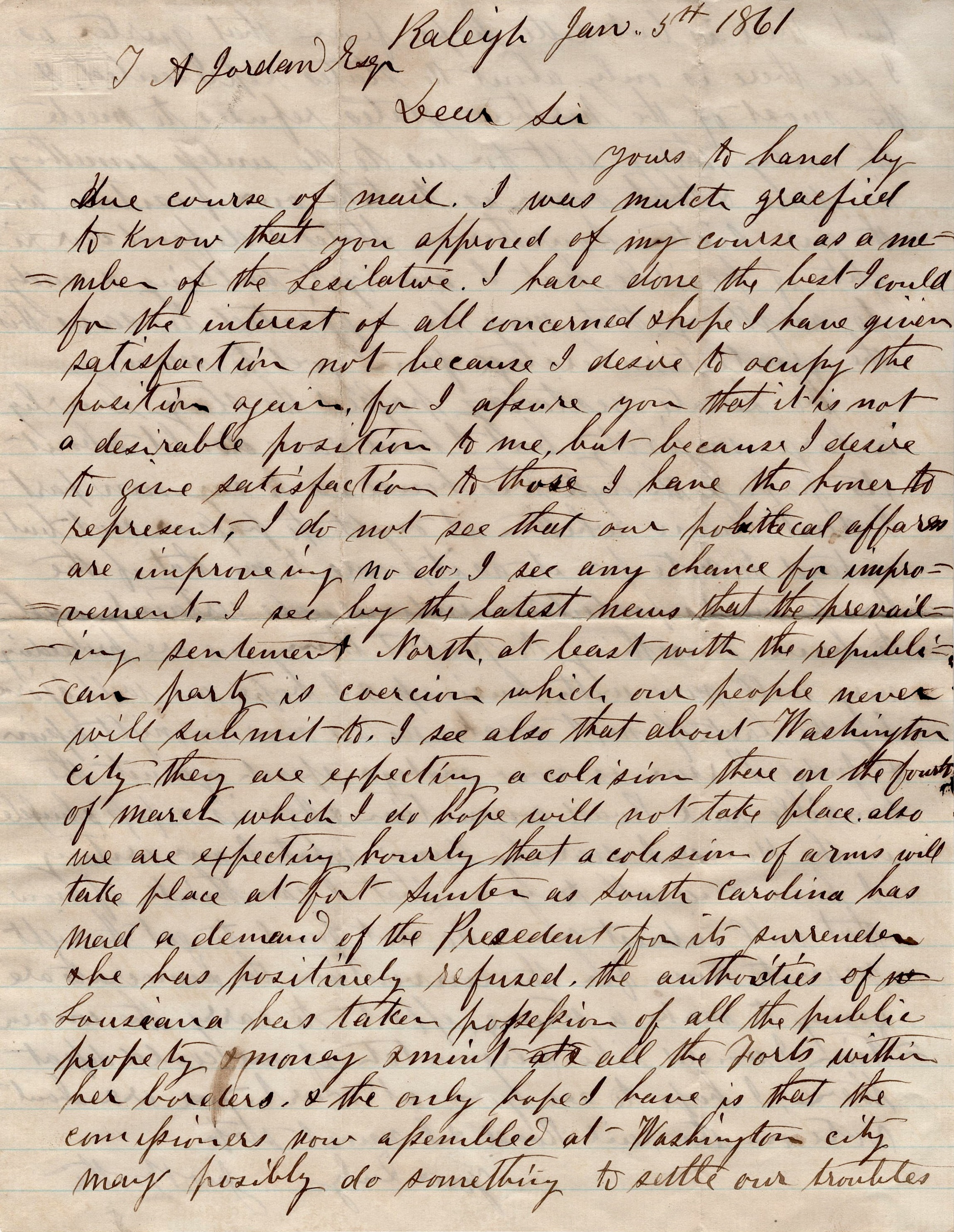
T R A N S C R I P T I O N
Raleigh [North Carolina]
January 5 1861
T. A. Jordan, Esq.
Dear Sir,
Yours [came] to hand by due course of mail. I was much gratified to know that you approved of my course as member of the legislature. I have done the best I could for the interest of all concerned & hope I have given satisfaction not because I desire to occupy the position to me, but because I desire to give satisfaction to those I have the honor to represent. I do not see that our political affairs are improving. Nor do I see any chance for improvement.
I see by the latest news that the prevailing sentiment North, at least with the Republican Party, is coercion which our people never will submit to. I see also that about Washington City they are expecting a collision there on the 4th of March which I do hope will not take place. Also we are expecting hourly a collision of arms will take place at Fort Sumter as South Carolina has made a demand of the President for its surrender & he [Buchanan] has positively refused. The authorities of Louisiana has taken possession of all the public property & money & mint, all the forts within her borders, & the only hope I have is that the commissioners now assembled at Washington City may possibly do something to settle our troubles. But there is little hope from that quarter as I see there is only about 16 states represented & the most of the northern states refuses to meet.
The only thing left for us to do unless something is done—and that soon—is to take our position with our southern states & defend our rights if possible. But I am yet willing to & ready to [do] anything that may be suggested to save this greatest inheritage from God to man.
The Senate yesterday passed the stay law 1 by a large majority but I have some doubt about its passage through the House. As to my own part, I do not know whether it ought to pass or not, but intend to vote for it as it seems to me that if the Banks needs protection, individuals certainly ought to have something to protect them. We are proceeding very well now with business & I hope we will adjourn by the last of next week. We are now in night session & Judge [Samuel J.] Person [of New Hanover county] is now making a speech against the Danville Railroad connection 2 & there is [such] a fuss and bustle in the House, I hardly know what I am writing.
I have said all to you that I can think of now that will interest you. Do not fail to get the right man to run for the Convention. The Democrats are going to make a strong effort to carry the Convention. I would like very much if we could defeat them. I hope to see you at court. We are about to vote on the railroad & I must stop.
Yours truly, — Jno. Boothe
1 A “Stay Law” allows debtors extensions to pay their debts before creditors can seize their property. North Carolina’s General Assembly enacted this law in 1861 to protect debtors facing hardship during the impending war.
2 Eastern North Carolina officials objected to a connection between the North Carolina Railroad at Greensboro and the Richmond & Danville Railroad. They feared the proposed Greensborough & Danville Railroad (“Danville Connection”) would result in traffic being diverted away from the port at Wilmington to a Virginia port. Profits of the Wilmington & Weldon Railroad and the Raleigh & Gaston Railroad would be reduced.

 Spared & Shared 23