
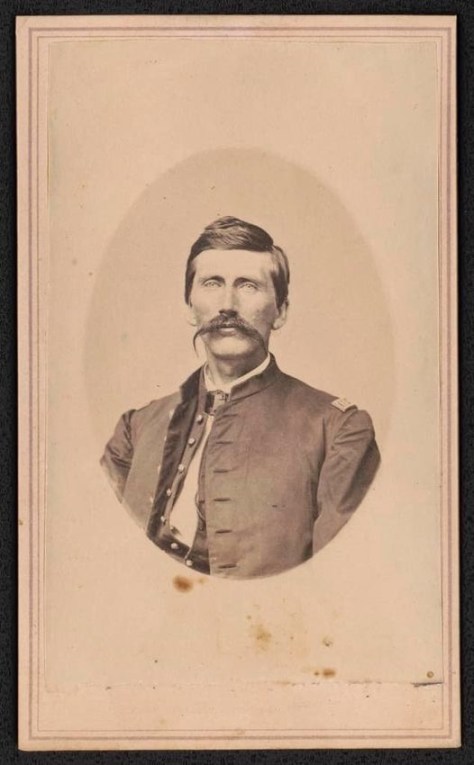
The following letter was written by John Henry Hedges Cross (1840-1926), the son of Henry Cross (1814-1888) and Catherine Hedges (1816-1888). John wrote this letter in November 1862 while serving in Co. H, 31st Iowa Infantry. His father was also in the service as a member of Co. D, 9th Iowa Infantry (from September 1861 to September 1864). He was wounded slightly in the shoulder at Pine Ridge, Arkansas.
John H. H. Cross enlisted on 14 August 1862 in the 31st Iowa Volunteers and was mustered into the service in mid September 1862 at Camp Herron in Davenport. He remained in the service for his full term of three years, mustering out on 27 June 1865. A few years after the war he married Melissa Mercy Bullock (1840-1923) and lived in Marshall county, Iowa, for a few years before moving to Nebraska.

To read other letters by members of the 31st Iowa that I have previously transcribed and posted on Spared and Shared, see:
Andrew Gillespie Henderson, Co. F, 31st Iowa (1 Letter)
Andrew Gillespie Henderson, Co. F, 31st Iowa (1 Letter)
Milton S. Wade, Co. F, 31st Iowa (1 Letter)
Michael W. Kirby, Co. I, 31st Iowa (1 Letter)
To read a diary kept by an unidentified soldier of the 31st Iowa Infantry between 4 September 1862 to 30 September 1864 housed at the Missouri Historical Society (that does not appear to have been transcribed), see: Diary of Unidentified soldier of the 31st Iowa Infantry.
T R A N S C R I P T I O N
Benton Barracks, St. Louis, Mo.
Co. H, 31st Regiment Iowa Vols.
November 6, 1862
Dear Mother,
I take this blessed opportunity of writing to you to let you know that I am well and hope these few lines will find you enjoying the same blessing from God, the bountiful giver of all good.
I left Camp Herron [Davenport, IA] last Saturday in the afternoon and started for St. Louis and arrived here safe and sound on Tuesday night about 7 o’clock. Now I will endeavor to give you a description of the trip.
November 1st, left Camp Herron and got on board of the [steamer] Sucker State 1 in the evening about 8 o’clock and started at 10 and arrived at Muscatine [City] at 1 o’clock at night, November 2nd, and in the morning when I waked up, it was snowing like all fury. It was rather a cold time but we got along pretty well. About noon it turned warm and pleasant. Towards night we landed at a little town by the name of Pt. Ross 2 and there we got off and some supper and after supper, we went on the boat and stayed all night.

The next morning, November 3rd, we left the boat and took the cars for Keokuk. We arrived at the city at 8 in the morning and there we got breakfast. George Foster and myself got the breakfast for one mess. We stayed there about noon waiting for the boat to come down over the rapids and to unload some freight, and then we went on the old Sucker State again. It is one of the dirtiest boats that I ever seen and just before sundown the boat got stuck on a sand bar and was out of wood. The [boat] hands took a skiff and went to shore, got a flatboat load of wood and then we got off and started for Dixie but it was after dark when we got started. The weather was very pleasant.
November 4th, when the sun rose, my eyes could see the land of Missouri. It is a hard looking country and Illinois is not much better down here but the people are more like somebody. The weather is not quite so pleasant today as it was. The wind blows from the south and makes it disagreeable. But I have not had anything on but my blouse coat since I left Keokuk. We arrived at St. Louis in the evening and stayed on the boat all that night and most of the next day.
November 5th, I went off of the boat and there I saw William Gates. He was taken prisoner at Shiloh. He belongs to the 20th Illinois. I saw John Conklin, He eat dinner with us. After dinner I went out in the city and the first man that I saw was Felix Basinger and pretty soon I met Jake Barnhill and Fred Houses and Larve [?] Smith. They were on their way to Kentucky. They were going as bridge builders.
St. Louis is a large city. I have not saw a frame house yet. They are all brick and stone and when I got back, the regiment had orders to march to Benton Barracks. We started from the boat after dark and arched up there. Some of the boys were almost tired out and when I got to the barracks, there came in John Hubanks and Steve Collins. They were glad to see their old neighbors. John has been sick.
November 6th, after breakfast I started to see the new home and first thing I knew I met James Wright. He is sick. He left the regiment three weeks ago. He said that Father was limping round with his cane. There is several of our company sick. Jacob Dreibelbis, S[amuel] J. Nelson, William Barnhill, William Whitmore, S[amuel] Williamson, L[eroy] Burnight. Them was left at Camp Herron and Merve [Mervin] Nelson, R[obert] Nelson, B. Jarret, [James] D. Ennis, O[liver] Ackerman, C. W. Halley, M[atthias A. Watson are sick here but not very bad. The rest of the boys are well. Write soon. — John H. H. Cross
[to] Catherine Cross
1 The Sucker State [slang for Illinois] was a sidewheel packet built at McKeesport, Pennsylvania, in 1860. It was built for the St. Louis to St. Paul trade. Her first home was in Galena, Illinois. She was burned in Alton Slough in 1872.
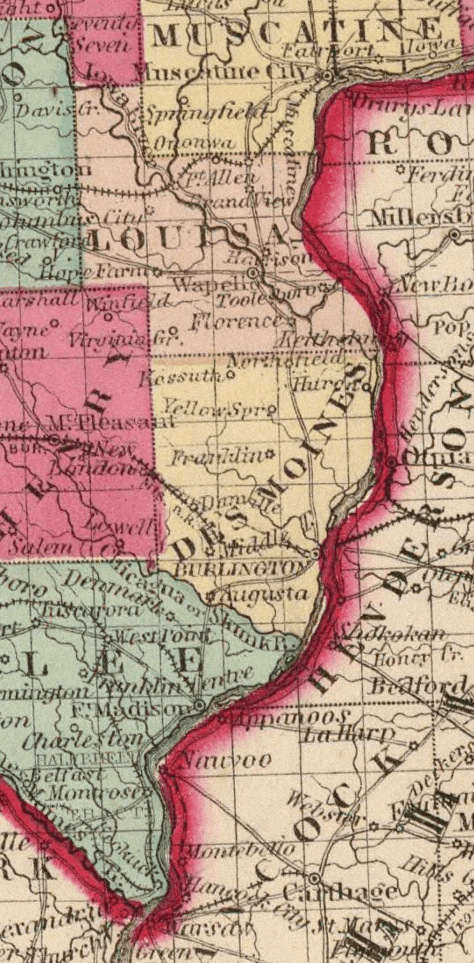
2 I could not find the name of this town on the early Iowa maps. Perhaps I have transcribed it incorrectly. It must have been somewhere near the bend of the Mississippi River opposite the Mormon village of Nauvoo, some dozen miles north of Montrose, as the 1860 map of Iowa shows a railroad running north from Keokuk to that location. Montrose was located near the foot of the Lower Rapids, also known as the Des Moines Rapids. These shallow rapids, about 11 miles in length, presented a major obstacle to river traffic, especially during periods of low water, which would explain why the author and other passengers took the train around the rapids.


 Spared & Shared 23