
This letter was only signed “Father” but the content reveals that he was most likely a member of Co. H, 1st Vermont Heavy Artillery. This company was at Fort Slocum till March, 1864, then at Fort Bunker Hill till May, 1864 when they were ordered to the Virginia battlefront to be used as infantrymen in Grant’s Overland Campaign. The regiment joined the 6th Army Corps at Spottsylvania Court House on 15 May 1864—little more than a week after Grant launched his campaign.
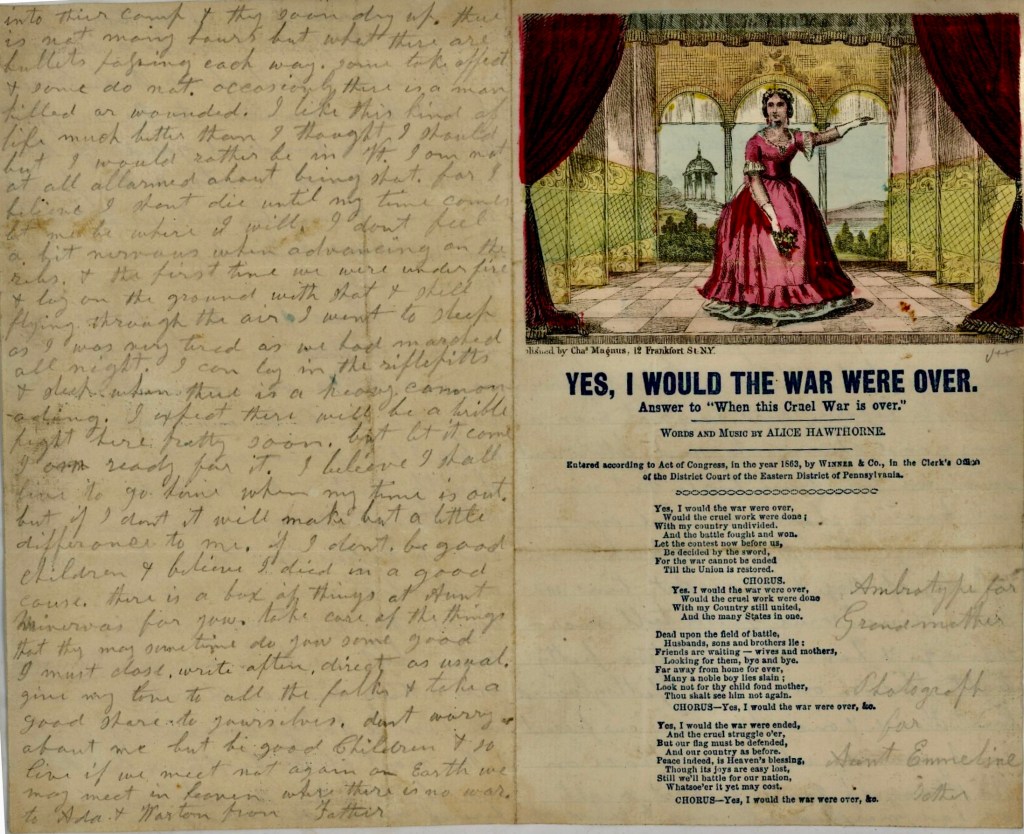
In his letter, he refers to Uncles Levi & Lyman who appear to be serving with him. Likewise he refers to an Aunt Minerva. Since the letter was written to his children, Ada and Walton, these aunts and uncles were most likely the author’s siblings or in-laws. The letter was written on stationery printed with the words to the tune by Alice Hawthorne entitled, “Yes, I would the war were over.” It is annotated in the margin, “Ambrotype for Grandmother, Photograph for Aunt Emeline. — Father.” These are articles that were presumably sent to Aunt Minerva in the box he mentions in the letter.
By posting this information on Spared & Shared Facebook, an astute subscriber named Amanda Champagne McCarty was able to locate a Vermont family that satisfied all of these relationships and I feel certain that the letter can now be attributed to Benjamin F. Strong (1825-1864) of Woodstock who was a 36 year-old mechanic when he entered the service in August 1862 with Levi F. Barnaby (1826-1873) and Lyman Aldrich. Levi was married to Minerva Strong (1836-1912), Benjamin’s sister. Lyman was married to Ellen Blaisdell, sister of Benjamin’s 1st wife Elvira Blaisdell (1833-1860). Benjamin’s and Elvira’s children were Ada Strong (1851-1919) and Frank Walton Strong (1855-1942). After Elvira died in February 1860, Benjamin took Esther D. deCamp (1840-1862) as his second wife and they had a child named Fanny but both mother and daughter died while Benjamin was in the service.
What is most chilling about this discovery, however, is that Benjamin was killed by an enemy sharpshooter on 9 June 1864—just two days after having written to his children: “I am not alarmed about being shot for I believe I shan’t die until my time comes, let me be where I will….I expect there will be a terrible fight here pretty soon, but let it come. I am ready for it. I believe I shall live to go home when my time is out. But if I don’t, it will make but a little difference to me. If I don’t, be good children & believe I died in a good cause.” No wonder the letter was cherished and the words on the song sheet all the more poignant:
Dead upon the field of battle,
Husbands, sons and brothers lie:
Friends are waiting—wives and mothers,
Looking for them, bye and bye.
Far away from home for ever,
Many a noble boy lies slain;
Look not for thy child fond mother,
Thou shalt see him not again.
Chorus—Yes, I would the war were over.
T R A N S C R I P T I O N
Camp in the field near Cold Harbor, Virginia
June 7th 1864
My dear children
As I have a little spare time this morning, I will write a few lines to let you know that I am yet alive & what is more, am well. Uncles Levi & Lyman are well. Uncle Lyman had a letter from home this morn. I received a letter from you a few days ago but I have not had time to write before. There has not been a very good chance to send letters out since we have been here, but now we have a chance to send every morning.
We left [Fort] Bunker Hill on the 12th day of May & since that time we have done some pretty tall marching & have been in two pretty tight places—once near Spottsylvania Court House and once here on our present campground which took place on the 1st day of June just at night. We had marched all day and came up with the main part of the Corps just in time to form and make a charge on the rebs. A part of our regiment, Cos. F, L. K, & H [the 1st Battalion], advanced to the very front to within a hundred yards of the rebel entrenchments & they poured the grape and canister into us like hail. But we were behind a small rise of ground & by laying flat down, we most of us escaped being killed or wounded. There were about 84 lost in our four companies—one man killed and 10 wounded in Co. H. One corporal lost a leg and one sergeant an arm. All have been sent to the General Hospital in Washington. In this last affray, our loss was pretty severe. They think more so than the rebs but we hold our position & are getting very well entrenched.
We have a large amount of artillery & the most of the fighting has been done by it. When the rebs commence firing on us, they send a few shells into their camp & they soon dry up. There is not many hours but what there are bullets passing each way. Some take effect and some do not. Occasionally there is a man killed or wounded. I like this kind of life much better than I thought I should but I would rather be in Vermont. I am not alarmed about being shot for I believe I shan’t die until my time comes, let me be where I will. I don’t feel a bit nervous when advancing on the rebs & the first time we were under fire & lay on the ground with shot and shell flying through the air, I went to sleep as I was very tired as we had marched all night.
I expect there will be a terrible fight here pretty soon, but let it come. I am ready for it. I believe I shall live to go home when my time is out. But if I don’t, it will make but a little difference to me. If I don’t, be good children & believe I died in a good cause. There is a box of things at Aunt Minerva’s for you. Take care of the things that they may some time do you some good.
I must close. Write often. Direct as usual. Give my love to all the folks and take a good share to yourselves. Don’t worry about me but be good children & so life if we meet not again on earth, we may meet in Heaven where there is no war.
To Ada & Walton, from Father

 Spared & Shared 23