

The following letter was written by Robert Spencer Paul (1842-1905), the son of Hosea Paul (1809-1870) and Ellen Gamble (1813-1889) of Cuyahoga Falls, Summit, Ohio. Robert learned the surveyors trade from his father; his gateway into a career in civil engineering. From 1862 to 1865 he served on the topographical staff of the Army of the Cumberland and after attending Lebanon College in Ohio and the Pennsylvania Polytechnic College, he settled in Akron where he was elected county surveyor, succeeding his father in 1870.
He married Sarah Matilda Romig on 25 July 1872. They were the parents of at least 1 son and 6 daughters. He lived in Stow Township, Summit, Ohio, United States in 1850 and Ohio, United States in 1870. He died on 23 August 1905, in Akron, Summit, Ohio, United States, at the age of 62, and was buried in Oakwood Cemetery, Cuyahoga Falls, Summit, Ohio, United States.
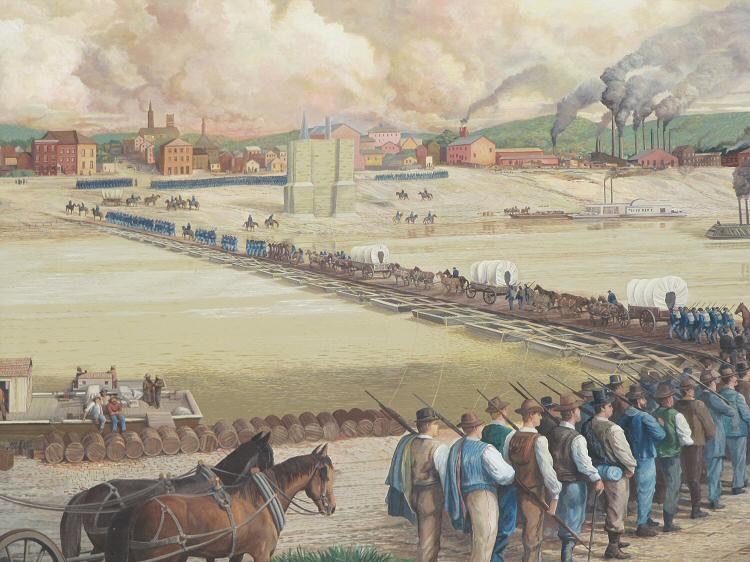
In his letter Robert describes the fortifications that were being hastily constructed near Cincinnati in the fall of 1862 as Braxton Bragg’s and Kirby Smith’s Rebel Armies threatened the Queen City itself. The bulk of this work was carried out by the Black Brigade—the first formal organization of black men used for military purposes in the North during the Civil War. They felled trees, constructed roads, built breastworks, and dug rifle pits for nearly three weeks. Confederate General Henry Heth’s force of between six and eight thousand soldiers came within a few miles of the river near Fort Mitchell, but did not engage. The new defensive works and the presence of more than 25,000 Union soldiers alongside local militia and Squirrel Hunters proved a formidable deterrent. Heth’s forces departed and the Federal Army then turned its attention to safeguarding Louisville.
“On September 20, The Black Brigade disbanded. The 705 surviving members of Cincinnati’s Black Brigade marched through the streets of Covington, Kentucky shouldering shovels and pickaxes, then crossed the pontoon bridge. Martial music played and banners rippled in the breeze as the men strode proudly through the main streets of the Queen City. Judge Dickson dismissed them with an emotional speech: ‘The sweat-blood which the nation is now shedding at every pore is an awful warning of how fearful a thing it is to oppress the humblest being. Until our country shall again need your services, I bid you farewell.'” [Source: The Black Brigade and the Defense of Cincinnati by David T. Dixon]
Robert frequently mentions “Harry” in the letter. This was his older brother Harrison Daniel Paul (1835-1906) who served in Co. G, 1st Ohio Infantry. He became a Lieutenant Colonel and Chief Engineer of the Department of the Ohio.
To listen to a great summary of the Black Brigade and their contribution to saving Cincinnati from destruction, see: https://www.youtube.com/watch?v=oJTTkyq5jLA
T R A N S C R I P T I O N
Cincinnati, Ohio
September 14, 1862
Dear Parents,
I am well and have been. Received two letters from home today, today being the first day in a week that I could get to the post office. Friday I was out in a very hard rain without my coat and got wet twice, but I did not take cold. There was a great influx of squirrel hunters [from Ohio] for a few days past but I hear they are going home as fast as they can as there are over 75,000 troops here to fight the rebels. I do not know when the fortifications will be finished. Harry has the Black Brigade under him now. Tom Peters has one half and Harry the other, giving each 600 negroes. They are by far the better workmen. Harry and Tom Peters’ works are by far the best constructed of any along the whole line and they have been told so by Major [James H.] Simpson and Col. [Charles] Whittlesey.1
You will see by the papers I sent you that Harry and Tom Peters have charge on the Newport side. Harry at Three Mile Run, Peters at Camp Shaler. Harry has had two forts to construct while none of the others have had more than one. Harry eats with the Black Brigade and the cooks of the negro company that he messes with were getting $100 a month apiece as cooks before they went to the fortifications. They do get things up in style. The white cooks in the camp around are too dirty to eat after. In Harry’s division, there are 300 to 500 negroes chopping all the time and they will chop more than three city white men. They are a good-natured jolly set, more than half mulatto, pretty smart fellows.

Now in regard to the question father asks, I will state Col. Whittlesey says the Engineer Corps will get their pay and as I rank as a commissioned officer, it will be something. All corps will be paid. No persons work for nothing except those that refuse pay. As to my board, I get it where I can. If I can get around, I go to Harry’s boarding house which is about half the time. The rest of the time I have got my meals at eating houses, farm houses, groceries, bakeries, and camps just where I happen to be. I am not at all particular.
You ask why does not Harry write sometimes. I see him once a day and sometimes not at all, generally two or three times when I see him. We are either tired or busy and I have not heard whether he writes you or not. I have [not] seen any Dayton friends. If there has been any Falls boys here to see me, they could not find out much as the office has been locked all the time, all having gone to the wars. Mother thinks I could get clothes, does she? Well an officer has to find his own. What I am going to do after what I am at is done, I do not know. Perhaps I can get something else to do. I will try and find out what chance there would be for Hosea here as he is a better writer than I am and he would stand a better chance for a place in some of the departments. I will write him soon. Send me the Summit County Beacon. I have much to write you if I had time. Would like to write to Dwight and Ed. Can’t they write to me and tell me all going around the house, [such as] if Black Tom and his mother are well, how quack gets along, if our garden is good, if they go to school, and lots of things I want to know. I will write them a long letter soon. Have Mary write and ask any questions about going to Dayton for she wants to and I will try and find out all she wants to know. If I had had the time, I would have written a good long letter of the things I have seen here. I will do so soon if I can. Your son, — Robert S. Paul
1 Colonel Charles Whittlesey and Major James H. Simpson were with the Topographical Engineers for the Department of the Ohio.


 Spared & Shared 23