
William Tooley of Granville, NY, enlisted in Company K of the 123rd New York Volunteer Infantry Regiment in the summer of 1862, just after turning 21. His older brother Horace joined the regiment as well. The 123rd fought at Chancellorsville, VA in 1863, where William was captured and then paroled. After the Battle of Gettysburg, the 123rd was sent west to join General William T. Sherman’s Atlanta Campaign and March to the Sea. William lost his older brother at the Battle of New Hope Church, GA, on May 25, 1864. By the time William and the 123rd reached North Carolina in early 1865, they began to sense that the end of the war was near. On April 1st, William penned a letter to his brother Eber back home in which he expressed his anticipation of being soon “done with Uncle Sam” and pursuing a girl he liked when he returned home. General Lee surrendered to General Grant on April 9th, but word did not immediately reach Sherman’s troops. On the 10th, the 123rd was engaged in fighting in the swamps near Goldsboro, NC, where the final casualty of the regiment would fall, it was 23-year-old William Tooley. It was a couple of days later that the regiment would learn of the great surrender in Virginia and celebrate the impending end of the war and return to home and loved ones. It is for soldiers like William and his brother Horace, who gave the last full measure of devotion, that we celebrate Memorial Day. [Source: The Last to Fall]
William’s letter provides us with a first account of Burnside’s Mud March in mid-January 1863.
See also—1863: William Tooley to Eber Tooley
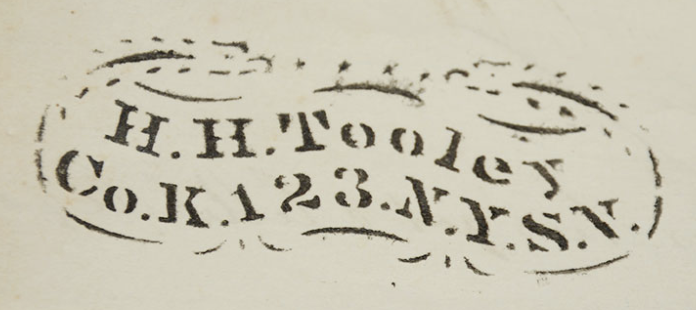
T R A N S C R I P T I O N
Camp near Stafford Court House
Sunday, February 1, 1863
Eber Tooley,
Dear brother, your letter came to hand Friday night and I was very glad to hear from you. I am well and should have written before but have been waiting to get my dog type [photograph] taken to send to you. Went over to the Court House yesterday to get it but there were so many there waiting that I came back to camp. This morning, F. Cook and myself were the first ones there and got them taken. It is just as well that you did not send that money for we were paid Thursday. I received eight dollars and twenty cents which pays us up to the first of November.
We left Fairfax on the 19th of January which was Monday. The roads were then in fine condition and [made] splendid marching. We arrived at Dumfries Tuesday night—a small village which looks as if it may have seen better days before the war. But like all the villages in Virginia, it shows too plainly the effects of the war on individual property as well as national. Most of them have but one street left, building blackened with smoke, some burned, some torn down, others without any roof, &c. But I will not attempt to describe it with pen and ink. It is too tedious for me. But I had began to give you a description of the march.
As I said before, the roads continued to be in good condition until Tuesday night. We encamped half a mile south of Dumfries. Soon after we halted for the night, it commenced to rain and rained all night. All we had to shelter us was our little shelter tents which we always carry with us. Even the officers did not fare any too well, but better than they did the next night. Well, in the morning we were marched off in the mud and rain, for one night’s rain makes it very muddy here. It did not rain much in the afternoon. We marched four or five miles when they found the train so far in the rear that we were obliged to halt for the night. But the roads were so bad that the train could not get up with us until the day at noon. Consequently we were obliged to go without supper and breakfast and the officers had to take their chances on the ground with the rest of us, their baggage being with the wagons. And so it kept on raining nights for three days. But, however, we managed to get through the mud somehow and arrived at our present camp which is situated half a mile north of the Court House. In the whole, it was a very hard march for both man and Jackass. Several mules and horses were left dead on the road.

Eber, I wish you would send me some stamps. I thought I wrote to you for some in my last letter but I must have forgotten it as you did not send them. I had my picture taken twice for you and once for mother. I do not know which one would suit her the best. I think of sending them by Asa Fish. He is going to start home tomorrow. If he carries them, you will find them at the office. Yours truly, — William
Eber, I cannot write any more until I get some stamps. Mother, I have not written to you in a good while for I have not had much time to write but I think of you very often. I received a letter from Mary last night. She said her folks were over to see you and that you were going over there. You will see by my picture that I am not very thin in flesh yet. If I had money to spare, I would send enough to get a case but I have not. Write soon, mother. — William


 Spared & Shared 23