
These letters were written by Lyman Tylee (1838-1863) who enlisted at age 23 as a private in Co. B, 19th Ohio Volunteer Infantry (OVI) on 13 September 1861 and rose in rank to Sergeant Major and transferred to Field & Staff on 1 July 1862. He was killed in action at Stones River, Tennessee, with other brave officers and men on 2 January 1863, “while gallantly performing their duties.” He was erroneously carried on the roster under the name Lyman Tyler at times.
Lyman was the son of Samuel Tylee (1798-1875) and Harriet Giddings (1805-1860) of Hubbard, Trumbull county, Ohio. He wrote these letters to his brother, Festus Giddings Tylee (1834-1864), who married Harriett Muriel Downing (1835-1921) in 1858 and was farming in Medina county, Ohio, at the time these letters were written in 1862.
Letter 1
Near Corinth, Mississippi
May 27, 1862
Dear Brother,
Though I have written you twice since I received any news from you, I will today drop you a few lines. We are now much closer to the enemy’s lines than when I last wrote. Are daily skirmishing a little. We (the 19th) go on picket every four days. Came in this morning from picket. Last Thursday we were on the outposts and the Rebels shelled us wounding five men seriously. Yesterday all passed off quietly. Our pickets and theirs talked together some and there was but little firing done.
A few days since I received a letter from Amelia Tylee stating that Augustus (who was wounded at the Battle of Shiloh) was improving slowly. He was of Co. H, 45th Illinois Colunteers. Was wounded in the knee about 4 p.m. Sunday (6th) and was sent home in about a week after the battle. 1
Gus is not very well but is improving and the rest of the boys are well except Cal[vin] Clingan who has been sick for several months most of the time and was discharged and started on his way home on Sunday. Charles Hume was detached from our company and was Clerk for Gen. Boyle. His health was quite poor and he disappeared a week after the battle and since then we have not heard from him. He called to see us in the morning and left us saying he would go back to Boyle’s Headquarters (where he stayed) and would call again in the evening. He did not go back to the General’s quarters and all efforts to find him have been without success.
I saw Lt. P. W. Chase of Medina. He was taking care of Dr. Spillman who was very sick. I called again to see them and was told Chase had gone to Cincinnati, Ohio, with Dr. Spillman. Have they got to Medina?
If you see Chase, tell him I am well and would like to hear from him. Write soon. Write long and oblige your brother, — Lyme
1 Augustus Adams Tylee (1837-1909) was the son of William Tylee (1807-1884) and Juliet Hulbert (b. 1807) of Trumbull county, Ohio. Gus served as a corporal in Co. H, 45th Illinois Infantry. Military records show him under the name of Augustus A. Tyler.


Letter 2
Camp Florence, Alabama
June 23, 1862
Dear brother,
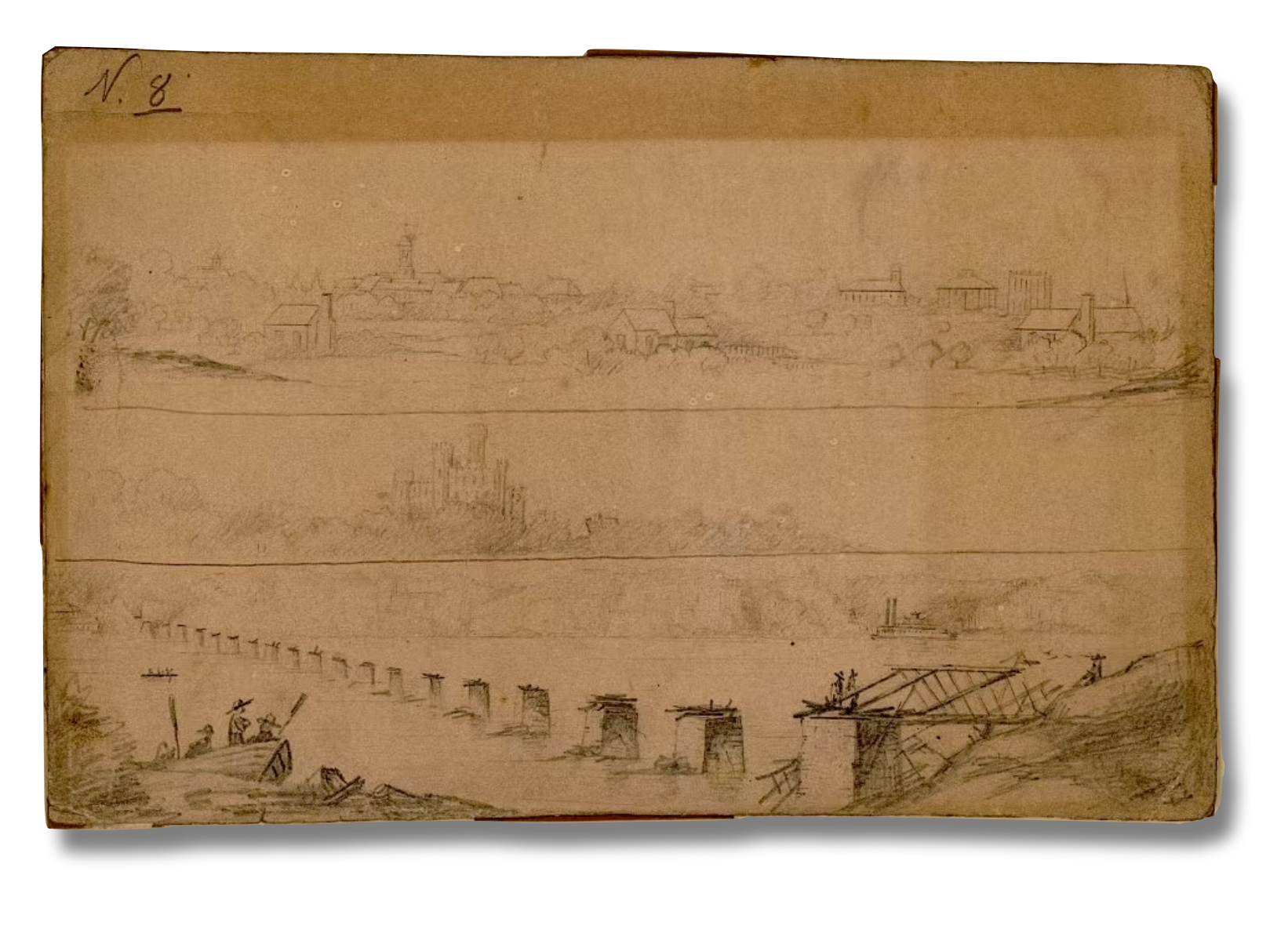
We are now camped in sight of the village of Florence where we have been for five days. Be assured that we enjoy ourselves here for the situation is delightful after our tiresome march. We worked hard during the advance on Corinth and after the evacuation we left our camp (June 3rd) and marched southward in the direction of Booneville. Six miles south of Rienzi we halted for two days and then faced about and back to Rienzi. From there we turned east and by way of Jacinto to Iuka where we lay over one day and were paid off for two months.
We left Iuka and our regiment was rear guard for the first day. The days was excessively warm and sultry and the dust filled the air in clouds. Our train was several miles long and on account of the frequent stoppages in crossing streams &c., we only accomplished 12 miles by sunset. Then the train moved slowly on and through swamps and up hills we trudged along until ten p.m. when the rear of the train halted and the men wrestled allowed to lay down. But ‘ere they were fairly comfortable, the bugle sounded and we were once more on the road. A mile brought us to Bear Creek which is a fine stream. We pulled on our shoes and forded the creek in our usual style, then we marched on and found the country improving and when the moon rose, the sight was grand. The cornfields by the roadside stretched away on either side to the timber and the plantation buildings appeared like villages in the distance.
After 4 a.m. we reached camp. The rest of the division were all in before sunset and just as we got arms stacked to rest, the bugle sounded for the other Brigade to fall in for the march. From the heat, dust, and want of food, we felt greatly fatigued as we had been on the road nearly 24 hours and marched 19 miles and it was so warm during the day that several men were sun struck though all recovered. We lay down for about an hour and then, after taking a hearty breakfast, we started again. We marched to suit our own convenience, reaching camp at 5 p.m. making 15 miles.
We camped near a beautiful stream where we all enjoyed the luxury of a good bath—the most refreshing thing we had known for many a day. The next morning we started and three miles brought us to Tuscumbia [Alabama]—a neat but deserted village and only about one quarter inhabited by citizens. Uncle Sam’s boys have possession and take good care of the place. The distance from Tuscumbia to the Tennessee River was about three miles and by noon we had camped on the south bank of the river and our boys were all sporting in its waters. After a rest of two days, we were ferried across the river and marched to this point and are camped in the edge of a shady wood while to the east we have a fine open space for a parade ground. 80 rods from us the village of Florence is situated and to the south at the distance of half a mile, the noble river is distinctly seen.
We have now two hours drill every day and have regular guard mounting and dress parade. The regiment has raised a handsome sum by subscription for the purchase of new instruments for our brass band and we will then feel as big as “anybody.” The citizens of Florence are very quiet and several of them come out to see dress parade, &c. A rebel regiment was raised almost entirely in this town and vicinity and yet the county gave a majority of several hundred against secession. After the Ordinance of Secession was forced upon the people, self interest made a great many rebels. Touch a man’s pocket and you reach his heart. I saw one cuss that is about as good a Union man as John Crainer and heartily wish that all such men would go into the Rebel army as that is where they properly belong.
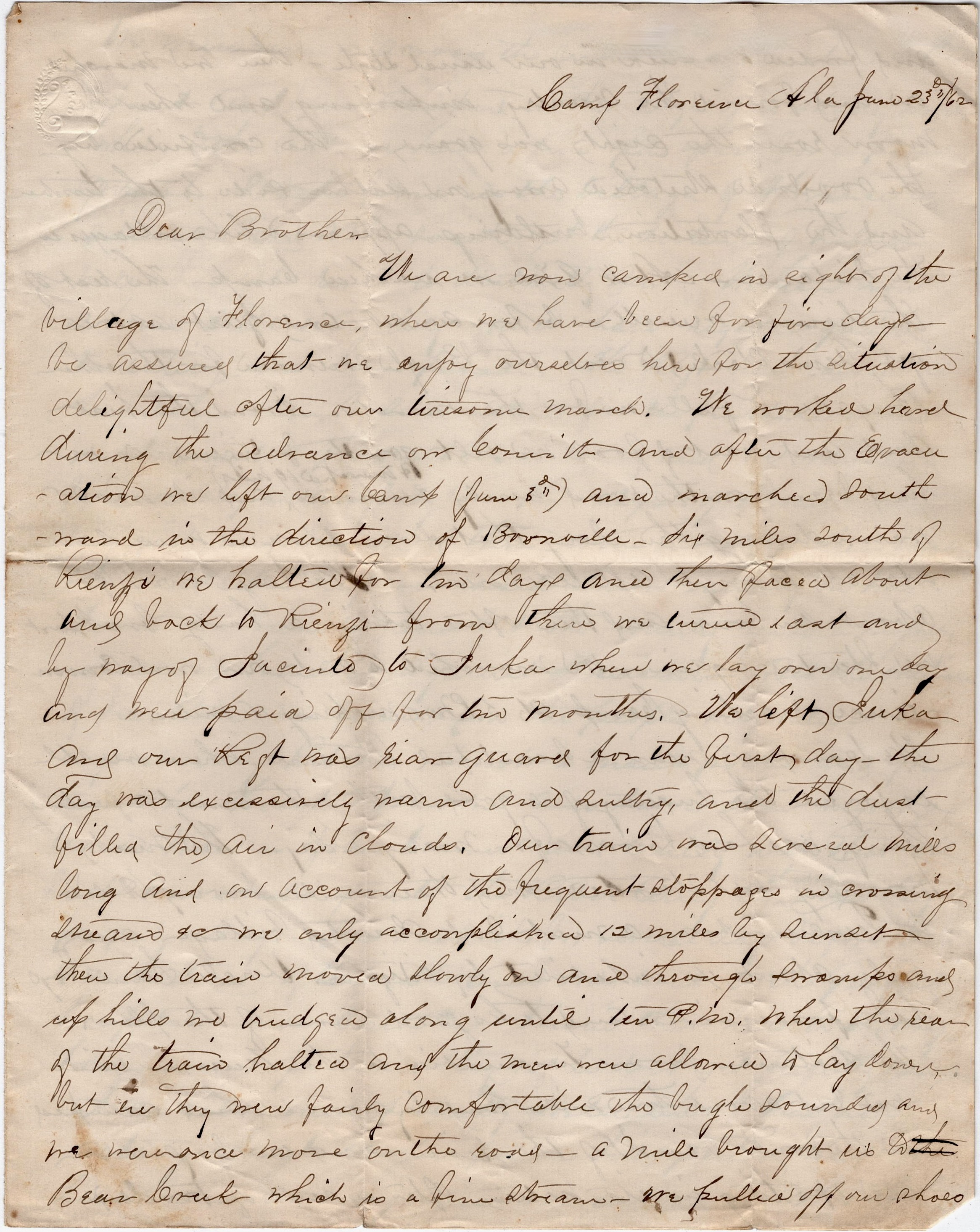
Gus [Dilley] was sick for several days before the evacuation of Corinth and was sent to the General Hospital near Corinth. I learn that he is on the way home and hope he will stay if he don’t get perfectly sound. I am well and perfectly contented. I am now Acting Sergt. Major for a brief period and have been so busy since our arrival here that I have not yet visited town. I went over the river yesterday to Headquarters (as our regiment is the only part of our division on this side) and coming back found Poly Brisbine’s Regt. (15th) just going to go aboard to cross. We spent several hours together pleasantly and then he went with his brigade through Florence to camp.
Is Dr. Spillman dead? Poly said that he heard so. Dr. Spillman was well liked in the regiment and by all the rest of the surgeons under him. I must close and hope you will write soon as I have written you several letters since I heard from you. Direct to Florence, Alabama via Cairo, Illinois.
Truly yours, — Lyme


Letter 3
Camp Battle Creek, Tennessee
Headquarters 19th Regiment O. V.
August 15, 1862
Dear Brother,
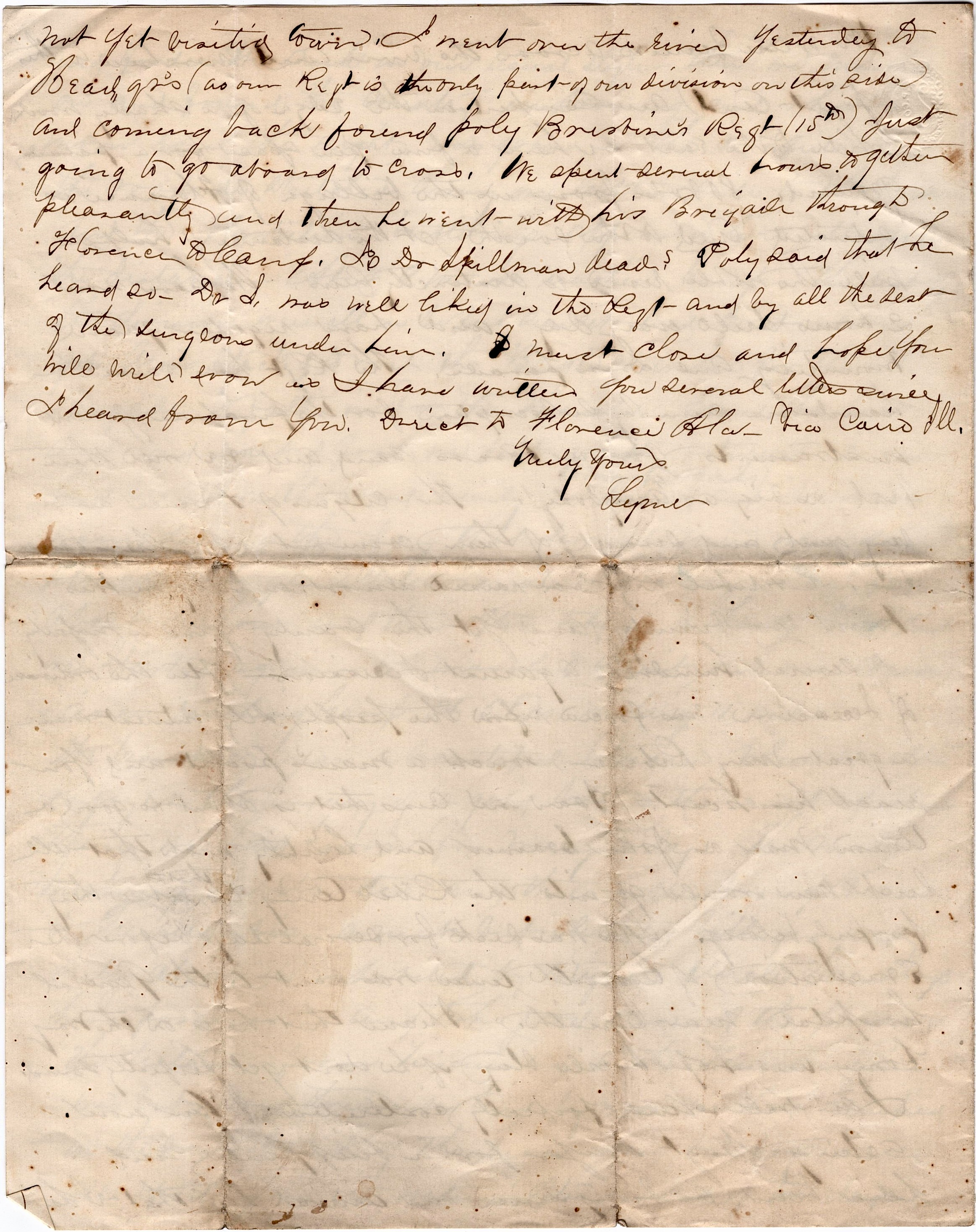
Though I am not indebted to you in the way of correspondence, I will write you a few lines hoping you may be prompted to reply. It is a long time since I heard from you though I have written to you always promptly.
The Old 19th made the march from Corinth without anything worthy of note occurring. We arrived here the 14th of last month and camped where we now lay. The spt we close is in a shady woods and very pleasant but during the middle of the day when no air is stirring, it is hot enough for comfort. This month is perhaps hottest of all the year and I tell you, the sun comes down fairly scorching things. It has been dry for some time and I think we will have rain soon which will make the air purer. There is no particular news to tell you. Gus [Dilley] is at Camp Dennison where he reported at the expiration of his furlough home. His health is poor and I think he will get a discharge—at least I hope so for I do not think he will be fit for duty for a long time, if ever. My health has generally been good since I entered the army but on the march here I got overheated and was quite sick for a time. I got better and went on duty but was taken down again. Am now getting better and the Doctor says I will be fity for duty in a few days.
I believe I told you before that Cal[vin] Clingan had been discharged. He is at home now. Charlie Hume disappeared suddenly and mysteriously one eek after the Battle of Shiloh and all efforts to find him have been in vain. Poor Charlie was a true-hearted boy and conscientiously endeavored to do his duty. At the time of his disappeareance, he was on detached duty as clerk for Gen. [Jeremiah T.] Boyle, at that time commanding our brigade. Col. [Samuel] Beatty since the Battle of Shiloh has commanded our brigade in a manner creditable to himself and satisfactory to all.
Lt. Col. [Elliott Woodbridge] Hollingsworth is absent but we expect him back soon. His place is well filled by Major [Charles F.] Manderson who is now commanding the regiment. We are camped on one side of the Tennessee River and the Rebels on the other. We are only a short distance from the Alabama and Tennessee line. This is East Tennessee and the north side of the river is watched by Union soldiers and south side by traitors. Our position is considered a good one. We have expected an attack several times and may be called to fight at any moment, but many think that the Rebels will not attack us here. Chattanooga is about 25 miles from here and there is said to be a heavy force of Rebels there.
You have heard ‘ere this of the murder of Gen. Robert McCook (Brig. Gen.) by the Rebel guerrillas while sick and compelled to ride in ambulance apart from his command. It causes intense feeling here as elsewhere. Maj. Gen. McCook (brother of the murdered man) is in command of the forces here.
I hope soon to hear of a vigorous policy which with the great number of men being raised will speedily close this horrid war. Write soon. Direct to Lyme Tylee, Sergeant Major, 19th Ohio Regt., [Thomas L.] Crittenden’s Division, Louisville, Ky.
Ever truly yours, — Lyme Tylee


 Spared & Shared 23