
The following letter was written by John W. McCleary who enlisted in the fall of 1861 as First Sergeant in the 4th Independent Battery Indiana Light Artillery. He was promoted to 2nd Lieutenant some six weeks after this letter was written and remained with the battery until early March 1863 when he resigned. At the time the letter was written on 2 February 1862, the 4th Indiana Battery occupied the heights above the Green river at Munfordville, Kentucky—an elevation which commanded the important bridge over the river. They would later join the march to Nashville and lay siege to Corinth. McCleary was presumably with the regiment in the battles of Perryville (Chaplin Hills) and Stones River before he resigned.
The battery was commanded by Capt. Asahel Kidder Bush and was sometimes referred to as “Bush’s Battery.” Bush proudly boasted that, “No Battery in the field stands higher in the estimation of those who have witnessed its part in the Battle of ‘Chaplin Hills’ and ‘Stones River’ than this.”
See also: Reminders of the 4th Indiana Battery’s Fight along the Wilkinson Pike, by Dan Masters, Civil War Chronicles, 12 March 2024.
[Note: This letter is from the private collection of Greg Herr and was made available for transcription and publication on Spared & Shared by express consent.]
T R A N S C R I P T I O N

Advance Division
Camp Wood [near Munfordville, Kentucky]
February 2, 1862
Dear Hattie,
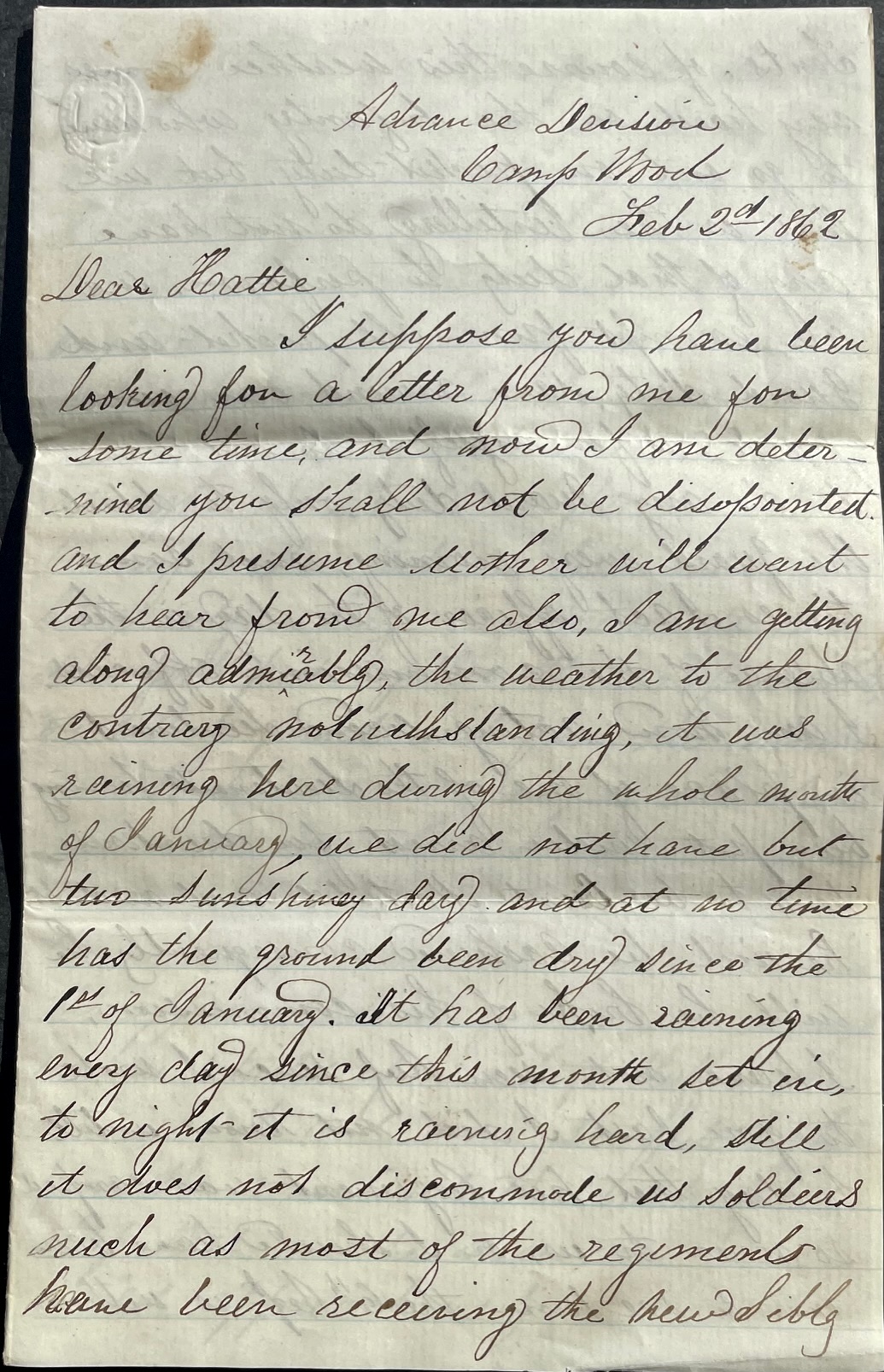
I suppose you have been looking for a letter from me for some time and now I am determined you shall not be disappointed and I presume Mother will want to hear from me also. I am getting along admirably, the weather to the contrary notwithstanding. It was raining here during the whole month of January. We did not have but two sunshiny days and at no time has the ground been dry since the 1st of January. It has been raining every day since this month set in. Tonight it is raining hard. Still it does not discommode us soldiers much as most of the regiments have been receiving the new Sibley tents. Of course this weather comes very hard on the infantry who have to go out on picket duty but we—that is, the artillery—do not have any of that duty save around our own park. As for myself, I do not have to do any guard duty—only to detail the guard every morning and sometimes I act officer of the day in the absence of the commissioned officers.
I am now acting 2nd Lieutenant in place of one of the lieutenants having been under arrest for drunkenness. He is to be court martialed and no doubt he will be cashiered. Consequently he will be broke of his commission. I have not seen Ruf since i wrote to you last. I did not know until today that his Regiment was camped so near to us, or I should have been over to see him. The 6th [Indiana] Regiment is within a stone’s throw of our camp. Their baker bakes the bread for our company so we have fresh bread every day. I get plenty to eat and drink and on the whole I must say I have enjoyed myself very much during my enlistment so far.
I wish you could see this camp with its thousands of tents at night when the lights are all burning in their tents. It looks like a large city—as large as Cincinnati and New York put together. The camp is situated on rolling ground and from the mound on which our company is situated you can see all over the camp. We are situated on the left of Green river bridge and our guns command the approach to it for miles around. We are situated upon a high bluff on the river bank and some 300 feet high above the river and the bank is so steep that neither man no beast could approach us from the river front.
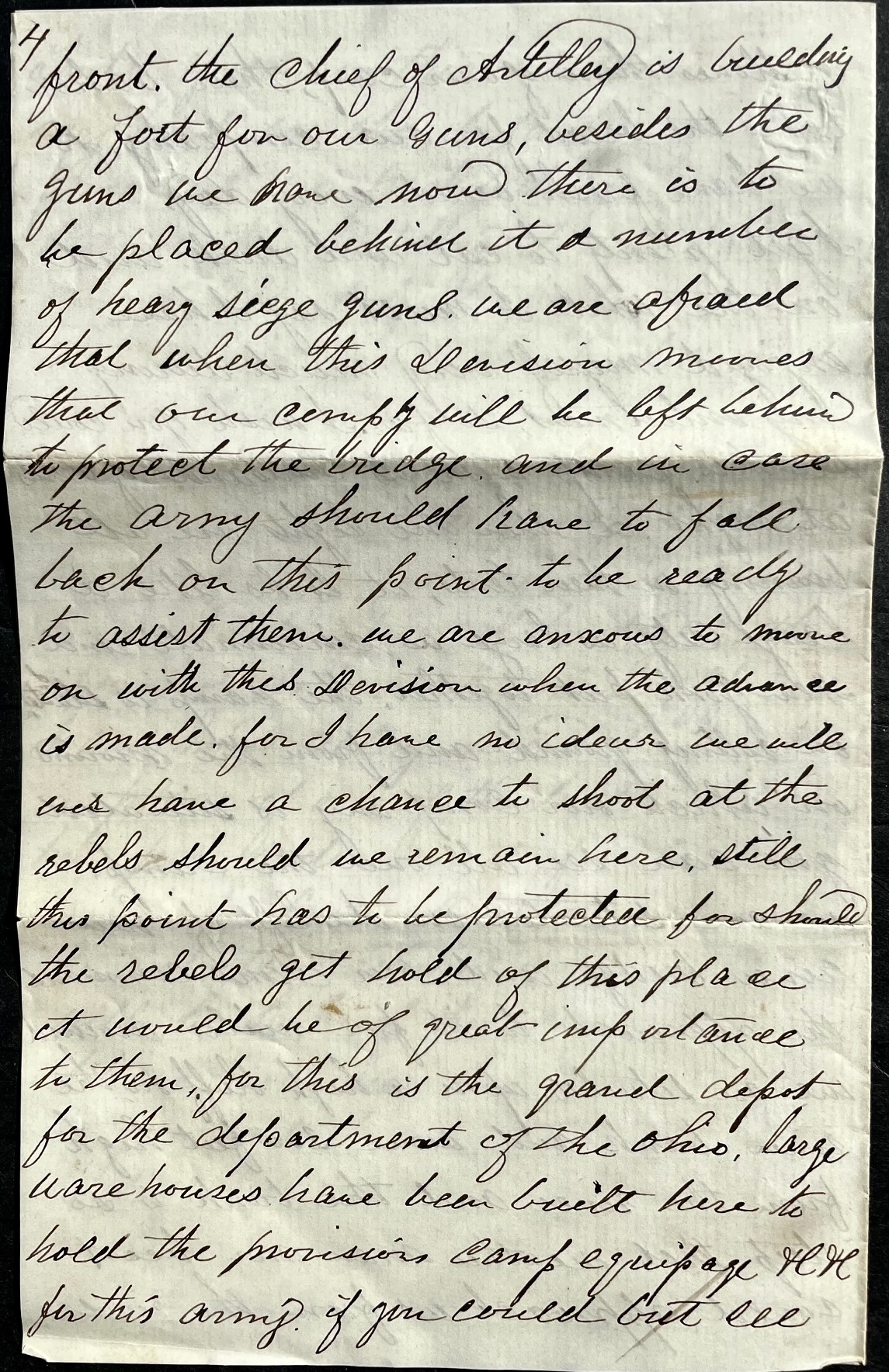
The Chief of Artillery is building a fort for our guns. Besides the guns we have now, there is to be placed behind it a number of heavy siege guns. We are afraid that when this Division moves that our company will be left behind to protect the bridge and in case the army should have to fall back on this point, to be ready to assist them. We are anxious to move on with this Division when the advance is made for I have no idea we will ever have a chance to shoot at the rebels should we remain here. Still this point has to be protected for should the rebels get hold of this place, it would be of great importance to them for this is the grand depot for the Department of the Ohio. Large warehouses have been built here to hold the provisions, camp equipage, &c. &c. for this army. If you could but see the piles of ammunition, ordnance, and quartermaster’s stores here, you would think they could not be used up in ten years.
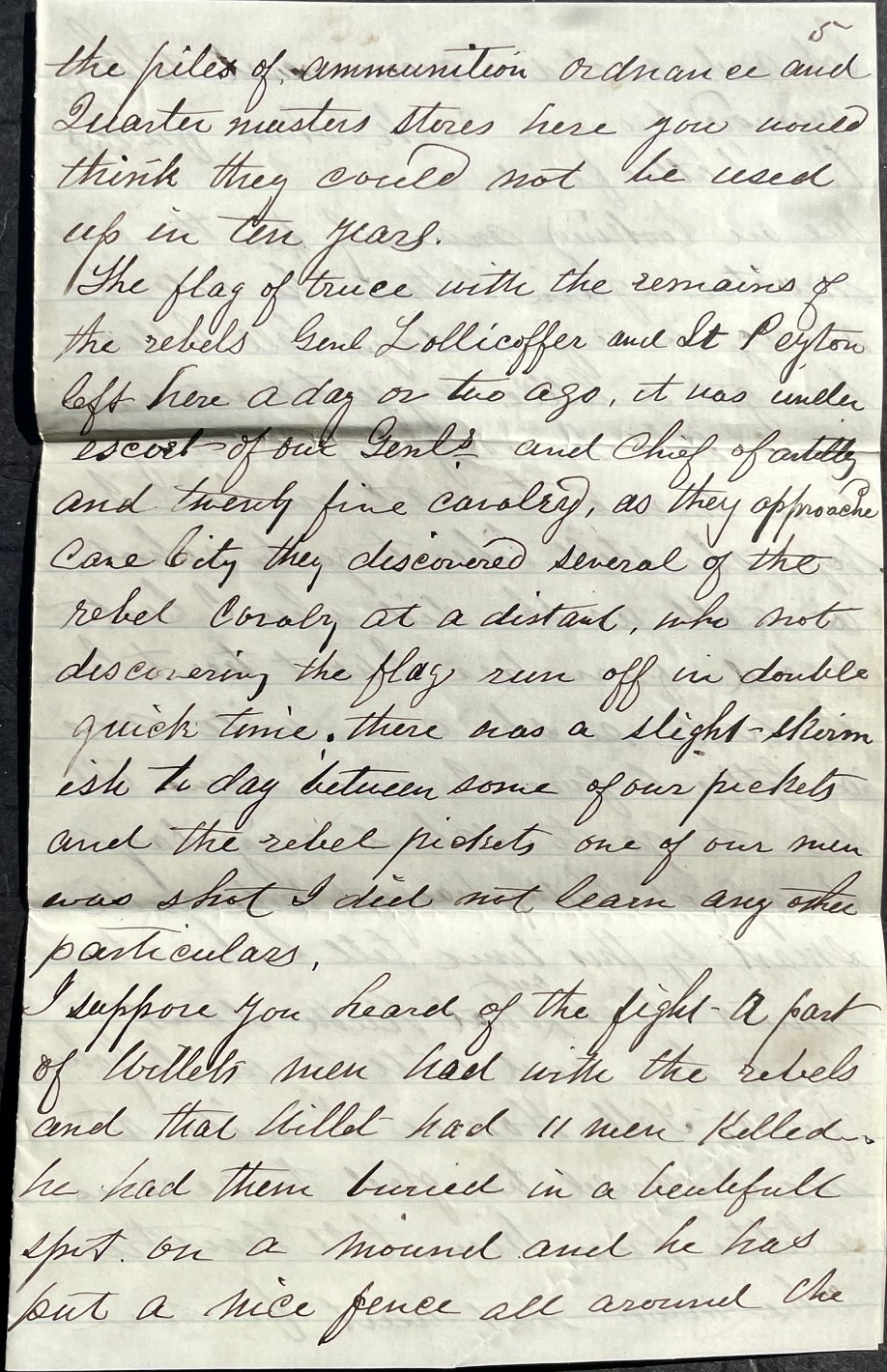
The flag of truce with the remains of Gen. Zollicoffer and Lt. Peyton left here a day or two ago. It was under escort of our generals and Chief of Artillery adnd 25 cavalry. As they approached Cave City, they discovered several of the rebel cavalry at a distance who, not discovering the flag, run off in double quick time. 1
There was a slight skirmish today between some of our pickets and the rebel pickets. One of our men was shot. I did not learn any other particulars.
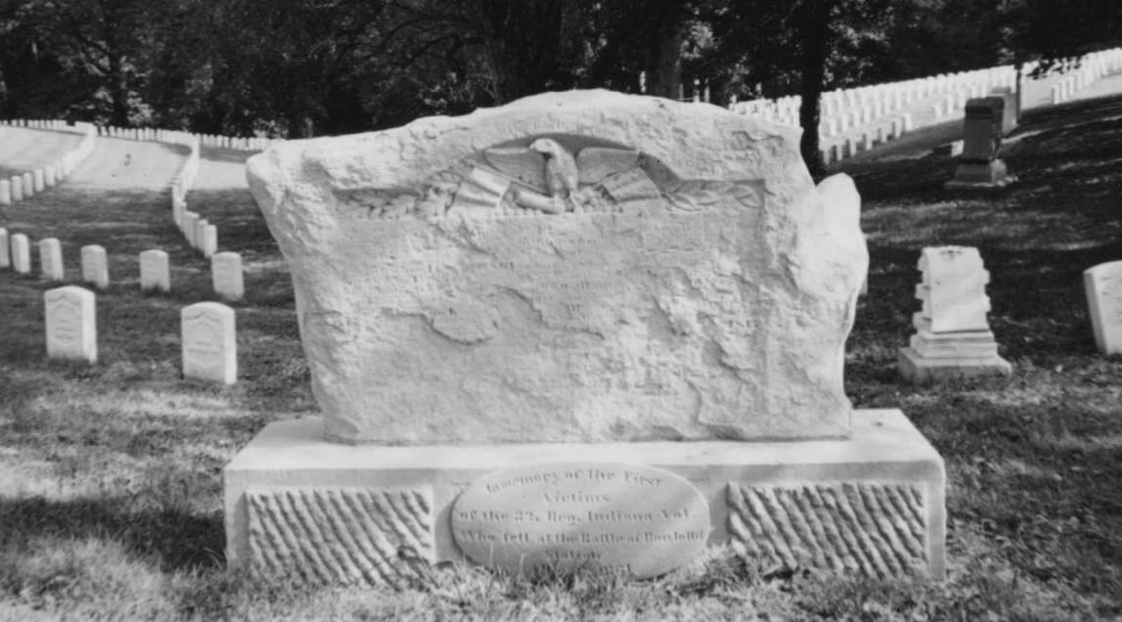
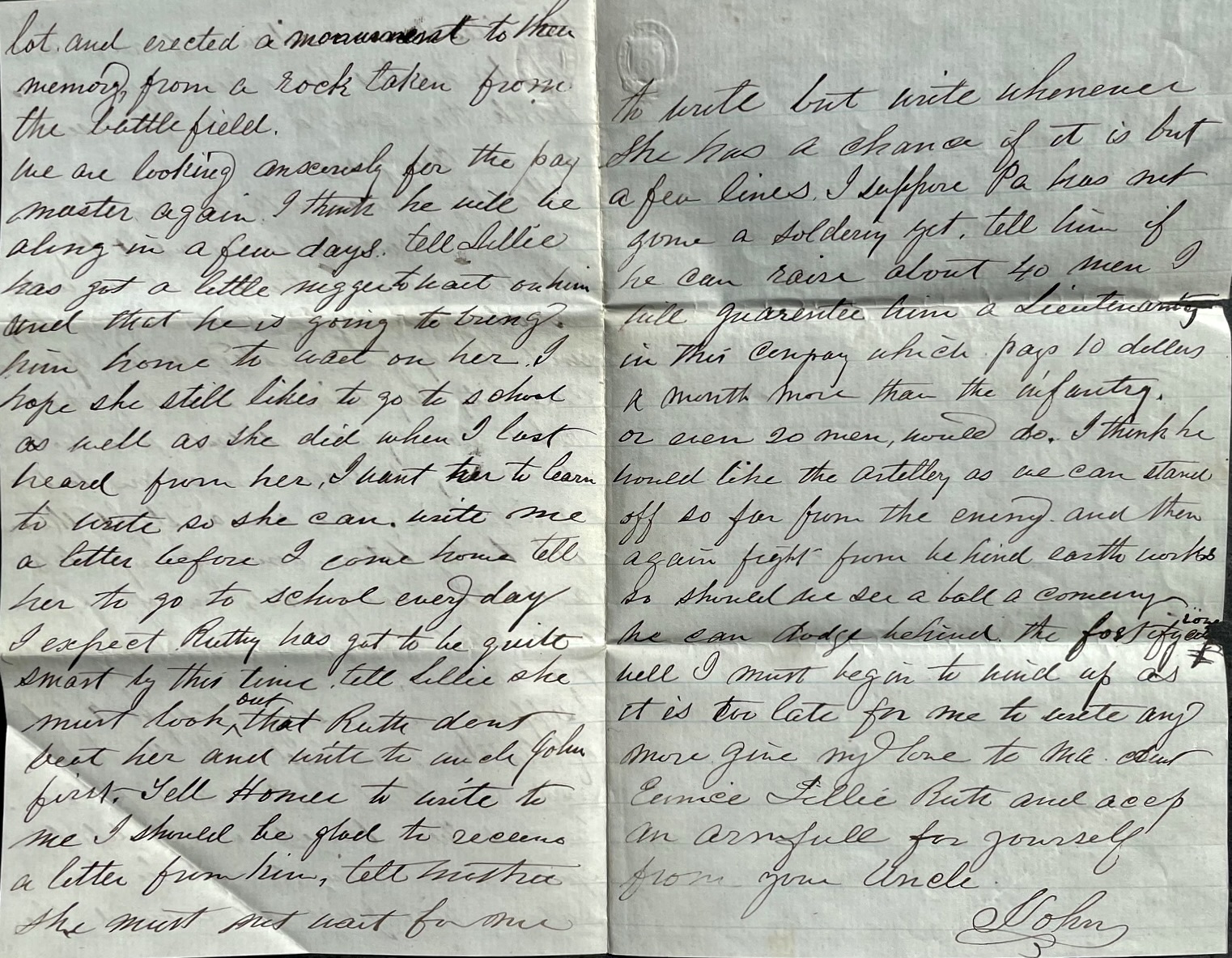
I suppose you heard of the fight [Battle of Rowlett’s Station] a part of the Willit’s [Willich’s] men had with the rebels and that Willit [Col. August Willich] had 11 men killed. He had them buried in a beautiful spot on a mound and he has put a nice fence all around the lot and erected a monument to their memory from a rock taken from the battlefield. 2, 3
We are looking anxiously for the pay master again. I think he will be along in a few days. Tell Lillie has got a little nigger to wait on him and that he is going to bring him home to wait on her. I hope she still likes to go to school as well as she did when I last heard from her. I want her to learn to write so she can write me a letter before I come home. Tell her to go to school everyday. I expect Ruthy has got to be quite smart by this time. Tell Lillie she must look out that Ruth don’t beat her and write to Uncle John first. Tell Horace to write to me. I should be glad to receive a letter from him. Tell Mother she must not wait for me to write but write whenever she has a chance if it is but a few lines. I suppose Pa has not gone a soldiering yet. Tell him if he can raise about 40 men, I will guarantee him a lieutenancy in this company which pays 10 dollars a month more than the infantry, or even 20 men would do. I think he would like the artillery as we can stand off so far from the enemy and then again fight from behind earth works so should we see a ball a coming, we can dodge behind the fortifications.
Well, I must begin to wind up as it is too late for me to write any more. Give my love to ma, Aunt Eunice, Lillie, Ruth, and accept an armful for yourself. from your uncle, — John
1 “The bodies of Gen. Zollicoffer and Peyton reached this point, per Railroad, on the 30th, encased in splendid coffins, labeled and directed to the care of Gen. McCook, for the same to forward under an escort of flag of truce to some place. Early on the morning of the 31st two ambulances, with four horses attached to each, moved from headquarters with the mortal remains of Zollicoffer and Peyton. The procession was headed by Gens. Johnson and Negley, of this division of the army, with a host of Colonels and Orderlies of the two staffs, and one of Frank Leslie’s artists. Then followed the ambulances, and in the rear twenty-five of Graham’s Cavalry, your humble servant one of the number. We crossed Green River in safety on the pontoon bridge, took the Glasgow road as far as Horse Cave, a small village, situated on the Railroad, which has lost most of its houses by the lighted torch of the infuriated “secesh,” who have to let go and give back as our army increases or advances. This place is noted for the great cave here, from which it derives its name. We had no opportunity to examine the cave only as we passed by near its mouth-we could see far into it. From this point we turned to our left, and took the Louisville and Nashville pike-a good road-but every place where timber has stood upon its borders it has been felled across it to obstruct our march.” [Letter in the Indianapolis Daily Journal, 6 February 1862, by Pvt. Mastin Dashiell, 3rd Indiana Cavalry.]
2 “We are now at Camp George Wood right where they had their fight last week. Me and George was down and saw the place where our men was buried. There was ten of our men killed and about 75 of the rebels killed.” James H. Smith, 4th Indiana Battery, letter of 27 December 1861 at Camp George Wood, KY. Spared & Shared 23.
3 “As a final tribute to the slain patriots, Private Adolph Bloettner of Company F chose a piece of local limestone and sculpted a beautiful monument in their honor. Bloettner carved an eagle with outstretched wings in relief on the top of the marker, adorning the face of the stone with cannon, American flags, an oak sprig and an olive branch. Names of the dead and their birth dates were inscribed on the tablet along with an inscription in German that translated into English reads: “Here rest the first martyrs of the Thirty-second, the first German regiment of Indiana. They were fighting nobly in defense of the free Constitution of the United States of America. They fell on the 17th day of December, 1861, in the battle at Rowlett’s Station, in which one regiment of Texas rangers, two regiments of infantry, and six pieces of artillery, in all over three thousand men, were defeated by five hundred German soldiers.” The stone survives as the oldest Civil War memorial marker.” [Source: Battle of Rowlett’s Station, KY by David T. Dixon, Emerging Civil War, 17 December 2021]

 Spared & Shared 23