
This letter was penned by Nathan Dresher (1815-1900), the son of Phillip Dresher (1785-1828) and Anna Trexler (1791-1855). He was married to Mary Elizabeth Zeller (1819-1908) and had two children—Daniel Dresher (1843-1868) and Anna D. Dresher (1845-1927). Nathan was born in Longswamp township, Berks county. He attended school at Doylestown and the Allentown Academy. He was proficient in music and a violinist. After his father died, the family moved to Allentown where Nathan went into the lumber business with various partners through the years. He retired from the business in 1860 and lived comfortably off his real estate holdings. His wife was the daughter of Rev. Daniel Zeller. Nathan was a staunch Republican.
The letter was datelined from Lancaster, Pennsylvania, where 46 year-old Nathan and his 18 year-old son Daniel were apparently sightseeing as nothing in the letter suggests that they were conducting business there and Nathan was in early retirement.
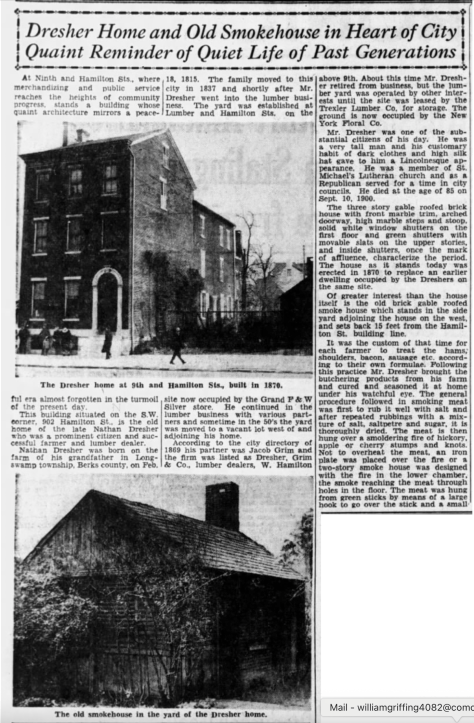
The Martin House, or sometimes referred to as the Dresher-Martin Mansion was a home built at 902 Hamilton Street., the southwest corner of Hamilton and Ninth Street. The home was originally owned by Nathan Dresher, a prominent citizen of early Allentown and a successful lumber dealer. The Dresher family moved to Allentown from Berks Country in 1837 and shortly afterwards opened the lumber buisness. The origional home was built sometime after that on a large lot at It consisted of a three story gable roof brick home with front marble trim, arched doorway, high marble steps and stoop. It also had solid white window shutters on the first floor and green shutters with moveable slats on the upper stories. Along with the home was a wooden smokehouse at the rear of the property for preparing meat, and a washhouse with heated bathrubs and clothes washing facilities. In 1870/71, the home was expanded by Nathan Dresher for his daughter Anna Dresher and her husband Dr. Henry Martin. Dr Martin had been a surgeon for the Union Army during the Civil War. The addition consisted of a large 3-story section in the rear along South Ninth Street. This expanded the home to a a 20-room mansion. The home included a walnut staircase, eight marble fireplace mantles and a large library. The estate also had a glass greenhouse in a large yard. The block between Ninth and Tenth streets, between Hamilton and south to Walnut at the time was the home of Allentown’s lumber and building buisnesses. To the west was a large lumber yard of Edwin and Jonas Trexler, the father and uncle of later General Harry C. Trexler. The Trexlers were in buisness with the Dresher family at the time the home was expanded in 1870.
T R A N S C R I P T I O N
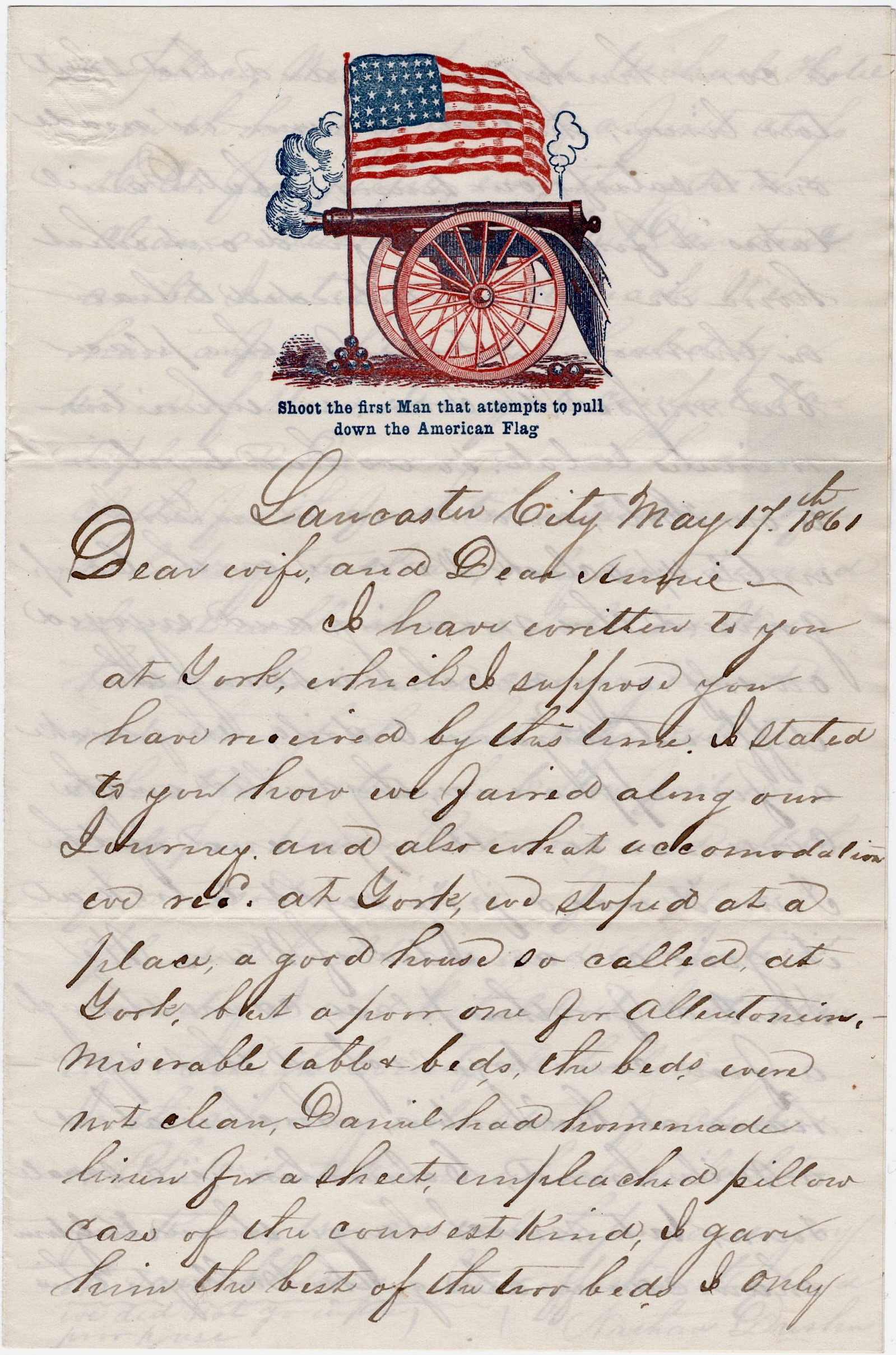
Lancaster City
May 17, 1861
Dear wife and dear Annie,
I have written to you at York which I suppose you have received by this time. I stated to you how we fared along our journey and also what accommodation we received at York. We stopped at a place—a good house, so called, at York, but a poor one for Allentownians. Miserable table & beds. The beds were not clean. Daniel had homemade linen for a sheet, unbleached pillow case of the coarsest kind. I gave him the best of the two beds. I only had a corn husk mattress and bed sheet tow linen. The table common. We made out to satisfy our hunger but Daniel takes it first rate. He finds out what home is.
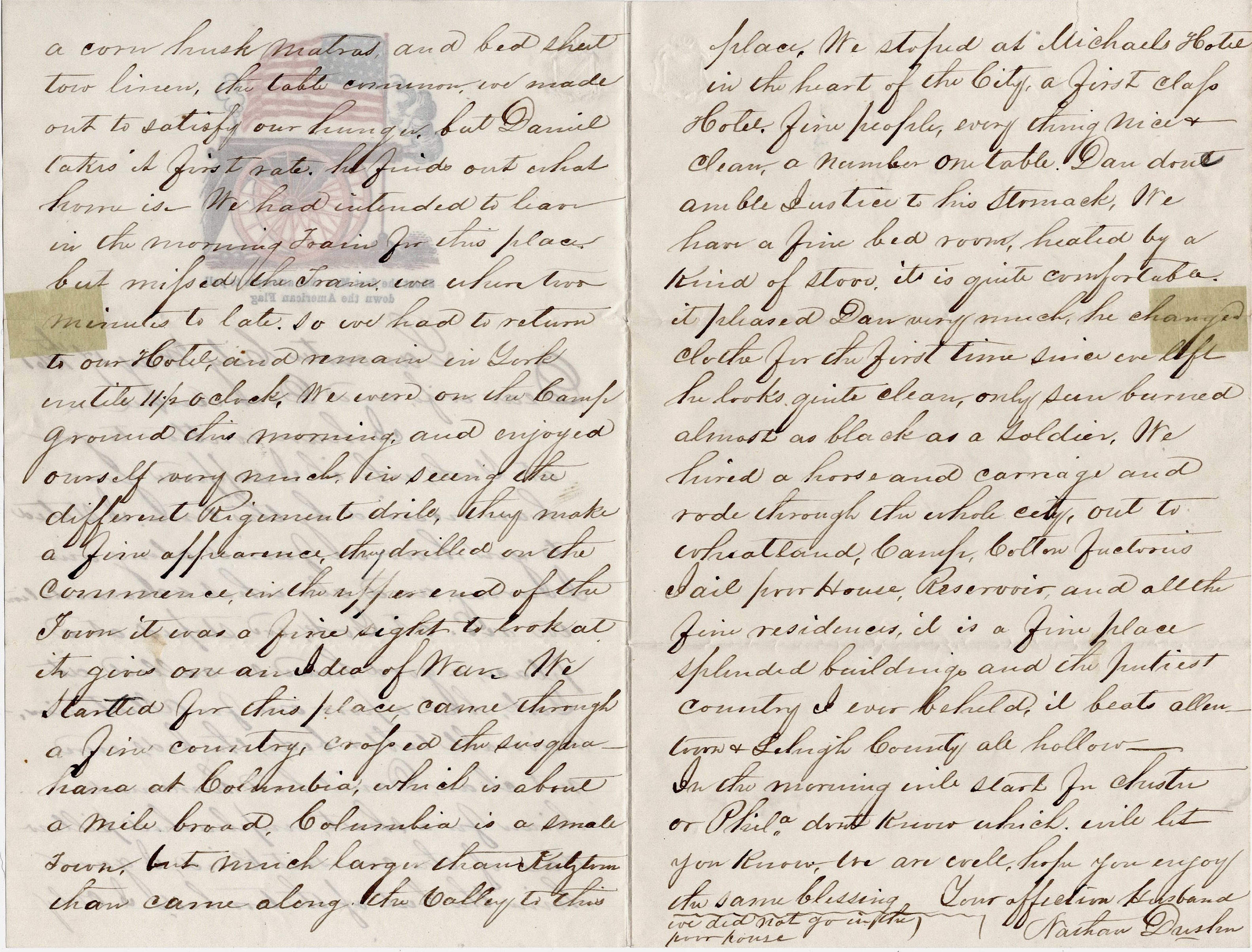
We had intended to leave in the morning train for this place but missed the train. We were two minutes too late so we had to return to our hotel and remain in York until 11.30 o’clock. We were on the camp ground this morning and enjoyed ourselves very much in seeing the different regiments to drill. They make a fine appearance. They drilled on the commence [common] in the upper end of the town. It was a fine sight to look at. Gives one an idea of war. We started for this place, came through a fine country, crossed the Susquehanna at Columbia which is about a mile broad. Columbia is a small town but much larger than Kutztown. Then came along the valley to this place.
We stopped at Michael’s Hotel 1 in the heart of the city—a first class hotel. Fine people, everything nice & clean. A number one table. Dan does ample justice to his stomach. We have a fine bed room heated by a kind of stove. It is quite comfortable. It pleased Dan very much. He changed clothes for the first time since we left. He looks quite clean, only sunburned almost as black as a soldier.
We hired a horse and carriage and rode through the whole city, out to Wheatland 2, Camp, Cotton factories 3, Jail 4, Poor house, Reservoir, and all the fine residences. It is a fine place, splendid buildings, and the prettiest country I ever beheld. It beats Allentown & Lehigh county all hollow.
In the morning will start for Chester or Philadelphia, don’t know which. Will let you know. We are well. Hope you enjoy the same blessing. Your affectionate husband, — Nathan Dresher
We did not go in the poor house.

1 Michael’s Hotel was the establishment of John Michael. It stood at 17 North Queen Street in Lancaster, Pa. The name was later changed to the American House, and then again to “The Grape.” Michael’s Hotel sign had grapes on it, hence the name.
2 Wheatland was the home of James Buchanan.
3 In 1860, Lancaster, PA, was home to the Conestoga Steam Mills, a significant industrial complex that was the county’s first steam-powered cotton mill, established in the mid-1840s. The city also had other mills, including the Baumgardner’s Mill, though the primary source of cotton in the region around 1860 was centered at the Conestoga Steam Mills, which became the city’s largest industry and employer by the 1880s.
4 The Lancaster County Prison was built in the 1850s and designed to resemble a medieval castle to instill public confidence in its security.
 Spared & Shared 23