
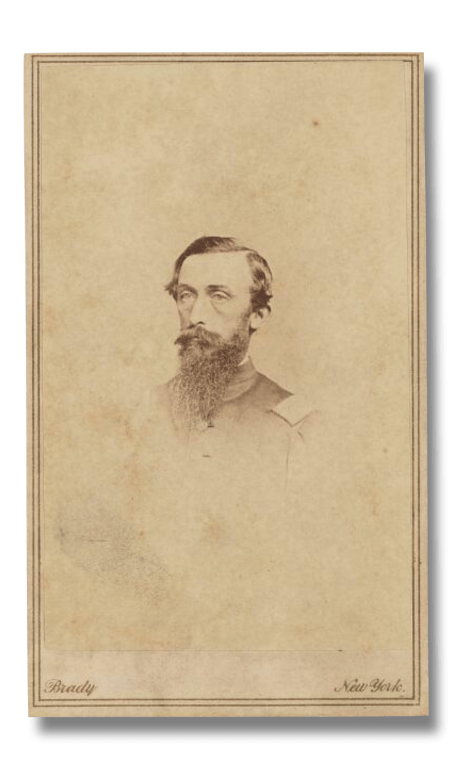
The following letter was written by Archibald (“Arch”) F. Jones (1825-1879) who served as Captain of Co. G, 53rd Pennsylvania Infantry in the Civil War. He wrote the letter to his wife, Mary Ann (Ross) Jones (1830-1920) with whom he married in 1848. Arch served nearly three years and was discharged on 24 July 1864. He was a farmer in Potter county, Pennsylvania, before the war but afterwards, returned to Coudersport where he went into the dry good business.
Archibald’s letter was written in November 1862, just after the regiment’s arrival at Falmouth where they were assigned Provost Duty. In the Battle of Fredericksburg that would take place some three weeks later, the 53rd was part of the 2nd Corps crossing of the Rappahannock at dawn on the 13th with 283 officers and men. They suffered heavy casualties with 158 men lost (21 killed and 133 wounded).
To read other letters or a diary by members of the 53rd Pennsylvania that I have been transcribed and published on Spared & Shared, see:
George Scheetz, Co. A, 53rd Pennsylvania (1 Letter)
Samuel M. Royer, Co. C, 53rd Pennsylvania (1 Letter)
George J. Whitman, Co. G, 53rd Pennsylvania (1 Letter)
Lionel Stanley, Co. H, 53rd Pennsylvania (1 Letter)
Adam Yeager, Co. I, 53rd Pennsylvania (1 Letter)
James Wilson Barnett, Co. K, 53rd Pennsylvania (1 Diary)
James W. Burrell, Co. K, 53rd Pennsylvania (1 Letter)
John Amos Burrell, Co. K, 53rd Pennsylvania (2 Letters)
Charles F. Smith, Co. K, 53rd Pennsylvania (1 Letter)
T R A N S C R I P T I O N
Falmouth, Virginia
November 20, 1862
Dear Mary,
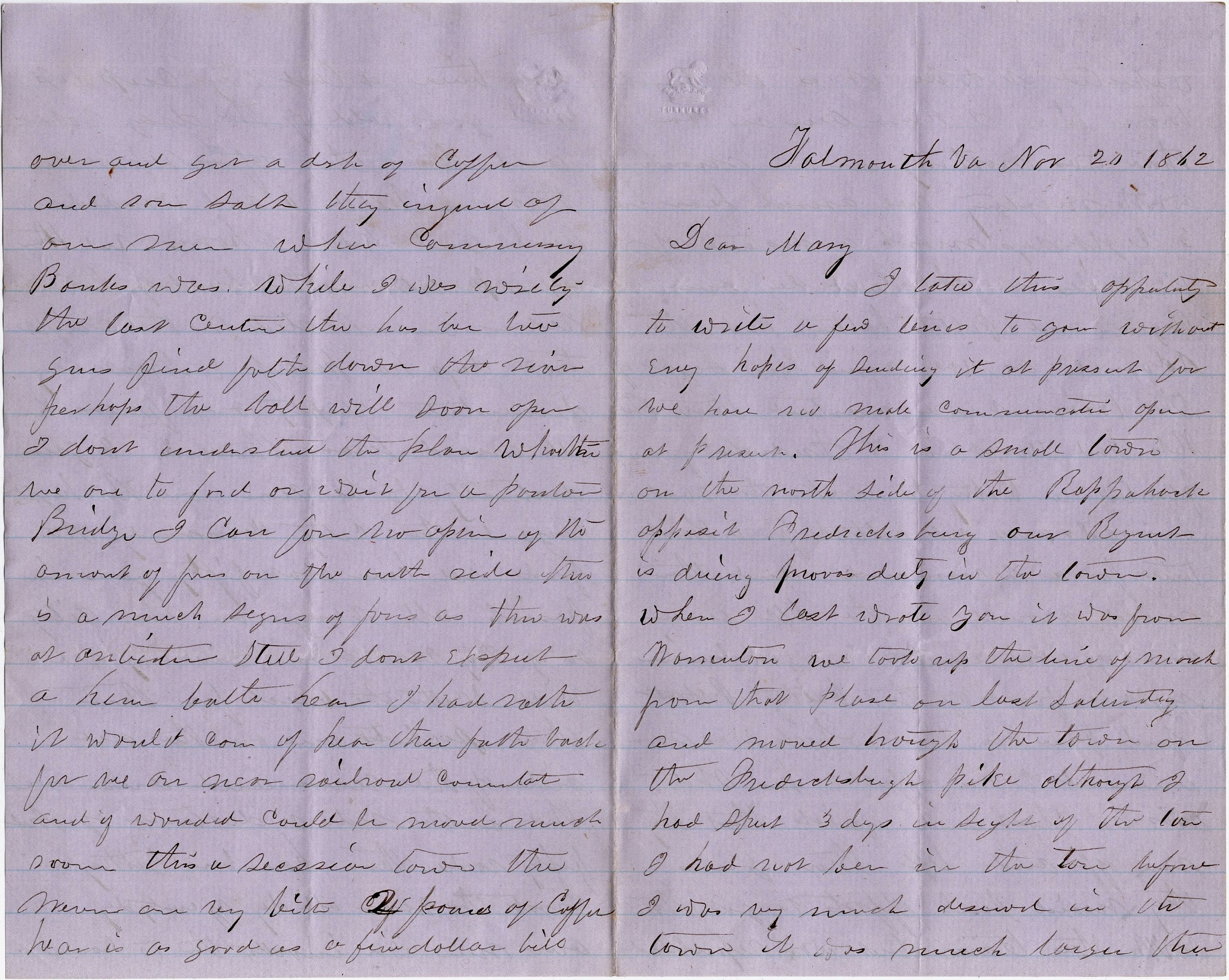
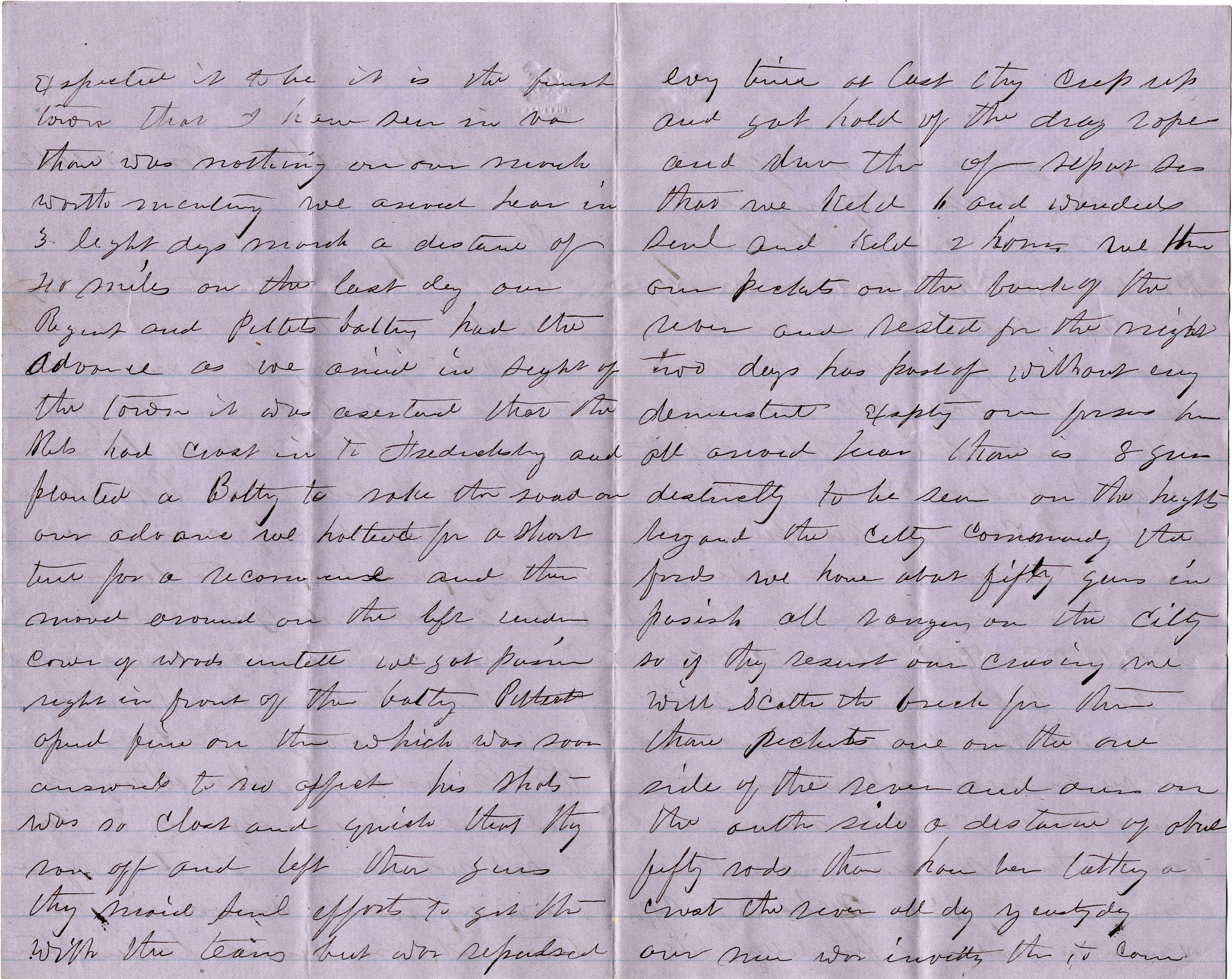
I take this opportunity to write a few lines to you without any hopes of sending it at present for we have no communication open at present. This is a small town on the north side of the Rappahannock opposite Fredericksburg. Our regiment is doing provost duty in the town. When I last wrote you it was from Warrenton. We took up the line of march from that place on last Saturday [15 November] and moved through the town on the Fredericksburg Pike. Although I had spent 3 days in sight of the town, I had not been in the town before. I was very much [ ] in the town. It was much larger than I expected it to be. It is the finest town that I have seen in Virginia. There was nothing on our march worth mentioning.
We arrived here in 3 light days march—a distance of 40 miles. On the last day our regiment and Pettit’s Battery [1st N. Y. Light Artillery] had the advance. As we arrived in sight of the town, it was ascertained that the Rebs had crossed into Fredericksburg and planted a battery to rake the road on our advance and we halted for a short time for a reconnoissance and then moved around on the left under cover of woods until we got position right in front of the battery. Pettit’s [Battery] opened fire on the which was soon answered to no effect. His shots was so close and quick that they ran off and left the guns. They made several efforts to get them with the teams but was repulsed every time. At last they crept up and got hold of the drag rope and drew them off. Report says that we killed 6 and wounded several and killed two horses.
We then [posted] our pickets on the bank of the river and rested for the night. Two days has passed off without any demonstration excepting our forces be all around here. There is 8 guns distinctly to be seen on the heights beyond the city commanding the fords. We have about fifty guns in posish [position] all ranged on the city so if they resist our crossing, we will scatter the brick for them. Their pickets are on the one side of the river and ours on the other side—a distance of about fifty rods. They have been talking across the river all day. Yesterday our men was inviting them to come over and get a drink of coffee and some salt. They inquired of our men where Commissary Banks was. While I was writing the last sentence, there has been two guns fired, both down the river. Perhaps the ball will soon open. I don’t understand the plan—whether we are to ford or wait for a pontoon bridge. I can gain no opinion of the amount of forces on the other side. There is as much signs of forces as there was at Antietam. Still I don’t expect a hard battle here. I had rather it would come off here than farther back for we are near railroad connection and of wounded, could be moved much sooner.
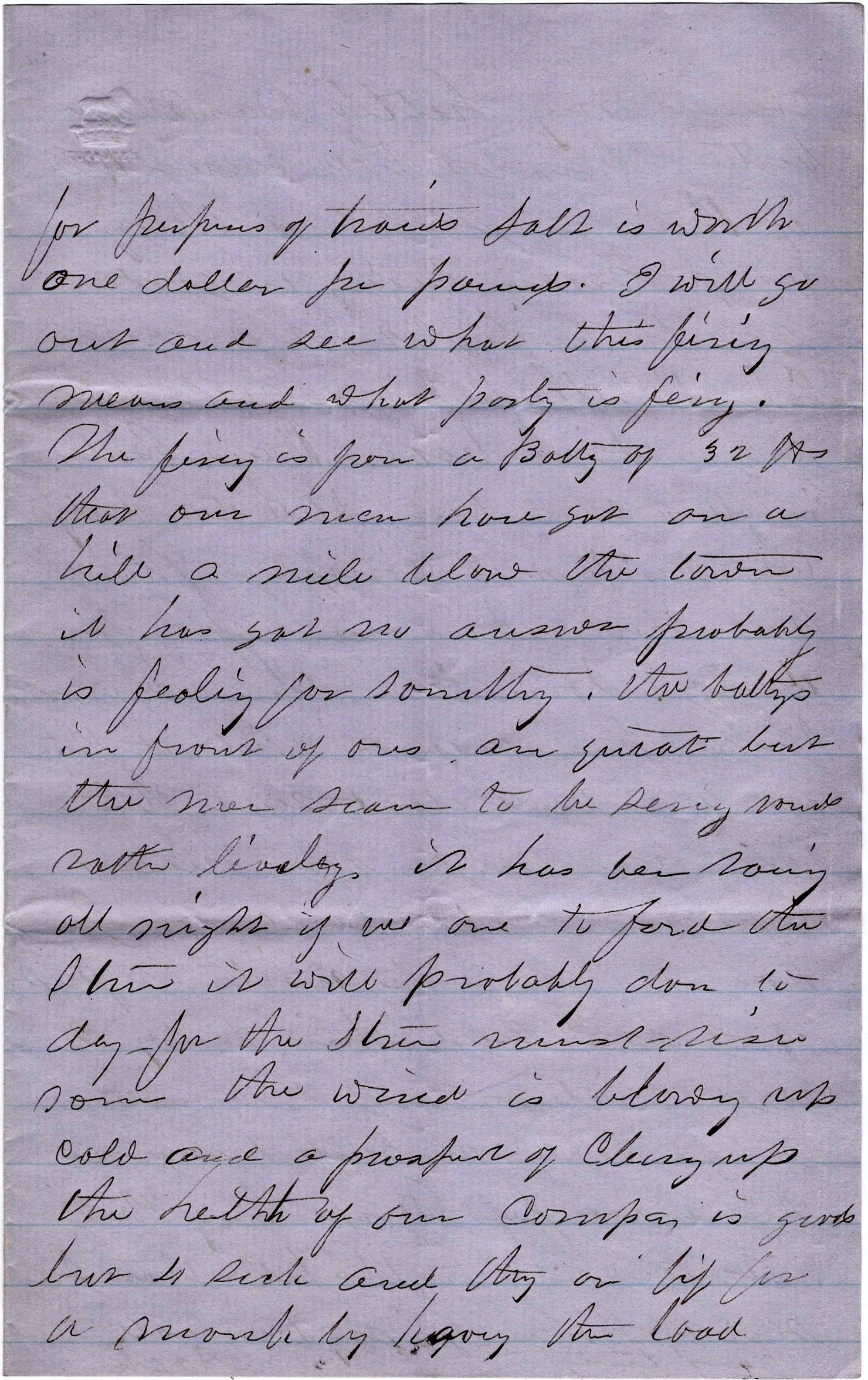
This is a secession town. The women are very bitter. Four pounds of coffee here is as good as a five dollar bill for purpose of trades. Salt is worth one dollar per pound. I will go out and see what this firing means and what party is firing.
The firing is from a battery of 32-pounders that our men have got on a hill a mile below the town. It has got no answer. Probably is feeling for something. The batteries in front of ours are quiet but the men seem to be [ ] rounds rather lively/ It has been raining all night. If we are to ford the stream, it will probably be done today for the stream must rise some. The wind is blowing up cold and a prospect of clearing up.
The health of our company is good. But four sick and they are fit for a month by having the load covered. My health was never better than at the present time. If there is such a thing as a man being in good rig for a fight, it is me. Col. [Richard] McMichael is sick [and ] has got a sick leave. Major [Octavius S.] Bull is also sick but still does duty. There is but three companies that has more than one officer for duty. Some time since I wrote for a pair of under shirts. If they are not sent, don’t send them for I have bought some here.
The firing still continues. I have no more to write at present. If I don’t send this today. I will write more tomorrow. I have received no mail but once since we left Harper’s Ferry. That was answer to the letter than I wrote to Baker. Give my love to all, yours truly, — Arch
Morning of the 21st. All quiet along the line. The firing alluded to was our men had a battery that commanded the Richmond Railroad. As a train was leaving [ ], they fired on it. Report says that they wrecked it on the track.
It has ben rainy all night very hard. I had quite a time. The wet softened the ground and lost the pins and the wind came up and blew the tent in [ ] of me. During a heavy rain I called two brave men to my assistance and suceeded in restoring order [ ] and to hold away the night with wet blankets. All well. — Arch

 Spared & Shared 23