
The following letter was written by Johnson O. Foote (1844-1933), the son of Orley Newell Foot (1818-1888) and Fanny Bowker (1822-1904) of Defiance county, Ohio. Johnson helped to raise and enlisted in Co. F, 111th Ohio Vol. Infantry (OVI) at the age of 18 as a drummer on 25 August 1862. He was promoted to corporal in January 1864, to commissary sergeant in May 1864, given as commission as 2nd Lieutenant in May 1865, and mustered out of the regiment in late June 1865.
Foote wrote the letter to Corporal John W. Cleland (1843-18xx) who enlisted in the same company in September 1862 at age 19. He was promoted to 1st Sergeant in March 1863. In April 1864, Sgt. Cleland was promoted to 2nd Lieutenant and in May 1865 to 1st Lieutenant. He was mustered out of the service with his company in June 1865 at Salisbury, North Carolina. Cleland may have been on detached duty or in the hospital at Knoxville at the time this letter was penned.

T R A N S C R I P T I O N

Loudon, Tennessee
October 16, 1863
Friend John,
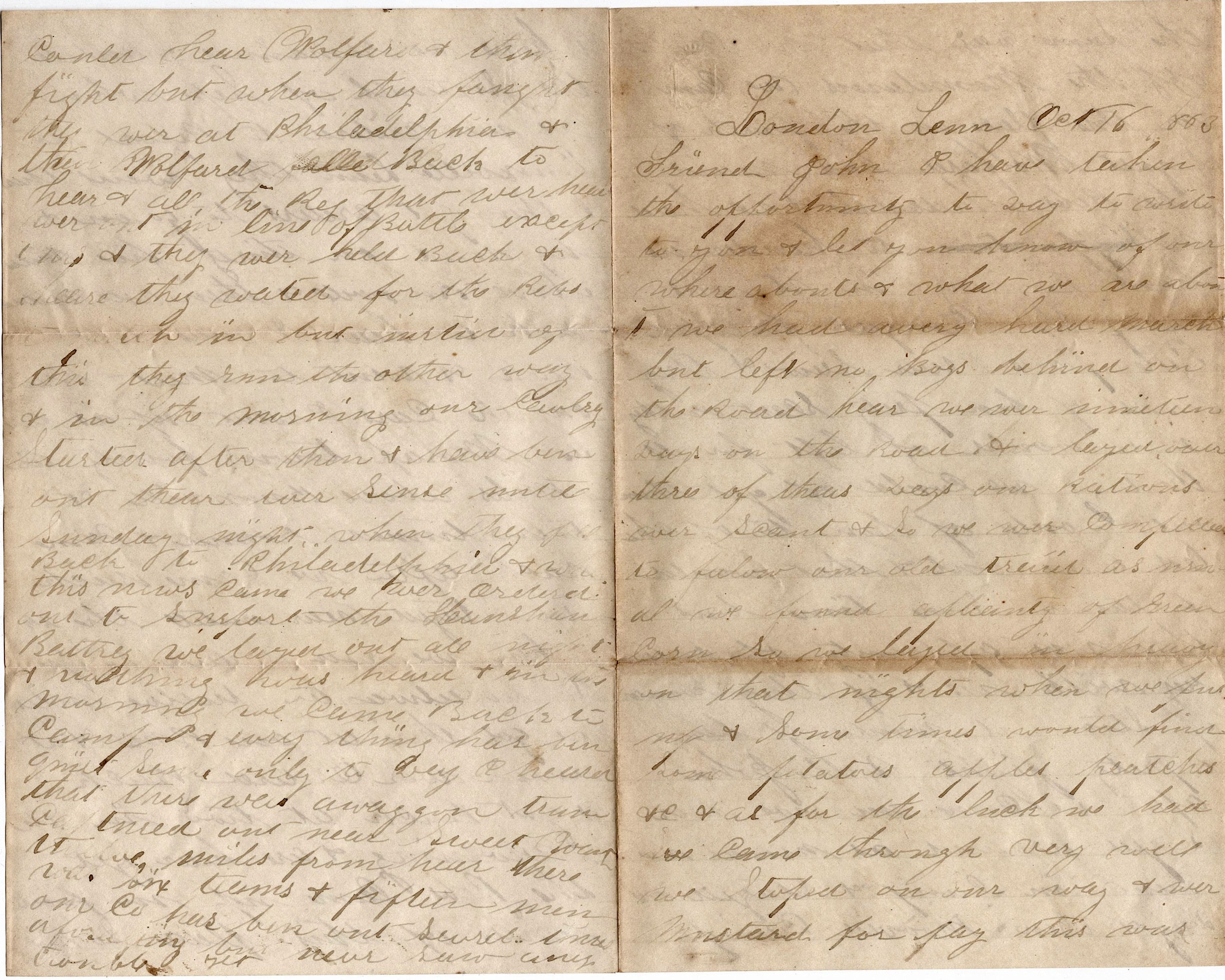
I have taken the opportunity today to write to you and let you know of our whereabouts and what we are about. We had a very hard march but left no boys behind on the road here. We were 19 days on the road and laid over three of these days. Our rations were scant and so we were compelled to follow our old train. As usual as we found plenty of green corn so we laid in heavy on that nights when we put up and sometimes would find some potatoes, apples, peaches, &c., and as for the luck we had, came through very well.
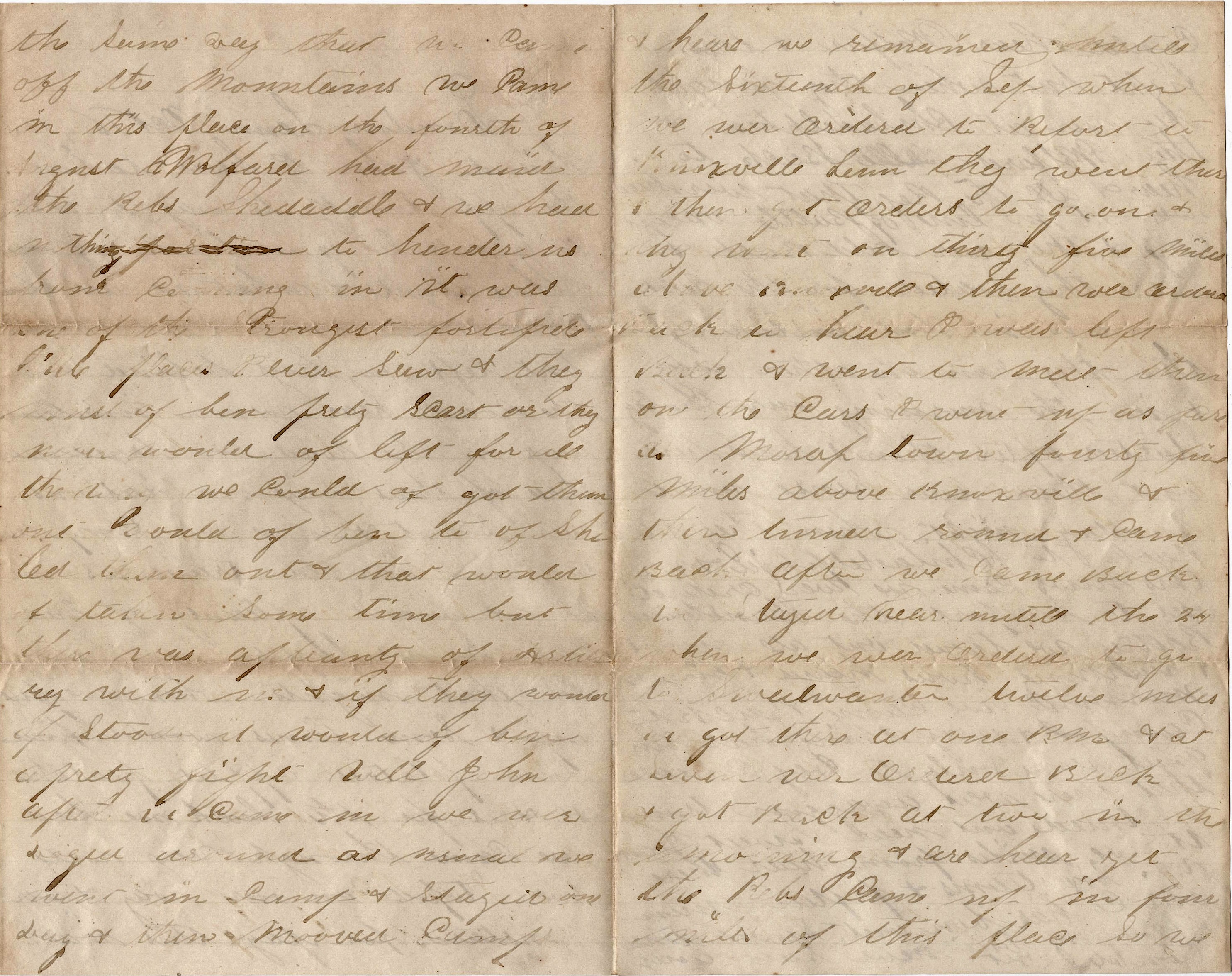
We stopped on our way and were mustered for pay. This was the same way that we came off the mountains. We came in this place on 4th of August. [Col. Frank] Wolford [and his cavalry brigade] had made the rebs skedaddle and we had nothing to hinder us from coming in. It was one of the roughest fortified places I ever saw and they must of been pretty scared or they never would of left for all the [?] we could of got them out. Could have been to of shelled them out and that would of taken some time but there was plenty of artillery with us and if they would of stood, it would of been a pretty fight.
Well, John, after we came in, we were dragged around as usual. We went in camp and stayed one day and then moved camp and here we remained until the 16th of September when we were ordered to report to Knoxville, Tennessee. They went there and then got orders to go on and they went on 35 miles above Knoxville and then were ordered back to here.
I was left back and went to meet them on the cars and went up as far as Morristown, 45 miles above Knoxville, and then turned round and came back. After we came back, we stayed here until the 24th when we were ordered to go to Sweetwater 12 miles. We got there at 1 PM and at 7 were ordered back and got back at two in the morning and are here yet.
The rebs came up [with]in 4 miles of this place so we could hear Wolford and them fight but when they fought, they were at Philadelphia and then Wolford fell back to here and all the regiments that were here were out in line of battle except ours and they were held back and here they waited for the rebs to march in but instead of this, they run the other way. And in the morning our cavalry started after them and have been out there ever since until Sunday night when they fell back to Philadelphia. And when this news came, we were ordered out to support the Henshaw Battery.
We laid out all night and nothing was heard and in the morning we came back to camp and everything has been quiet since—only today I heard there was a wagon train captured out near Sweetwater 12 miles from here. There was six teams and 15 men. Our Co. has been out several times a foraging but never saw any trouble yet.
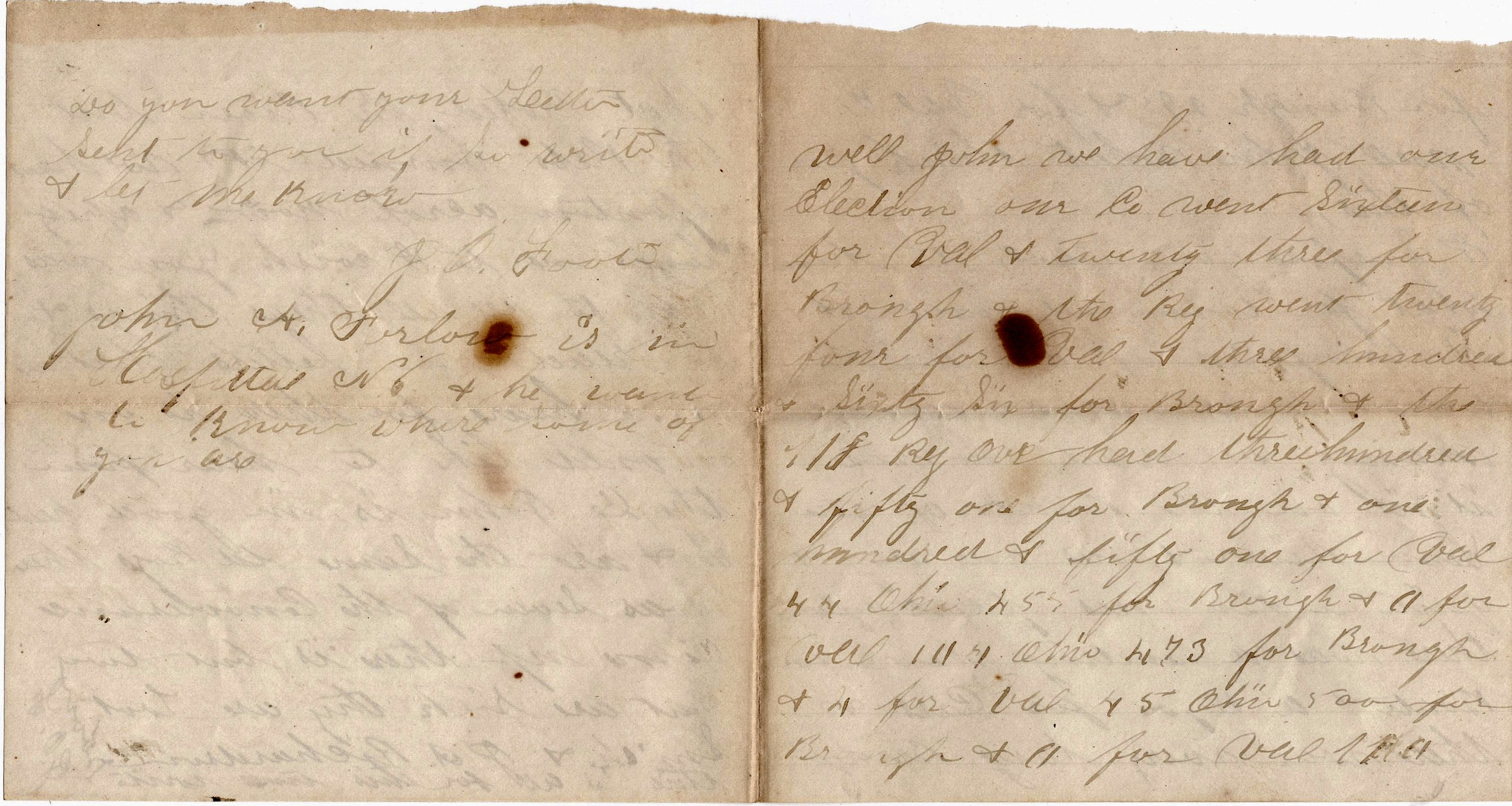
Well John, we have had our election. Our Co. went 16 for Vallandigham and 23 for Brough and the Reg. went 24 for Val. and 366 for Brough and the 118th Reg. OVI had 351 for Brough and 151 for Val. [The] 44th Ohio 455 for Brough and 11 for Val. [The] 104th Ohio 473 for Brough and 4 for Val. [The] 45th Ohio 500 for Brough and 11 for Val. Well, John, what think you of this?

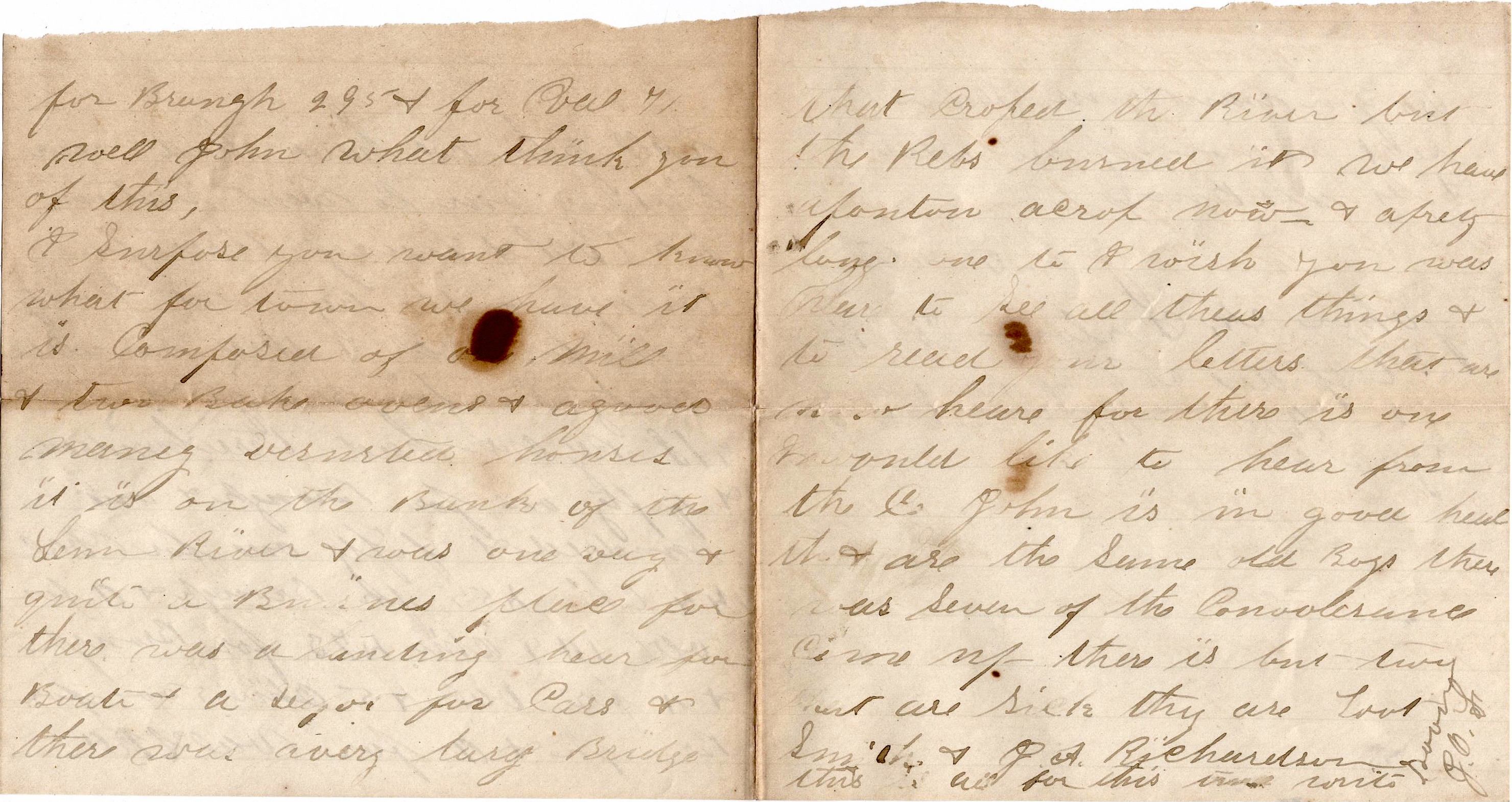
I suppose you want to know what for [a] town we have. It is composed of one mill and two bake ovens and a good many deserted houses. It is on the bank of the Tennessee river and was one day quite a business place for there was a landing here for boats and a depot for cars, and there was a very large bridge that crossed the river but the Rebs burned it. We have a pontoon across now and a pretty long one too. I wish you was here to see all these things and to read your letters that are now here for there is one I would like to hear from. The company, John, is in good health and are the same old boys. There was seven of the convalescents came up. There is but two that are sick. They are Loot Smith and J[ames] A. Richardson. Do you want your letters sent to you? If so, write and let me know. — J. O. Foote
John A. Forlow is in Hospital N6 & he wants to know where some of you are.
 Spared & Shared 23