
The following letters were written by John L. Phelps (1840-1914), the son of Richard J. Phelps (1817-18xx) and Catherine Camp (1819-1852). They were all written during the American Civil War when John served in Co. D, 85th Illinois Infantry. At the time of his enlistment in August 1862, John was described as a 5′ 10″ tall, grey-eyed, dark-haired farmer from Mason county, Illinois. He served through the end of the war, mustering out on 5 June 1865 at Washington D. C.
He was married on 12 February 1869 to Isabella Sloss (1851-1894) in Nebraska and lived out his days farming in Nora, Nuckolls county, Nebraska.
The letters are from the collection of Doc Krausz who made them available for transcription and publication on Spared & Shared by express consent.
Images of soldiers in the 85th Illinois shared on Civil War Faces:
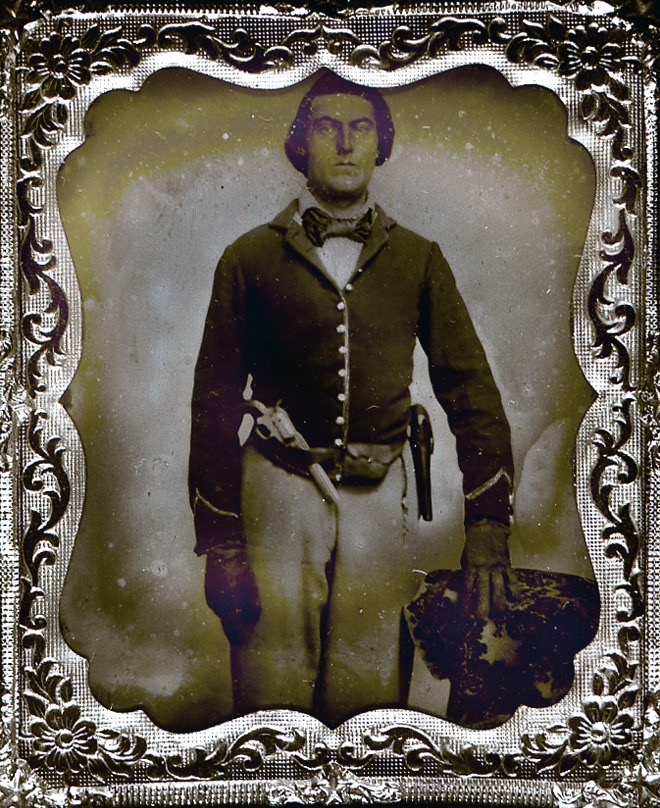
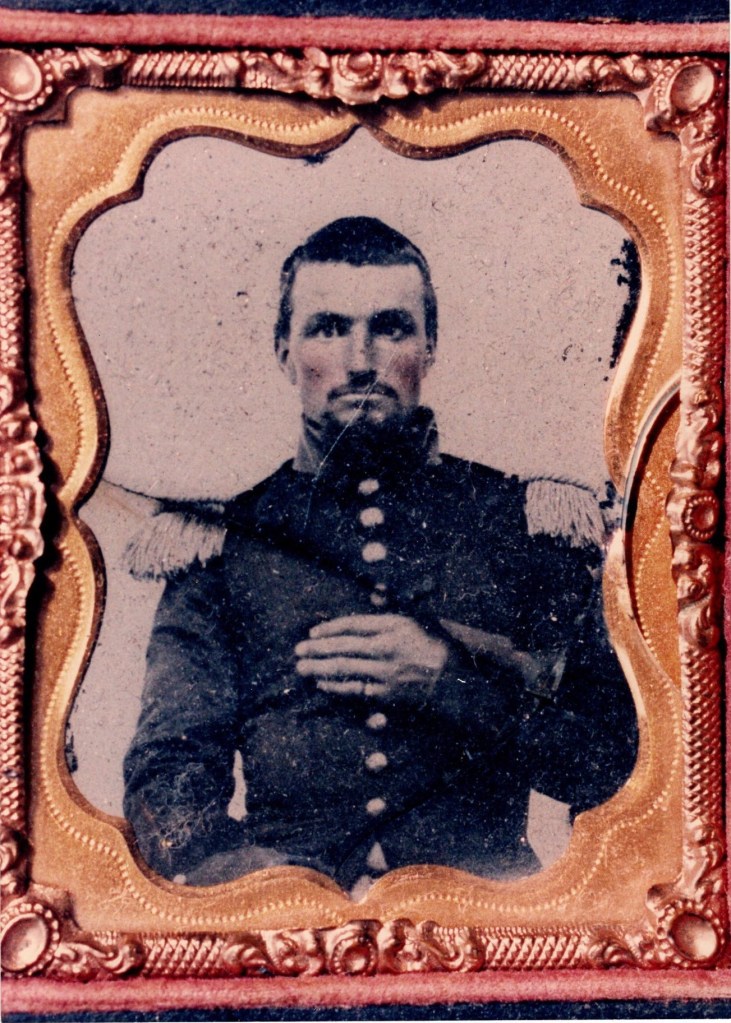

Letter 1
[Editor’s note: This letter was datelined from Brentwood, Tennessee, where the regiment was garrisoned from early April until the 1st of June 1863. While at Brentwood, in early May, the regiment received four months pay. The health of the regiment generally improved there as well.]

Camp Brentwood
May 10, 1863
Dear Father,
Yours of the 3rd was received the 9th. I was very glad to hear from home. I was anxious to hear from the money that I sent. I am well at present, hoping this may find you all well. I had heard of the death of Uncle Mead. You had a hard time bringing him home. I know more about the disease of camp cafe that you could tell me. I seen more while I was in the hospital than I ever want to see again. I hope that I never shall have to spend another six weeks in a hospital. If I should take sick, I would want to go to the hospital as soon as possible.
I received sister’s letter the 3rd. From the way you write, I don’t know whether you get all my letters or not. She spoke about Cyrus getting one that was [written] while we was on picket. I wrote one to Aunt Sarah about the 6th of April. Also I wrote one to Elizabeth the 16th and another the 26th. I write so many that I can’t hardly recollect the date of all of them all. I would like to know whether you get them all. The last one I wrote I sent my minature but you have got it before this time.
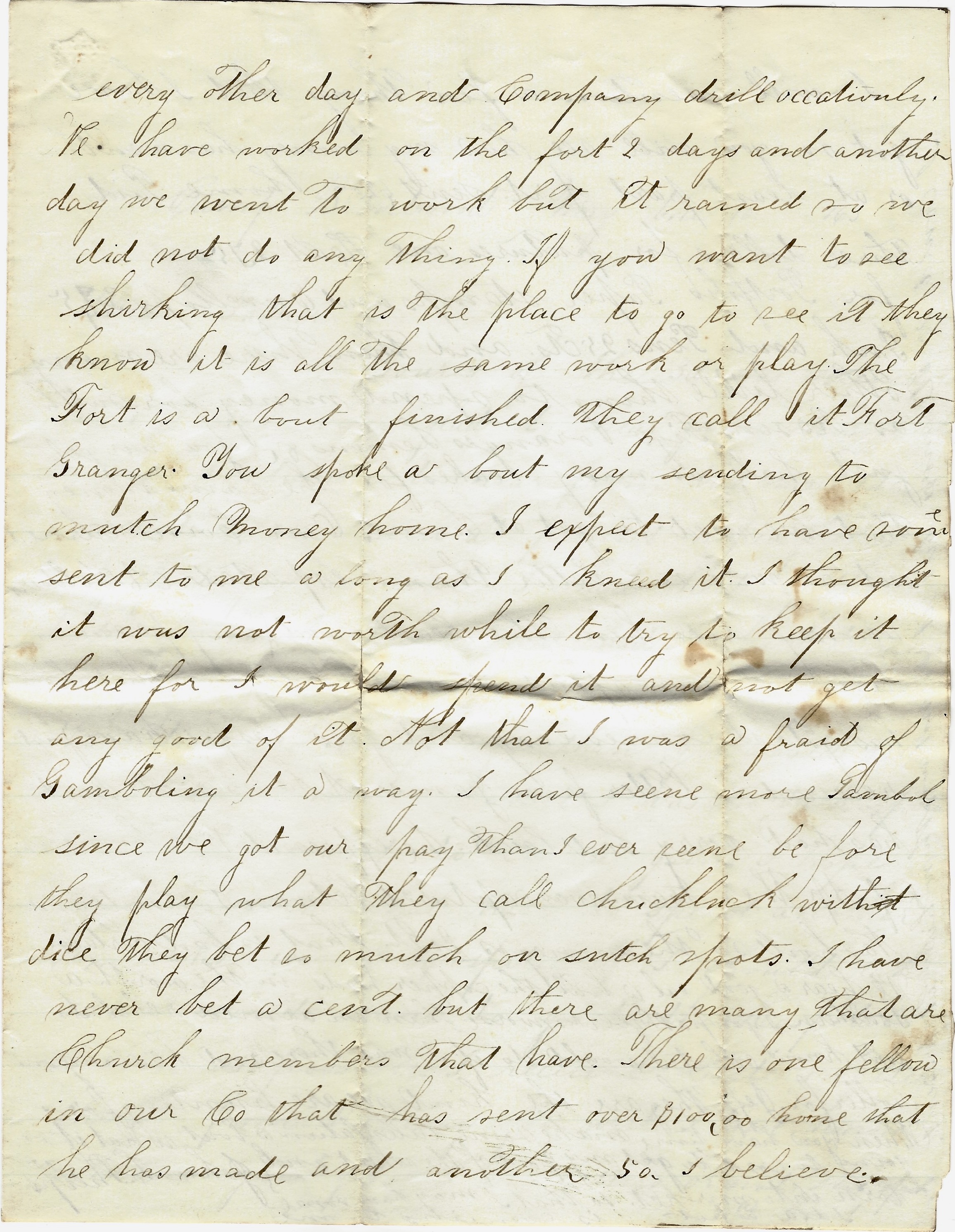
Colonel [Robert S.] Moore arrived here last Sunday. He looks well though he is still a little lame. All the boys I believe likes the Colonel very well. I like him very well. He has things about as he pleases. Colonel Dan McCook of the 52nd Ohio is acting Brigaduer General. THey say he only outranks Col. Moore three days—that is, his commission is only three days the oldest. The other day when out on drill, McCook spoke about having Brigade drill. Moore told him he didn’t know anything about his Brigade drill. We have to stand picket once a week, camp guard once a week. We have Battalion drill about every other day and company drill occasionally. We have worked on the fort two days and another day we went to work but it rained so we did not do anything. If you want to see shirking, that is the place to see it. They know it is all the same—work or play. The fort is about finished. They call it Fort Granger.
You spoke about my sending too much money home. I expect to have some sent to me along as I need it. I thought it was not worthwhile to keep it here for I would spend it and not get any good of it—not that I was afraid of gambling it away. I have seen more gambling since we got our pay than I ever seen before. They play what they call chuck-a-luck without dice. They bet as much on such spots. I have never bet a cent but there are many that are church members that have. There is one fellow in our company that has sent over $100 home that he has made and another $50. I believe I will mention a few things that I have got so you will see how my money has went or at least part of it. Sent $62 home. Paid three dollars for pictures. One hat $2.75. For portfolio, paper, stamps, and envelopes $3.75. Ink and pens 25 cents. And then there are many other little things to spend money for such as raisons, figs, oranges, lemons, &c. You can get just half as many cakes for the same money that we used to get at home.
Our corn turned out as well or better than I expected. A soldier’s money does him the least good of any person living. He can spend it and hardly see what he has got. It comes easy and goes easy. I have just received a letter from James A. He is well but has had very bad luck. He expressed $75 home the 8th of April [but] the train was captured between Louisville and Nashville so the money is lost. That is bad certain.
We hear a good deal about the Copperheads in the North. A southern sympathizer is worse than an armed rebel. I don’t know what I would do if I was there and hear anyone holler for Jeff. They are the kind we are hunting for.
When you have time, make some calculations about what it is going to cost to get my part of the wheat and corn into market so that I may have some idea what is coming to me. I could write more but it is not worthwhile at present. — John L. Phelps
D. B. is at the hospital yet. He don’t get much better. If you want to write, direct to General Hospital No. 23, Nashville, TN.



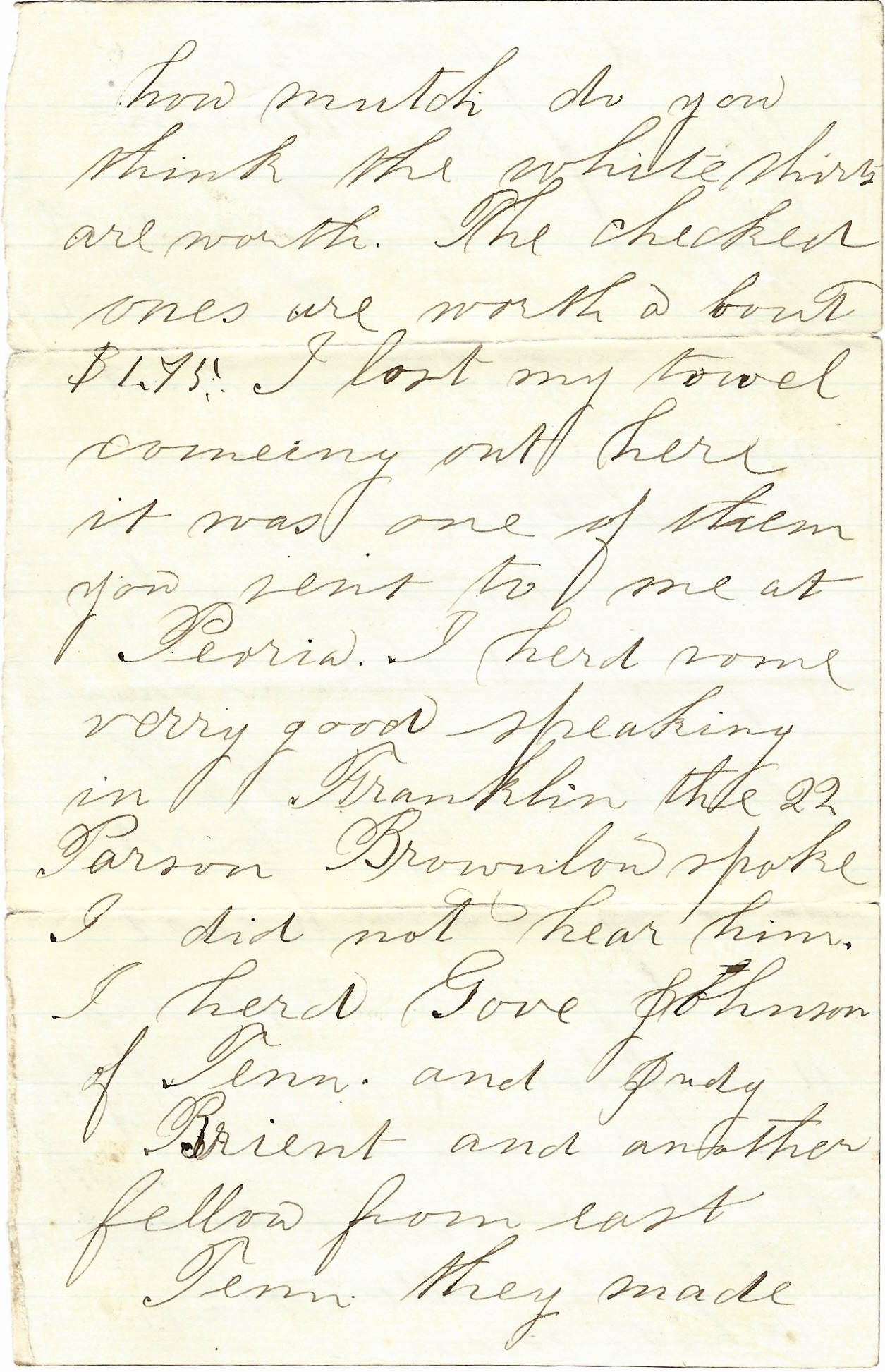
[Editor’s Note: The following slip of paper is undated but was most likely written early in John’s service when he was in Tennessee. There was a very large Union meeting held in Franklin on 23 August 1863 and my hunch is that it was written at that time.]
…How much do you think the white shorts are worth. The checked ones are worth about $1.75. I lost my towel coming out here. It was one of them you sent to me at Peoria. I heard some very good speaking in Franklin the 22nd. Parson Brownlow spoke. I did not hear him. I heard Gov. [Andrew] Johnson of Tennessee and Judge Bryant and another fellow from East Tennessee. They made good speeches in favor of the Union. They said the worst proclamation that had ever been issued was the first fire on Fort Sumter. Their speeches was interesting to all who heard them I think—at least among the soldiers.
I heard a Negro preach last Sunday. His text was 11th Chapter, 36th Verse of John. He was somewhat awkward in his language but he done better than some white men.

Letter 2
[Editor’s Note: This letter was datelined in early February 1864 from McAfee’s Church where they built winter quarters in late November 1863. The camp was located in a dense pine forest at the northern limits of the battlefield of Chickamauga and some six miles from Chattanooga. They remained in camp at McAfee’s Church until the launch of the Atlanta Campaign.]

Camp McAfey’s Church
February 7, 1864
Dear Father,
I seat myself this pleasant Sabbath morning to write you a short letter. I received yours January the 18th about the 26th. Also the gloves you sent me. The gloves are very good ones. The only fault I found with them, the left one is a size smaller than the right. If you had wrote on them gloves the postage would have only been 4 cents. James H. only lost 4. Also a pair of socks 4 cents. If you write what is in the package, it will come cheaper.
I received a letter from Eliza wrote the 24th. It come to hand the 4th.
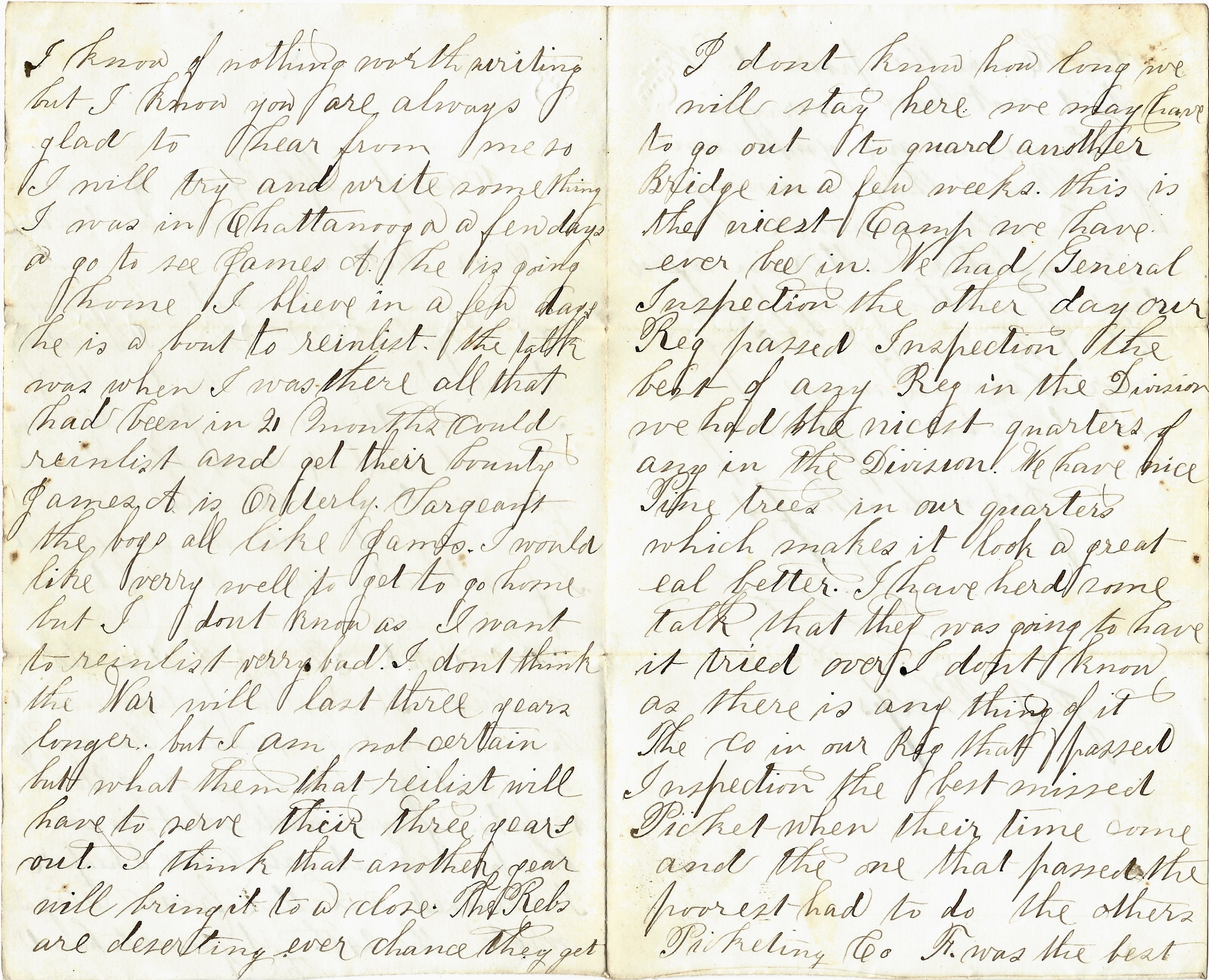
I know of nothing worth writing but I know you are always glad to hear from me so I will try and write something. I was in Chattanooga a few days ago to see James A. He is going home, I believe, in a few days. He is about to reenlist and get their bounty. James A. is Orderly Sergeant. The boys all like James. I would like it very well to get to go home but I don’t know as I want to reenlist very bad. I don’t think the war will last three years longer but I am not certain but what them that reenlist will have to serve their three years out. I think that another year will bring it to a close. The Rebs are deserting every chance they get.
I don’t know how long we will stay here. We may have to go out to guard another bridge in a few weeks. This is the nicest camp we have ever been in. We had General Inspection the other day. Our regiment passed inspection the best of any regiment in the division. We had the nicest quarters of any in the division. We have nice pine trees in our quarters which makes it look a great deal better. I have heard some talk that they are going to have it tried over. I don’t know as there is anything of it. The company in our regiment that passed inspection the best missed picket when their time come and the one that passed the poorest had to do the others picketing. Co. F was the best. Co. H was the poorest. We did not have a very fair chance as we just came off of picket that morning.
I will answer Elizabeth’s letter in a few days if nothing happens. I am always glad to hear from you. — John L. Phelps

Letter 3

Camp near Acworth Station, Ga.
June 3, 1864
Dear Aunt Sarah.
Yours of the 17th and Father’s of the 26th was received last evening and one from Eliza date the 20th. So you see I had a fine time reading letters. I am well and enjoying myself very well. We camped here the 6th—the longest we have laid at any one time since the 7th of last month without being in a line of battle or where we could hear firing. Since we stopped here, everything has been quiet. Our regiment has not been in any engagement although we have been in front a good part of the time. When we took Rome, we lost a good many men for what the fight lasted. There has been but very little hard fighting done for the amount of ground we have gained. There was pretty hard fighting done at Resaca one afternoon. We know very little about what is going on—only what we see.
The Rebs are said to be falling back across the Chattahoochee River. I think they will try to make a stand there but if there is any way to get around, I think Sherman will flank them. That is his way of fighting. I don’t believe he wants to lose a man more than he can help. We advance and then build fortifications. Last Saturday night we worked until after midnight building fortifications. I think we will move forward in the morning. I expect we will have one hard fight before we get to Atlanta.
The soldiers are all in good spirits about getting to go home. Some thinnk they will get to eat their Christmas dinner at home. I heard Colonel Dillworth say that he thought it could not last long the way things was going. He seemed to be in good spirits. He said when we got home, he expected he would have to come down to Bath every few days to get us out of some trouble.
We have had some very warm days down here. It is warmer here than it was at Nashville. There is some pieces of corn around here that looks well & some little wheat that is ripe enough to shell out. But the army is feeding it to their teams. I guess they don’t like that we take the fences wherever we stop—if there is any.
I have not seen James A. They are about 3 miles from here. Two of the boys out of Co. F, 51st [Illinois] was here today. I answered E. C.’s letter last evening. The mail was going out yesterday evening & I wrote it in a great hurry. We have not been getting our mail regularly. I don’t know when we will have a chance to send letters—perhaps in two or three days. I directed Elizabeth’s letter to Bath. I don’t know which place she will get it the soonest.
I got my hat last evening. I like it very well. J. H. W. got one mailed at Snicarte. The postage was 4 cents which mine was 16 cents. I don’t think they should make that difference in the two places. Please send me some thread. Nothing more. Yours truly, — John L. Phelps


Letter 4

Camp in the field, Ga.
June 20, 1864
Dear Father,
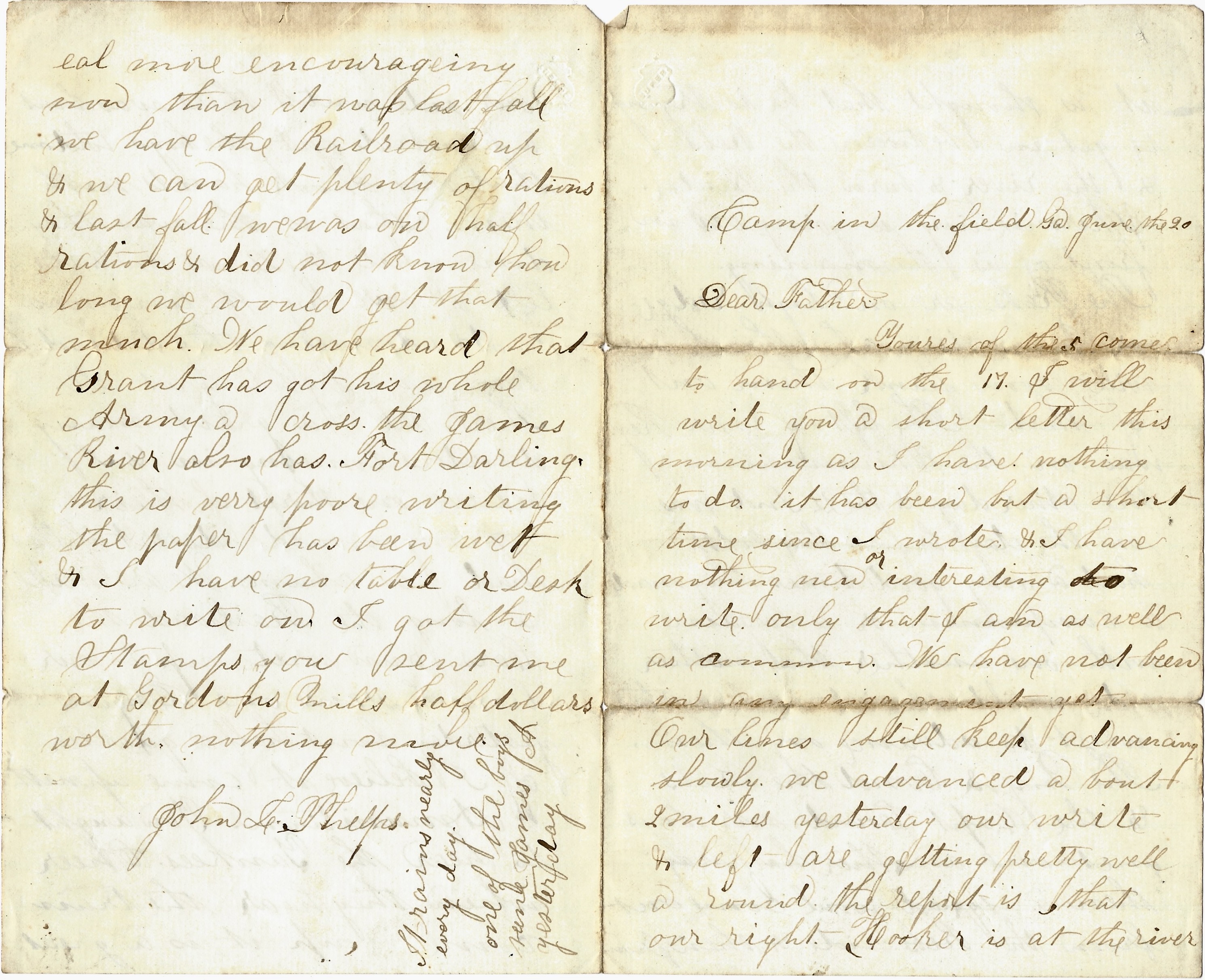
Yours of the 5th came to hand on the 17th. I will write you a short letter this morning as I have nothing to do. It has been but a short time since I wrote & I have nothing new or interesting to write—only that I am as well as common.
We have not been in any engagement yet. Our lines still keep advancing slowly. We advanced about two miles yesterday. Our right and left are getting pretty well around. The report is that our right—Hooker is at the river—it is thought that he is trying to get in between the Rebs and the river & burn the bridge. Skirmishing is going on in front of us this morning. The Rebs are on the high ridge or mountain. I think we will soon flank them out of that. The left of our regiment was on the skirmishers the other day and the 22nd Indiana was on the day before. They both had a very good time. They made a compromise or a bargain with one another that neither side would shoot unless they went to advance on them.
The Major [of the] the Rebs and the Capt. [of our] our boys met one another halfway. Then a squad would come out from the Rebs side and then from our side until there was about a hundred out. The boys told me that they shook hands with them. That is the way they done while the 22nd was on & the left of our regiment was not advancing. They did not have any fighting at all. There was a great many deserters coming in & I believe one thrd of their army would desert if they had a chance.
We are right along the railroad. The cars run right up to our lines. I seen one engine yesterday about half a quarter off. I believe it come up with the ammunition. You ought to hear the Yankees cheer when they hear the train come up. It is a great deal more encouraging now than it was last fall. We have the railroad up & we can get plenty of rations & last fall we was on half rations & did not know how long we would get that much.
We have heard that Grant has got his whole army across the James River. Also has Fort Darling. This is very poor writing. The paper has been wet & I have no table or desk to write on. I got the stamps you sent me at Gordon’s Mills. Half dollars worth. Nothing more. — John L. Phelps
It rains nearly every day. One of the boys saw James A. yesterday.

Letter 5

Camp 9 miles from Atlanta
July 8, 1864
Dear Father,
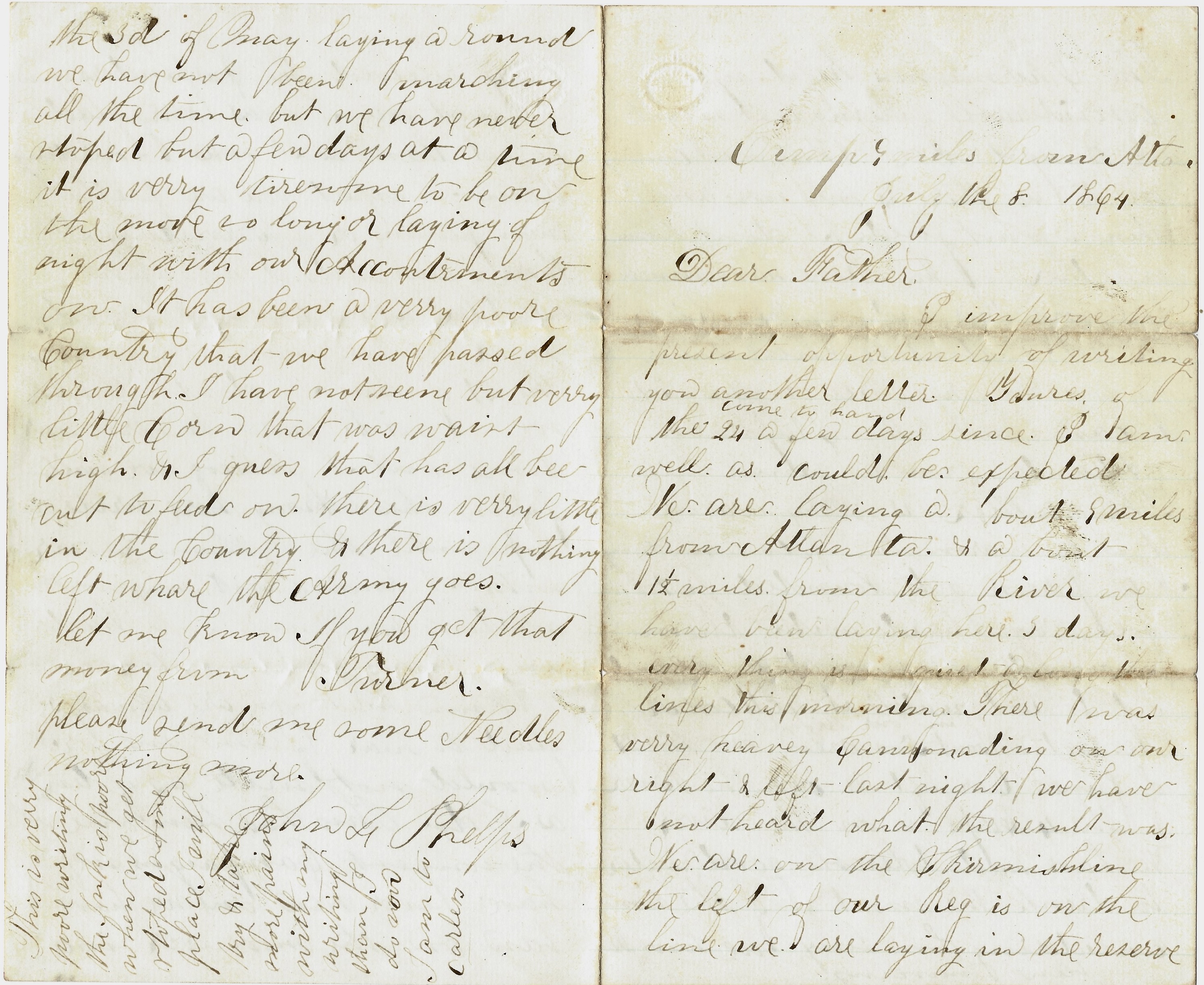
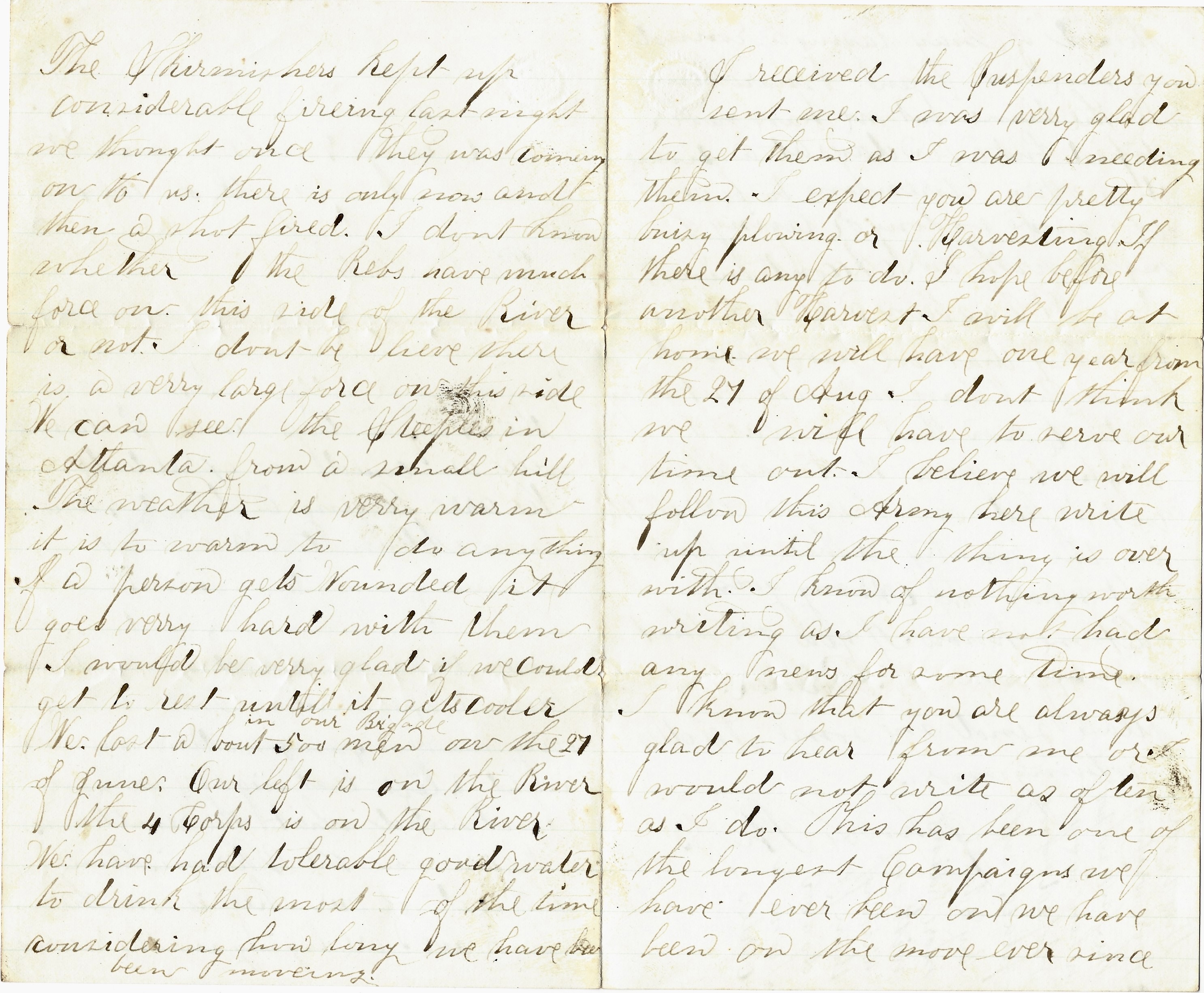
I improve the present opportunity of writing you another letter. Yours of the 24th come to hand a few days since. I am well as could be expected. We are laying about 9 miles from Atlanta & about 1.5 miles from the river. We have been laying here 3 days. Everything is quiet along the lines this morning. There was very heavy cannonading on our right and left last night. We have not heard what the result was. We are on the skirmish line. the left of our regiment is on the line. We are laying in the reserve. The skirmishers kept up considerable firing last night. We thought once they was coming on to us. There is only now and then a shot fired. I don’t know whether the Rebs have much force on this side of the river or not. I don’t believe there is a very large force on this side. We can see the steeples in Atlanta from a small hill.
The weather is very warm. It is too warm to do anything. If a person get wounded, it goes very hard with them. I would be very glad if we could get to rest until it gets cooler. We lost about 500 men in our brigade on the 27th of June. Our left is on the river. The 4th Corps is on the river. We have had tolerable good water to drink the most of the time considering how long we have been moving.
I received the suspenders you sent me. I was very glad to get them as I was needing them. Expect you are pretty busy plowing or harvesting. If there is any to do. I hope before another harvest, I will be at home. We will have one year from the 27th of August. I don’t think we will have to serve our time out. I believe we will follow this army here right up until the thing is over with.
I know of nothing worth writing as I have not had any news for some time. I know that you are always glad to hear from me or I would not write as often as I do. This has been one of the longest campaigns we have ever been on. We have been on the move ever since the 3rd of May laying around. We have not been marching all the time but we have never stopped but a few days at a time. It is tiresome to be on the move so long or laying off nights with our accoutrements on.
It has been a very poor country that we have passed through. I have not seen but very little corn that was waist high. I guess that has all been cut to feed on. There is very little in the country and there is nothing left where the army goes.
Let me know if you get that money from Turner. Please send me some needles. Nothing more. — John L. Phelps
This is very poor writing. The ink is poor. When we get stopped some place, I will try and take more pains with my writing than I do now. I am too careless.
Letter 6

[Before Atlanta] Georgia
August 4, 1864
Dear father,
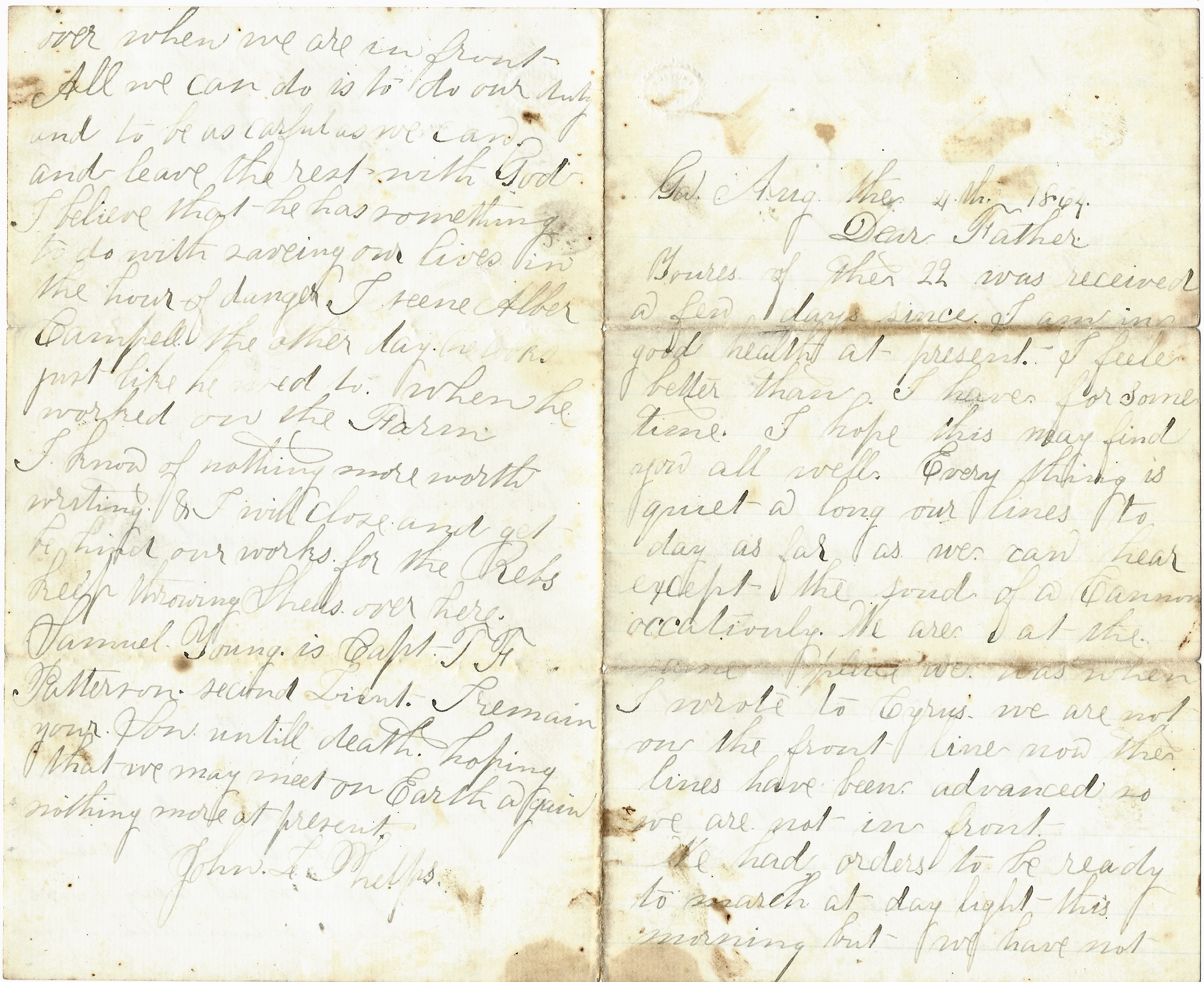
Yours of the 22nd was received a few days since. I am in good health at present. I feel better than I have for some time. I hope this may find you all well. Everything is quiet along our lines today as fast as we can hear except the sound of the cannon occasionally. We are at the same place we was when I wrote to Cyrus. We are not on the front line now. The lines have been advanced so we are not in front.
We had orders to be ready to march at daylight this morning but we have not moved yet. But I am afraid we will move. I have heard two bugles.
August 6th. You will see from the above that I had to stop writing. We had to move out and advance the line on the right & then we had to go on picket that night. We built some skirmish pits. We lay in them until morning. At daylight we had to advance about half a mile farther. I believe there was no one hurt. Cos. K and I took about 25 prisoners. We was relived last evening. We are in the second line of works. There is as much danger here as there is in the front line. The bullets fly over from the skirmishers with a shell occasionally but not hurting anyone today that I have heard of. I think from the way our lines run that we are trying to out flank the Rebs and get on to the railroad running to Montgomery, one branch. The other, I believe, runs to Charleston.
I remember well two years ago today, two years ago yesterday I put my name down and was sworn in. I think the war will be over before this time next year but if not, those that are left of us will begin to think about getting home. But one year is a long time to look ahead and in front at that. A ball is liable to hit a person at any time for they are continually flying over when we are in front. All we can do is to do our duty and to be as careful as we can and leave the rest with God. I believe that He has something to do with saving our lives in the hour of danger.
I seen Albert Campbell the other day. He looks just like he used to when he worked on the farm. I know of nothing more worth writing & I will close and get behind our works for the Rebs keep throwing shells over here. Samuel Young is Capt. T. F. Patterson’s second lieutenant. I remain your son until death. Hoping that we may meet on earth again. Nothing more at present. — John L. Phelps

Letter 7
[Before Atlanta, Georgia]
August 15, 1864
Dear Father,
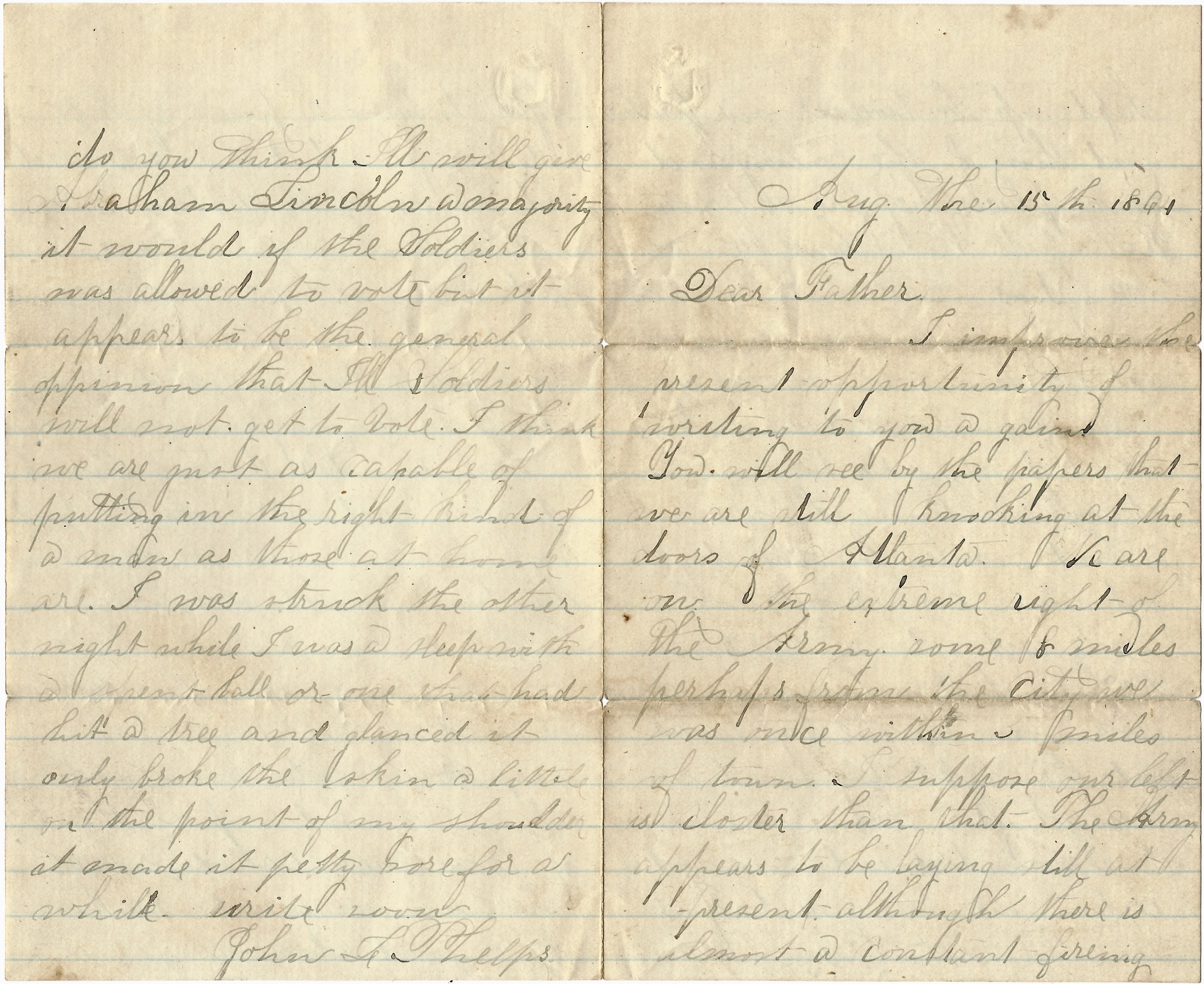
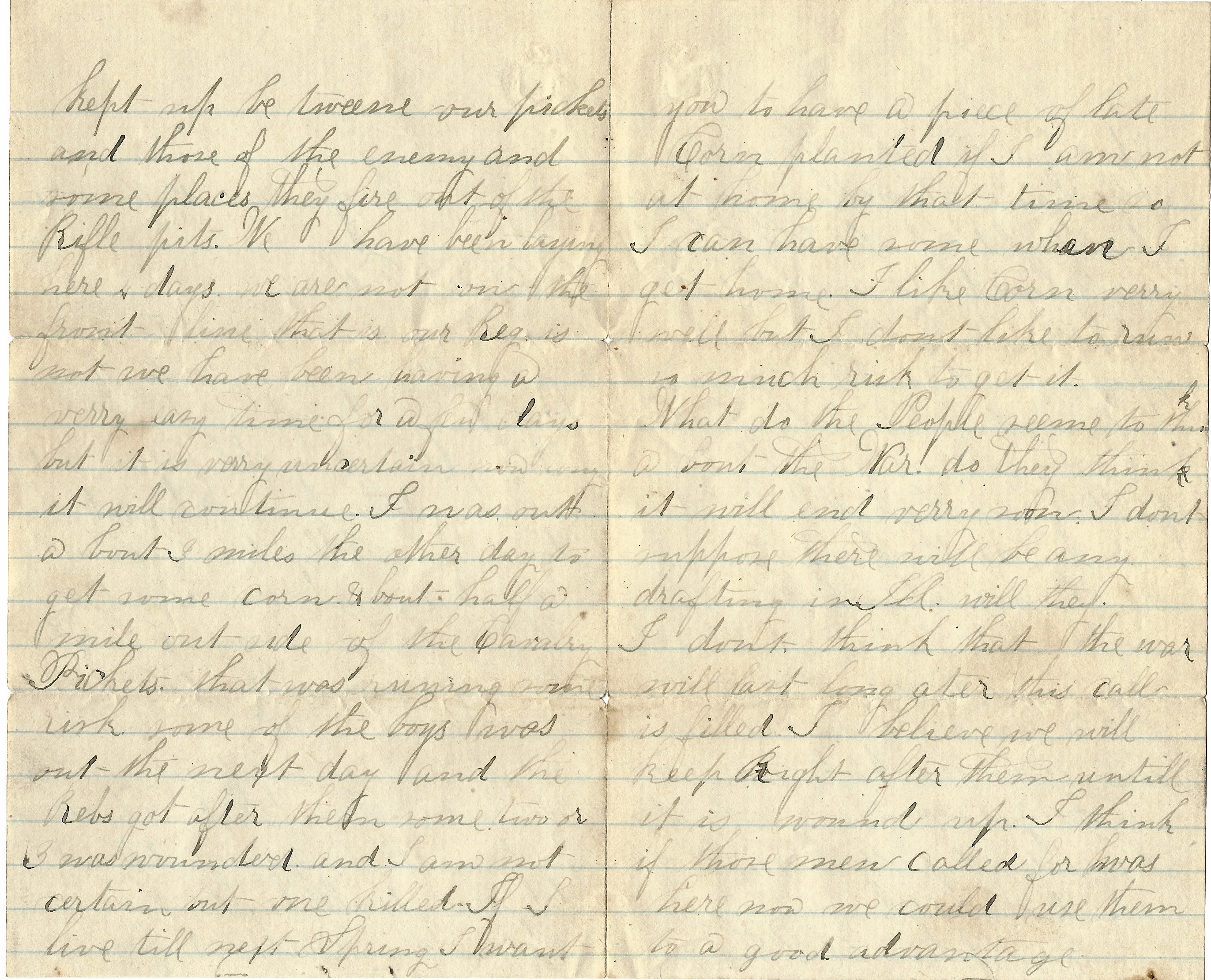
I improve the present opportunity of writing to you again. You will see by the papers that we are still knocking at the door of Atlanta. We are on the extreme right of the army some 8 miles perhaps from the city. We was once within 5 miles of town. I suppose our left is closer than that. The army appears to be laying still at present although there is almost a constant firing kept up between our pickets and those of the enemy and some places they fire out of the rifle pits. We have been laying here 4 days. We are not on the front line—that is, our regiment is not. We have been having a very easy time for a few days but it is very uncertain how long it will continue.
I was out about 3 miles the other day to get some corn & about half a mile outside of the cavalry pickets. That was running some risk. Some of the boys was out the next day and the Rebs got after them—some two or three wounded and I am not certain but one killed. If I live till next spring, I want you to have a piece of late corn planted. If I m not at home by that time, I can have some when I get home. I like corn very well but I don’t like to run so much risk to get it.
What do the people seem to think about the war? Do they think it will end very soon? I don’t suppose there will be any drafting in Illinois, will they? I don’t think that the war will last long after this call is filled. I believe we will keep right after them until it is wound up. I think if those men called for was here now, we could use them to a good advantage.
Do you think Illinois will give Abraham Lincoln a majority. It would if the soldiers was allowed to vote but it appears to be the general opinion that Illinois soldiers will not get to vote. I think we are just as capable of putting in the right kind of man as those at home are. I was struck the other night while I was asleep with a spent ball or one that had hit a tree and glanced. It only broke the skin a little on the point of my shoulder. It made it pretty sore for a while.
Write soon. — John L. Phelps
Letter 8

Goldsboro, North Carolina
March 30, 1865
Dear Father,
I have received 3 letters from you since we arrived here. We got here the 24th of March. I wrote one letter to Elizabeth. I thought I would wait a few days before writing to you.
We had a long muddy trip of it making two months and four days from the time we left Savannah until we got here. There was a great deal of rain making it very muddy. We had to corduroy nearly all the way. It is the worst country I ever seen. A wagon was most sure to get down if it got off the main road. We passed through some of the poorest country I ever seen. We passed through a strip of about 40 miles after we crossed the Pee Dee River that there was scarcely anyone living—only a few little houses along where persons lived that worked the pine timber to get the turpentine and rosin.
There are a great many people that are bound to suffer through North Carolina. There is nothing at all left for them to live on. You see the army had to depend on living off of the country mostly and when we come into a poor country, it took everything to make a mouthful you might say.
Our regiment was in two fights—one of the 16th, the other on the 19th. We was very lucky in getting out of it. We was detailed with the train at Fayetteville on the Cape Fear river & was with the train until we got through. I tell you, we was lucky in missing it. I have never heard what the loss on either side [was] but from all accounts the Rebels lost a great many the most men.
We crossed a good many fine rivers on our trip. We crossed two branches of the Broad River, Catawba, Pee Dee, Cape Fear & Neuse. We have the best line of communication we have ever had. We have railroad from Wilmington through and river to Kinston 30 miles from here and then they haul with the wagons from there to here, making two lines all the way. We have more rations that we ever had before. Old Billy [Sherman] told the boys he would give us a rest here and we should have the best the North could afford. We have plenty of pork, beans, codfish, sugar, coffee, & crackers.
I just received a letter from E. C. speaking of the election. I say there is nothing fair in levying a tax on all alike. Some men have done a great deal for the war and some have not done a thing. Nobody had to make up a bounty for me to come and I wish you did not have to pay anything for anyone else to come.
Every soldier puts full confidence in Sherman as our leader. Everyone likes him and is willing to obey him. I would rather be under Sherman than any other general that I know of Grant may be as good. He has had a harder place than Sherman has but Sherman in my man. — John L. Phelps


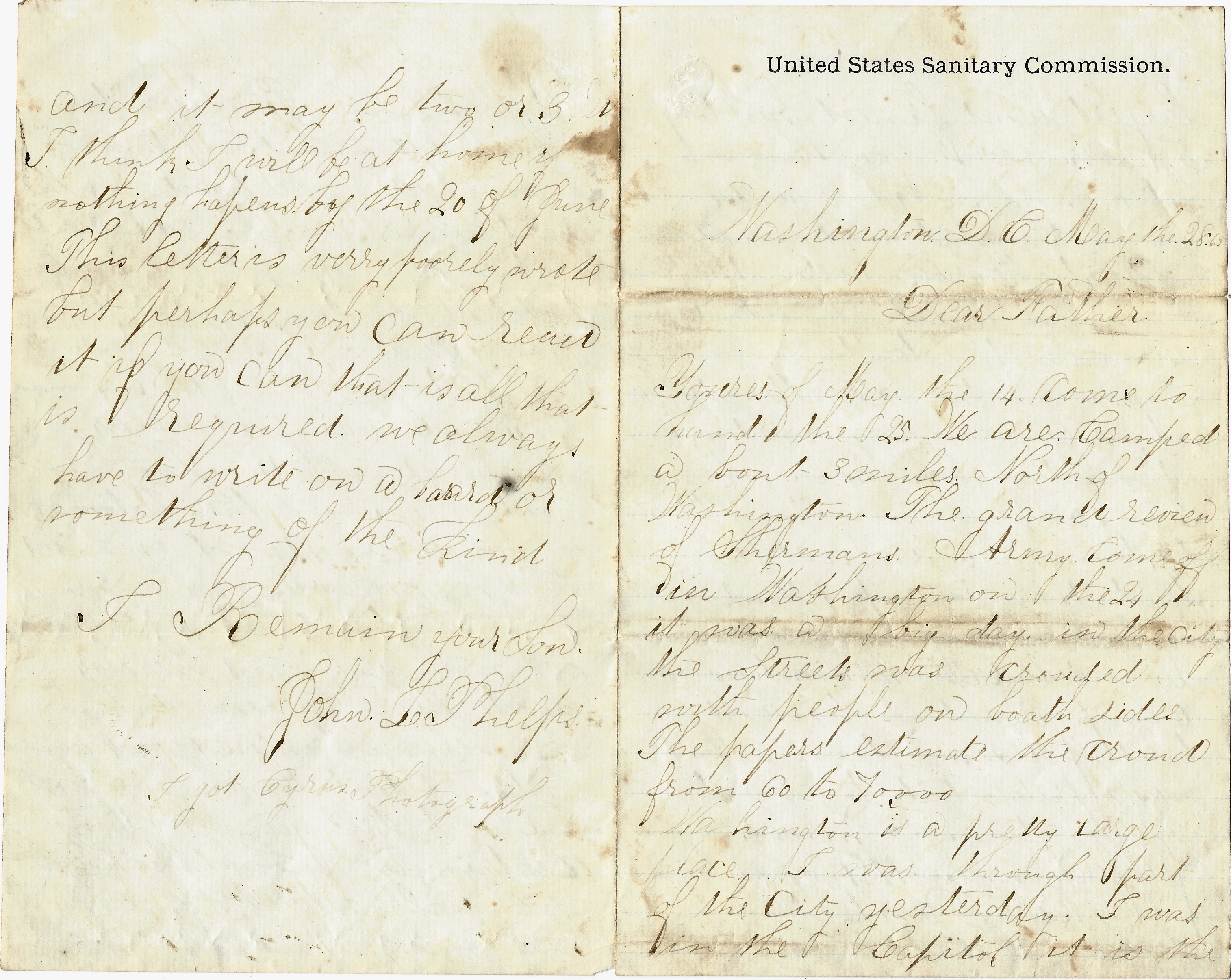
Letter 9

Washington D. C.
May 28, 1863
Dear father,
Yours of May the 14th come to hand the 25th. We are camped about three miles north of Washington. The Grand Review of Sherman’s ARmy come off in Washington on the 24th. It was a bidg day in the city. The streets was crowded with people on both sides. The papers estimate the crowd from 60 to 70,000.
Washington is a pretty large place. I was through part of the city yesterday. I was in the Capitol. It is the largest and finest building I ever seen. You have no idea how big it is until you go through it. It is all solid marble, even the floors. The house is lit up with gas in the daytime.
I was in the Patent Office. It is a very large building. It is built of marble. You can see everything there that ever was invented that there is a patent on by looking long enough. I seen Gen. Washington’s camp chest, his tent and tent poles, his dishes that was presented to Martha Washington by Thomas Jefferson in 1781, his buckskin pants that he wore.
We had a long, tiresome march from Raleigh to Washington but I think I am very well paid for the hard marching if I could not have seen the [Rebel] Capitol without it. We marched from near Raleigh to Richmond in 7 days. We left Richmond then and camped near Washington the 19th. The Long Bridge across the Potomac is quite a sight. It is said to be one mile and a quarter long.
I don’t know whether we will get paid here or not. There is some talk of our being mustered out here but I don’t think we will. I can’t tell you anything certain about when we will start for Illinois. We may start in a week and it may be two or three. I think I will be at home by the 20th of June. This letter is very poorly wrote but perhaps you can read it. If you can, that is all that is required. We always have to write in a board or something of the kind.
I remain your son, — John L. Phelps
I got Cyrus’s photograph.

 Spared & Shared 23