
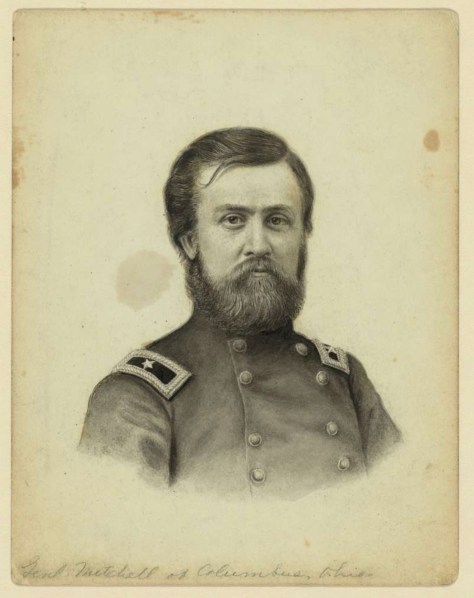
The following letters were written by John Grant Mitchell (1838-1894), a graduate of Kenyon College who was preparing for a career in law when the Civil War broke out. He enlisted in the 3rd Ohio Volunteer Infantry, helped raise and became the Colonel of the 113th Ohio Infantry, and became a brigade commander in XIV Corps where he played a major part in the Atlanta Campaign. He was promoted to brigadier general, the youngest civilian-soldier to attain that rank without benefit of preparative military training. He was brevetted major general after the war. Mitchell resumed his legal career and married Laura Platt, niece of President Rutherford B. Hayes. Mitchell was president the Columbus City Council and an Ohio pension commissioner.
He addressed the letters to Capt. David Taylor who was commissioned a 1st Lieutenant in Co. C, 1st O.V.I., April 15, 1861, and Captain of Co. B, 113th Regiment, O.V.I., August 12, 1862. Muster Rolls indicate that he resigned on 10 June 1863, not long after this letter was written. The following explanation for his resignation comes from his Find-A-Grave obituary:
“In 1863, Mr. Taylor organized the negro slaves as contraband of the war, and pressed them into service in building the fort at Franklin, Tenn., and gave each of the contrabands papers freeing them from slavery, for which Gen. W. S. Rosecrans highly commended him.
Early in February, 1863, Captain Taylor arrived at Franklin, Tenn., after a rough campaign through Kentucky’s mud, snow and rain, and immediately, with his comrades, was placed on steamboats, when down the Ohio River, and up the Cumberland River, retaking the forts from Donaldson to Nashville, then south to Franklin, a tired but victorious army. At once, Gen. C. C. Gilbert put the tired soldiers to work clearing the ground and building a fort. In this work David Taylor pressed all the slaves into the work of building.
On the evening of February 22, 1863, David Taylor was severely injured, causing paralysis of his left side. When it became apparent that his recovery was extremely doubtful, Gen. W. S. Rosecrans caused a detail of the chaplain of the 78th Illinois and another soldier to accompany him to Columbus, Ohio, where he was treated by Doctor Smith, the Surgeon General of Ohio, but he never fully recovered from his injury. General Rosecrans highly complimented David Taylor for his care of the soldiers who were benefited by the rest they received while the slaves built the fort, and after the war visited him at his home.”
Letter 1
Camp at Franklin, Tennessee
May 19th 1863
Capt. D. Taylor, Co. B, 113th OVI
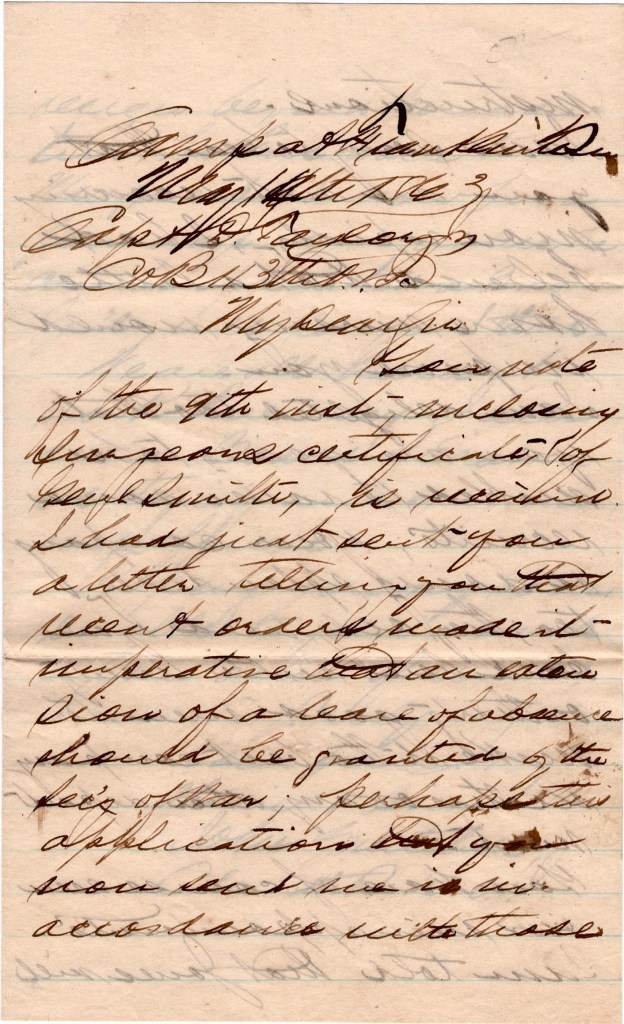
My dear sir, your note of the 9th installment enclosing surgeon’s certificate of General Smith [Surgeon General of Ohio] is received. I had just sent you a letter telling you that recent orders made it imperative that an extension of a leave of absence should be granted to the Secretary of War. Perhaps this application that you now send me is in accordance with those instructions.
I am sorry to hear that you are not recovering more rapidly. I had believed that a little home nursing would improve you.
I am delighted too that you are going to be enabled to raise some recruits; your company is doing splendidly too; they only need you back here with twenty or thirty good men to make it the best company in this or any other department.
You have of course seen our new appointments. I am told that Jones will resign beyond [ ]; he has gone to Murfreesboro now for a few days and unless he can be appointed a Brigadier General, will resign, I think.
We are all hard at work here now. I am on a Board of Examiners trying and examining officers. Hoping you may soon be able to join us with a fine batch of recruits, I am very truly your friend & obedient servant, — John Mitchell, Col. 113th Regt. O. V. I.

Letter 2
Camp at Franklin, Tennessee
May 30th 1863
Capt. D. Taylor, Jr., Co. B, 113th Ohio Vol.
My dear sir, your letter of a recent day is just received. I very much regret to learn that you are still unfit for duty. You remember that my constant hope was that twenty or thirty days at home would entirely restore your health.
It would be impossible for me to advise you in regard to offering a resignation. Dr. Smith’s opinion in the case I should trust implicitly. He knows much better than I could whether you will soon be ready for service. Your paralysis alarms me lest you may never be able for foot service in the field again. But you can tell about these things yourself, Captain, much better than anyone can for you.
If you are not able to return when the present leave of absence expires, if I were in your place, I should make no further attempt but would resign at once. You have done your whole duty faithfully and nothing more could be asked of you. All I wanted was a fair trial and I must ask more than that.
I am sorry that you have been unable to fill up your company to the maximum number. It is a splendid company—nothing like it in this regiment.
Your ordnance account is all square, I presume. I have just been looking over it for the quarter ending March 31st and if I remember correctly, it is all straight. About your other papers, I know nothing but judging from this they must be in prime condition.
In case you determine to resign, you have the necessary forms, I think. It would be useless for me to tell you how much I regret your talking about a resignation—all that you know already. Still, feelings have nothing to do with a soldier’s duty, and hence I can say nothing knowing that what you do will be done conscientiously. I hope you still find time to call upon my wife. She is happy at all times to see you.
I am, Captain, very truly your friend, — John G. Mitchell


 Spared & Shared 23