


George Messer of the 107th Illinois Infantry was “a good man and a man that I thought a heap of. He was liked in his company and regiment but he is now gone where there is no trouble, no war, nor no fighting. Tell his wife that he is buried nice and was well cared for whilst sick.” So wrote a fellow soldier following the discovery of George’s death from chronic diarrhea late in December 1863 at the Lamar House Hospital in Knoxville, Tennessee.
There is nothing remarkable about George Messer to distinguish him from the thousands of men who answered their country’s call for volunteers to put down the rebellion. He was a simple carpenter from rural Illinois who sought to acquire his share of the American dream — a home to call his own and a loving family to love and support. But his sense of patriotic duty caused him to put those dreams on hold until the rebellion was ended. Unfortunately for George — and the family he left in Illinois — that day did not come before he succumbed to the disease that plagued him throughout most of his term of service. Though he never fired a gun at the enemy, he did not desert nor shirk his duty when he was capable of fulfilling it like several others in his regiment. Though he saw others less qualified than himself rise to positions of leadership in the regiment, he maintained his spirit and did his best to comfort and give hope to those he left behind in Illinois.
George was a devoted husband who wrote faithfully and regularly to his wife during his absence — at least twice a week and sometimes more. His voluminous correspondence provides us with a record of the 107th Illinois Infantry that is rare and reveals the internal machinations and jealousies of the regiment that unit histories do not characteristically reveal. In short, it is a good read.
George Messer (1833-1863) was the son of William H. Messer (1804-1892) and Hannah McClure (1796-1861) of Richland County, Ohio. He had an older sister named Rebecca Messer (1831-1904) who was married to David Bell (1829-1912) in January 1853. Sometime in the late 1850’s, George Messer came to Illinois with his parents and his older sister’s family to settle in Creek Township in Dewitt county. It was here that he met and married Charlotte (“Lottie”) Kelley (1839-1907), the daughter of Alexander Kelley (1813-1882) and Lucinda Anderson (1816-1869). They were married on 27 March 1860 at her father’s resident by John J. McGraw, Justice of the Peace.
George enlisted in Co. F, 107th Regiment Illinois Volunteer Infantry. The letters span the time from his muster into service in September of 1862 until his death at the end of December, 1863. Several years ago I had the privilege of transcribing and publishing 82 letters of the letters that George wrote to his wife Lottie (Charlotte) during his time in the service along with his nephew, William Wesley McNulty. Recently I was sent scans of two of George’s letters from the Early Illinois Collection of Brad Emalfarb with the express consent for publishing them on Spared & Shared. Both letters were datelined from Glasgow, Kentucky, in April 1863 and neither were in the collection of George’s letters I had previously published. The two letters are significant because they both provide descriptions of the construction of Fort Williams, an earthwork fort constructed on a hill just outside of Glasgow. We learn that much of the early earth moving necessary in the construction of the fort was done by impressed enslaved laborers and only when an attack was anticipated in late April 1863 were the entire 107th Illinois enlisted men assigned duty to finish the works by felling trees and laying the abatis that surrounded the fort.
Rather than attempt to add these two letters to that previous webpage, I have posted them here with an active link. To read George’s other letters, see The Civil War Letters of George Messer, Company F, 107th Illinois Infantry.

Letter 1
107th Regiment Illinois Volunteers, Co. F
Camp Hobson, Glasgow, Kentucky
Thursday, April 2nd 1863
My dear wife,
I seat myself this morning to answer yours of the 28th and 29th which I received yesterday evening and I was glad to hear that you was all well and hearty. I still keep hearty and have a stomach strong enough to eat almost anything.
I am out on picket again today and I am sitting on a big Beach log writing. I intended to write to you today and did not expect to have to go on duty again today but our details are very heavy and has come my turn sooner than I expected and I concluded that I would not be fooled out of writing to you like I was last Sunday so I brought portfolio and writing materials along with me and shall put in all my spare time today in writing.
We commenced yesterday morning to dig rifle pits with 40 Negroes that we pressed in around the country and there is 80 Negroes at work today and there will still be more tomorrow. They are going to press in three hundred and fifty and if they work like they did yesterday, we will soon have the fortifications completed and I for one am not sorry that the Negroes are to do the work for I don’t like to work as well as I used to. Still I am heartier and feel stouter than I was for a long time.
You spoke about wanting to know about my chance of promotion. There is but little chance just now. There may be when Capt. Wismer is exchanged and comes back or is mustered out or resigns. I don’t know what he will do or what will be done with him. David Willis has not got any commission yet and I don’t know whether he will get one or not. Either [David] Willis or [William D.] Catterlin will be the 2nd Lieutenant. I think there is another man that is trying to get the place and I would not be much surprised if he gets it. He is very intimate with the Colonel and has it is generally believed a man at home working for him with the Governor. It is nobody else but P[arker] S. Adams. I don’t want you to say anything about what I have said. All the chance that I have is if Catterlin is promoted for me to get up a petition and I can get all the company to sign it except two or three for Orderly Sergeant. I may not get it them but I shall make the effort at least and I think there be nothing dishonorable about it in that way. Those that I speak about that would not sign my petition are ones that want to be promoted themselves. They have nothing against me and they appear to be my personal friends but appearances are very often deceitful.
I get along very well where I am and I chant make any fuss about it if I don’t get any higher. All that I would desire a higher office for would be for the pecuniary assistance that it might afford and at the same time be capable of doing my duty. I don’t want to get promoted to any place that I could not fulfill for that would be worse than having no office at all.
P[arker] S. Adams is sick and has been for three days. He has something like the flux. He was some better this morning. John Graham is not very well. He has a bad cold and sore throat. He is boarding in our mess now. He wanted to get our nigger to cook for him. He could not do that so he turned his nigger off and has come to board with us. We have the best cook there is in camp and he gets up things in pretty good style the most of the time.
I did not send that other novel by A. C. Graham. He was in a hurry to start so I forgot it until after he was gone. I will come home pretty [soon] and bring it myself and I suppose that will do as well and perhaps better than to send it by anyone. I will close for a few minutes.
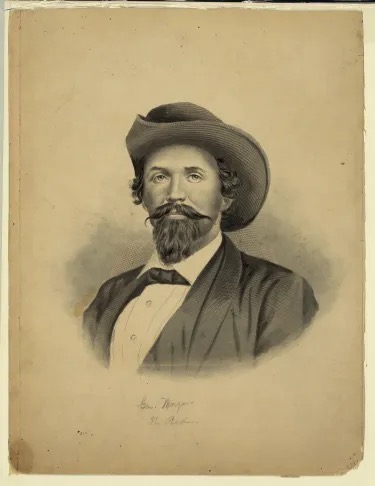
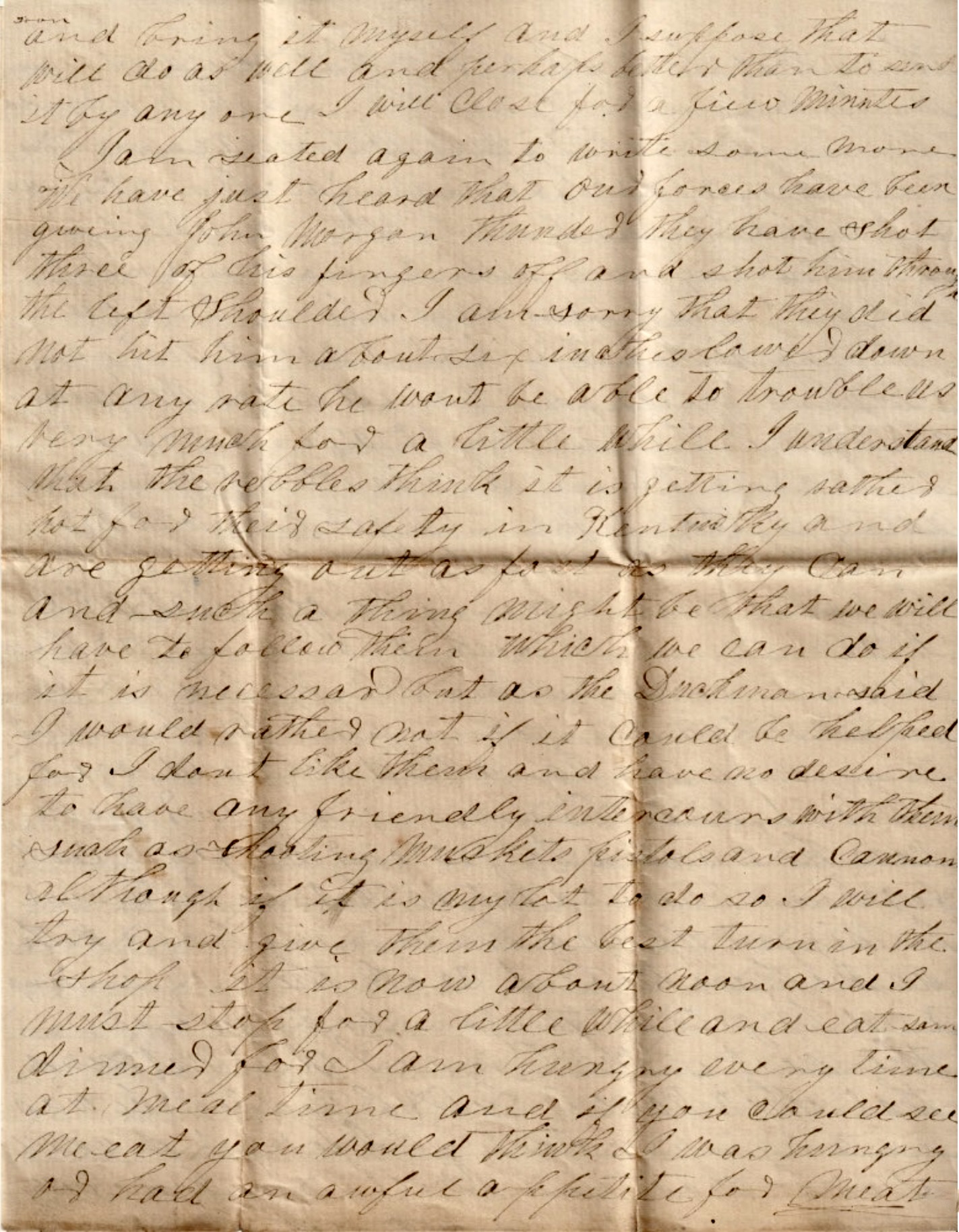
I am seated again to write some more. We have just heard that our forces have been giving John [Hunt] Morgan thunder. They have shot three of his fingers off and shot him through the left shoulder. I am sorry that they did not hit him about six inches lower down. At any rate, he won’t be able to trouble us very much for a litle while. I understand that the rebels think it is getting rather got for their safety in Kentucky and are getting out as fast as they can and such a thing might be that we will have to follow them, which we can do if it is necessary but as the Dutchman said, I would rather not if it could be helped for I don’t like them and have no desire to have any friendly intercourse with them such as shooting muskets, pistols, and cannon, although if it is my lot to do so, I will try and give them the best turn in the shop.
It is now about noon and I must stop for a little while and eat some dinner for I am hungry every time at meal time and if you could see me eat, you would think I was hungry or had an awful appetite for meat.
I must try and fill this sheet yet but I don’t know what to write about for I wrote you a tolerable long letter and started it to you by Ben Cross last Tuesday morning. I am not certain whether I will get to come home when those return that have went or not. There are several that are talking about going and they have sent for money to take them home. If they have, I may not get to come. I have sunk away in the bottom of my pocket enough to pay my way home at least and if we should leave this place, it may be that there won’t be any chance for anyone to go very soon again.
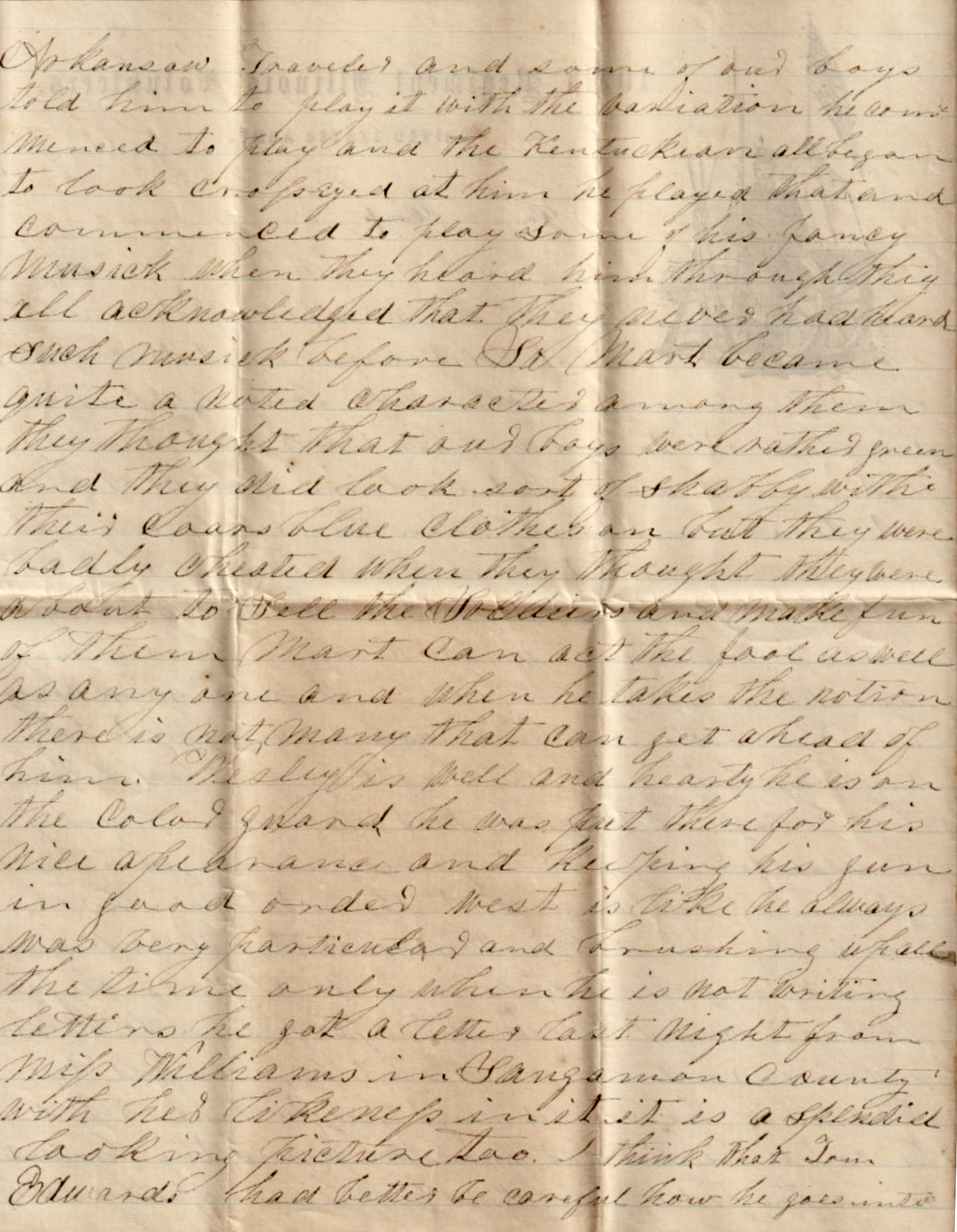
Some of our boys went down to town the other evening and Mr. Phares, [our wagon master] as they all call him, was along. They were invited into the parlor to hear some music. They played on the violin awhile and some of our boys asked Mr. [Martin] Phares if he could not play a tune or two. He said he did not know [but] he would try. They handed him the fiddle and asked him to play the Arkansas Traveler and some of our boys told him to play it with the variation. He commenced to play and the Kentuckians all began to look cross-eyed at him. He played that and commenced to play some of his family music. When they heard him through, they all acknowledged that they never had heard such music before. So Mart[in] became quite a noted character among them. They thought that our boys were rather green and they did look sort of shabby with their coarse blue clothes on but they were badly cheated when they thought they were about to sell the soldiers and make fun of them. Mart can act the fool as well as anyone and when he takes the notion, there is not many that can get ahead of him. 1
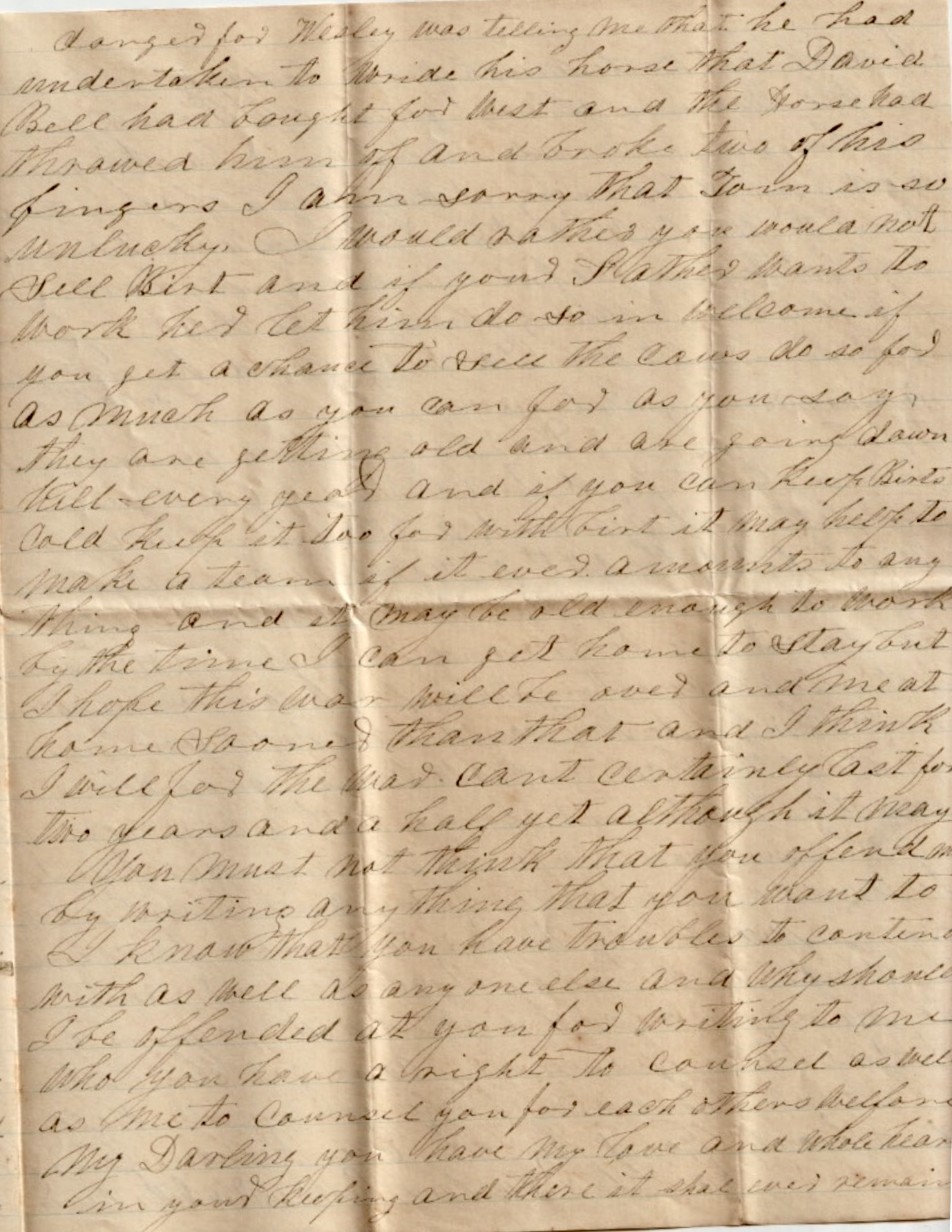
Wesley [McNulty] is well and hearty. He is on the color guard. He was put there for his nice appearance and keeping his gun in good order. West is like he always was, very particular and brushing up all the time—only when he is not writing letters. He got a letter last night from Miss Williams in Sangamon county with her likeness in it. It is a splendid looking picture too. I think that Tom Edwards had better be careful how he goes into danger for Wesley was telling me that he had undertaken to ride his horse that David Bell had bought for West and the horse had throwed him off and broke two of his fingers. I am sorry that Tomis so unlucky. I would rather you would not sell Birt and if your Father want to work her, let him do so. If you get a chance to sell the cows, do so for as much as you can for as you say, they are getting old and are going down hill every year. And if you can keep Birt’s colt, keep it too for with Birt, it may help to make a team if it ever amounts to anything and it may be old enough to work by the time I can get home to stay. But I hope this war will be over and me at home soner than that and I think I will for the war can’t certainly last for two years and a half yet, although it may.
You must not think that you offend me by writing anything that you want to. I know that you have troubles to contend with as well as anyone else and why should I be offended at you for writing to me who you have a right to counsel as well as me to counsel you for each other’s welfare. My darling, you have my love and whole heart in your keeping and there it shall ever remain.
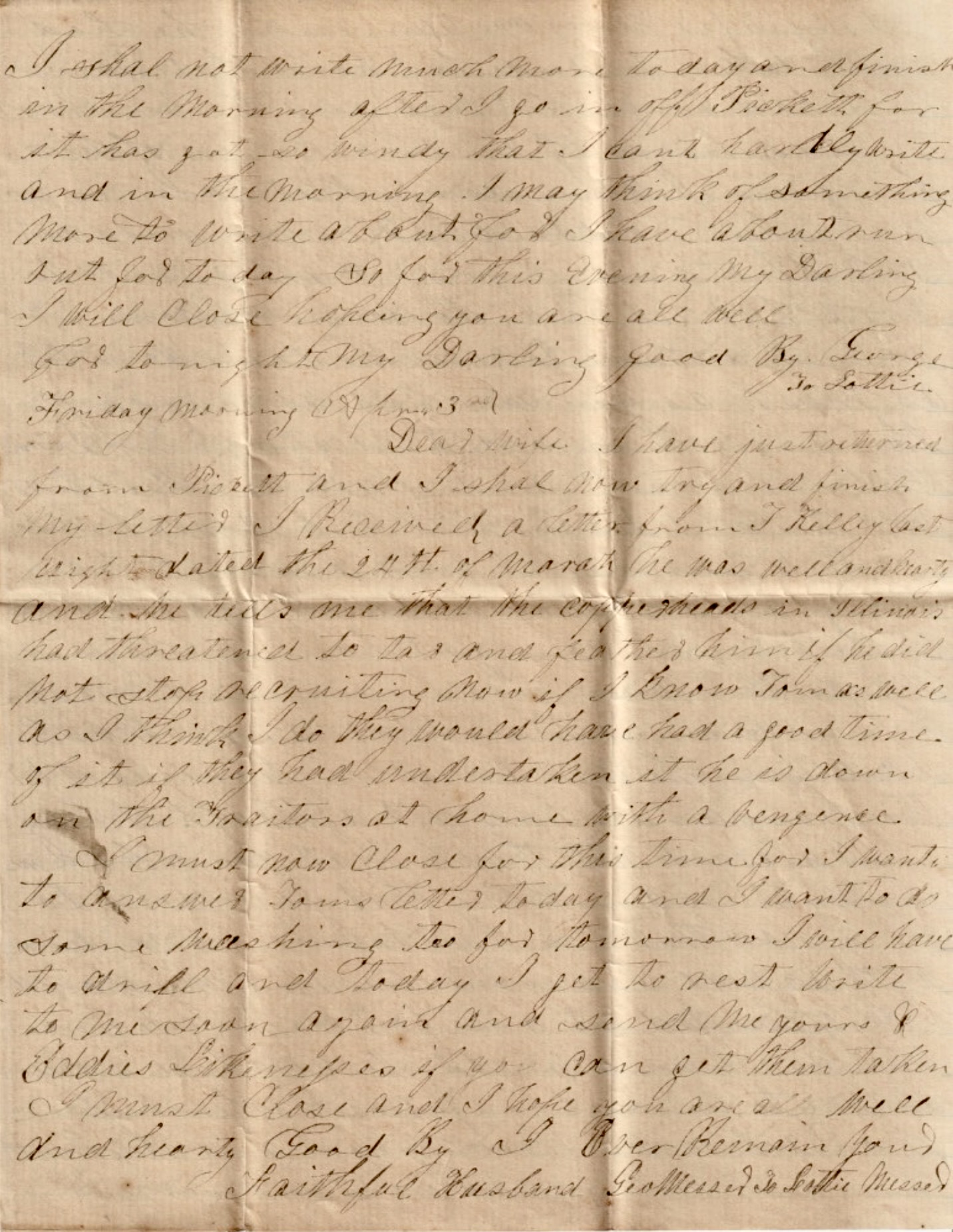
I shall not write much more today and finish in the morning after I go in off picket for it has got so windy that I can’t hardly write and in the morning I may think of something more to write about for I have about run out for today. So for this evening, my darling, I will close hoping you are all well for tonight. My darling, goodbye — George
Friday morning, April 3rd Dear wife, I have just returned from picket and I shall now try and finish my letter. I received a letter from T. Kelley last night dated the 24th of March. He was well and hearty and he tells me that the Copperheads in Illinois had threatened to tar and feather him if he did not stop recruiting. Now if I know Tom as well as I think I do, they would have had a good time of it if they had undertaken it. He is down on the traitors at home with a vengeance.
I must now close for this time for I want to answer Tom’s letter today and I want to do some washing too for tomorrow I will have to drill and today I get to rest. Write to me soon again and send me yours & Eddie’s likenesses if you can get them taken. I must close and I hope you are all well and hearty. Goodbye. I ever remain your faithful husband, — Geo. Messer
To Lottie Messer
1 Mart Phares was a soldier in the Union army during the war, having enlisted at Clinton, and rendered good service. He has been receiving a pension for disability sustained during the war. He went to Lombard University but did not graduate. He had a strong predilection for music, and early began playing for balls. He made music his profession. He played with so much spirit and with such feeling that his execution proved pleasing and acceptable. He was a good caller, having in his palmy days a good, strong voice and was in great demand. For a generation or more he has been associated with an orchestra, either his own or someone else’s. He was looked up to with affection by the other players here. No man has rendered more or better service to the social world here than has Mart. He has directed some of the most brilliant parties ever held in Galesburg. He has played not only for the old but for the children. The violin was his favorite instrument, and who can tell how much pleasure it has given to others under his willing hand. Mart is dead. His favorite is stilled, no more forever to be caressed by his touch. No more will he be seen directing the movements of the dance his face beaming with pleasure. He was known to more men, women and children then any other man here. All called him Mart. He ministered to the pleasures of others, caring little for his own. He was a simple soul. He bore no ill wills. He had a kind and affectionate word for other musicians. No one enjoyed more than he did the concourse of sweet music. He could be seen at every concert of any note, drinking it all down. He was looked up to as a sort of big brother by the younger. He may not have been distinguished; he may not have performed any great deed that will cause his name to go ringing down the corridors of time; but he made life sweet, enjoyable and tolerable to others. Many great men fail to do that. [Source: Obituary, Clinton Public]



Letter 2
107th Regiment Illinois Volunteers, Co. F
Camp Hobson, Glasgow, Kentucky
Sunday, April 12th 1863
My dear wife,
I seat myself this day at [ ] o’clock to write you a few lines to let you know that I am well and hearty and I hope these few lines may find you all well. Everything is bustle and excitement here now. We are expecting an attack here every day and the whole regiment has turned out to finish up our fort and cut down timber. In two days more we will have our earthworks complete and then we are making an abatis around the outside of the ditch and for fear you won’t know what it is, I will tell you. It is made out of saplings trimmed with the limbs about three feet long and sharped at the points. The trees are placed with the butt towards the ditch and the shgarp points out with dirt throwed in the butt of them to kep them stationery. This is to prevent the Rebels from taking the place by storm. When they come up, they will run against the sharp points of the abatis and give us time to shoot them before they can get through. It is the general opinion of the officer commanding here that we will have to fight them in less than a week and perhaps inside of the next twenty-four hours.
There was a letter intercepted by one of our men from one of the Rebels to his wife in which he said that they would visit Glasgow the 15th of this month for they might as well come here and get shot as stay where they was and starve to death for they had nothing to eat and could get nothing unless they could come into Kentucky to get it. If they come, depend upon it, they will fight with desperation and they will be received with firmness on our part. I expect to get a letter from you this evening and I would wait until tomorrow to send this but the mail may be cut off from us by that time and I want you to know how we are situated here. Still I don’t want to discourage you but you have a right to know the truth, let it be good or bad. I am not alarmed in the least and I don’t want you to be for it may all blow over in a few days and not amount to very much at all.
You must excuse this short letter and poor writing for I have but one hour to write in and then I will have to go to work so I have to write like a horse on a gallop. We commenced to work with the whole regiment yesterday morning and have made considerable show. I have nothing more of importance to write this time and in fact, have not time to write much for my hour is nearly up. I will write to you again in a day or two if there still remains a chance to send letters and if we should have a fight, I will give you the earliest intelligence of the result that I possibly can.
I must now close for today. I send a kiss to you and Eddy. My respects to all. Goodbye. Your ever loving husband, — Geo. Messer
To Lottie Messer
Write often and remember yours, — George


 Spared & Shared 23