
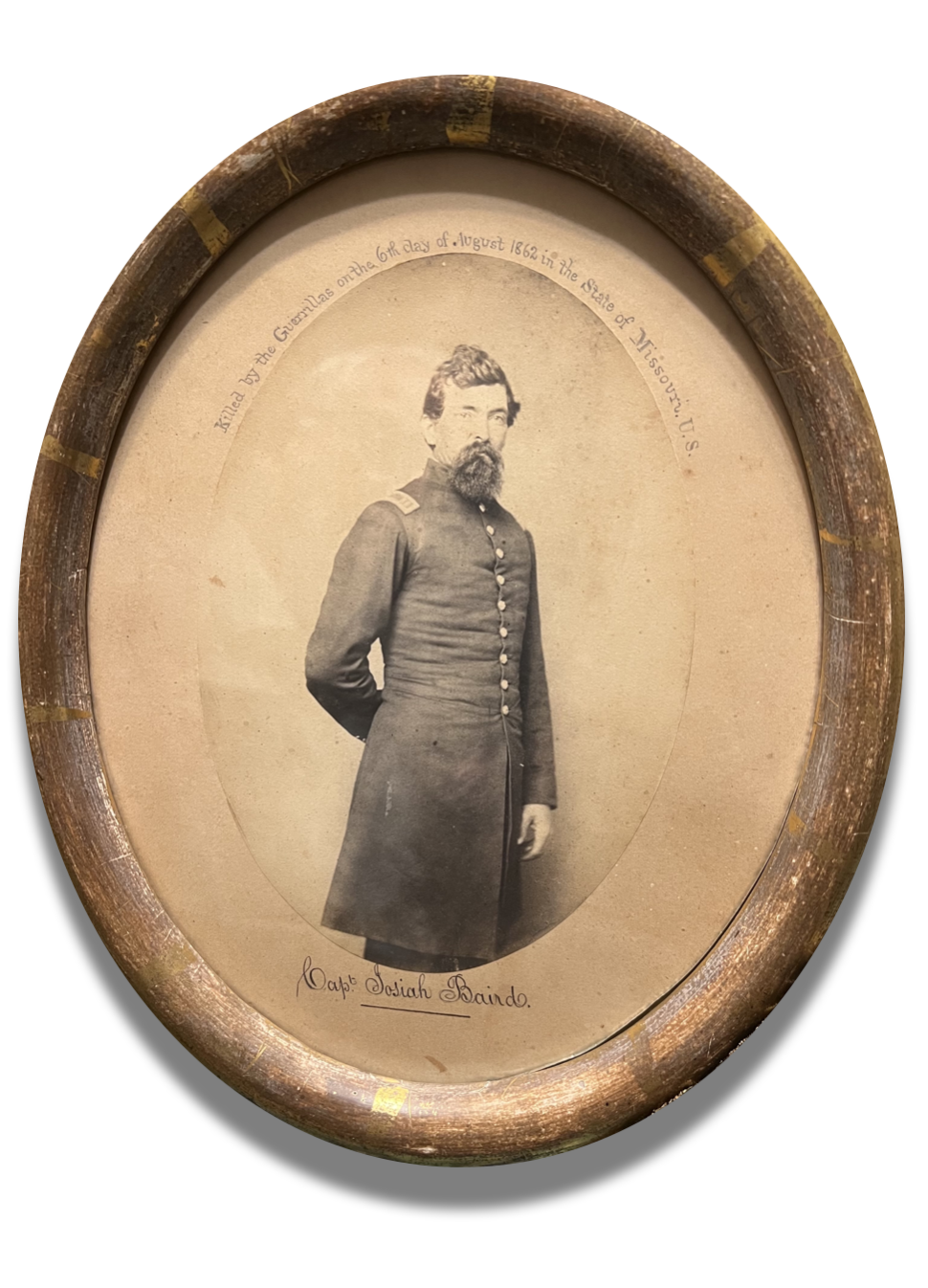
Recently I was sent transcripts of Civil War letters written by Capt. Josiah Baird, Co. D, Merrill’s Horse, St. Louis, MO. These transcripts were made from the original letters about 1960 by Grace Baird—a Baird family descendant—and passed on to me by John Baird, Grace’s grandson. Earlier this year, John had sent me letters written by a younger brother of Josiah’s named Robert Baird who served in Co. H, 49th Pennsylvania Infantry [See—1862: Robert Baird to his Family]. He also sent me a letter by another brother named Henry Baird, who died in the H. L. Hunley submarine accident [See—1861: Henry Baird to William Baird]. Most of Josiah’s letters were written to a fourth brother named John Baird.
In the previously published Baird family letters on Spared & Shared, I was provided with scanned copies of the original documents to verify the accuracy of Grace Baird’s transcriptions completed 65 years ago. Regrettably, the whereabouts of Josiah’s original letters remains elusive to the descendants of the Baird family except for the one dated 28 December 1861. Nonetheless, I have chosen to publish these transcriptions for several reasons. Firstly, having examined Grace’s transcriptions of other family letters, I can confidently vouch for her expertise in this undertaking, giving me little cause to question the accuracy of her work. Secondly, there exists a considerable community of Civil War enthusiasts who have a keen interest in the Merrill Horse Regiment; Josiah’s letters from the war are substantiated and enriched by transcriptions of pre-war correspondence, which offer valuable insights into the challenges faced in Missouri prior to the conflict.
Background
Josiah Baird was the 10th child (8th son) and 7th living son of William and Nancy Harlison Baird. Josiah was born in the old family home near Pleasant Gap, Centre Co. Pa, on Aug 3, 1826. The family farm has since become a Pennsylvania State fish hatchery. Josiah grew up with his brothers and one sister—William being 20 years old when Josiah was born—John 18, James 15, Eliza 14, Samuel 11, Robinson 7 and Henry 2.
The first we hear about Josiah is when he was 20 years old, from a letter dated May 2, 1846 and written by a David B. Larimore, New Wilmington, Mercer Co. Pa. to John and Hannah Baird. The salutation was “Dear Cousins” but to date the relationship has not been determined. His mother was Eliza Baird and father David Larimer or Larimore, but even Margaret Ellen Baird McClelland did not know the connection, for in her notes she wrote, “Who was Eliza Baird.” In this letter he say he is “anxious to hear how Samuel is and whether he had got able to work or not. How are you getting along with your barn building and if Josiah went to a trade. Also how is William getting along building his house.”
Josiah evidently took up the trade of carpentry and cabinet making for several years later we hear he had a little cabinet shop on the property where he and his family lived in Clearfield, County seat of Clearfield Co. Pa.
On Dec 29, 1852, Josiah was united in marriage to Mary Fetterman Merrill, daughter of Wm. Merrill, Esq. by Alex McLeod, rector of St. Andrews Church, Clearfield. He was 26 and she was 15. She was born May 11, 1837.
The 1st letter we have from him was dated July 1853, Clearfield, and written to his brother John at Bellefonte in which he states they are all well and that he was very busy. He wants Hannah to save some butter and lard for him for he said, “It is impossible to get butter here without going 20 miles for it and paying twenty cents a pound and lard is not to be had here at all. Times is pretty hard here now. The money matter is suspended till Spring. Give my respects to Father and Mother and all the friends. Mary joins in sending her love to you & Hannah, Father & Mother, your brother, — Josiah Baird.”
Josiah’s next letter was dated, Clearfield, Sept 26, 1855. “Dear Brother, I take the pleasant opportunity in answering your letter which I received this evening. It was better than 2 weeks on the road. I was very sorry to hear of Mother’s illness, but I hope these few lines may find her much better. [She died Sept 23, 1855]. If I had got your letter last week I would have gone over. I will wait until I hear from you. You must write as soon as you get this letter and let me know if Mother is getting well and if Henrietta has a bad turn. The dystantery [dysentery] is very bad in Clearfield. There has been more deaths in Clearfield this season than there has been for many years. We are all well at present. William Henry is pretty well again. He had a very hard turn of dystantery. Mary joins in sending our love to all of you. I remain yours, — Josiah Baird. P. S. If Mother gets worse you must let me know and I will come over to see her.
Josiah’s next letter to John was written on September 3, 1857 at Clearfield, Pa. and refers to the hard times caused by the Financial Panic of 1857. “I take the opportunity of writing to you to let you know that we are all well at present in Clearfield. I have not heard from home for some time. I believe I wrote last. I received a letter from Henry last week [this is the Henry Baird who died in the H. L. Hundley submarine accident in Charleston Harbor, October 15, 1863]. They were all well in Mobile. He says times are very dull in Mobile this summer but he says the prospects for the winter season is better. We have trying times in Clearfield. At the present time, it is feared that our lumbermen will all fail. There was four of the merchants went to Philadelphia last week for money and returned without it. They say they can’t pay a dollar. The most of the money that is in Clearfield is New York money and the news came last night that they had all failed or suspended. If that is the case, it is still worse for Clearfield than the failing of the Pennsylvania banks. I don’t know how it is going to terminate. There must be a change soon or else there is going to be trying times here soon…I expect to come home some time this fall or winter. I will finish my work in about 2 months. I am preparing to go West in the Spring if times will admit. Mary joins in sending love to Father & Hannah, yourself and the rest of the friends. Wm Henry is growing to be quite a large boy. We can send him to the stores & shops on errands. Nothing more at present but remain your affectionate brother, — Josiah Baird.”
On May 11, 1858, Josiah wrote a letter to his father from Clearfield, Pa. It reads in part: “I take up my pen to inform you how I am getting along in the getting ready to go West. Times is a great deal harder than I thought or when I was to see you last. I have fell short considerably of what I expected to go West with. I have tried to get money on a loan. I offered 15% but could not raise it. If you could raise me $50 for 3 or 4 months, I would be willing to pay 10% rather than not get it. I have a lien that I can half collect in 4 months which I could raise the money for you in that time. I have rented my house and has taken no work so I am obliged to do something. I can’t afford to pay board and do nothing. There is no work to be had now. Had I known this 2 months ago I might have had some jobs. We are all well. Mary joins in sending her love to you, John & Hannah. Nothing more but remains. Your affectionate son, Josiah Baird”
Sometime in the summer of 1858, Josiah again addressed his father in a letter datelined from Chillicothe, Livingston county, Missouri: “I take the present opportunity of informing you of my whereabouts and my prospects. I am enjoying good health at present and I hope these few lines find you all enjoying the same blessing. I have been very sick since I left home. When I was in Iowa, I had an attack of fever but a very light turn. I was amongst strangers but not without friends. Had it not been for the Odd Fellows, I expect I would have had a very hard time of it. They moved me from the Hotel to a private house and nursed me well. It cost me but three dollars. Since I got well, I feel better than I have for a year. I have gained 10 lbs in 2 weeks. I have been to work in this place for 2 weeks. I commenced working for $1.75 per day. I am now making $2.00. I am paying $2.50 per week board. I have taken two jobs—a church and a storeroom. I will commence them in two weeks if I have luck and not disappointed in hands. I will clear $500 on them. I am getting double the amount for the church that I could in Penn. and can hire hands as cheap here as I could there and board is not any higher here than in Clearfield.
Chillocothe is a very pretty place. It is situated on the Hannibal & St Joseph railroad and in a good farming country but not very well farmed. The city stands on a high rolling prairie and not over one half mile from timber. In fact, the timber comes to the edge of the city. Lots can be bought from $125.00 up to $300 & $500. There is a hotel going up 100 x 175, four stories high. If I had been here sooner I would have had the job and may get the managing of it yet. The man that is doing it is working by the day & is no mechanic. Land is rising very fast in this section of the state. There are a great many Eastern men coming here. Land joining the city is worth from $25 to $50 per acre. Three or four miles it can be bought from $12 to $15 according to location. There is some as pretty land in this country as ever I saw. I passed over some prairie coming to this place that can’t be beat in any state that can be bought for $6 per acre within 3 miles of the railroad and within 10 miles of this city. I think a man could do well in this country to going to the cultivating of fruit. The farmers have been very dilatory in the way of raising fruit. I have seen but one or two orchards.
I must give you a history of my travels from Bloomington to this place. I gave it in Wm’s letter to that place. When I left Bloomington, Macon Co, Mo., there were 9 of us. The road was so bad we were afraid to ride in the stage so we hired an ox team. An ox team in this country is from three to six yoke. We had three. Well, there was five ladies in the party and three men besides myself, and there was not any of the party that had ever seen many hardships. They had all been raised in the city—Cincinnati. We got along very well the first six miles then we came to the Chariton River. Were ferried over. The Ferryman told us that we would have to hire a pilot to take us across the bottom. We gave a man $2 to ride before the oxen. We got about one mile when the oxen stalled. Then we had two miles to go. There was no other but get out and wade for it. I got out in water up to the waist. The balance of the men got out and we tried to make the oxen pull the ladies, but they could not do it so three of them got out & waded 2 miles in water to the waist. I began to think traveling in the West was pretty hard. After we got over that place, we had four other creeks to cross at which I had to make a raft to take the ladies across and swim the team. We sent the oxen back and got a horse team at Linneus, the count seat of Linn Co. We were five days coming sixty miles. Part of the road was very good and we came over some very nice country but along the streams it is hard country. Probably you have heard a great deal about the people of Missouri and the border ruffins. I see nothing wrong with the people as far as I have travelled in this state. Never hear Kansas mentioned. I have never been asked my politics since I came here. I still remain your affectionate son, — Josiah Baird.”
As Civil War loomed, Josiah struck up a more frequent correspondence with his brother John. Writing from Chillicothe, Missouri on 4 February 1861, Josiah wrote: “Times are very hard in this country at present and no prospect of getting better soon. Provisions are cheap but no money to buy them with. Money is worth from 4 to 5 per cent a month. If the National difficulties is not settled soon, I don’t know what will become of us in this portion of Missouri. Almost all the people here have got all their means invested in lands & they can’t turn it into money now. There is a great many leaving. Some going north & some going south—more going south than north. There is a great many want to go if they had the means to go with. We have an election in this state on the 18th of this month to elect delegates to a state convention to decide whether we will go with the balance of the southern states. We have some seceders in this state but there is a large majority in favor of the Union. We are going to see hard times unless there is a union of all the states. I have been idle for 3 months and it is hard to tell how much longer it will be. There is nothing doing nor won’t be till this difficulty is settled. If I could sell, I would leave the border for awhile.”
Then, two weeks later, 20 February 1861, Josiah wrote his brother again: “We are having very exciting times in this state at present, and I don’t think the worst has come yet. We had an election last Monday to elect delegates to a state convention. There is 3 from each sectional district. The district we are in has elected Union candidates by 2000 majority. The seceders are very much down in the mouth (the old snake killers as they are called000that means the old settlers). The Union men are not in favor of going out of the Union until all constitutional remedies are exhausted. The secession candidates are for immediate secession. The old citizens brand every Eastern man as an Abolitionist—it don’t matter what his political views are. I have seen some hard fights over it and came very near it myself. I was attacked on the day of the election by some three or four cutthroats, but when they saw I would not run, they drew their revolvers but was a little too drunk to use them. I happened to be armed with a colt revolver and a ten-inch bone knife. When they saw me draw my weapons they ran. I was very glad I got clear of using them. My opinion is Missouri will stay in the Union if all the balance go out, although there will be some hot times and a great many lives lost.”
On 20 May 1861, Josiah wrote to John: “No doubt you have heard there has been a fight in this state at St Louis between the United States troops and the State Militia or I might say the Missouri Secessionists. Six hundred of the latter was taken prisoners. It created quite an excitement in the interior. The secessionists in part of the state are for driving out all the Union men out of the state and in a great many places they have driven them out. I know of twenty in our neighborhood that were made to leave. In this city the secessionists have the majority but the union men have the pluck. We won’t be driven out. We will die first. If I could have collected my money I would have left this state until the troubles were over but that is out of the question now. Every thing is at a stand still and nothing doing, nor no money in the country. I don’t expect to be able to do anything this summer. There is no credit here now—especially a northern man. If I had a team I would have put in a crop this season, but I had none and I would not go in debt for one here.”
A month later, on 17 June 1861, Josiah wrote to John: “Hurrah for the Union & the Stars & Stripes. We are having hot times here now. Our city was taken in possession by the United States troops on Friday last – 600 landed here on the cars about 12 o’clock. Before the cars stopped they were half way through the city on a double quick time. The secessionists troop saw them come. They took to the brush and has not been heard of since. Ha Ha. So much for Southern chivalry. There is about 60,000 troops in this state from Illinois & Iowa. They have taken possession of all the principal cities in the state.
“My life has been threatened by half a dozen. I am not afraid. The stars & stripes float over my house. They will float there til I die.“
Josiah Baird, 17 June 1861
The Governor [Sterling Price] called for 50,000 state troops. After he issued his proclamation, he left for the South—him & all his officers. If he is caught he will be hung to the first tree. We have had a great deal of treachery with the officers of the state to force us out of the Union, but thank God they were caught in time to save the state from destruction. I have very hard getting along. I have not collected a dollar for nine months. I will loose about one thousand dollars by men running off & going south. If I could only raise money enough to send Mary home, I could get along. I would go into the army. I can get a commission as captain. Mary is very near scared to death. My life has been threatened by half a dozen. I am not afraid. The stars & stripes float over my house. They will float there til I die. I will have to close. I must send this by hand to Illinois. Our respects to all. Good by. — Josiah“
Two weeks later on 5 July 1861, Josiah again wrote from Chillcothe, Missouri: “We have still a great deal of excitement here. We don’t know what day there will be an attack upon the city by the Rebels. We are taking prisoners every day—spies sent into camp. We have 1,000 men stationed in & within six miles of this city on the railroad. We are trying to get up a regiment of men in this county for home guard, but to be sworn in for three years. I am elected captain of one of the companies. If we get into service & should happen to get into an engagement we will not show much quarter to the Rebels. We have lived long enough with them to know if they got the upper hand, we would have to hang, but fortunately the boot is on the other leg. I think some of them will smell hemp. They have formed guerrilla parties all over the state. They stole 1,000 horses & mules in our county all from Union men. I don’t know whether I will live to see it or not but nevertheless, it will come to pass. This state will be white yet. We had a splendid old Fourth of July. The morning of the 3rd the secessionists said we could not get up a celebration on the Fourth. We went to work after dinner was over. We had dinner on the Fourth for 1,000 men & had a glorious time generally. The Iowa 3rd Regiment is a fine looking lot of men with uniforms. Iowa is doing nobly. We are without a state government. Our governor has run off & gone to Arkansas. It is to be hoped he never will come back.”
Two weeks later, on 16 July 1861, Josiah shared even more troubling news: “I once more take the liberty of addressing you to give you the news of the day. When I wrote you last we had not had any fighting in North Missouri. We are having it now plenty and to spare. The Rebels commenced by burning bridges on the Hannibal & St Joseph R.R. at Monroe—100 miles from this place. They burnt the station depot & 3 trains of cars, 2 bridges & tore up considerable track. They had a fight with the troops. Col Smith of the Illinois commanded the government troops. General Harris the Rebels. The fight lasted 48 hours. There were 700 of our boys & 3600 of the Rebels. There were six of our boys wounded (none killed). They are all doing well. The Rebels lost, killed & wounded 120 – 60 horses taken & 50 stand of arms. Yesterday the Rebels fired into a train on the North Mo. R.R. killing one and wounding six. They lost ten killed, 20 wounded. We captured 40 horses. In all the fighting in North Missouri, we have lost 1 killed 20 wounded. You will see it in the papers.
Mary started this morning to Illinois. I sent her to Jacksonville. There were 5 ladies going there. If I had money I would have sent her home to Clearfield. I will be compelled to stay and see it out. I started Mary with barely enough to pay her fare there (Illinois). I have to borrow & pay a dollar a week for it. She is amongst strangers where she is. I must get her home somehow. I will try and get out of these rebels what I have lost by them. I have a company of 100 men as true as ever mounted a horse. We will be mustered into service as soon as we can equip. I have not time to write a long letter. I have just come in from a scout & am nervous. You said you could send me a draft. Yours truly, Josiah Baird”
Civil War Letters
Letter 1
Benton Barracks, St Louis, Mo.
September 21, 1861
Dear Brother,
I take the present opportunity of writing you a few lines in a hurry. I am ordered to get my command ready for an hours notice. Where I am going, I do not know. I have been appointed Captain, commanding the first squadron in the regiment.
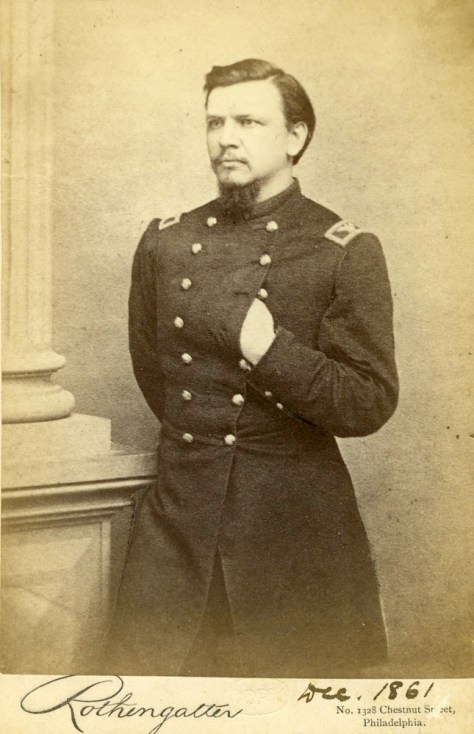
Our Col. is a splendid officer. He was a graduate of West Point and since that time has been in service of the United States for 12 years. His name is Lewis Merrill—was born in Union Co. Pa. His father was a lawyer and practiced in Bellefonte a number of years ago. You will know our regiment by the name of Merrill’s Horse. It is an independent regiment. If you look at the papers you will probably hear from us. Mrs Baird is in Jacksonville, Ill. I wish she was at home. I will have to wait till I get a payment from the government. My wage is $143 per month.
I had a letter from Robert yesterday. I was surprised to see him in service. We are all needed and more too. Missouri is all in the hands of secessionists but St Louis & Jefferson City. Write often. Direct to Josiah Baird, Captain Co. D, Regt. Merrill’s Horse, St. Louis, Mo.
I will have my letters forwarded from St Louis. Give my love to Father and all the friends.
Letter 2
Camp Merrill
Jefferson City, Mo.
October 8, 1861
Dear Brother: I received your kind letter yesterday. It found me well. I have not time to write you a long letter. I am just waiting for transportation. My squadron is sent on detached services. I am going up the south side of the Osage River. I cross at Osage Bluff and proceed to St. Thomas. From there Barnett Station [and] from there Iberia, Tuscumbia (both in Miller Co.) & cross the river. Then to Stone House. From there to Syracuse (Morgan Co.) on the Pacific R.R. and rejoin the regiment. I expect to get into a fight before I join the regiment. I have 130 men. At Iberia there is from three to six hundred secessionists. I feel confident of routing them. I will let you hear from me on this event. It will take me two weeks to make the trip. I have a team of ten wagons with me. If I have to lose, I will destroy my wagons. We had a stampede with our horses last Thursday. We lost 50 and 4 or 5 men hurt badly.
I appreciate your advice and will try to live up to it if it is in my power. Give my love to father, your lady & all the balance of the friends. Your affectionate Brother,– Josiah
Direct to Capt. Baird, Co D., Merrill’s Horse, St Louis, Mo.
Letter 3
Camp McKinstry
Springfield, Missouri
November 7, 1861
Dear Brother,
I take pleasure in writing you a few lines to let you know how we are getting along in Missouri. We expected to fight in this place when we came in. When we got here, the enemy was fifty miles off. When we got to Quincy [Hickory Co.], 80 miles north of this, we was met by a messenger stating that Price was advancing on Springfield [Mo.] with 50,000 men. Fremont was there with 15,000. We marched 80 miles without halting. When we got in, the report was “the enemy’s pickets was within 10 miles, still advancing.” I told our Colonel I would bet him any amount they were not within fifty. The General was going to have me arrested for disputing his word. I told him I still stuck to what I said. He said he had reliable information that there was an advance of five thousand of the enemy at the old battle grounds (that is where Gen. Lyons was killed). We marched down and made a reconnaissance for five miles around but saw no enemy. The night before we got there, there had been four hundred passed through but did not stop.
Fremont has been superseded. What movement Hunter will make, I don’t know. I hope we will pursue the enemy into Arkansas and make them fight. We have got an army now that can clean them out so that they cannot organize in Missouri again. A soldier sees some pretty hard times but takes in consideration the cause. We stand it without grumbling. For my own part, I have fared very well. I have had good health. It rather got me to ride 80 miles without getting out of the saddle but [when I] think of poor regiments of infantry marching the same on foot, carrying a musket & knapsack & blankets, I can’t say a word. There is 40,000 troops at this place and 140 pieces of artillery.
Mary is in Clearfield. Give my love to all the friends. Write often. Direct to Capt. Baird, Merrill’s Horse, St. Thomas [Cole Co., Mo.]. The battleground at Wilson Creek is four miles long. A great many ladies & nurses are there yet. From your Brother, — Josiah
Letter 4
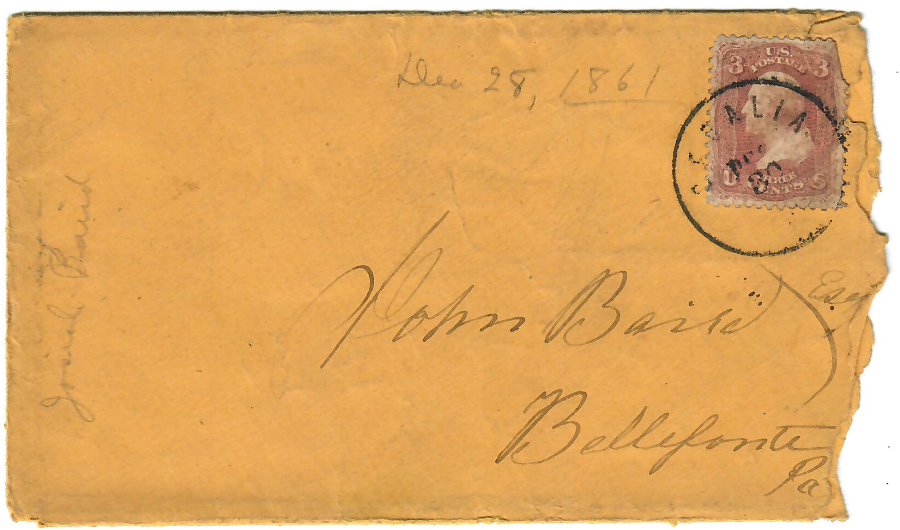
Camp near Sedalia, Missouri
December 28, 1861
Dear Brother,
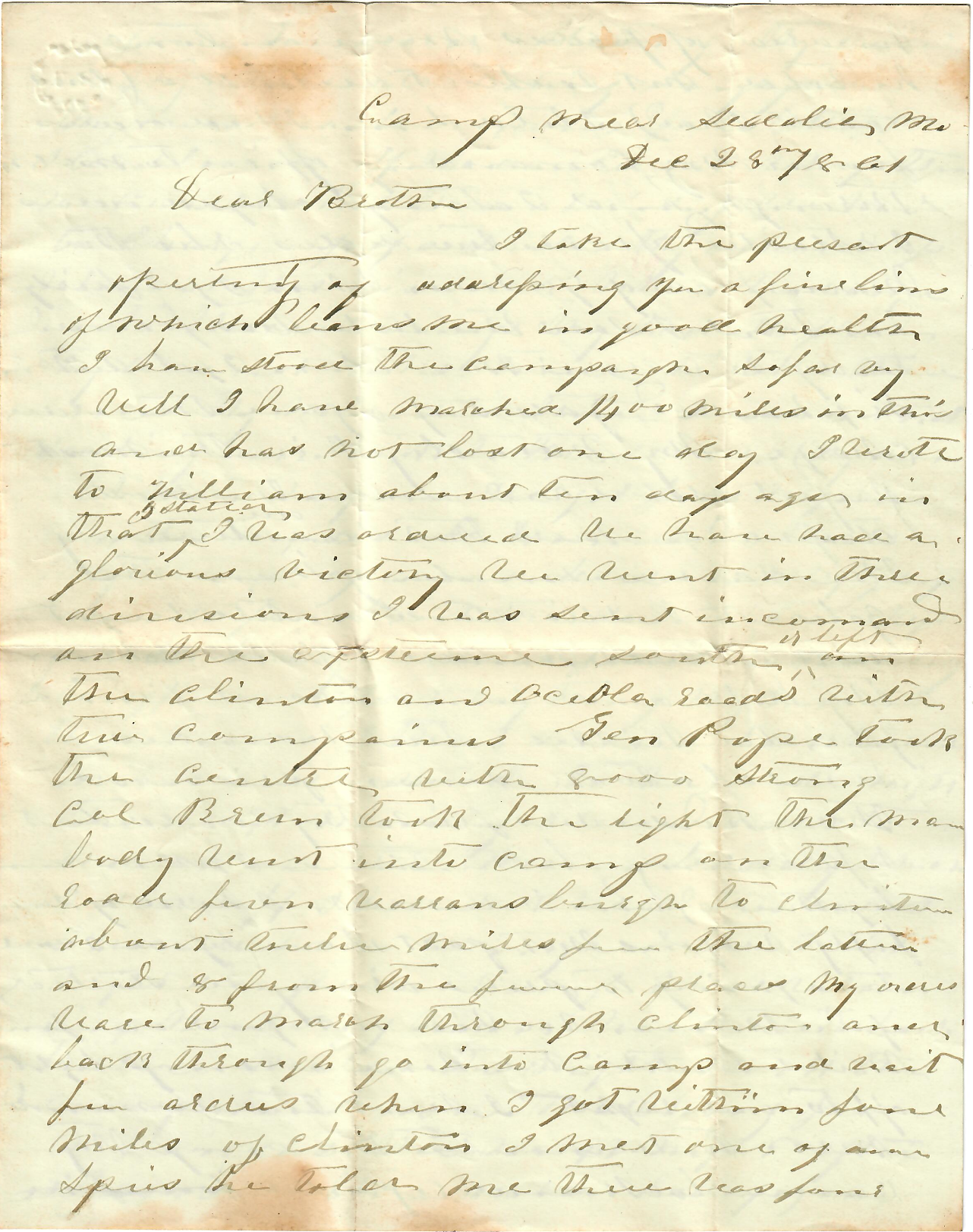
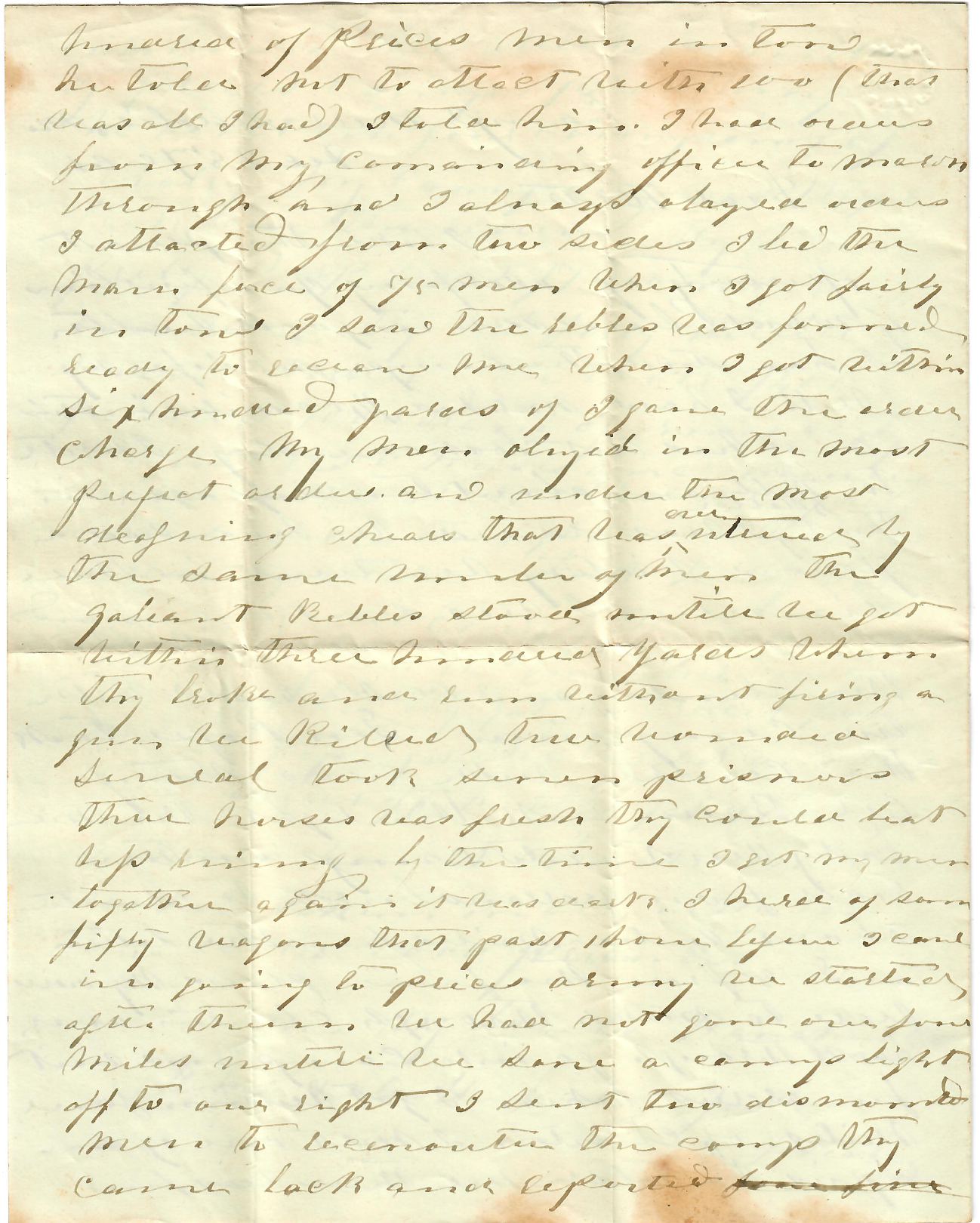
I take the present opportunity of addressing you a few lines which leaves me in good health. I have stood the campaign so far very well. I have marched 1400 miles in this and has not lost one day. I wrote to Wm. about ten days ago. In that I stated I was ordered. We have had a glorious victory. We went in three divisions. I was sent in command on the extreme southern or left on the Clinton [Henry Co.] and Osceola [St Clair Co.] roads with two companies. Gen. Royce took the center with 8,000 strong. Col. Brim took the right. The main body went into camp on the road from Warrensburg [Johnson Co.] to Clinton, about twelve miles from the latter and 8 from the former place. My orders were to march through Clinton and back through, go into camp and wait for orders.
I got within four miles of Clinton. I met one of our spies. He told me there was four hundred of Price’s men in town. He told me not to attack with 100 men (that was all I had). I told him I had orders from my commanding officer to march through and I always obeyed orders. I attacked from two sides. I led the main force of 75 men. When I got fairly in town I saw the rebels was formed ready to redan me. When I got within six hundred yards, I gave the order, “Charge!” My men obeyed in the most perfect order and under the most deafening cheers that was ever uttered by the same number of men. The gallant Rebels stood until we got within three hundred yards when they broke & ran without firing a gun. We killed two, wounded several, and took some prisoners.
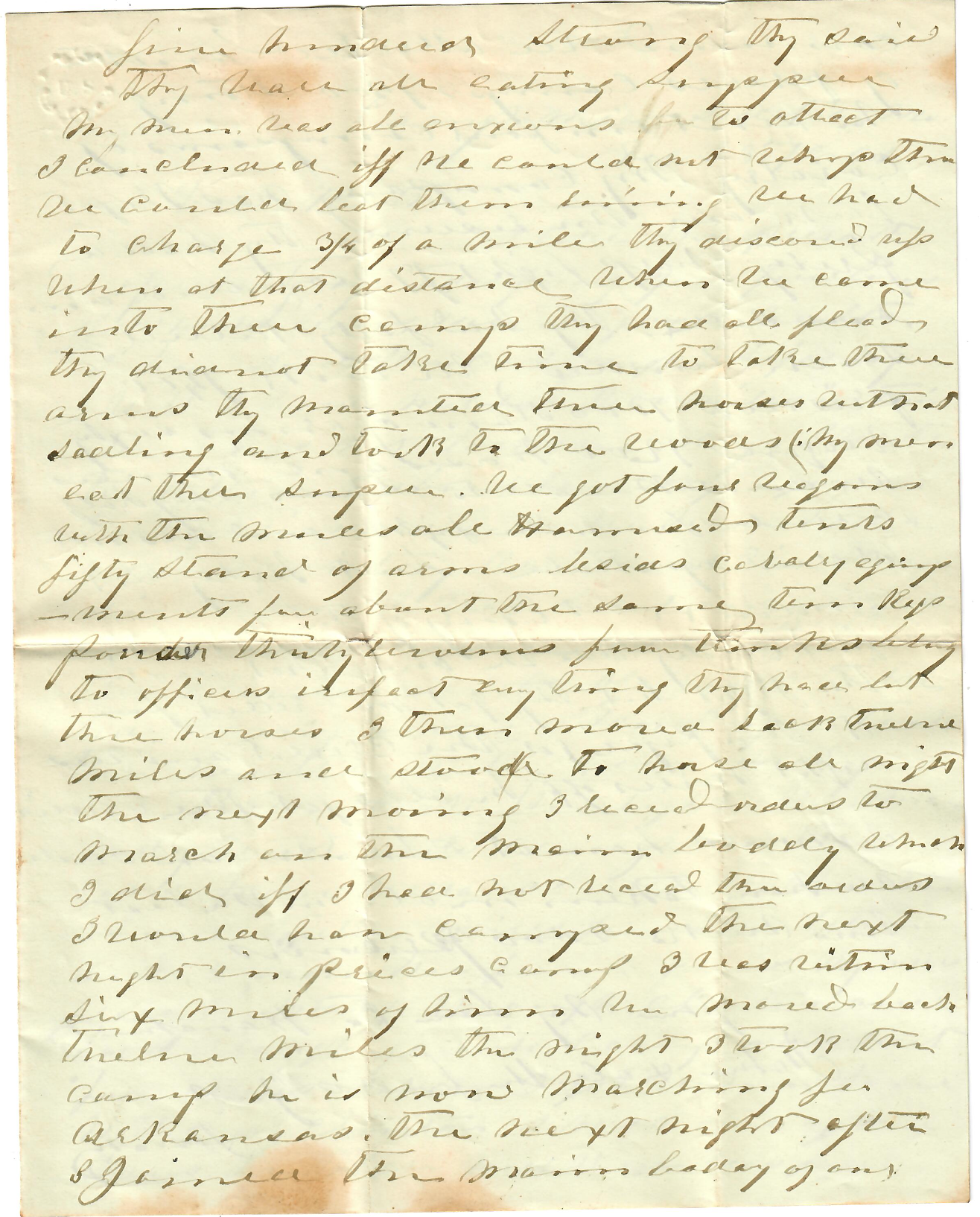
Their horses was fresh. They could beat us running. By the time I got my men together again it was dark. I heard of some fifty wagons that passed one hour before. I came in going to Price’s army. We started after them. We had not gone over four miles until we saw a camp light off to our right. I sent two dismounted men to reconnoiter the camp. They came back & reported five hundred strong. They said the men were eating supper. My men was all anxious to attack. I concluded if we could not whip them, we could beat them running. We had to charge ¾ of a mile. They discovered us when at that distance. When we came into their camp they had all fled. They didn’t take time to take their arms. They mounted their horses without saddling and took to the woods. My men ate their supper.
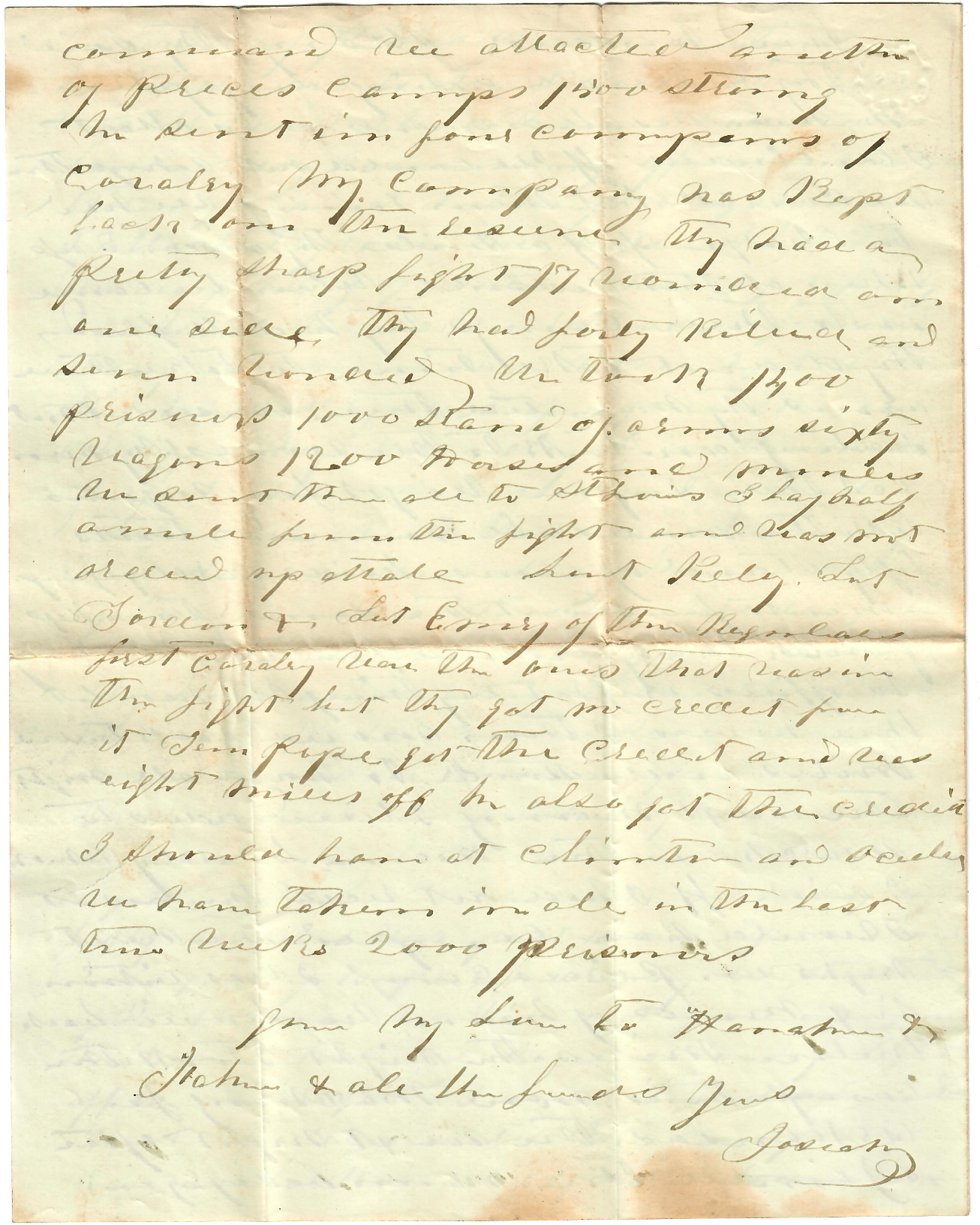
We got four wagons with the mules all harnessed, tents, fifty stands of arms besides cavalry equipment for about the same, ten kegs of powder, thirty [ ], four trunks belonging to officers, in fact, everything they had but their horses. I then moved back twelve miles and stood to horse all night. The next morning I received orders to march on the main body which I did. If I had not received the orders I would have camped the next night in Price’s camp. I was within six miles of him. We moved back twelve miles the night we took their camp. He is now marching for Arkansas. The next night after I joined the main body of our command we attack another of Price’s camps, 1500 strong. We sent in four companies of cavalry. My company was kept back on the reserve. They had a pretty sharp fight—seventeen wounded on our side. They had forty killed and seven wounded. We took 1400 prisoners, 1,000 stands of arms, sixty wagons, 1200 horses & mules. We sent them all to St Louis. I lay half a mile from the fight and was not ordered up at all. Lieut. Kelly, Lieut. Jordon & Lieut. Emory of the Regular first cavalry was the ones that was in the fight, but they got no credit from it. Gen. Royce got the credit and was eight miles off. He also got the credit I should have had at Clinton & Osceola. We have taken in all in the last two weeks 2000 prisoners.Give my love to Hannah & Father & all the friends. — Yours, Josiah
Letter 5
Camp Marshall
Sedalia, Missouri
January 28, 1862
Dear Brother,
I am laying in camp today trying to keep dry, but it is as much as a bargain. We are having a very wet time—mud knee deep and upwards. This the first wet time we have had since I came in the army. I am trying very hard to get a furlough for thirty days to get clear of the mud. If I accomplish it, I will be to see you. We have run the Rebels across the Osage River and I don’t think they will get back this winter. The river is rising very fast. They will all starve if they leave the state. I was in another little fight since Silver Creek but it didn’t amount to anything. No person hurt on either side. They surrendered without firing a gun. Secession is very nearly played out in Missouri. We will go south in five or six weeks to Memphis. Our Regiment has been applied for from different places—Washington, Virginia, Kentucky and Cairo. I think we will go down the Mississippi. I wish I could send my horse to you to recruit for me. I have rode him 2,000 miles in four months and he is not four years old yet. If I can get him some place to recruit till spring, he would stand the service next summer. I have three of them, all full blood. Two I got on the battlefield of Silver Creek, a black mare and a saddle I got with her. I was offered three hundred dollars for her. I intend to send her to Gardner Thompson in the spring to raise me a colt. There was five hundred contraband horses sold here last week from one to fifteen dollars. If I had been layed off I would have spent the last dollar in horses, sent them to Illinois and give one half for keeping them after then doubling my money. There is plenty of horses and guns here now. I have four hundred dollar shot guns. I intend to have one apiece for all my friends by Spring. There is nothing new in the Department of the West.
Give my love to Father, Hannah & the children, Wm’s family, &c. Yours truly, –Josiah Direct to Capt Baird, Co. D, Merrill’s Horse, In the field, St. Louis, Mo.
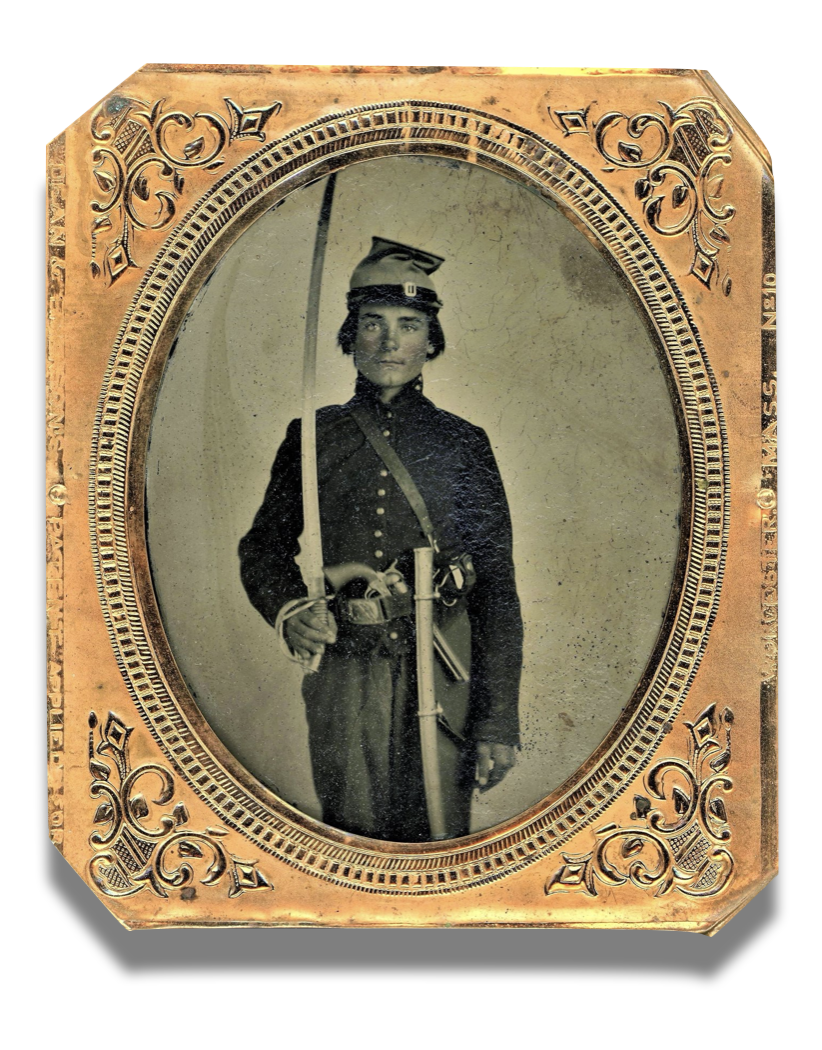
Death of Capt. Josiah W. Baird
Capt. Josiah W. Baird, a townsman of Clearfield Pa. and Commander of Company D of Merrill’s Horse was slain on Sat, Sept 6, 1862 in an engagement with a guerrilla band near Glasgow Mo. [Howard Co.]. 1 Mrs. Baird who was on a visit to her husband, accompanied by Dr. R. W. Landis, Chaplain of the Regiment, and the body of the captain returned to her home Friday evening. The community was taken by surprise as no notice of the disaster had reached it (the telegram which had been sent announcing the fact having failed to arrive, and only a short time before letters had been received here from Capt. Baird himself.
The facts of his death appear to have been these. Word was brought to the camp at Glasgow on Saturday morning that a guerrilla band was lurking in the brush some 8 or 10 miles north of Glasgow and Capt. Baird and a portion of his command were detailed along with some of the State Militia to proceed against them. Having reached the place, the advance was fired into by the enemy and Capt. Baird, having ordered his men to dismount, advanced at their head into the brush where the guerrillas were concealed. In the first charge of the enemy upon his advance, Capt. Baird fell mortally wounded. The femoral artery having been severed, he survived but a few moments. As he sank down, however, he discharged his revolver twice at the foe who were now in sight and animated his men to the charge. The guerrillas were entirely cut up and defeated and the man who shot Capt. Baird fell pierced by four balls.
The captain was greatly beloved by his men and highly esteemed by the officers of the regiment. No braver man or patriot has fallen in this war. He was born Aug 3, 1826. The obsequies were attended on Saturday. The whole community for miles around appeared to be present and the funeral was the largest ever seen in this place. A detail of military and the band accompanied the body to the church and then to the grave and it seemed to us that nothing could excel the exquisitely fine performance of the band on the occasion. The Rev. John M. Galloway, Pastor of the Presbyterian Church, assisted by Dr Landis conducted the services.
Headquarters, Reg’t Merrill’s Horse.
Macon City, Mo. Oct 19th 1862
1 CIVIL WAR INCIDENTS IN HOWARD COUNTY, PART I: 1861-1863 Compiled by William Lay
“One battle was fought on September 6, 1862, on the old Fristoe farm about four miles northwest of Armstrong. Fourteen rebels were on their way from Macon to join Price’s army. They were attempting to miss Glasgow, but someone reported them to the Federal soldiers stationed there. The rebels stopped at the old Fristoe home and went to the woods for dinner. While two of the group were gone to the well for water the Federal soldiers charged on to the other soldiers from out of a cornfield. The rebel captain offered to surrender but Captain Beard [Capt. J. W. Baird] of the Federals said. ‘We take no prisoners.’ The group from Glasgow included 40 Federals under Beard and about 40 of the state militia under Morgan. When Beard ordered the charge the rebel leader said for each to care for himself. All ran for cover except two who stood their ground. The name of one of these men was George Teeters [from Randolph County and only 17 years old at the time]. The Federals started firing and shots flew thick and fast for a few minutes. The rebel who stood with Teeters wounded Captain Beard and then the two gave up. The Federals fatally wounded Teeters and would have shot his companion if Morgan had not refused to do so. The Federals also captured the two men who had gone to the well. Beard was taken to the Fristoe house, where he soon died. Teeters body was not touched until permission was obtained from Glasgow to bury him. With $40 obtained from his pockets and some money that they contributed, the neighbors bought a suit of clothes and a casket and buried him. When the battle site was examined soon afterwards many shots were discovered high up in the trees on the opposite bank of the small creek. Many thought these shots were fired by Morgan’s men, many of whom were really southern sympathizers forced to fight in the state militia.” (Article by William A. Markland in the Bicentennial Boonslick History, Boonslick Historical Society, 1976, p. 96)
 Spared & Shared 23