

The following letter was written by Hazen Bedell (1785-1835) from his log cabin in Montebello, Hancock county, Illinois. Montebello existed for no more than five years, but settlers were originally attracted to its location on the Mississippi River. A ferry was established at “Montebello” in 1829 to cross the Mississippi River. Homes, streets as well as the court house were built but it would all prove to be a failure as it was too low in elevation and prone to flooding. According to an article in the Journal of the Illinois State Historical Society (1908-1984), Vol. 18, No. 4 (Jan., 1926), most of Montebello is underwater now, caused by the construction of the Keokuk dam. The town of Hamilton, Illinois, was later established in the same vicinity but at a higher elevation and at the foot of the rapids.
In a Journal of the Illinois State Historical Society (1908-1984), Vol. 18, No. 4 (January 1926), entitled “The First Permanent Settlement in Hancock County, Illinois,” author Calvin S. Sifferd, Jr. wrote that Montebello was located on the SW of Section 18 and that it was “the only logical place for a settlement on the river” as it was “the only spot where the shore came directly to the water. Every other foot of the river bank for ten miles up and down the river was either precipitous bluffs or tangled swamps. The river in front of the town was a dangerous rapid, but nevertheless the settlers were attracted to Montebello because of the timber. The majority of the settlers were from Ohio and Kentucky where they had become accustomed to broad timberlands and disliked to settle on the treeless prairie.”
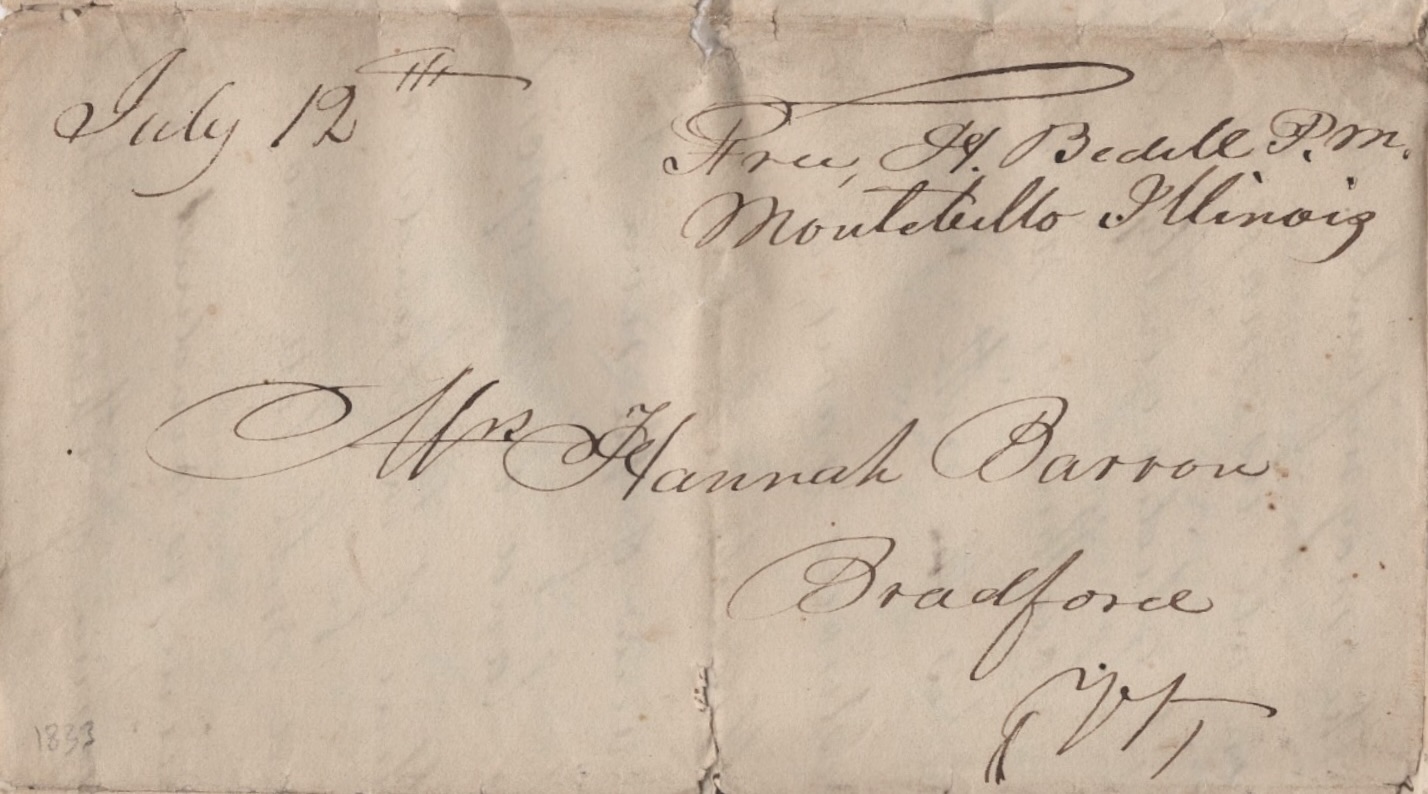
During the three years that Montebello was recognized as the county seat, court was held in Hazen Bedell’s cabin. The county seat was officially transferred to Carthage in 1833—the year of this letter. A post office was established in the town in 1829 and Hazen Bedell served as postmaster. You’ll notice that Bedell free franked his letter, the privilege of a post master and identified himself as PM (post master) on the outside of the letter. He served as post master until his death in 1835.
See also—Letter from Hazen Bedell to John W. Weeks, October 24, 1831

T R A N S C R I P T I O N
Montebello [Illinois]
July 7, 1833
My dear Niece,
I have waited a long time(and to confess the truth, not with that degree of patience that becomes a philosopher or a man on my experience in the promises of a fair lady whose promises have been aptly though perhaps rather severely compared with pie paste & consequently made to be broken) for your promised letter. Now “thinks i to myself,” I will just sit down & drop a line to my “fair cousin” and put her in mind of her promise.
Well, dear Hannah, I do not know how I can entertain you better than to give you a short description of my family & place of residence. My family consists of a wife (a second one) and three children—two sons and a daughter. My eldest son Edward Augustus, 17 years of age, and my daughter Ann Mariam 14 years old are children by my first wife whom I married in the State of New York previous to the late war. My third child, a son by my present wife, we call Lucian Lynch. He is three years old. My daughter is now absent at school.
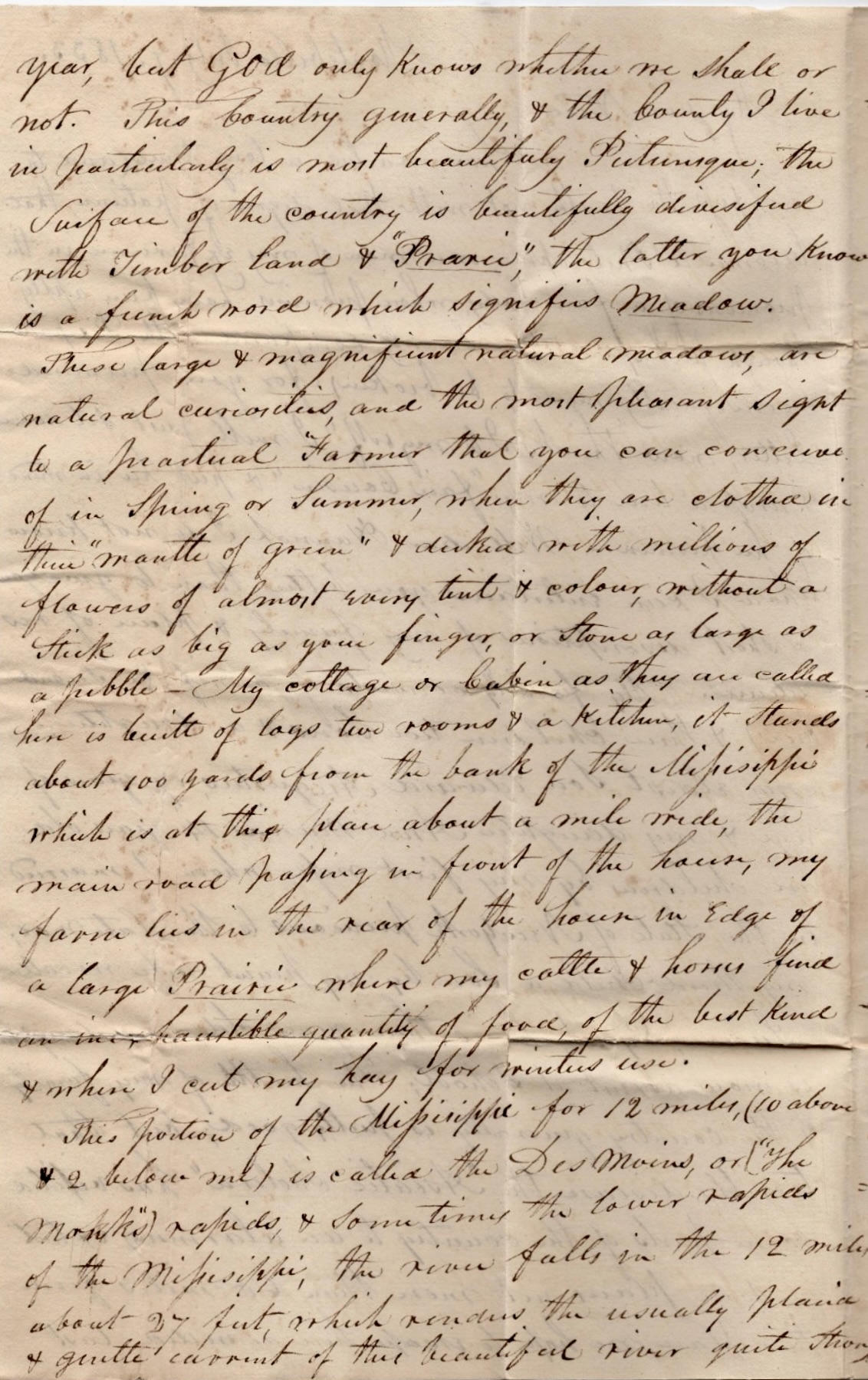
The health of my family & the country generally is pretty good but that terrible disease the “Asiatic Cholera” has visited some parts of the country to an alarming extent—in some places not more than 60 miles from this place. We hope to escape here as we did last year but God only knows whether we shall or not. This country generally, and the county I live in particularly is most beautifully picturesque. The surface of the country is beautifully diversified with timber land and “prairie,” the latter you know is a French word which signifies Meadow.
These large and magnificent natural meadows are natural curiosities and the most pleasant sight to a practical farmer that you can conceive of in Spring or Summer when they are clothed in their “mantle of green” and decked with millions of flowers of almost every tint and color without a stick as big as your finger, or stone as large as a pebble. My cottage—or cabin as they are called here—is built of logs two rooms & a kitchen. It stands about 100 yards from the back of the Mississippi which is at this place about a mile wide. The main road passing in front of the house. My farm lies in the rear of the house in edge os a large prairie where my cattle and horses find an inexhaustible quantity of food of the best kind & when I cut my hay for winter use.
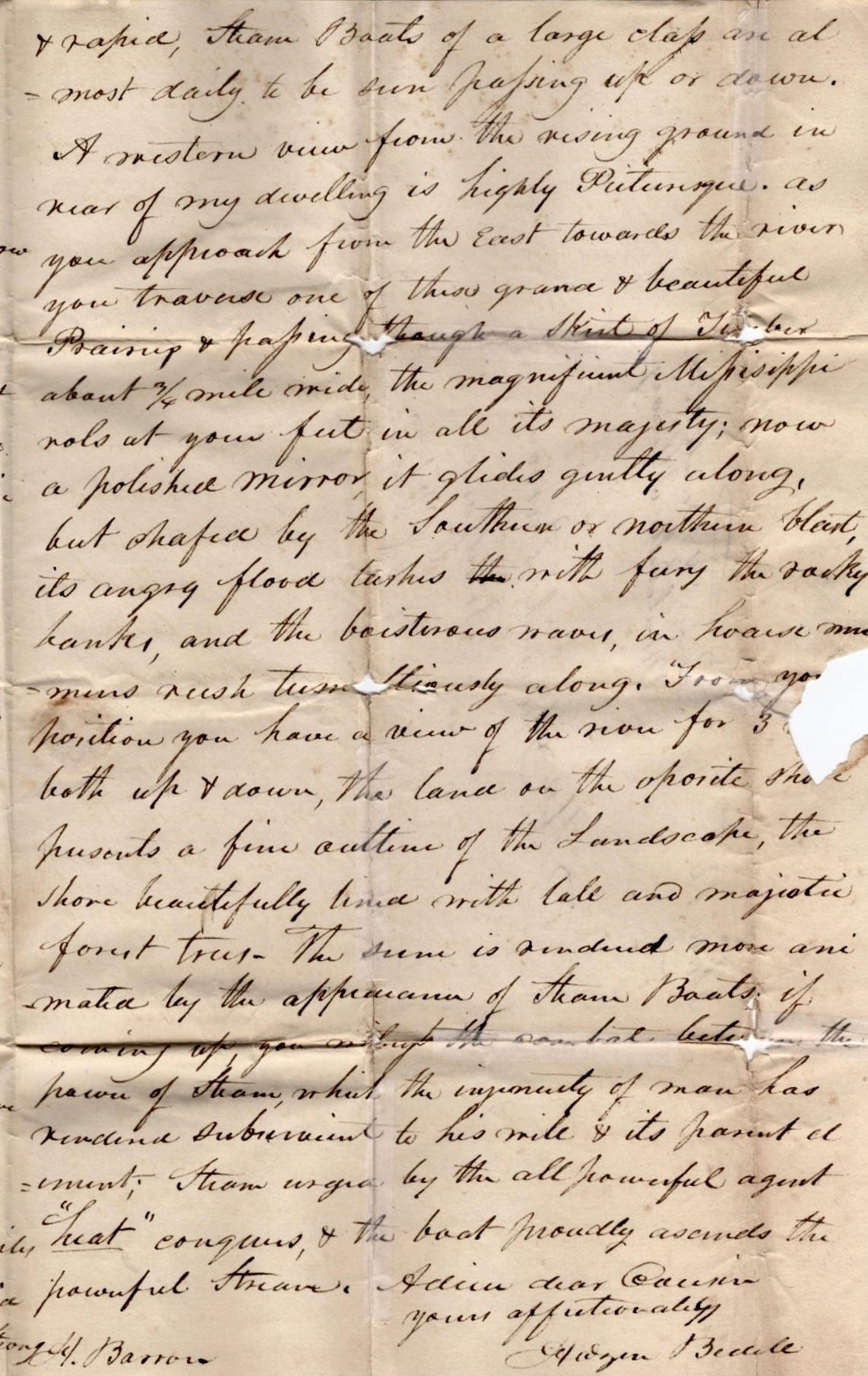
This portion of the Mississippi for 12 miles (10 above & two below me) is called the Des Moines (or “The Monks”) Rapids & sometimes the Lower Rapids of the Mississippi. The river falls in the 12 miles about 27 feet which renders the usually placid & quiet current of the beautiful river quite strong & rapid. Steamboats of a large class are almost daily to be seen passing up or down.
A western view from the rising ground in rear of my dwelling is highly picturesque. As you approach from the East towards the river, you traverse one of these grand & beautiful prairies, and passing through a skirt of timber about three-quarters mile wife, the magnificent Mississippi rolls at your feet in all its majesty. Now a polished mirror, it glides gently along, but chafed by the Southern or Northern blast, its angry flood lashes with fury the rocky banks and the boisterous waves in hoarse murmurs rush tumultuously along. From your position you have a view of the river for three miles both up and down. The land on the opposite shore presents a fine outline of the landscape, the shore beautifully lined with tall and majestic forest trees. The scene is rendered more animated by the appearance of steamboats. If coming up, you witness the combat between the power of steam, what the ingenuity of man has rendered subservient to his will, & its parent element. Steam urged by the all powerful agent “heat” conquers & the boat proudly ascends the powerful stream. Adieu dear cousin. Yours affectionately, — Hazen Beddle

 Spared & Shared 23