
The following letter was written by Mary W. (Milling) Milling (1828-1910), the cousin and wife of Dr. James Smythe Milling (1831-1895), and the daughter of Dr. John N. Milling (1790-1864) and Mary Elizabeth Whitaker (1801-1861) of Camden, Kershaw county, South Carolina. Mary’s husband was a physician and planter in Fairfield District, S.C. In 1859, Milling moved his slaves to a plantation in Bossier Parish, La., where he spent much of his time while his wife (and cousin) Mary W. Milling and their children remained with her family near Camden, S.C. In 1866, Mary and the children moved to Louisiana. The children were Minnie (b. 1857), Jane (b. 1859), John (b. 1860), and James (b. 1862).
Find-A-Grave indicates that Milling served the Confederacy in Co. B, 28th Louisiana Infantry (Gray’s), or “Mark’s Guards.” However, this letter in March 1863 does not suggest that he was in the service at the time.
See also—The James S. Milling papers, 1852-1883 at the University of North Carolina at Chapel Hill.
T R A N S C R I P T I O N
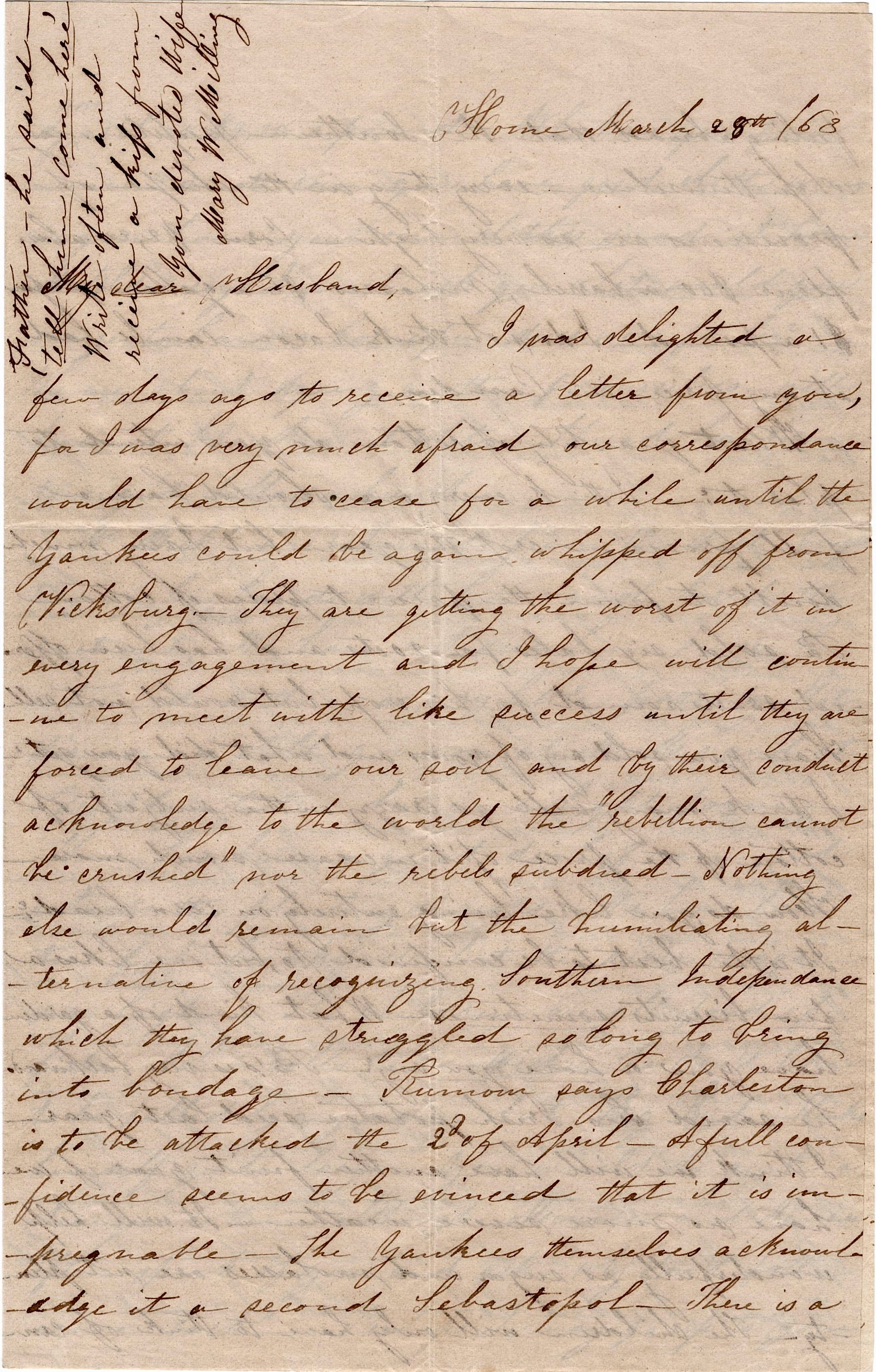
Home [Camden, South Carolina]
March 28th 1863
My dear husband,
I was delighted a few days ago to receive a letter from you, for I was very much afraid our correspondence would have to cease for a while until the Yankees could be again whipped off from Vicksburg. They are getting the worst of it in every engagement and I hope will continue to meet with like success until they are forced to leave our soil and by their conduct acknowledge to the world the “rebellion cannot be crushed” nor the rebels subdued. Nothing else would remain but the humiliating alternative of recognizing Southern Independence which they have struggled so long to bring into bondage. Rumor says Charleston is to be attacked the 2nd of April. A full confidence seems to be evinced that it is impregnable. The Yankees themselves acknowledge it a second Sebastopol. There is a feeling abroad that the Southern people may whip themselves.
Everything in the shape of provisions are so very high—corn $2.25 a bushel, flour $60 a barrel, molasses $6 a gallon, sugar $1 a pound. I do not think bacon can be had at any price in Camden.
What quantity of cotton do you intend to plant? I think everyone should have a full provision crop this year but I very much doubt it from the present prices of cotton. Pa sold six bales for 20 cents and has been offered 25 cents round for his crop but would not sell. Have you sold any of yours and what did you get? I think many will go crazy on the subject of cotton if the price of it increases much more.
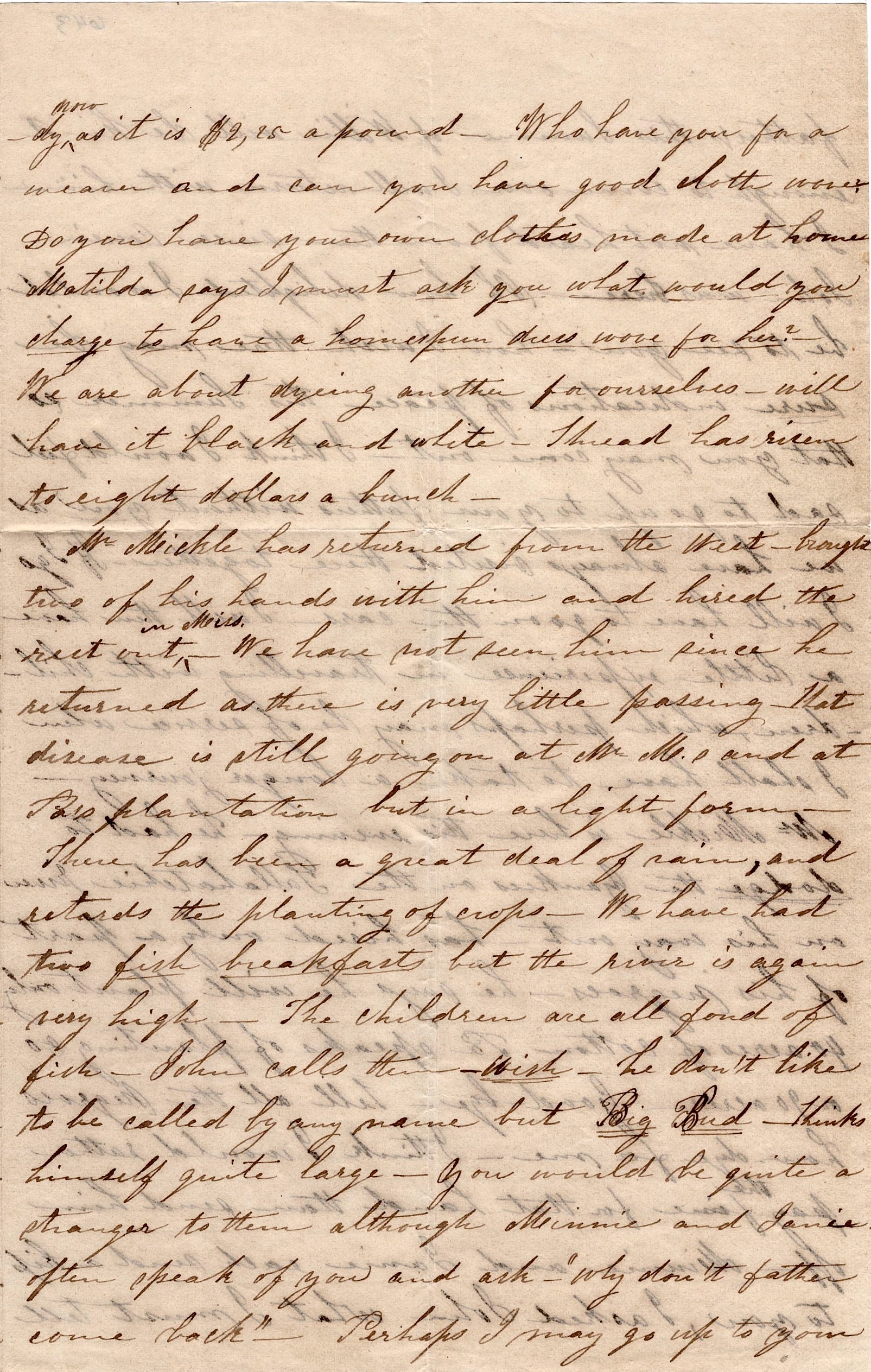
How do you like living entirely on corn bread? It is the best to be confined to, but one likes a few biscuits sometimes. What kind of a garden have you, or have you any? Pa’s is very backward. He saved his Irish potatoes seed last year, I think we will have another fruit year if we have no more severe weather. It will help wonderfully as sugar and molasses are not plenty. The children will only have to think of candy now as it is $2.25 a pound.
Who have you for a weaver and can you have good cloth woven? Do you have your own clothes made at home. Matilda says I must as you what would you charge to have a homespun dress wover for her? We are about dyeing another for ourselves. Will have it black and white. Thread has risen to eight dollars a buch.
Mr. [John Belton] Mickle has returned from the West. Brought two of his hands with him and hired the rest out in Mississippi. We have not seen him since he returned as there is very little passing. That disease is still going on at Mr. Mickle’s and at Pa’s plantation but in a light form. There has been a great deal of rain, and retards the planting of crops. We have had two fish breakfasts but the river is again very high. The children are all fond of fish. John calls them wish. He don’t like to be called by any name but “Big Bud. Thinks himself quite large. You would be quite a stranger to them although Minnie and Janie often speak of you and ask, “Why don’t father come back.”
Perhaps I may go up to your father’s this summer. If Willie will be kind enough to come over, I will return with him. I have not heard from them since cousin John was here. Oh how delighted I would be to see you. How I wish there may be sure indications of peace this summer so that you may come out. I think I would feel sad to go up to your father’s without you as we have always visited there together. If I go, I will have to go on the cars. I will then have a little experience in traveling with children, which perhaps may be of service when I shall have to take a longer journey.
Mr. Mickle is here this evening. He had to dodge the Yankees on the Tallatchie river on his way out. Has hired only a part of his negroes. He says he will plant only 40 acres of cotton. Pa speaks of planting 80 or 90 acres.
Goodbye. Tell all the negroes how-dye for me, I think I would rather pay the fine for that hand than send him off. Minnie and Janie each send a kiss to you. I asked John what I must tell Father. He said tell him come here. Write often and receive a kiss from your devoted wife, — Mary W. Milling


 Spared & Shared 23