
The following letter was written by 45 year-old Nathaniel Peyton Young (1816-1896) of Smithfield who was the county clerk of Isle of Wight county, Virginia, at the time of the 1860 US Census. The letter was penned on 17 July 1861 just prior to the battle of Bull Run and at a time when Virginian’s lived in fear of a Yankee invasion. To protect the record books of the Isle of Wight county from theft or destruction during the Civil War, Young had his manservant, Randall Booth, transport the books to the western part of the state for safekeeping.
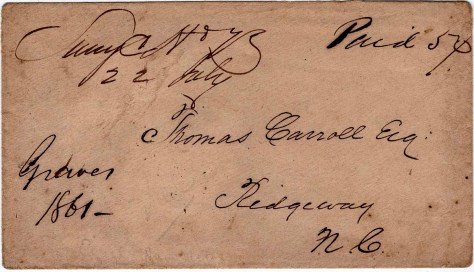
Nathaniel was married to Sarah Virginia Carroll (1822-1875) and when the war began, they were the parents of four daughters, born between 1845 and 1852. Sarah was the daughter of Gray Carroll (1773-1843) and Polly Wheadon (1785-1840). He wrote the letter to his brother-in-law, Thomas Carroll (1805-1888), a farmer in Ridgeway, North Carolina, who cultivated his plantation with 24 slaves ranging in age from 21 to 72 in 1860.
T R A N S C R I P T I O N
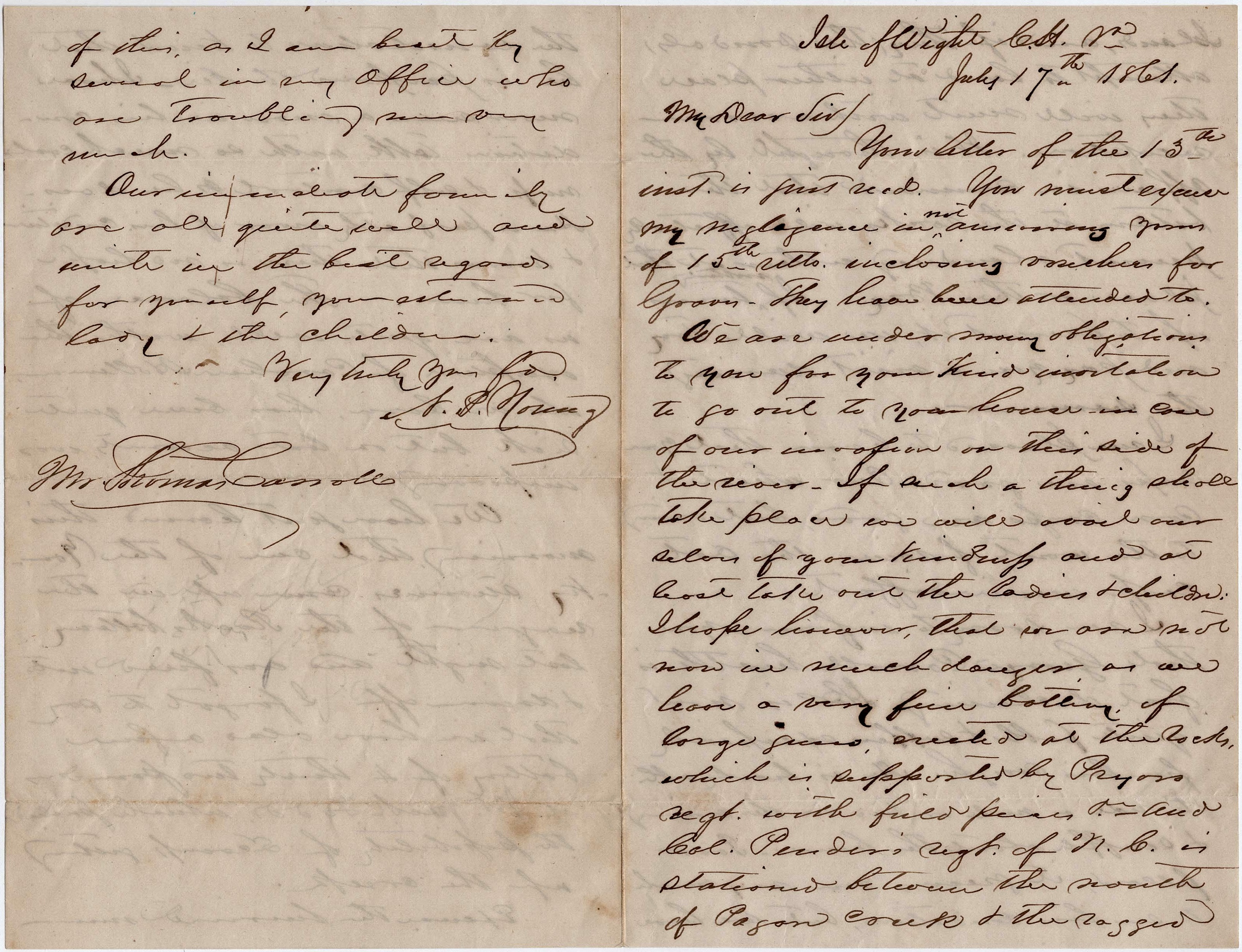
Isle of Wight Court House, Virginia
July 17, 1861
My dear sir,
Your letter of the 13th inst. is just received. You must excuse my negligence in not answering yours of the 15th ulto. enclosing vouchers form Graves. They leave here attended to.
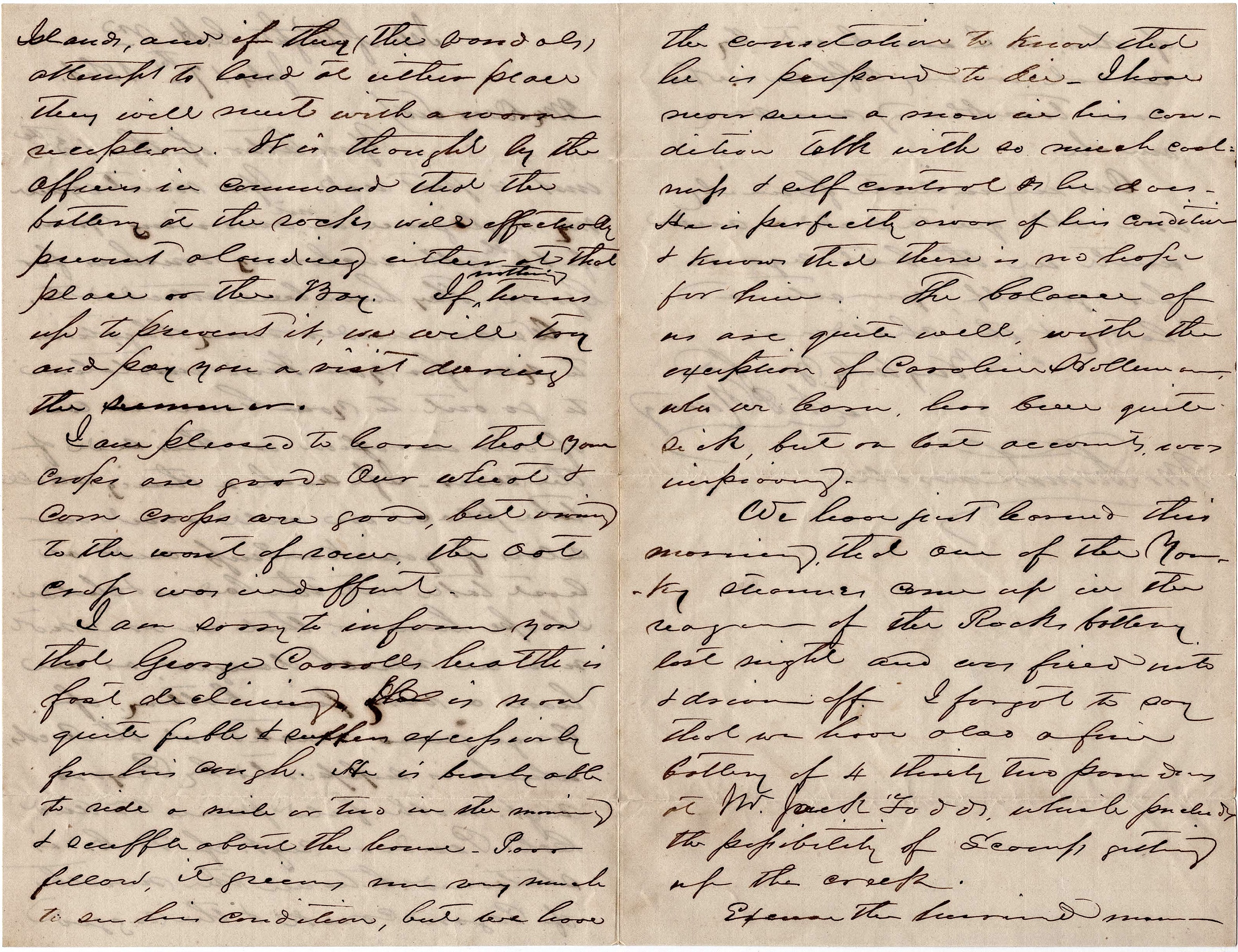
We are under many obligations to you for your kind invitation to go out to your house in case of our invasion on this side of the river. If such a thing shall take place we will avail ourselves of your kindness and at least take out the ladies & childrren. I hope, however, that we are not now in much danger as we leave a very fine battery of large guns erected at the rocks which is supported by Pryor’s Regiment with field pieces &c. and Col. Pender’s Regiment of North Carolina is stationed between the mouth of Pagan Creek 1 & the ragged Islands, and if they (the vandals) attempt to land at either place they will meet with a warm reception. It is thought by the officers in command that the battery at the rocks will effectually prevent a landing either at that place or the Bay.
If nothing turns up to prevent it, we will try and pay you a visit during the summer. I am pleased to learn that your crops are good. Our wheat & corn crops are good, but owing to the want of rain, the oat crop was indifferent.
I am sorry to inform you that George Carroll’s health is fast declining. He is now quite feeble & suffers excessively from his cough. He is barely able to ride a mile or two in the morning & shuffle about the house. Poor fellow. It grieves me very much to see his condition but we have the consolation to know that he is prepared to die. I have never seen a man in his condition talk with so much coolness & self control as he does. He is perfectly aware of his condition & knows that there is no hope for him. The balance of us are quite well with the exception of Caroline Holleman who we learn has been quite sick, but on last accounts, was improving.
We have just learned this morning that one of the Yankee steamers came up in the region of the Rocks battery last night and was fired into & driven off. 2 I forgot to say that we have also a fine battery of four 32-pounders at Mr. Jack Todd’s which precludes the possibility of scamps getting up the creek.
Excuse the hurried manner of this as I am beset by several in my office who are troubling me very much. Our immediate family are all quite well and write in the best regards for yourself. Your esteemed lady & the children.
Very truly yours, — N. P. Young
Mr. Thomas Carroll
1 Pagan Creek is a tributary of the James River in Isle of Wight county, Virginia.
2 The Yankee steamer may have been the USS Harriet Lane. The Pagan River enters the James River at the location of the town of Smithfield, Virginia. In the early stages of the Civil War, Union naval forces based at Fort Monroe maintained a blockade of the James River and conducted reconnaissance missions and skirmishes against Confederate shore batteries. The Harriet Lane was an active participant in these early actions.
 Spared & Shared 23