
The following letter was written by Edward Gookin Parker (1841-1864) of Kittery, York county, Maine who enlisted when he was 21 years old in Co. K, 17th Maine Infantry on 18 August 1862 as a private. He was killed in action on 12 May 1864 at Spotsylvania Court House during the Overland Campaign after having risen to the rank of sergeant.
Edward was the son of William G. Parker (1798-1882) and Lydia Hall (1808-1857). He wrote the letter to Samuel Badger Neal (1842-1901), the son of John Robert and Anna Maria (Badger ) Neal. He was born in Portsmouth, New Hampshire, on 29 April 1842 and fitted for college at Phillips Exeter Academy. He graduated from Harvard College in 1864 and the following year entered the NH National Bank of Portsmouth as a cashier. He then went to New York as a salesman in the coal business, to Boston as a bookkeeper, and then as a coal salesman. He suffered from ill health and lived with his parents in Kittery for a while, managing his father’s coal business. He lived until 1901. He was found dead in his stable, having been knocked down and trampled by his horse.
See also—“Rambles About Home,” Stories of Kittery, Maine, Recorded by Samuel Badger Neal.
T R A N S C R I P T I O N
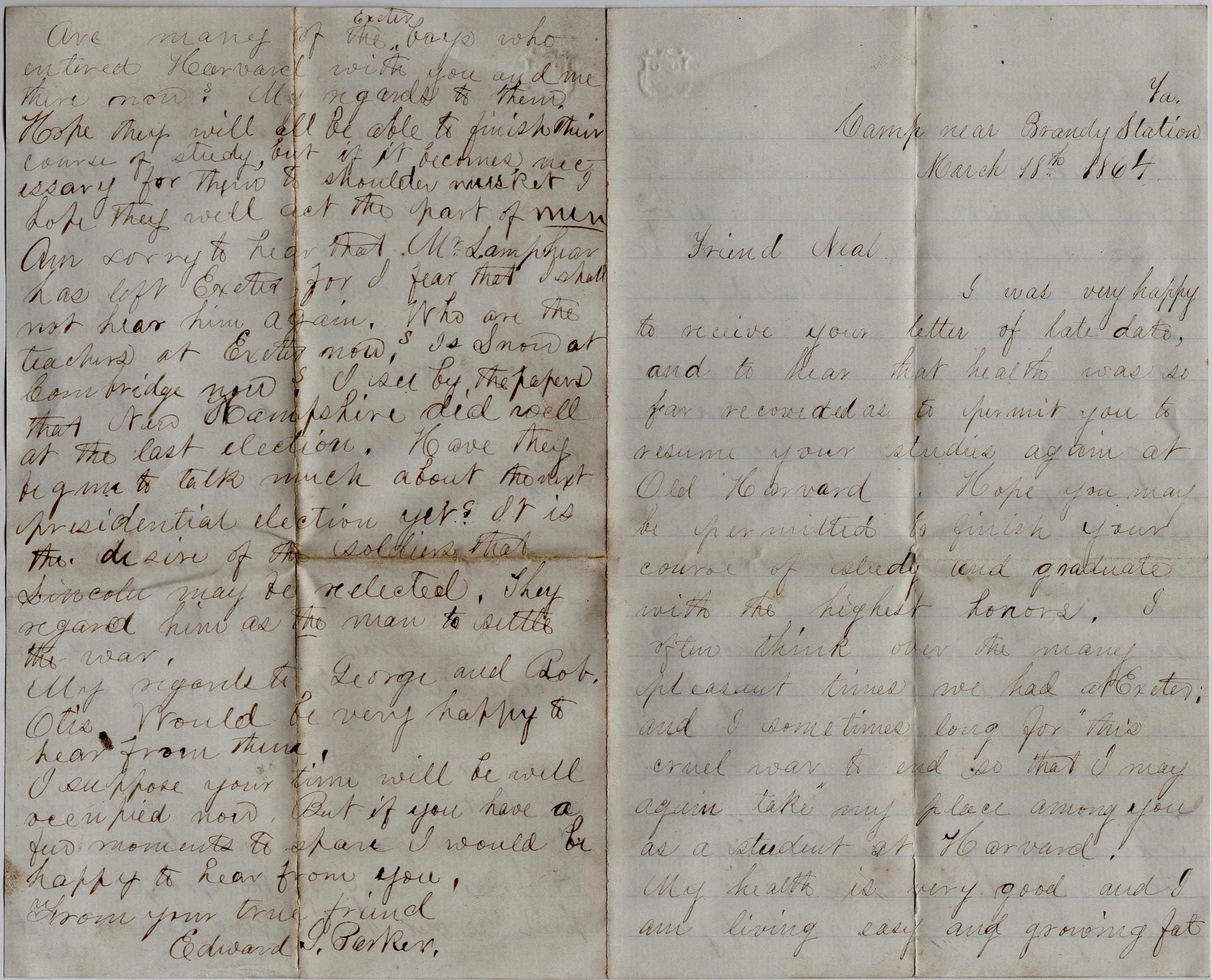
Camp near Brandy Station, Va.
March 18, 1864
Friend Neal,
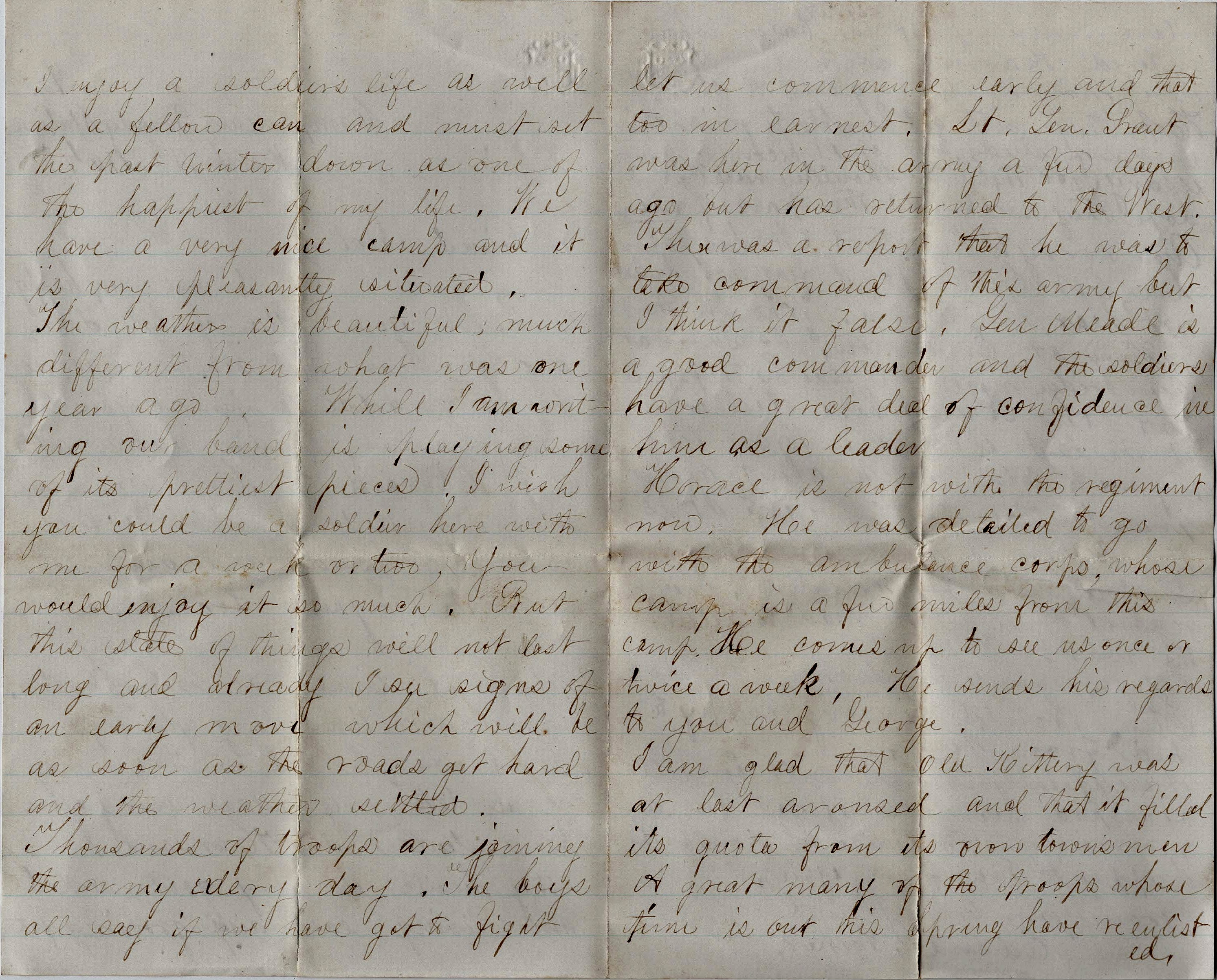
I was very happy to received your letter of late date and to hear that health was so far recovered as to permit you to resume your studies again at Old Harvard. Hope you may be permitted to finish your course of study and graduate with the highest honors. I often think over the many pleasant times we had at Exeter and I sometimes long for this cruel war to end so that I may again take my place among you as a student at Harvard. My health is very good and I am living easy and growing fat. I enjoy a soldier’s life as well as a fellow can and must set the past winter down as one of the happiest of my life. We have a very pleasant camp and is it very pleasantly situated.
The weather is beautiful—much different from what was one year ago. While I am writing, our band is playing some of its prettiest pieces. I wish you could be a soldier here with me for a week or two. You would enjoy it so much. But this state of things will not last long and already I see signs of an early move which will be as soon as the roads get hard and the weather settled.
Thousands of troops are joining the army every day. The Boys all say if we have got to fight, let us commence early and that too in earnest. Lt. Gen. Grant was here in the army a few days ago, but has returned to the West. There was a report that he was to take command of this army but I think it false. Gen. Meade is a good commander and the soldiers have a great deal of confidence in him as a leader.
Horace is not with the regiment now. He was detailed to go with the ambulance corps whose camp is a few miles from this camp. He comes up to see us once or twice a week. He sends his regards to you and George.
I am glad that Old Kittery was at last aroused and that it filled its quota from its own townsmen. A great many of the troops whose time is out this spring have reenlisted. Are many of the Exeter Boys who entered Harvard with you and me there now? My regards to them. Hope they will be able to finish their course of study but if it becomes necessary for them to shoulder musket, I hope they will act the part of men.
Am sorry to hear that Mr. Lamphear has left Exeter for I fear that I shall not hear from him again. Who are the teachers at Exeter now? Is Snow at Cambridge now? I see by the papers that New Hampshire did well at the last election. Have they begun to talk much about the next Presidential election yet? It is the desire of the soldiers that Lincoln may be reelected. They regard him as the man to settle the war.
My regards to George and Bob Otis. Would be very happy to hear from them. I suppose your time will be well occupied now. But if you have a few moments to spare, I would be happy to hear from you. From your friend, — Edward G. Parker
 Spared & Shared 23