

The following letters were written by Peter Lightle (1832-1862), the son of Samuel Lightle (1798-1851) and Lear Ford (1802-1870) of Ross county, Ohio. Peter was married to Sena Downing (1834-1910) 1856 in Pike county, Ohio, and had two young children, Evangeline (b. 1858) and Albert (b. 1860) at the time that he answered his country’s call to serve as a corporal in Co. D, 33rd Ohio Infantry. Muster records inform us that he enlisted on 17 August 1861 and served until his death on the battlefield at Perryville, Kentucky, on 8 October 1862. Pension records describe Peter as standing 5’9″ tall with dark eyes and black hair.
On August 27, 1862, Confederate cavalry and artillery attacked Fort McCook which was garrisoned by the 33rd Ohio Infantry, prompting the Union soldiers to retreat under the cover of darkness. The Northern soldiers withdrew to Decherd, Tennessee and then marched to Nashville and Bowling Green, where it rejoined the rest of the Army of the Ohio, which was in pursuit of General Braxton Bragg’s Confederate army. The Northern army then moved to Louisville, Kentucky, where it arrived on September 26. On October 1, 1862, the Army of the Ohio departed Louisville in search of the Confederates, finding them at Perryville, Kentucky. At the Battle of Perryville (October 8, 1862), the 33rd entered the engagement with approximately four hundred men. The regiment had 129 men killed or wounded in the battle, nearly one-third of its total active strength.
Peter’s letters and the family tintypes are the property of Natalie Stocks who graciously made them available to Spared & Shared for transcription and publication. Peter was her g-g-g grandfather by way of his daughter Evangeline. She inherited the letters of Peter, and his brother in law, William Washington Downing, and his brother in law, Henry Downing.(33rd OH Infantry Regiment). All of the letters were written to Peter’s wife, Mrs. Sena Downing Lightle.


Letter 1
Camp Taylor
May 14, 1862
Dear Sena,
I take my pen in hand to let you know that I am well at present and truly hope when this reaches you it may find you all well. I received a letter from you the 12th and was very glad to hear from you but sorry to hear that Albert was sick. I had no time to write to you any sooner. I came in the same day from picket that I received your letter and got my dinner and sit down to read the papers that the boys got from home and the next morning I went on camp guard and came off this morning.
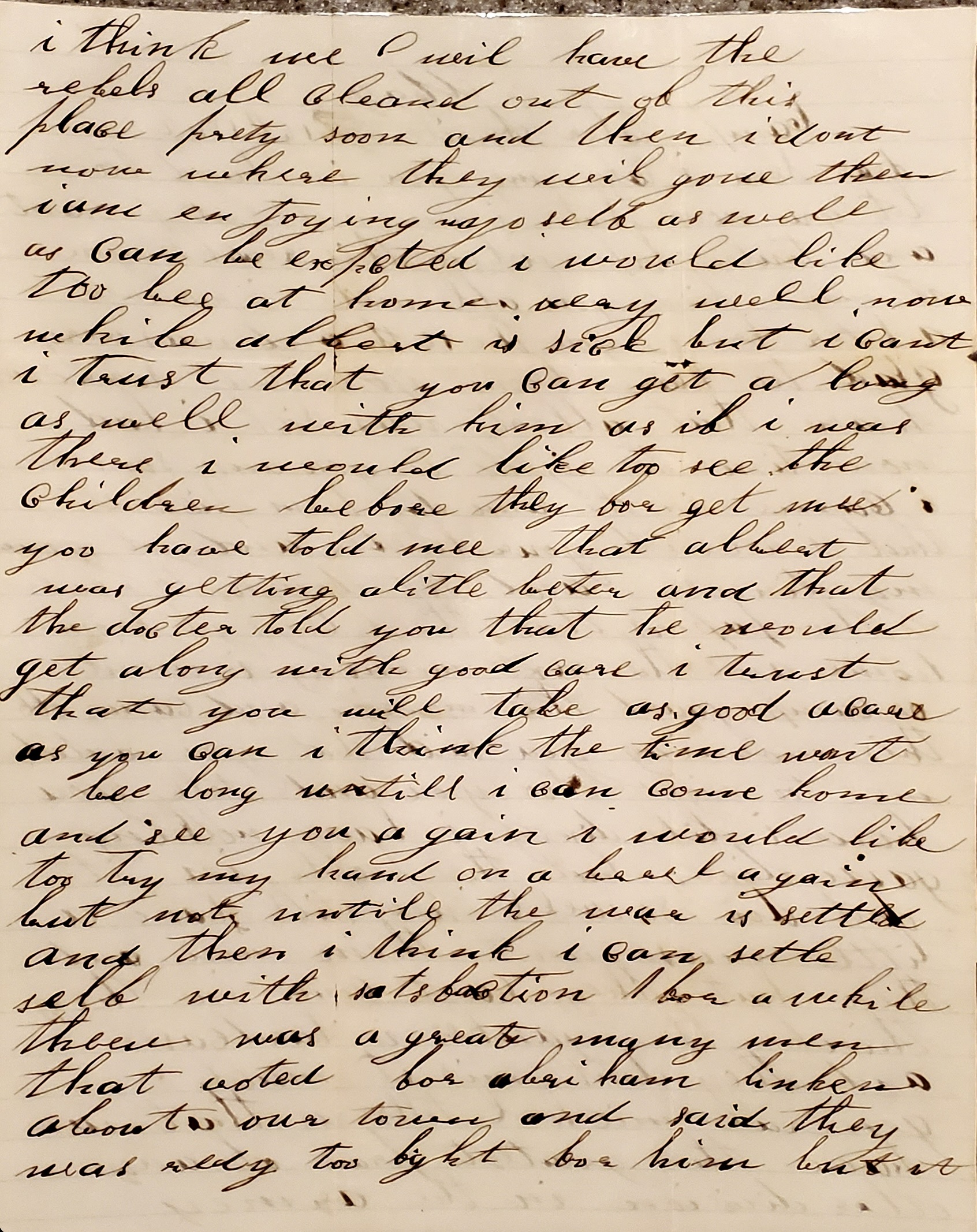
You said that you wanted me to write to you and tell you how I like Dixie but the people in it don’t do so well. We still have a little muss with them now and then but they can’t come in. They think that the Yankees is hard cases and they don’t miss it much. General Mitchell tells us that we have the greatest praise of any other division in the army. I think we will have the rebels all cleaned out of this place pretty soon and then I don’t know where they will go then.

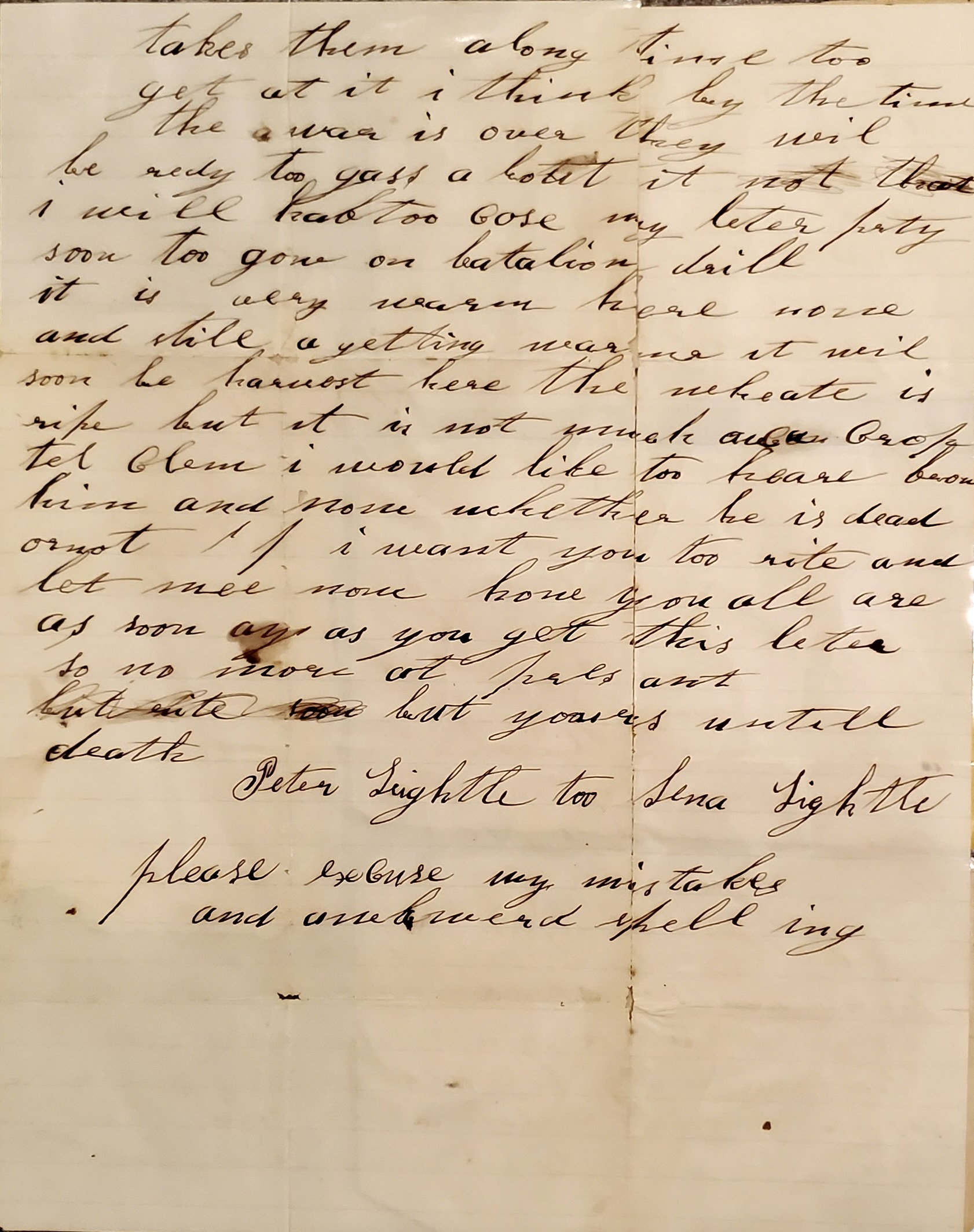
I am enjoying myself as well as can be expected. I would like to be at home very well now while Albert is sick but I can’t. I trust that you can get along as well with him as if I was there. I would like to see the children before they forget me. You have told me that Albert was getting a little better and that the doctor told you that he would get along with good care. I trust that you will take as good a care as you can. I think the time won’t be long until I can come home and see you again. I would like to try my hand on a [ ] again but not until the war is settled and then I think I can settle self with satisfaction. For a while there was a great many men that voted for Abraham Lincoln about our town and said they was ready to fight for him, but it takes them a long time to get at it. I think by the time the war is over, they will be ready to gass about it.
I will have to close my letter pretty soon to go on Battalion Drill. It is very warm here now and still a getting warmer. It will soon be harvest [time] here. The wheat is ripe but it is not much of a crop. Tell Clem [James] I would like to hear from him and know whether he is dead or not. I want you to write and let me know how you all are as soon as you get this letter. So no more at present but [remain] yours until death, — Peter Lightle
to Sena Lightle
Please excuse my mistakes and awkward spelling.

Letter 2
Camp near Battle Creek
August 17, 1862
Dear wife and children,
It is with pleasure that I take my pen in hand to inform you that I am well at present and truly hope when this reaches you it may find you all enjoying the same blessing.
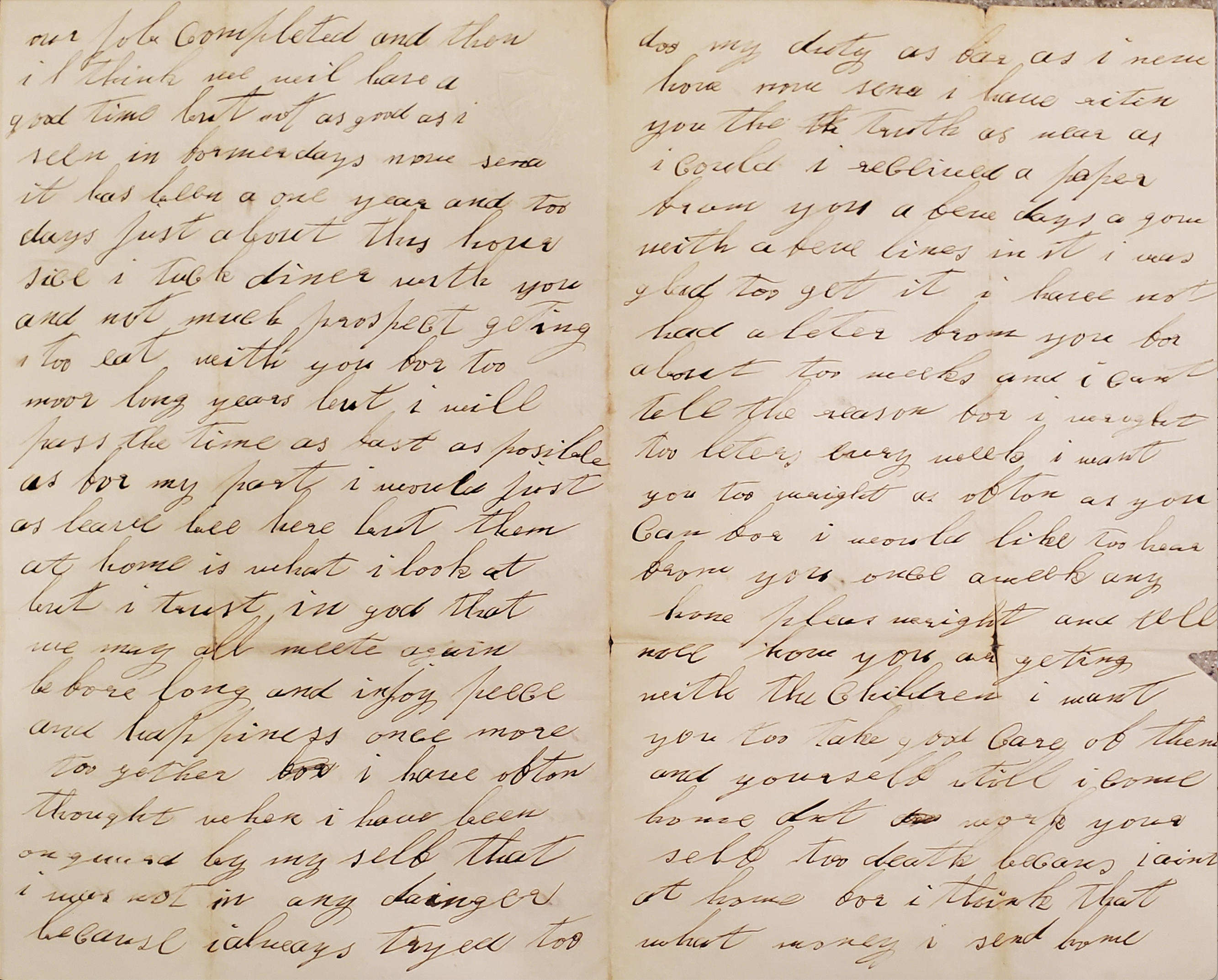
Now the first thing I will tell you what we are doing. We are fortifying this place. There is about six hundred men at work on it day and night. Our regiment is at work on it today. The reason that I am not at work there was about three corporals out of Co. D [were] detailed and that left Bewn Lewis and myself in camp. We are on duty about every other day and expect to be until we get our job completed and then I think we will have a good time—but not as good as I seen in former days.
Now Sena, it has been one year and two days [and] just about this hour since I took dinner with you and not much prospect getting to eat with you for two more long years. But I will pass the time as fast as possible. As for my part, I would just as leave be here. But them at home is what I look at. But I trust in God that we may all meet again before long and enjoy peace and happiness once more together. I have often thought when I have been on guard by myself that I was not in any danger because I always tried to do my duty as far as I knew how.
Now Sena, I have written you the truth as near as I could. I received a paper from you a few days ago with a few lines in it. I was glad to get it. I have not had a letter from you for about two weeks and I can’t tell the reason for I wrote two letters every week. I want you to write as often as you can for I would like to hear from you once a week anyhow. Please write and tell me how you are getting [along] with the children. I want you to take care of them and yourself until I come home. Don’t work yourself to death because I ain’t at home for I think that what money I send home [should] pretty near keep you.
But I must bring my letter to a close. Please write. So no more at present but remain yours until death, — Peter Lightle
to Sena


Letter 3
Camp on Chaplin Heights
October 11th 1862
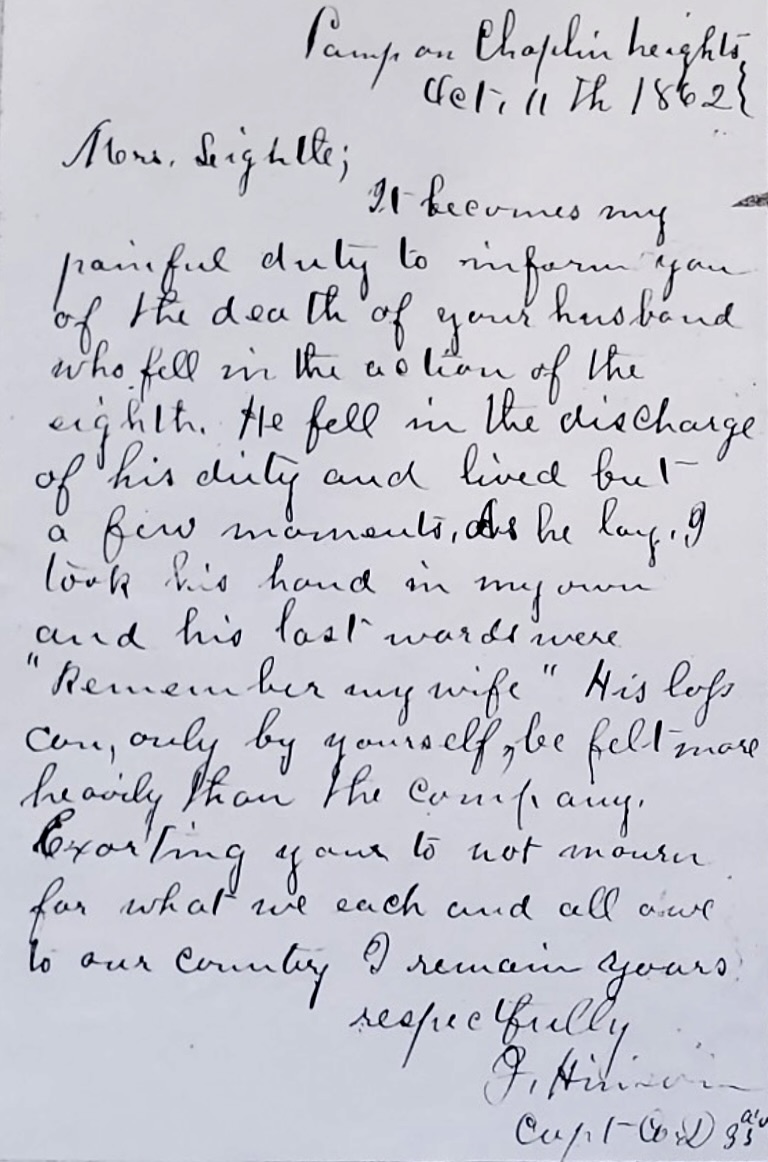
Mrs. Lightle,
It becomes my painful duty to inform you of the death of your husband who fell in the action of the 8th [at Perryville, Kentucky]. He fell in the discharge of his duty and lived but a few moments. As he lay, I took his hand in my own and his last words were, “Remember my wife.” His loss can, only by yourself, be felt more heavily than the company. Exhorting you to not mourn for what we each and all owe our country, I remain yours respectfully, — J. Hinson, Capt. Co. d, 33rd OVI 1
1 Born in Ohio, Joseph Hinson (1842-1904) enlisted in the 1st Ohio Infantry for three months on 16 Apr 1861. Mustered in as a Private in Company G at Lancaster, Pennsylvania on 29 Apr 1861. Mustered out with his Company at Camp Chase, Columbus, Ohio on 1 Aug 1861. Enlisted in the 33rd Ohio Infantry for three years. Mustered in as 1st Lieutenant of Company D at Camp Morrow, near Portsmouth, Ohio on 27 Aug 1861. Promoted to Captain on 23 Mar 1862. Severely wounded in the left arm on 20 Sep 1863 during the Battle of Chickamauga, Georgia resulting in his arm being amputated. Returned to his Company on 23 Jan 1864. Promoted to Major on 28 Jan 1865 and transferred to Field and Staff (F&S). Promoted to Lieutenant Colonel on 18 May 1865. Promoted to Colonel on 26 Jun 1865, but not mustered. Mustered out with the Regiment at Louisville, Kentucky.
 Spared & Shared 23
Thank you! Peter, Sena, Evangeline, and Albert together again. Great work!
LikeLike