

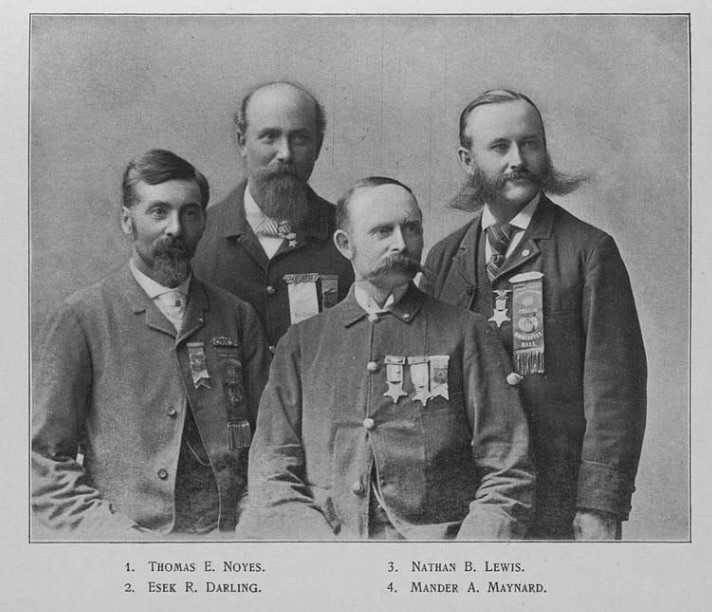
The following letter was written by Sgt. Mander Alvan Maynard (1841-1913) of Co. F, 7th Rhode Island Infantry. He mustered into the regiment on 6 September 1862 and transferred into the new organization on 21 October 1864.
He was the youngest son of Moses William Maynard (1805-1894) and Martha Barnes Brigham (1809-1882) of Worcester, Massachusetts. During the winter of 1861-62 he taught school in Burrillville. The regimental history claims he was with the regiment in the Battle of Fredericksburg but contracted typhoid fever in January 1863 and was sent to hospitals at Baltimore and Portsmouth before rejoining his regiment at Lexington, Kentucky in November 1863. [This letter suggests he was still with the regiment in early March 1863, however.] He mustered out of the regiment in June 1865. In 1866 he married Sarah J. Anthony.
In the 1860 US Census, 18 year-old Mander was enumerated in his parents’ household in Ward 8 of Worcester, Massachusetts. Besides his parents, there was 26 year-old Adda and 23 year-old Malcom, both mentioned in this letter.
Mander’s letter references the Battle of Fredericksburg in which he and the 7th Rhode Island participated. For a good summary of the battle and the role played by the 7th Rhode Island, see “Here We Lost Many Good Men:” A New Account from the Battle of Fredericksburg, by Robert Grandchamp.
T R A N S C R I P T I O N
Newport News, [Virginia]
March 8, 1863
Dear sister Adda,
I promised you a long letter on this sheet of paper and you shall have it now or as soon as I can finish it. It may take more than one day but I will try to answer the questions in your former letters as fully as possible.
Malcom concludes that Albert M. Smith [of Smithfield, R. I.] is the man I helped off of the battlefield. No sir. He was 2nd Sergeant but got scared before we got to the field and left and instead of his belt &c. being shot off, two men in the company say they helped him take them off. He was not wounded in the least but played it and got discharged. Capt. [Lyman M.] Bennett found out what the matter was and reduced him to the ranks. The person I helped off was William H. Russell 1 and he laid beside me when he was struck by a piece of shell.
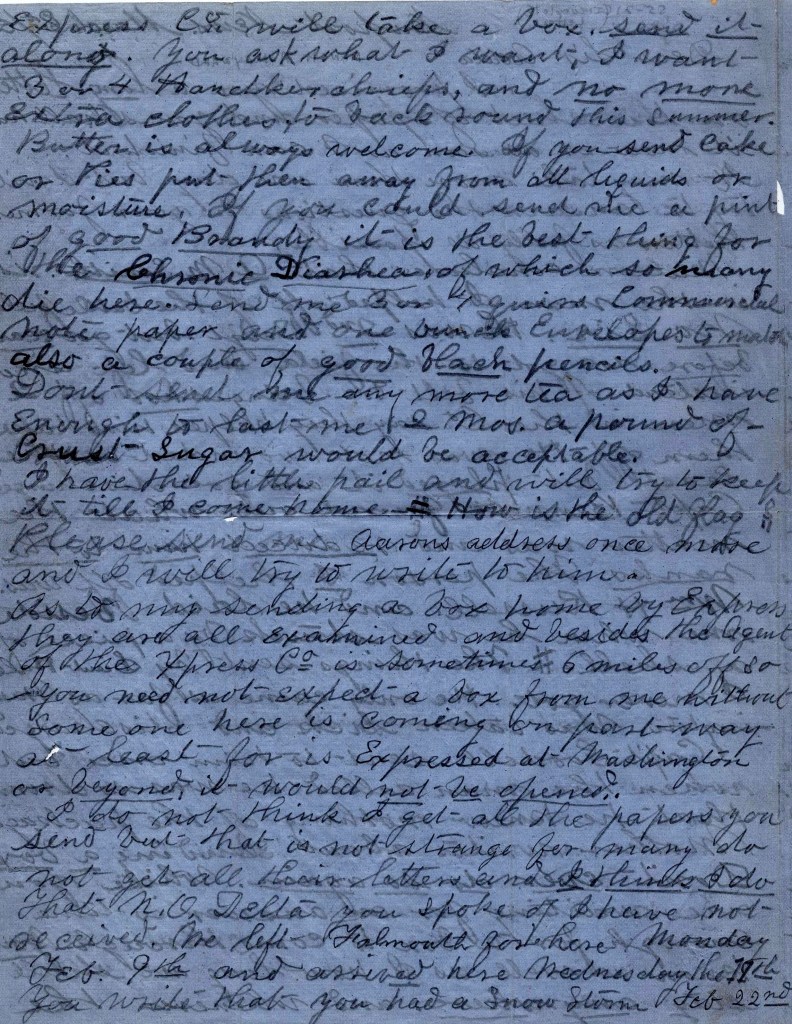
The things sent by Lieutenant Hall, I never got. He only came as far as Washington, was taken sick, and discharged. Capt. Goodell sent to him once but when the man called, he [Hall] was so drunk that he knew nothing of the package. Mother writes about sending a box. Don’t ever do so again. While you are waiting for an answer is time enough for a box to come through. You know as well as I how long we shall stay anywhere and whenever the Express Co. will take a box, send it along. You ask what I want. I want three or four handkerchiefs and no more extra clothes to pack around his summer. Butter is always welcome. If you send cake or pies, put them away from all liquids or moisture. If you could send me a pint of good brandy, it is the best thing for the chronic diarrhea of which so many die here. Send me three or four quires commercial note paper and one bunch envelopes to mail. Also a couple of good black pencils. Don’t send any more tea as I have enough to last me two months. A pound of crust sugar would be acceptable. I have the little pail and will try to keep it till I come home.
How is the old flag? Please send me Aaron’s address once more and I will try to write to him. As to my sending a box home by Express, they are all examined and besides, the agent of the Express Co. is sometimes 6 miles off so you need not expect a box from me without someone here is coming on part way at least for if expressed at Washington or beyond, it would not be opened.
I do not think I get all the papers you send but that is not strange for many do not get all their letters and I think I do. That N. O. Delta you spoke of I have not received. We left Falmouth for here Monday, February 9th, and arrived here Wednesday the 11th [aboard the steamer Georgia].
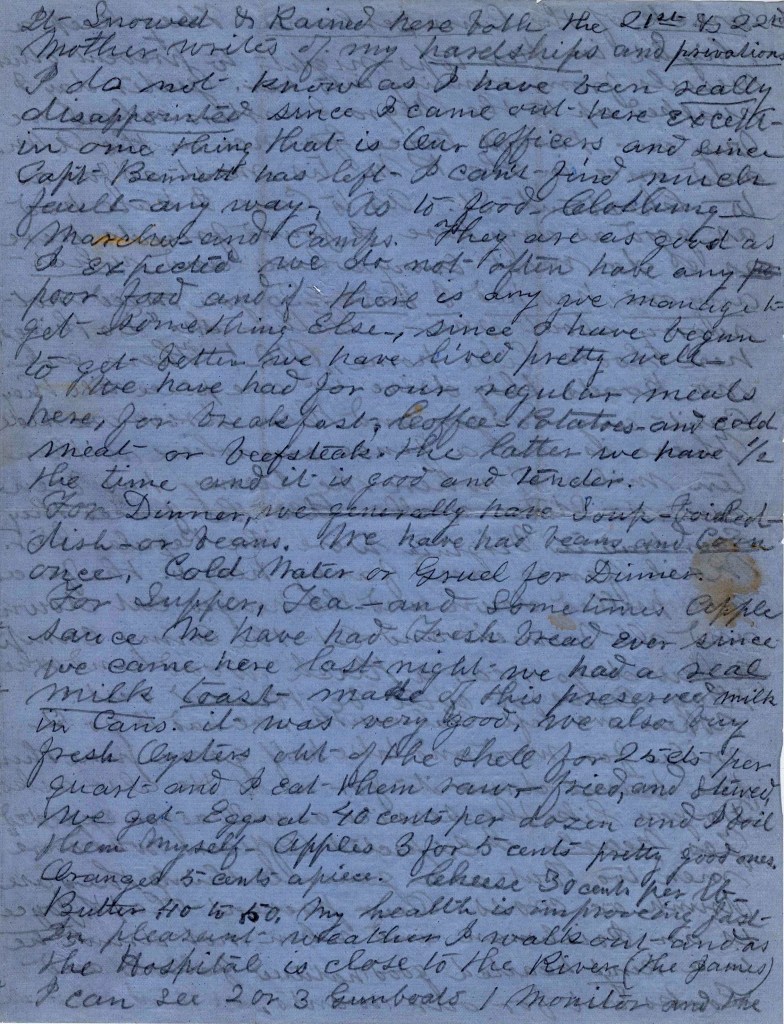
You write that you had a snow storm February 22nd. It snowed and rained here both the 21st and 22nd. Mother writes of my hardships and privations. I do not know as I have been really disappointed since I come out here except in one thing [and] that is our officers. And since Capt. Bennett has left, I can’t find much fault anyway.
As to food, clothing, marches and camps, they are as good as I expected. We do not often have any poor food and if there is any, we manage to get something else. Since I have begun to get better, we lave lived pretty well. We have had our regular meals here; for breakfast—coffee, potatoes and cold meat or beefstake. The latter we have half the time and it is good and enter. For dinner we generally have soup, boiled dish or beans. We have had beans and corn once, cold water or gruel for dinner. For supper, tea and sometimes apple sauce. We have had fresh bread ever since we came here. Last night we had a real milk toast made of this preserved milk in cans. It was very good. We also buy fresh oysters out of the shell for 25 cents per quart and I eat them raw, fried, and stewed. We get eggs at 40 cents per dozen and I boil them myself. Apples 3 for 5 cents—pretty good ones. Oranges 5 cents apiece. Cheese 30 cents per lb. Butter 40 to 50 cents.
My health is improving fast. In pleasant weather I walk out and as the hospital is close to the river (the James), I can see two or three gunboats, 1 monitor, and the wreck of the [USS] Cumberland. They keep a light on her tops nights to prevent other vessels from running into her. Yesterday I walked up to the Negro quarters where we buy our things twice—once in the a.m. and once in the p.m. Tis most as far as Chestnut Street [in Worcester, Mass.]
As to care, I have had as good as any here. I found friends here as I do most everywhere and what anyone has had, I have. So you need not worry about me.

Father asks, “Do things here look like home.” No! There are no roads. They drive in one place till they can’t any longer and then drive one side. There is not a fence anywhere within ten miles of where the Army has been and no slatted walls. All the fences they ever had in Virginia were the regular Virginia rail fence and fancy hedges cut down and all burned and let the Army camp a few days near a thick wood and when they leave it, will be thinned out. When we left Falmouth, we had to go two miles for wood and take half green pine then. The teams drew it for us.
He also asks, “Do you like the service as well as you expected?” Yes, nearly. I expected officers who were men too but as a general thing, they are drunk or cross. Our present Capt. [William Howard] Joyce is an Irishman and when not drunk, he is a kind-hearted, good-natured fellow and looks out for our wants. [end of letter is missing]
1 William H. Russell of Dartmouth. Massachusetts, was a private in Co. C. F, 7th Rhode Island Infantry. He was wounded in the Battle of Fredericksburg and transferred to the Veteran Reserve Corps on 12 September 1863. He mustered out of the service in June 1865.


 Spared & Shared 23