
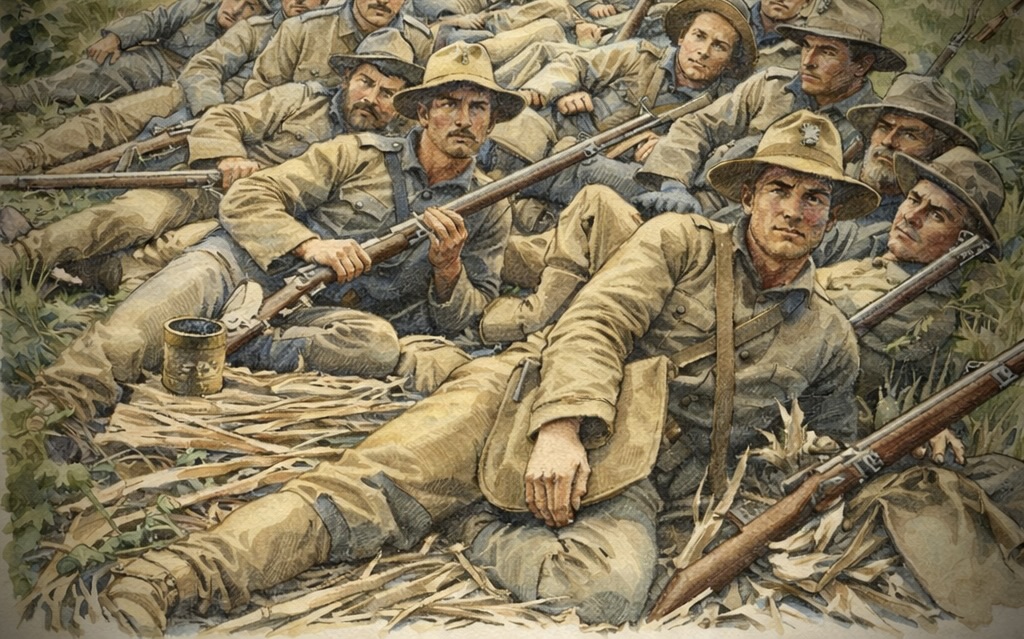
The following letter was written by James Harvey Knight (1877-1899) who enlisted in Co. M of the 14th US Infantry in June 1898 at San Francisco and was killed in action by a gunshot wound at Santa Ana near Manila in the Philippines on 5 February 1899. His remains were brought home the following year for re-burial in the Holy Cross Catholic Cemetery in Colma, San Mateo county, California, Section G, Row 19, Grave 8, but without headstone. He was the stepson of Thomas McCoy, and brother of Clair McCoy.
T R A N S C R I P T I O N
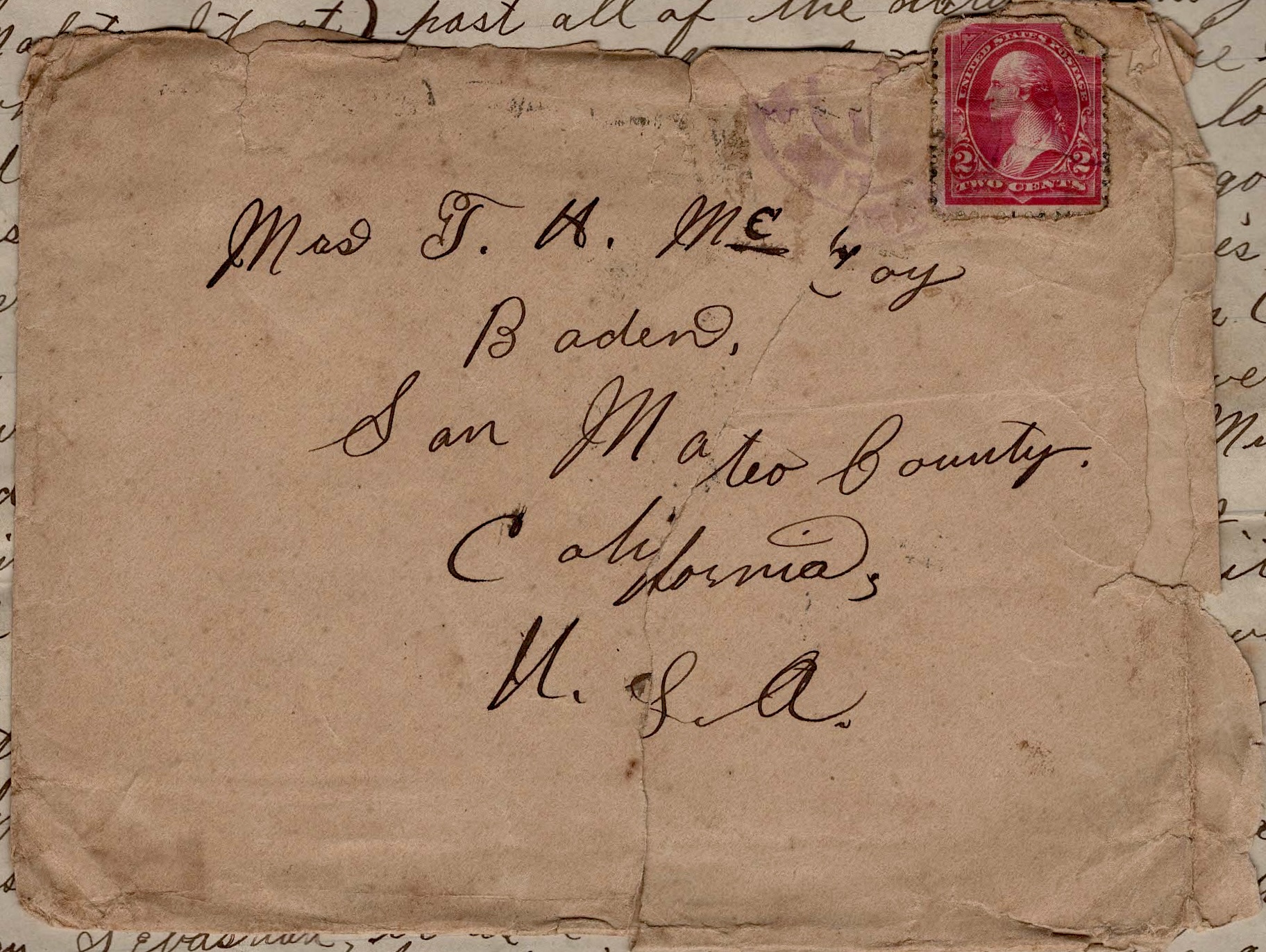
Cuartel de Malate
Manila, Philippine Islands
Monday, November 7th [1898]
In camp 10 a.m.
Dear Mother,
I happen to have an hour or so to spare today so I will tell you about a trip some of my comrades and myself took yesterday. We started from the Cuartel about 7.30 a.m. in the morning and we took it along easy. We went down Calle Malate (Malate Street) past all of the native veno joints, or small whisky shops as we would call them in the States, only instead of whiskey they sell a native drink. It looks and tastes somewhat like Chinese gun, only it is a good deal stronger. Well we walked down past these places and out across the old Spanish parade grounds (which we use now for our dress parades, and we went on over into the walled city, our destination being the Spanish Museum which is in a large building fronting on the Pasiz River. We arrived there after an hour’s walk only to find it closed up for the day. We were told that it would be open to visitors at 4 p.m. on the following day.
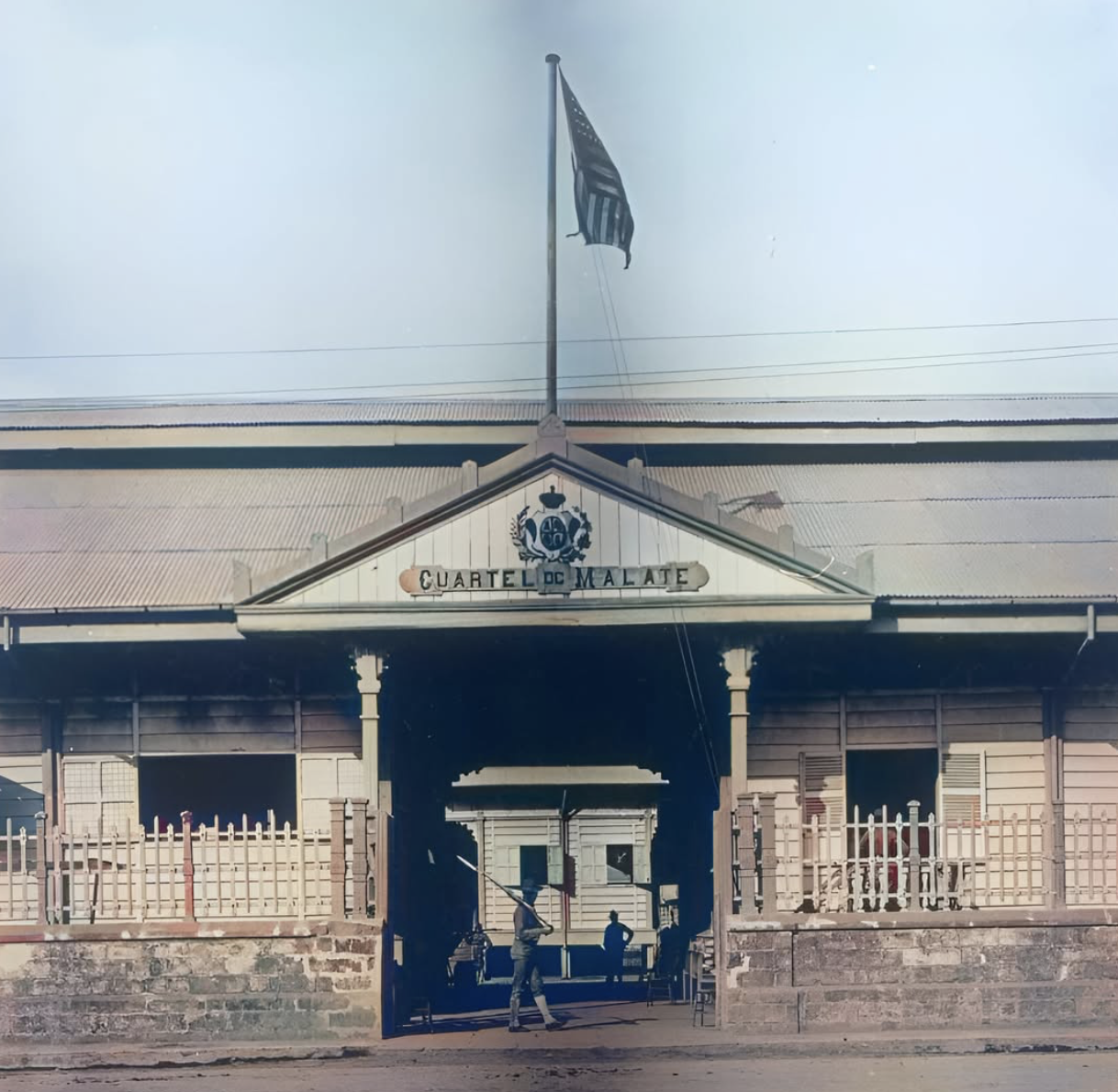
We were disappointed, of course, but we decided to put in the day somehow so we started out to go out to a place called San Sebastion. It is a suburb on the extreme northwest end of the city. It is here that the city prison is located and is it from here that the English Railroad startes. We stopped at a Pilipino Catholic Church on the way over and we stoped at the church while a native priest was saying mass. I can hardly tell you what the inside looked like. It was fixed up like our churches at home are only they don’t have pews. They have pine hardwood floors and the people kneel down on their knees and pray. There is only one thing there that I noticed that seemed out of place and that was large piles of dirt and rubbish that was swept up into the corners and left there to pile up. We stayed to mass—if that is what you call it (I don’t know much about churches so I will have to be excused if I make any mistakes)—and when it was over, we proceeded on our way.

We stopped at the Cuartel de Meisic 1 where the 3rd Artillery is stationed at, and I went in and talked to Tom Horn 2 for a few minutes. He is looking pretty fair, though not as fat and hearty as he did on my last visit about a month ago. I asked him when he thought he would go home and he told me that he expected to be discharged in the course of a couple of months, and that he intends to stay here for a while after he gets his discharge. He said that he and 9 more of his comrades are going to out together $100 apiece and get a prospecting outfit and that they are going back in the hills and have a look for minerals. He said that he hoped he would get some mail pretty soon as he has not heard from home for a long while and I guess we are in the same fix as I have not received any mail since the 19th of October, but by Wednesday we will have our mail as the SS City of Peking arrived at Hong Kong last Saturday, November 5th, and it is tumored that she has over 9 tons of mail on board for the soldiers. I hope so as do all the rest of the boys. It will take a few days to bring it over to Manila from Hong Kong as it takes two days for the steamer to go there and two for her to return. It is a little over 6 hundred miles to Hong Kong.
Well I talked a short time to Tom and he was telling me all about Pat Ferriter getting married and about Della Cameran having a child and all the Baden news that I got from you a long while ago. I didn’t let on that I knew anything about it until he got through and then I told him the balance that he didn’t know. The boys that were with me got tired of waiting for me so we started out for the railroad to see what was to be seen.
We arrived at the railroad depot after a long walk and you would laugh if you could see the cars that they use. The engines are all small—something like the one that they have at the packing house, but the passenger cars and the box cars look like as if they had been built for a kid to play with—they are so small. The passengers coaches are just the same as they are all over Europe. There are four compartments to each car and all they can put in each car is 8 persons, two to each compartment. One enters these cars from the side. The cars have a foot board running along the upper half of each, being a window. When one wants to travel on the railroad, why you buy a ticket to whatever point that you want to go to [and] the ticket agent takes your name and address and assigns you to a certain apartment in a certain car of the train, and you are locked in the car, and when you arrive at your station, why a fellow comes around and lets you out. A guard they call him. One not used to his ways would think that he was president of the railroad. There are 28 stations on the road and it is close on to 200 miles long. It costs $6 Mexican money or $3 in American money to go the round trip. It takes all day to make the round trip. I have not had a chance to make it yet, or take it. I should have said as there are guards stationed at the depot, and they are instructed not to let any American soldiers go out on the trains but this will be changed in a few months and then I will take a trip as soon as I can get a furlough and I will let you know later on what the country looks like.
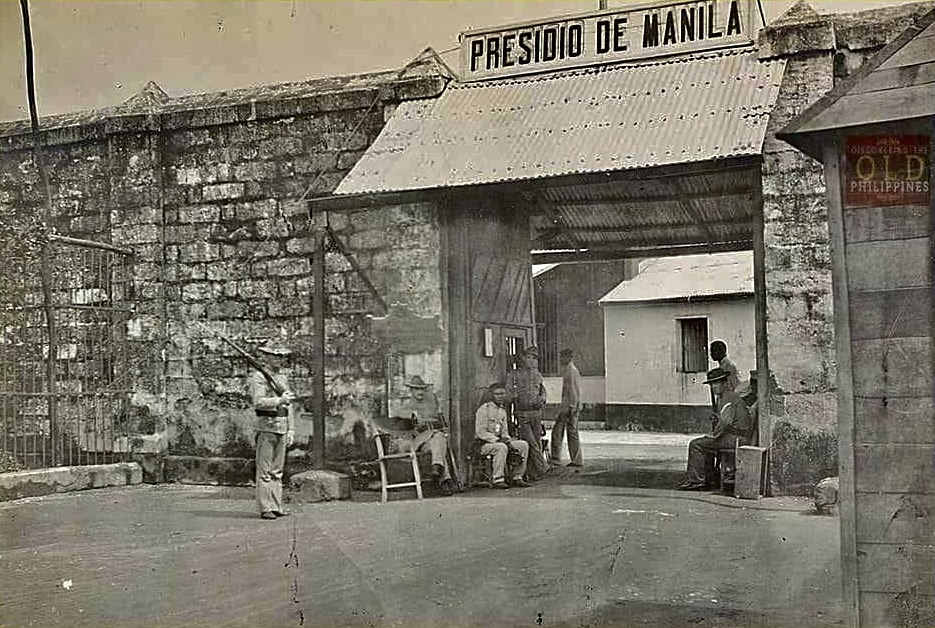
We saw about all there was to be seen around there and then started out to see the prison. It is about one mile north of the railroad depot and so it did not take a great while to cover the distance. We were admitted to the jail without any trouble and we passed inside, the gate keeper gave each one of us a square brass check with B. P. stamped on one side of it. That was so that he would know us when we came out again. We were met inside the walls by a couple of soldier boys that were sent up for a year apiece. One of them had got drunk and abused his officer and the other had got full and got into a fight on the Escolta (the Main street of Manila). They showed us all around and I must say that it is a dismal place for a human being to have to live in. There is nothing to be seen but filth and misery on all sides. There was four English sailors in there too and about twenty Spaniards and 150 Filipino’s. The Americans and Englishmen were given 30 cents Mexican money each morning, 30 cents apiece I should have said, and that is 15 cents American money. They get that to live on each day and it is given them about 9 o’clock every morning. And there is an old woman there that comes in each morning and afternoon and she takes their money and goes out and she brings them back a handful of rice, a couple of onions, and a few potatoes, and a bit of grease to cook the stuff with. She makes a pretty good profit out of them and they have to pay two cents for little sticks of wood to cook their food with. They are really being slowly starved to death.
They have a horrible means of killing a man when he has been sentenced to die. It is called the Spanish garrote and it is a vise that man put his neck into and there is a screw that winds up like a house-movers jack and it takes only thirty seconds to break a man’s neck. It is a simple thing to look at, but I’ll bet it is a terrible thing to see in action.
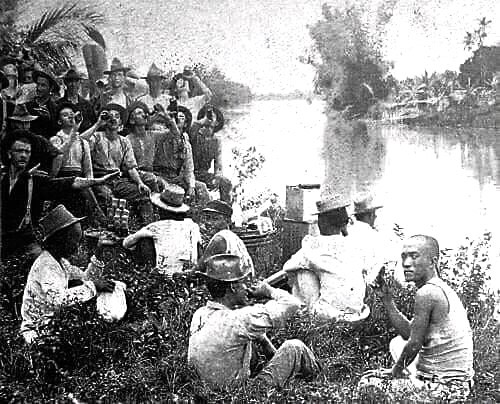
We saw about all there was to be seen and then started for home, and, as we were crossing the big stone bridge that goes over the Pasig River over the main part of New Manila, we stopped to see the natives dredging the river. They (a half dozen of them or so) have a large canoe with a step in each side near the water line. They take a common straw basket apiece and dive or drop straight down to the bottom of the river and fill this basket with sand and mud and come to the surface with it and dump it in the boat. They have long poles stuck down along side of their boats so as to steady themselves when they come up with their load. They do an awful lot of work in a day’s time. A stranger would hardly think that they could stay in the water so long and I would not believe it myself if it were not for the fact that I have seen them with my own eyes. And for a day’s work of ten hours, they get the large sum of 50 cents apiece, or 25 cents in our money. They are good workers in the water but are not to be compared with the Kanakas of Honolulu as the natives of that place just seem to make their home in the water.
We proceeded on our way to our quarters out in Malate and so ended one day’s tramping. Of course I have not put down here one quarter of what we saw, but what to you would be strange. Why, we are used to such sights and don’t take any more notice of them. I can tell you all about these things when I get home—if I ever do—but if I do it will be some four or five years from now as like Tom Horn, I intend to stay here for a few years if the U.S. holds these islands. And there does not seem to be much doubt left now but what they will. This is no country for a white man from a northern country like myself, but I am willing to take my chances if I can make a few thousands dollars down here in a few years time.
As to getting out of the army, why I cannot tell when we will be discharged. I guess it will be a long time from now, though. We hear rumors every day. Some have it that we will be sent home before Christmas and others that we will put in a year more down here, and I think that the latter comes nearer hitting the nail on the head. I will not trouble you or myself in the future when writing as fellow cannot tell whether they are truth or fiction. I will have to carry this letter over for a day or two so that I can write an answer to your letters. I know that there are some in this mail for me and the steamer has just come into the harbor. There is another steamer coming up the straits and she has a large sailing ship in tow. She is about 8 or ten miles down the straits yet, and I guess she will not be in for a couple of hours yet. The first one that came in came from Hong Kong so I guess she has the mail on her. It will take until tomorrow morning to sort it out and then we will get it, so I will lay this aside until after I get mine. This could not leave here before next Friday yet at the earliest as the next steamer to sail is the United States transport Scandia and she leaves for the U. S. next Friday with 250 sick and discharged soldiers. So now I will close this for today.
In camp after Guard Mount, 9 a.m.
Tuesday, November 8, 1898
Cuartel de Malate, Manila, P. I.
I am with you once more (on paper). I have not much to say for today. The weather is pretty fair as it always is in the tropics. I have to stay in my quarters from 9 o’clock this morning until 9 o’clock tomorrow morning as I am supernumerary of the guard for today. I am the guy that is called upon to take his place, but then, that is all the better for me, as if I am called upon for the next 24 hours to my duty, why that lets me out of going on guard tomorrow. And if I am not called out, I have to stand guard for 24 hours so from now until tomorrow morning I am not supposed to leave my quarters. I have nothing to do but still I have to remain within easy call.
I took a trip down to Lunette last night. It is the Main Park and driveway for the elite of Manila. They gather there every evening in large gangs—Spanish and Americans—and have their carriages drive up to the Park and stop. The driveway extends along the water front about 50 feet back from the beach for a distance of between three and four miles. We have a band stand in the middle of the Park and the regimental bands of our troops play there three times a week—Tuesdays, Thursdays, and Sunday nights. The different bands take turns at playing. The band that is supposed to be the best is the 13th Minnesota Band and there is no doubt but what they are fine. They are great at opera music and National Airs. I wish you could have heard the cheering the soldiers made last Thursday evening when the band played the last time, or rather the next to the last time, as all the bands down here always play the Star Spangled Banner last, and all soldiers have to take their hats off and stand at attention while it is being played. Even the Spanish gentlemen that come out for an airing of an evening with their ladies stand at attention and take their hats off too. But the other night the band played Dixie just before the NationalAir an maybe we didn’t cut loose with our yells and Dewey’s Flag Ship—the Olympia—was lying only about half a mile from the shore and I guess that they must have heard the band stand and kept it turned on steadily for about 2 minutes.
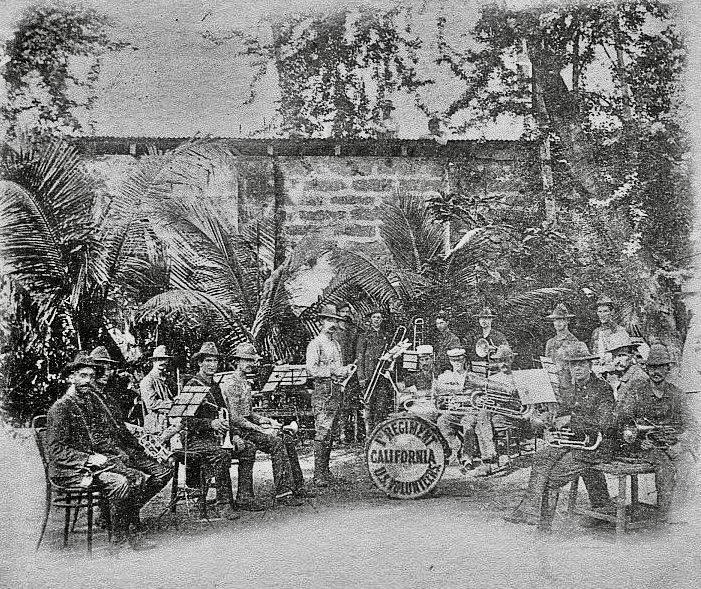
I will miss the concert tonight as I have told you the reason that I have to stay in quarters, and that is about all the enjoyment that I get now, except the baseball games that we are always playing. There is a game pretty nearly every day and I am getting tired of watching them. About once a week I go down and visit the boys of the 1st California Regiment. I have a lot of old chums in that regiment that I used to go to school with in San Francisco. I always have a good time when I go down to see them and I always give them the same when they come out where I am.
The steamers that came in to the harbor yesterday did not bring any mail with them but there is one that has just come in and it is said that she came from Hong Kong. She has just dropped her anchor over in Subic Bay, over near Cavite. If she has the mail on her, why, we can expect to get it sometime this evening and I will let you know all about it as to whether or no we get it before I close this for today. The man in the Post Office down at New Manila have put up a sign stating that mail is expected from the U.S. on the 9th or 10th of this month. That would be tomorrow or the next day, although it does come in a day or so ahead of time once in a while. I hear the bugler blowing mess call so as dinner is ready, why I must drop this pen for a while so that I can go out and eat a little.
In camp 7.30 a.m.
Cuartel de Malate, Manila, P. I.
Friday, November 11th 1898
Dear Mother,
I received 3 bundles of papers from you by the mail yesterday and I also got your letter that was enclosed in one of the papers. It is dated September 25th. I am glad to know that you have heard from me since arriving here. I wrote that letter on the Sunday morning just after we dropped anchor in Manila Harbor. I am sorry to hear that you have the rheumatism, and hope that by the time this reaches you, that it will have disappeared. This country is a bad place for it too. A good many of the boys have it bad. A person not knowing what the climate is in the tropics might think this would be a good country for such ails as that, but they would be sadly disappointed as it is warm here, but a different kind of a heat than that we get in the States. It is a damp heat and a fellow has to be very careful and try and keep away from catching cold as it does not take but very little to bring on a fever as I have learned to my sorrow. I am all right now, but I put in a few days misery with the fever. But I took care of myself in time and now i am feeling good once more.
Things are at a stand still here now—that is, I mean things are very quiet. We have not much to do but take care of our health and that is not an easy thing to do. We have to be very careful. I see by the cablegrams that we got yesterday that [Henry Tifft] Gage is California’s next Governor. I suppose Tom does not like that as I guess that he is still a good 16 to 1 Democrat. We also heard that [Theodore] Roosevelt carried New York. He must be well liked there as New York used to always go Democratic. I thank you for those news items. You don’t know how welcome those newspapers are to a fellow down here. Of course we have newspapers down here, such as they are. I will send you a copy of them, one of each, along with this—that is, in the mail. I hope that you will enjoy reading htem.
We are expecting to get paid today or tomorrow. The mail will leave tomorrow on the Scandia direct for the United States and this will go on her, I hope. I see by a cablegram that we got yesterday that the SS New Port left San Francisco on Tuesday, November 8th for Manila. She will arrive here by the 1st next month or so. I am on old Guard Fatigue today—that is, the day after one comes off guard, why he has to herd prisoners around. THe prisoners are compelled to do two hours work per day. They carry all the refuse away from the Cuartel and dump it in the bay. It is a very disagreeable task, herding them, as some of them are inclined to be very fresh with their guards, and once in a while one of them tries to get away, and that is the mean part of the job as the guard’s orders are very plain—that is to shoot them down at the first break that they make to get away. A sergeant tried to get away from his keeper down here—it is about a month ago that it happened—but the sergeant is dead now and the guard got made a corporal fr the dirty trick. Of course if the prisoners were natives or Spanish, we would not think of shooting them as they are no good. They appear very friendly, of course. Why wouldn’t they? But we are on to them with both feet. They would stick a knife in a fellow’s back if they got the chance. But the fellows that we have to watch are our own men that get put in [the guard house] for getting drunk or fighting, and a fellow hates to have any trouble with his comrades.
I wish you would ask the Niederost’s as to whether or no they know Pete Kyne. He comes from Spanish town. He was raised over there. I have got to know him from hearing him talk about the coast. He knows Donovan and Kearns and all the rest of the people from the coast that we know, including Clocks. Ask Claire if she knows Clocks, or not, and tell her that I have not had time to use up all them kisses that she sent but I thank her ever so much.
Well, Mother, I think I shall have to close this now as my rifle and weapons need a little polishing so I must fix them up as I will be called on for duty in a short while. I will now have to bid you all goodbye, hoping that you are al well and happy. Give Claire a big kiss for me and tell her to be a good girl. So with love for all, I remain your loving son, — Harvey Knight, Co. M, 14th U. S, Infantry, Military Station No. 1, Philippine Islands, via San Francisco, California
P. S. This Pete Kyne that I speak of is in Co. H of the 14th. He has just brought me over three papers called the Coast Advocate.
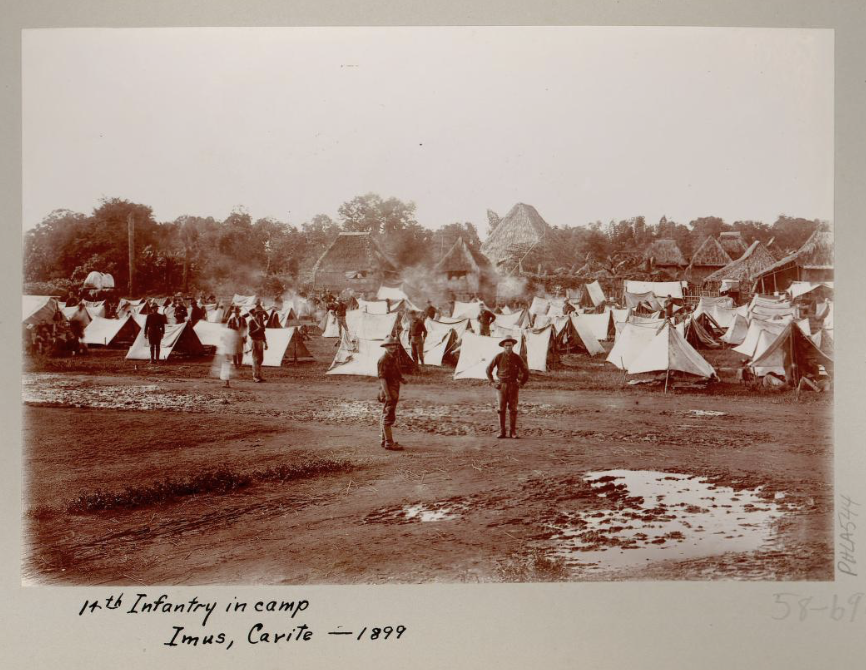
1 The Cuartel de Meisic was a Spanish-era barracks in Manila, located in the Binondo district (now the site of the Lucky Chinatown Mall area), not within Intramuros like some other cuartels. During the American period, it housed various U.S. Army units, including elements of the 3rd Artillery Regiment, which was stationed in the Philippines from approximately 1900 to 1903.
2 Thomas W. Horn (1873-1937) was born in Redwood, California, where he was mining prior to his enlistment on June 4, 1898 and enrolled in Battery G, 3rd US Artillery. He was discharged August 17, 1899 at Manila. Philippine Islands.
 Spared & Shared 23