
The following letter was written by Dr. Charles Augustus Cheever (1793-1852), the son of Dr. Abijah Cheever. It describes his sea voyage to St. Bartholomew (St. Barts) to perform vaccinations, presumably for small pox. In datelining his letter, Dr. Cheever failed to write the year. In a book published in 1854 under the title, “Extracts from the writings of Charles A. Cheever,” it is stated that Charles made his voyage to the West Indies “for the purpose of introducing vaccination as a preventative for the smallpox” and this trip was made during the period he worked for Dr. Brown of Boston in the Spring of 1815 and the autumn of 1816 when he moved to New Hampshire.
Charles “entered Harvard in 1809 and took his A. M. in 1813. He had the good fortune to study medicine with Dr. John Warren and in 1815 with Dr. John B. Brown, and enjoyed the benefit of his large dispensary practice, then the only clinical opportunity in Boston. In 1816 he received his M. D. and settled in Portsmouth, New Hampshire, where he was the leading surgeon for thirty-six years, until his untimely death in 1852. Previous to this he made a voyage to the West Indies to carry vaccination, then a new practice, there. His material of vaccine was embodied in an Irish lad whom he vaccinated on starting and took with him to supply the vaccine virus. This trip was entirely successful. Portsmouth, New Hampshire, was a compact town of about seven to nine thousand people. It was intensely conservative, older physicians were abundant, and his progress in acquiring practice was extremely slow.
Although always somewhat impecunious, he lavished his scanty means in all expenses which would advance him as a doctor. He bought new books, was extravagant in new instruments, and disregarded cost of knowledge. He early attracted students, and always had from one to three under him. He formed a good library, read and catechized his students, took them to see his cases, taught them to dissect and to prepare anatomical injections, dried specimens and skeletons, so that he collected for those times an unusual though small museum. Anatomical material could be obtained only by very expensive purchase. $25 to $50, from New York and Philadelphia (no railway transportation), or by illegal means.
The cadavers were obtained and dissected in the attic of his house. His home was the center of anatomical and surgical knowledge for thirty miles around, and over this area he was for thirty-six years known as “The Surgeon.” His work ranged from dentistry and obstetrics to the major surgical operations. Considering the limitations, ignorance, prejudice and timidity with which he was surrounded, it is remarkable that he undertook, for his first attempts, new and recently described operations.
He operated successfully for cataract, and to ensure it kept his patient in his own house and nursed him. He operated for strabismus, also removed breasts and tumors, amputated limbs. The first asepsis of subcutaneous surgery coming to his early knowledge, he operated for club-foot and tendon sections, and treated his patients by apparatus. He was among the first here to follow up a trephining by laying open the dura mater for hemorrhage or for abscess. No asepsis, no ether! Nerve and audacity were required to assail these new problems; enlightened only by his own dissections and his own reading, he practised what he had never seen. The unaided natural senses of sight and touch guided a hand, erudite only by dissection, safely to the recesses of a quivering and moving patient.
Keen insight, intuition even, made him a noted diagnostician, esteemed as such by his contemporaries.
He died too early, shattered by domestic griefs which preyed on a sensitive nature.” [Sketch by David Williams Cheever]
I believe the letter was written to Brigadier General Arnold Welles (1761-1827), a Boston native, who served as the first President of the Boston Branch of the Bank of US (which is now the US Treasury). He married Elizabeth Warren of in 1790, daughter of Dr. Joseph Warren, killed at the Battle of Bunker Hill in 1775. Warren was a presiding officer of the Mass. Congress, whose portrait was painted by John Singleton Copley. Arnold Welles father, Gov. Thomas Welles, was a prominent citizen of Wethersfield/Glastonbury, CT.
Transcription
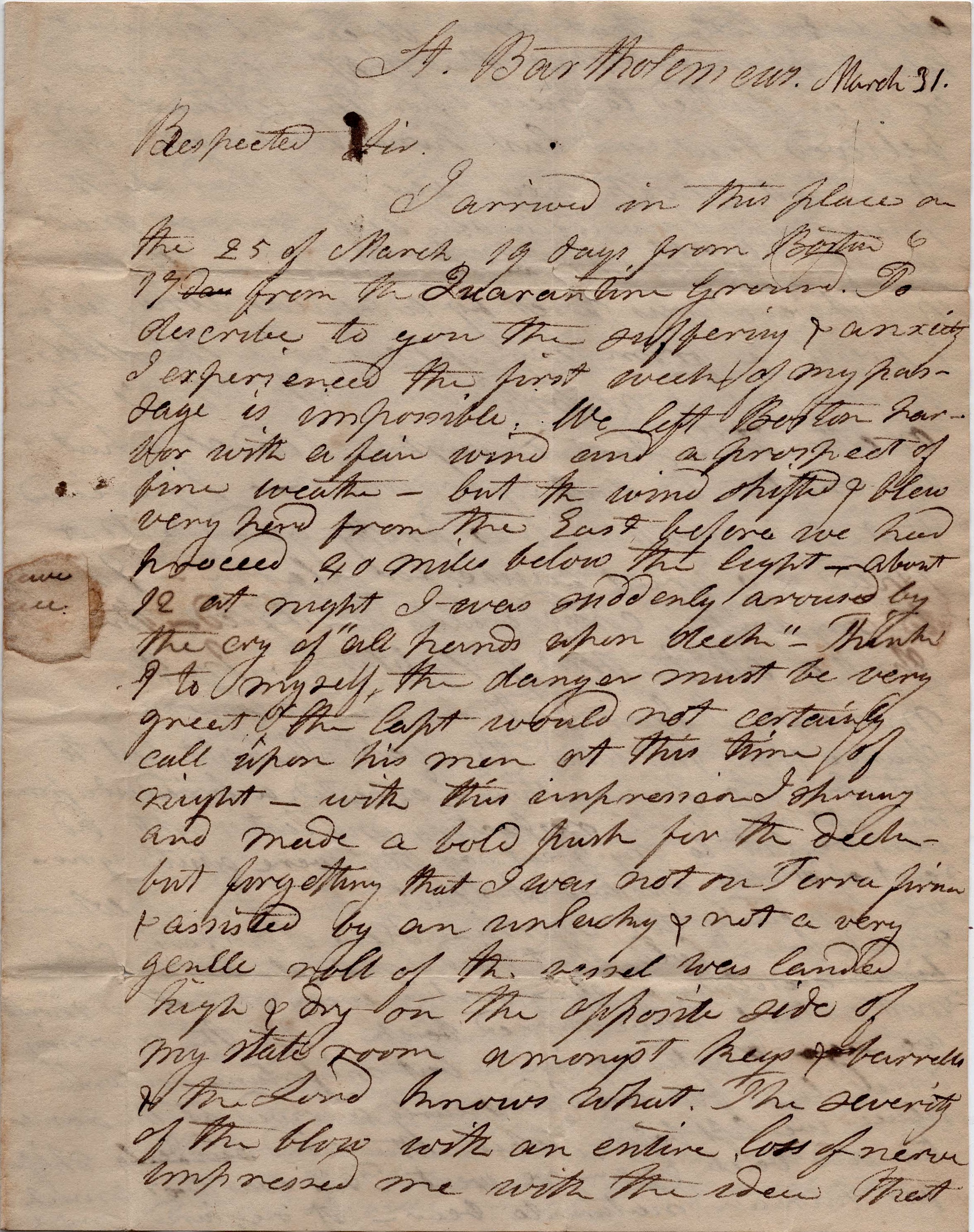
St. Bartholomew [West Indies]
March 31 [1815 or 1816]
Respected Sir,
I arrived in this place on the 25th of March, 19 days from Boston and 17 from the Quarantine ground. To describe to you the suffering & anxiety I experienced the first week of my passage is impossible. We left Boston Harbor with a fair wind a prospect of fine weather—but the wind shifted and blew very hard from the east before we had proceeded 40 miles below the light. About 12 at night I was suddenly aroused by the cry of “All hands upon deck!” Thinks I to myself, the danger must be very great or the Captain would not certainly call upon his men at this time of night. With this impression, I sprung and made a bold push for the deck forgetting that I was not on terra firma and assisted by an unlucky and not a very gentle roll of the vessel, was landed high and dry on hte opposite side of my state room amongst kegs & barrels & the Lord knows what. The severity of the blow with an entire loss of nerve impressed me with the idea that all was lost—that some dreadful accident had happened—that the ship was foundered or was dashed to pieces upon the rocks. I verily believed that my last hour had come.
After the first shock was over, I picked up the pieces and mustering all my courage made another bold push to gain the deck. At the hatchway, I was met by a sailor, who, judging I presume from my appearance the state of my mind, accosted me with, “What’s the matter, doctor?” “Sure enough,” replied I, “What’s the matter?” Looking round I perceived that the weather was pretty good and that I had no great cause for alarm. I retreated to my berth, considerably mortified—the sport of all the sons of Neptune.
In the morning I learnt that in consequence of a change in the wind, the Captain thought best to put back to Quarantine. I expected a broadside from the Captain and Mate respecting my last night’s adventure but to my great joy they were quite ignorant of it. We arrived at Quarantine at noon where we remained till morning. Here I suffered so much from the cold that had I not started with the firm resolution of surmounting every obstacle, I should most certainly have turned back.
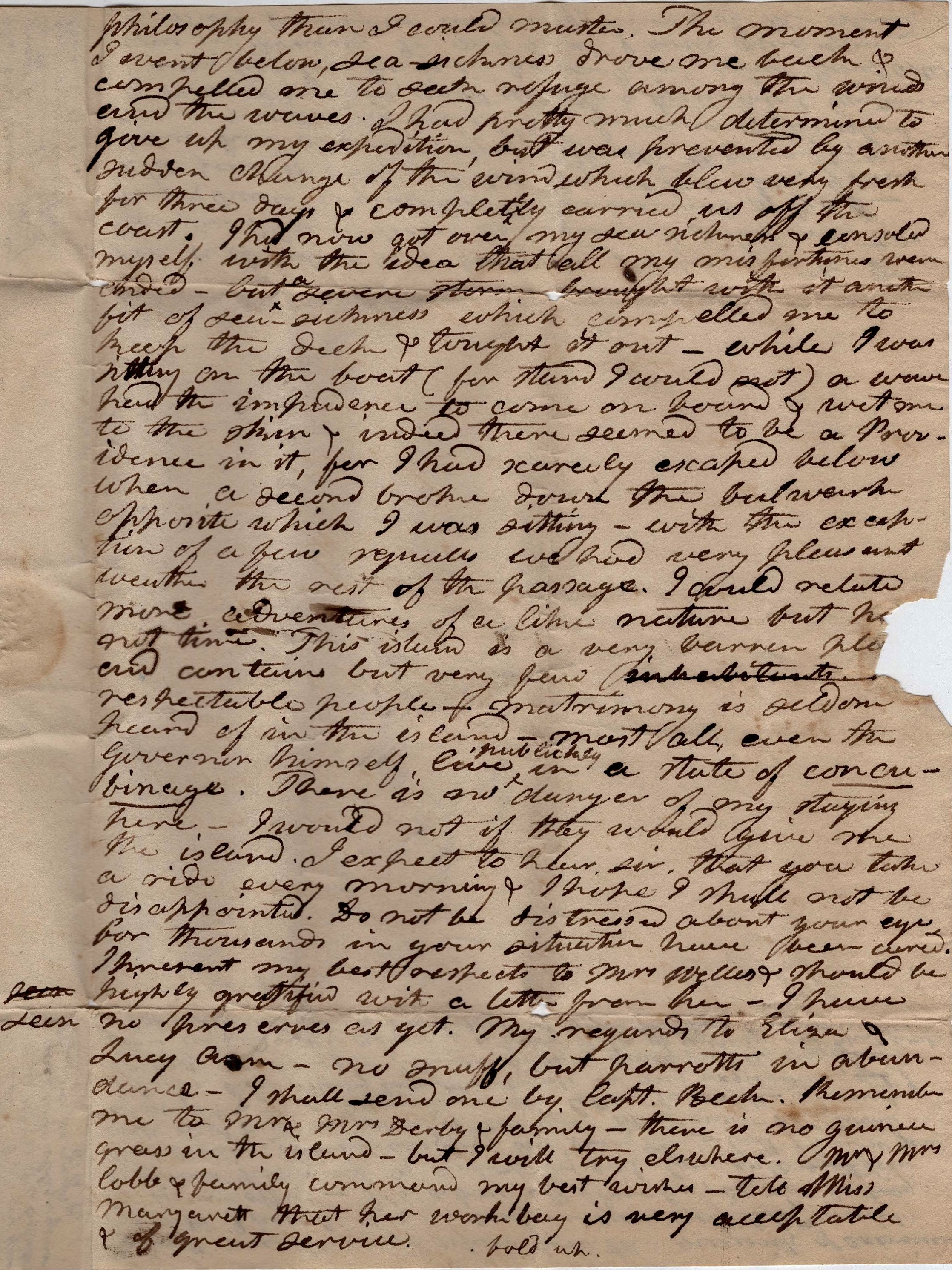
In the morning we started again, but misfortunes seldom come alone for we had nearly arrived at the same place we left before when the wind shifted and back again we went. This was too much for human nature to bear. It required more philosophy than I could muster. The moment I went below, sea sickness drove me back and compelled me to seek refuge among the wind and the waves. I had pretty much determined to give up my expedition but was prevented by another sudden change of the wind which blew very fresh for three days and completely carried us off the coast. I had now got over my sea sickness and consoled myself with the idea that all my misfortunes were ended. But a severe storm brought with it another fit of seas sickness which compelled me to keep the deck and tough it out.
While I was sitting on the boat (for stand I could not), a wave had the impudence to come on board & wet me to the skin & indeed there seemed to be a Providence in it for I had scarcely escaped below when a second broke down the bulwark opposite which I was sitting. With the exception of a few squalls, we had very pleasant weather the rest of the passage. I could relate more adventures of a like nature but have not time.
This island is a very barren place and contains but very few respectable people. Matrimony is seldom heard of in the island. Most all—even the Governor himself—live publicly in a state of concubinage. There is no danger of my staying here. I would not if they would give me the island.
I expect to hear, sir, that you take a ride every morning and I hope I shall not be disappointed. Do not be distressed about your eye for thousands in your situation have been cured. I present my best respects to Mrs. Wells & should be highly gratified with a letter from her. I have seen no preserves as yet. My regards to Eliza & Lucy Ann. No snuff but parrots in abundance. I shall send one by Capt. Becker. Remember me to Mr. & Mrs. Derby and family. There is no guinea grass in the island, but I will try elsewhere. Mr. & Mrs. Cobb and family command my best wishes. Tell Miss Margaret that her work bag is very acceptable and of great service.
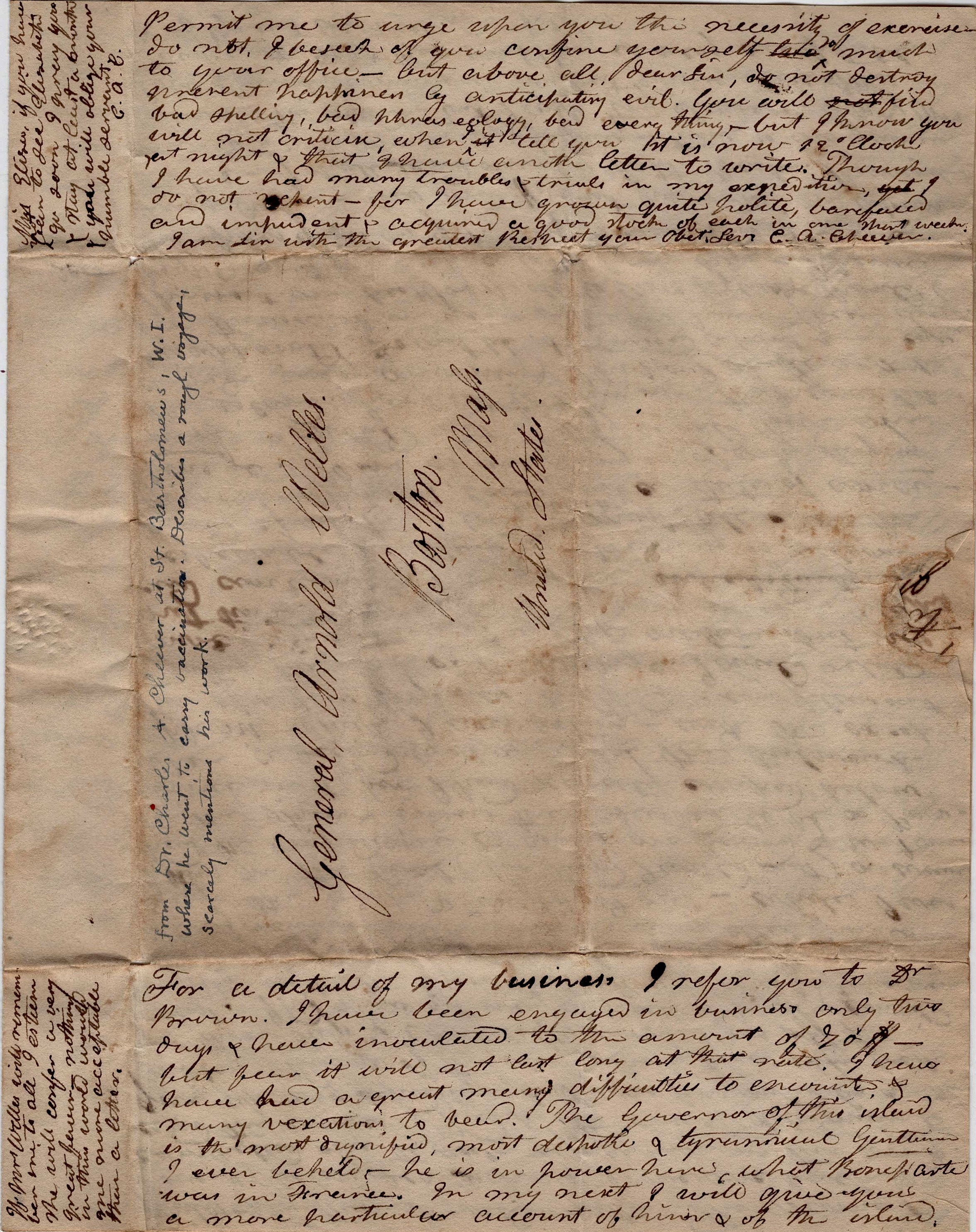
For a detail of my business, I refer you to Dr. Brown. I have been engaged in business only two days & have inoculated to the amount of $70 but fear it will not last long at that rate. I never have had a great many difficulties to encounter & many vexations to bear. The Governor of this island is the most dignified, most despothe & tyrannical gentleman I ever beheld. He is in power here what Bonaparte was in France. In my next I will give you a more particular account of him and of the island. 1
Permit me to urge upon you the necessity of exercise. Do not, I beseech of you, confine yourself so much to your office. But above all, dear Sir, do not destroy present happiness by anticipating evil. You will forgive bad spelling, bad phraseology, bad everything, but I know you will not criticize when I tell you it is now 12 o’clock at night and that I have another letter to write. Though I have had many troubles & trials in my expedition, I do not repent, for I have grown quite polite, barefaced and impudent & acquired a good stock of each in one short week. I am, Sir, with the greatest respect your obedient servant, — C. A. Cheever
1 The Governor of St. Bartholomew at the time of Cheever’s visit would have been Berndt Gustav Stackelberg (1784-1845. He was a Swedish military officer and diplomat. He ruled the colony from 1812 to late in 1816. The population on the island at the time was about 6,000, with roughly half being enslaved. Slavery was not abolished on the island until 1847.

 Spared & Shared 23