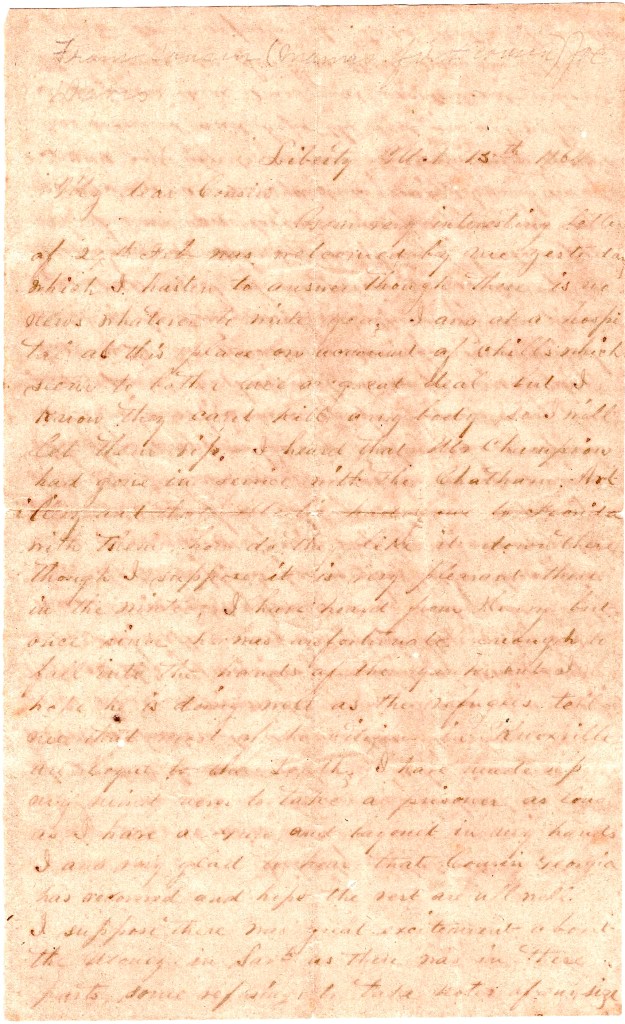
1864: Joseph Oliver Davis to his Cousin

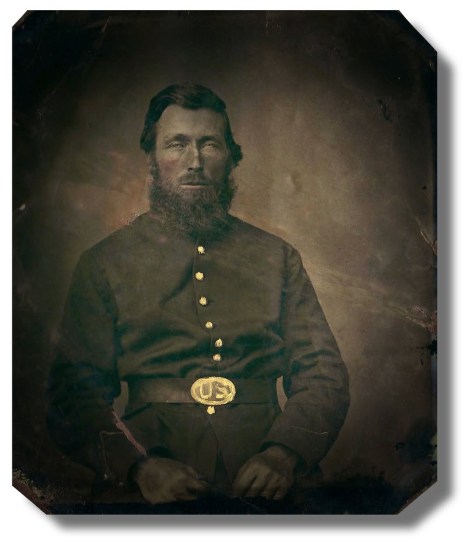
I could not find an image of Joseph but here is one of Absalom E. Dillingham of Co. B, 8th Georgia Infantry. (Georgia Confederate Images)

The following letter was written by Joseph Oliver Davis (1841-1891) of Chatham county, Georgia, who enlisted in Co. B (“Oglethorpe Light Infantry”), 8th Georgia Volunteer Infantry in August 1861. Muster Rolls inform us that he was elected to sergeant on the 23rd April 1864, some five weeks after this letter was written from a hospital in Liberty, Virginia. He appears to have returned to his regiment in time for the spring campaign of 1864 because he was admitted to the Jackson Hospital in Richmond, Virginia, on 9 May with a slight Minié ball wound to his left hand received on 6 May 1864 in the Wilderness. He was later wounded severely by a Minié ball to his right arm and right side on 30 September 1864 in the Battle of Chaffin’s Farm. He was said to be among the 139 enlisted men left in the 8th Georgia who surrendered at Appomattox on 9 April 1865.

Joseph was the son of John Edward Davis (1805-1883) and Elizabeth Amanda Schaffer (1819-1854) of Savannah, Chatham county, Georgia. In 1877, long after the war, Joseph married Elmira Isabel Futch. The couple lie side by side in Taylors Creek Cemetery in Liberty county, Georgia. The inscription on his headstone states: “We Miss Thee From Our Home Dear Father, We Miss The From Thy Place, A Shadow O’er of Life Is Cast, We Miss The Sunshine Of Thy Face, We Miss Thy Kind & Willing Hand, Thy Fond & Earnest Care, Our Home Is Dark Without Thee, We Miss Thee Everywhere. In Memoriam, Joseph O. Davis, Born March 30, 1841, Died Sept. 26, 1891. A Kind Husband, A Devoted Father, A True Friend & A Useful & Respected Citizen. Death Claimed Him And Our Hearts Are Sad.”

T R A N S C R I P T I O N

Liberty [Virginia]
March 15th 1864

My dear Cousin,

Your very interesting letter of 24th February was welcomed by me yesterday which I hasten to answer though there is no news whatever to write you. I am at a hospital at this place on account of chills which seem to bother me a great deal and I know they can’t kill anybody so I will let them rip. I heard that Mr. Champion had gone in since with the Chatham Artillery and had already gone to Florida with them. 1 How do they like it down there—though I suppose it is very pleasant there in the winter. I have heard from Henry but once since he was unfortunate enough to fall into the hands of the Yanks, but I hope he is doing well as the refugees tell me that most of the citizens in Knoxville are loyal to the South. I have made up my mind never to take a prisoner as long as I have a gun and bayonet in my hands.

I am very glad to hear that Cousin Georgia has recovered and hope the rest are all well. I suppose there was great excitement about the money in Savannah as there was in these parts, some refusing to take notes of any size but it suited us very well for if I wanted to buy anything and they would not chance the bills, I took what I wanted and kept the money though I thought it my duty to do so for it was the money that the C. S. paid us for service.

I think the spring campaign will open in a month or so and then I will draw a furlough on a plantation but as I don’t want to leave right away, would prefer a furlough. Have you made up your mind to be a farmer or have you given up the idea. I shall bring this foolishness to a close as it is bed time. With love to all, I am affectionately your cousin, — Joseph Davis

Co. B, 8th Georgia Regiment, Anderson’s Brigade, Buckner’s Division, Longstreet’s Corps, Greenville, Tennessee


1 The Chatham Light Artillery was formed in Savannah in the spring of 1862. In March 1864, the unit joined Colquitt’s Brigade to go to Florida to counter the Union invasion there and they played a prominent role in the Battle of Olustee on 20 February 1864.
1863: John W. Snyder to a Friend

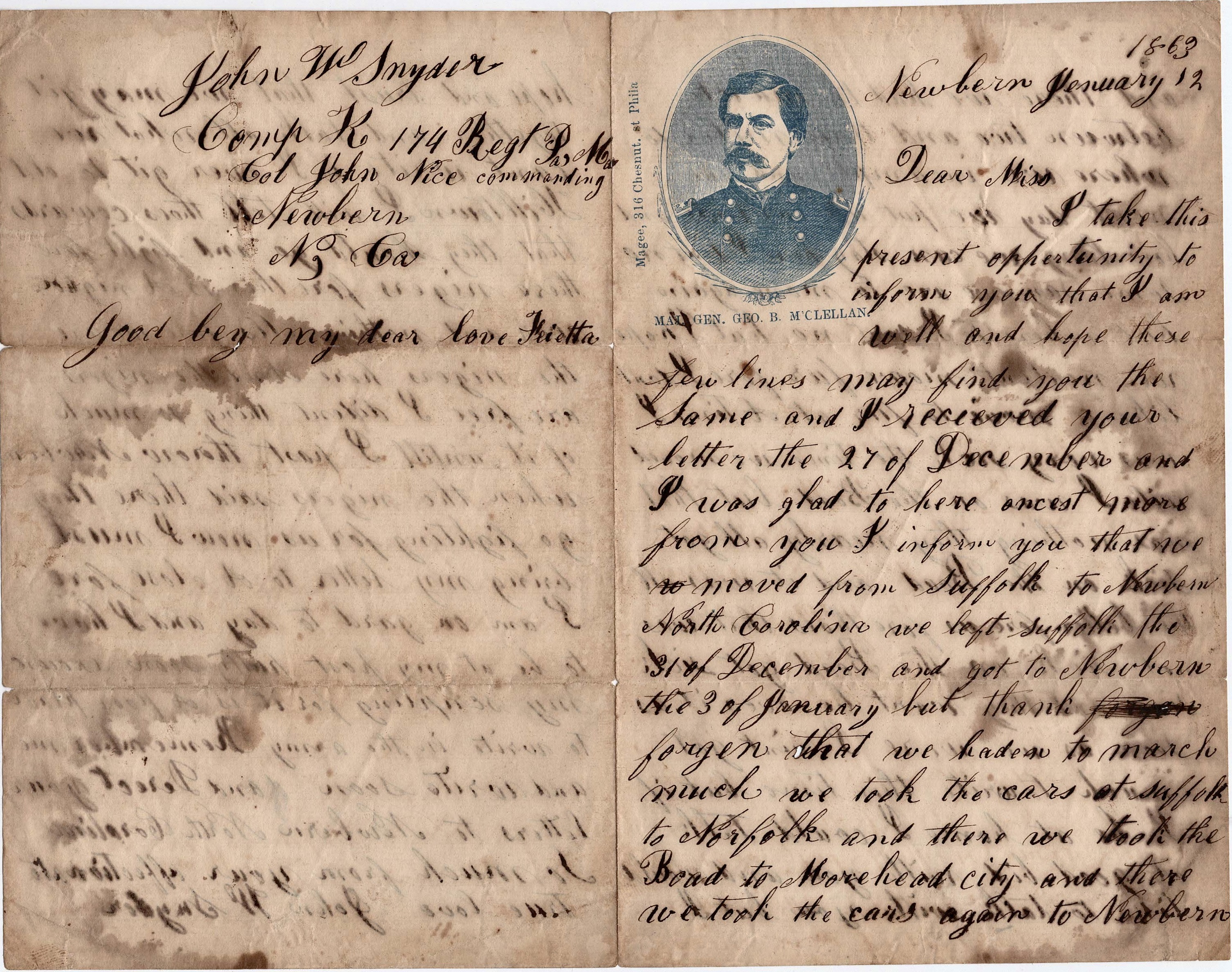
The following letter was written by John W. Snyder (1838-1926) of Hiltown township, Bucks county, Pennsylvania. John wrote the letter from New Bern North Carolina, while serving in Co. K, 174th Pennsylvania Militia. After it was organized in November 1862, the regiment saw service at Suffolk until late December when they traveled to New Bern, as described in this letter.

Clearly, John found himself disillusioned with his tour of duty, perceiving a transformation in the war’s purpose from a struggle to preserve the Union to a campaign aimed at the liberation of enslaved individuals.

T R A N S C R I P T I O N

Newbern [North Carolina]
January 12, 1863

Dear Miss,

I take this present opportunity to inform you that I am well and hope these few lines may find you the same and I received your letter the 27th of December and I was glad to hear once more from you.

I inform you that we moved from Suffolk to Newbern, North Carolina. We left Suffolk the 31st of December and got to Newbern the 3rd of January, but thank fortune that we hadn’t to march much. We took the cars at Suffolk to Norfolk and there we took the boat to Morehead City and there we took the cars again to Newbern and there we had to march between two and three miles to where we encamped. And the next day we put up our tents and how long we can stay here, I don’t know. Some say we are to move again but where to, I don’t know. But I hope we needn’t move for I don’t like to move too far at a time.

I was very sick the time we moved while I was on the boat, but that was nothing. They nearly all got sick on the boat and it was all the better for us for those that was not sick on the boat got sick since and they won’t be over it as soon as we were.

I ain’t got much to write this time but if I be at home, I could talk a good bit with you and would like to talk wit you but I hope and trust that we may get together and talk all what ew can’t write. If I ever get to Old Hilltown, I will tell those cowards that they should go and fight for these niggers for this is a nigger war and nothing else for we are the niggers here and the niggers are free. I didn’t think so much of it until I passed through Newbern when the niggers said there they go fighting for us now.

I must bring my letter to a close for I am on guard today and I have to be at my post pretty soon. Excuse my scribbling for it is a poor place to write in the army. Remember mr and write soon and direct your letters to Newbern, North Carolina. So much from your affectionate true love, — John W. Snyder

John W. Snyder. Co. K, 174th Regt. Penn. Militia
Col. John Nyce, commanding
Newbern, N. C.

Goodbye my dear love Fietta.

1849: James Morrow to John B. Bull

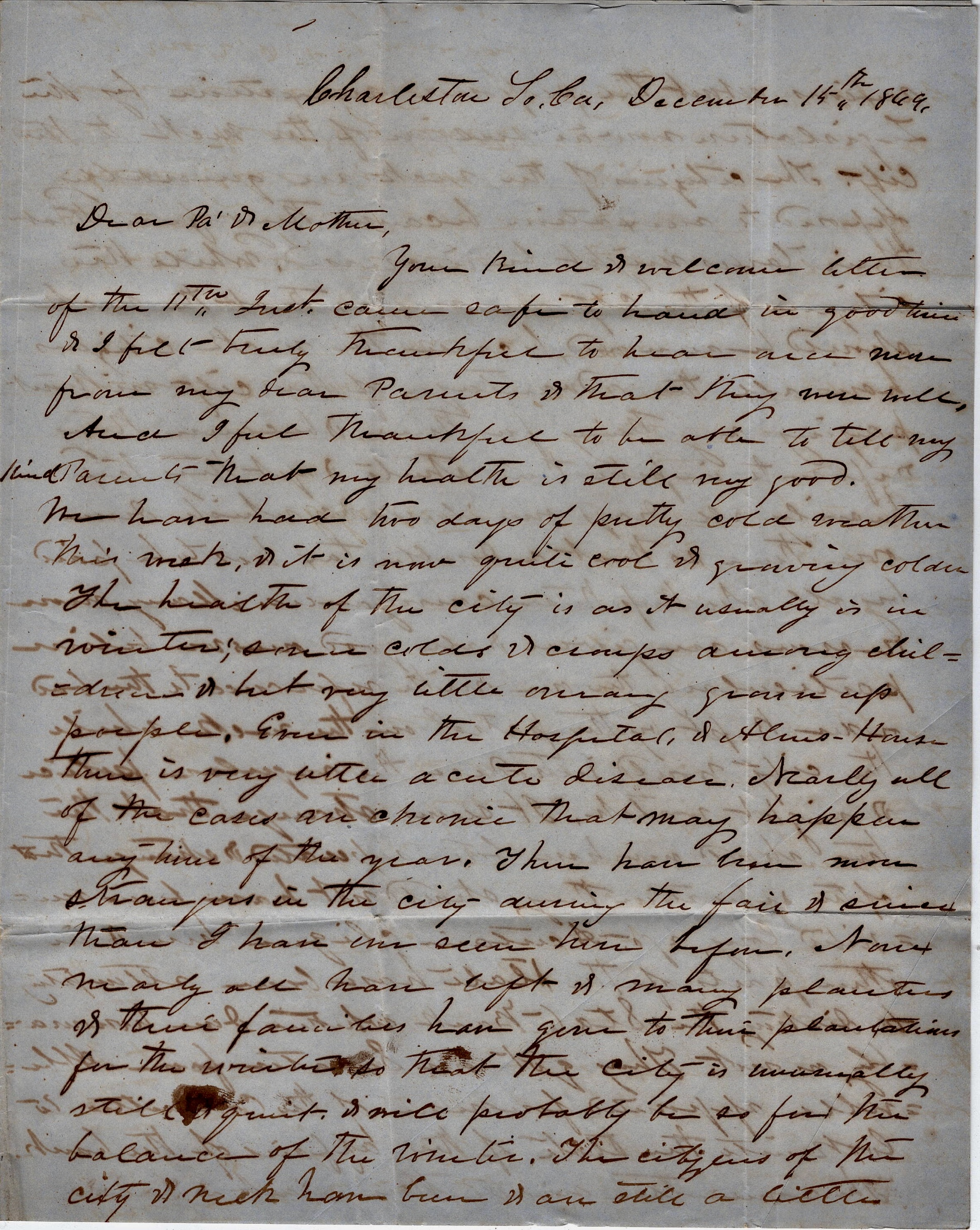
The following letter was written by James Morrow (1820-1865) of South Carolina, a graduate of Philadelphia Medical College and a young physician with an extensive background in natural history and agriculture. In 1853, Secretary of State Edward Everett appointed him to serve as agriculturist with the U.S. expedition to Japan led by Commodore Matthew C. Perry. The objective of the expedition was to open diplomatic and commercial relations with Japan, despite that island nation’s strong tradition of cultural isolation. Besides armed vessels to intimidate the Japanese, the U.S. government also loaded supply ships with samples of American products, and enlisted Dr. Morrow to gather samples of Japanese plants for scientific study and for propagation at a new greenhouse on the grounds of the U. S. Capitol in Washington, D.C. To read more on this expedition and the role played by Dr. Morrow, see Oqui Adair: First Chinese Resident of South Carolina, Part 1.

Dr. Morrow wrote the letter to his stepfather and plantation owner, James Baxter Bull (1790-1855), and his mother Sarah Dunn (1794-1857) of Willington, Abbeville District, South Carolina. His father, David Morrow, was an Irish immigrant who came to the US in 1818 from County Down, Ireland.

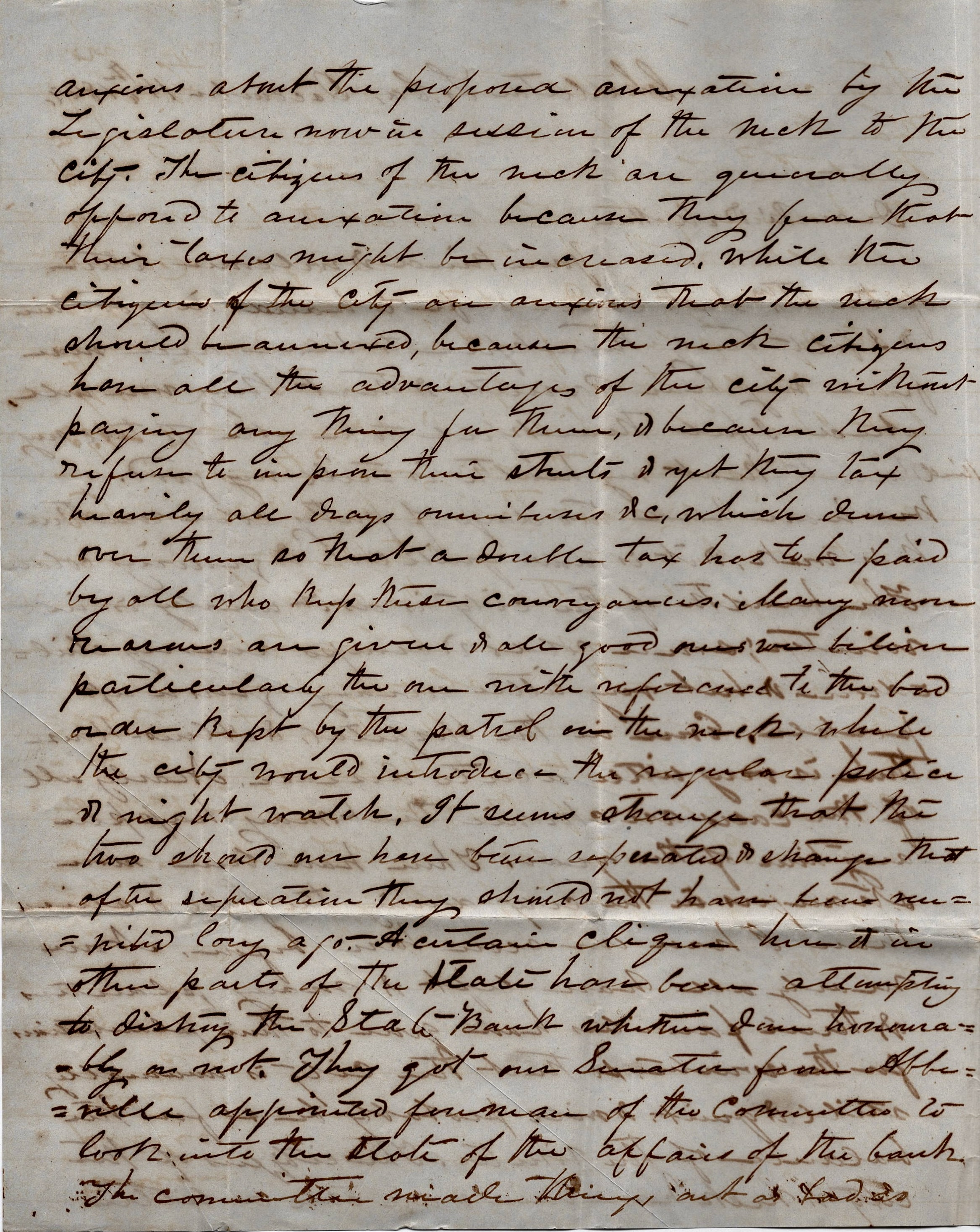
The doctor’s letter addresses several topics, but particularly emphasizes the prevailing political concerns of the moment, including the apprehension among citizens regarding the Legislature’s consideration of the annexation of the “neck” to the City of Charleston. Additionally, he mentions the criticism directed at the State Bank.

It should be noted that Dr. Morrow’s surname was spelled Morrah in the 1850 Census record and the gravestones of several of his relatives in the Willington Cemetery bear the name “Morrah” as well.

T R A N S C R I P T I O N

Charleston, South Carolina
December 15th 1849

Dear Pa & Mother,

Your kind & welcome letter of the 11th inst. came safe to hand in good time & I felt truly thankful to hear once more from my dear parents & that they were well. And I feel thankful to be able to tell my kind parents that my health is still very good.

We have had two days of pretty cold weather this week. It is now quite cool & growing colder. The health of the city is as it usually is in winter; some colds and croups among children but very little among grown up people. Even in the hospital & alms house there is very little acute disease. Nearly all of the cases are chronic that may happen any time of the year.

There have been more strangers in the city during the fair and circus than I have seen here before. Now nearly all have left & many planters & their families have gone to their plantations for the winter so that the city is unusually still & quiet & will probably be so for the balance of the winter.

The citizens of the city and neck have been & are still a little anxious about the proposed annexation by the Legislature now in session of the neck to the city. The citizens of the neck are generally opposed to annexation because they fear that their taxes might be increased while the citizens of the city are anxious that the neck should be annexed because the neck citizens have all the advantages of the city without paying anything for them & because they refuse to improve their streets & yet they tax heavily all drays, omnibuses, &c. which draw over them so that a double tax has to be paid by all who keep these conveyances. Many more reasons are given & all good ones we believe, particularly the one with reference to the bad order kept by the patrol in the neck, while the city would introduce the regular police & night watch. It seems strange that the two should ever have been separated & strange that after separation they should not have been reunited long ago.

A certain citizen here and in other parts of the State have been attempting to destroy the State Bank, whether intentionally or not. They got our Senator from Abbeville appointed foreman of the Committee to look into the state of the affairs of the bank. The committee made things out as bad as they could and still they were better than they had been represented to be so that the Legislature concluded to maintain the honor of the state & let the bank remain unaltered. They postponed indefinitely the Bill to destroy it. Do not think I have been discussing & studying politics for I have said nothing about them & belong to no party & intend to belong to none but I have been listening learning all I could when it came in the way.

Cotton is selling more briskly now than when I wrote to Pa last. It sells now from 10 to 10.75 for good cotton & the prospect is rather on the side that it will keep up for a few weeks at least. Maybe Pa knows that this is always uncertain.

Give my love to my dear Mother & tell her that I have had one patient but he did not stay sick long. Please Pa, tell me if Dr. Anderson expects to come soon to Charleston soon. Mrs. Fell has had an application for his operating room for some kind of office—an eye operating office, I think, & is anxious to make some arrangement with him about it. Please write to me often. Adieu, dear Pa & Mother & believe me your affectionate son, — Jas. Morrow

To Mr. John B. Bull

P. S. I sent Pa & Mother’s kind love to Uncle John’s family. I wrote to Cousin Mary.

1861: William Henry Koch to Howard Battin

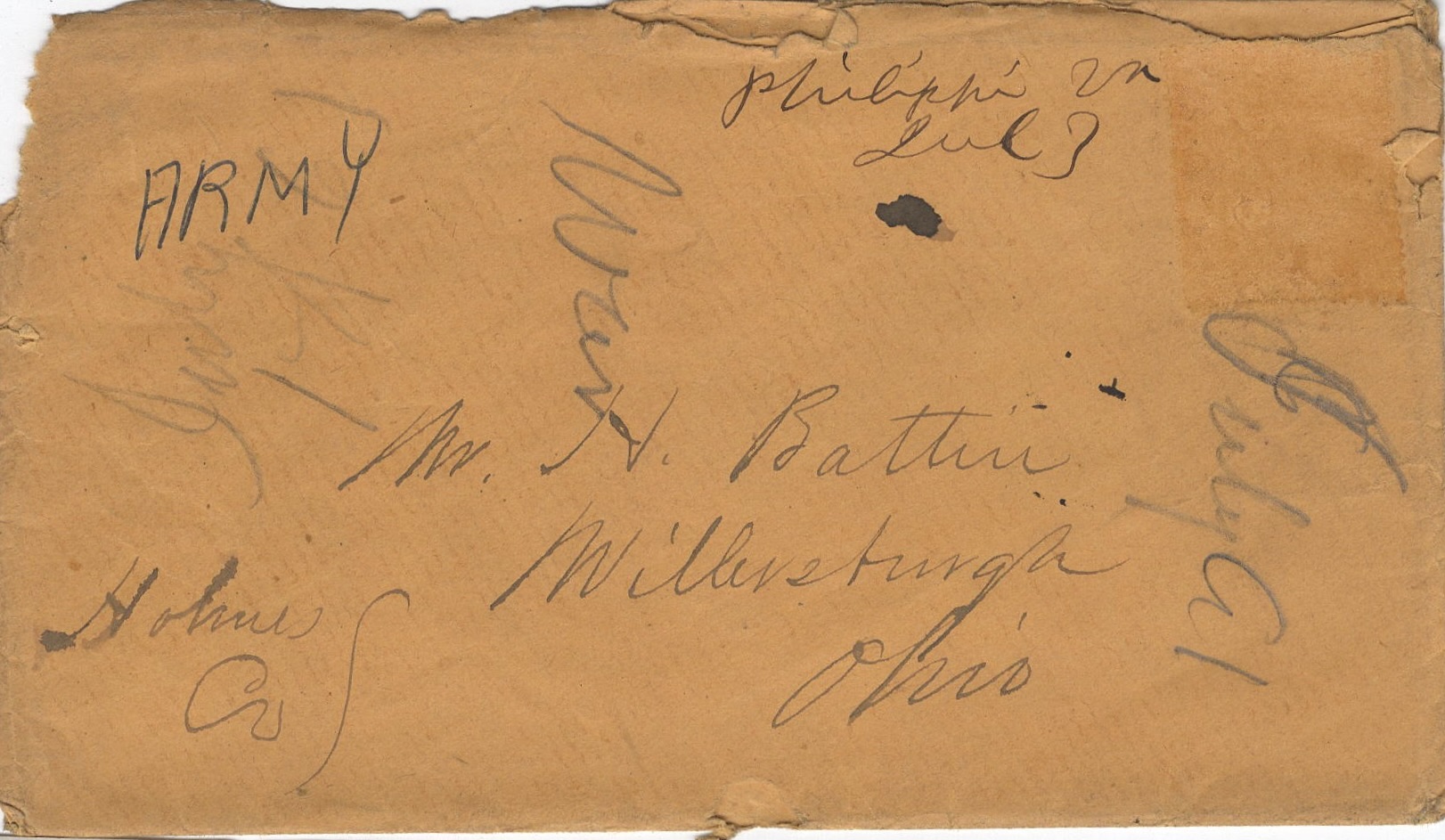
The following letter was written by William Henry Koch (1836-1915) of Millersburg, Holmes county, Ohio, while serving in Co. G, 16th Regiment Ohio (3 months, 1861). He served as a corporal in the company from 22 April 1861 to 18 August 1861.

William wrote the letter to Howard Battin (1826-1882), a railroad conductor, who also kept a boarding house in Millersburg, Holmes county, Ohio. William was the son of John E. Koch (1801-1881) and Maria S. Neely (1807-1896).

T R A N S C R I P T I O N

Philippi [Virginia]
2nd July 1861

Mr. H. Battin,

Dear Sir, I have thought for some time of writing you but have failed to do it until now and shall try and let you know about how we look and feel. We are, as you will see, still at Philipi. Have been here almost four weeks. We look rather rough for Boys not being used to this kind of life, and fare about the same—not so well as at home. But this we cannot expect in the life we are now leading. Our commissary department being rather badly conducted, we very often fall short of provisions. Then you may see the Boys making for the country on the hunt of something to eat pretty generally returning loaded. If you had seen Chapman Wiggins and myself coming into camp last Saturday with chickens, milk, pies and a little of everthing good to eat, I think you would have smiled.

We are camped with Co. E of Springfield and K of Dresden as guard over the bridge crossing Valley RIver. The balance of the force here, amounting to about six thousand strong, are camped on the hill above the town on the road leading from Grafton to this place and are well fixed for the enemy but we have no fear of the enemy disturbing us until we do them—and then but little, as they have proven themselves to be better trained to fast running than we are—at least do so at the time of the attack here. 1

We were ordered to prepare to march over a eek ago but the order being countermanded did not get to move. The Boys felt as though they were going to have some fun, all thinking we were going to attack a party of secessionists located at or near Laurel Hill about twelve miles from this place.

The balance of our regiment are at Cheat River on the Baltimore & Ohio Railroad about 22 miles from Grafton and about 15 from this place. We have been in hopes we would soon be united but have now given up all hopes of seeing the other until we get ready to leave for home which we think will be about four weeks if not sooner.

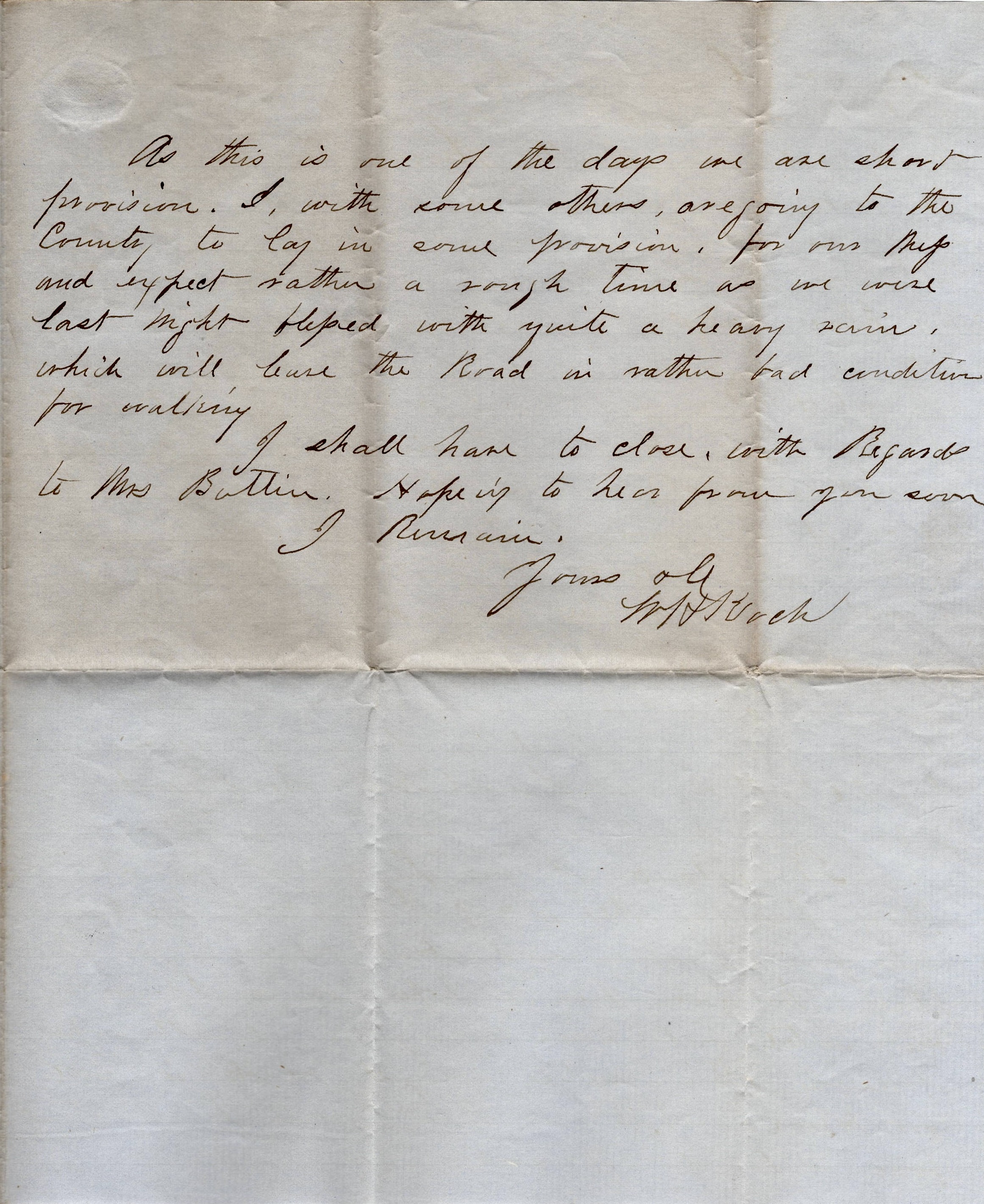
As this is one of the days we are short provision, I with some others are going to the country to lay in some provision for our mess and expect rather a rough time as we were last night blessed with quite a heavy rain which will leave the road in rather bad condition for walking. I shall have to close with regards to Mrs. Battin. Hoping to hear from you soon, I remain, yours obediently, — W. H. Koch


1 William refers to the battle (skirmish) that took place in and around Philippi, Virginia (now West Virginia) on June 3, 1861, which resulted in a Union victory and marked a significant moment in the early stages of McClellan’s military career. The largely untrained Confederate forces skedaddled from the battlefield with minimal opposition, and the Union forces mockingly dubbed the conflict the “Philippi Races.

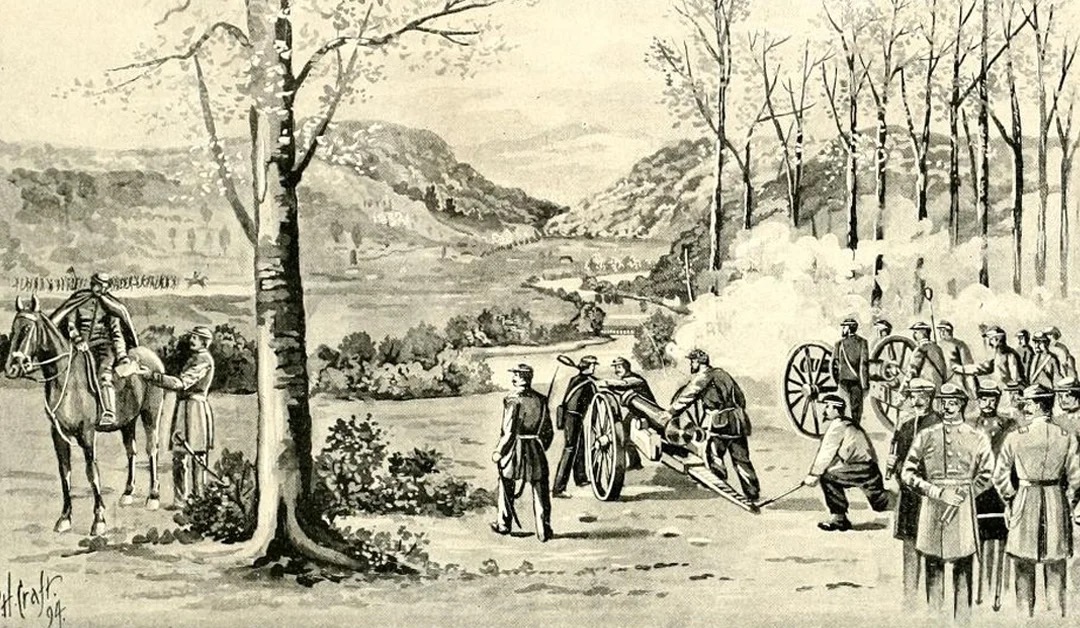
This illustration depicts the Battle of Philippi. Image Source: The Memorial War Book, 1894.

1861: Eliza (Atkinson) Battin to Howard Battin

This letter was written by Eliza (Atkinson) Battin (1834-1871), the 1st wife of Asa Howard Battin (1829-1896) of Wellsville, Ohio. She wrote the letter to her brother-in-law, Howard Battin (1826-1882), a railroad conductor, who also kept a boarding house in Millersburg, Holmes county, Ohio.

According to an obituary, Eliza’s husband was born on a farm one mile west of Hanover, Columbiana County, Ohio, March 16, 1829. His boyhood and youth were spent upon a farm in the vicinity of his birthplace, and his early education was obtained in the district school. Later he attended a private school under the auspices of the Quaker church, of which both his parents and grandparents were members. He was studious and ambitious, and, at the age of eighteen years, he became employed as a teacher. The next five years he taught in the district schools of Columbiana County, and during that time he took up and pursued the study of law. He was admitted to the bar at New Lisbon in May, 1853, and in April, 1854, he began the practice of his chosen profession at Salem, Columbiana County. In December, 1858, he removed to Wellsville, where he opened an office and practiced law for ten years, with the exception of the time he spent in the army during the Civil War. He enlisted April 19, 1861, shortly after the rebellion began, as Captain of Company K, Third Regiment, Ohio Volunteers. He returned home from the field about May 1, 1862, broken in health. His one year’s service was chiefly performed in West Virginia and Kentucky.

Most of Eliza’s letter was devoted to copying one from her husband who wrote her from Clarksburg, Virginia, in early July 1861 where the 3rd Ohio Volunteers were encamped. She rewrote portions of her husband’s letter because his duties as captain left him little time to write to anyone other than his wife.

See also—1861: Asa Howard Battin to John & Sarah (Howard) Battin.

T R A N S C R I P T I O N

Wellsville, Ohio
July 7, 1861

Brother Howard,

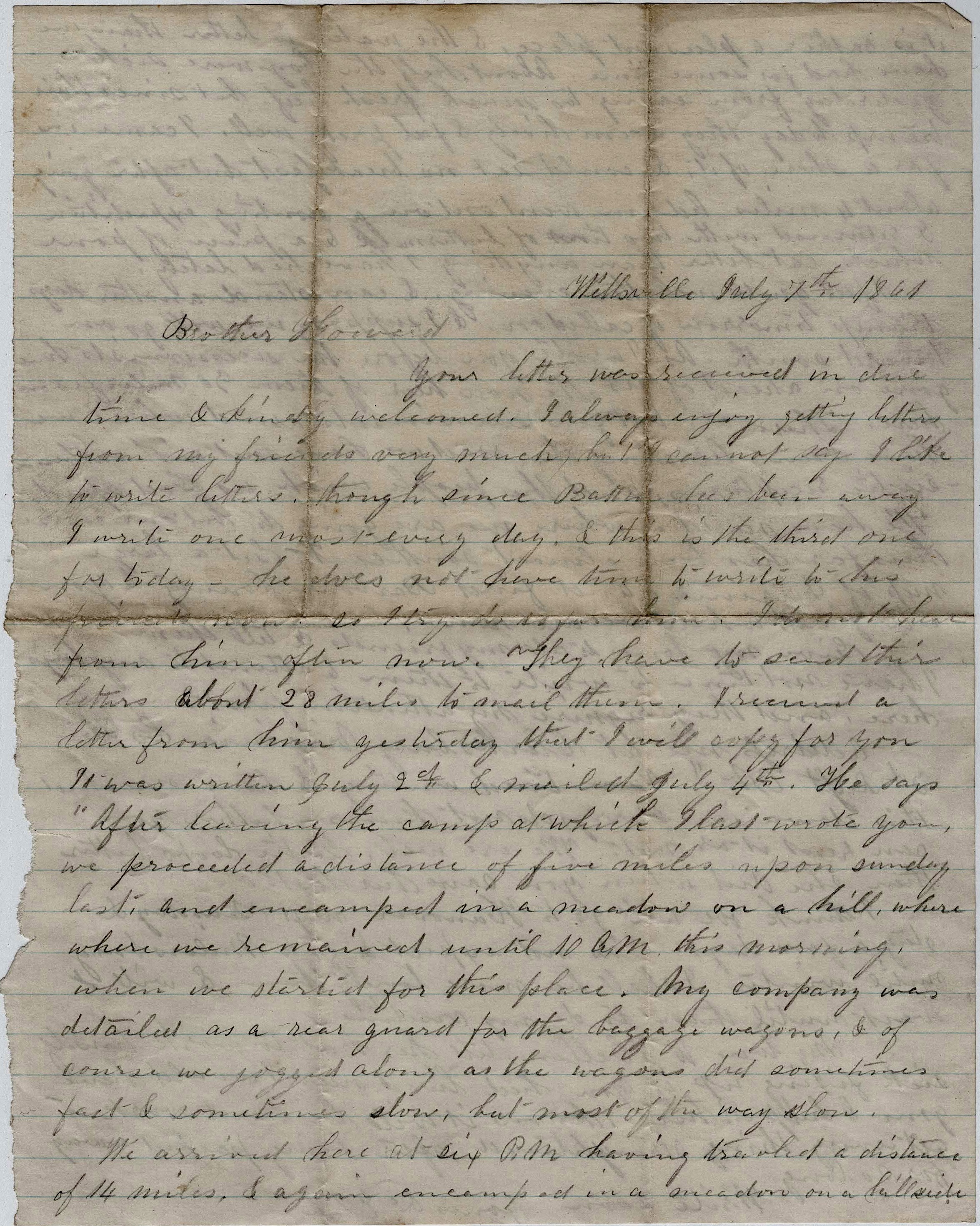
Your letter received in due time & kindly welcomed. I always enjoy getting letters from my friends very much but I cannot say I like to write letters though since Battin has been away, I write one most every day & this is the third one for today. He does not have time to write to his friends now so I try to do so for him. I do not hear from him often now. They have to send their letters about 28 miles to mail them. I received a letter from him yesterday that I will copy for you. It was written July 2nd and mailed July 4th.

He says, “After leaving the camp at which I last wrote you, we proceeded a distance of five miles upon Sunday last, and encamped in a meadow on a hill where we remained until 10 a.m. this morning when we started for this place. My company was detailed as a rear guard for the baggage wagons, and of course we jogged along as the wagons did—sometimes fast and sometimes slow, but most of the way slow.

We arrived here at six p.m. having traveled a distance of 14 miles, & again encamped in a meadow on a hillside. It is rather a pleasant place & the water is better than we have had for some time. About half the Boys were sick yesterday from eating too much fresh beef, but since this tramp today they seem lively & feel pretty well. I came in for a share of it & could eat no breakfast but after going about 4 miles, Adam went out on a scouting expedition and returned with two tins of buttermilk & a piece of pone which eat better than anything I have had lately. I feel quite well this evening and can stand another day’s tramp tomorrow if called on, and I suppose we will go on toward south.

As I wrote you before, the secessionists have gone on ahead of us. We now hear of them 30 miles from here. There are but few secessionists around where we have been. All along the road we have met with enthusiastic receptions, and the people wish us God speed.

We have no idea where we are going to but our course thus far has been almost southeast. Get a large map of Virginia and find Barbour county & you will find where we are now. Give my love to all my friends and tell them that I have not time to write to them & attend to my Boys here, and they require my attention first. Address me at Clarksburg, Virginia, Co. K, 2rd Regt. Ohio Volunteers.”

I am tired writing & have scratched this down in a hurry. Do not know whether you can read it or not. We are well. Gertie looks better than she did when you saw her last. I think we will go to Hanover next Tuesday and stay a few days. I do not expect to go to Millersburg until winter. I shall be more lonely then & I will wait until then to do my visiting.

My love to Hellen. Tell her not to work herself sick fixing up. If you had lived near, I would have gone and helped her. I know it will be hard work to get everything straightened after being packed away for so long. Write soon. Yours &c. — Eliza

1863: John H. Miller to Lavina Jennett Miller

An unidentified Yank (Will Griffing Collection)

The following letters were written by John H. Miller (1827-Aft1900), a 36 year-old farmer/blacksmith from East Hamburg, Erie county, New York, while serving in Co. D, 67th New York National Guard. In 1863, the 67th New York National Guard was a regiment of Union Army infantry that served for 30 days during the summer in response to Lee’s anticipated invasion into Pennsylvania. They served from late June to early August. The 68th New York National Guard, mentioned by John in the second letter, left the State with the 67th NY National Guard on June 24, 1863, en route to Harrisburg, Pa., for a service of thirty days. It served in the 5th Brigade, 1st Division, Department Susquehanna, and was mustered out of the United States service July 29, 1863, at Elmira, N. Y.

John emigrated from Germany in the mid 1850s and his writing skills were somewhat limited. He wrote the letters to his wife, Lavina Jennett Miller (1831-1895).

John’s letter includes a description of medical ailments experienced by himself and others and some treatments that sound barbaric, leaving me baffled as to their actual efficacy.

Letter 1

Harrisburg, Pennsylvania
June 26, 1863

Dear Wife,

As we arrived here all safe and sound, I think it is well to let you know about it. We arrived last night about nine o’clock and camped in the car house except a few who were not well. Alber [Oaks], Darius [Munger], Isaac Chandler and others did not feel in the best of spirits. Isaac was so bad off that two men had to assist him to the Hotel. Diarrhea was the complaint. Alber says he feels pretty well this morning. He vomited on the way. The doctor attends to them, myself the same. He stuck in his lance, Charley Smith said, about two inches but I should think about one and a half. It hurt like hell but I feel like a new being ever since yesterday.

We arrived at Elmira in the night, night before last, and left at six in the morning. The country looking first best, nothing in winter and spring crop. Old Genesee is of the old stamp. This side of Elmira I see mountain after mountain, looking like hay stacks from two up to one thousand feet in height covered mostly with white oak and hemlock timer, stone and rocks. The creek from Elmira as big as Nathan’s following down the flats from 6 rods to half mile in width until it forms the Susquehanna river. The poorest looking land you ever saw. I should think it would require one hundred acres for one sheep.

The men that are all able bodied have left their homes from Elmira to Harrisburg. An immense amount of women and children which came out to wave handkerchiefs, hats, rags, hands, or anything that was handy all along the entire line. I thought I see Bob down on the Susquehanna river waving a rag of some kind but it could not have been. When we stopped at Sunbury, the women brought us what I called the best bread and butter together with coffee the city could afford. It’s within 45 miles of Harrisburg.

The war news is all sorts. They say the Rebels fell back 8 miles last night that was within 18 miles of this place. Hooker is in the rear. Our forces are in front. The Rebels [will] never live to see Virginia again if reports are true. The Governor of this State has called out in a Proclamation of this morning 60,000 additional troops to serve for ninety days.

This is a fine country. Genesee no comparison. I hope this will find you well and reconciled. Only think of the condition of families left in this portion of the State compared with our own. I hope the children feel well and mind what you tell them. Johnny, be a good boy and see all is right. Tell mother not to worry herself. All is right. My love to you all. If you wish to send me any answer, please direct to Harrisburg, Pa.

Goodbye until I find things in different shape. — John H. Miller


Letter 2

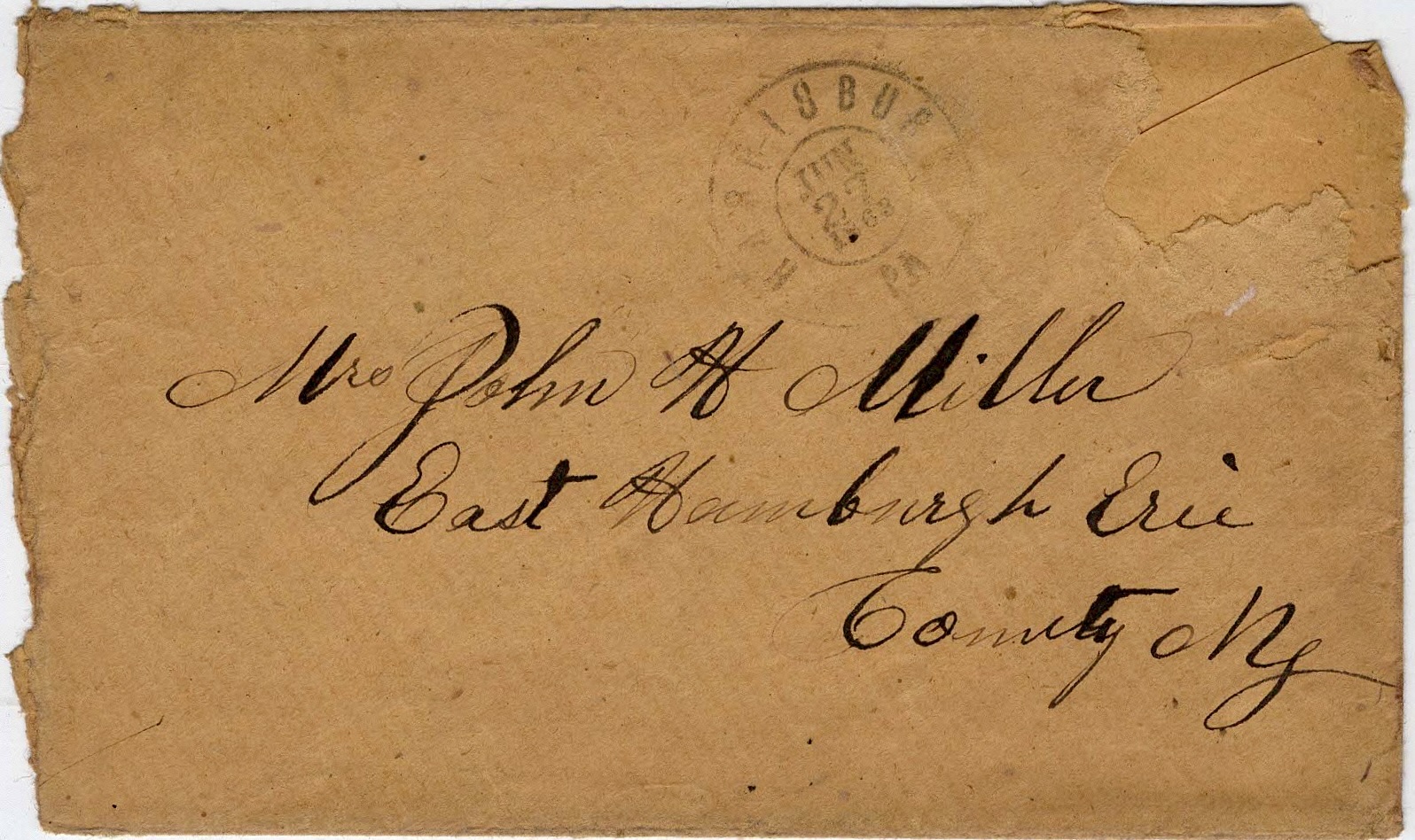
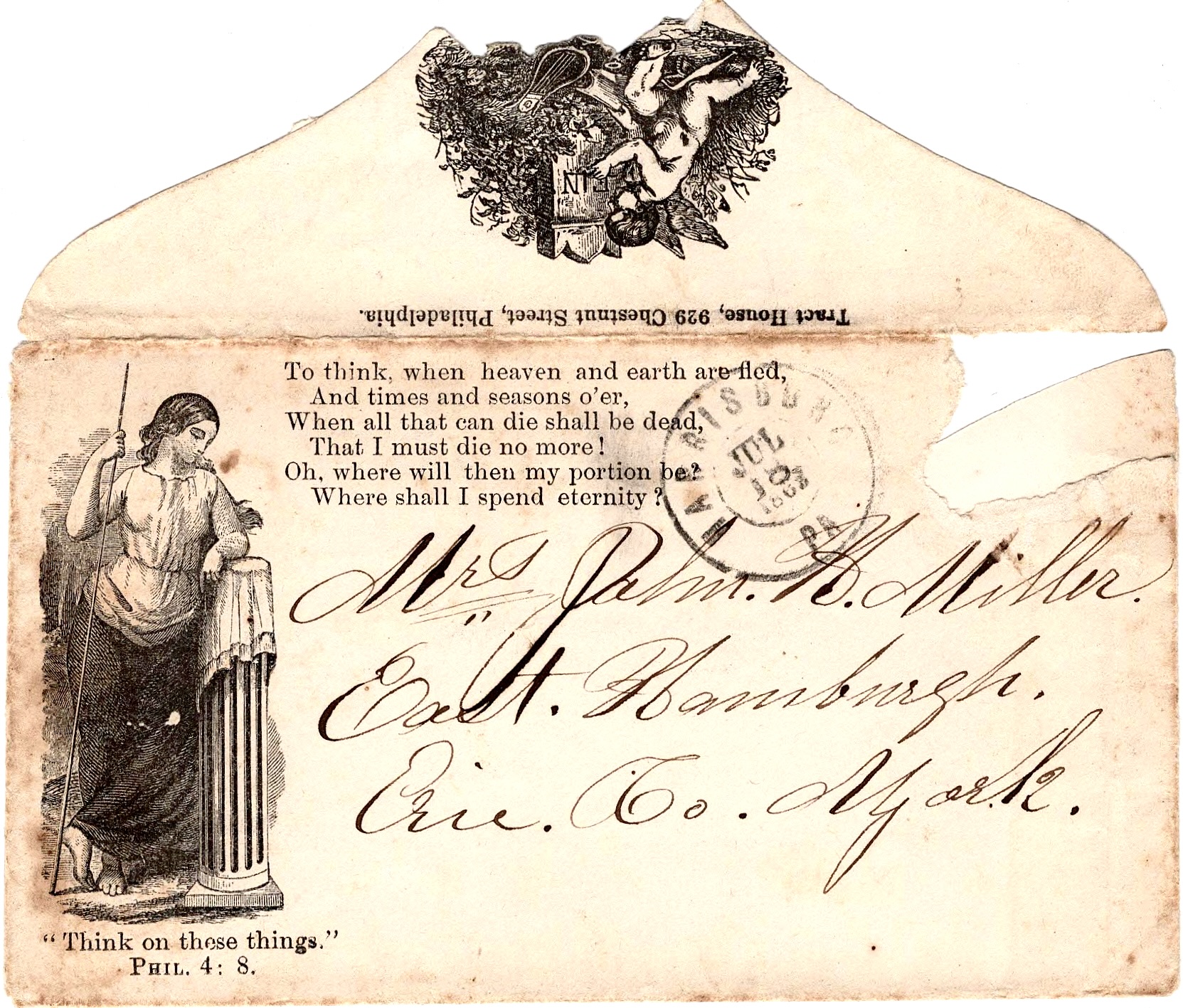
Addressed to Mrs. John H. Miller, East Hamburgh. Erie county, New York

Camp Curtin [near Harrisburg, Pennsylvania]
July 18, 1863

Dear Wife,

I take this, probably my last opportunity, to write you these few lines while we remain in Pennsylvania. I was taken with the shits—plain speaking—a night before last worse that I ever had them in all my life. I took my old medicine in cold water which probably relieved the pain during the night. In the morning I took two and a half tablespoon full of salt and hot water—as hot as I could drink it. No more of it ever since, all right.

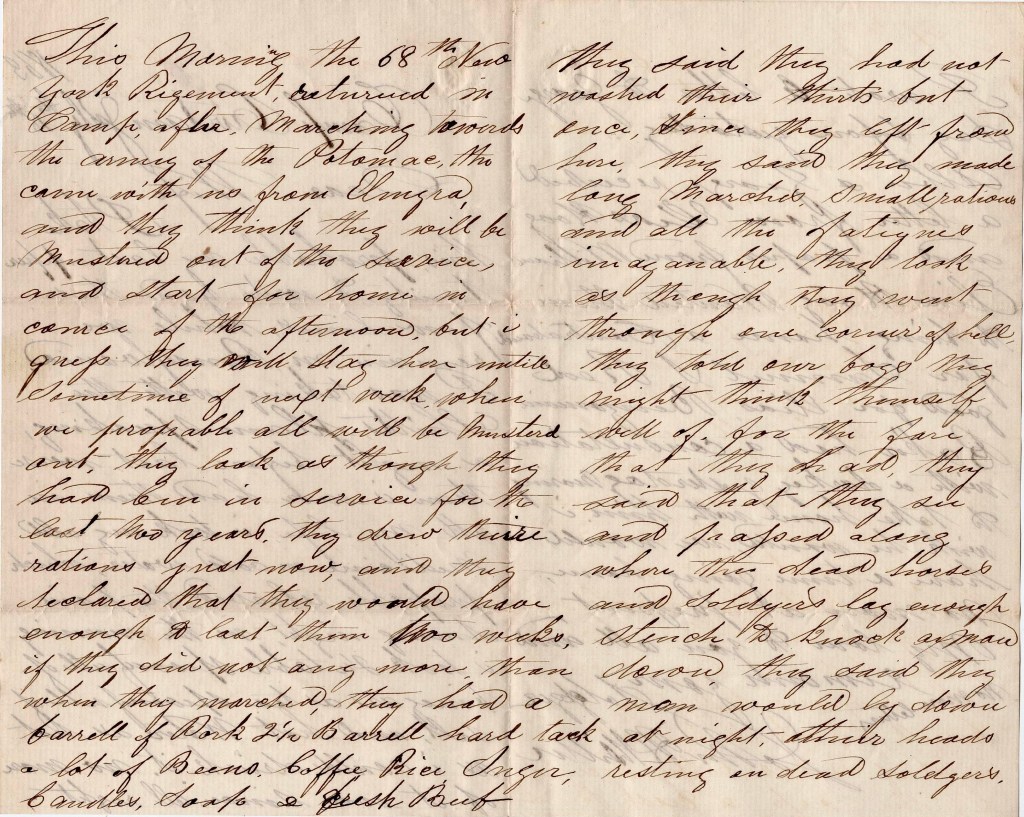
This morning the 68th New York Regiment returned in camp after marching towards the Army of the Potomac. They came with us from Elmira and they think they will be mustered out of the service and start for home in course of the afternoon, but I guess they will stay here until sometime of next week when we probably all will be mustered out. They look as though they had been in the service for the last two years. They drew their rations just now and they declared that they would have enough to last them two weeks if they did not [get] any more than when they marched. They had a barrel of pork, 2 and a half barrel hard tack, a lot of beans, coffee, rice, sugar, candles, soap and fresh beef. They said they had not washed their shirts but once since they left from here. They said they made long marches, small rations, and all the fatigues imaginable. They look as though they went through one corner of hell. They told our boys they might think themselves well off for the fare that they had. They said that they see and passed along where the dead horses and soldiers lay [with] enough stench to knock a man down. They said the men would lay down at night, their heads resting on dead soldiers.

I wrote a letter to George day before yesterday. Alber [Oaks] & George received a letter from Elias Hoag and a paper from William. Elias Hoag wanted them to bring home a contraband for Samuel S. Real. Good for Elias. Benjamin Baker had a consultation with a darkey yesterday morning to take home with him. I wish he would, We would have a time going home. No more at present. My love to you all and remain your soldier, — John H. Miller


1862: John L. Dippy to Henry Vanfleet

The following letter was written by John L. Dippy (1843-1864) of Co. H, 23rd Michigan Infantry. John enlisted at Antrim, Michigan, on 12 August 1862. He was killed in the fighting near Stone Mountain, Georgia, on 25 September 1864.
John was the son of John and Louisa (Pitts) Dippy of Bennington, Shiawassee, Michigan.

Bowling Green, Kentucky. Adolph Metzner drawings, Library of Congress

T R A N S C R I P T I O N

Addressed to Mrs. Henry Vanfleet, Pinckney, Livingston county, Michigan

Bowling Green, Kentucky
December 21, 1862

Friend Henry,

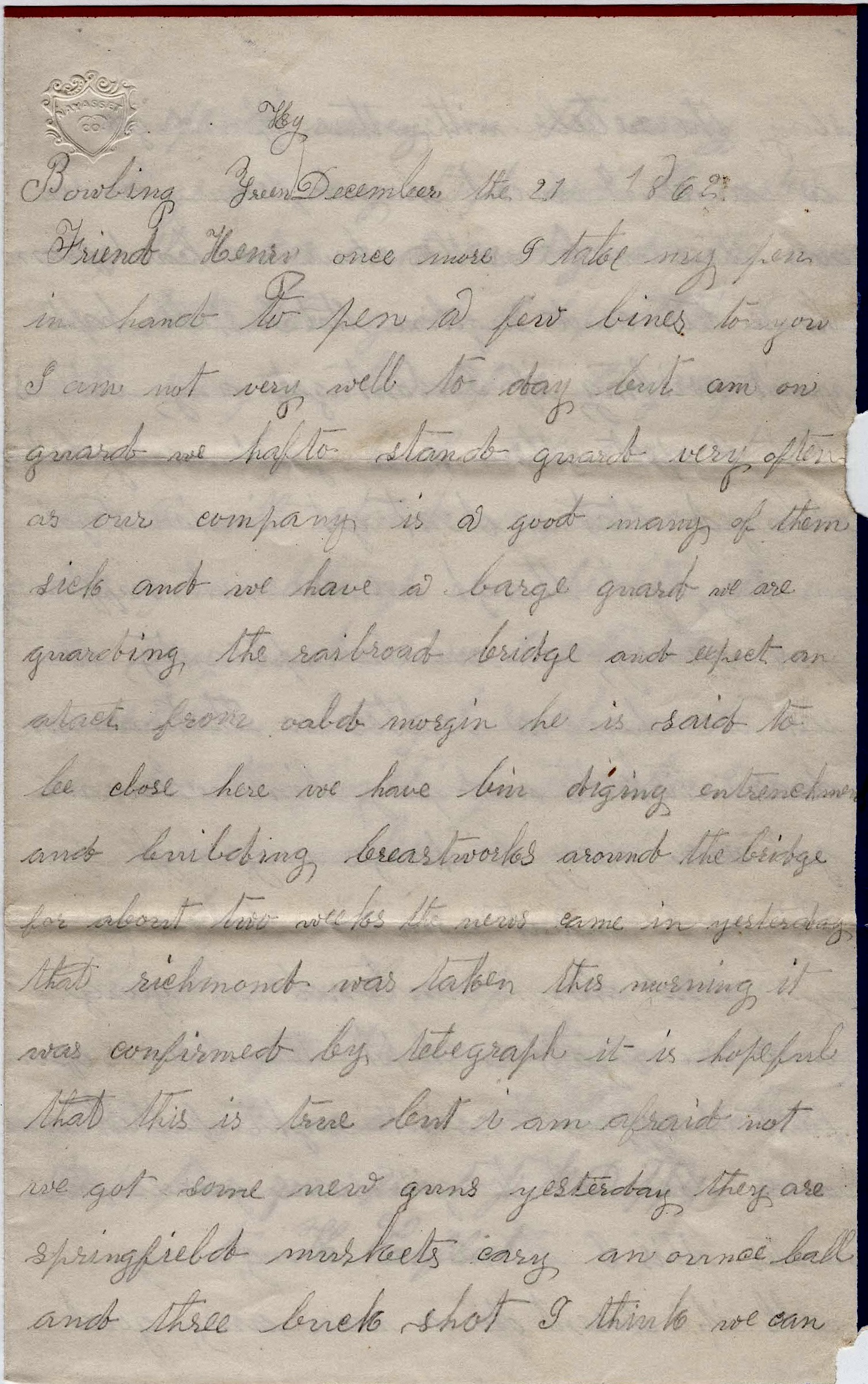
Once more I take my pen in hand to pen a few lines to you. I am not very well today but am on guard. We have to stand guard very often as our company is a good many of them sick and we have a large guard. We are guarding the railroad bridge and expect an attack from Old Morgan. He is said to be close here. We have been digging entrenchments and building breastworks around the bridge for about two weeks.

The news came in yesterday that Richmond was taken. This morning it was confirmed by telegraph. It is hopeful that this is true but I am afraid not.

We got some new guns yesterday. They are Springfield [Model 42] muskets. [They] carry an ounce ball and three buck shot. I think we can slay the Rebels with these if we get a chance. 1

The Model 1842 Springfield smoothbore musket...very effective at short range.

I haven’t heard from you in over three weeks. Neither have we heard from home. Tell Aunt Angeline that I shall have to quit writing if I don’t get any letters but I expect there is a good many letters delayed that we don’t get. We haven’t got our pay yet though we are not suffering for money as we have plenty to eat. We have a sutler so that we can draw tickets and pay him when we get our pay. He charges very high for things. I haven’t run in debt any yet and don’t intend to.

George and me together kept ten dollars of our first pay and lent eight of that and used the rest to get some gloves for winter. This I think is doing very well. It doesn’t do a man any good to spend money in the army as things are very high and the doctors say the cakes and candy do the men more hurt than good.

I hope that I will see you all before long again but maybe not if we have an attack here. I will stand my chance to never see you although my health has been very good since I enlisted.

If McClellan has got Richmond, I think the fighting is about done. If Morgan makes an attack here, we will have lots of news to write for I think we will whip him. When you get these few lines of scribbling, please write me a good long letter. This from your friend, — J. L. Dippy

To H. Vanfleet


1 The regiment initially carried “Austrian” or Prussian Model 1809 muskets which had been converted to percussion firing. Since Dippy claims the new weapons fired a buck and ball, they must have been the Model 1842 smoothbore Springfield musket.

1863: George Earl Judson to his Sister

Sgt. George Earl Judson, 2nd Connecticut Heavy Artillery

The following letter was written by George Earl Judson (1843-1864) who enlisted on 15 August 1862 in Co. I (“Woodbury Company”) of the 19th Connecticut Volunteer Infantry Regiment. The regiment was organized and mustered at Camp Dutton, outside of Litchfield, departing by train for Washington, DC on September 5th and assigned to the defenses of Alexandria, Virginia after their arrival. They spent the fall of 1862 on picket and patrol duty in the city until January 1863, when the 19th was reassigned to the outer ring of forts and redoubts defending Alexandria. Judson was promoted to corporal on July 16th and in November, the regiment was redesignated as the 2nd Connecticut Heavy Artillery. Judson was made acting sergeant in Co. I in January 1864 and was officially promoted to that rank on February 15th. In May, the regiment was called into the field to serve again as infantry in the 6th Army Corps during Grant’s Virginia Campaign. It fought with valor at Cold Harbor, Petersburg, and Winchester and suffered heavy casualties. On 19 October 1864 at Cedar Creek the regiment suffered a loss of 38 killed in 96 wounded; among the latter was Sergeant Judson, who received a gunshot wound in the left hip. He was eventually sent to the General Hospital at Patterson Hill in Baltimore, Maryland, where he died in late October from his wound.

George was the son of Capt. Ransom Judson (1797-1854) and Lucy Tuttle (1801-1885) of Southbury, New Haven county, Connecticut.

T R A N S C R I P T I O N

Redoubt D near Fort Lyon, Va.
July 12, 1863

Dear Sister,

It is Sunday and another inspection is through with. While I am down here sitting in my cloth house writing to you, I suppose you will be at church sitting up there in the gallery listening to a sermon from Parson Smith, or perhaps singing some of the good old tunes that I used to know, and which I have not forgotten. I should like to sing a few of them with you this evening after tea, but it is so far up there, I fear I should not get bak in time for dress parade so I think it will not be best for me to come. Our chaplain preached to us last Sunday in the bomb proof but today we have had no preaching.

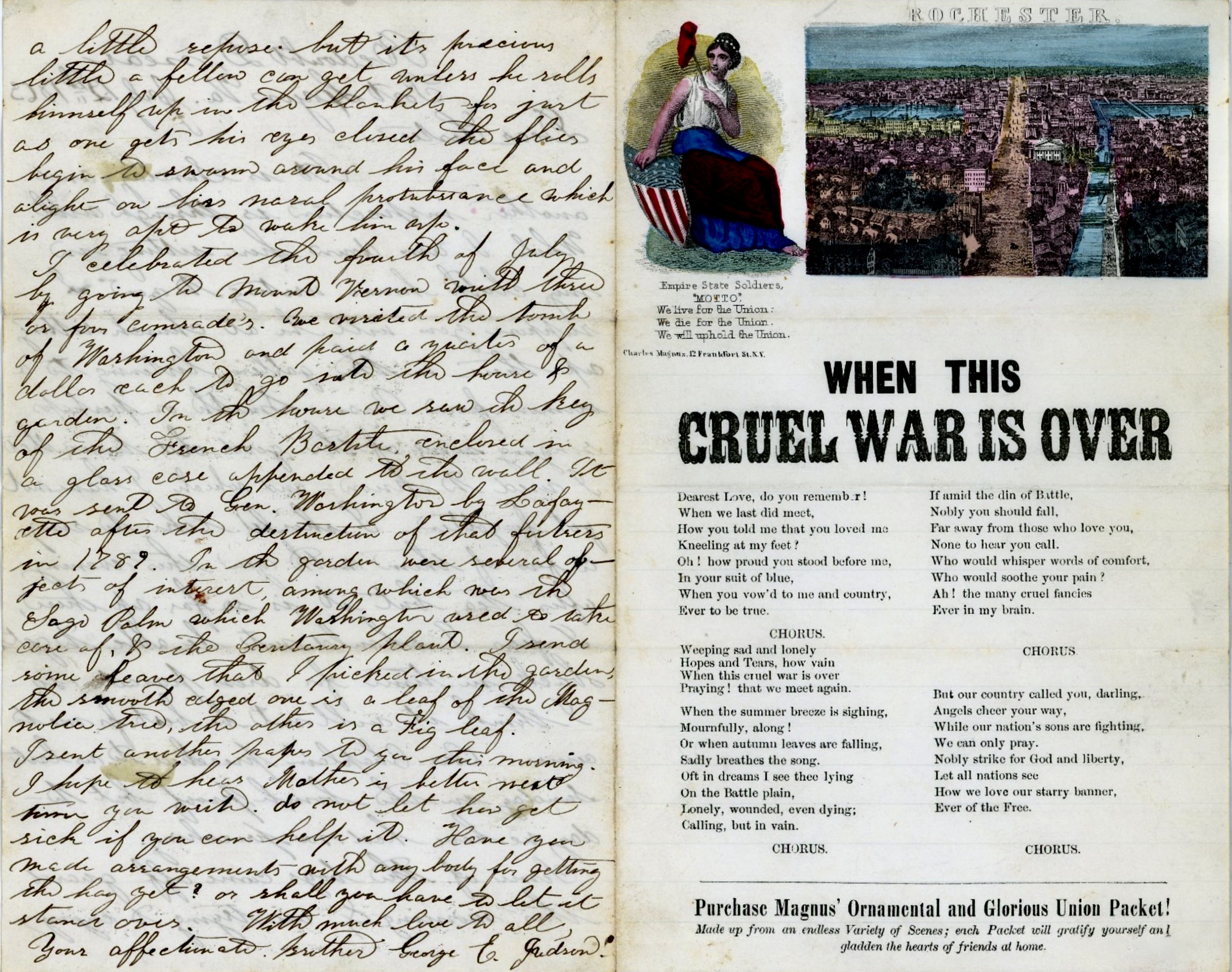
Some of the boys come off guard this morning & are trying to enjoy a little repose but its precious little a fellow can get unless he rolls himself up in the blankets for just as one gets his eyes closed, the flies begin to swarm around his face and alight on his nasal protuberance which is very apt to wake him up.

I celebrated the fourth of July by going to Mount Vernon with three or four comrades. We visited the tomb of Washington and paid a quarter of a dollar each to go into the house & garden. In the house we saw the key of the French Bastille enclosed in a glass case appended to the wall. It was sent to Gen. Washington by Lafayette after the destruction of that fortress in 1789. In the garden were several objects of interest, among which was the Sago Palm which Washington used to take care of, & the Petanary [?] plant. I send some leaves that I picked in the garden. The smooth edged one is a leaf of the Magnolia tree. The other is a fig leaf.

I sent another paper to you this morning. I hope to hear Mother is better next time you write. Do not let her get sick if you can help it. Have you made arrangements with anybody for getting the hay yet? or shall you have to let it stand over? With much love to all. Your affectionate brother, — George E. Judson

1864: Cornelius Cheeseman to Margaret (Jenkins) Cheeseman

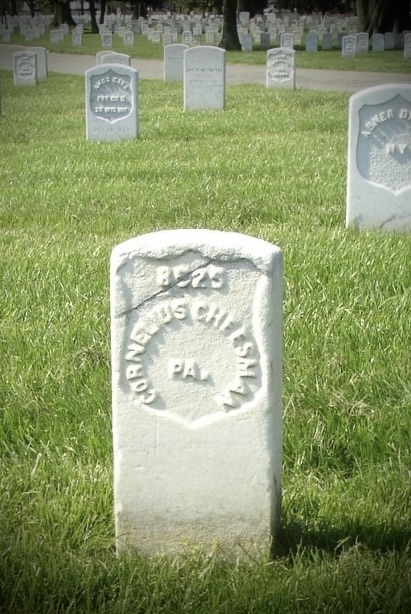
Cheeseman’ headstone in Arlington Cemetery

The following letter was written by Cornelius Cheeseman (1836-1864) of West Rushville, Fairfield county, Ohio. He wrote the letter while serving in Co. A, 83rd Pennsylvania Infantry. He mustered into the regiment on 15 January 1864 and he died of chromic diarrhea in Lincoln Hospital, Washington D. C. on 29 September 1864.
Cornelis wrote the letter to his wife, Margaret (Jenkins) Cheeseman, whom he wed in April 1857. In his correspondence, Cornelius expresses his intention to “come home this fall,” despite being in the midst of a three-year enlistment; notably, he does not mention pursuing a medical discharge. Furthermore, he urges her to “say nothing” about this matter, implying a potential intention to desert. This raises the possibility that such a plan may have been his objective from the outset, as he resided in Ohio while enlisting in a Pennsylvania regiment, possibly as a substitute or to secure a bounty.
T R A N S C R I P T I O N

Camp Distribution, Va.
July 23rd 1864

Dearest one,

Once more I will try to write but it will only be a few lines as my time is short. You will be disappointed in not getting any money [but] I have not got my money yet as the raid in Maryland took us away from the hospital. Just as soon as I get it, I will send you come. I am going to come home this fall—that is certain. But I don’t know what time yet. Keep still. Say nothing. Then I will be safe. Don’t write till I write again for I expect to leave here soon and then I would not get it.

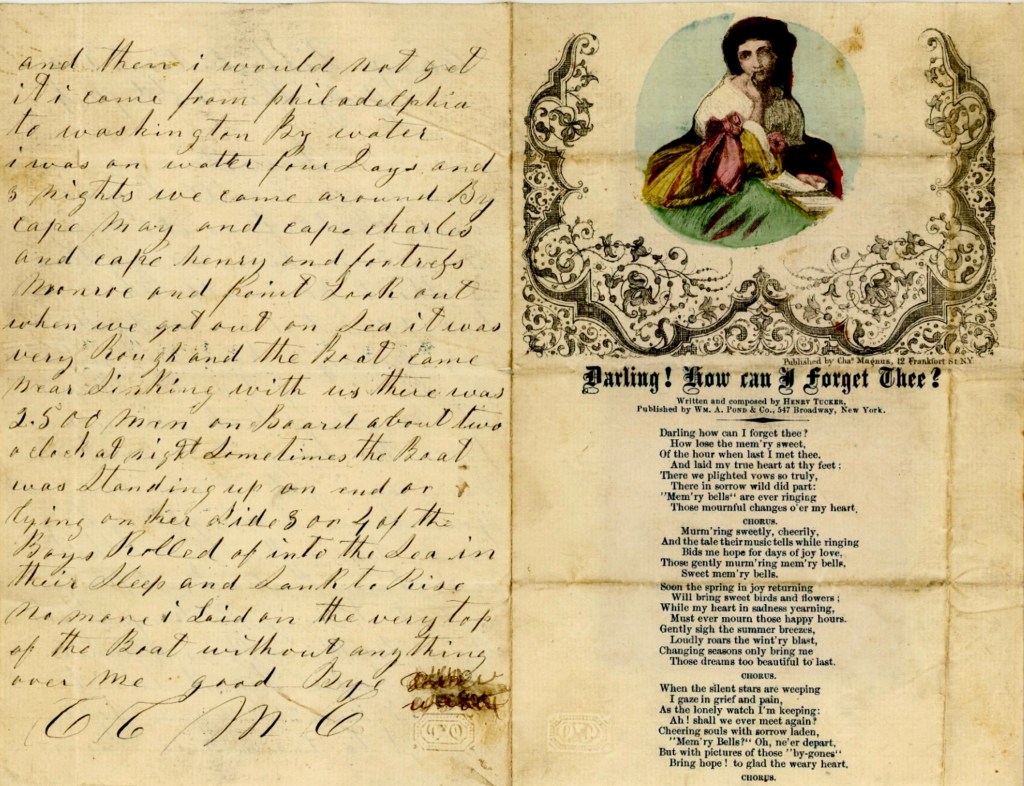
I came from Philadelphia to Washington by water. I was on water four days and three nights. We came around by Cape May and Cape Charles and Cape Henry and Fortress Monroe and Point Lookout. When we got out on sea, it was very rough and the boat came near sinking with us. There was 2500 men on board. About two o’clock at night, sometimes the boat was standing up on end or lying on her side. Three or four of the Boys rolled off into the sea in their sleep and sank to rise no more. I laid on the very top of the boat without anything over me. Goodbye, C. C. [to] M. C.

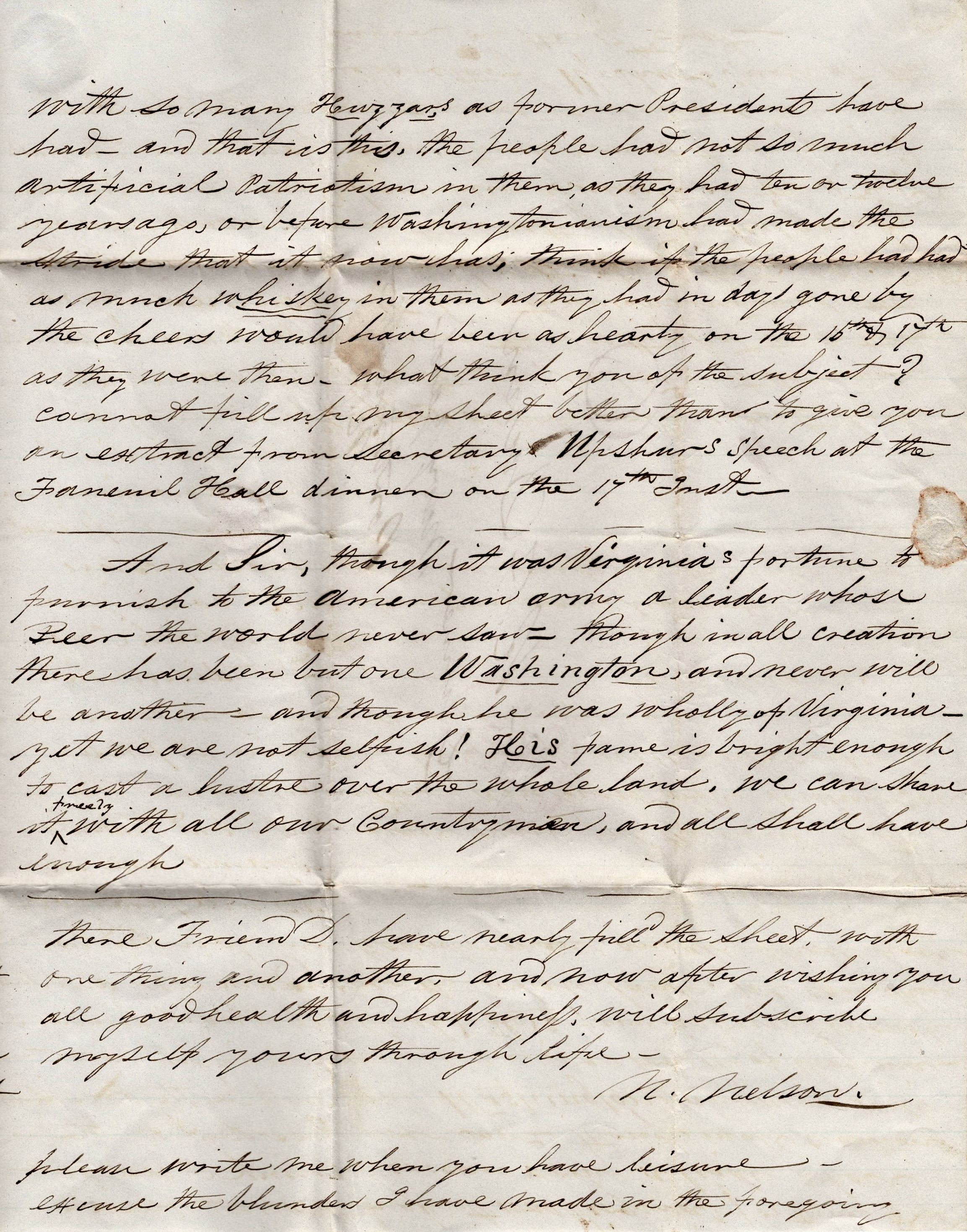
1843: Nehemiah Nelson to Richard Fletcher Dunn

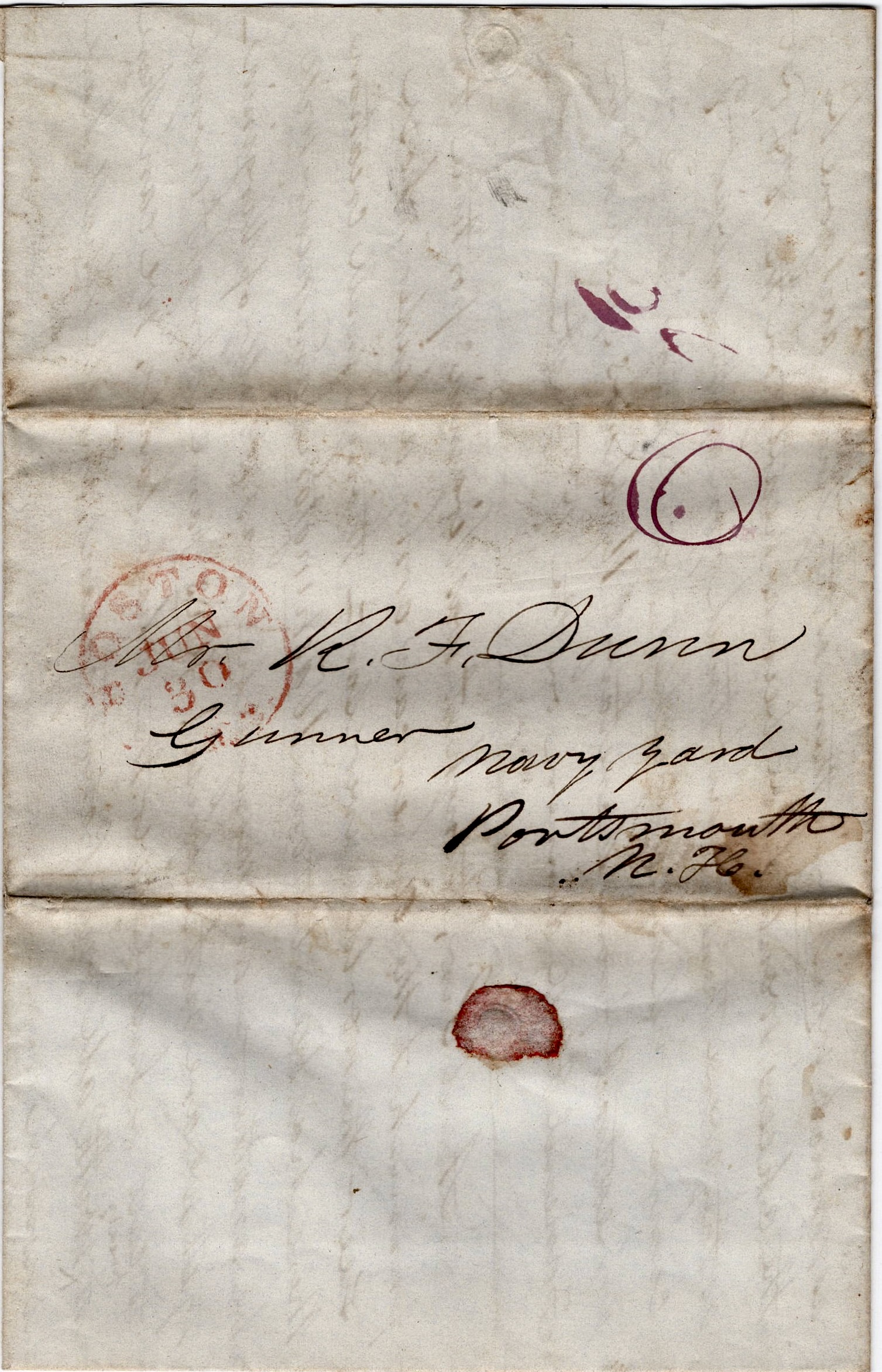
The author of this letter is believed to have been Nehemiah Nelson (b. 1806-1861) who kept a grocery store at 41 Commercial Street in Boston. He wrote the letter to Richard Fletcher Dunn (1788-1863), a native of Northumberland, England, who came to the United States in 1807 and worked as a copper-plate printer in Philadelphia until joining the merchant service in 1809 (with a fraudulent certificate of citizenship).

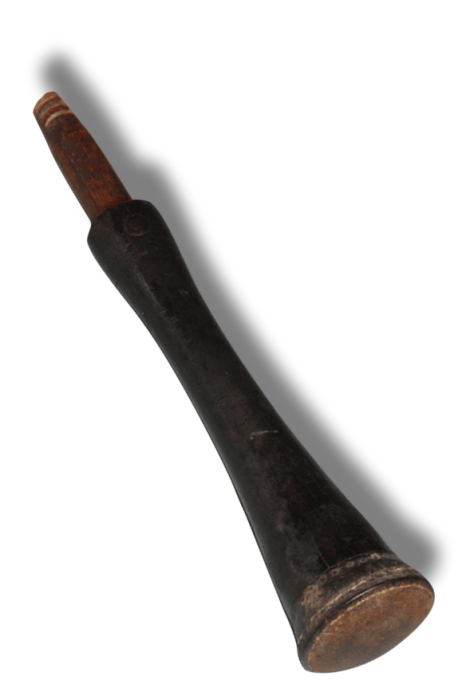
One of the artifacts proudly displayed by the Portsmouth Historical Society’s museum is Richard Fletcher Dunn’s artificial leg. Nelson’s letter informs us the leg was made by Southworth Howland.

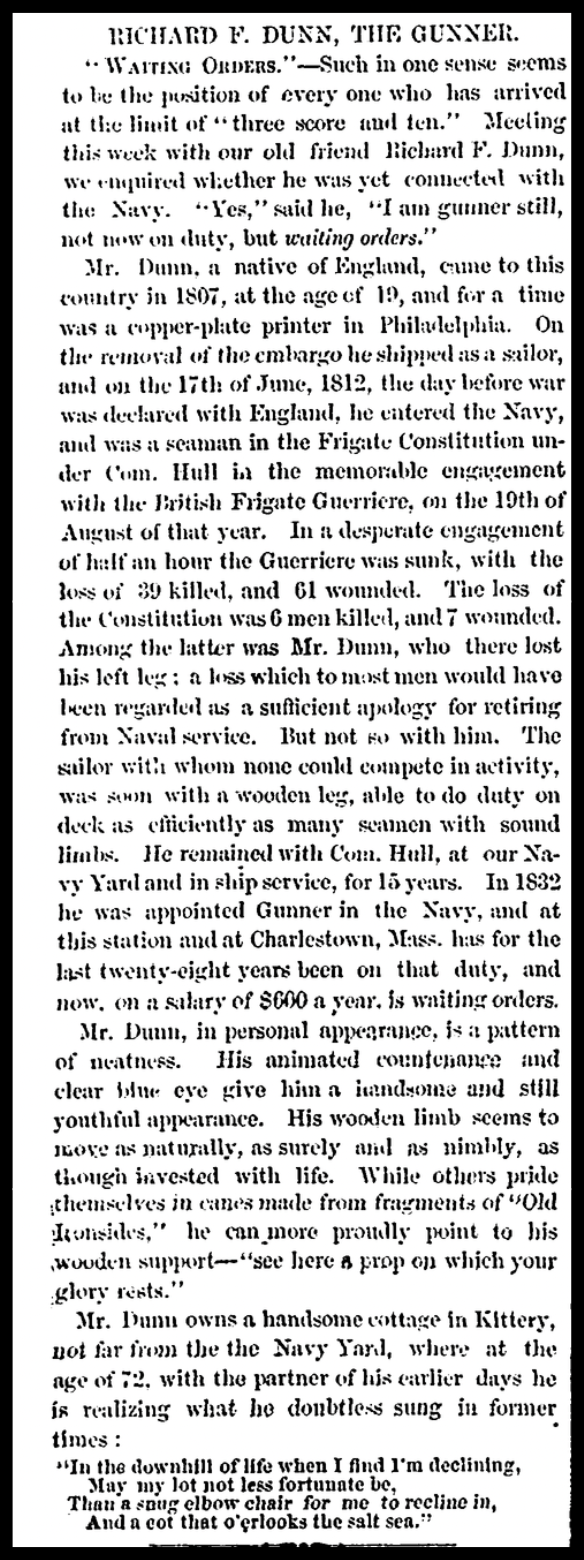
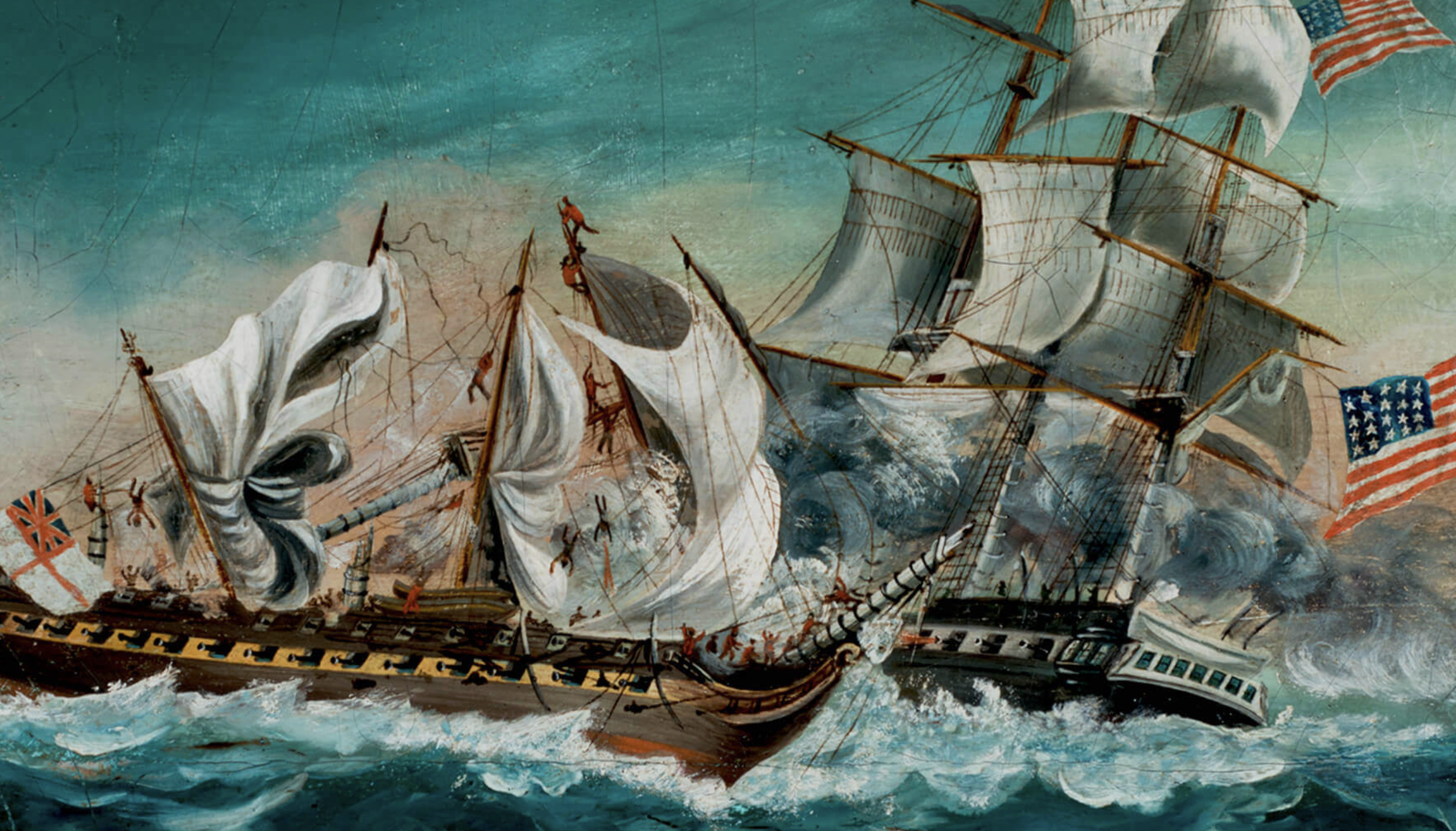
He then signed up for the US Navy and participated in the War of 1812, serving aboard the USS Constitution under the command of Capt. Isaac Hull. He was on board during the engagement with the British frigate HMS Guerriere on the 19th of August 1812—an engagement that last more than half an hour resulting in the sinking of the HMS Guerriere and the loss of 39 crew members killed and 61 wounded. The USS Constitution, on the other hand, suffered little damage, thus earning her the nickname “Old Ironsides.” She suffered the loss of only 6 crew members and 7 wounded. Among the latter was Dunn who lost his left leg, blown off by a cannon ball.

Though lesser injuries might have warranted retirement from the service of his adopted country, Dunn remained steadfast in his commitment to the Navy, ultimately serving at the Kittery Navy Yard. He continued to serve under Capt. Hull (later Commodore Hull) at the Navy Yard, performing his duties on a wooden leg “as efficiently as many seamen with sound legs.” According to the 1860 US Census, he was still listed at Kittery, York County, Maine, with his occupation recorded as “Gunner, USN.” When inquired that year about his ongoing connection with the Navy, he replied, “Yes, I am gunner still, not now on duty, but awaiting orders.” He passed away on 1 February 1863, and his widow, Mary F. (Dixon) Dunn, died in 1872. They are buried in Eliot, Maine.

The USS Constitution battles the HMS Guerriere on 19 August 1812.

T R A N S C R I P T I O N

Boston [Massachusetts]
June 29, 1843

Friend Dunn,

Yours of the 7th inst. was duly received and I was very glad to know that you took the remarks which I made in my last in the spirit in which they were made (viz) in all kindness. You said a letter from on the 22nd inst. but I had nothing worth relating. But this morning I am big with an important subject (viz) wooden legs.

A person came into my store this morning and asked if I knew Mr. Jones who was once in the Custom House. I told him I was well acquainted with him. Said he, I made his wooden leg. That led to a conversation about you and Mr. Bardine, and from what this man said, I should think Mr. Bardine was anything but a gentleman. You will understand me, this person did not talk harsh of him, but gave me a history of him for a number of years back.

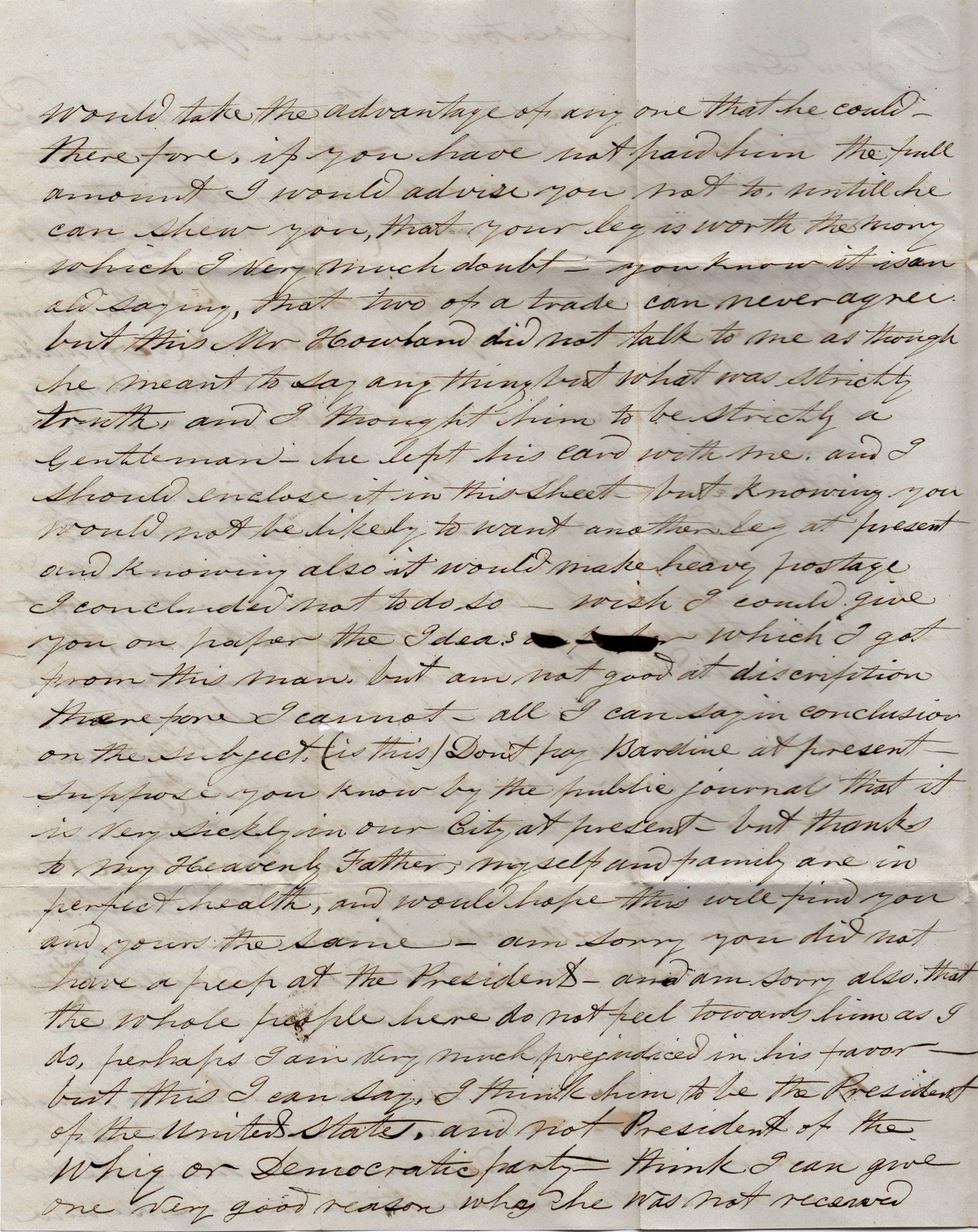
In the first place, he remarked that Bardine was very poor, so much so that he got people to subscribe various sums and got this man (whose name is Southworth Howland 1 ) to make him a leg which he did and charged him $25 for it. Well, when he came for the leg, he brought only $20 and said he had collected only that sum, but would get the balance since Bardine told him to sue for the balance. But Howland thought it would cost more than it would come to so he let him run. And many other things he told me which makes me think that he—Bardine—would take the advantage of anyone that he could. Therefore, if you have not paid him the full amount, I would advise you not to until he can show you that your leg is worth the money which I very much doubt.

You know it is an old saying that two of a trade can never agree but this Mr. Howland did not talk to me as though he meant to say anything but what was strictly truth, and I thought him to be strictly a gentleman. He left his card with me and I should enclose it in this sheet, but knowing you would not be likely to want another leg at present and knowing also it would make heavy postage, I concluded not to do so, Wish I could give you on paper the ideas which I got from this man, but I am not good at description—therefore, I cannot. All I can say in conclusion on the subject is this. Don’t pay Bardine at present.

Suppose you know by the public journals that it is very sickly in our City at present. But thanks to my Heavenly Father, myself and family are in perfect health, and would hope this will find you and yours the same.

Am sorry you did not have a peek at the President [John Tyler] and am sorry also that the whole people here do not feel towards him as I do. Perhaps I am very much prejudiced in his favor. But this I can say, I think him to be the President of the United States and not the President of the Whig or Democratic party. Think I can give one very good reason why he was not received with so many huzzah’s as former Presidents have had and that is this—the people had not so much artificial patriotism in them as they had ten or twelve years ago, or before Washingtonianism had made the stride that it now has. Think if the people had had as much whiskey in them as they had in days gone by, the cheers would have been as hearty on the 15th and 17th as they were then. What think you of the subject? 2

Cannot fill up my sheet better than to give you an extract from Secretary [Abel C.] Upshur’s [Secy. of Navy] speech at the Faneuil Hall dinner on the 17th inst.

“And Sir, though it was Virginia’s fortune to furnish to the American army a leader whose peer the world never saw, though in all creation there has been but one Washington, and never will be another, and though he was wholly of Virginia, yet we are not selfish! His fame is bright enough to cast a luster over the whole land. We can share it truly with all our countrymen, and shall have enough.”

There, friend Dunn, have nearly filled the sheet with one thing and another, and now after wishing you all good health and happiness, will subscribe myself yours through life. — N. Nelson

Please write me when you have leisure. Excuse the blunders I have made in the foregoing.


1 Southworth Howland (1775-1853) learned the house carpenter’s trade but, being “an ingenious and skillful workman and was often called on to do jobs not entirely in the line of his trade. One of these was to alter and fit an artificial leg, imported from England by a neighbor; but he found it easier to make a new one, with such improvements as gave satisfaction to the wearer. His success became known, and during the next forty years he was called on to furnish artificial limbs for a large number of men and women residing in all parts of the United States, no other person manufacturing them in this country, so far as known, for many years after. He was a man of decided convictions and was prompt and fearless in defending them.”

2 This is a reference to the Washingtonian movement that was in full swing in the 1840 as were many other “ism’s.” The Washingtonian movement evaporated within a few short years. They became embroiled in the politics of the day. They were a victim of their own decision to support the elimination of all drinking in the US in that era through the temperance movement.

The Portland Journal, June 23, 1860