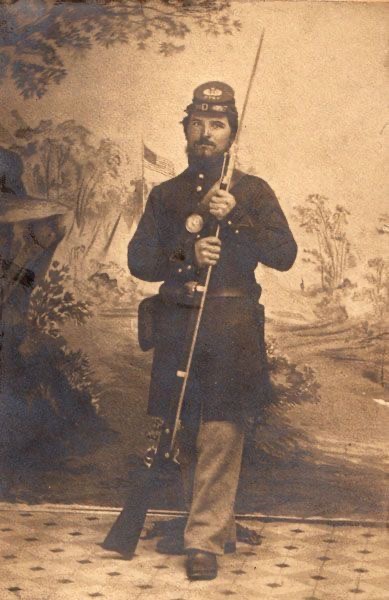
I could not find an image of Drummond but here is one of Humphrey Blaisdell who served in Co. G, 2nd Maine Infantry. He was wounded at Bull Run and taken prisoner; exchanged about mid-August. Note that he is wearing the “cadet grey” cap, frock coat and pants. (Ron Field Collection)
The following letter was written by Pvt. Rutherford “Drummond” Richardson (1843-1862) of Co. B (“the Castine Light Infantry”), 2nd Maine Infantry. He enlisted on 28 May 1861 and served his company faithfully until he was cut down in the fighting at Malvern Hill on 1 July 1862 and died of his wounds at the regimental hospital on 7 July 1862. Drummond was the son of James Richardson (1808-1889) and Sybil H. Burton (1813-1910) of Eddington, Penobscot county, Maine.
This letter was penned in mid-August, 1861, approximately a month after the Battle of Bull Run in which the regiment was heavily engaged. Those interested in a detailed account of the battle itself might enjoy reading a letter by Pvt. Robert Alonzo Friend to his brother Will, dated 1 August 1861. He served with Drummond in Co. B. It can be found transcribed on my friend Harry Smeltzer’s “Bull Runnings” website.
T R A N S C R I P T I O N
[Camp on Arlington Heights, Virginia] [Mid-August 1861]
Dear Mother,
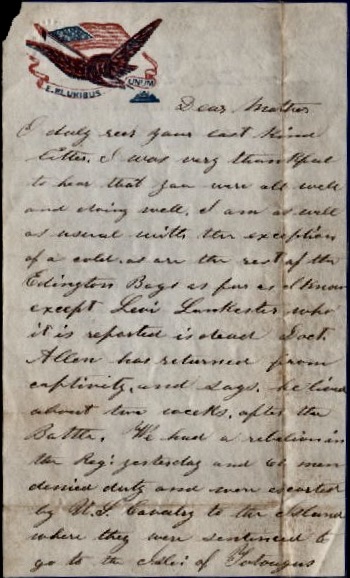
I duly rec’d your last kind letter. I was very thankful to hear that you were all well and doing well. I am as well as usual with the exception of a cold, as are the rest of the Eddington Boys as far as I know except Levi Lancaster who it is reported is dead. Doctor [W. H.] Allen has returned from captivity and says he lived about two weeks after the battle. 1
We had a rebellion in the regiment yesterday and 66 men denied duty and were escorted by U.S. Cavalry to the Island where they were sentenced to go to the Isle of Tortugas, Gulf of Mexico, there to perform hard labor till the term of their enlistment, or till they will take arms in defense of the country. And their pay is stopped from this time hence forth. 2
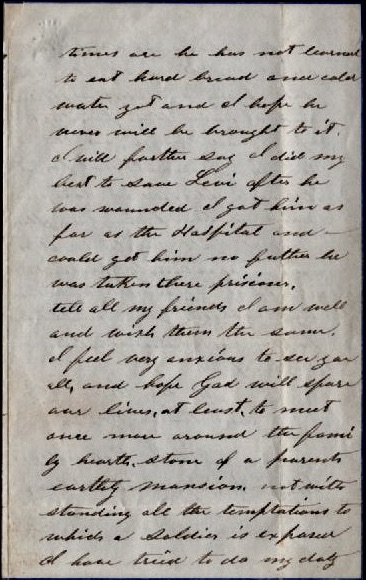
I have some faint hopes of seeing you all in the course of a month though it is very uncertain. Col. [Charles Davis] Jameson has resigned and Lt. Col. [Charles W.] Roberts is in command at present. I can think of nothing that will interest you further more than you can see in the papers. Please tell Martha I send my best respects to herself and family. Tell George he may thank his stars he is so well off. He don’t know what hard times are. He has not learned to eat hard bread and cold water yet and I hope he never will be brought to it.
I will further say I did my best to save Levi after he was wounded. I got him as far as the Hospital and could get him no further. He was taken there prisoner. Tell all my friends I am well and wish them the same. I feel very anxious to see you all and hope God will spared our lives, at least, to meet once more around the family hearth stone of a parent’s earthly mansion, not withstanding all the temptations to which a soldier is exposed. I have tried to do my duty. Keep soberness and truth on my side, and the good will of my commanding officers and I have thus far kept up a good name in the regiment.
You must not forget to write often as it does me good to hear from you often and I will write as often as an opportunity presents itself. I must now close by wishing you well and happy and subscribing myself your most obedient and loving son, — R. D. Richardson
To Mr. & Mrs. J. Richardson
1 Genealogical records suggest that Levi E. Lancaster (1832-1861) of Co. C, 2nd Maine Infantry, was killed in action on the battlefield at First Bull Run, but this letter informs us that Drummond was able to assist Levi to a field hospital that was later overtaken by Confederates and surgeons and wounded soldiers alike were taken prisoners. Dr. W. H. Allen of the 2nd Maine Infantry was also captured and reported that Levi lived two weeks before he died. Levi was married in 1856 to Hannah Ellen Shepherd (1833-1908) and the couple ha one daughter, Annie (b. 1857).
2 Some of the men became discontented three months after leaving the state from seeing three months’ men from other states returning home. Sixty-six claimed their time had expired, became insubordinate, and were sentenced to Tortugas; but this sentence was later commuted to a transfer to the 2nd N. Y., where they served about a year and then returned and served faithfully with the regiment for the remainder of the term.
I could not find an image of Joseph but here is one of Alonzo Beckwith Coon of Co. B, 1st Wisconsin Cavalry (ancestry.com)
The following letter was written by Sgt. Joseph Henry Saunders (1825-1862) of Albion, Dane county, Wisconsin who enlisted in Co. H. 1st Wisconsin Cavalry on 12 October 1861 and died of disease on 6 October 1862 in a hospital at Cape Girardeau, Missouri. The surgeon reported his cause of death due to “fever, diarrhea, and chills.” Joseph was buried in Missouri but there is a cenotaph to his memory near the graves of his parents in the Evergreen Cemetery at Albion. Joseph’s parents were Jesse Saunders (1798-1888) and Esther Stillman Coon (1800-1874) who came to Wisconsin from New York State in 1841 when Joseph was 15 years old.
Joseph was married in December 1847 in Dane county to Henrietta L. Carpenter. They had one daughter, Esther M. Saunders, born in March 1850. After Joseph’s death, Henrietta remarried in 1865 to Ephraim Palmer and resided in Fulton, Rock county, Wisconsin.
I have been waiting now about a week for a letter from you. I have not received one from you since the one that [ ] wrote and sent in yours. That is the only one I have received since I came back to camp. I hope this will find you in good health for it leaves me in very good health although I am suffering from a bad cold that I took a few days ago.
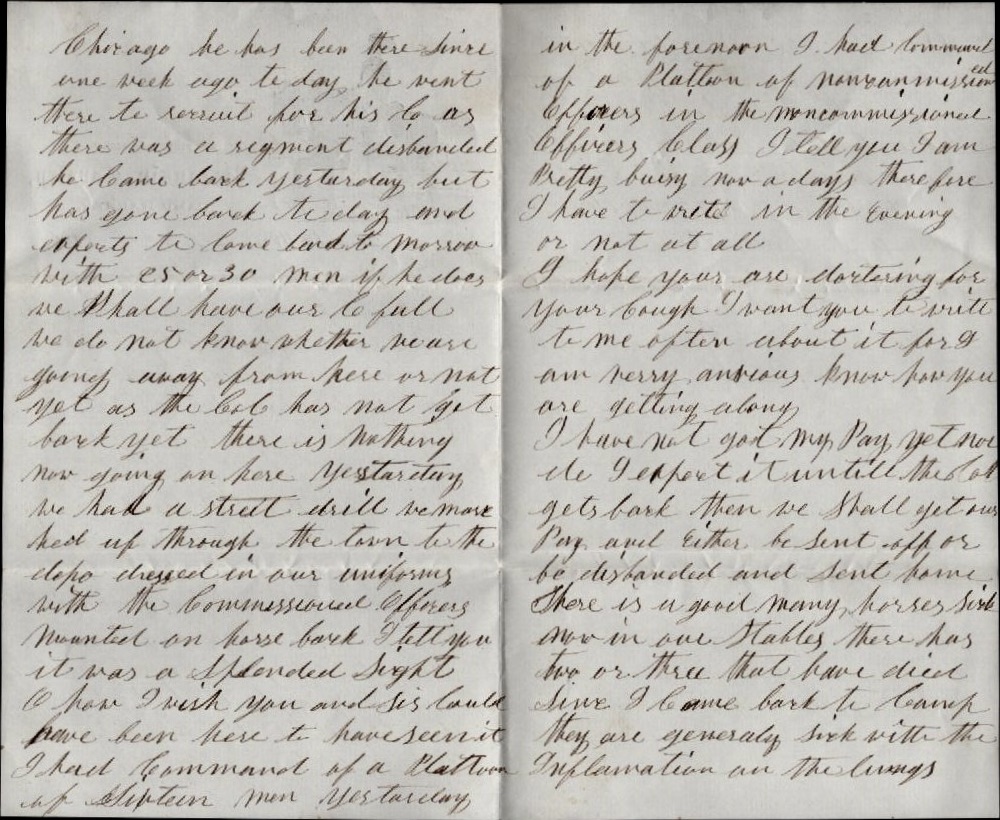
Day before yesterday I was confined to my tent but have been able to attend to my duties since. I do not know whether I wrote to you about the Cap[tain L. M. B. Smith] being in Chicago. He has been there since one week ago today. He went there to recruit for his company as there was a regiment disbanded. He came back yesterday but has gone back today and expects to come back tomorrow with 25 or 30 men. If he does, we shall have our company full. We do not know whether we are going away from here or not yet as the Colonel has not got back yet.
There is nothing now going on here. Yesterday we had a street drill. We marched up through the town to the depot dressed in our uniforms with the commissioned officers mounted on horse back. I tell you, it was a splendid sight. Oh how I wish you and sis could have been here to have seen it. I had command of a platoon of sixteen men yesterday. In the forenoon I had command of a platoon of noncommissoned officers in the Noncommissoned Officers Class. I tell you, I am pretty busy now-a-days. Therefore, I have to write in the evening or not at all.
I hope you are doctoring for your cough. I want you to write to me often about it for I am very anxious [to] know how you are getting along.
I have not got my pay yet nor do I expect it until the Colonel gets back. Then we shall get our pay and either be sent off or be disbanded and sent home. There is a good many horses sick now in our stables. There has two or three that have died since I came back to camp. They are generally sick with the inflammation of the lungs.
I want you should write often for it is a great consolation to hear from home. I must close for it is getting. about time for the roll call and I have it to do. So good night. From your affectionate husband, — J. H. Saunders
1 Camp Harvey was the campsite of the First Wisconsin Cavalry and was located in Green Ridge Cemetery, south of Kenosha near Lake Michigan. A boulder now marks the spot having been sited by Frank H. Lyman in 1917. “On Sunday morning, November 24, 1861, the First Regiment Wisconsin Cavalry arrived in Kenosha; they came by train and arrived about 6 in the morning, tired, hungry, and cold. Many citizens were waiting to receive them; a breakfast was prepared at the Durkee House. Approximately 800 soldiers settled at Camp Harvey, which was located on the sand ridge just south of the cemetery grounds.”[See Camp Harvey Boulder]
These letters were written by William Burgess Wall (1829-1909), a native of Virginia, who graduated from the Jefferson Medical College in 1853, and later served as a Surgeon with the 33rd Mississippi Infantry. William wrote the letters to his first wife, Bethunia Perkins (1840-1871) whom he married in 1856.
The second letter was written not long after the fall of Atlanta whereupon Hood took his army northwest and attempted to disrupt Sherman’s supply lines only to discover that Sherman had no intention of maintaining his supply line but rather to march across Georgia and live off the land. Hood then decided to march into Tennessee to attack elements of Thomas’s divided forces. The third letter was written on the march in Georgia. The fourth letter was written after Hood’s failed attempt to take Franklin, TN, and just before the Battle of Nashville. Following that defeat, Hood’s army was effectively destroyed.
Letter 1
Canton, Mississippi January 10, 1864
Dear Wife,
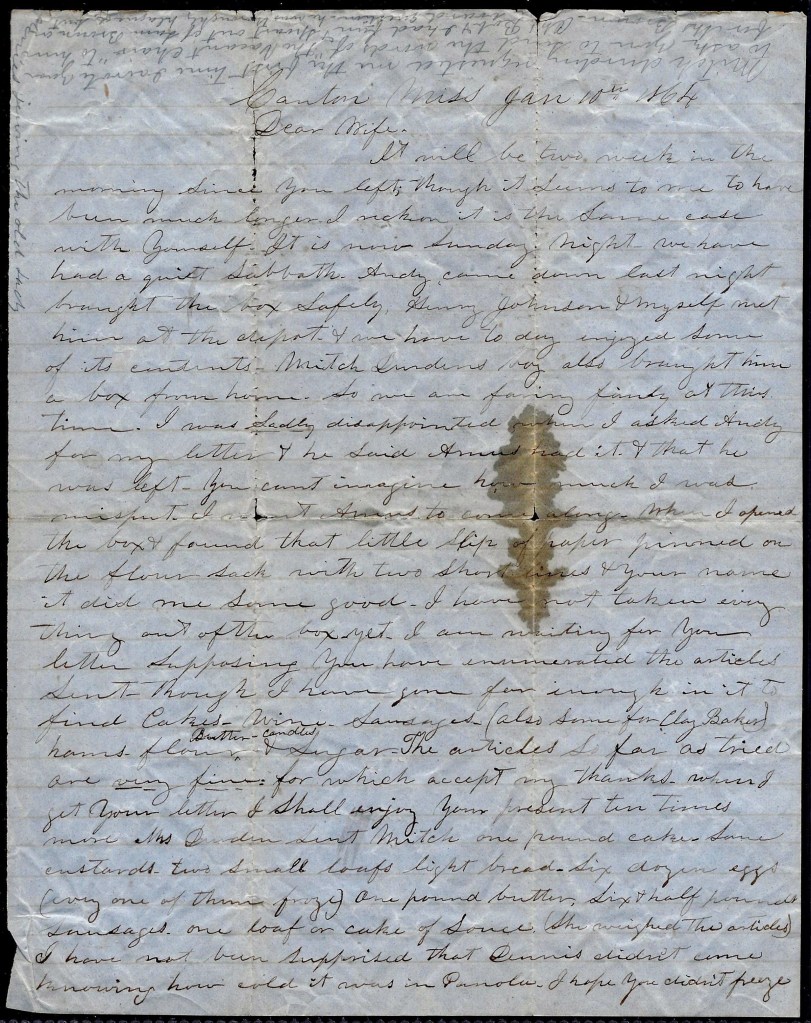
It will be two weeks in the morning since you left though it seems to me to have been much longer. I reckon it is the same case with yourself. It is now Sunday night. We have had a quiet Sabbath. Andy came down last night. Brought the box safely. Henry Johnson & myself met him at the depot & we have today enjoyed some of its contents. Mitch Linden’s boy also brought him a box from home so we are faring finely at this time.
I was sadly disappointed when I asked Andy for my letter & he said Amus had it & that he was left. You can’t imagine how much I was misput. I want Amus to come along. When I opened the box & found that little slip of paper pinned on the flour sack with two short lines & your name, it did me some good. I have not taken everything out of the box yet. I am waiting for your letter supposing you have enumerated the articles sent though I have gone for enough in it to find cakes, wine, sausages (also some for Clay Baker), hams, flour, butter, candles, & sugar. The articles so far as tried are very fine for which accept my thanks. When I get your letter, I shall enjoy your present ten times more.
Mrs. Durden sent Mitch one pound cake, some custards, two small loafs [of] light bread, six dozen eggs (every one of them froze), one pound butter, six & half pounds sausages, one loaf or cake of sauce (she weighed the articles). I have not been surprised that Dennis didn’t come knowing how cold it was in Panola. I hope you didn’t freeze.
I have thought of you many times & seen you shivering near the fire since it has been so cold. I am a little anxious for Dennis to come on. I miss him in the cooking arrangements.
Well, I reckon you begin to want me to say something about coming home. Of course you will not think of looking for me until I have had time to eat up the goodies you sent me & how long that will be, I can’t exactly tell yet. I think, however, I will try & get a pass after Dr. McCarty gets back. He is now at home. His wife was extremely sick when he left here. She will hardly get well & it is uncertain when he will be back. You need not look for me before the 20th or last of the month & you needn’t feel disappointed if I don’t come then for I may not be able to get leave. I wish it was so that I could be there in time to meet with Jim Johnson. If he comes, give him my kindest regards. I think I shall write him in a few days. It would do me a great deal of good to see him. All of your acquaintances here are well. Weathersby has gone to bed. Henry Johnson is sitting by reading. Oh! what did Mannie & Laura say when you returned home without bringing them anything from me? Give them my love & kiss them for me. My love to Mrs. Oliver. Respects to all friends. Howdy & respects to the servants.
My health is as usual. How is yours? Have you gotten any liquor? If you haven’t sold any cotton since you went home, don’t sell any until you hear from me again unless you have some good & safe opportunity of sending it to the neighborhood of Memphis. I am not anxious for you to sell it anyway. Say nothing of this to anybody. Don’t tell anybody but what you have plenty of money when you don’t have an opportunity of sending a letter by hand & you wish to write. Send it by mail. I will stop now & write again soon. How much pork have you put up? Can you get Milton from Dupuy? If I do write short letters, I love for you to write long ones. Good night “dear.” As ever, your devoted husband, — W. B. Wall
Mitch Durding requested me the first time I wrote you to ask you to send the words of “The Vacant Chair” to him for Mrs. Brown. Oh! Bob & I had fun & sport out of Sam Brown on the board question. He was roughly plagued but denies serving the old lady.
Letter 2
Palmetto, Georgia September 21, 1864
Dear Wife,
Yours of the 6th written in Carroll was received several days ago. I had mailed you a letter on the day before I received it & should have answered it immediately but we were in the act of moving. We got to this place—Palmetto, a depot on the Atlanta & West Point (Ga.) Railroad. The distance from here to Atlanta is about twenty-five (25) miles. There are many conjectures as to our destination. Some think we will remain here & many suppose we will go to the Blue Mountains, North Alabama. None of us know what Gen. Hood’s purposes are.
I informed you in my last that my resignation was not accepted. I was very much disappointed. I was much sorrier on your account than on my own. It is very hard for one who has been in a regiment & brigade as long as I have in this,. If he has properly discharged his duties & had good health, to get post duty. Though I shall make an effort at it as it will so no harm. You must make your calculation to remain in North Mississippi for I cannot move you away as long as I am in field service. I have no doubt my resignation would be accepted if tendered after this campaign is over but I don’t know now that I shall tender my resignation any more. I prefer you would not insist upon it although I know your great anxiety for me to be with you & at home. I wish you however always to tell me plainly how your health is & how everything gets along generally for upon these will mostly depend my actions. I do not wish to quit the service if I can possibly avoid it though I long to be at home again.
I requested you in my last to let me know how much money you could get for certain articles—ie.; the cotton on hand in bales & in the seed & the store house & how much the four percent certificates were worth. This I wanted to know intending to buy a negro or two if they could be had at reasonable prices. But of course I don’t want anything sold without I instruct you to do so as I may not wish to buy any negro atall. Keep the buggy you bought some time ago if you wish to do so & can take any care of, though I don’t think I would have bought it & paid cotton for it. I don’t want you to send me any clothes of any sort until I order them. I have just as many as I can take care of for the present.
You ask me to become guardian of your younger sisters & brother & that Willie is very anxious for me to do so at present. I should certainly take great pleasure in serving them in that way if I could, but I cannot take hold of it just now., but will as soon as circumstances will permit if the children desire it.
As to moving the negroes from the bottom, I think it best in all probability for them to stay there for the present in your Uncle John’s charge. I am sorry for the children & feel deeply concerned in their interest & am willing to do anything for them in my power. None of us know what is best to do at this time. I shall try to get a leave of absence when this campaign is over. It will probably not end before winter sets in. You must not think of visiting me. If you were here I could not be with you. I have strong hope that the war will end by next spring.
Where is little Kelly Oliver? He has not reported to his command. I saw Pryor Perkins yesterday. He is very well. All of your acquaintances are well so far as I know. How are William Hair, Clay Baker, & Alvey Middleton?
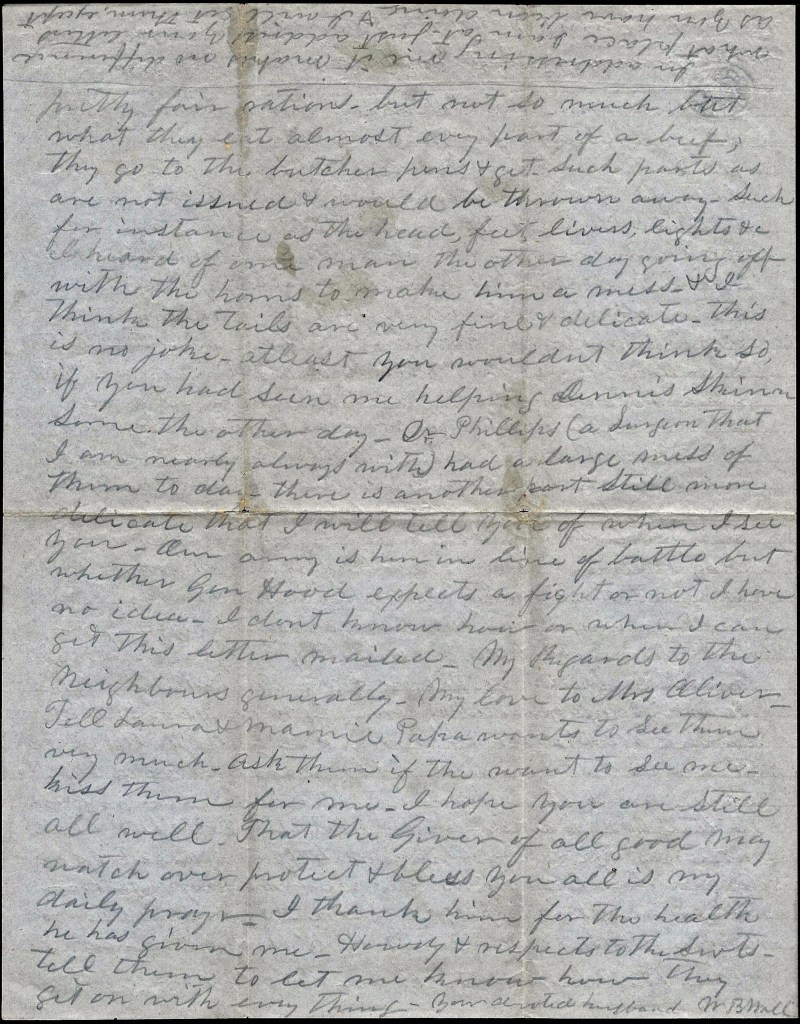
I think of you almost constantly & wonder how you are getting on. I know you miss Margaret. I hope you don’t have so much company as you used to. It would be more than I would like for you to wait upon. Take care of your provisions & don’t get out for if things are as high there as they are here, you would never be able to buy. Price of a few articles here. Flour from 0.75 to 1.oo pound, sweet potatoes $8 to $10 bushel, butter $5 to $8 lb., chickens half grown $2 to $3, young turkeys $5, sugar cane syrup or sorghum $10 to $15 gallon, & so on. I know these articles are not so high in Panola & I hope they never will be. Soldiers are getting pretty fair rations but not so much. But what they eat almost every part of a beef. They go to the butcher pens & get such parts as are not issued & would be thrown away, such for instance as the head, feet, livers, lights &c. I heard of one man the other day going off with the horns to make him a mess & I think the tails are very fine & delicate. This is no joke—at least you wouldn’t think so if you had seen my helping Dennis Shinn some the other day. Dr. Phillips (a surgeon that I am nearly always with) had a large mess of Mim today. There is another part still more delicate that I will tell you of when I see you.
Our army is here in line of battle but whether Gen. Hood expects a fight or not I have no idea. I don’t know how or when I can get this letter mailed. My regards to the neighbors generally. My love to Mrs. Oliver. Tell Laura and Mannie Papa wants to see them very much. Ask then if they want to see me. Kiss them for me. I hope you are still all well. That the Giver of all good may watch over, protect, and bless you all is my daily prayer. I thank Him for the health He has given me. Howdy & respects to the servants. Tell them to let me know how they get on with everything. Your devoted husband, — W. B. Wall
In addressing me it makes no difference what place I am at. Just address your letters as you have done & I will get them except instead of Hood’s Army, put it Army Tennessee. It is night. Everybody asleep. I had no pen & ink & have used as you see a pencil & written badly at that but suppose you can make out what I have written—at least enough of it. So goodnight dearest.
September 22nd. Since writing the below, I have learned that Kelly Oliver is with the regiment. I am now at the cook yard with Henry Johnson & will take dinner—that is, eat with him today. He says he is putting his best foot forward for me. Sends love.
Letter 3
[Note: The following letter was offered for transcription and publication on Spared & Shared by Darren Wheeler recently donated it to the museum in Cedartown.]
Army of Tennessee [Cedar Town, Georgia] October 8, 1864
My dear wife,
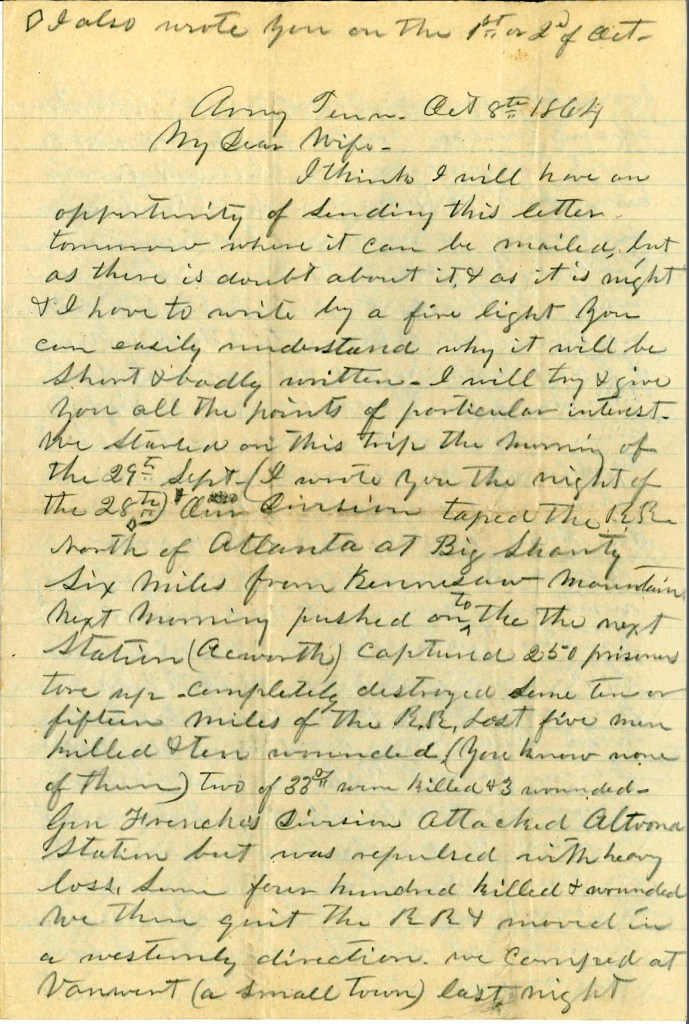
I think I will have an opportunity of sending this letter tomorrow where it can be mailed, but as there is doubt about it, and as it is night & I have to write by a fire light, you can easily understand why it will be short & badly written. I will try and give you all the points of particular interest.
We started on this trip the morning of the 29th September (I wrote you the night of the 28th). Our Division taped [?] the railroad north of Atlanta at Big Shanty, six miles from Kennesaw Mountain. Next morning pushed on to the next station (Acworth), captured 250 prisoners, tore up, completely destroyed some ten or fifteen miles of the railroad, lost five men killed & ten wounded (you know none of them), two of 33rd [Mississippi] were killed, 43 wounded.
Gen. [Samuel Gibbs] French’s Division attacked Altoona Station but was repulsed with heavy loss. Some four hundred killed and wounded. We then quit the railroad and moved in a westerly direction. We camped at Van Wert (a small town) last night. Tonight we are camped at Cedar Town about twelve miles from Rome. I can’t tell where we will go from here but think we will continue destroying Sherman’s transportation & likely go up into Tennessee. Sherman will I think be compelled to follow us, give up Atlanta & that portion of Georgia which he has overrun. I don’t think Gen. Hood designs to fight him when it can be avoided but by flank movements make him retrace his steps.
Our men are in the best of health & spirits I ever saw them. Day before yesterday was very rainy. It had rained the greater portion of the night before but we traveled on as if it had been perfectly clear & pleasant. Yesterday was clear and very warm. Today has been fair & cold. I have worn my overcoat all day. I have not heard a single man grumble on the trip at anything. The marching has been hard, rations sometimes short and soured before the men got them (There are cooking details who cook all the rations & then issue them) & when it rains much, they often sour before the men get them. This generally makes them grumble very much but this time I don’t believe a man has complained.
Just at this moment (since writing the above), I learn from the character of orders that our Corps will be sent on an expedition like a raid—where to, I don’t know or how long [we’ll] be gone. I can’t tell. We take nothing with us, either of medicines, baggage, or anything that can be dispensed with and only one piece of artillery to the Division, so I know we are going on a quick trip somewhere.
Well, I am glad to tell you that both myself and Albert (my horse) are in fine plight. So is Dennis. I have everything with me that I want—clothes, money, &c. I am very anxious to hear from you, but think it likely I will not for several weeks to come though you must continue to write regularly & often just as if the letters come straight to me for there is no telling which one I will get, Don’t be uneasy or disappointed if there should be a long interval without your hearing from me. I expect there will be for we will likely not be for some time nearer than fifty or a hundred miles of where a letter can be mailed to you. So be easy. I will write every opportunity.
I still think the war will close with this campaign. I am very anxious to see you and the children & Mrs. Oliver. Give them my love and kiss them for me. All of your acquaintances here are well. I hope your health has improved. I am writing under great disadvantages & you must do the best you can in making it out. I must stop now anyway as I am called to see one of Gen. [Winfield Scott] Featherston’s staff officers. Good night “my dear.” Howdy & respects to the servants. Regards to all the neighbors. Again, good night “Sweet one.” Your husband, — W. B. Wall
Letter 4
Army of the Tennessee December 13, 1864
My dear Wife,
I have no news to write. I hope you have received some of the letters I have written lately as in them I gave you all the news from your relatives, which only amounted to they were well & doing tolerably well &c. No letter from you yet of later date than October 21st. The time seems very long to me. You have no doubt received several of mine written since then.
It snowed here about a week ago. It is still upon the ground. The weather has been quite cold. The thermometer standing from 12 to 15 degrees below zero all the time. You would probably like to know how I am situated. Well, Dr. [George C.] Phillips ¹ & myself took possession of a negro cabin that was nearly filled with corn. This we had thrown in the loft & to the back of the cabin leaving us about half the room. It is well pointed & has an excellent fireplace. We have some boxes & broken chairs to sit on. So you see we are doing finely. At night we put down hay & spread our blankets on that for sleeping. We get plenty fat beef to eat & have but little to do except make ourselves comfortable. I have had only one man to report to me sick this month & there wasn’t much the matter with him, I don’t know how the men out on the lines stand the cold as they do. They have no extra amount of clothing, but few blankets, & scarce of woods. They suffer with cold but endure it without much complaint. The wind is blowing fiercely today.
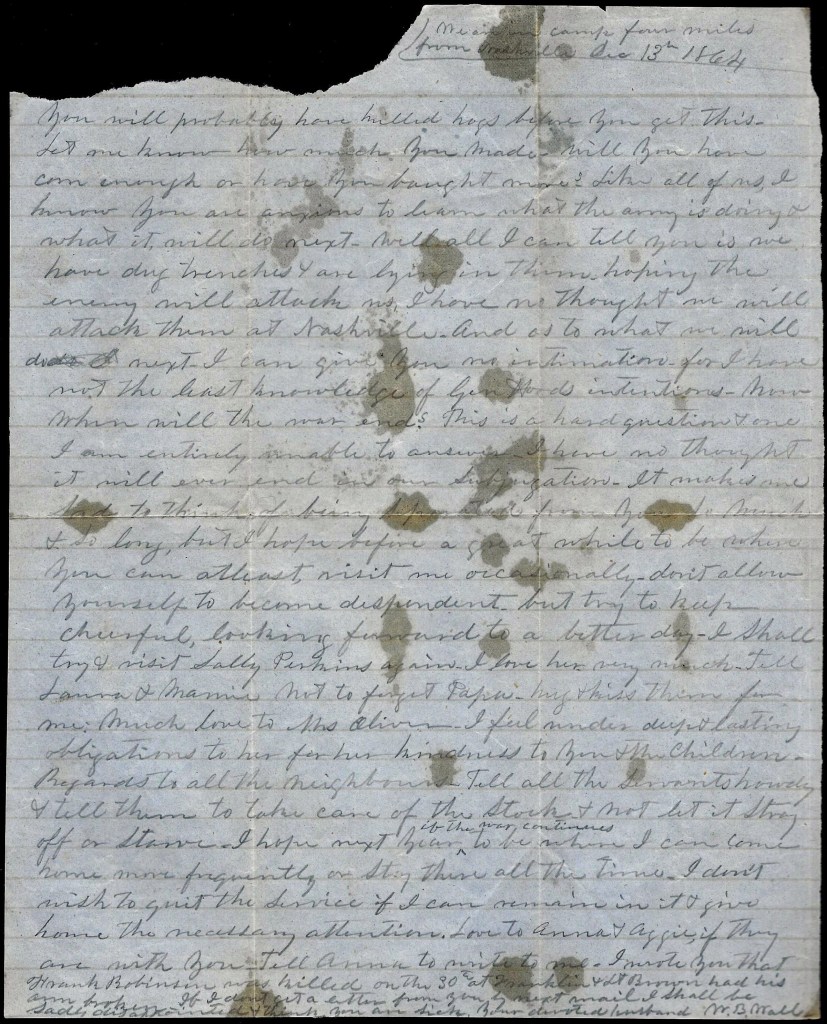
You will probably have killed hogs before you get this. Let me know how much you made. Will you have corn enough or have you bought more? Like all of us, I know you are anxious to learn what the army is doing & what it will do next. Well all I can tell you is we have dug trenches & are lying in them, hoping the enemy will attack us. I have no thought we will attack them at Nashville. And as to what we will do next, I can give no intimation for I have not the least knowledge of Gen. Hood’s intentions.
Now when will the war end? This is a hard question & one I am entirely unable to answer, I have no thought it will ever end in our subjugation. It makes me sad to think of being separated from you so much & so long, but I hope before a great while to be where you can at least visit me occasionally, Don’t allow yourself to become despondent but try to keep cheerful—looking forward to a better day. I shall try & visit Sally Perkins again. I love her very much. Tell Laura & Mannie not to forget Papa. Hug & kiss them for me. Much love to Mrs. Oliver. I feel under deep & lasting obligations to her for her kindness to you & the children. Regards to all the neighbors. Tell all the servants howdy & tell them to take care of the stock & not let it stray off or starve. I hope next year if the war continues to be where I can come home more frequently or stay there all the time. I don’t wish to quit the service if I can remain in it & give home the necessary attention.
Love to Anna & Aggie, if they are with you, Tell Anna to write to me. I wrote you that [1st Sgt] Frank Robertson [Co. I] was killed on the 30th at Franklin & [2d] Lt. [Samuel B.] Brown [Co. I] had his arm broken. If I don’t get a letter from you by next mail, I shall be sadly disappointed & think you are sick.
Your devoted husband, — W. B. Wall
We are in camp four miles from Nashville, December 13, 1864
¹ George C. Phillips was a 25 year old physician in Tchula, Holmes County, Mississippi, when the war started. He enlisted as a private in Company G, “Black Hawk Rifles,” 22nd Mississippi Infantry, on August 12, 1861. He was appointed an assistant surgeon in the regiment on September 26, 1861.
This is a carte-de-visite (cdv) of Harriet E. Whiting (1839-1888), the daughter of Presbyterian minister, Rev. Russell Whiting (1797-1855) and Theodotia M. Mitchell (1798-1845) of Preston, Chenango county, New York. Note that her mother died when she was but 5 or 6 years old. At the time of the 1850 US Census, Harriet, or “Hattie” as she was called, lived with her father and her stepmother Eva (her mother’s step-sister) in Oswego, Kendall county, Illinois. Five years later, Hattie’s father died when the family resided in Sugar Grove, Kane county, Illinois.
A search of School records informs us that Hattie’s father was an 1835 graduate of Union College in New York State. He then attended the Princeton Theological Seminary from 1825-1826, the Andover Theological Seminary from in 1828, and was ordained by the Albany Presbytery in October 1828. His first pastorate was at Batavia, New York (1829-1831) and then at various other churches in Western New York before relocating to Oswego, Illinois in 1849.
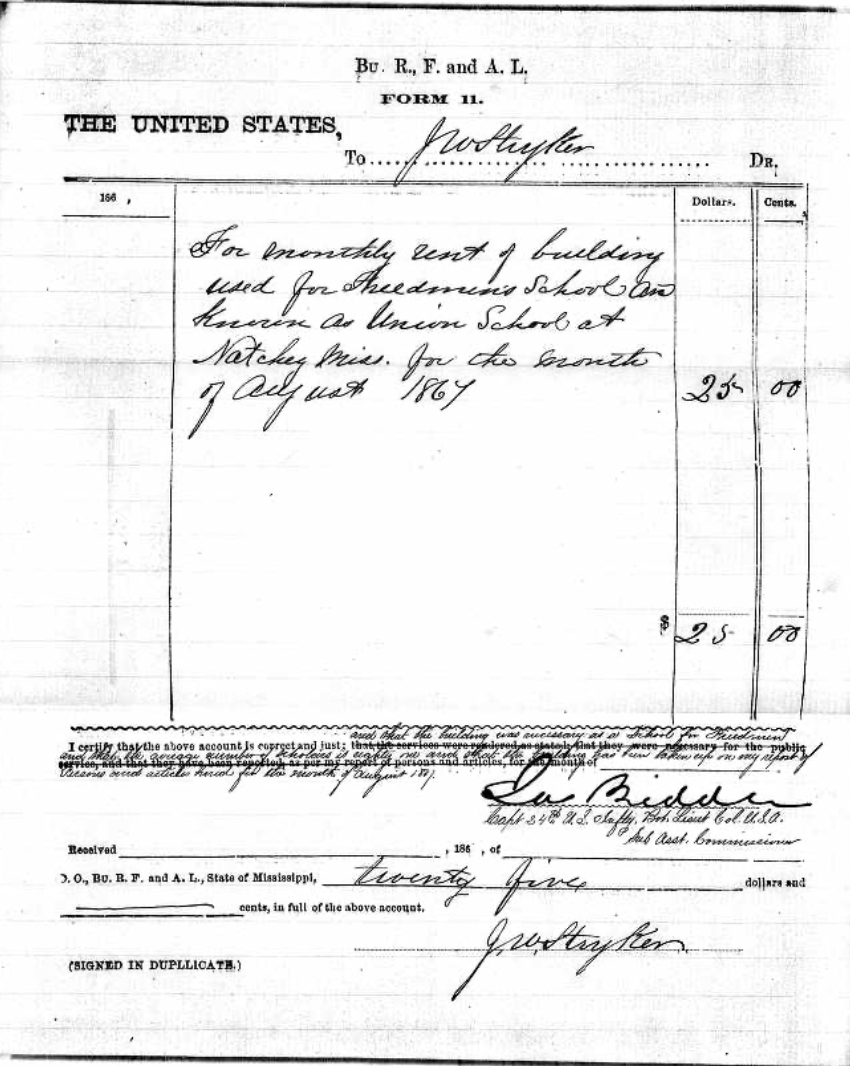
Freedmen’s Bureau Records, 1865-1878
Hattie’s whereabouts could not be confirmed in the 1860 US Census when she would have been 21. It may be that she was on her own working as a school teacher somewhere. The cdv featured above that was taken in Natchez by the Hughes & Larkin studio was probably taken in 1865. That’s the year that the Freedmen’s Bureau established schools in the vicinity of Natchez. Hattie married Jonathan W. Stryker (1836-1888) on 3 March 1867 in Joliet, Illinois. A Freedmen’s Bureau record dated August 1867 shows that J. W. Stryker (and Hattie) were reimbursed by the Bureau for the monthly rent of $25 for the Union School in Natchez.
The 1870 US Census records enumerate Jonathan and Hattie Stryker in Port Gibson, Claiborne county, Mississippi where they were working as teachers for the Freedman’s Bureau. That census record informs us that Jonathan was born in Canada. The couple were living in Spink, South Dakota, in the 1880s where they died.
Curiously, in a poor hand, someone has written on the front of Hattie’s cdv, “My school marm.” This was most likely a black student attending school in Natchez. The cdv was found in the album of a member of the 3rd US Colored Cavalry.
In yet a different hand, not Hattie’s, someone has written on the verso, “Stray Lamb Hattie.” Hattie’s signature is believed to be at the bottom of the verso.
[Note: This photograph is from the collection of Rick Brown who asked for research on the image and gave express consent for me to share it on Spared & Shared.]
The following partial letter is missing the signature page and there is no accompanying envelope to aid us in confirming his identity. The date and camp location make it certain he was in the 2nd Massachusetts Infantry and friends from West Boyleston mentioned in the letter suggest the possibility that he was from Co. C where the company was recruited, but I can’t be certain of this.
Though he is not identified, the letter remains interesting for the description of the punishment meted out to a civilian huckster who undoubtedly refused to keep his distance from Camp Andrews while the regiment was in training. The “poor fellow” was made to wear a “barrel shirt” and marched around the camp at the point of a bayonet to the delight of the whole regiment.
The letter was written on patriotic stationery “Ellsworth’s Last Letter.”
Officers of the 2nd Massachusetts Infantry at Camp Andrew in 1861
T R A N S C R I P T I O N
Camp Andrews June 30, 1861
Dear Parents,
I thought you would like to hear from me and as there was nothing for me to do do for a few hours, I knew my time could not be better occupied than by scratching a few lines to you that would be acceptable. We have just parted with our friends Ford Laflin & Morrow. The parting is not without regret. You cannot tell how pleasant it is to us to see those that so lately bound themselves with us to serve God and those to to that have mourned with us over their sins & have found the pearl of great price. Can I ever forget the time when my rejoicing came, when light first beamed into my soul? I think not.
I received another present from you and one from Cousin Lizzie and Sammy. They sent me some paper or a package—one of Benjamin Russell’s putting up—and Lizzie wrote me a letter. You may thank Aunt Anna for those apples for me and tell her I shall remember the giver.
Well, I have not much more time to write now for am on guard & have to run every few moments & shall have to go on again in a little while.
Monday, July 1st. Well, I have got off of guard & have done my Washington & mending this forenoon and now am ready to finish this. Mr. Ezra Newton & Jery Shepard [of West Boyleston] were here this forenoon but could not get on the field. I did not have a chance to talk with them any but I spoke with them [briefly].
I see by the morning Journal that we are to go Thursday or Friday. I think it can be relied on for we are preparing every day.
We had a very comical show here yesterday. There was an old rum seller just outside of the lines selling rum. The Officer of the Day took him, thrust his head through a barrel, & marched him all over the field & off again with a guard each side of him & one charginf bayonets close to his neck. The drummers and fifers played a Quick March & the whole regiment were spectators. I rather pitied the poor fellow. You can imagine how a man would look walking round inside of a barrel with nothing but his head and legs out.
Civil War soldiers receiving “Barrel Shirt Punishment”
Evening. You will no doubt see the account of the presentation of a flag to our regiment this afternoon. There was a large number of ladies present. I presume there was from three to five hundred present in all….[rest of letter is missing]
The following letter was written by Constant Crandall Hanks (1821-1871), the son of Uriah Hanks III (1789-1871) and Florilla Howes (1803-1890) of Hunter, Greene county, New York. Constant was married to Hannah Reynolds (1818-1881) and had several children when he left his “hoop shaving” job in Ulster county to enlist in September 1861 as a private in Co. K, 80th New York Infantry (originally designated the 20th NYSM).
Regimental records inform us that Constant was promoted to corporal soon after his enlistment and was wounded in action on August 30, 1862, at 2nd Bull Run but recovered and mustered out on September 12, 1864. However, he again enlisted on October 6, 1864 and was wounded on April 3, 1865, at Petersburg, Va.; mustered out on individual roll, June 7, 1865, at McClellan Hospital, Philadelphia, Pa.
See also—1862: Constant Crandall Hanks to Florilla (Howes) Hanks. It should also be noted that The Military History Institute at Carlisle, Pennsylvania, holds two of Constant’s letters from 1865, and Duke University claims 53 letters of Constant’s.
T R A N S C R I P T I O N
Upton Hill, Virginia Camp Wadsworth Col. Pratt, N. Y. S. M.
Father, dear Sir,
May your shadow never be less. It is my earnest wish that you may pick up courage [and] live till Old Jeff Davis is strung up by the neck, nibbled to death by punkys such as torment a man in bark peeling, live till the last vestige of this foul treason at the South her is sunk to the deep hell where it belongs till all at the North who sympathize with it—the South—may follow it there, till peace and its blessings may once more come to our land, till I come home so that you & I can drink one barrel of good cider in honor of the triumph of Freedom, law, order, and the constitution over slavery, anarchy, and those damned traitors that for their own aggrandizement would destroy all. Then, if your time has come, may you go in peace saying as did good old Zachariah after seeing our Savior, now let my servant depart in peace for my eyes have seen the salvation. You can then let thy servant go in peace for you have seen the salvation of the country.
I don’t know as I should bother you with a letter now only that I wrote a letter to mother Sunday and forgot to put a postage in it so she could write me again and she is the only [one] that will write me any now and I want to hear from home once a week if I can. I have not got any this three weeks.
Our regiment went off into the rebel country some 10 miles from our camp. We took some 50 loads of corn and hay. We started 2 o’clock in the morning. We did not see any of their soldiers. We got back just in good spirits. I wrote Mother that we did not have very comfortable blankets. I had just got the letter done and in the letter bag when they issued out to us good heavy warm ones. If they had give them a month ago, it would saved a good many lives.
Tell Mary Rose that while sitting in my tent tonight I can hear right across the street some soldiers singing the hymn, “There is rest for the weary” in four bunks “of Eden there is rest forever more.” Tell her I want her to sing to you. for me. I want you to get Mother to write me a good long letter [and] to tell me in it how you are all. Tell Cyrus that was an interesting letter he sent [and] that I thank him kindly for it.
They say Old tory John Burtis had to put up the Stars and Stripes before they would raise that house. Good Amen!
Be a good bot—take care of yourself. Hoping that we may drink that cider. I will say goodbye, — Com Hanks
I could not find an image of John but here is one of William W. Lamb of Co. E, 109th New York Infantry.
The following letter was written by John H. Warner (1839-1919) of Co. G, 109th New York Infantry. He enlisted on 7 August 1862 at Lansing, New York, and was mustered out of the service on 17 May 1865 at Philadelphia. John was married at lived at Lockport, New York, until he checked himself into a Home for Disabled Soldiers in 1905 where he remained until his death in 1919. He gave the name of his son, James P. Warner (1872-1914) of Lockport, Niagara county, NY, as his nearest relative.
John was the son of George C. Warner (1811-1862) and Alvira Gilpin (1810-1849) of Lansing, Tompkins county, New York. He wrote the letter to his sister, Mary C. Warner (1842-1920) who later married William H. Tucker. He also mentions a younger brother named Genoa (b. 1846).
John’s letter was written from Satterlee Hospital in Philadelphia. He complains of a cold and sore throat—not symptoms that would warrant hospitalization so he must have been recuperating from something more chronic or perhaps he was detailed there to work as a hospital aide. He doesn’t say and the regimental roster only tells us he was “discharged with detachment, May 17, 1865 at Satterlee Hospital.” There isn’t much war news in the letter but there is a good description of the holiday decorations at the hospital and of the Christmas dinner provided the soldiers in Philadelphia hospitals by the generous donation of Dr. & Mrs. M. C. Egbert. [See: The American Menu]
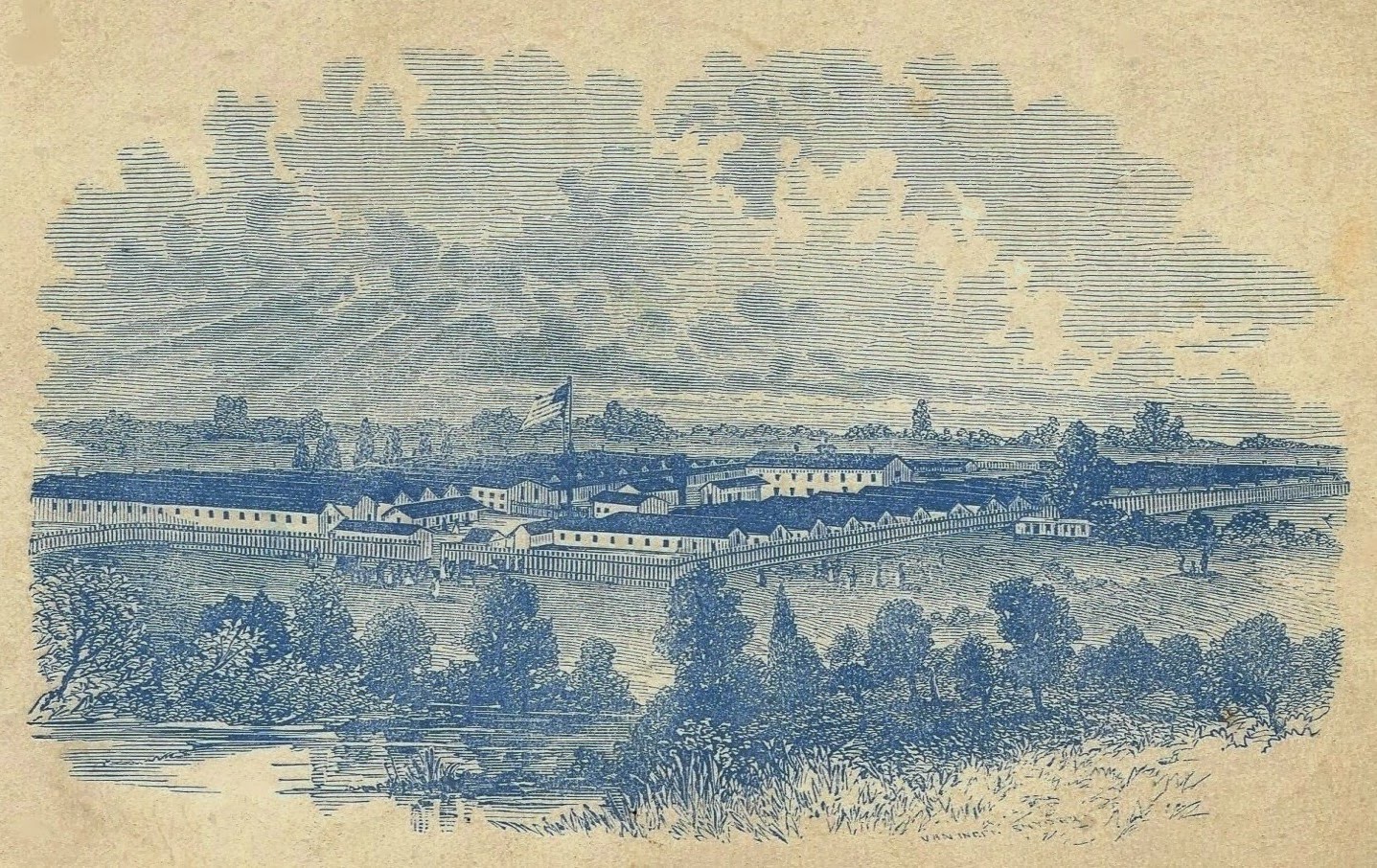
Satterlee Hospital, Philadelphia, PA
T R A N S C R I P T I O N
Satterlee U.S. Army Gen Hospital West Philadelphia, PA Christmas 1864
Dearly loved Sister,
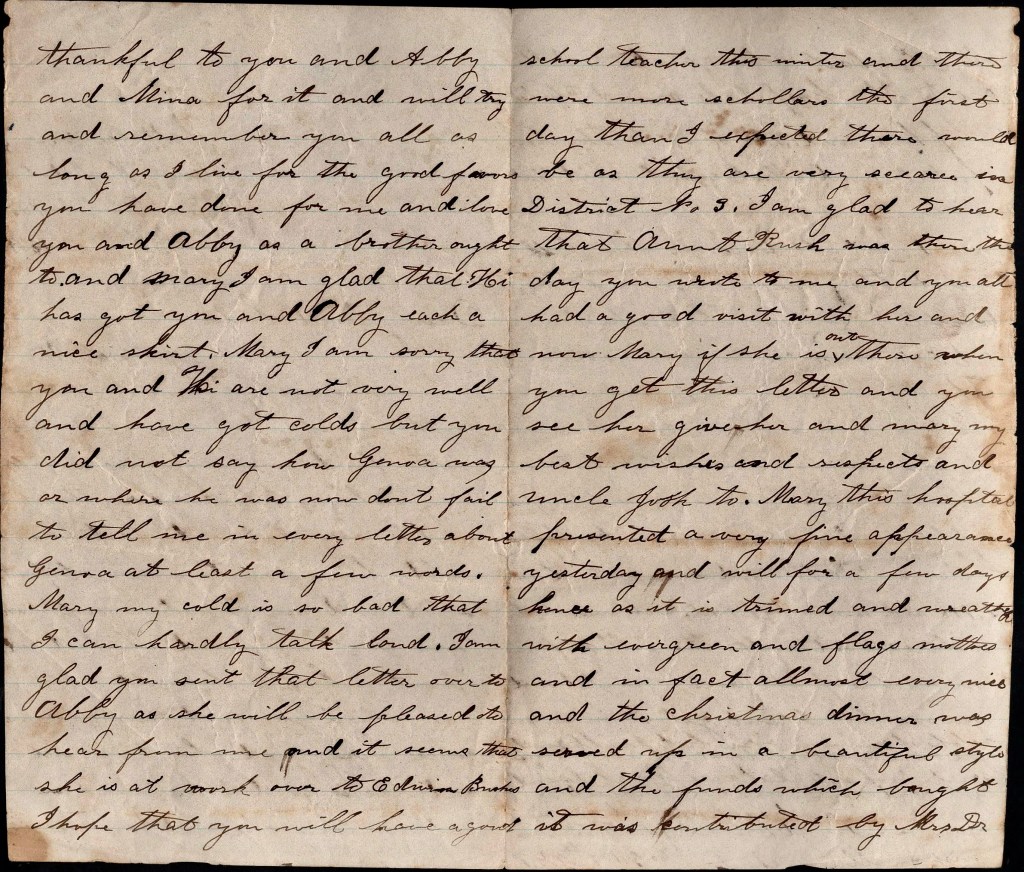
Yours of the 16th was received by me the 21st with much pleasure, but did not find me enjoying myself very well as I had a sore throat and a very bad cold. But the cold hangs onto me yet pretty solid and my throat is not much sore just now and that dried fruit which I brought with me which you and Mina gave me comes very good when I am sick and tastes good to me when I can’t eat anything else and I am ever thankful to you and Abby and Mina for it and will try and remember you all as long as I live for the good favors you have done for me and love you and Abby as a brother ought. And Mary, I am glad that Hi has got you and Abby each a nice skirt. Mary, I am sorry that you and Hi are not very well and have got colds, but you did not say how Genoa was or where he was. Now don’t fail to tell me in every letter about Genoa or at least a few words.
Mary, my cold is so bad that I can hardly talk loud. I am glad you sent that letter over to Abby as she will be pleased to hear from me and it seems that she is at work over to Edwin Bushes. I hope that you will have a good school teacher this winter, and there were more scholars the first day than I expected there would be as they are very scarce in District No. 3. I am glad to hear that Aunt Rush was there that day you wrote to me and you all had a good visit with her and now Mary, if she is out there when you get this letter and you see her, give her and Mary, my best wishes and respects and Uncle Josh too.
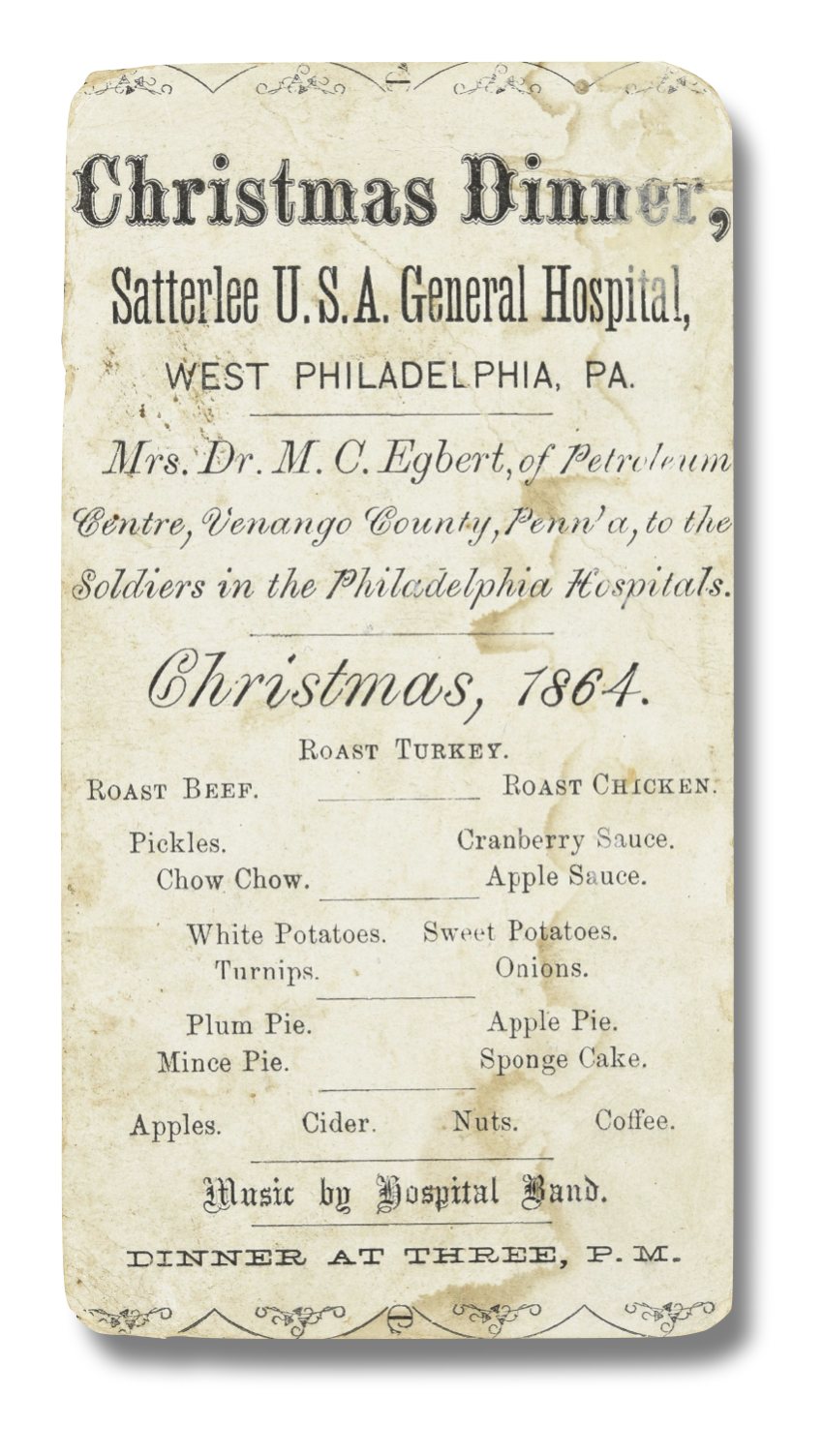
The Bill of Fare card for the Christmas Dinner hosted by Mrs. Emma Egbert (wife of Dr. Milton Cooper Egbert of Petroleum Centre) for the soldiers at Satterlee Hospital (Wisconsin Historical Society)
Mary, this hospital presented a very fine appearance yesterday and will for a few days hence as it is trimmed and wreathed with evergreen and flags and in fact almost every[thing] nice, and the Christmas dinner was served up in a beautiful style and the funds which bought it was contributed my Mrs. Dr. M. C. Egbert who gave 5,000 dollars to the hospitals around Philadelphia and 1,700 of it to this hospital. And Mrs. Egbert said that a Christmas dinner given everyday would not be doing for them half what they are sacrificing for us (noble woman that). She lives at Petroleum Centre, Venango Co. PA.
The dinner consisted of roast beef, turkey, and chicken, pickles, chow chow, cranberry sauce, applesauce, white potatoes, sweet potatoes, turnips, onions, pumpkin, apple and mince pie, sponge cake, apple cider, nuts, coffee, and dinner at 3 PM and music by band. Each man had a large card with the bill affair on his plate and I would send you one, but I can’t get it in an envelope of common size, but I will send you more good reading and Abby too for scrapbook. Not all at once, though.
I send you and Mina, and all the rest, my best wishes and respects and remain your friend and brother, — John H. Warner, Co. G, 109th New York Vol.
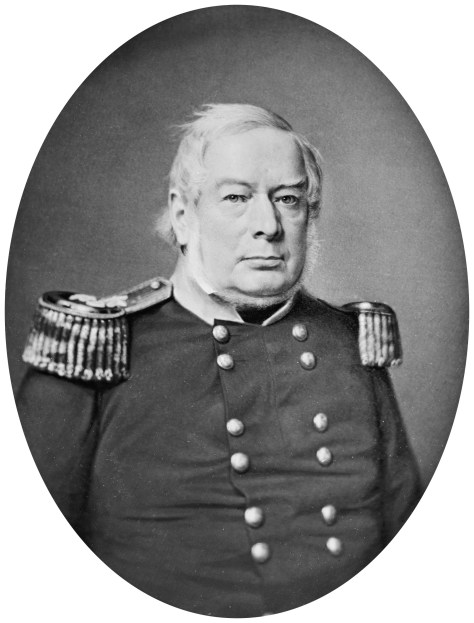
This letter was written by Sylvester Churchill (1783-1862) who began his military career at the outbreak of the War of 1812. He was appointed a 1st Lieutenant in the 3rd US Artillery and served with distinction, rising progressively in rank until 1847 when he was breveted Brigadier General for his services in the Mexican-American War. At the beginning of the Civil War he had been Inspector General for over 20 years. He retired in September 1861. He was married to Lucy Hunter (1786-1862).
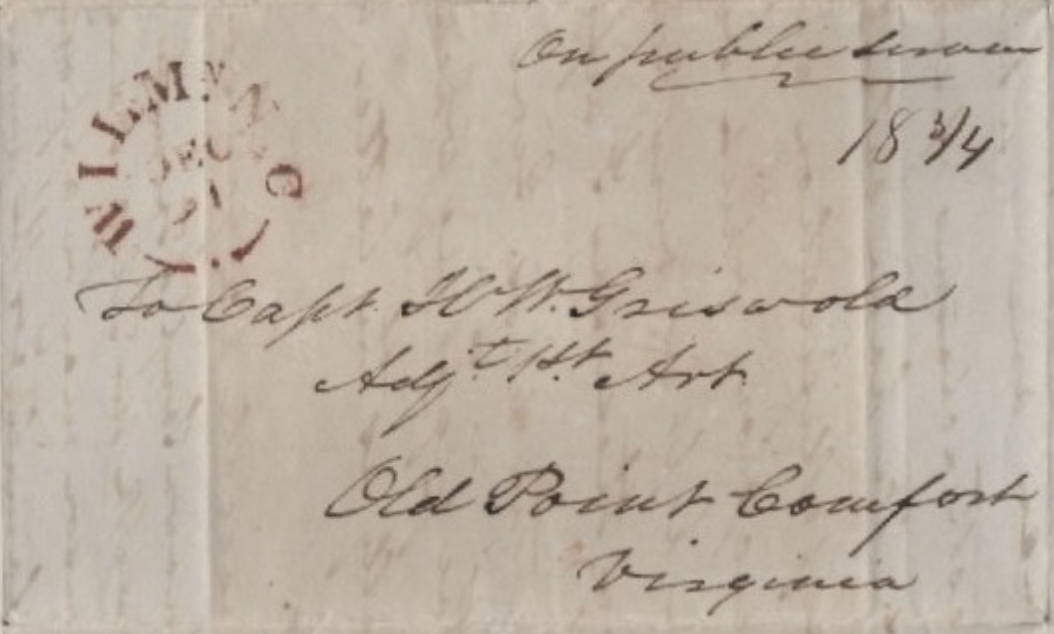
The letter was adressed to Capt. Henry William Griswold (1795-1834), an 1815 graduate of the US Military Academy and a career artillery officer. At the time this letter was written in December 1830, he was in garrison at Ft. Monroe (Old Point Comfort, Va,) were he was Captain of the 3rd US Artillery. Griswold wrote a letter of recommendation for Edgar Allen Poe to enter West Point where Poe was stationed in 1828-29.
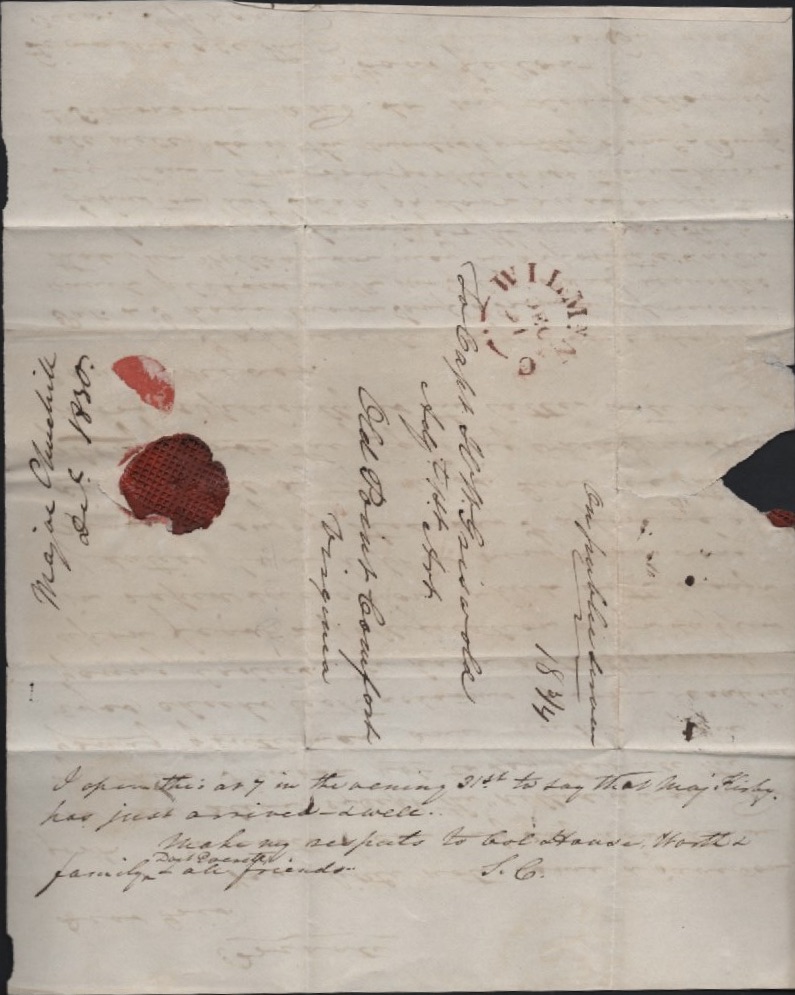
Churchill drafted the letter during the Holiday Season of 1830 in Wilmington, North Carolina, as indicated by the content and postal markings. While he does not disclose the specifics of his long-term assignment, it is evident that it pertained to military service, as he included the “Private” sheet directed to Griswold amidst what was likely official correspondence. He notes that his family was safely settled at Fort Johnson—a historic Revolutionary War fort situated on the Clinch River near Wilmington. His assignment may have been connected to Fort Caswell, which was under construction during that period. He hints at some fear of being “kilt dead by nigs” which explains why he kept his family at Fort Johnson. I’m not aware of any particular slave revolt at that time but, in general, there was a constant fear among slave owners throughout this period of slave uprisings as the slaves greatly outnumbered the white inhabitants. As a Northerner, his presence among a large slave population may have heightened his anxiety.
In the previous year Churchill had been on assignment to perform an assessment of the value of the Mount Dearborn Armory situated on an island in the Catawba River in Chester County. South Carolina. This armory was intended to be comparable to the ones built at Springfield and Harper’s Ferry but it was never fully completed and it was completely abandoned by 1825. Churchill was paid $8 a day for 8 days to determine the property value when it was sold back to the State of South Carolina. The state subsequently sold it to Daniel McCullough who built a cotton factory on the site which was destroyed by Sherman in 1865. [See: Mount Dearborn Armory]
T R A N S C R I P T I O N
Addressed to Capt. W. H. Griswold, Adjutant 1st Art., Old Point Comfort, Virginia
Private
[December 1830] Dear Gris–
Your little note came & gave comfort. In haste I can only say now that we are all alive except the “killed and wounded” by which I mean not to say that all the young gentlemen are unhit by the eyes, cheeks, teeth, & charms of some beautiful young ladies. We have entertainment upon feast & jollification upon suppers in rapid succession, which with enough of duties, have left us very busy. Long may we enjoy these, say I, before we are kilt dead by the nigs. Give me the glory first, the fighting when I must—more especially as the latter will not come—never.
I appreciate all you said about Pat. & I have known Samp. & Trimble 1 before. Am much pleased with Mr. [ ]. Have requested that Mr. Williamson may be appointed sutler.
Leave my family for the present at Fort Johnston, but shall go down occasionally to see them—tomorrow, for the first time. They are all well. So is the modest, worthy Dimock & family & Simonson—and so, my dear fellow, is your fellow, — S. C.
Give me all the news I pray.
I open this at 7 in the evening 31st to say that Maj. Kirby has just arrived & well. My my respects to Col Hand’s, Worth’s family & all friends.
1 This was probably Isaac Ridgeway Trimble (1802-1888) who graduated from the US Military Academy in 1822 and was commissioned a 2nd Lt. of Artillery. He was and engineer and in the 3rd US Artillery before he left the service in 1832 to pursue a career in railroads. He became a Confederate General in the Civil War.
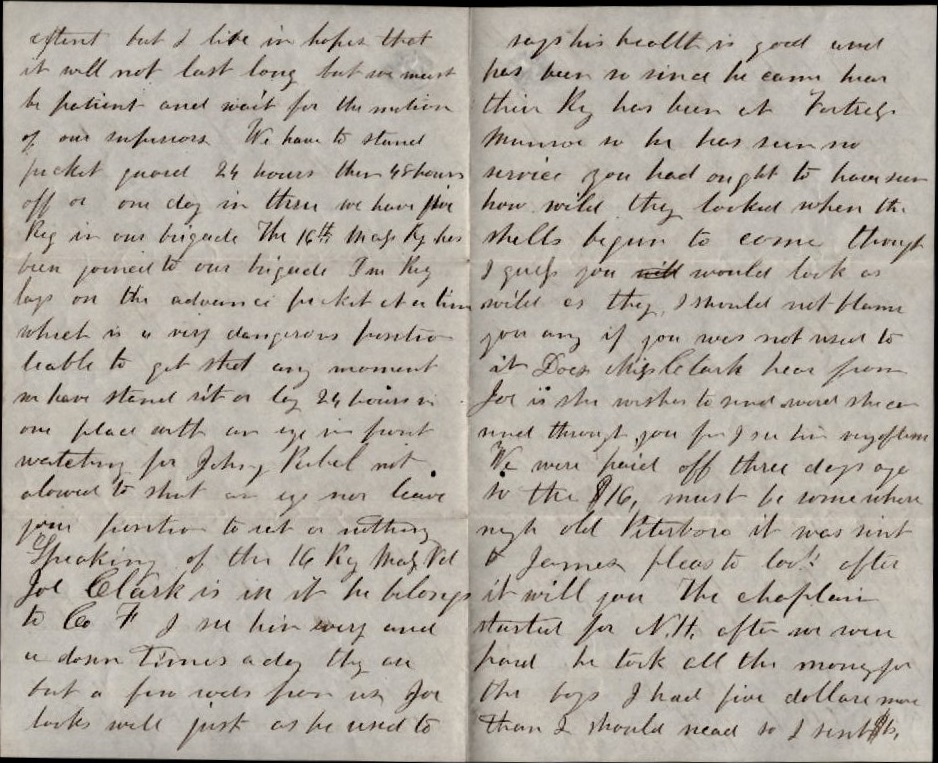
Regrettably I have been unable to attribute this letter to a particular soldier known only as “John.” We know that he was from Peterborough, Hillsboro county, New Hampshire, and that he was in the service during the Peninsular Campaign of 1862 when he assisted a friend in Co. G, 2nd New Hampshire Infantry badly wounded in the Battle of Williamsburg. He is presumed to have been in that same regiment at the time but this is uncertain.
He wrote this letter from “camp near Richmond” (not Petersburg) so my hunch is that he was in a regiment in Butler’s Army of the James (AOJ) where they had been building redoubts north of the James River for the past several weeks. In fact, the letter was dated on 15 June 1864, the very day that the Army of the Potomac (AOP) launched its first wave of attacks on Petersburg later in the day.
The author’s location suggests to me that he was not a member of the 2nd New Hampshire, if he ever was, since the remaining members of that regiment were part of the AOP and were within a week of being discharged at the end of their term of service. Those that were still with the army were then on Provost Guard duty and not in the forward entrenchments. There were 70 original members who reenlisted but they remained in the AOP.
The New Hampshire regiments serving in the AOJ in 1864 included the 3rd, 6th, 12th and 13th but none of these regiments participated in the Battle of Williamsburg. It may have been that John served in the 2nd New Hampshire early in the war, was discharged for some cause and then reenlisted in another regiment but no such person could be identified on the roster of Co. G.
I have attempted to track down the author’s regiment by tracing the history of the 16th Massachusetts that he mentioned had recently been added to their brigade. Further, he says they had been posted at Fortress Monroe and seen no prior action. This is odd because that regiment had a long history of service and been in many battles. The only possible explanation for this is they were new recruits to that regiment but even if this were the case, the 16th Massachusetts was in the AOP, not the AOJ. It may be that John had the name of the regiment wrong as the only Joe Clark I could find serving in that regiment was killed at the 2nd Battle of Bull Run.
I have made efforts to ascertain the identity of the author by examining his familial connections, particularly his mother and sister, to whom he addressed the letter, but these attempts have proven unfruitful. The correspondence suggests that Mrs. James B. Tubbs was his mother, married to a jeweler residing in Peterborough. Her full name was Justina M. Tubbs (notably, her maiden name coincided with her husband’s) and their marriage took place in 1847 when she was 20 years old. It is possible that she had a prior marriage or gave birth to 2 children outside of wedlock; however, the genealogical records remain silent regarding this delicate matter.
T R A N S C R I P T I O N
Camp near Richmond June 15th 1864
Dear Mother,
It is the sacred Sabbath—a day for rest but no rest is there for us. We know no Sabbath here. This pleasant morning the rebels are firing shells at our camp. A number have passed over and some have struck in the midst of us but no one is hurt as yet in our regiment. One shell exploded and took one man’s arm off and wounded three men. Some of our boys are out at work in the redoubt today getting ready for the final strike, this being a very important position so we have to very vigilant on guard or on fatigue duty. We are getting the bitter of a soldier’s life to its fullest extent but I live in hopes that it will not last long. But we must be patient and wait for the motion of our superiors.
We have to stand picket guard 24 hours, then 48 hours off, or one day in three. We have five regiments in our Brigade [now]. The 16th Mass. Regt. has been joined to our brigade. Our regiment lays on the advance picket at a time which is a very dangerous position liable to get shot any moment. We have [to] stand, sit, or lay 24 hours in one place with an eye in front watching for Johnny Rebel, not allowed to shut an eye nor leave your position to rest or nothing.
Speaking of the 16th Regt. Mass. Volunteers, Joe Clark is in it. He belongs to Co. F. I see him every and a dozen times a day. They are but a few rods from us. Joe looks well—just as he used to. Says his health is good and has been so since he came here. Their regiment has been at Fortress Monroe so he has seen no service. You had ought to have seen how wild they looked when the shells begun to come through. I guess you would look as wild as they. I should not blame you any if you was not used to it. Does Miss Clark hear from Joe? If she wishes to send word, she can send through you for I see him very often.
We were paid off three days ago so the $16 must be somewhere nigh Old Peterboro. It was sent to James. Please to look after it, will you? The chaplain started for New Hampshire after we were paid. He took all the money for the boys. I had five dollars more than I should need so I sent $5 by him directed to Mrs. J[ames] B. Tubbs. It will be left at the bank subject to your order, the same as the money was I sent by [ ]. I thought I would send it to you for I did not know where Mr. Tubbs would be. Please to let me know when the money gets home.
Oh! how I wish I could be with it and stop in and surprise you a little. Perhaps you have seen Dan Gould if he has got home. Please go and see him for me, won’t you? Dan was one of my best friends. Ask him if he remembers what he said to me when I was cutting his knapsack off of him. He looked up to me and said, “Well John, my fighting is done for the present, isn’t it?” 1
You must write to me as often as you can. A letter is very acceptable in this region and a letter from mother or sister is worth two others. Yours truly. Sister, remember brother, — John.
1 Daniel Walton Gould (1838-1916) of Peterborough, New Hampshire. Dan was the son of Gilman and Mersilvia (Walton) Gould. He was educated in the public schools of his native town and spent three years in the law office of R. B. Hatch there. At the outbreak of the civil war he enlisted at Peterborough in Co. G of the 2nd New Hampshire Infantry, and was mustered into service at Portsmouth on June 16, 1861. He was first under fire at Bull Run. In the battle of Williamsburg, in May, 1862, he was wounded twice, once in the leg, where he carried the bullet all his life, and in the left arm, which it was necessary to amputate. After the war he returned to Peterborough, where he served as town clerk and in 1872-73 was a member of the New Hampshire legislature. In 1874 he was appointed to a clerkship in the United States Treasury Department at Washington. He moved to Chelsea in 1876, when he was appointed inspector of customs at the Boston custom house. He served as an alderman in Chelsea for several terms.
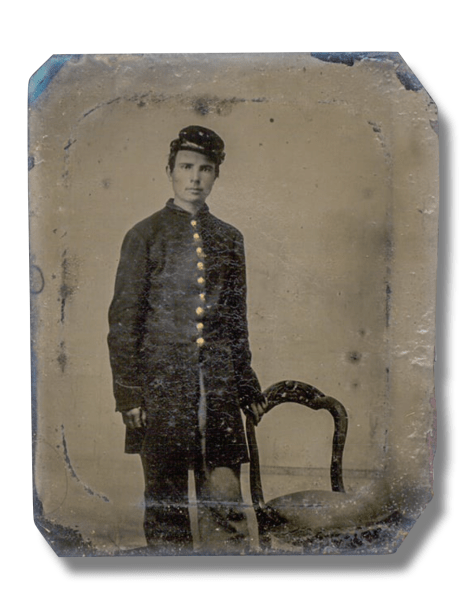
I could not find an image of Kessler but here is one of Dexter Etheridge who served in Co. F, 1st Michigan Sharpshooters (Dale Niesen Collection)
The following letters were written by Thomas Jefferson Kessler (1843-1901), the son of Abram P. Kessler (1816-1864) and Mary L. Wirt (1819-1886) of Goshen, Elkhart county, Indiana. An obituary informs us that Thomas was born in Summit county, Ohio, in 1843, and came to Elkhart county, Indiana, with his parents when he was only five years old. They settled on a farm in Washington township. In the spring of 1863 “he enlisted in the First Regiment of the Michigan Sharpshooters. The regiment was assigned to the 2nd Brigade, 1st Division, of the Army of the Potomac, Gen. Wilcox commanding. He was in the battle of Petersburg when his commander captured that place. When the war closed, Mr. Kessler returned to Goshen and was employed as clerk by Deferees & Company. He was married in the fall of 1867 to Miss Hattie C. Barnes and one son, Guy B. Kessler, was born to them. Mr. Kessler was in 1872 appointed to the U. S. railway mail service with a route on the Lake Shore road. He held the position about 15 years, when he resigned…”
An examination of Thomas’ military records indicates that he enlisted on 28 June 1863 and was mustered into Company G of the 1st Michigan Sharpshooters on 8 July 1863. He completed his service and mustered out on 28 July 1865 in Washington, D.C. The letter from Camp Douglas (near Chicago) was where the 1st Michigan Sharpshooters served as prison guards until 7 March 1864, at which point they were reassigned to join the Army of the Potomac for the Overland Campaign. The content of this letter serves as a primary source, offering insights into the operations and conditions of the camp and its inmates during the period overseen by Colonel DeLand, thus contributing to the existing body of knowledge documented by institutions such as the Camp Douglas Restoration Foundation.
[Note: This letter is from the private collection of Greg Herr and was transcribed and published on Spared & Shared by express consent.]
Letter 1
Addressed to Miss Elisabeth Kessler, Bristol, Elkhart county, Indiana
Camp Douglas December 9th 1863
Dear Sister,
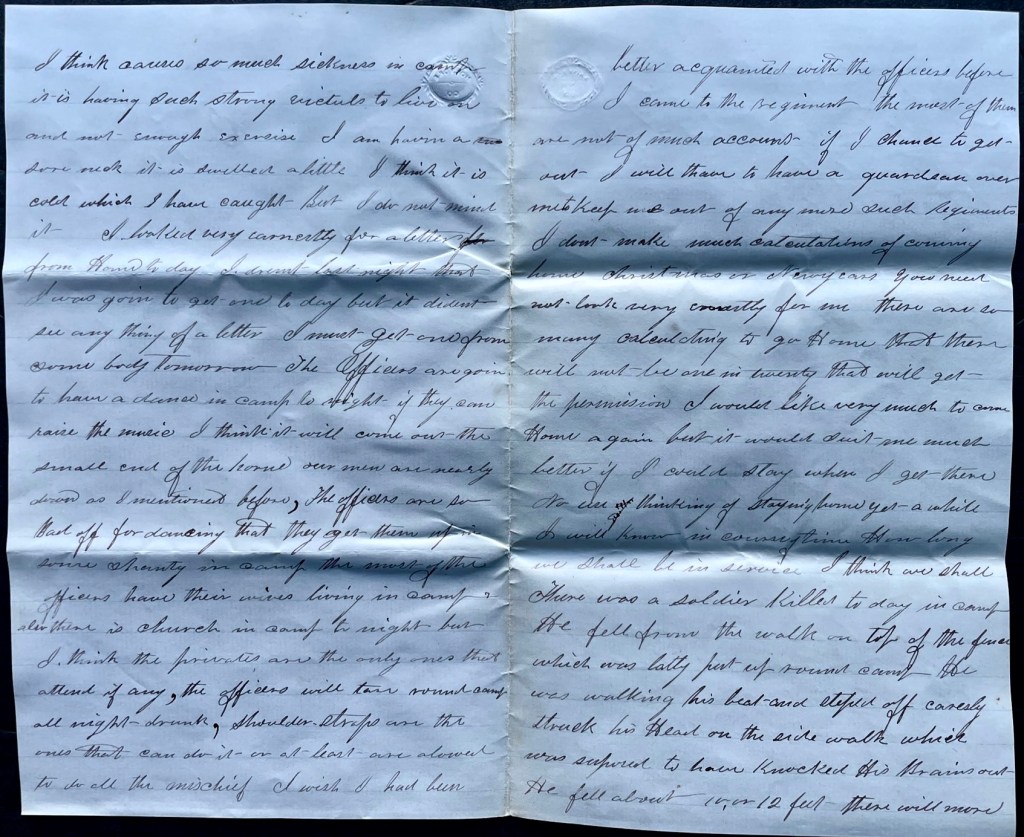
I spend this evening in writing you a few lines. I received your letter a few days since. I think I answered it in Henry’s letter. I received his letter before he got mine. I have no news special of interest to relieve the monotony of the times and will write such news as will come before me to pass away the present night. I am feeling pretty well but the majority of our Band Boys are not able to be up. There is four of them that are pretty sick tonight. The complaint is the diarrhea and has run them down very fast. I have been somewhat down for a few days with the same complaint but have got nearly over it. I do not know what causes this sickness unless it is the pleasant weather we have. I can’t compare it to anything else. Another thing which I think causes so much sickness in camp, it is having such strong victuals to live on and not enough exercise. I am having a sore neck. It is swelled a little. I think it is cold which I have caught but I do not mind it.
I looked very earnestly for a letter from home today. I dreamt last night that I was going to get one today but I didn’t see anything of a letter. I must get one from somebody tomorrow. The Officers are going to have a dance in camp tonight if they can raise the music. I think it will come out the small end of the horn. Our men are nearly down as I mentioned before. The officers are so bad off for dancing that they get them up in some shanty in camp. The most of the officers have their wives living in camp. Also there is church in camp tonight but I think the privates are the only ones that attend if any. The officers will tear around camp all night drunk. Shoulder straps are the ones that can do it or at least are allowed to do all the mischief. I wish I had been better acquainted with the officers before I came to the regiment. The most of them are not of much account. If I chance to get out, I will have to have a guard on over me to keep me out of any more such regiments. I don’t make much calculations of coming home Christmas or New Years. You need not look very earnestly for me. There are so many calculating to go home that there will not be one in twenty that will get the permission. I would like very much to come home again but it would suit me much better if I could stay when I get there. No use of thinking of staying home yet a while. I will know in course of time how long we shall. be in service. I think we shall.
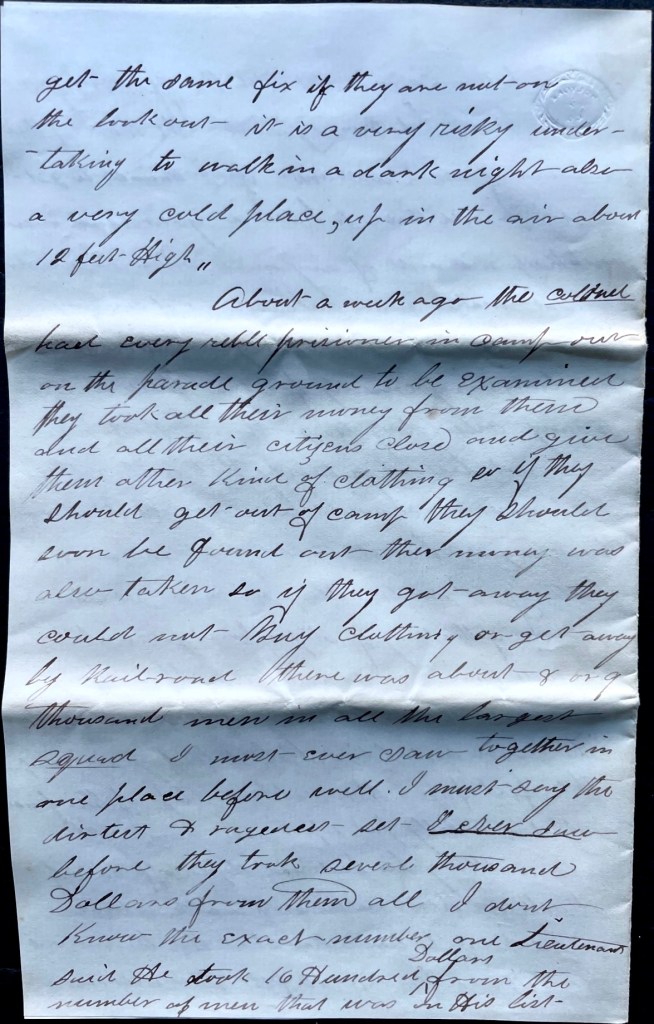
There was a soldier killed today in camp. He fell from the walk on top of the fence which was lately but up round camp. He was walking his beat and stepped off carelessly, struck his head on the side walk which was supposed to have knocked his brains out. He fell about 10 or 12 feet. There will more get the same fix if they are not on the lookout. It is a very risky undertaking to walk in a dark night. Also a very cold place up in the air about 12 feet high.
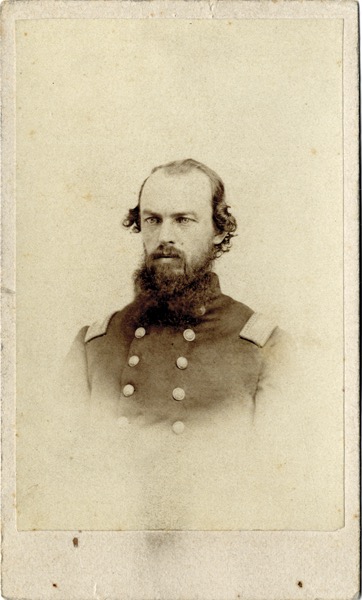
Charles Victor DeLand was the colonel of the 1st Michigan SS from its initial muster until 4 February 1865.(Dale Niesen Collection)
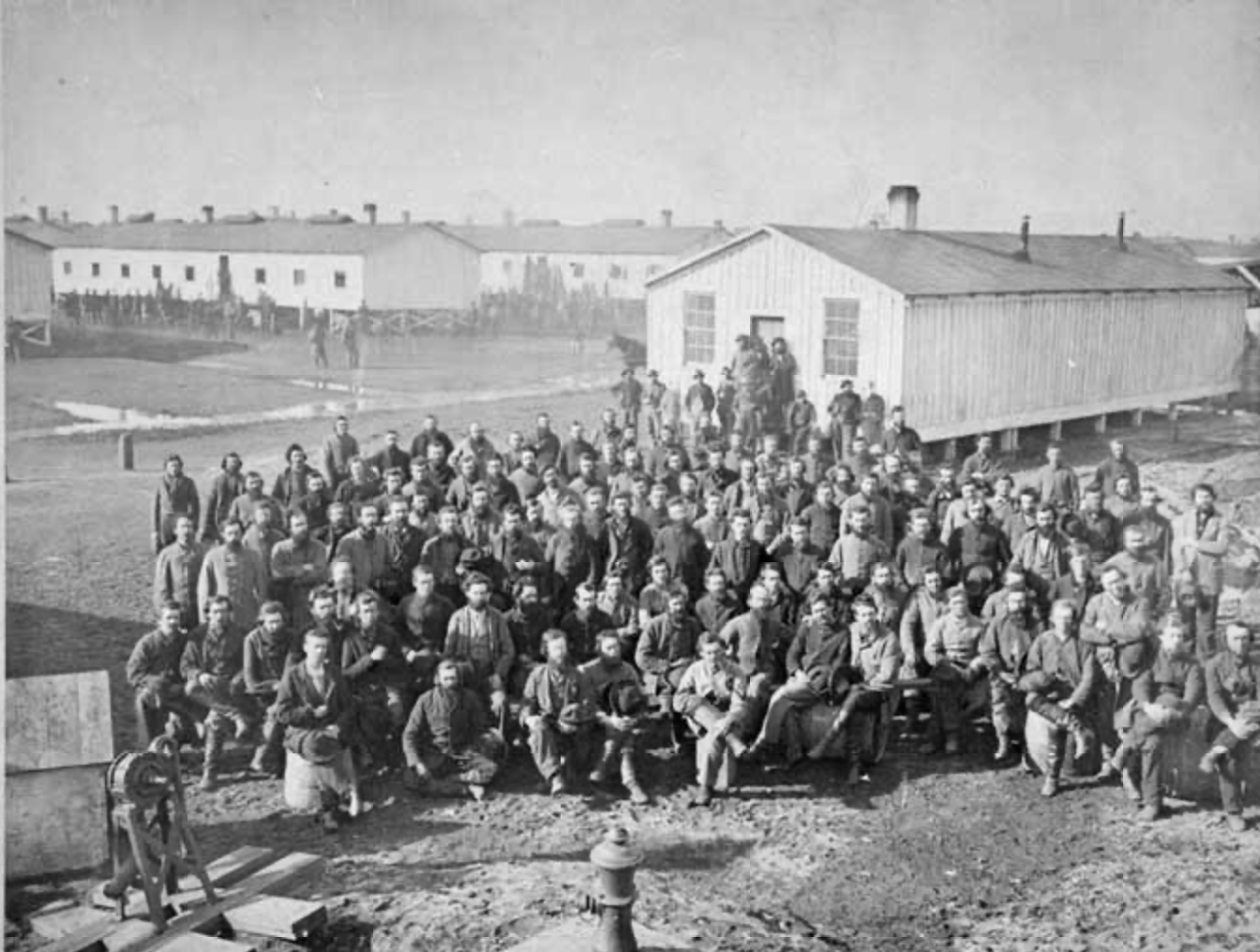
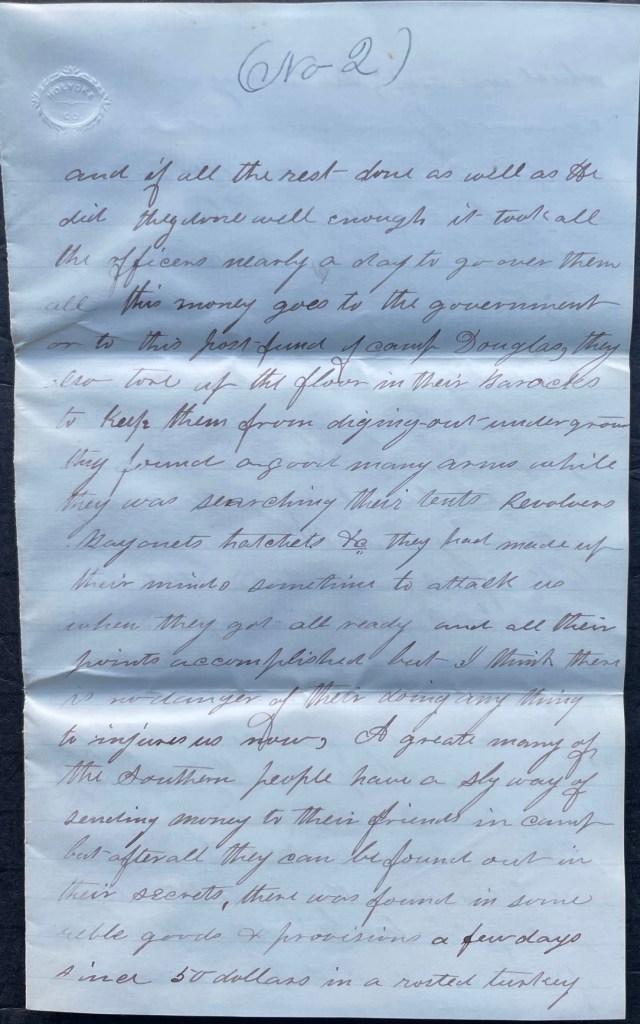
About a week ago the Colonel had every rebel prisoner in camp out on the parade ground to be examined. They took all their money from them and all their citizen’s clothes and give them other kind of clothing so if they should get out of camp, they should soon be found out. Their money was also taken so if they got away, they could not buy clothing or get away by railroad. There was about 8 or 9 thousand men in all—the largest squad I most ever saw together in one place before. Well I must say [they were] the dirtiest and raggediest set I ever saw before. They took several thousand dollars from them all. I don’t know the exact number. One Lieutenant said he took 16 hundred dollars from the number of men that was on his list and if all the rest done as well as he did, they done well enough. It took all the officers nearly a day to go over them. All this money goes to the government or to this post fund of Camp Douglas. They also tore up the floor in their barracks to keep them from digging out underground. The found a good many arms while they was searching their tents—revolvers, bayonets, hatchets, &c. They had made up their minds sometime to attack us when they got all ready and all their points accomplished but I think there is no danger of their doing anything to injure us now.
Camp Douglas Prisoners, 1864 (The Chicago Historical Society)
A great many of the Southern people have a sly way of sending money to their friends in camp but after all they can be found out in their secrets. There was find in some rebel goods & provisions a few days since. 50 dollars in a roasted turkey which was sent. The turkey was examined by our men and there was found in a small bottle in the turkey’s breast full of greenbacks which was expected to be smuggled through all safe. There is some more coming about the same way but the Mr. Rebs will not be able to get it. The rebels in the South send letters here giving all the secrets they send in goods and provisions. There is supposed to be a box of goods coming with money in it. There was a letter written to the effect. A Mother wrote to her son and says to him as follows, “When you get your box of goods, take the box and make kindlin’ wood of it. Cut it very fine. Count every nail. Look sharp, &c. This is enough to suspicion that there is money round. But as it happens, Mr. Colonel examines all letters before they go to the rebel post office but the letter which I speak of will not reach the prisoner nor the money which was sent him. The money is supposed to be morticed into the side of the box, &c. This seems rather bad to look at the matter and their being destitute of means to keep them from freezing. “But nevertheless it is nothing more than they deserve.” Let them behaves themselves as they ought and they would not need suffer the consequences.
A pipe bowl of the Devil and his fiddle (made in France) uncovered in excavation at site of Camp Douglas in 2015 which may or may not date to the Civil War years(Camp Douglas Restoration Foundation, 2015)
Our people in the North speak of the southern classes of people not being enlightened to any extent whatever. They are very much mistakened. These are some of the best educated men in the camp among prisoners I ever saw. There are lawyers, doctors, &c. &c. that a great deal better qualified for business than the most of our men in camp. I presume [if we were] to take a fight, they could whip us also. I do not wish you to understand these as my principles, and further not to think I have turned to be a rebel since we have been in Camp Douglas. These are not my principles.
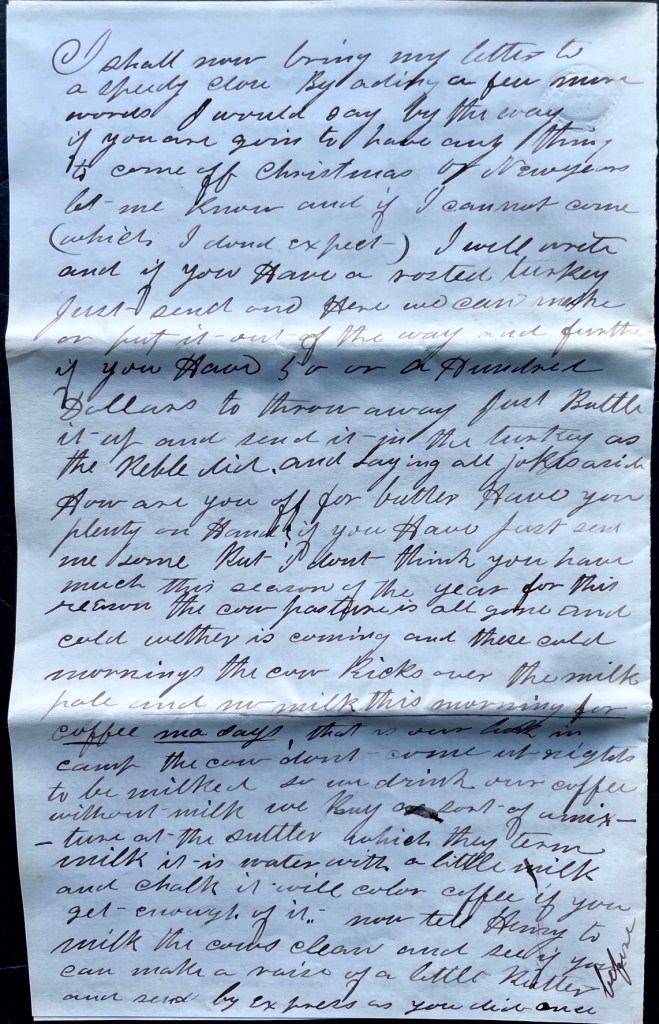
I shall now bring my letter to a speedy close by adding a few more words. I would say by the way if you are going to have anything to come off Christmas or New Years, let me know and if I cannot come (which I don’t expect), I will write and if you have a roasted turkey, just send oner here. We can make or put it out of the way and further if you have 50 or a hundred dollars to throw away, just bottle it up and send it in the turkey as the Rebel did. And laying all jokes aside, how are you off for butter? Have you plenty on hand? If you have, just send me some. But I don’t think you have much this season of the year for this season the cow pasture is all gone and cold weather is coming and these cold mornings the cow kicks over the milk pail and no milk this morning or coffee now days. That is our talk in camp. The cow don’t come at nights to be milked so we drink our coffee without milk. We buy a sort of a mixture at the sutler which they term milk. It is water with a little milk and chalk. It will color coffee if you get enough of it. Now tell Henry to milk the cows clean and see if you can make a raise of a little butter and send by Express as you did once before.
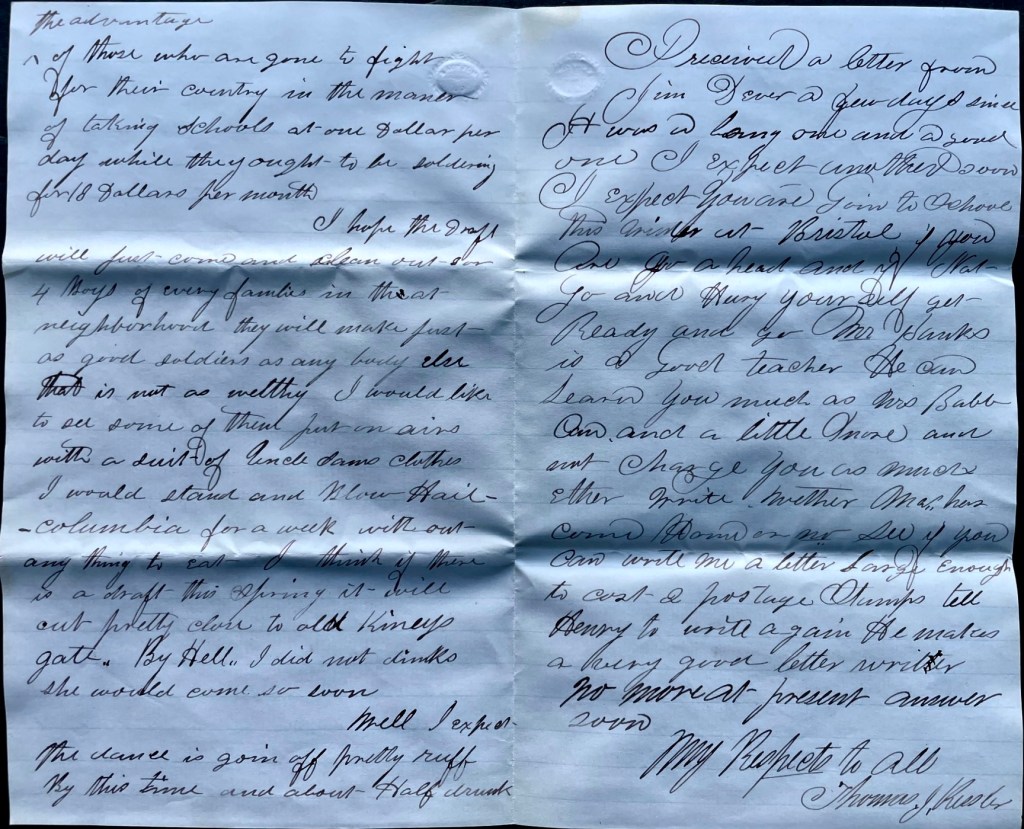
I see I had not room enough on the last sheet to close my letter. I want you to write to me soon as you get this. Don’t wait so long and when you write, give me all the news there is going on—who goes home with the girls and who don’t, and who can’t go. Henry says he has got what he wanted for a long time and that was a drum. I expect he does nothing else but drum all the time. He had better come and join the Michigan Sharpshooters. I think if Henry goes to Hiram Rex School this winter he will be able to take charge of the Army of the Potomac next spring. I think a wooden man would answer about as well. I know it in the Weikle District. It is not fair for all the cowards to stay at home and take advantage of those who are gone to fight for their country in the manner of taking schools at one dollar per day while they ought to be soldiering for 18 dollars per month.
I hope the draft will just come and clean out 3 or 4 boys of every family in that neighborhood. They will make just as good soldiers as anybody else that is not as wealthy. I would like to see some of them put on airs with a suit of Uncle Sam’s clothes. I would stand and blow Hail Columbia for a week without anything to eat. I think if there is a draft this spring, it will cut pretty close to old Kinney’s gate. “By hell, I did not dink she would come so soon.” 1
Well, I expect the dance is going off pretty rough by this time and about half drunk.
I received a letter from Jim Dever a few days since. It was a long one and a good one. I expect another soon. I expect you are going to school this winter at Bristol. If you are, go ahead and get ready and go. Mr. Hanks is a good teacher. He can learn you much as Mrs. Babb 2 can and a little more and not charge you as much either. Write whether Ma has come home or no. See if you can write me a letter large enough to cost two postage stamps. Tell Henry to write again. He makes a very good letter writer. No more at present. Answer soon. My respects to all. — Thomas J. Kessler
Thomas J. Kessler, 1st Regiment S. S., Brass Band, Camp Douglas, Chicago, Illinois
To E. Kessler, Bristol, Elkhart, Indiana
Answer immediately. Truly yours, — T. J. K.
1 Thomas may have been referring to Frederick G. Kinney (1804-1879), a native of Union (now Snyder county), Pennsylvania, who came to a 200-acre farm four miles north of Bristol, Elkhart county, Indiana, in May 1849. He raised seven children and by his thrift and accumulated wealth, provided them all with homes of their own. His four oldest children were all boys of military age, Benjamin (b. 1835), Frederick (b. 1838), George (b. 1842), and Lewis (b. 1845). It does not appear that any of them served in the Union army.
2 This was probably Ann Eliza (Shields) Babb (1825-1916). She was daughter of Mr. and Mrs. Hector Shields. After her education she was a school teacher in Peru, Ohio for several years. She married Benjamin Babb on 24 Dec 1851 after which they moved to Elkhart, IN where they lived the rest of their lives. She worked with him in their bookstore for many years and gained a reputation of being an encyclopedia of general knowledge. She was also a student of the Bible and was often called on to give Bible studies. The couple had no children.
Letter 2
Addressed to A. P. Kessler, Esq., Bristol, Elkhart county, Indiana
Warrenton Junction, Virginia May 1st 1864
Dear friends,
I suppose it has been some time since you heard from me and as it is about the last opportunity I shall have to write you, I take pleasure to drop you a few lines this Sunday eve. I am well at present and hope this will find you all the same. I received Pa’s letter yesterday morning. Was forwarded from Annapolis to me. Was glad to hear from home. I wrote one and sent it or mailed it at Fairfax. I suppose you will get it.
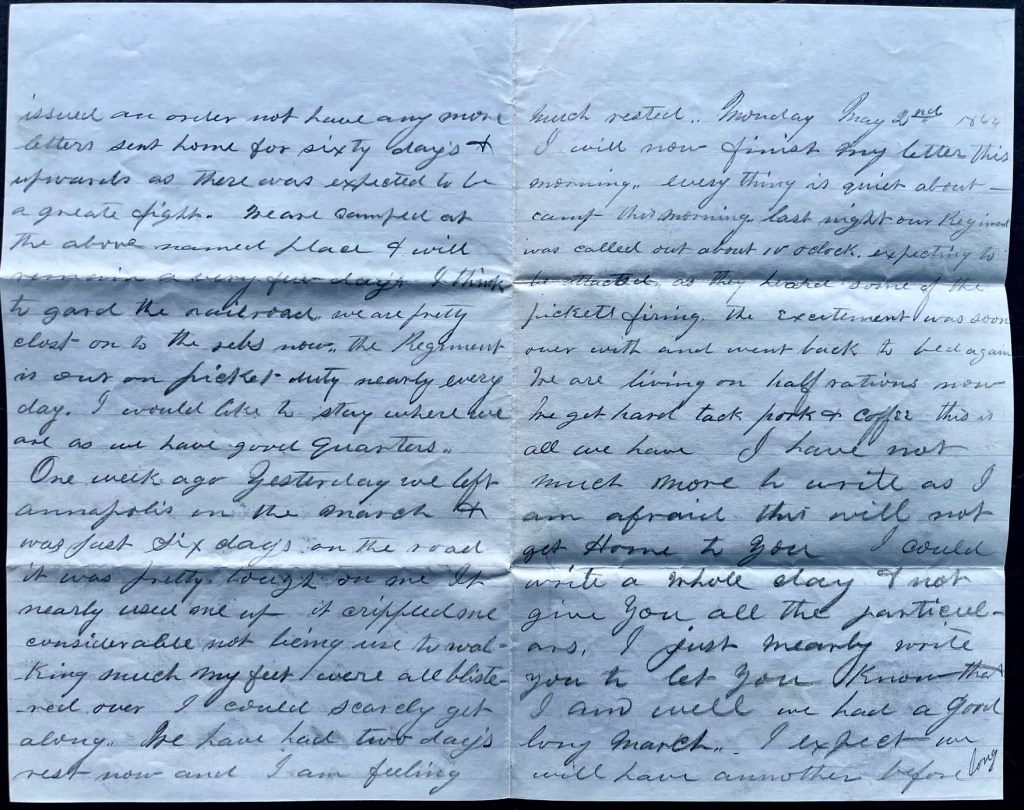
As I said, it would perhaps be the last time for a good while as Gen. Burnside issued an order not [to] have any more letters sent home for sixty days & upwards as there was expected to be a great fight. We are camped at the above named place & will remain a very few days, I think, to guard the railroad. We are pretty close on to the rebs now. The regiment is out on picket duty nearly every day. I would like to stay where we are as we have good quarters.
One week ago yesterday we left Annapolis on the march & was just six days on the road. It was pretty tough on me. It nearly used me up. It crippled me considerable, not being use to walking much. My feet were all blistered over. I could scarcely get along. We have had two days rest now and I am feeling much rested.
Monday, May 2, 1864. I will now finish my letter this morning. Everything is quiet about camp this morning. Last night our regiment was called out about ten o’clock expecting to be attacked as they heard some of the pickets firing. The excitement was soon over with and went back to bed again. We are living on half rations now. We get hard tack, pork & coffee. This is all we have.
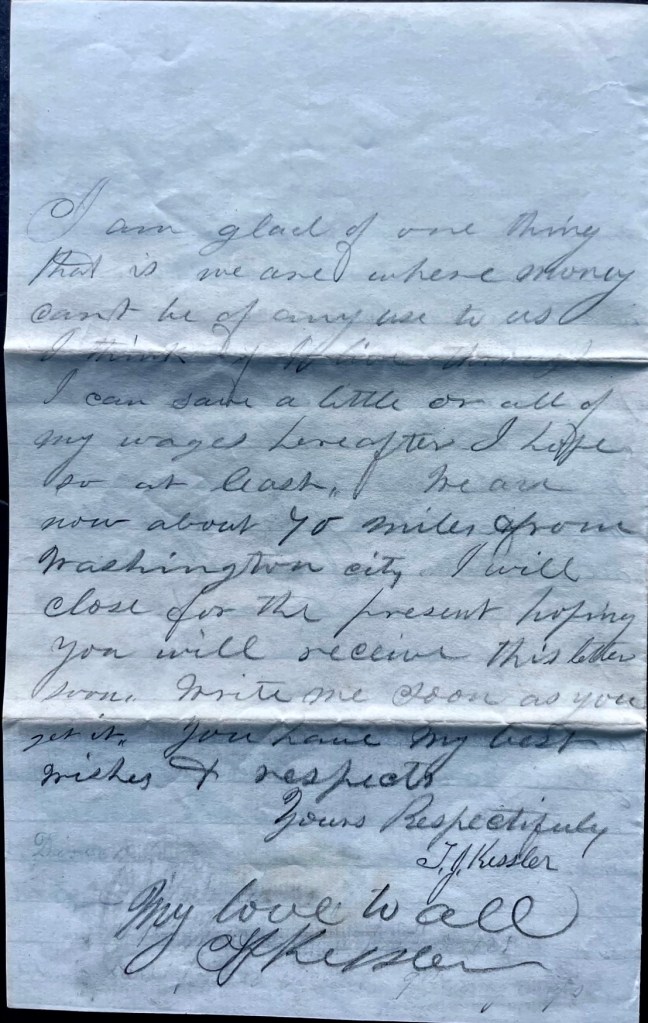
I have not much more to write as I am afraid his will not get home to you. I could write a whole day and not give you all the particulars. I just merely wrote you to let you know that I am well. We had a good long march. I expect we will have another before long. I am glad of one thing—that is we are where money can’t be of any use to us. I think if I live through, I can save a little or all of my wages hereafter. I hope so at least.
We are about 70 miles from Washington City. I will close for the present hoping you will receive this letter soon. Write me soon as you get it. You have my best wishes & respects. Yours respectfully, — T. J. Kessler






















 Spared & Shared 23