1864: Samuel Augustus Duncan to James Graham Gardiner

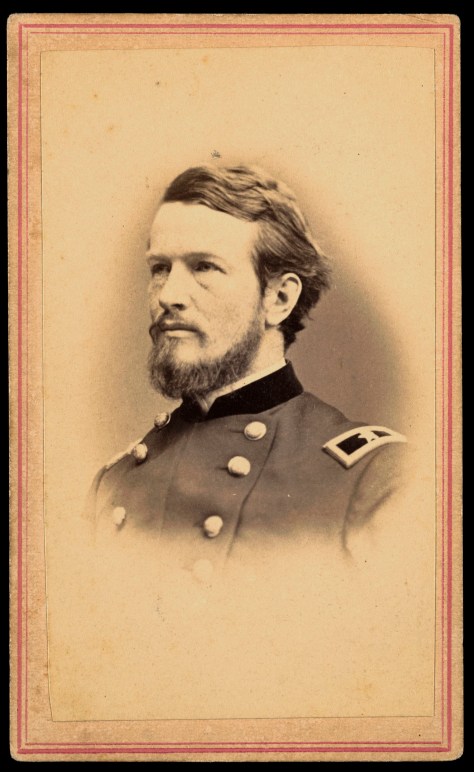
Samuel Augustus Duncan

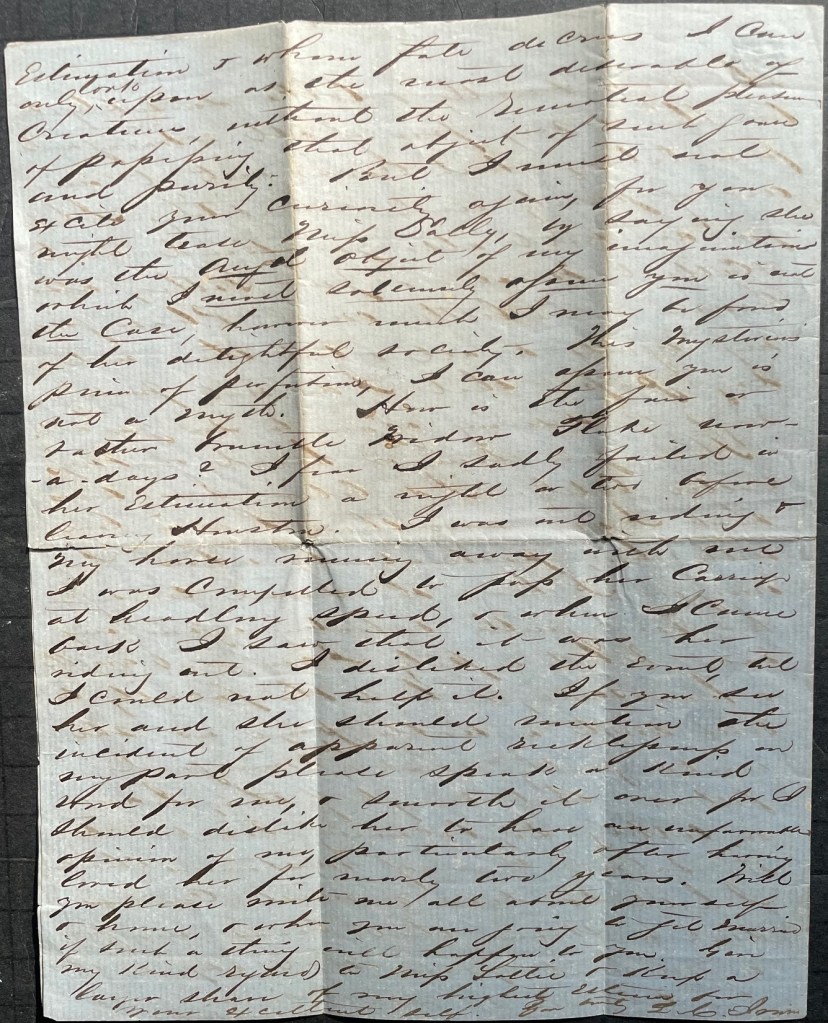
The following letter was written by Samuel Augustus Duncan who began his service in the Civil War as Major of the 14th New Hampshire Infantry Regiment and was later commissioned the Colonel of the 4th U.S. Colored Troops (USCT) Infantry Regiment. He was brevetted Brigadier General, US Volunteers on October 28, 1864 for “gallant and meritorious services in the attack upon the enemy’s works at Spring Hill, Va.” On March 13, 1865 he was brevetted Major General, US Volunteers for “gallant and meritorious services during the war.” After the end of the conflict he became a patent lawyer, and served as Assistant United States Commissioner of Patents from 1870 to 1872.

Duncan’s letter is primarily focused on the treatment and care provided to Col. Alexander Gardner (1833-1864), 14th New Hampshire Infantry, following his mortal wounds sustained at the Battle of 3rd Winchester (or Opequon) on September 19, 1864. It can be inferred from the correspondence that the Gardner family harbored resentment toward the regimental surgeon, Dr. William Henry Thayer, for his inability to preserve the colonel’s life. Nevertheless, Duncan offers a robust defense of the doctor’s decisions and actions during in the aftermath of the battle.

Samuel wrote the letter to James “Graham” Gardiner who served as an adjutant to Samuel in the 4th USCT but who resigned following the death of his brother Alexander as he was the only surviving son in the family.

See also—1864: Alexander Gardiner to Ira Colby
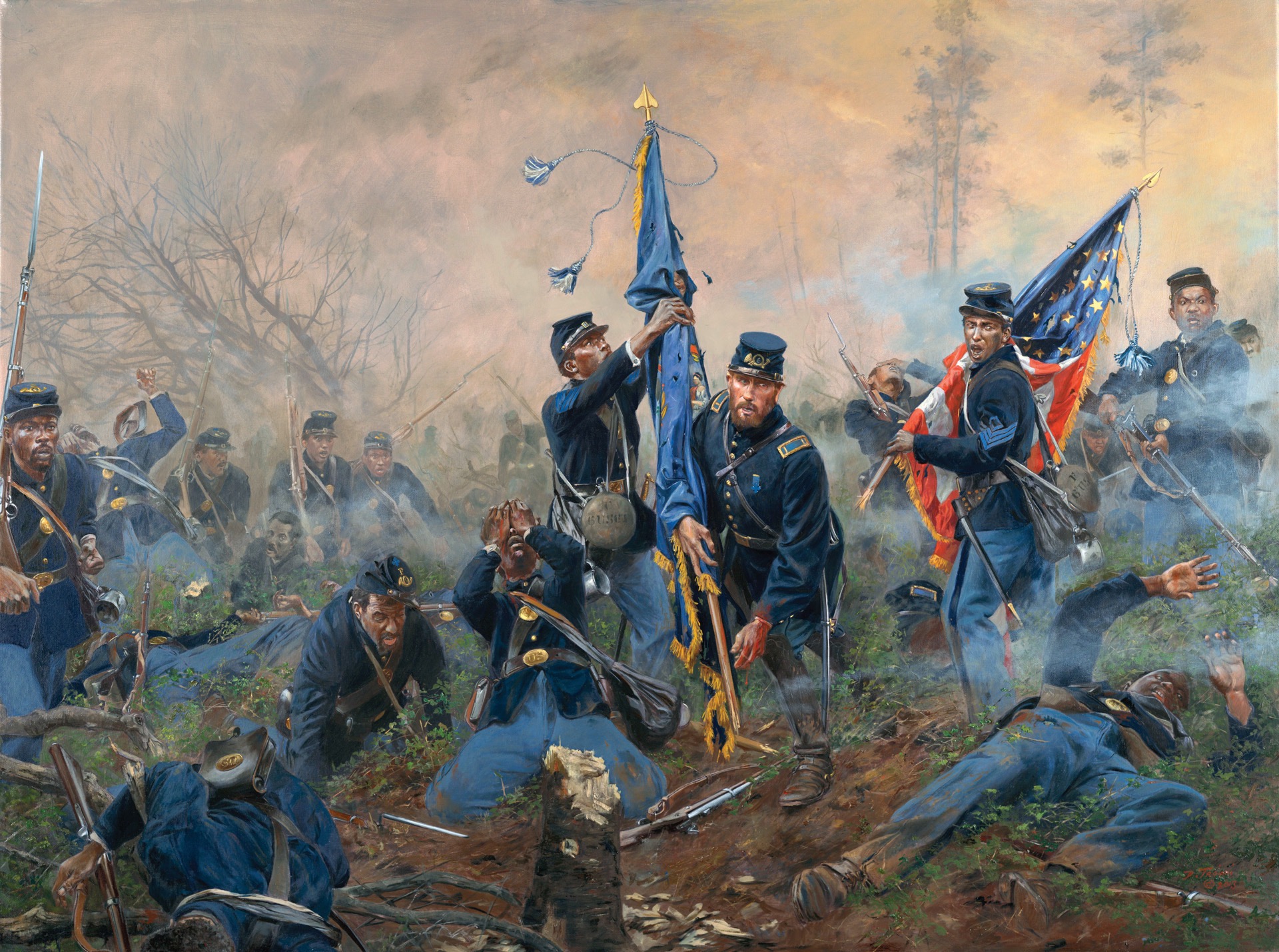
Referring to the Battle of New Market Heights, Samuel wrote, “that was a terrible morning. It is not often that troops are called upon to enter such a murderous fire as was that. Even now I fail to comprehend the policy of putting us into it as we did go in. The affair might have been more successfully managed with less loss of life. Did you before leaving the Brigade hear this feature of it talked over any? I cannot see how any of us came out of that fight alive. How I ever got back from the skirmish line unharmed, mounted as I was, is a mystery.”

Note: This letter is from the personal collection of Greg Herr and was offered for transcription and publication on Spared & Shared by express consent.

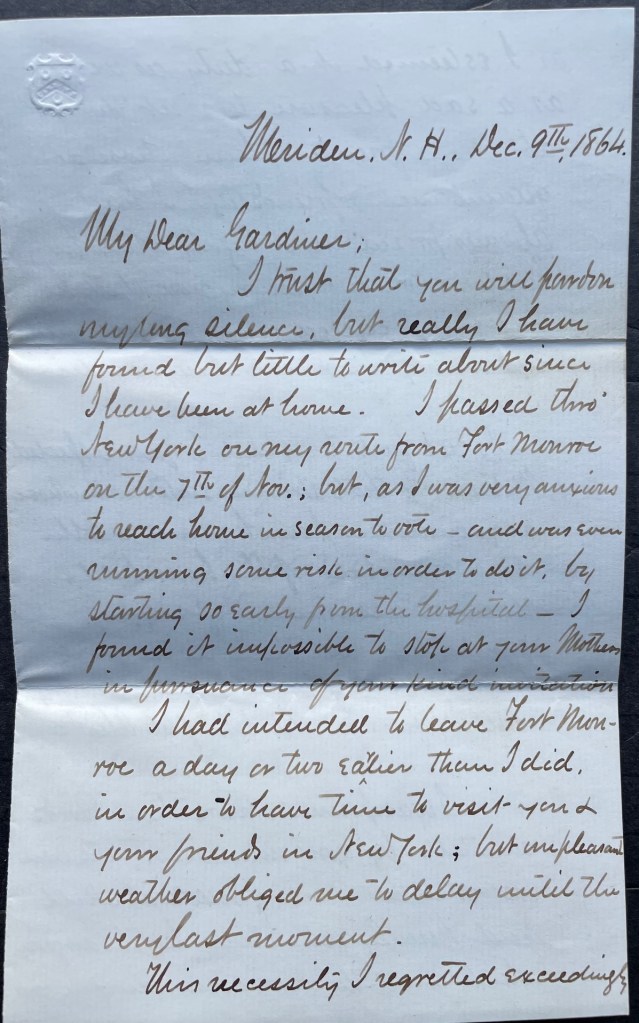
T R A N S C R I P T I O N

Meriden, New Hampshire
December 9th 1864

My dear Gardiner,

I trust that you will pardon my long silence but really I have found but little to write about since I have been at home, I passed through New York on my route from Fort Monroe on the 7th of November, but as I was very anxious to reach home in season to vote—and was even running some risk i order to do it by starting so early from the hospital—I found it impossible to stop at your Mother’s in pursuance of your kind invitation. I had intended to leave Fort Monroe a day or two earlier than I did in order to have time to visit you & your friend in New York, but unpleasant weather obliged me to delay until the very last moment. This necessity I regretted exceedingly as I esteemed it a duty, as well as a sad pleasure to visit the afflicted friends of him whose acquaintance & friendship I had always prized most highly while he lived, and whose memory now that he has been called away is treasured up among the most valued recollections of the past.

Do not fail to extend to your respected Mother, to that stricken sister with whose acquaintance I am honored, & to the other members of the household, renewed assurances of my profoundest sympathy with them in the great sacrifice which the country called for in the life of Col. Alexander Gardiner.

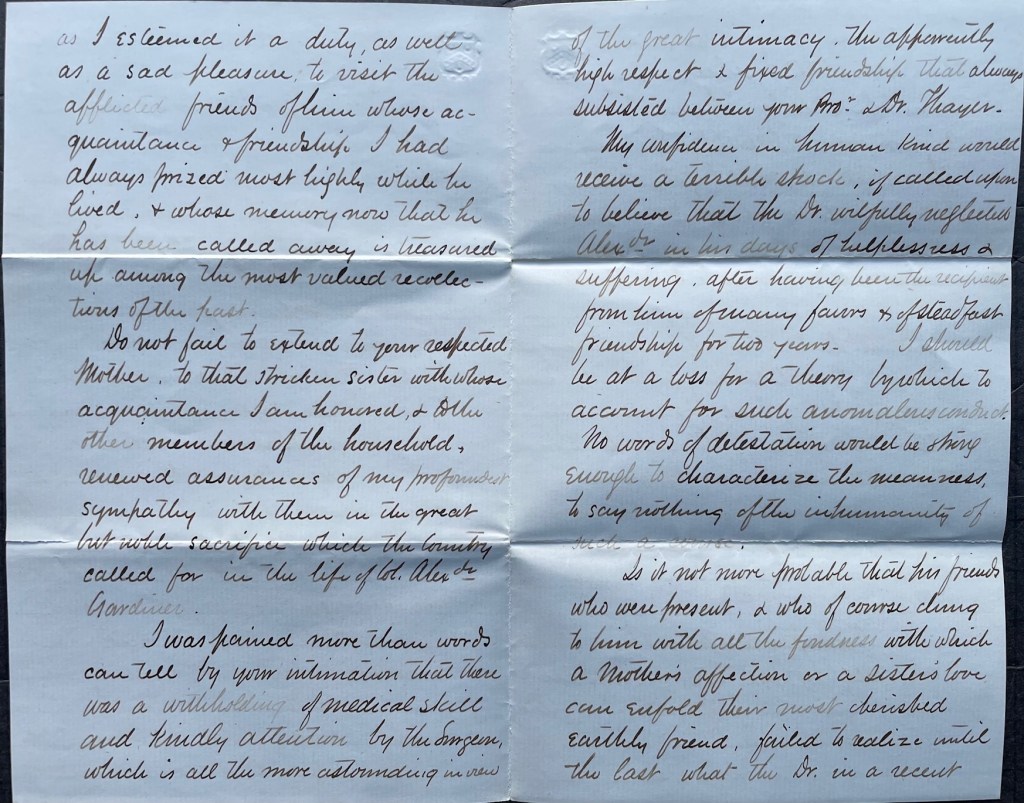
I was pained more than words can tell by your intimation that there was a withholding of medical skill and kindly attention by the surgeon which is all the more astounding in view of the great intimacy, the apparently high respect & fixed friendship that always subsisted between your brother and Dr. [William Henry] Thayer. 1 My confidence in human kind would receive a terrible shock if called upon to believe that the Dr. willfully neglected Alexander in his days of helplessness & suffering after having been the recipient from him of many favors and of steadfast friendship for two years. I should be at a loss for a theory by which to account for such anomalous conduct. No words of detestation would be strong enough to characterize the meanness to say nothing of the inhumanity of such a course.

Is it not more probable that his friends who were present & who of course clung to him with all the fondness with which a Mother’s affection or a sister’s love can enfold their most cherished earthly friend, failed to realize until the last what the Dr. in a recent letter to me says it was apparent to himself and other skillful surgeons whom he called in council from the first, viz. that the Colonel’s wounds were necessarily of a mortal character. and , failing to realize this fact, easily and almost naturally formed wrong ideas respecting the course of treatment which was actually adopted, and which was sanctioned by the consulted surgeons of acknowledged skill.

Of course this would not excuse any inattention or lack of friendly ministration that could prolong life or assuage pain & could be given consistently with the manifold imperative duties that at such a time & in such an emergency tax a surgeon’s time and energies to their utmost capacity.

I can but hope that you and all your friends in forming your final estimates in this matter will give due prominence to the multifarious and distracting cares that fall to a surgeon’s lot after a great battle as well as to the repeated consultations which Dr. Thayer had about your brother with other prominent surgeons, and especially to the peculiarly intimate relation which had always subsisted between the surgeon and his patient, and it would be a great relief to me, I assure you, could I know that such a belief at last obtains among those who were present by your brother’s bed, as will notdo violence to thoserelations of intimacy and warmest friendship.

Dr. Thayer writes that he has sent the Colonel’s widow at her request a full account of the nature of his wounds & treatment. I am glad that he has done so. Doubtless you have seen that account ere this. If so, I presume that the letter which I have could add little of information, and yet if you would like to see it, I will forward it to you. I do really think that it sets forth the Dr.’s inner feeling in the case more explicitly than it might be proper for him to express them in a letter to Mrs. Gardiner, whom he has known for so short a time only. For that reason it may be a satisfaction to you to see it, as I assure you it has been to me, His assertion that he would have preferred dismissal from the service rather than leave the Colonel in the hands of others—that in fact he had made up his mind to remain with his friend so long as life remained, even at the sacrifice of his official position, if that need be, I believe entitled to credit. Might not such a resolve to weigh much in the forming of any judgment of the Dr.’s treatment of the case.

By this time I suppose that our Division has been incorporated into the 25th Corps under Gen. Weitzel. A recent letter from Col. [John Worthington] Ames [of the 6th USCT] represents him as well. Buckman is A.A.A.G.; Appleton of the 4th A.A.A. G.; Chamberlain of the 6th, Aide-de-Camp; and Spaulding of the 2nd Cavalry. Commissary–Wilber is still Quartermaster. The Colonel says that he recently rode over the battleground of New Market Heights [and] that everything there is so changed that he could hardly recognize the place. Troops are encamped all around, and all the trees in the vicinity have been felled and consumed. Gardiner, that was a terrible morning. It is not often that troops are called upon to enter such a murderous fire as was that. Even now I fail to comprehend the policy of putting us into it as we did go in. The affair might have been more successfully managed with less loss of life. Did you before leaving the Brigade hear this feature of it talked over any? I cannot see how any of us came out of that fight alive. How I ever got back from the skirmish line unharmed, mounted as I was, is a mystery. But believe me, my dear fellow, my thoughts that morning were not for myself half so much as for you. In the heat of the battle, I reproached myself, as my mind went out to that scene of suffering at Winchester and glanced at the probable fate hanging over your dear brother—if in fact he were then alive—for having allowed you to encounter the perils of that hour. Had harm befallen you, I know not how I could have reconciled your friends to my instrumentality in having drawn you into the service.

I would most gladly have spared you the anguish of that battle scene—anguish not from fear occasioned by appalling terrors that encompassed us, for I do not believe that you would shrink in the presence of danger however great, but by reason of your consciousness, the necessarily kindled into unwonted life, that after Alexander you would be the sole surviving son of your Mother on whom her hopes and affections would center more and more as other supports should be withdrawn. My own wound was forgotten in my joy at your safety.

And then I felt too that had a reasonably generous spirit been manifested by one who had the power, you would have been on your way to carry aid and comfort to your brother instead of being subjected to that ordeal. What pit ’tis that so much gaul should be found in men’s composition that they cannot lend a respectful ear to a reasonable request!

I cannot blame you should your recollections of your former superior officers be other than the most pleasant.

When I left the hospital (Nov. 5th), Lt. Pratt was very low. His case seemed hopeless. His wife was with him & was very calm & resigned, but Col. Ames now writes that Pratt has “weathered the storm” and will recover. I hope so, certainly, for he is a pleasant & companionable officer. But poor Vannays [?] we shall see no more. I think the commander–his staff of the 3rd Brigade—should be satisfied with their record of exposure to danger that day.

I am getting on well. Can walk a little in the house with a cane, but it is very slow and awkward work. Shall probably leave for Annapolis soon after the 1st of January, although it will be two months before I can return to the field.

[Col.] Ames [of the 6th USCT] writes that the “Canal” is a humbug still. It will not be near completion this year. It has among other novelties an old dredging machine sunk in the middle of it. Our men are all out of it. Thanks for that. It has cost Butler a good deal to make a Brigadier out of the Superintending Genius of the [Dutch Gap] Canal.

USCTs at work in the Dutch Gap Canal  (Library of Congress). In August 1864, Gen. Benjamin F. Butler, commander of the Army of the James, ordered that a ditch or canal be dug across the narrow neck of land here to enable Union gunboats to evade Confederate batteries on the James River. Under brutal conditions and occasional Confederate sniper and artillery fire, Union soldiers from the 116th and 169th New York volunteers but mostly from the 4th, 6th, 10th, 36th, 38th, and 100th regiments of the US Colored Troops regiments were given the task.

I hope that you are not suffering from the ague acquired on the James [river]. My diarrhea has troubled me much since I came home. Now, my dear Gardiner, if I can at any time be of any service to you, I am yours to command. Should you ever incline to reenter the service, I could doubtless assist you, and it would be a great pleasure to me to have you near me. My sorest regret connected with your resignation, aside from the sad circumstances that called for it. was that I should be deprived of your services and the pleasure of your society. It is but right that you should know that my regret was generally shared by those who had come to know you.

Again, please present my warmest regards to your friends. Letters from you will always be welcome. Cordially, your friend, — Sam’l A. Duncan
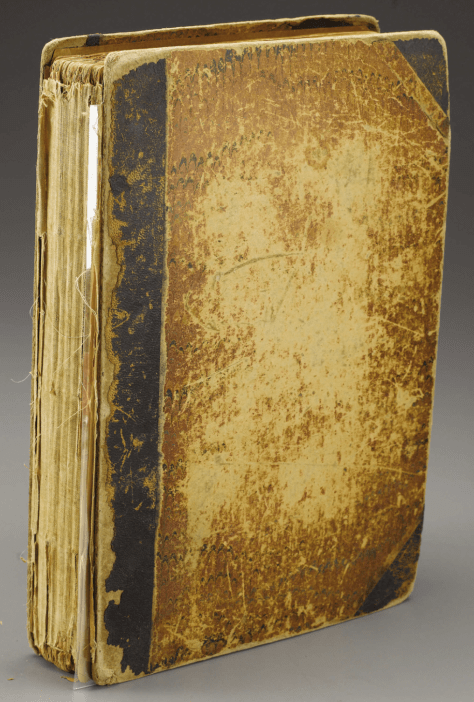

Dr. William H. Thayer’s Letters

1 William Henry Thayer began his military career as a medical officer in the 14th New Hampshire Volunteer Infantry. He was appointed Medical Inspector in November, 1863, and served in that capacity until January, 1864. He earned the promotion to Surgeon-in-Chief in February, 1865. Thayer’s letters sold at auction in 2007 with dates from January 3, 1864 to March 10, 1865, written from various locations between Washington D.C. and Savannah, and ranging in length from one to 15 pages. They were pasted to the pages of the scrapbook in chronological order. The correspondence began in Concord, where Dr. Thayer wrote to his wife after being “…so fully occupied with my duties that I could not get through with my reports, & instructions for the medical officers…” One of the more interesting letters includes his account of meeting President and Mrs. Lincoln on a Saturday trip to the White House. Upon seeing the exhausted President, Thayer wrote that “…Mr. L was near the door, looking so haggard…” Later, Dr. Thayer related his experience after gaining a private audience with the President, and reiterates that Lincoln looked “very thin and hollow-eyed.”
1863: Lewis Cass Irwin to Mary Dudley Stiles

The following letter was written by Lewis Cass Irwin (1828-1889), one of the three steamboat captains in the Marine Department of the Military District of Texas, New Mexico and Arizona under Magruder’s overall command. Captain Irwin was assigned to the sub-quarters at at Sabine Pass, while Capt. Henry S. Lubbock and Capt. S. K. Brown were assigned to Galveston and Matagorda Bay, respectively. All three captains reported to “Commodore” Leon Smith.

Lewis was the son of Robert Irwin, Jr. (1797-1833) and Hannah Rees (1802-1886) of Portage, Columbia county, Wisconsin. Prior to the war, Lewis was a clerk in the US Indian Agent Office and as a railroad agent in Hempstead, Texas. After the war he worked as a correspondent of the Galveston News and Dallas Commercial and eventually moved to New Mexico. He died in December 1889 after a year’s residence in the Confederate Home in Austin, Texas.

Lewis wrote the letter to Miss Mary Stiles who was probably Mary Dudley Stiles (1843-1928), the daughter of William Woodbridge Stiles (1816-1889) and Ann Marie Bryan (1821-1895) of Houston, Texas. She married Augustus Norman Edmundson (1844-1912) in 1869.

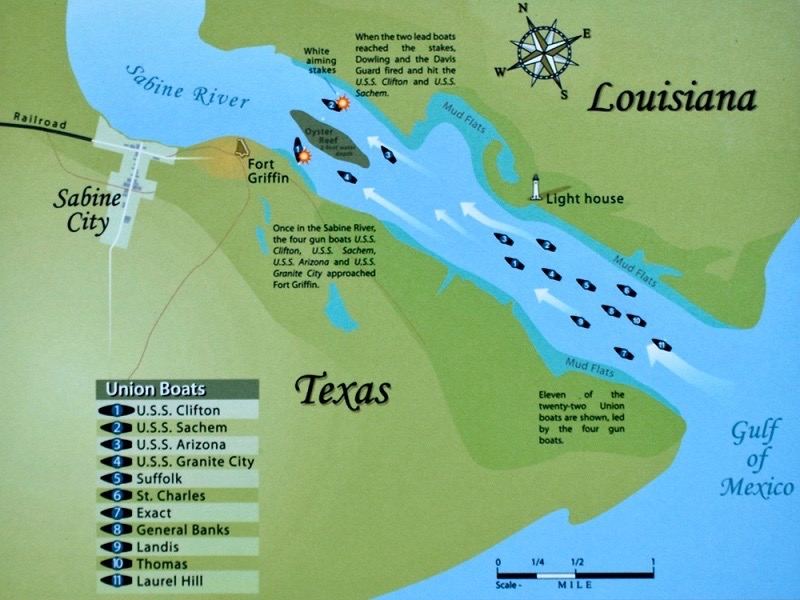
The Second Battle of Sabine Pass (September 8, 1863) On September 8, 1863, the Union forces sent two gunboats up each channel of the Sabine River. The two boats proceeding up the Louisiana channel were to make their way around Oyster Reef and up to Sabine Lake. They would then attack Fort Griffin from the north. Dowling and the Davis guards held fire until the ships were in effective range, enduring Union shelling in their bombproof shelters. When the Confederate artillerymen opened up on the Union ships, their fire was so fast and accurate that they quickly disabled the lead ship in each channel, effectively ending the attack. Source: http://beg.utexas.edu

T R A N S C R I P T I O N

Confederate States Steamer “Clifton1
September 26th 1863

Miss Mary Stiles, esteemed friend,

I hope you will pardon the liberty I again repeat in addressing you a line or two from my present location. But the time has been so long since I had the pleasure of calling upon your family, and my being weary of looking for a reply to my note to your excellent parents, soon after the success out troops met with at this point, impels me to try again to hear something from the home of the dearest friends I believe I have the honor to have in this state.

We have all been hard to work since the fight and have now begun to realize a little of the pleasures of quietude and order. This steamer possesses at present a pretty good crew & her engines work splendidly. We have tried her twice up into the Bay and out far enough for the enemy to get a good view of their handsome gift. Everything is in pretty fair order & tonight the Commodore and his officers enjoyed ourselves together in lively tales and songs upon the quarter deck. We have a magnificent awning stretched aft making under it a fine promenade, that is nearly as large as your front yard. These heavy guns occupy a part of the space but they are not at all in the way and very much of an ornament.

We are anchored in the stream opposite the town where we can distinctly hear Col. Lockett’s splendid band discoursing most ravishing airs that come floating merrily upon the breeze. When the sun has ceased its feverish influence, moonlight nights have also strayed along our [ ] pathway & we find ourselves happy and almost contented.

I called upon one of the young ladies of Sabine this evening before tea. She plays handsomely upon her guitar and is also very entertaining. I rather like her. She sings sweetly and talks sensibly & too she is very free of all extravagant formalities which carries with it an air of purity and amiability. I hope you are well also. Your kind and excellent mother & your father, also Laura and the little ones. Please give my regards to all and tell them not a day passes that I do not find myself desiring again to see you all.

Have you seen or heard of Miss Lottie lately? I do believe sometimes that I am more than half in love with her, particularly when I imagine I hear the sweet tones of her voice gently vibrating upon my ear. What a pity I am not wealthy or handsome, and had the faculty to win such a noble prize as she would justly make for some good fellow. But enough of this. I am in talking so becoming traitor to the sacred love of mysterious character I hold so dear and must cease such a strain that bears me for a moment from that object who has become so samelike in my estimation & whose fate decrees I can only look upon as the most desirable of creatures, without the remotest pleasure of possessing that object of such good and purity. But I must not excite your curiosity again, for you might tease Miss Sally by saying she was the angel object of my imaginations which I most solemnly assure you is not the case, however much I may be fond of her delightful society. This mysterious prize of perfection I can assure you is not a myth. How is the fair or rather brunette widow Flake now-a-days? I fear I sadly failed in her estimation. A night or two before leaving Houston. I was our riding & my horse running away with me, I was compelled to pop the carriage at headlong speed, & when I came back, I saw that it was her riding out. I disliked the event but I could not help it. If you see her and she should mention the incident of apparent recklessness on my part, please speak a kind word for me & smooth it over for I should dislike her to have an unfavorable opinion of me, particularly after having loved her for nearly two years. Will you please write me all about yourself & home, and who you are going to get married, if such a thing will happen to you. Give my kind regards to Miss Lottie & keep a larger share of my highest esteem for your excellent self. Yours truly, — L. C. Irwin

1 The CSS Clifton was a side-wheel steam ferryboat built in 1861 and launched at Brooklyn as the USS Clifton. She carried 8 guns and was assigned to the Mortar Flotilla in the West Gulf Blockading Squadron and engaged in the bombardment of Forts Jackson and St. Philip below New Orleans, the attack on Vicksburg in June 1862, the capture of Galveston in October 1862, and the July 1863 reconnaissance up the Atchafalaya and Teche Rivers. She was captured by Confederate forces on 8 September 1863 at Sabine Pass, Texas. She ran aground and was burned by Confederates on 21 March 1864 after an unsuccessful attempt to run the Union blockade. The Clifton remained a wreck, with portions of its stack and the walking beam visible landmarks for many years. The engine’s walking beam was removed in 1911 and installed in a park in Beaumont. Called a “walking beam” because of its steady rocking action, the 9-foot by 18-foot cast iron diamond-shaped beam pivoted in the center, transmitting vertical motion of the ship engine’s single large piston, which turned the shaft of the paddlewheel. In 2011, the walking beam was acquired by the THC for installation at the Sabine Pass Battleground State Historic Site as part of new interpretive exhibits. Prior to installation, the walking beam went through an extensive conservation process at the Texas A&M Conservation Research Laboratory. See photos from a staff visit to that lab a couple months ago: https://www.facebook.com/media/set/…. Learn more about Sabine Pass Battleground State Historic Site: www.visitsabinepassbattleground.com.


1862: Michael W. Kirby to Juliette (Lindsey) Kirby

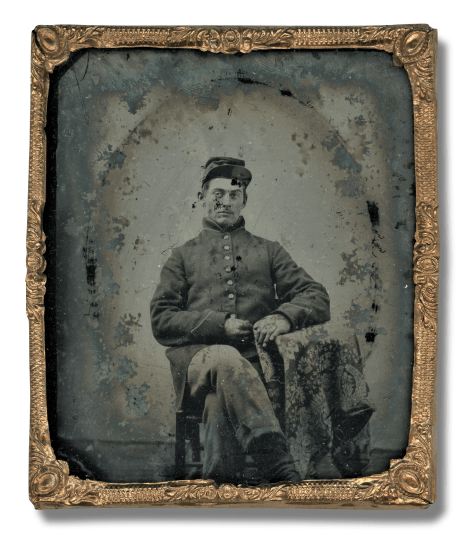
I could find no image of Michael but here is one of Charles P. Philpot who also served in the 31st Iowa. Charles died of disease in Andersonville Prison in 1864. (Iowa Civil War Images)

The following letter was written by Michael W. Kirby (1836-1863) of Cottonville, Jackson county, Iowa, who enlisted at the age of 27 on 6 August 1862 in Co. I, 31st Iowa Infantry. He died on 6 February 1863 at Young’s Point, Louisiana. Family tradition has it he died in battle but military records reveal that he died of disease though he likely participated in the three day battle of Chickasaw Bluffs near Vicksburg in late December 1862.

Michael wrote the letter to his wife, Juliette (Lindsey) Kirby (1843-1921). The couple were married on 30 May 1860 in Jackson County, Iowa, when she was but 16 years old. They were both natives of Pennsylvania.

Michael wrote this letter from the steamer that was transporting them down the Mississippi river to Helena, Arkansas, where they went into camp on November 20th, 1862. Another soldier in the 31st Iowa, Milton S. Wade of Co. F, wrote of the same journey in a letter to a friend, “We stopped at St. Louis on our way down and for 3 days we saw Benton [Barracks]. We were about 2 weeks coming from St. Louis. We got fast on those sand banks below the Ohio river. The farther we get down river, the smaller the river is. There is lots of troops coming down the river every day.” [Source: Milton Weed to Owen W. Nims.]  Though neither Michael or Milton mention the name of the steamer they were on, I found a notice in the Daily Democrat (Davenport) of 19 November 1862 that reported them on the steamer Continental with “625 tons of government freight.” The steamer’s captain was O’Neal.
Though he did not die in battle, Michael expressed the same patriotic sentiments that motivated many young men from both the North and the South to enlist: “We must expect to see hard times before we get back. I don’t care how much we have to endure if we only secure our liberty—if not for us, for those that are left at home and for the generations that may come after us. May the blessings of God attend our army.”

T R A N S C R I P T I O N

[Steamer Continental]
November 10, 1862

Dear Wife,

I take this time to let you know that I am well at the present time and hope these lies [lines] will find you all in good health. We started from St. Louis at night about 9 o’clock. We went three miles and run on a sand bar. Here we stayed trying to get off of it till the next day. And then, when we got off, went on awhile [and] struck again. We got off, then went on till 9 o’clock at night, then we struck again and have been trying to get off. We now are getting off. It is about 3 o’clock in the afternoon that I am writing. We are moving now.

The boat is loaded too heavy with freight. It is the largest one in the river. There is about 1200 soldiers on it, about 200 head of cattle and 50 horses, a very large amount of government grain, meat and hay, oats, and potatoes and other goods for the army.

I will tell you about the sick in the regiment. We left in Camp Herron four of our boys. One of our company in St. Louis—William Whitman—he had the measles. There was 31 of the regiment let at St. Louis sick with the measles. There is about 40 sick on the boat now. We are not over 40 miles from St. Louis now. I hope we will get better after this.

We [have] very poor accommodations on the boat. We live more like hogs than anything else. Our meat was poor. We now have three crackers and coffee but this is not if everything else was right but we must expect to see hard times before we get back. I don’t care how much we have to endure if we only secure our liberty—if not for us, for those that are left at home and for the generations that may come after us. May the blessings of God attend our army.

We have been very lucky with our regiment so far. There has not been one lost yet & in some of the other regiments there has been a good many killed by accidents and carelessness. Some have got into a fight with the boat hands. I have heard of about fifty that have been killed. There was 12 killed below here last week by the rebels. They shot from the shore [and] killed 12 of our men. This was a boat last week blowed up. The boiler bursted and killed some soldiers. I don’t know how many. So there is danger everywhere. I hope we will get along safe.

The sick that was left behind may be glad they did not come now for they will have a better chance to when there is not so many on the boat. I think I have wrote all that I think of now. The boat shakes no that it is hard for me to write. I am sitting on a pile of grain writing. We are going on now middling fast.

Dear friend, I think of home and friends but that is all the good it will do for the present. Most of us may not get back but it is hard to tell. God knows best. We expect to be in a battle before long, I will write as soon as we land where we are. Destined for Mrs. Juliette Kirby

From M. W. Kirby

1864: William Gage Besse to Lucy (Woodcock) Besse

The following letter was written by William Gage Besse (1843-1914), the son of Constantine D. Besse (1813-1891) and Lucy Woodcock (1809-Aft1864) of Wayne, Kennebec county, Maine. William enlisted in 1864, age 21, in Co. K of the 1st District of Columbia Cavalry and on February 14, 1865 was transferred to Co. K of the 1st Maine Cavalry. He was discharged August 1, 1865 and returned to Lewiston to live.

Readers will notice that though William served in a cavalry regiment, in 1864 they were dismounted and used as infantrymen at Yorktown and Portsmouth, and even in the trenches at Bermuda Hundred in this case.

T R A N S C R I P T I O N

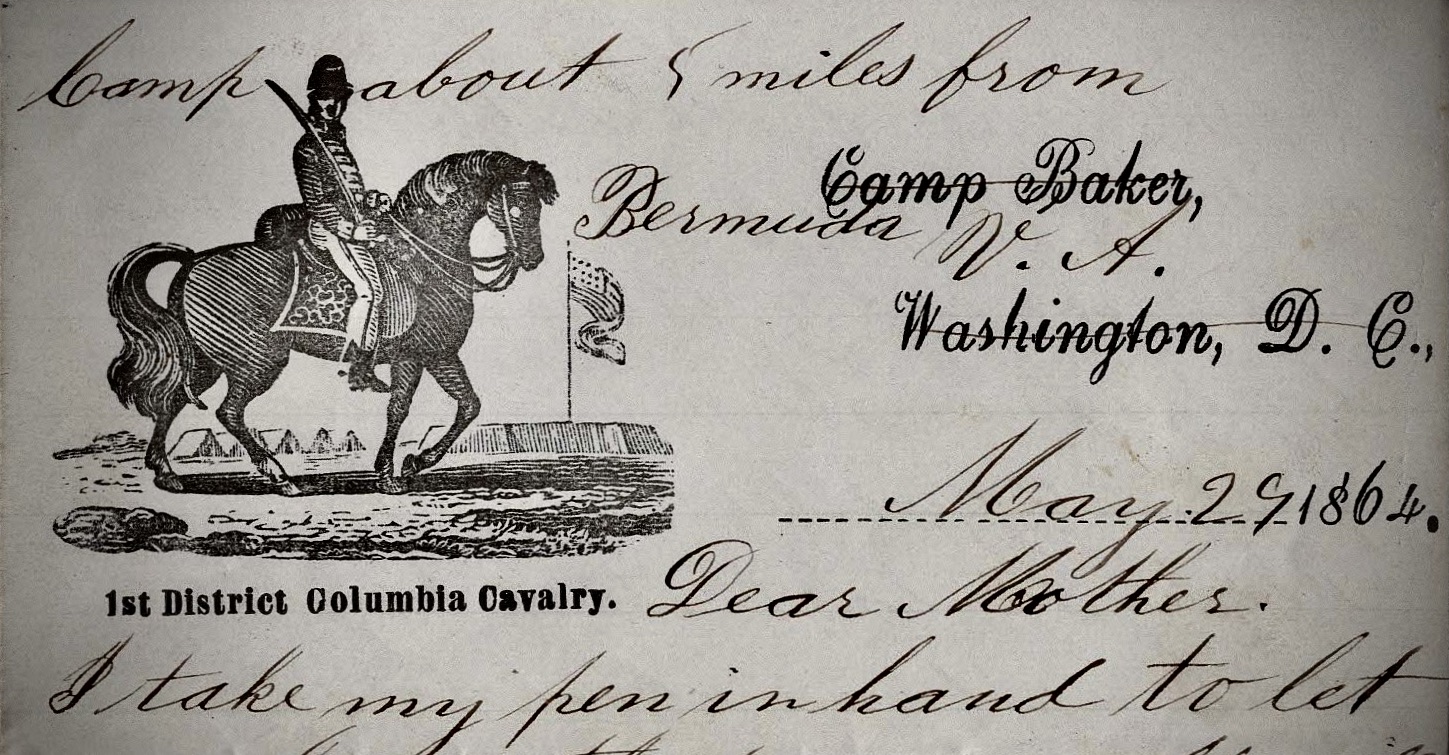
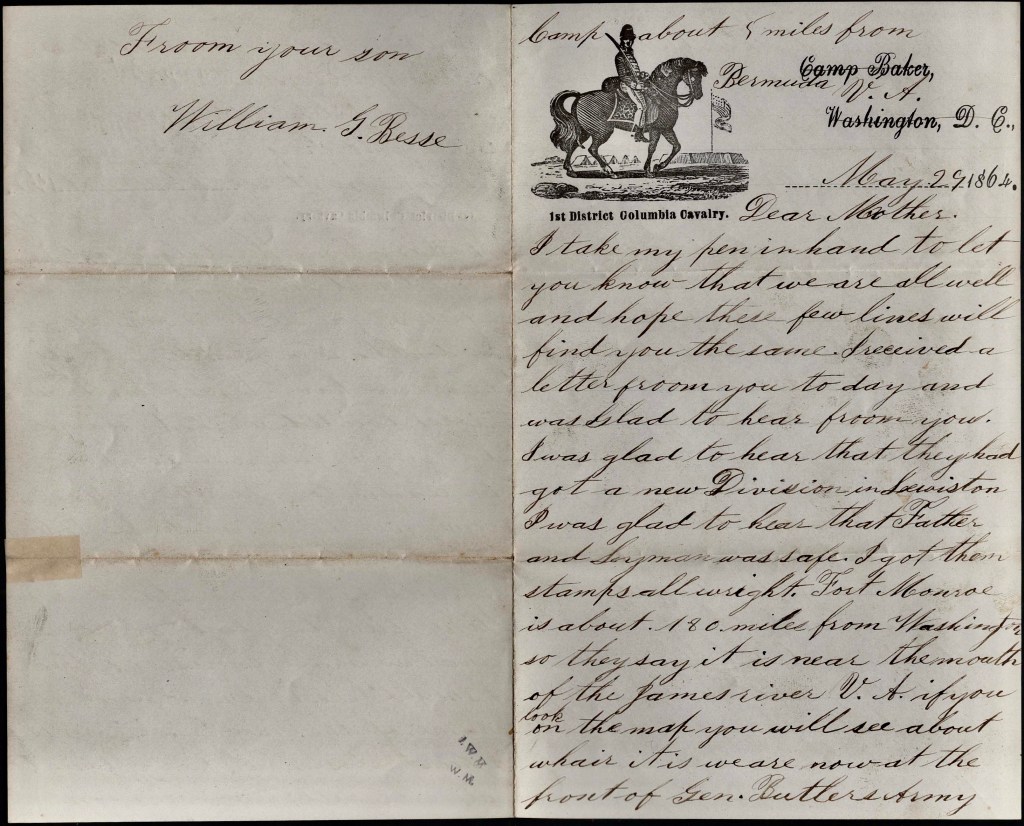
Letterhead of William’s Stationery

Camp about 5 miles from Bermuda, Va.
May 29, 1864

Dear Mother,

I take my pen in hand to let you know that we are all well and hope that these few lines will find you the same. I received a letter from you today and was glad to hear from you. I was glad to hear that they had got a new Division in Lewiston. I was glad to hear that Father and Lyman was safe. I got them stamps all right.

Fort Monroe is about 180 miles from Washington so they say. It is near the mouth of the James river, Va. If you look on the map you will see about where it is. We are now at the front of Gen. Butler’s army, probably not more than 20 miles from Richmond. Some say it is not more than 16 but I don’t know. We are getting along first rate. We left our camp at Bermuda last Thursday about dark and marched to the front. We laid on the ground that night. In the morning we moved to the breastworks and pitched our tents. We are guarding the breastworks and doing picket duty. Part of our company is on picket now. The rebel works are in plain sight of a fort a little ways to our right. Bill and I was over there Friday. The sharpshooters were firing and they fired three shells over and they went over our heads. They will make a big noise but I thought the little ones was the worst for I could not tell when they was coming.

George got a letter from you today with one dollar in it. I got a letter from Bro. Cilley today with three postage stamps in it. We have got the mail but twice since we left Washington. Mr. Cilley said he would send me a paper once in a while so you see he is very clever. We don’t have a great deal to do here. We have to sleep with our rifles loaded with 15 charges laying by our side so as to be ready for the rebs if they come over to see [us]. We have to turn out at three o’clock in the morning under arms and stand in line till daylight so you see that we are early risers out here.

I should like to know what the name of the new Division is. I must close now. Give my love to all the folks. Write soon. From your son, — William G. Besse

1863: Charles H. Burghardt to Libbie Burghardt

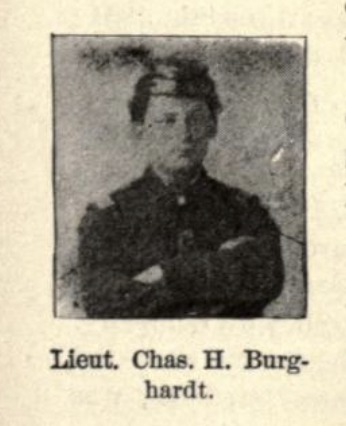
Burghardt after he was promoted to 2nd Lieutenant.

This letter was written by Charles H. Burghardt (1844-1865) of Schenectady, New York, who enlisted on 8 September 1862 to serve three years in Co. D, 4th New York Heavy Artillery. He was commissioned a 2nd Lieutenant of Co. B (and later Co. K) in December 1864 and was severely wounded in the left leg on 2 April 1865 at Sutherland Station, Virginia. The wound required amputation of the limb but was unsuccessful in saving his life. He died at Annapolis, Maryland in 17 April 1865.

T R A N S C R I P T I O N

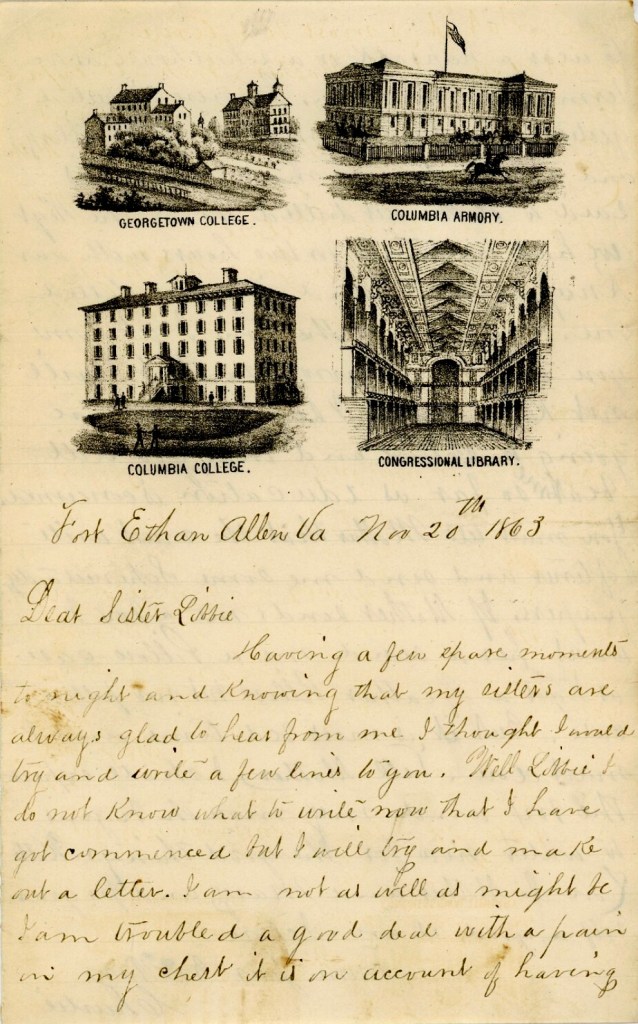
Addressed to Miss Libbie Burghardt, Schenectady, New York

Fort Ethan Allen, Va.
November 20th 1863

Dear Sister Libbie,

Having a few spare moments tonight and knowing that my sisters are always glad to hear from me, I thought I would try and write a few lines to you. Well, Libbie, I do not know what to write now that I have got commenced but I will try and make out a letter.

I am not as well as might be. I am troubled a good deal with a pain in my chest. It is on account of having to wear a knapsack—or a schoolhouse as we term it—on inspection. We were inspected yesterday by General Barry, Chief of Artillery, and a fine show we made. Our company was said to be the best drilled company in the regiment. We had to stand for two hours with our knapsacks on and it most killed me.

I suppose by the time I get home, you will have grown so that I will not know you. I suppose you are going to school and that you will beat me so far as education is concerned.

You must tell mother that she must write oftener and send me some Schenectady papers. If Mother sends me a box, I want her to send me a pillow case as I have got a feather pillow but not pillow case. But it is most bed time and I must close. Tell Mother I shall expect the box and my mouth begins to water now for the good things. With love to Mother and Mary and for yourself a good share, I close. From your brother, — Charlie

1862: John H. Moore to James M. Moore

The following letter was written by John H. Moore (1840-1910) of Belmont county, Ohio, who served in Co. A, 1st W. Virginia Infantry. He wrote the letter form their camp near Alexandria, Virginia, shortly after the humiliating defeat at 2nd Bull Run in which they had fought under Maj. Gen. Irvin McDowell’s 3rd Corps in Pope’s Army of Virginia.

Union forces retreat during the Second Battle of Bull Run. Image Source: New York Public Library Digital Collections.

T R A N S C R I P T I O N

Camp near Alexandria
September 5th [1862]

Dear Parents,

It is with pleasure that I write you a few lines to let you know that I am well at present and hope you are all enjoying the same. We are back at Alexandria again but don’t know how long we will stay here. We have had some very big fighting out here—another Bull Run scrape. We lost eight men missing and three men wounded—namely John A. Foster in the shoulder, Frank Dietrich in the hip with a piece of shell, Hezakiah Clark in the left side and arms. The others were taken prisoners. I got off safe.

We have not got any mail for three weeks nor couldn’t send any letters away. I heard that Thomas had enlisted. I want you to let me know if he has or not. We are laying here at Alexandria now. The day we came here we only had 160 men in the regiment. I don’t [know if] we will go into any more battles very soon. I have not go time to write any more at present as I send this with Major [Isaac Hardin] Duval who is going home to be Colonel of the 13th [9th] Virginia Regiment. Write as soon as you can.

No more at present. From your son, — John H. Moore

To James & Catharine Moore, Bridgeport, Ohio

Direct to John H. Moore, Care of Capt. Meddle, Co. A, 1st Reg. Va. Vols. Infantry

Near Alexandria, Va., via Washington D. C.

1862: Adin V. Cole to his Parents

The following letter was written by Adin V. Cole (1844-1862), the son of Kimball Cole (1810-1902) and Mary Stockwell (1819-1909) of Whitefield, Coos county, New Hampshire. He mentions a younger brother, Martin Marshall Cole (1849-1925) in the letter.

Anxious to fight for the Union, Adin enlisted when he was 18 in Co. C, 5th New Hampshire Infantry on 26 September 1861, but did not live long enough to see his first battle. He died on 8 March 1862—just two month after this letter was penned. He lies buried in the US Soldiers’ and Airmen’s Home National Cemetery in Washington D. C. (Site B 2031)

The author has placed a black arrow in the general area where Camp California was located.  The map is an 1861 map of the Defenses of Washington reprinted in the “Atlas to Accompany The Official Records of the Union and confederate Armies.”  Camp California was under the shelter of nearby Fort Worth (misspelled as Ft Wohth on this map).  Referring to Fort Worth, one Irish Brigade soldier wrote home that “in our front there is a very strong fort that would send very destructive messengers to any approaching enemy if they were to come within range of its long and heavy guns.”  General Sumner reportedly camped in a Sibley tent near Mr. Watkins’ home. [Source: Civil War Washington D. C.]

T R A N S C R I P T I O N

Camp California
January 5th 1862

Dear Parents,

I now answer your letter which I received last Thursday and was very glad to hear from you for it had been three weeks almost since I had heard from you. There is about an inch of snow on the ground this morning but it won’t stay long for it is coming off warm. I went out to drill this morning and I felt a little sick so I went to the Captain and asked him if he would excuse me and he said yes. It is the first time I have been excused from duty since my ankle got well. It has got so well that I can’t tell where it was hurt. It is as sound as the other now.

I will now answer some of your questions. First, about Oscar, tell Mr. Huntoon’s folks that he is doing first rate and is faithful to his duty. He has to be or else he must look out for himself. The best way is to be faithful and do your duty in good earnest and you will get along well enough. I have not had one bit of trouble with an officer nor anyone else since I enlisted, nor I don’t mean to have.

Ezra is getting along nicely. He does not have any trouble at all. His Captain like him first rate and as long as he keeps on the right side of his Captain, he will get along well enough. Those boots—I lost one of them when we moved from Concord to Washington and the other is most worn out. I shall have to get me a new pair of pants. Lately they are made of good cloth and I guess they will wear well. The rest of our clothing is good yet.

We sleep warm nights for it is not very cold here yet. You wrote that if three was anything I wanted you would send it to me. I don’t want anything now but shall by and by. Tell Martin I shall write to him before long.

One of our men got three of his four fingers on his right hand shot off the other night while on guard. I guess you have heard it was two but it was three fingers. His name you have heard before this I presume. If you hain’t, you will before long. Write as soon as you get this and put on the time you wrote the letter before and then I can tell if I get them all.

I must close so goodbye. From your son, — Adin V. Cole

To K. & M. S. Cole

1862: Owen Jones to Matilda (Darrah) Jones

The following letter was written by 19 year-old Owen Jones (1842-1921), the son of Isaiah Jones (1812-1888) and Matilda Darrah (1812-1888) of Philadelphia, Pennsylvania. At the outbreak of the Civil War, Owen enlisted in Co. K, 3rd Pennsylvania Reserves (32nd Volunteers). This regiment was organized at Philadelphia and moved to Easton, Pennsylvania, on 20 May 1861. They remained in “Camp Washington” at Easton until 22 July when they moved to Harrisburg where they were mustered into the US Service on 28 July. Owen was promoted to corporal on 1 March 1862 and then discharged on a surgeon’s certificate on 2 December 1862. After the war, Owen was employed as a police officer in Philadelphia.

Owen’s letter was written on 1 May 1863 from Falmouth during Gen. Irvin McDowell’s advance on Fredericksburg with 30,000 men. Their objective was to gain control of the town and potentially cross the Rappahannock River to continue their march on Richmond. Stonewall Jackson’s maneuvers in the Shenandoah Valley, however, disrupted this advance and forced McDowell to withdraw.

T R A N S C R I P T I O N

Camp near Falmouth
May 1, 1862

Dear Mother,

I received thy kind and welcome letter on the first and was glad to hear from thee and to hear that thee got the money and my [ ]. Thee said thee thought I would get tired of reading thy letters. The more thee writes, the better I like to read them. The more the merrier.

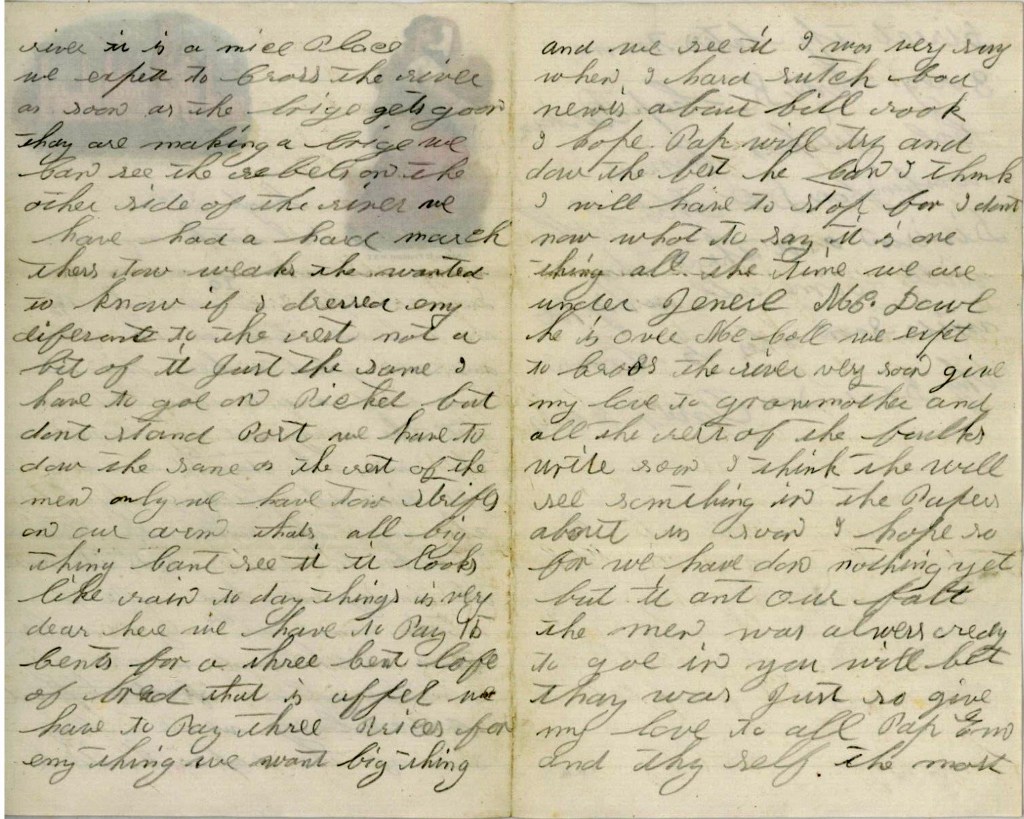
We have made another move. We are only 60 miles from Richmond. We are only 3 miles from Fredericksburg. We are along side of the Rappahannock river. It is a nice place. We expect to cross the river as soon as the bridge gets done. They are making a bridge. We can see the rebels on the other side of the river. We have had a hard march these two weeks.

Thee wanted to know if I dressed any different to the rest. Not a bit of it. Just the same. I have to go on picket but don’t stand post. We have to do the same as the rest of the men—only we have two [corporal] stripes on our arm; that’s all big thing. Can’t see it.

It looks like rain today. Things is very dear here. We have to pay 15 cents for a three-cent loaf of bread. That is awful. We have to pay three prices for anything we want big thing and we see it. I was very sorry when I heard such bad news about Bill Rook. I hope Pap will try and do the best he can. I think I will have to stop for I don’t know what to say. It is one thing all the time. We are under General McDowell. He is over McColl. We expect to cross the river very soon.

Give my love to grandmother and all the rest of the folks. Write soon. I think thee will see something in the papers about us soon. I hope so for we have done nothing yet but tain’t our fault. The men was always ready to go in. You will bet they was just so. Give my love to all, Pap, Em and thyself the most.

Direct thy letters to me, 3rd Regiment, Company K, Capt. [William] Brian, Col. Sykes commanding, Washington D. C., McCall’s Division. and then they will come all right. Write soon. This is from thy dear son, — Owen Jones

1863: James Peter Tilton to Emily Wirebach

I could not find an image of James but here is one of Martin Luther Werkheiser who served in the same company.

The following letter was written by James Peter Tilton (1841-1904), the son of Charles Tilton (1807-1891) and Charlotte VanFossen (1813-1895) of Easton, Northampton county, Pennsylvania. James wrote the letter to Sarah “Emily” Wirebach (1844-1947) with whom he would later marry.

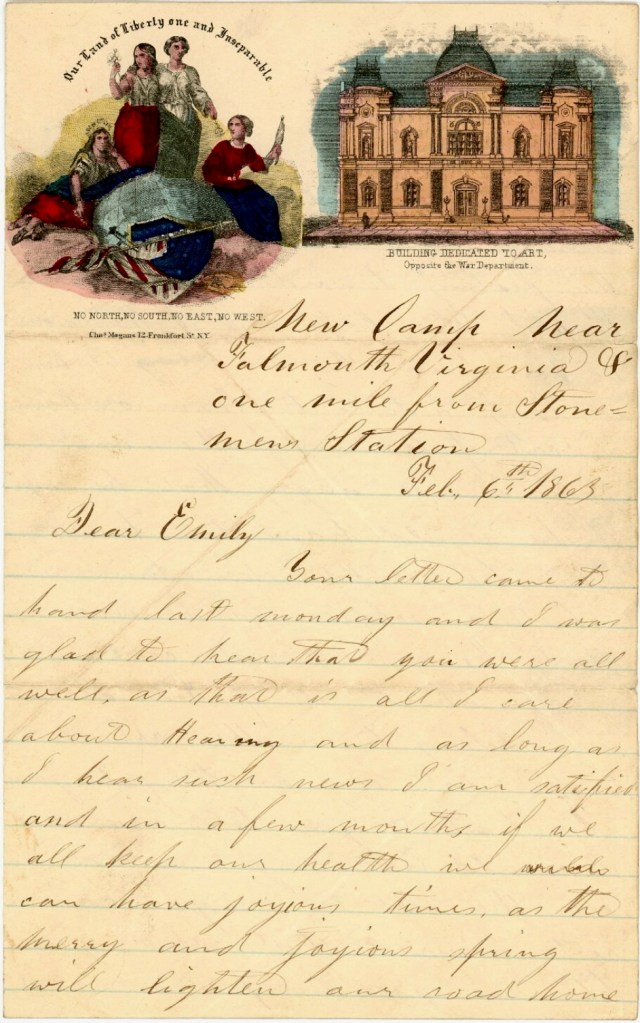
James was one of the first in his county to enlist in Co. C of the 1st Pennsylvania Infantry, serving from 20 April 1861 to 24 July 1861. A year later, he re-enlisted in Co. K, 129th Pennsylvania Infantry—a 9 month organization—from 11 August 1862 to 18 May 1863. It was while serving in the 129th that he wrote this letter from their camp near Stoneman’s Station in Virginia. It was several weeks following the Battle of Fredericksburg in which the regiment lost 142 in killed and wounded. In less than a month they would participate in the Battle of Chancellorsville though their losses would be fewer and most that remained were able to return home as their time expired.

Stoneman’s Station, Virginia

T R A N S C R I P T I O N

New camp near Falmouth, Virginia
And one mile from Stoneman’s Station
February 6th 1863

Dear Emily,

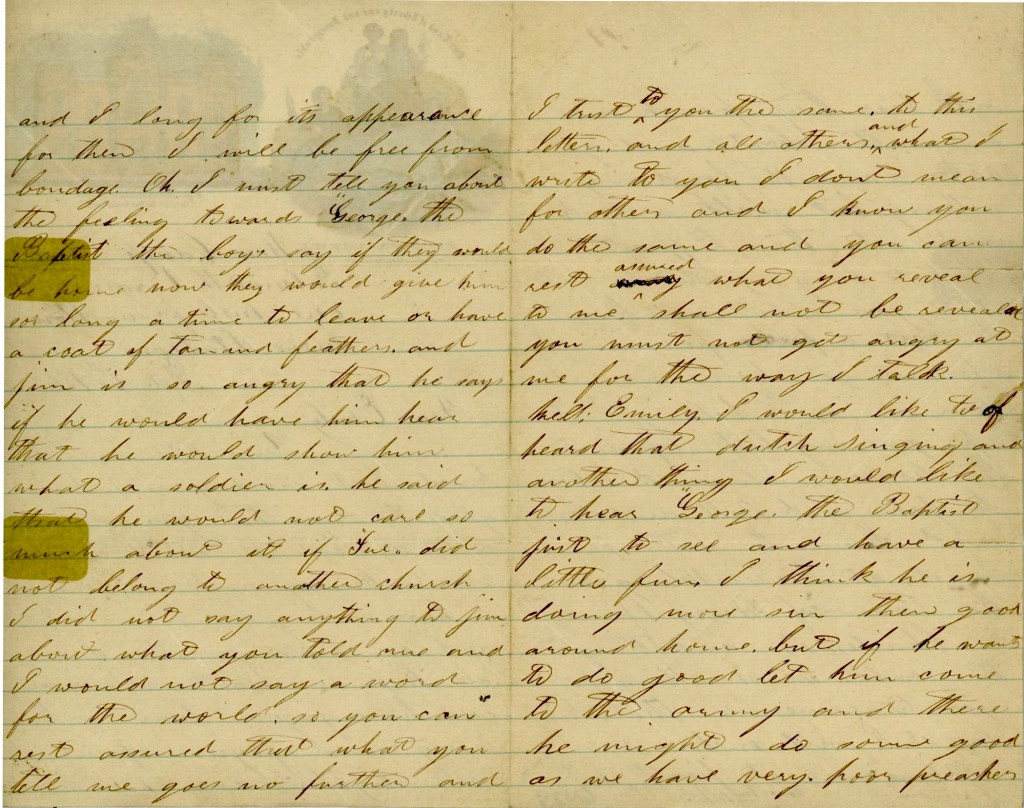
Your letter came to hand last Monday and I was glad to hear that you were all well as that is all I care about hearing and as long as I hear such news, I am satisfied and in a few months if we all keep our health, we can have joyous times as the merry and joyous spring will lighten our road home and I long for its appearance for then I will be free from bondage.

Oh! I must tell you about the feeling towards “George” the Baptist. The Boys say if they would be home now, they would give him so long a time to leave or have a coat of tar and feathers. And Jim is so angry that he says if he would have him hear that he would show him what a soldier is. He said that he would not care so much about it if “Sue” [?] did not belong to another church. I did not say anything to Jim about what you. told me and I would not say a word for the world so you can rest assured that what you tell me goes no further and trust to you the same to this letter and all others. What I write to you, I don’t mean for others, and I know you do the same. And you can rest assured what you reveal to me shall not be revealed. You must not get angry at me for the way I talk.

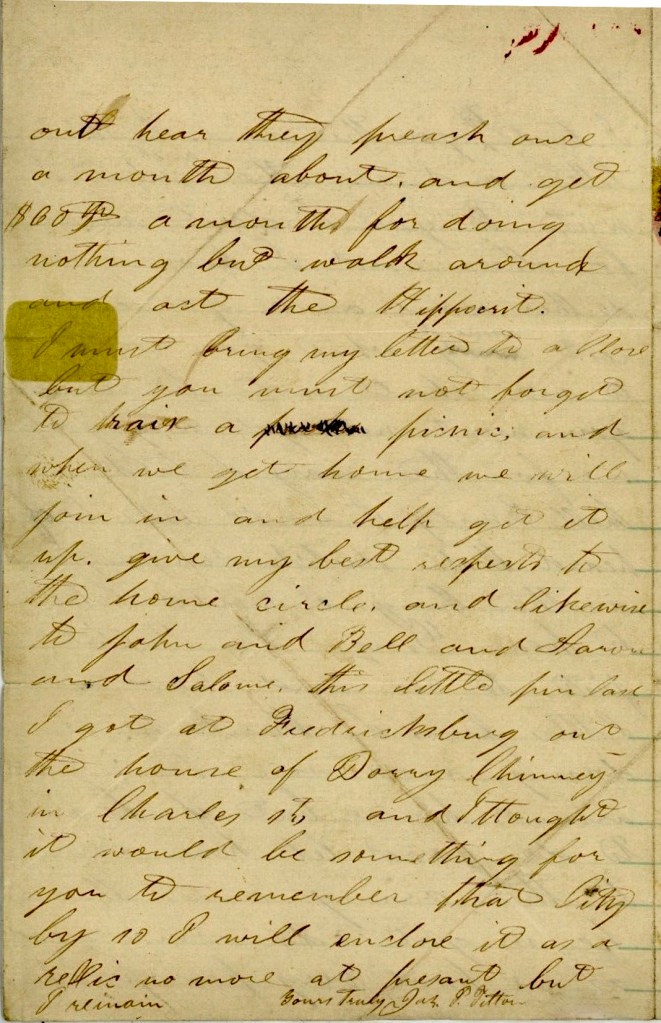
Well, Emily, I would like to of heard that dutch singing and another thing, I would like to hear “George the Baptist” just to see and have a little fun. I think he is doing more sin than good around home, but if he wants to do good, let him come to the army and there he might do some good as we have very poor preachers out here. They preach once a month about and get $60 a month for doing nothing but walk around and act the hypocrite. 1

I must bring my letter to a close but you must not forget to have a picnic and when we get home, we will join in and help get it up. Give my best respects to the home circle and likewise to John and Bell and Aaron an Salome. This little pin lace I got at Fredericksburg out of the house of Dorry Chimney in Charles Street and I though it would be something for you to remember that City by so I will enclose it as a relic. No more at present but I remain yours truly, — Jas. P. Tilton


1 The chaplain of the 129th Pennsylvania from August 1862 to May 1863 was William Henry Rice (b. 1840), a student in the Yale Theological Seminary when he volunteered to serve.

1864: Walter G. Jones to Sarah Jones

The following letter was written by Walter G. Jones (1840-1909), the son of Rev. Aaron Baldwin Jones (1801-1889) and Lydia Pickett (1804-1857) of Smithville, Broome county, New York. Just prior to the 1860 Census, Walter and Lola L. Nusom (1838-1901) were married and enumerated in the household with Lola’s parents in Triangle.

Muster rolls inform us that Walter was mustered into Co. C, 8th New York Cavalry as a private on 30 August 1862. At that time he was described as a 5 foot 10 inch tall married farmer with blue eyes and light hair. He was mustered out of the regiment as a private on 15 June 1865 at Washington, D. C.

Being the son of a Baptist minister and undoubtedly raised in a religious environment, Walter clearly possessed a strong conviction that God would safeguard him in battle: “…soldiering is a challenging endeavor for a man until he becomes accustomed to it. I believe I have acclimated and been hardened by it, to the extent that I now fear nothing except the bullets. Yet, I place my trust in God, confident that He will watch over me for the next eight months as He has for the past two years and four months. At times, I find it miraculous that I have been spared for this long, but God has declared in His holy word that if we ask, we shall receive, and He has kept His promise to me in this regard, for which I am deeply grateful.” In light of this, the image below of Walter alongside the Bible he carried in in his breast pocket that provided him protection is all the more poignant. In 1896 Walter attended a National Encampment in Boston, and he took along his treasured war souvenir. He was offered $200 for it. “I am a poor man,” he said, “but $5,000 wouldn’t buy it today.” 

Note: This letter is from the private collection of Greg Herr and was offered for transcription and publication on Spared & Shared by express consent.


T R A N S C R I P T I O N

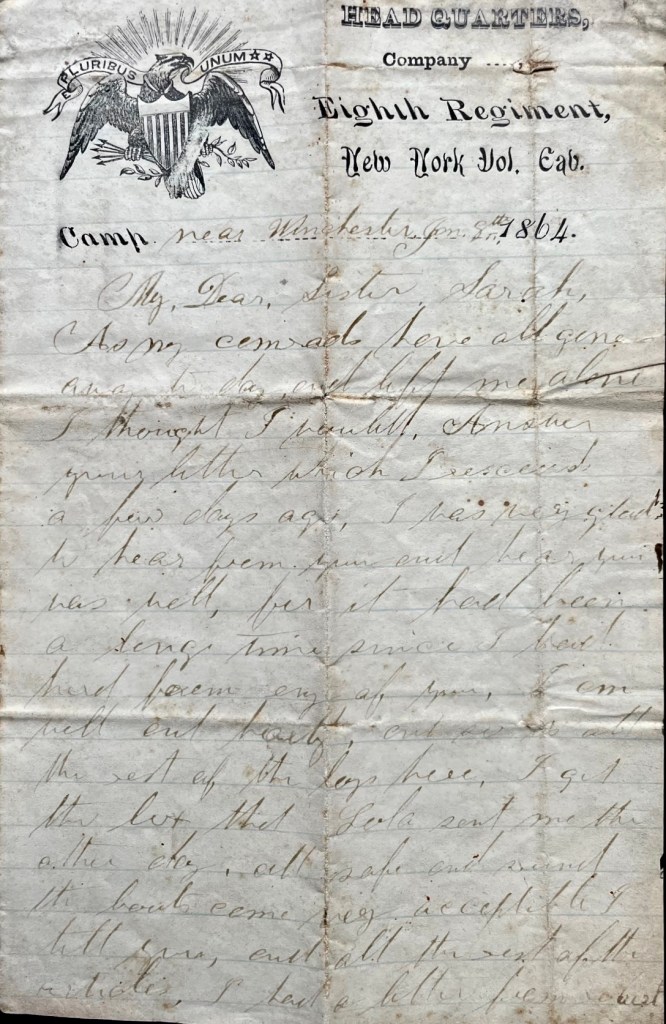
Headquarters Co. C, 8th Regt. NY Vol. Cavalry
Camp near Winchester, Virginia
January 8th 1864

My dear sister Sarah,

As my comrades have all gone away today and left me alone, I thought I would answer your letter which I received a few days ago. I was very glad to hear from you and hear you was well for it had been a long time since I had heard from any of you. I am well and hearty and so is all the rest of the Boys here. I got the box that [my wife] Lola sent me the other day all safe and sound. The boots come very acceptable, I tell you, and all the rest of the articles.

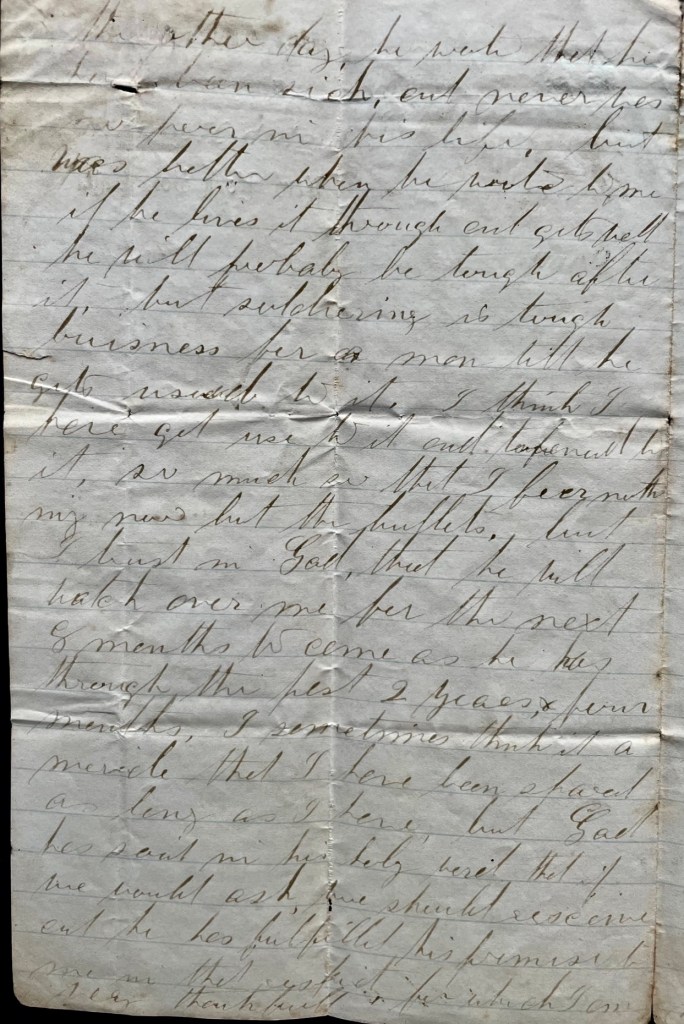
I had a letter from Robert the other day. He wrote that he had been sick and never had no fever in his life, but was better when he wrote to me. If he lives it through and gets well, he will probably be tough after it, but soldiering is tough business for a man till he gets used to it. I think I have got use to it and toughened by it, so much so that I fear nothing now but the bullets. But I trust in God that He will watch over me for the next 8 months to come as he has through the past two years and four months. I sometimes think it a miracle that I have been spared as long as I have, but God has said in His holy word that if we would ask, we should receive and He has fulfilled His promise to me in that respect for which I am very thankful.

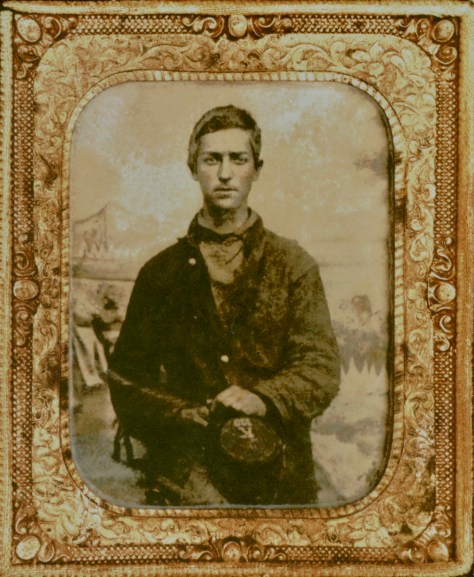
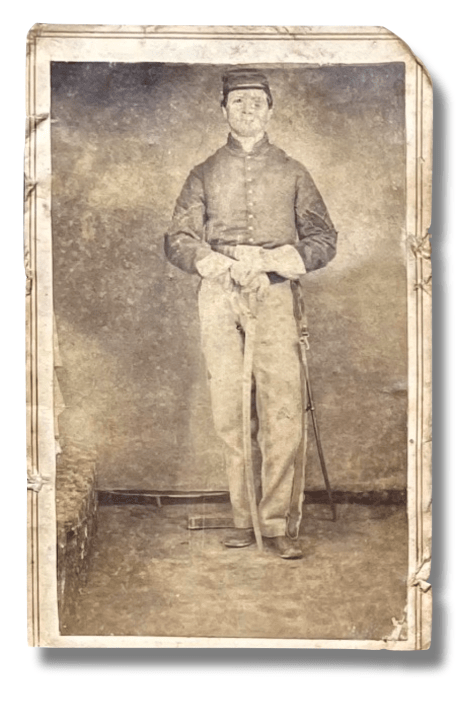
This cdv of a Union trooper was sold with the letter. He is unidentified and was presumed to be Walter but he wears stripes on his sleeves indicating the rank of a corporal or sergeant. It may have been a comrade of Walter’s in the 8th NYC. (Greg Herr Collection)

You say Augustus has got home alive. A few days before I got better, we got a letter from our Sergeant Major who was taken prisoner and he gave the names of all our regiment who was there when he left. He said Gus was a prisoner and in Richmond yet. I was about to write to our folks about it when I got your letter stating he had got home. Kershief [?] has shown himself and it is not the first time either. I would like to meet him here on the battlefield some time. I believe I would be a doing justice to shoot him before shooting a rebel, and I believe I could do it as easy too. But you may think these very hard words for me to use against a brother-in-law, but it is from the bottom of my heart sincerely, and I can never help them as long as they live together. It may be they [ ] happy for them, but if she would have no more to do with him at all and let her children out to someone, she could take care of herself and I should feel more at liberty to help her then. Out here it [ ] up by a miserable glutenous drunkard. But enough of this.

I got a letter from Lyman and [sister] Theodossia the other day. They were all bully when they wrote. I have not heard from our [ ] in a long time. I wrote to them a long letter some time ago but have received no answer. I inquired in the letter if he ever had a brother by the name of William or not. I wish you would find out…He says his father’s name was William Jones and used to live in Cortland County. He thinks that he and I are cousins. His name is Henry Jones. The name of the fellow who tents with me is Robert [B.] Lyday. There is three of us in the tent. Now Sarah, write to me often and all the news and [ ]… I remain your brother, — W. G. Jones