1863: Jeremiah Brower Taylor Diary

The following words were written by Jeremiah Brower (“J. B.”) Taylor (1817-1893), a New York City coal merchant from Stamford, Connecticut, who had earlier in his life attended Hamilton Literary & Theological Seminary and graduated from the University of the City of New York in 1848. Although licensed to preach by a New York Baptist church, he continued in his business until 1860. In that year he decided to become a Baptist missionary in Kansas. After conducting an exploratory visit to that state, he purchased land there and returned to Stamford in order to sell his house and prepare to move West with his family. On September 26, 1860 he was publicly set apart and ordained to the work of an Evangelist by a regular council of churches, in the Stamford Baptist Church.

The following is an account of J. B. Taylor’s visit to the Sac [Sauk] & Foxes Reservation in Kansas. I assume the account was written in 1863 but the pages I transcribed were not dated. The reservation occupied a tract of land on the headwaters of the Osage River 20 x 30 miles square, “bounded on the north by the Shawnee Reservation, on the east by the Chippeway and Ottawa Reservations, with the Osage Indians some distance south and the Kaws west at Council Grove.”
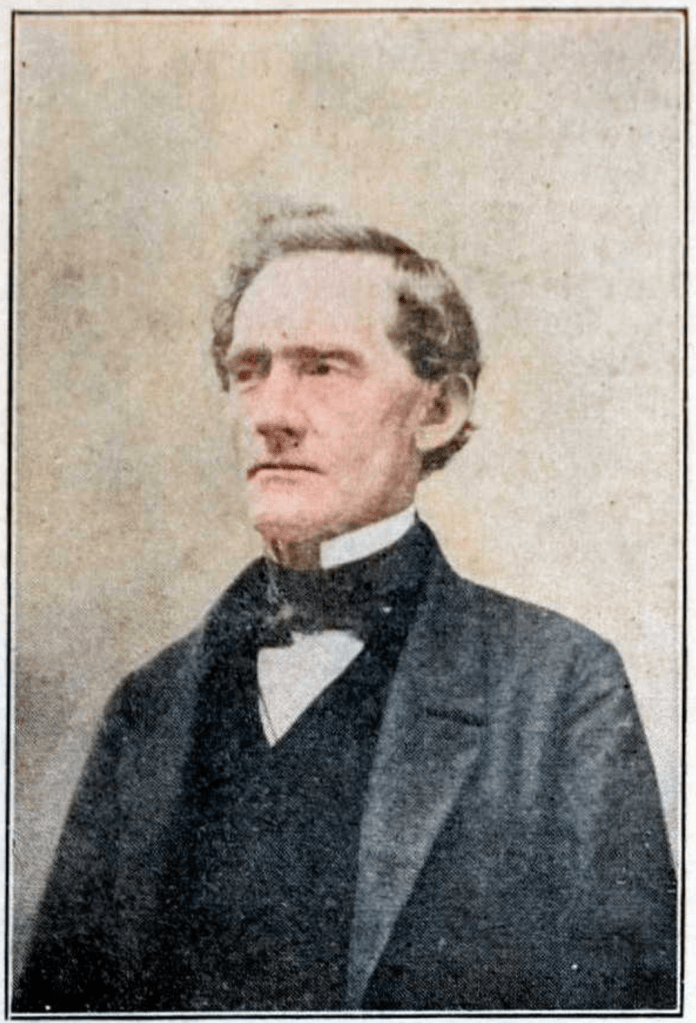
Henry Woodson Martin (1817-1901)

During his visit to the village where he found Chief Keokuk, Jr, J. B. Taylor was introduced to Henry Woodson Martin (1817-1901), who was appointed the Indian Agent for the Sac & Fox Tribes on October 1862 by President Abraham Lincoln. Martin was a native of Floyd county, Kentucky but had relocated to Paris, Edgar county, Illinois by 1837 where he married Catherine Morgan McReynolds (1822-1906). In the spring of 1856, he sold out his interest in a mercantile establishment and relocated to Kansas Territory, taking up residence in the fledging village of Tecumseh on the Kaw River—a few miles east of what would later become Topeka. Though there were pro-slavery settlers in their midst, the Martin’s found other like-minded, antislavery settlers who had come to the territory to make it a Free State. One of these families was my g-g-grandfather, Rev. James Sayre Griffing, a Methodist circuit rider who also made Tecumseh his home. No doubt the Martins attended church in the church my ancestor started in Tecumseh in 1856. He became a prominent merchant in Tecumseh and by 1860, he owned real property valued at $10,000 and had a personal estate of $8,000. Martin was a member of the Kansas State Legislature in 1862. In June 1862, he received appointment as a special agent to accompany a U.S. Army military expedition into Indian Territory to ensure the loyalty of the Native Americans in the Civil War and to raise Native American units to serve in the Union Army. Martin served for several months in the First and Second Indian regiments, rising to the rank of major. In October 1862, he received appointment as agent for the Fox and Saux Indians, a position he would hold from December 1862 to 1867.

The pages that I have transcribed below were only four pages out of J. B. Taylor’s diary that was auctioned on eBay. I had hoped to purchase it but it sold on 12 January 2025 for $8,200 and so I was unable to transcribe the 400+ pages. I decided to capture what history I could from the pages that were shared by the owner at the time of the auction.

Henry W. Martin’s Appointment as Agent for the Indians of the Sac and Fox Agency signed by President Abraham Lincoln, 17 October 1862.

Transcription

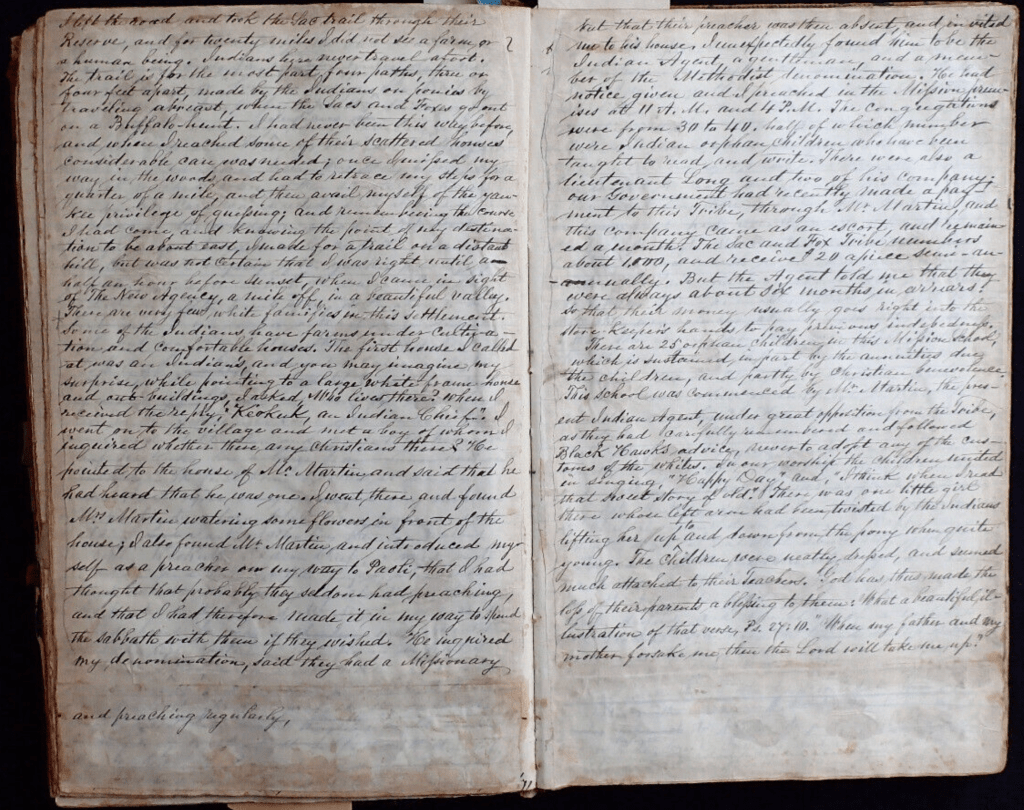
I left the road and took the Sac Trail through their Reserve and for twenty miles I did not see a farm or a human being. Indians here never travel afoot, The trail is for the most part four paths, three or four feet apart, made by the Indians on ponies by traveling abreast when the Sacs and Foxes go out on a Buffalo hunt. I had never been this way before and when I reached some of their scattered houses, considerable care was needed; once I missed my way in the woods and had to retrace my steps for a quarter of a mile, and then avail myself of the yankee privilege of guessing; and remembering the course I had come and knowing the point of my destination to be about east, I made for a trail on a distant hill, but was not certain that I was right until a half an hour before sunset when I came in sight of The New Agency, a mile off, in a beautiful valley.
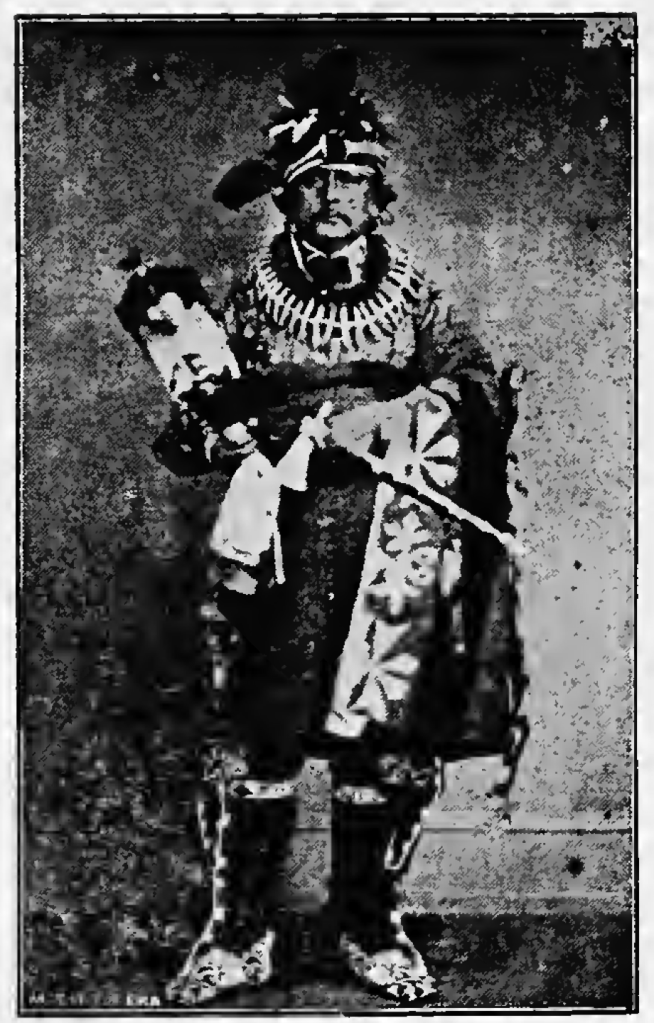
Keokuk, Jr., born 1822 in Illinois, about 1860

There are very few white families in this settlement. Some of the Indians have farms under cultivation and comfortable houses. The first house I called at was an Indian’s and you may imagine my surprise, while pointing to a large white frame house and out buildings, I asked, “Who lives there?” when I received the reply, “Keokuk, an Indian Chief.” 1 I went on to the village and met a boy of whom I inquired whether there [were] any christians there? He pointed to the house of Mr. [Henry Woodson] Martin and said that he had heard that he was one. I went there and found Mrs. Martin watering some flowers in front of the house. I also found Mr. Martin and introduced myself as a preacher on my way to Paoli; that I had thought that probably they seldom had preaching and that I had therefore made it in my way to spend the sabbath with them if they wished. He inquired my denomination, said they had a Missionary and preaching regularly, but that their preacher was then absent and invited me to his house. I unexpectedly found him to be the Indian Agent, a gentleman, and a member of the Methodist denomination. He had notice given and I preached in the Mission premises at 11 a.m. and 4 p.m. The congregation were from 30 to 40, half of which number were Indian orphan children who have been taught to read and write. There were also a Lieutenant Long and two of his company; our Government had recently made a payment to this Tribe, through Mr. Martin, and this company came as an escort and remained a month.

The Sac and Fox Tribe numbers about 1,000, and receive $20 apiece semi-annually. But the Agent told me that they were always about six months in arrears so that their money usually goes right into the store keeper’s hands to pay previous indebtedness.

There are 25 orphan children in this Mission School, which is sustained in part by the annuities due the children, and partly by christian benevolence. This school was commenced by Mr. Martin, the present Indian Agent, under great opposition from the Tribe, as they had carefully remembered and followed Black Hawk’s advice, never to adopt any of the customs of the whites. In our worship the children united in singing, “Happy Day” and “I think when I read that sweet story of old.” There was one little girl there whose left arm had been twisted by the Indians lifting her up and down from the pony when quite young. The children were neatly dressed and seemed much attached to their teachers. God has thus made the loss of their parents a blessing to them. What a beautiful illustration of that verse, Ps. 27.10. “When my father and my mother forsake me, then the Lord will take me up.”

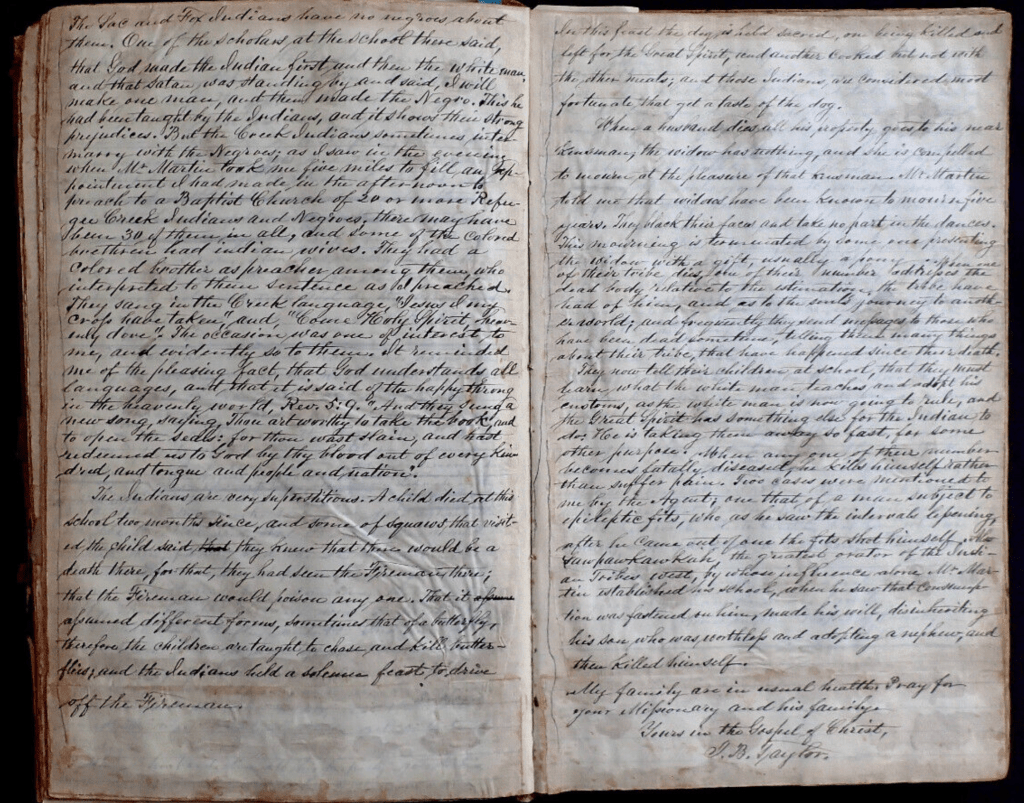
The Sac and Fox Indians have no negroes about them. One of the scholars at the school there said that God made the Indian first, and then the white man, and that Satan was standing by and said, I will make one man, and then made the Negro. This he had been taught by the Indians and it shows their strong prejudices. But the Creek Indians sometimes intermarry with the Negroes; as I saw in the evening when Mr. Martin took me five miles to fill an appointment I had made in the afternoon to preach to a Baptist Church of 20 or more [on] Refugee Creek—Indians and Negroes. There may have been 30 of them in all and some of the Colored brethren had Indian wives. They had a colored brother as preacher among them who interpreted to them [each] sentence as I preached. They sang in the Creek language, “Jesus I my cross have taken,” and “Come Holy Spirit, heavenly dove.” The occasion was one of interest to me, and evidently so to them. It reminded me of the pleasing fact, that God understand all languages, and that it is said of the happy throng in the heavenly world, Rev. 5:9 “And they sung a new song, saying Thou art worthy to take the book and to open the seals: for thou wast slain and hast redeemed us to God by the blood out of every kindred and tongue and people and nation.” 2

The Indians are very superstitious. A child died at this school two months since and some of the squaws that visited the child said they knew that there would be a death there, for that they had seen the Fireman there; that the Fireman would poison anyone. That it assumed different forms, sometimes that of a butterfly, therefore the children are taught to chase and kill butterflies; and the Indians held a solemn feast to drive off the Fireman. In this feast the dog is held sacred, on being killed and left for the Great Spirit, and another cooked but not with the other meals; and these Indians are considered most fortunate that get a taste of the dog.

When a husband dies, all his property goes to his near kinsman; the widow has nothing, and she is compelled to mourn at the pleasure of that kinsman. Mr. Martin told me that widows have been known to mourn five years. They black their faces and take no part in the dances. This mourning is terminated by someone presenting the widow with a gift, usually a pony. When one of their tribe does, one of their number addressed the dead body relative to the estimation the tribe have had of him, and as to the soul’s journey to another world; and frequently they send messages to those who have been dead some time telling them many things about their tribe that have happened since their death.

They now tell their children at school that they must learn what the white man teaches and adopt his customs, as the white man is now going to rule, and the Great Spirit has something else for the Indian to do. He is taking them away so fast for some other purpose. When any one of their number becomes fatally diseased, he kills himself rather than suffer pain. Two cases were mentioned to me by the Agent—one, that of a man subject to epileptic fits who, as he saw the intervals lessening, after he came out of one of the fits, shot himself. Also Shaw paw kaw kof, the greatest orator of the Indian Tribes west, by whose influence alone Mr. Martin established his school, when he saw that consumption was fastened on him, made his will, disinheriting his son who was worthless and adopting a nephew, and then killed himself.

My family are in usual health. Pray for your Missionary and his family. Yours in the Gospel of Christ, — J. B. Taylor
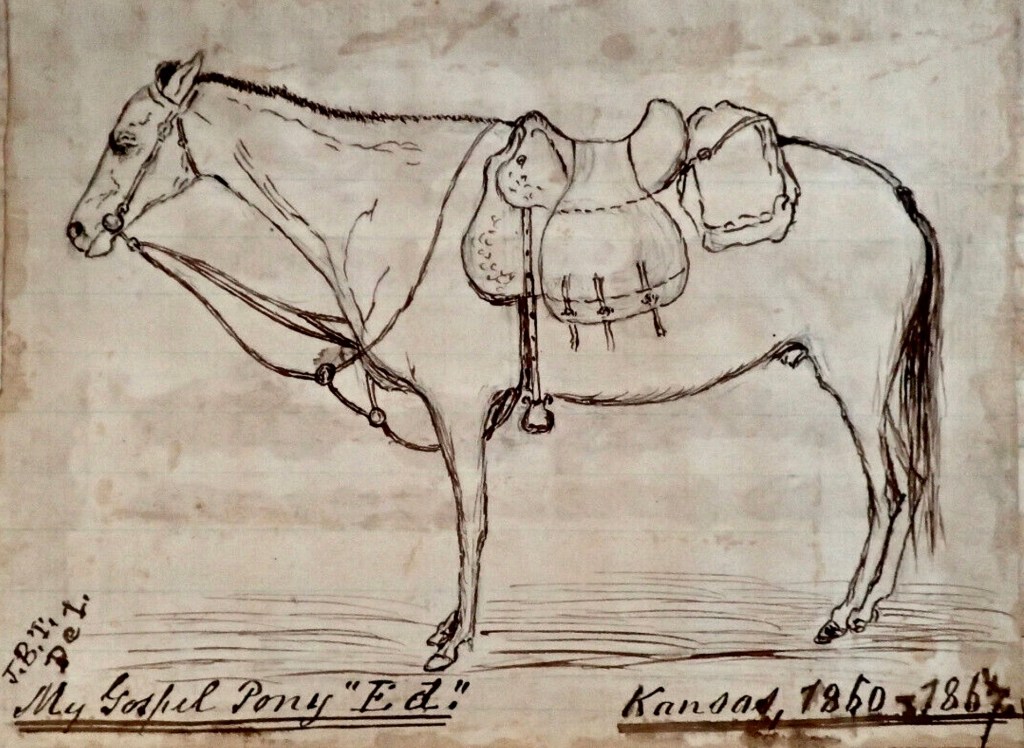
My Gospel Pony “Ed” ridden by Rev. Jeremiah B. Taylor in Kansas

1 Probably Keokuk, Jr.—later called Moses Keokuk who became an accepted minister in the Baptist Church. Keokuk, his father, died in 1848.

2 Many of the Negroes living among the Creek Indians were former slaves of tribal members who had lived in the upper and lower Creek territories in the Southeast. Intermarriage was common and there were many mixed-race descendants that found themselves on the reservation in Kansas in the 1860s.
1862: Charles Thompson to Friend Marshal

This letter was written by Charles Thompson (1842-1904) of Port Huron, St. Clair county, Michigan, who enlisted at age 19 as a corporal in Co. A, 7th Michigan Infantry. On 1 July 1862 he was commissioned a 2nd Lieutenant and on 6 May 1864 during the battle of the Wilderness, he was wounded and mustered out of the service on 5 October 1864. After the war he resided in Georgia for a time.

Camp Benton, 7th Regt. Michigan Volunteers, Col. J.B. Grosvenor, situated near Edwards Ferry. A. Hoen & Co., lithographer. March 1862.

Transcription

Camp Benton [near Edward’s Ferry on Potomac River]
January 14th 1862

Friend Marshal,

Your letter was received some time ago & the only excuse I have for not answering it is “business”—as usual rather poor excuse for me. I will try & not have it occur again. You have likely seen Capt. [Charles J.] Hunt. Do you have all the news. I was out looking at a Secesh battery on the other side of the river—one they have completed & they were at work all of Sunday on the other. You could see them quite plain with a glass from where we were. Their battery is near Ball’s Bluff. I guess it is to command the ferry “Edwards.”

They will have to vacate it before long for there are four 20-pound rifled cannon gone up there. I think there will be an advance movement made before long. Everything is ready for it. The whole army is lying idle except the one in South Carolina. They seem to be doing something. There is some talk of our Division going South but I do not believe it.

You had better enlist & come down with Capt. Hunt. You need not tell “Ettie” and it will be all right. “By the way,” how do you and “Ettie” get along? As well as ever? Now Marshal, take a fool’s advice & leave the girls alone.

There is no news of any importance so I will have to close, Give my respects to all the boys. Ed[mond] Fetchet & Bill Strout send their best respects. Write soon & believe me your friend, — Charlie Thompson

P. S. I am not coming home till the war is over. Ed is not going in February. — C. T.

1863: Simeon G. Royse to Mary (Garriott) Royse

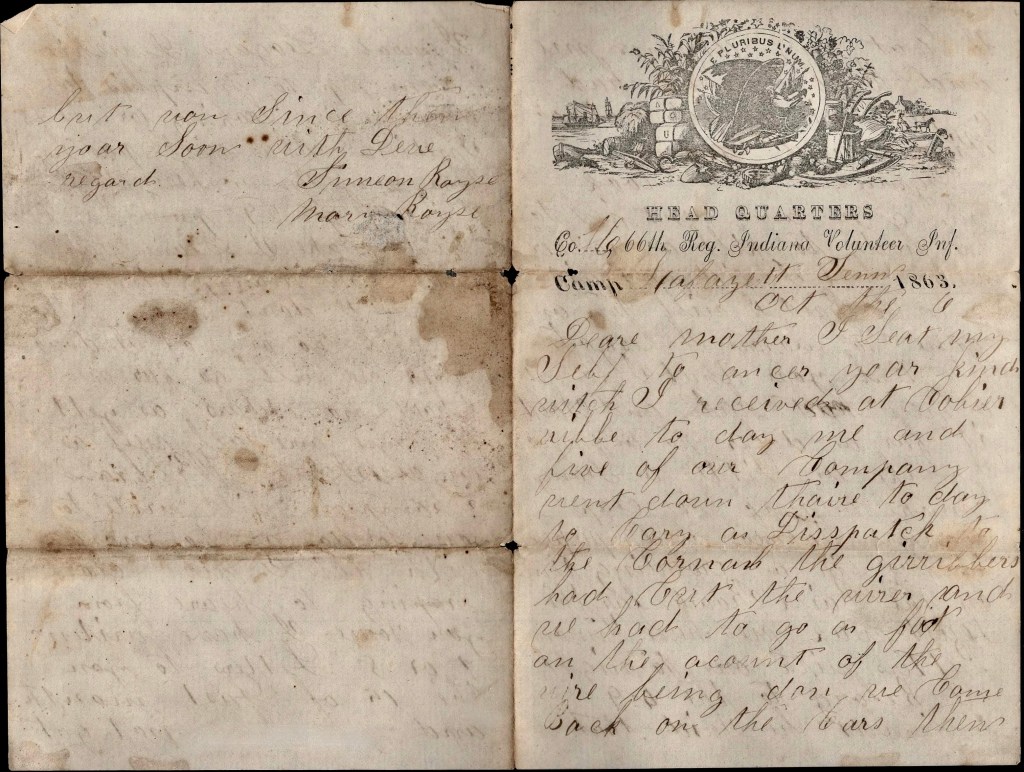
The following letter was written by Simeon G. Royse (1837-1867), the son of John W. and Mary (Garriott) Royse of Fredericksburg, Washington county, Indiana. Simon enlisted as a private in Co. H, 66th Indiana Infantry on 19 August 1862 and mustered out of the service on 13 June 1865.

Transcription

Headquarters Co. H, 66th Regt. Indiana Volunteers
Camp Lafayette, Tennessee
October 6, 1863

Dear Mother,

I seat myself to answer your kind [letter] which I received at Collierville today. Me and five of our company went down there today to carry a dispatch to the Colonel. The guerrillas had cut the wire and we had to go on foot on the account of the wire being down. We come back on the cars then.

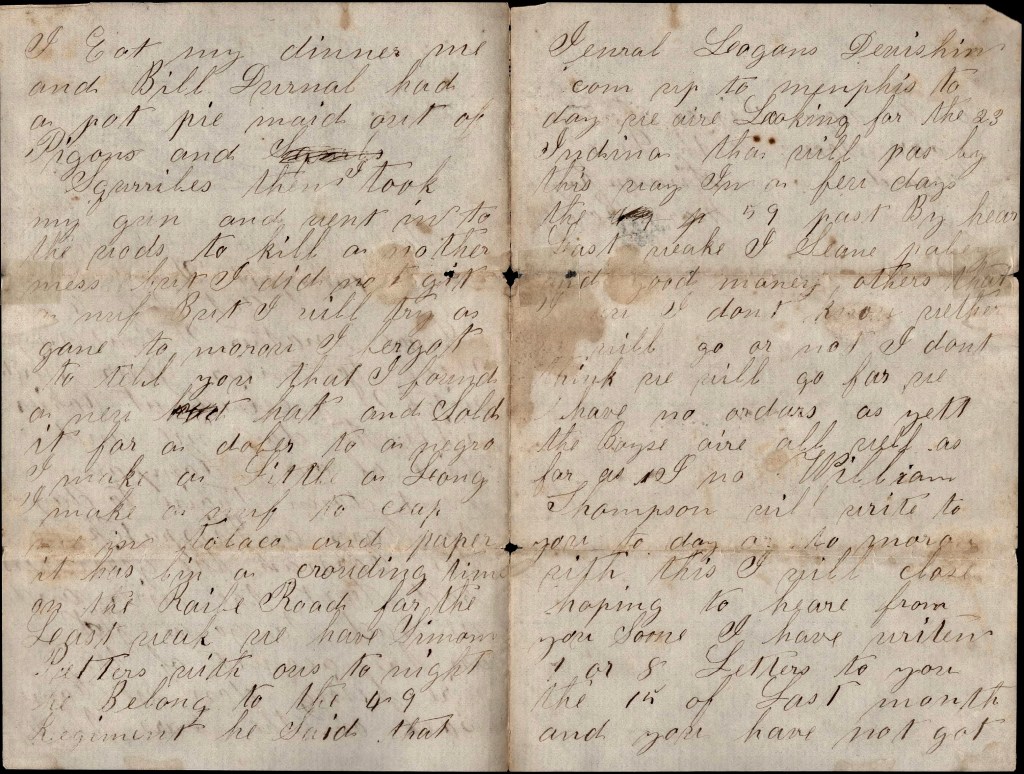
I eat my dinner. Me and Bill Durnill had a pot pie made out of pigeons and squirrels. Then I took my gun and went into the woods to kill another mess but I did not get enough. But I will try again tomorrow. I forgot to tell you that I found a new hat and sold it for a dollar to a negro. I make a little along. I make enough to keep me in tobacco and paper.

It has been a crowding time on the railroad for the last week. We have Simon Potters with us tonight. He belongs to the 49th Regiment. He said that General Logan’s Division come up to Memphis today. We are looking for the 23rd Indiana. They will pass by this way in a few days. The 59th passed by here last week. I seen Paleys and a good many others that I knew. I don’t know whether we will go or not. I don’t think w will go for we have no orders as yet. The boys are all well as far as I know.

William Thompson will write to you today or tomorrow with this. I will close hoping to hear from you soon. I have written 7 or 8 letters to you the 15th of last month and you have not got but one since then. Your son with due regard, — Simeon Royse

to Mary Royse

1861: Philip W. Royse to Simeon G. Royse

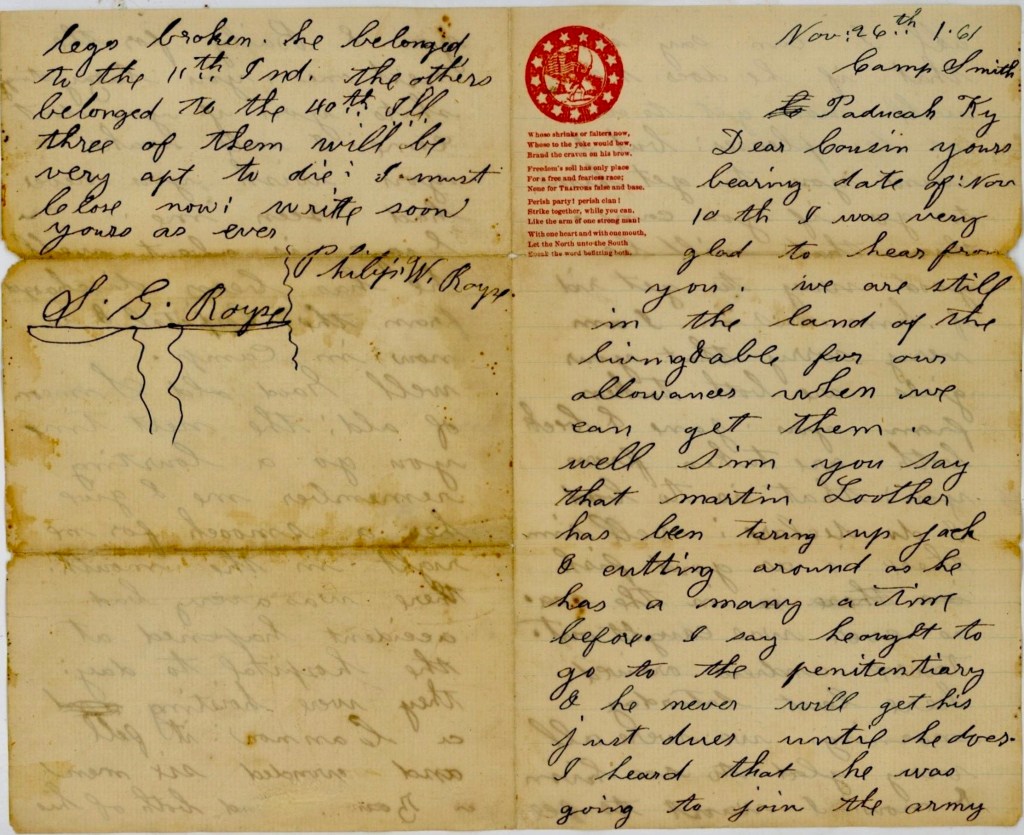
The following letter was written by Philip W. Royse (1840-1865), the son of Frederick Royse (1817-1849) and “Marcy” Zaring (1822-1905) of Fredericksburg, Washington county, Indiana. Philip enlisted on 27 July 1861 as a corporal in Co. C, 23rd Indiana Infantry but was later reduced to ranks and mustered out on 28 July 1864 after three years service. Though he survived the war, he died at home on 21 October 1865.

Philip wrote the letter to his cousin, Simeon G. Royse (1837-1867), the son of John W. and Mary (Garriott) Royse of Fredericksburg, Indiana.

Transcription

Camp Smith
Paducah, Kentucky
November 26, 1861

Dear Cousin,

Yours [received] bearing date of November 10th. I was very glad to hear from you. We are still in the land of the living & able for our allowances when we can get them.

Well, Sim, you say that Martin Luther has been tearing up Jack and cutting around as he has a many a time before. I say he ought to go to the penitentiary & he never will get his just dues until he does. I heard that he was going to join the army. All I can say is that if he does, he will not get to do as he pleases. But I want you to get him to go if you can. Then that will be a good way to get rid of him.

Sim, I am very sorry that your girls are both taken from you. Jane & Beck both are taken from you—that is too bad, I do declare. Well, Sim, there is as good fish in the sea as ever was caught out.

Trave Andrew arrived here last Saturday morning. We were all very glad to see him and now I want to see you & Baily for the next ones—you lazy stingy shits you. If you don’t come, I will make you wish you never had seen me. George is about well. He has been discharged from the hospital and is now in camp. Well, good old Simeon of old, the next time you go a courting, remember me and give her a smooch for me right in the mouth.

There was a very bad accident happened at the hospital today. They were hoisting a cannon. It fell and wounded six men. A Zouave had both of his legs broken. He belonged to the 11th Indiana. The others belonged to the 40th Illinois. Three of them will be very apt to die.

I must close now. write soon. Yours as ever, — Philip W. Royse

to S. G. Royse

1861: Charles Frederick Frink to Adelaide (Frink) Everit

The following letter was written by Charles (“Charlie”) Frederick Frink (b. 1842), the son of James Frink and Martha Goodhue Prescott of New Haven, Connecticut,

Charles was a 19 year-old clerk in the mercantile establishment of J. E. Wesener & Co. in Akron, Ohio, at the time he enlisted on 22 April 1861 in Co. G, 19th Ohio Volunteer Infantry (OVI)—a three-month’s regiment. He mustered out of the regiment on 31 August 1861.

In the New Haven city directory of 1863, it appears that Charles had returned East and went into partnership in the grover business with his brother, Nathan C. Frink (N. F. & C. F. F.), their establishment located at Green & Hamilton in New Haven.

Charles wrote the letter to his sister, Adelaide A. (Frink) Everit (1831-1910), the wife of William Lyon Everit (1826-1915) who were living in Akron, Ohio, in 1861. The “Mattie” and “Willie” mentioned in the final paragraph were Adelaide’s children.

The Battle of Rich Mountain

Transcription

Camp Buchanan
Buchanan, Upshur county, Virginia
July 6th 1861

My dear sister,

I received your very welcome letter yesterday and was quite vexed to think that that any of the boys had wrote that I was sick. I never was better in my life than I have been for the last two weeks and if I continue so to be, I shall be perfectly satisfied with my three months service in the Army of the U. S. and the State of Ohio.

We had an inspection of arms yesterday which resulted favorably for the whole regiment and especially for Co. G. The report is that we are to be paid off in a few days. Whether it is true or not, I do not know but think it probable. There was also a trial to see how many men would go for three years or during the war. There was fifteen men out of Co. G., Lieutenant [Gilbert S.] Carpenter heading the list, and I heard the Colonel [Samuel Beatty] remark that there was about 150 or 175 men in the regiment that would probably go for the war.

We have had pretty hard times for the last seven or eight days and the boys are looking forward with a good deal of feeling for the end of their three months and I think will be perfectly satisfied to remain at home for some time to come.

I had a letter from mother at Clarksburg. She wished me to return home as soon as my three months expired and come to think it over, I think it will be the best thing I can do for the present at least for if I returned to Akron, I should not want to go back to J[oseph] E. Wesener & Co. and I cannot see any other chance for the present. I shall write to Will and have him see if he cannot get me some kind of a place in New York.

If you please, you may pack my trunk and somewhere near the time my term expires—say three or four days—you may send it out by Express to New Haven.

If we get paid off and I ever get into any civilized town, I will send you a picture of Charles F. Frink with arms, equipments, and uniform so that you can see what kind of a child he is. Perhaps he would look better if he would have a dried cracker and an old tin cup in his hand but he will dispense with that for the present.

I wish you would ask William to send me a Cleveland and New York paper as soon as he can as we get nothing of that kind here—that is, nothing that is new.

As there is a call for drill, I will close and wishing you to bid goodbye to all Akron folks for me, I remain your affectionate brother, — Charlie

P. S. Love to Mattie & Willie and you must excuse this writing and the mistakes as I am writing on an old tin plate. — Charlie

Beverly
July 14th 1861

Dear sister,

I have just received this letter from one of the boys. I sent it from Buchanan by one of Co. H boys and he lost his knapsack on his way home and it was picked up and returned to our camp this morning.

On Thursday morning the 11th of June [should be July] we arose at 2 o’clock and marched about 12 miles across the mountain to the Rebel camp at Rich Mountain. They had it very strongly fortified but we attacked them in the rear and completely routed them taking about 50 prisoners and killing and wounding as many more. We took 4 pieces of cannon and about 100 stand of arms and all their camp equipage. It is valued at about $50,000. [See Battle of Rich Mountain]

I think we will return home very soon now as there seems nothing more to do this side of Richmond. — Charlie

There is 800 prisoners here.

1862: Elias Prather Musgrave to George W. Flake

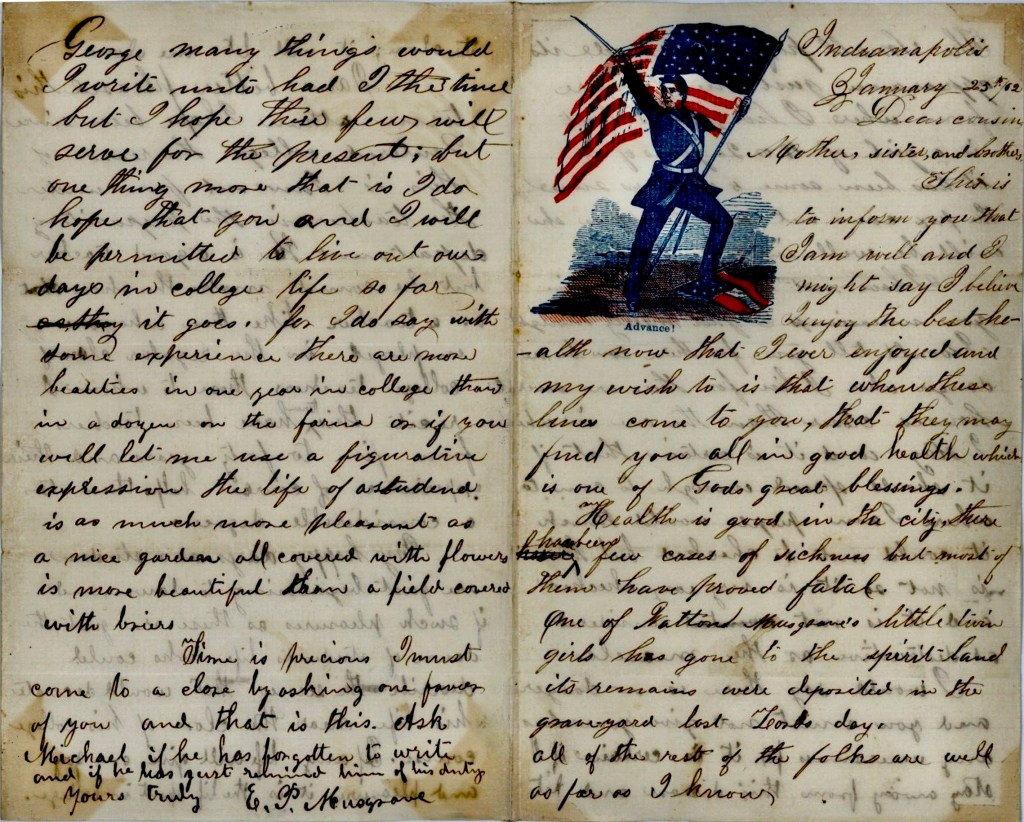
The following letter was written by Elias Prather Musgrave (1844-1864)m the son of Jacob Eli Musgrave (1805-1857) and Elizabeth Flake (1813-1899) of Martinsville, Morgan county, Indiana. Elias and Mattie Evans were married in May 1863. Elias wrote the letter to his mother and siblings but primarily to his cousin George W. Flake (b. 1840) who lived in Martinsville too.

A relative, Walton Musgrave (1828-1874), is mentioned in the letter. In 1860, Walton was a farmer in Warren township, Marion county, Indiana. He was married to Olive Smith (b. 1841) in 1856.

Transcription

Indianapolis [Indiana]
January 23, 1862

Dear cousin, Mother, sister, and brothers,

This is to inform you that I am well and I might say I believe I enjoy the best health now that I ever enjoyed and my wish to is that when these lines come to you, that they may find you all in good health which is one of God’s great blessings. Health is good in the city; there has been a few cases of sickness but most of them have [not] proved fatal.

One of Walton Musgrave’s little twin girls has gone to the spirit land. Its remains were deposited in the graveyard last Lord’s day. All of the rest of the folks are well as far as I know.

The small pox has made its appearance just one square from where I live; the subject is a girl of 18 or 20 years of age. It has been some 5 or 6 days since the pox came out and I suppose she will be well in a few days.

I have not written this to give you uneasiness. I just merely thought I would tell you for there are several houses closer than the one in which I stay and it is certain that if it should spread enough to come to where I am, people would think it could not be checked. But this is not so. It is very easy checked and it is not considered as destructive as the measles. I would say there is no danger and you must not give yourselves any uneasiness for it is certain if I stay away from this disease and let it alone, it will let me alone.

I am better pleased this term than I have been since I entered college. The reason of this is I am out from under the teacher in the preparatory department. He is a good teacher but he cannot make the show as a teacher like those who are employed in the regular class of college teachers those to whom I recite this term have been teachers from five to forty years and their experience of course helps them to a considerable degree.

My happy days as a student are just beginning to dawn and if such pleasures as these are just the dawn of student’s life, who could describe scenes that would decorate his life near the close of his college course. If any life will give one joy and pleasure, it is the life spent in college.

George, many thing would I write had I the time but hope these few will serve for the present. But one thing more—that is I do hope that you and I will be permitted to live out our days in college life so far it goes for I do say with some experience there are more beauties in one year in college than in a dozen on the farm, or if you will let e use a figurative expression, the life of a student is as much more pleasant as a nice garden, all covered with flowers is more beautiful that a field covered with briars.

Time is precious. I must come to a close by asking one favor of you and that is this. Ask Michael if he has forgotten to write and if he has, just remind him of his duty. Yours truly, — E. P. Musgrave

1862: William H. Carr to Lizzie Brick

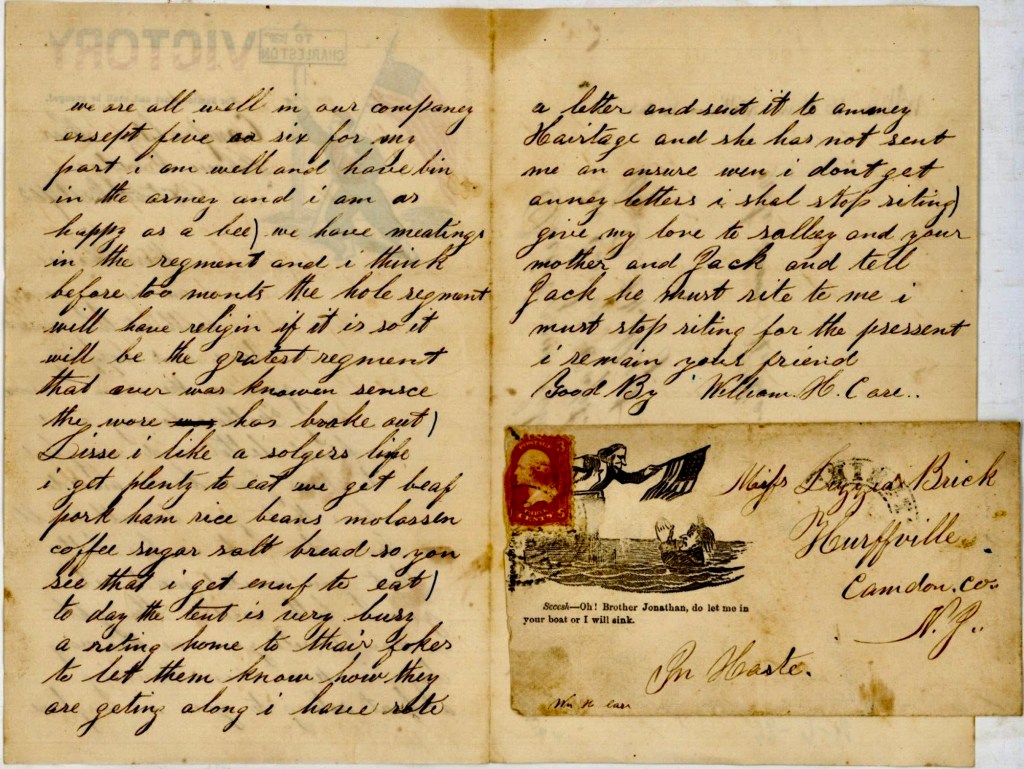
The following letter was written by William H. Carr who served in Co. D, 24th New Jersey Infantry—a nine months’ regiment. On Sept. 28, 1862, the regiment was equipped with Belgian rifles and other necessary accouterments for service, and on Tuesday, the 30th, broke camp and departed for Washington, going by steamer to Philadelphia and thence by rail. It was brigaded with the 28th N. J. and 128th Pa. regiments, under the colonel of the former, acting Brig.-Gen. Abercrombie having command of the division, which occupied the extreme right of the brigade on the Leesburg road. It was afterward permanently brigaded with the 4th and 8th Ohio, 14th Ind., 7th Va., and 28th N. J. regiments under the charge of Brig.-Gen. Kimball, in French’s division, Couch’s corps. It participated in the fighting at Fredericksburg, and the loss of the regiment, which behaved admirably throughout, was severe, amounting in all to 160.

According to regimental records, William survived the war. He was mustered out of the service at Beverly, New Jersey, on 29 June 1863. William wrote the letter to Lizzie Brick (1845-1919) who married John C. Thompson (1838-1911) in 1864 and resided in Hurffville, Gloucester county, New Jersey.

View from heights above the Chain Bridge, showing the ruins of a brick chimney (courtesy of Library of Congress).  The remnants of the brick industrial building are visible below, to the right of the Chain Bridge.

Transcription

Addressed to Miss Lizzie Brick, Hurffville. Camden county, New Jersey

Camp Oldon near Chain Bridge
October 21st 1862

Miss Lizzie,

I am enjoying good health at this present time and hoping you are the same. I received my Father’s loving and kind letter and was glad to hear from home and to hear that you are all well. Mr. Watson wrote on his letter that you wanted me to write you a letter and I thought I would write you one this very day. I have been thinking about writing to you a long time.

We are all well in our company except five or six. For my part, I am well and have been in the army and I am as happy as a bee. We have meetings in the regiment and I think before two months the whole regiment will have religion. It it is so, it will be the greatest regiment that ever was known since the war has broke out.

Lizzie, I like a soldier’s life. I get plenty to eat. We get beef, pork, ham, rice, beans, molasses, coffee, sugar, soft bread. So you see that i get enough to eat. Today the tent is very busy a writing home to their folks to let them know how they are getting along. I have wrote a letter and sent it to Anney Hairtage and she has not sent me an answer. When I don’t get any letters, I shall stop writing. Give my love to Sally and your mother and Jack and tell Jack he must write to me. I must stop writing for the present. I remain your friend. Goodbye. — William H. Carr

Direct your letter to William H. Carr in care of Capt. Ward, Co. D, 24th Regt. N. J. Vols., Washington D. C. Write soon

1861: Co. A, 7th Ohio Infantry to his Sister

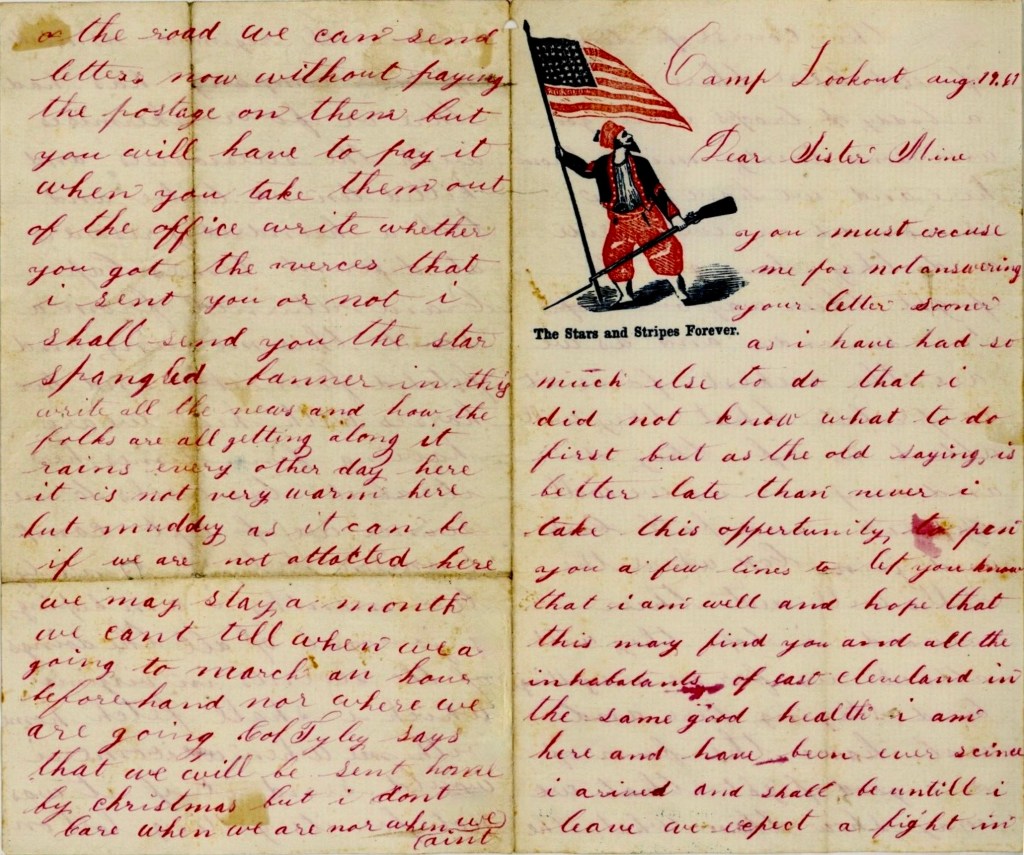
The following letter was written by a soldier in Co. A, 7th Ohio Volunteer Infantry (OVI). Unfortunately he did not sign his letter or there was, at one time, a second sheet. He wrote the letter to his sister but does not give her name. We only know that she (and probably he) lived in East Cleveland, Ohio.

Transcription

Camp Lookout [West Va.]
August 19, 1861

Dear sister mine,

You must excuse me for not answering your letter sooner as I have had so much else to do that I did not know what to do first but as the old saying is better late than never, I take his opportunity to pen you a few lines to let you know that I am well and hope that this may find you and all the inhabitants of East Cleveland in the same good health. I am here and have been ever since I arrived and shall be until I leave.

We expect a fight in the course of time if not before. There is a body of troops under Gov. Wise some twenty miles from here and we have them surrounded on every side and they have got to fight their way out or surrender. And we are the weakest force, it is probable that they will attack us if they do and over power us. We will retreat and fall back and join Cox where the rebels will meet their reward. I hope they will attack us for we are getting tired staying here and not have the fun of one good fight that we may show them what the 7th Regiment is made of.

Capt. Orrin J. Crane, Co. A, 7th OVI

Our company has had three or four skirmishes with the secessionists and killed ten or twelve and took a hundred prisoners at different times. Capt. [Orrin Johnson] Crane returned from a scout this morning and fetched four rebels and two horses with him. We are having fine times here. It [seems] about two weeks to me since we left Camp Dennison but it is nearly two months.

I am keeping a journal of all the doings of the 7th in Virginia which I shall fetch home with me when I come. I would send it if it was not for its getting lost on the road. We can send letters now without paying the postage on them but you will have to pay it when you take them out of the office. Write whether you got the verses that I sent you or not. I shall send you the Star Spangled Banner in this.

Write all the news and how the folks are all getting along. It rains every other day here. It is not very warm here but muddy as it can be. If we are attacked here, we may stay a month. We can’t tell when we are a going to march an hour beforehand,, not where we are going. Col. [E. B.] Tyler says that we will be sent home by Christmas but I don’t care when we are nor when we ain’t. [no signature]

1861: Milo Bailey to L. Bailey

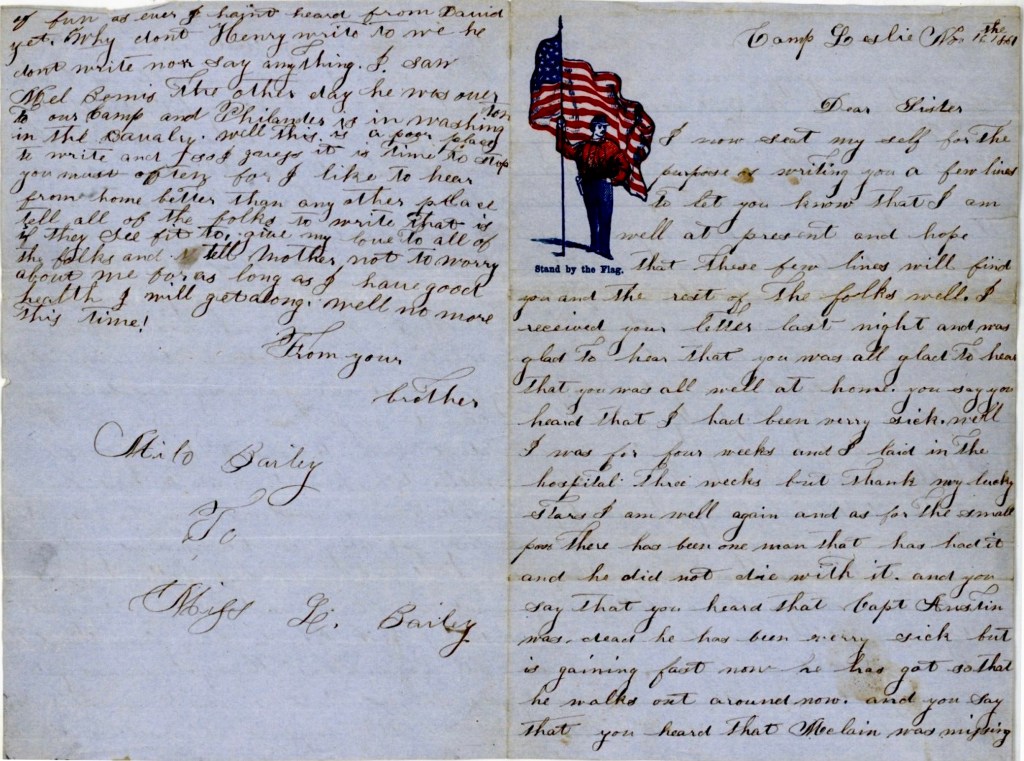
This letter was written by 16 year-old Milo Bailey (b. 1845) who enlisted as a private on 7 October 1861 At Wattsburg, Erie county, Pa. to serve in Co. K, 83rd Pennsylvania Infantry. Milo was wounded at the Battle of Gaines Mill on 27 June 1861 during the Peninsula Campaign and was discharged for wounds on 6 February 1863. He later reenlisted in February 1864 and was promoted to corporal of Co. B in March 1865. He mustered out of the regiment in late June 1865 as a veteran.

Transcription

Camp Leslie
November 16th 1861

Dear Sister,

I now seat myself for the purpose of writing you a few lines to let you know that I am am well at present and hope that these few lines will find you and the rest of the folks well. I received your letter last night and was glad to hear that you was all well at home. you say you heard that I had been sick. Well I was for four weeks and I laid in the hospital three weeks but thank my lucky stars, I am well again and as for the small pox, there has been one man that has had it and he did not die with it.

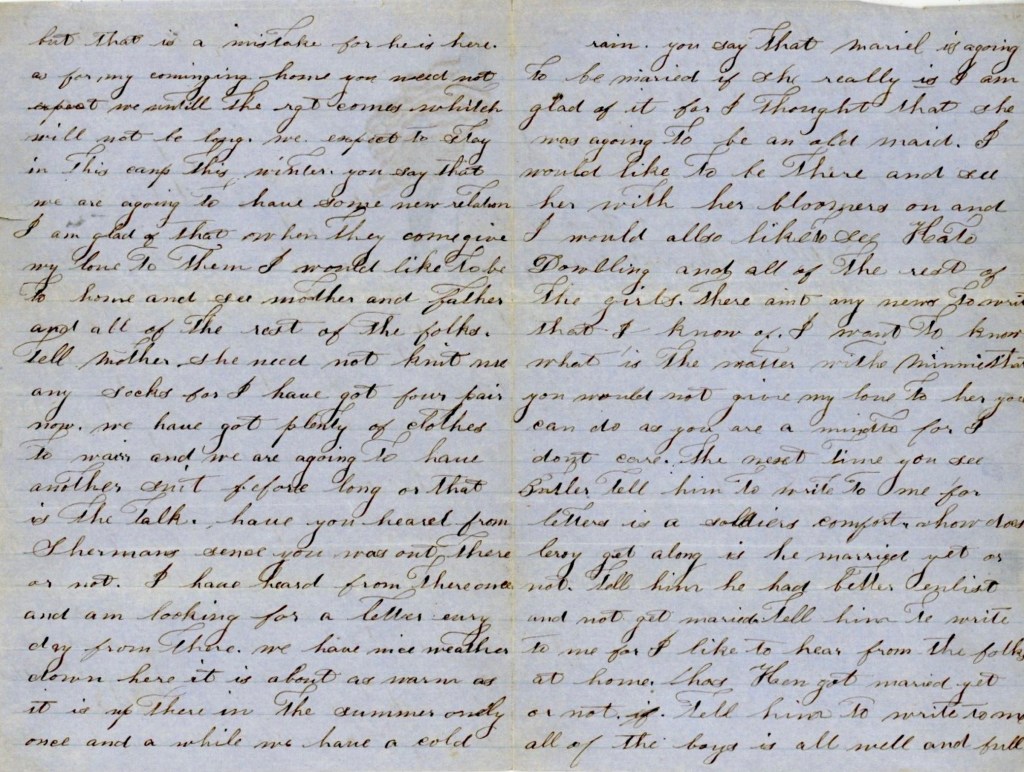
And you say that you heard that Capt. [Thomas M.] Austin was dead. He has been very sick but is gaining fast now. He has got so that he walks out around now. And you say that you heard that McClain was missing but that is a mistake for he is here. As for my coming home, you need not expect me until the regiment comes which will not be long. We expect to stay in this camp this winter.

You say that we are agoing to have some new relation. I am glad of that. When they come, give my love to them. I would like to be to home and see mother and father and all of the rest of the folks. Tell mother she need not knit me any socks for I have got four pair now. We have got plenty of clothes to wear and we are agoing to have another suit before long—or that is the talk. Have you heard from Sherman since you was out there or not? I have heard from there once and am looking for a letter every day from there.

We have nice weather down here. It is about as warm as it is up there in the summer, only once and a while we have a cold rain. You say that Mariel is agoing to be married. If she really is, I am glad of it for I thought that she was agoing to be an old maid. I would like to be there and see her with her bloomers on and I would also like to see Kate Dowling and all of the rest of the girls. There ain’t any news to write that I know of. I want to know what is the matter with Minnie that you would not give my love to her. You can do as you are a mind to for I don’t care. The next time you see Butler, tell him to write to me for letters is a soldier’s comfort. How does Leroy get along? Is he married? Tell him to write to me for I like to hear from the folks at home…

All of the boys is all well and full of fun as ever. I hain’t heard from David yet. Why don’t Henry write to me? He don’t write nor say anything. I saw Mel Bemis the other day. He was over to our camp and Philander is in Washington in the cavalry. Well, this is a poor place to write and so I guess it is time to stop. You must [write] often for I like to hear from home better than any other place. Tell all of the folks to write—that is, if they see fit to. Give my love to all of the folks and tell mother not to worry about me for as long as I have good health, I will get along. Well not more this time!

From your brother, — Milo Bailey

To Miss L. Bailey

1862: George G. Hussey to Anna & Lizzie

The following letter was written by George G. Hussey (1839-1910) who enlisted on 1 September 1861 as a sergeant in Co. D, 1st Wisconsin Cavalry. He reenlisted as a veteran and mustered out of the regiment on 19 July 1865 at Edgefield, Tennessee. George was from Springvale, Wisconsin.

Transcription

1st Regt. Wisconsin Cavalry
Camp Harvey [Kenosha, Wisconsin]
February 20th 1862

Dear Friends Anna & Lizzie,

I received your kind letter and read it with pleasure. I have got what an old woman would call the blues on account of stopping in this detested place so long. When I read the glorious news of our victorious Army in the South, I almost envy the boys (not the glory but their chance of winning it). When I joined this regiment, I expected to be having a lively time myself by this time.

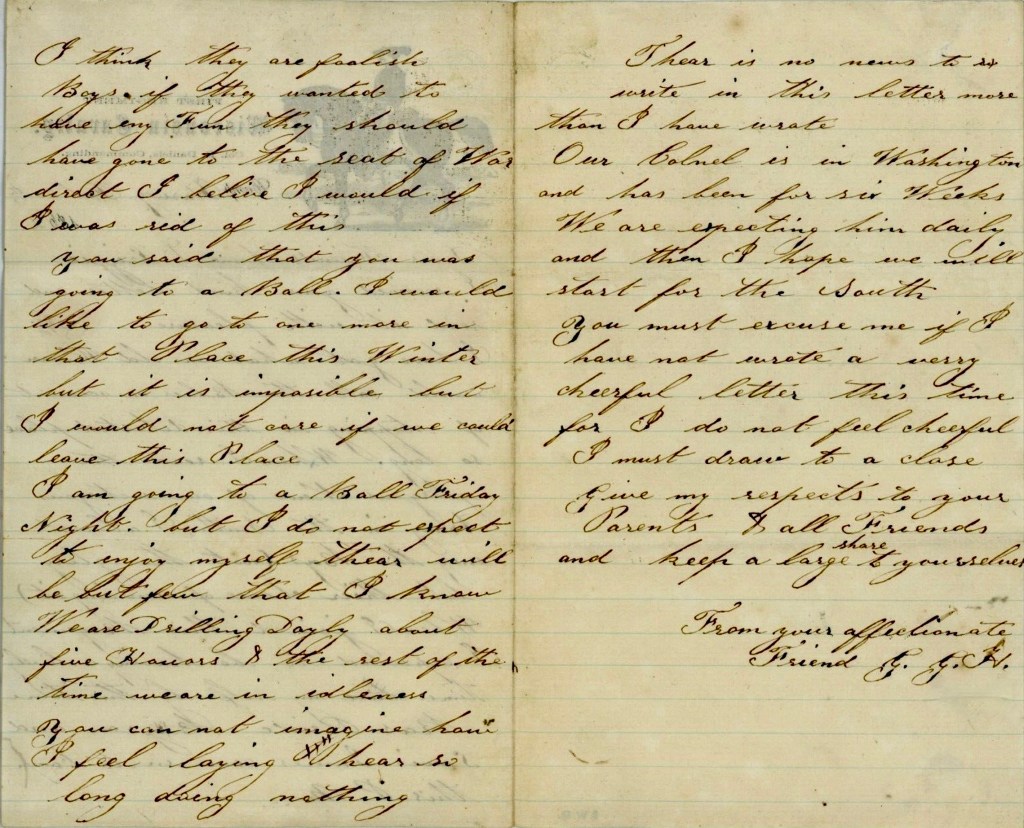
Ross Pride, Byron and Lewis James came into camp this p.m. I think they are foolish boys. If they wanted to have any fun, they should have gone to the seat of war direct. I believe I would if I was rid of this.

You said that you was going to a Ball. I would like to go to one more in that place this winter but it is impossible. But I would not care if we could leave this place. I am going to a Ball Friday night but I do not expect to enjoy myself. There will be but few that I know.

We are drilling about five hours & the rest of the time we are in idleness. You cannot imagine how I feel laying here so long doing nothing. There is no news to write in this letter more than I have wrote.

Our Colonel is in Washington and has been for six weeks. We are expecting him daily and then I hope we will start for the South. You must excuse me if I have not wrote a very cheerful letter this time for I do not feel cheerful. I must draw to a close.

Give my respects to your parents & all friends and keep a large share for yourselves. From your affectionate friend, — G. G. H.