
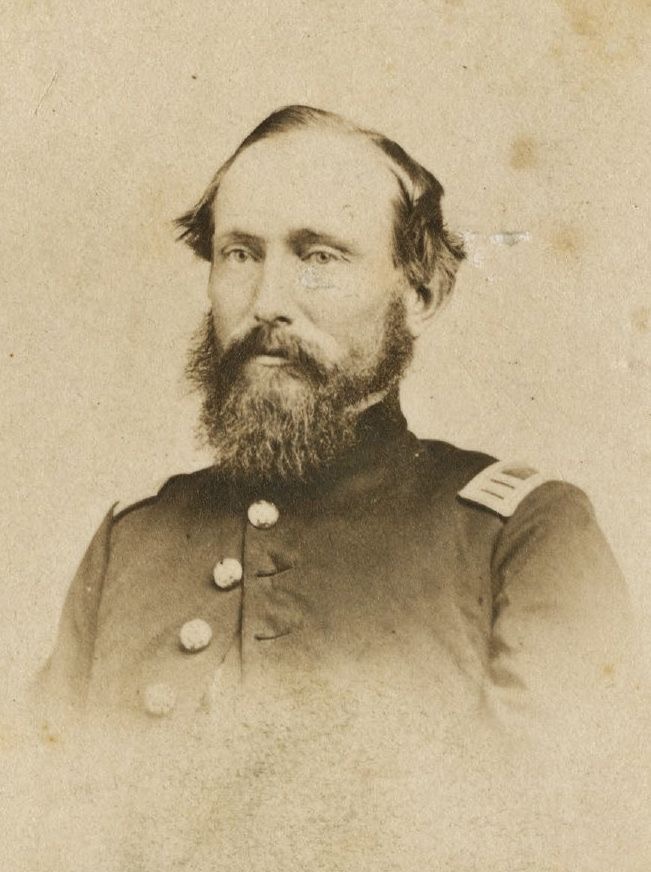
The following letter was written by Henry E. Stiles of Stevens Point, Portage county, Wisconsin, who enlisted in the 8th Wisconsin Battery (Light Artillery) on 8 October 1861 and was made Jr. 1st Lieutenant on 7 December 1861. When his captain, Stephen J. Carpenter—also of Stevens Point—was killed on 31 December 1862 at the Battle of Stones River, Henry was promoted to Captain of the Battery and remained in command of it until he mustered out of the service on 10 August 1865.
Henry and his sister Hannah Dean Stiles were enumerated in Stevens Point at the time of the 1860 US Census. Henry was employed as an Expressman. Their parents were Abial Stiles (1772-1857) and Azubah Hawley (17xx-1858). Henry’s parents were from the northeastern U. S. but lived in Canada for a while where Henry was born.
A newspaper clipping described the service of the battery as follows: “The men left here on the morning of December 26, 1861. Although it was late in the season there was no sleighing, and the men were loaded into wagons on the public square. It was & cold, stormy morning, and there were only a few people standing around on the square. From here the men drove to Wautoma, where they spent their first night. On the 27th they drove to Berlin, and the next morning took the cars for Racine. A few days later they were mustered into the service of the United States for three years. But it was not until March that their active campaigning commenced.
We have not time nor data to follow this first Stevens Point organization through to its final muster out. But they went to St. Louis, to Fort Leavenworth, out on the plains, finally tramped through and portions of Missouri, Kansas. Kentucky, Tennessee, Alabama, Mississippi, and Georgia, some of the men marching with Sherman and Kilpatrick from Atlanta to the sea, and finally come home by way of New York city. During this time the battery marched thousands of miles and was in some of the bloodiest battles of the war. Only about 90 men left Stevens Point on that cold December morning more than thirty-six years ago, but before its term of three years service had been concluded the battery had a total membership of 289 men.”
Henry’s biographical sketch on Find-A-Grave claims he was born in Montreal, Canada in 1825. “When he was fifteen years old, the family removed to New York (1840), where Henry grew to manhood. In 1849 he came to Wisconsin and after resided in Beloit for three years, went to California and remained for four years and a half. He then returned to New York, and thence again to Beloit, but after one year’s stay, went to Stevens Point where he remained until 1861. On breaking out of the war he raised the Eighth Wisconsin Light Artillery; was commissioned First Lieutenant, and afterwards promoted to Captain. His Battery was the last to leave Murfreesborough, (Murfreesboro) in August,1865. Was mustered out at Milwaukee, Wisconsin, and remained in that city until 1873, when he came to Minnesota and settled on section thirty-three, Becker Township. While in Milwaukee he was Vice-President and business manager of the “Daily News” for three years, two years in the grocery trade and the balance of the time was dealing in real estate and building. Mr. Stiles has been twice married; first to Jennie Joy, of Racine, Wisconsin, in 1863, who died the following year. His second wife was Harriet Paul, of Washington District of Columbia (D.C.), to whom he was married in 1867; she also departed this life in 1870, leaving two children, Winnifred H. and Georgiana P., both residing with their father. Per History of the Upper Mississippi Valley, Page 314, copy in my records (Kenneth C. Stiles – July 15, 1998).”
[Note: This letter is from the private collection of Greg Herr and was transcribed and published on Spared & Shared by express consent.]
T R A N S C R I P T I ON
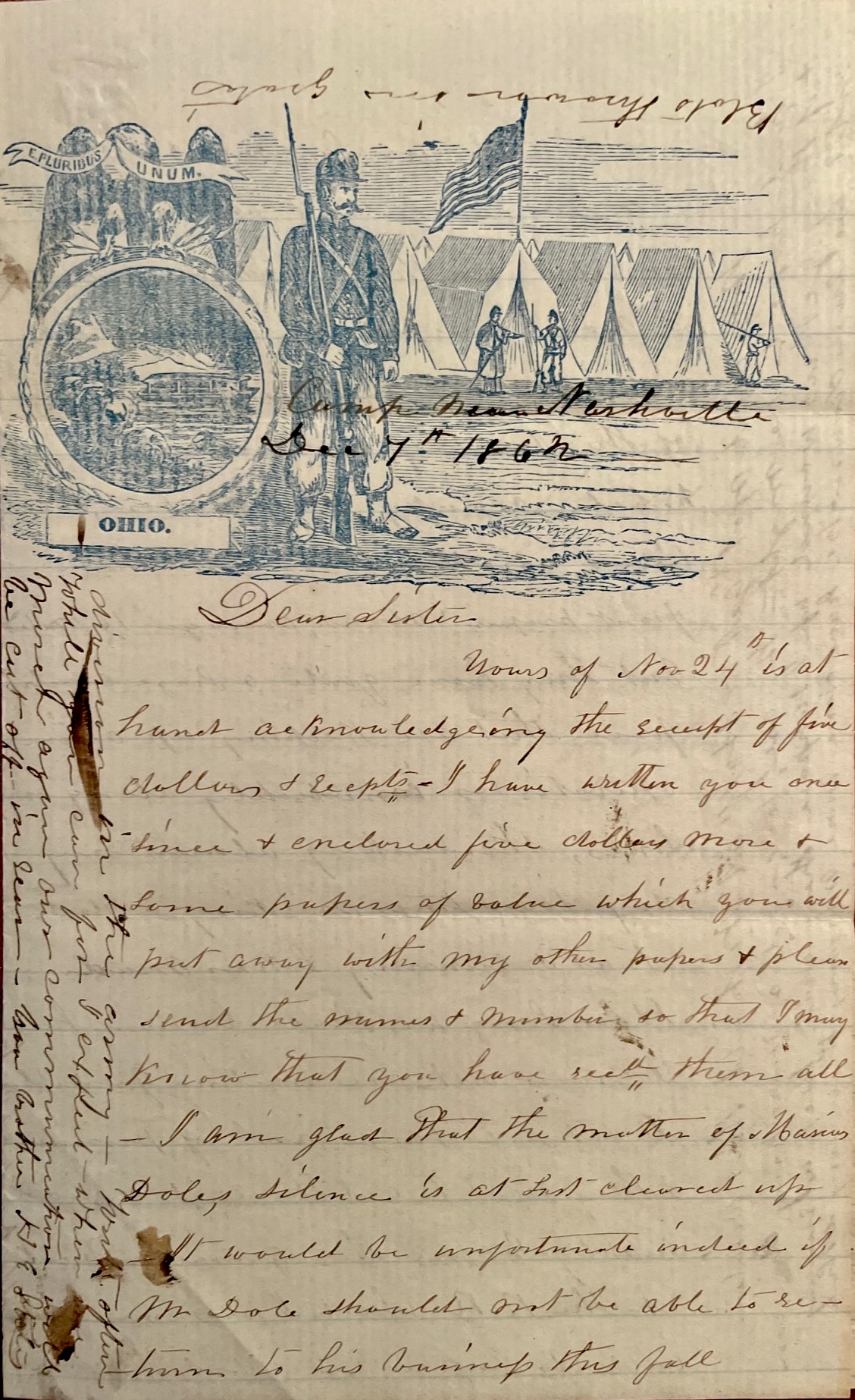
Camp near Nashville
December 7th 1862
Dear Sister,
Yours of the 24th is at hand acknowledging the receipt of five dollars and receipts. I have written you once since & enclosed five dollars more & some papers of value which you will put away with my other papers and please send the names and numbers so that I may know that you have received them all. I am glad that the matter of Masius Doles silence is at last cleared up. It would be unfortunate indeed if Mr. Dole should not be able to return to his business this fall.
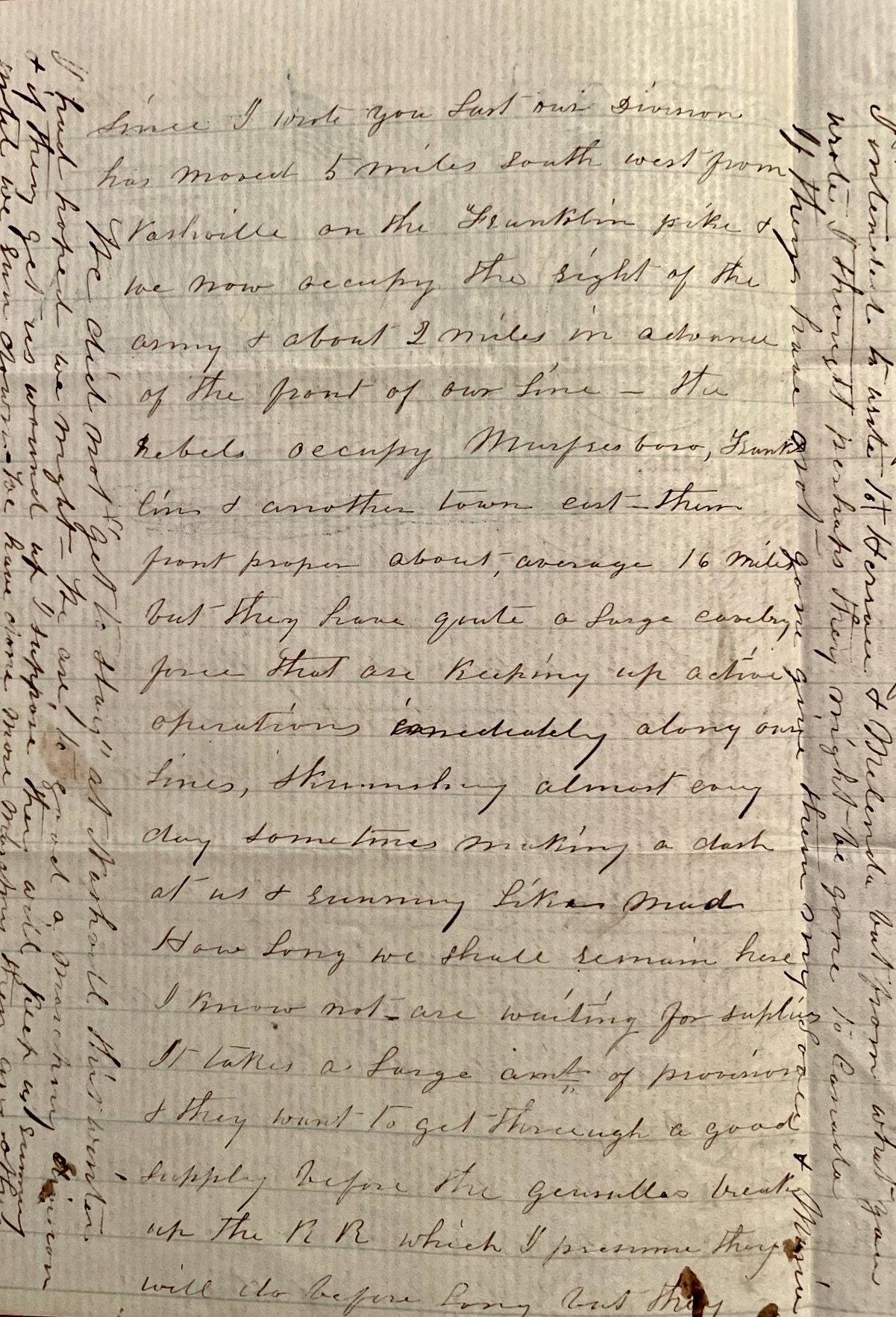
Since I wrote you last, our Division has moved 5 miles southwest from Nashville on the Franklin Pike & we now occupy the right of the army and about 2 miles in advance of the front of our line. The rebels occupy Murfreesboro, Franklin, and another town east. Their front proper about, average 16 miles but they have quite a large cavalry force that are keeping up active operations immediately along our lines, skirmishing almost every day, sometimes making a dash at us and running like mad.
How long we shall remain here I know not. Are waiting for supplies. It takes a large amount of provisions & they want to get through a good supply before the guerrillas breakup the railroad which I presume they will do before long but they are quiet now.
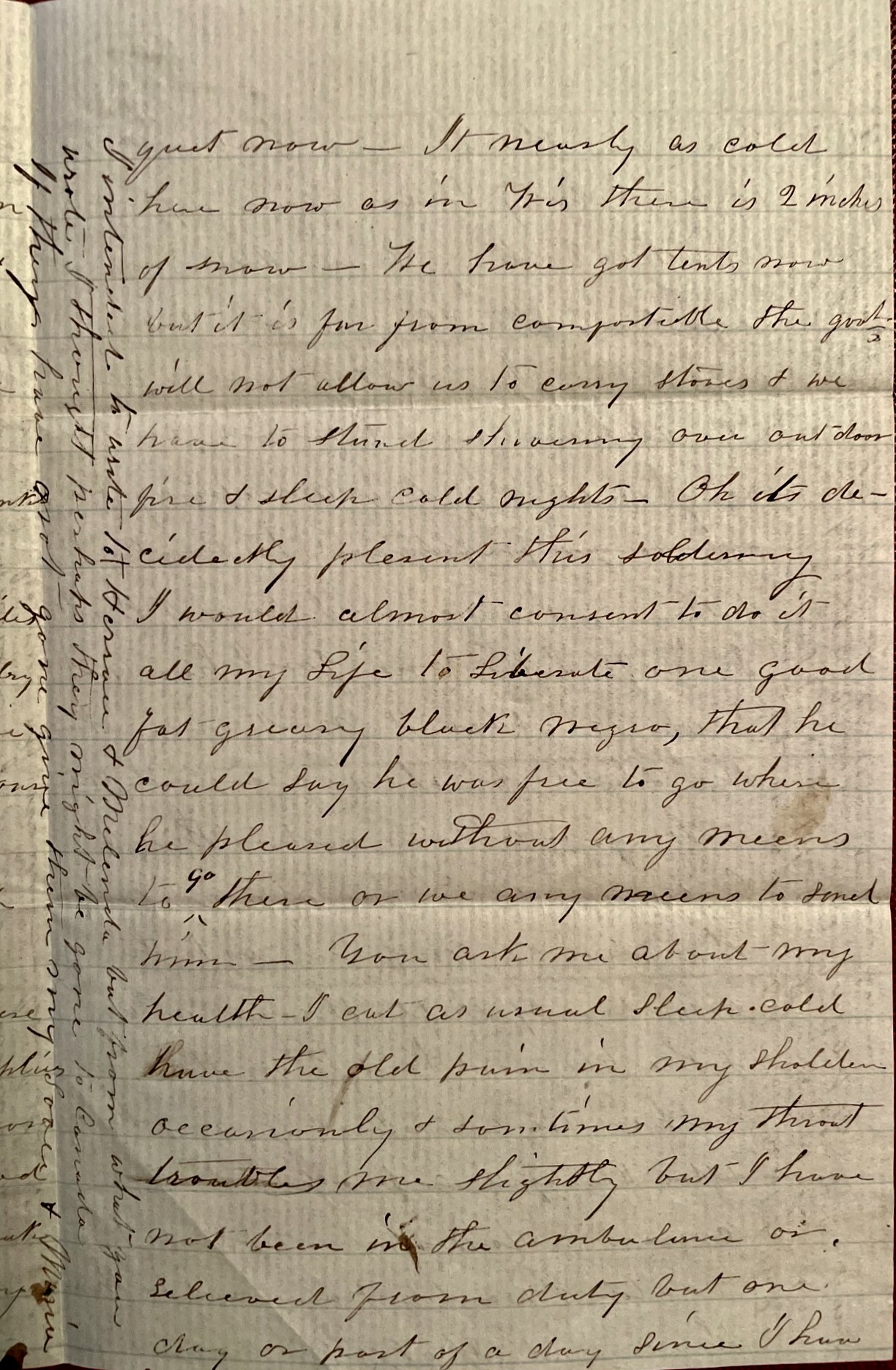
It’s nearly as cold here now as in Wisconsin. There is two inches of snow. We have got tents now but it is far from comfortable. The government will not allow us to carry stoves & we have to stand shivering over outdoor fire and sleep cold nights. Oh, it’s decidedly pleasant this soldiering. I would almost consent to do it all my life to liberate one good, fat, greasy black negro, that hecould say he was free to go where he pleased without any means to go there or we any means to send him.
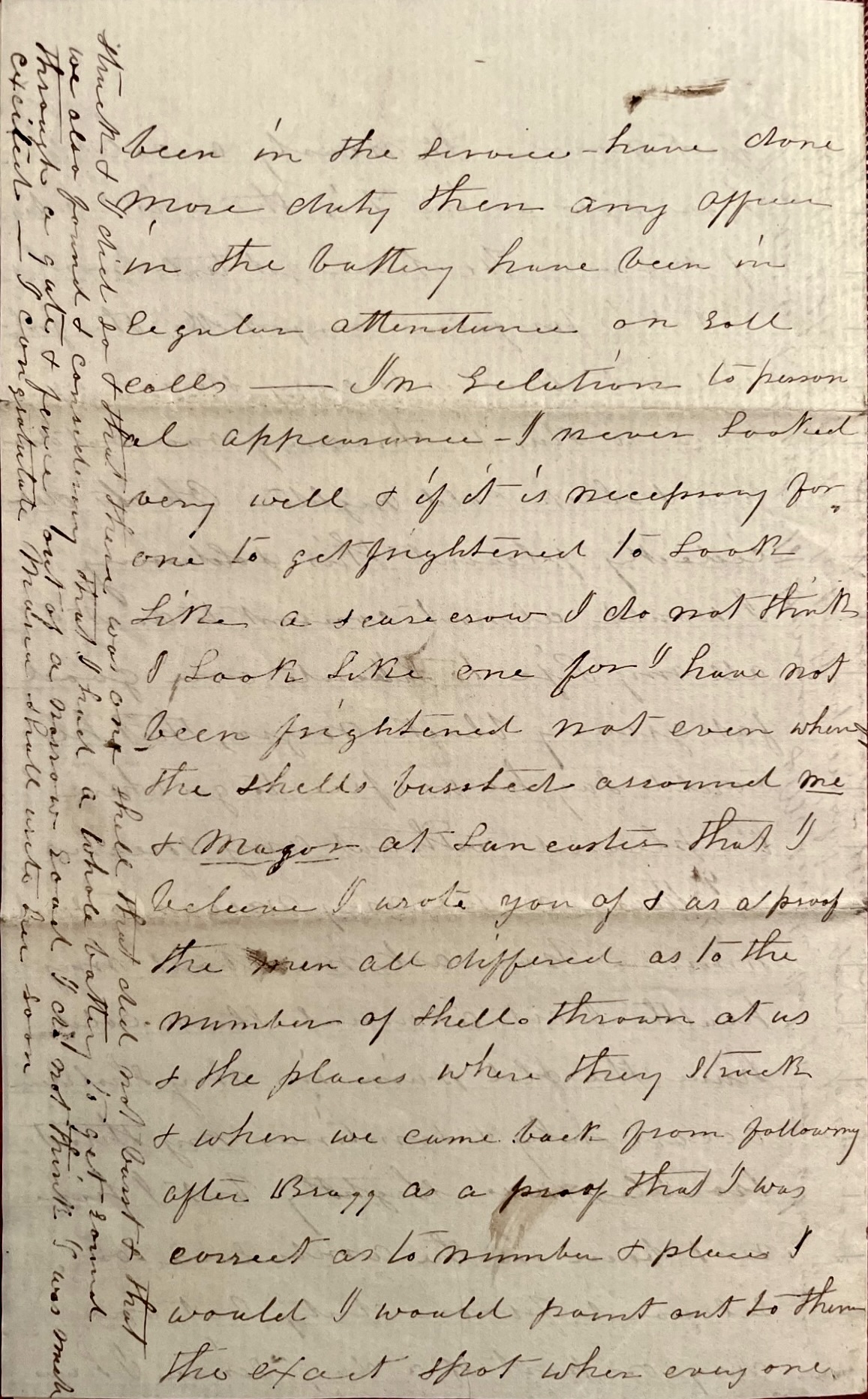
You ask me about my health. I eat as usual, sleep cold, have the old pain in my shoulder occasionally, and sometimes my throat troubles me slightly. But I have not been in the ambulance or relieved from duty but one day or part of a day since I have been in the service. Have done more duty than any officer in the battery. Have been in regular attendance. I never looked very well & if it is necessary for one to get frightened to look like a scarecrow, I do not think I look like one for I have not been frightened—not even when the shells bursted around me and Major at Lancaster [Kentucky]. That I believe I wrote you of, and as a proof, the men all differed as to the number of shells thrown at us & the places where they struck & when we came back from following after Bragg, as a proof that I was correct as to the number and places, I would point out to them the exact spot where every one struck & I did so & that there was one shell that did not burst & that we also found. And considering that I had a whole battery to get round through a gate and fence out of a narrow road, I do not think I was much excited.
I congratulate Mann. Shall write her soon. I intended to write to Herron & Melinda but from what you wrote, I thought perhaps they might be gone to Canada. If they have not gone, give them my love, and Maria.
We did not “get to stay” at Nashville this winter. I had hoped we might. We are too good a marching Division and if they get us wound up, I suppose they will keep us going until we run down. We have done more marching than any other division in the army. Write often while you can for I expect when we march again, our communication will be cut off in rear. Your brother, — H. E. Staley
 Spared & Shared 23