
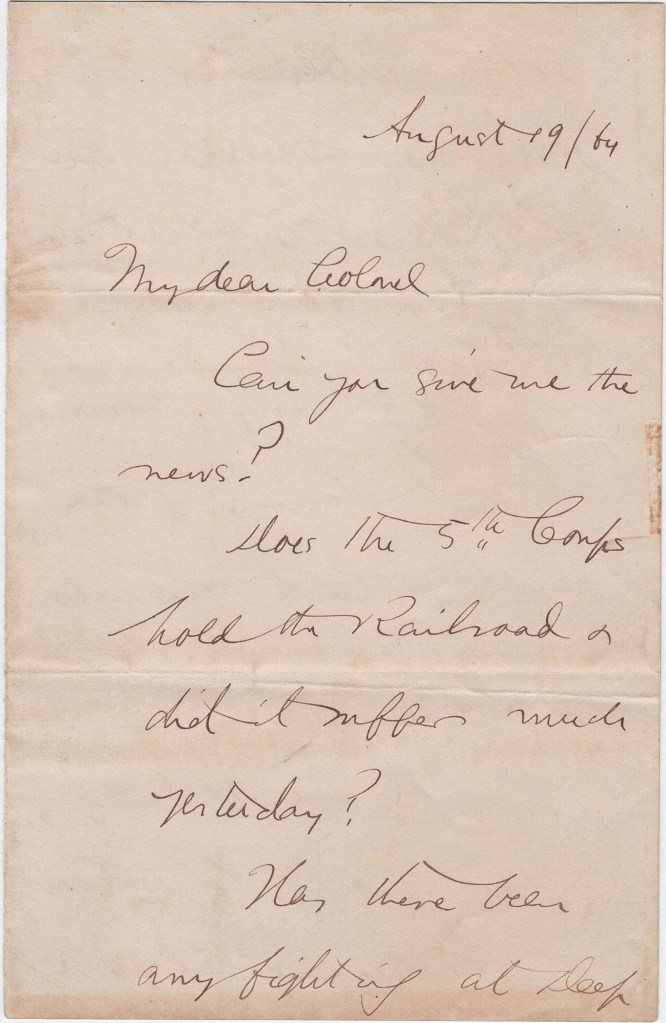
The following letter was written by Francis (“Frank”) Channing Barlow (1834-1896) while on convalescent leave from his command of the 1st Division, 2nd Corps, of the Army of the Potomac. He wrote the letter to Frederick Tracy Dent—Gen. Grant’s brother-in-law—who served as an aide-de-camp to Grant during the Overland Campaign and Siege of Petersburg in 1864.
Much has been written about Frank Barlow but one historian who has studied him extensively is Sarah Kay Bierle. The following excerpt comes from her article about Barlow she published on Emerging Civil War:
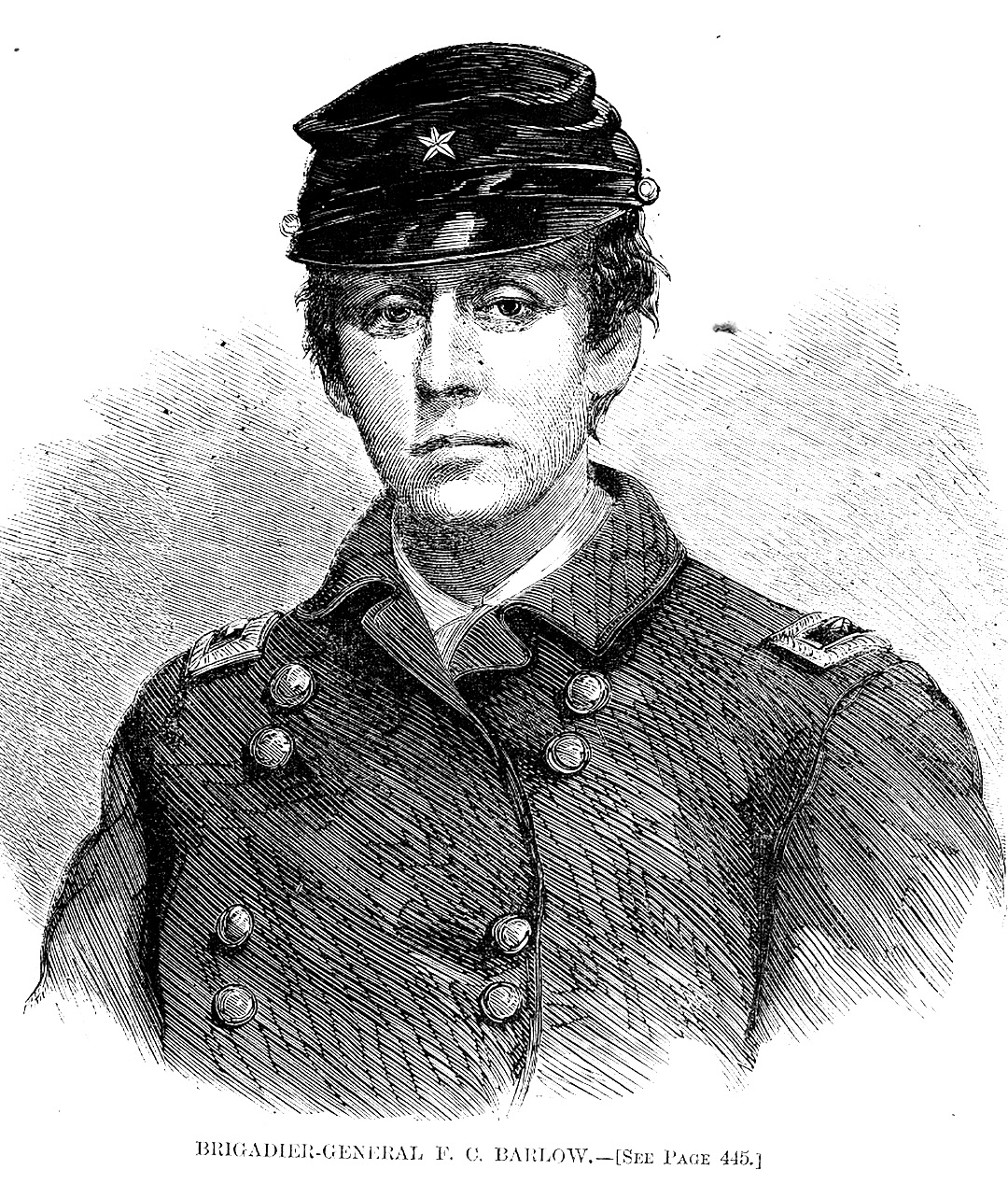
“Union General Francis C. Barlow is not generally hoisted on a symbolic white horse in Civil War memory. He has a reputation in the secondary source books for harsh discipline and a prickly temperament. He seems to be more remembered for his flaws at Gettysburg than his success at Antietam or hard fighting in the Overland Campaign. Barlow is associated with his bad days and outbursts rather than his moments of better humanity. Perhaps rightfully, perhaps not. I confess that is one of the things I like about studying Barlow, and I have been for about several years. He is far from a “marble man.” There’s a gritty rawness about his character and actions that doesn’t refine well in memory. There are moments to hate him and moments to admire him with all the complexity of real human life between. Barlow had a prickly relationship with his subordinates and superiors. There are moments recorded where he apparently was rather caring, but most of the time it seems that people wanted to give him a lot of space. Perhaps a regimental writer from the 148th Pennsylvania Infantry summarized it well, saying: “He had made a record for bravery and fearlessness…and was accounted a good General; but I always tried to keep out of his way as much as possible.” [See: General Barlow’s White Horse]
Frank was married to Arabella Wharton Griffin (1824-1864), who was ten years his senior. They married shortly after the firing on Fort Sumter at St. Paul’s Chapel in New York City. After months apart, Arabella volunteered as a nurse, arriving at Antietam just in time to see her wounded husband. When Frank was wounded again at Gettysburg, Arabella tended to him once more. In 1864, she accompanied him to the front, but while working in a field hospital in Tidewater Virginia, she contracted typhus and became critically ill. She died on July 28, 1864, after being transported to a vessel at City Point. Her death caused Frank immense grief, leading to concerns among his associates about his mental state. He received a 15-day furlough to attend her funeral but delayed his return due to exhaustion. This letter, written during that time, shows his anxiety to learn about his 2nd Corps Division’s movements. [See The Wives of Francis Channing Barlow]
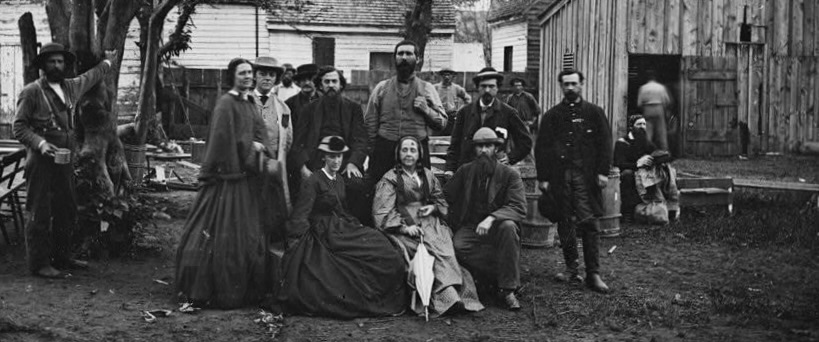
In the photograph appearing in the header of this post, Frank’s wife, Arabella, is the tall woman standing at left.
T R A N S C R I P T I O N
[Note: This letter is from the personal collection of Jim Doncaster and was transcribed and published on Spared & Shared by express consent.]
August 19, 1864
My dear Colonel.
Can you give me the news?
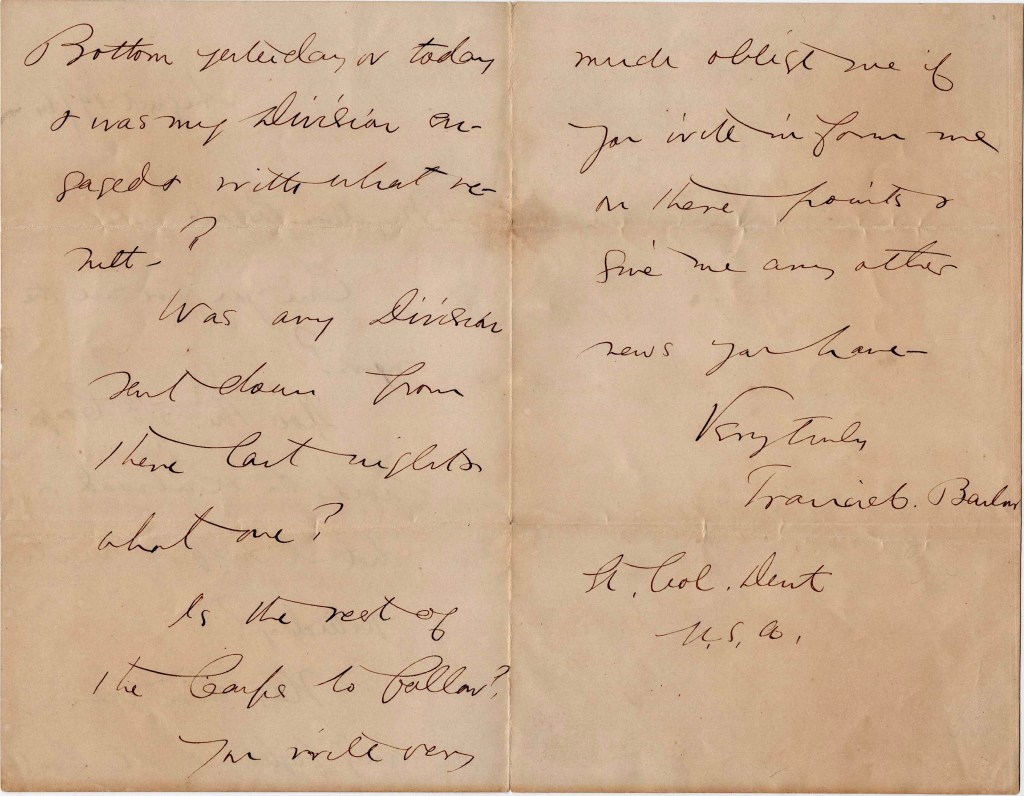
Does the 5th Corps hold the railroad & did it suffer much yesterday? Has there been any fighting at Deep Bottom yesterday or today. And was my Division engaged & with what result?
Was my Division send down from there last night & what one? Is the rest of the Corps to follow?
You will very much oblige me if you will inform me on these points & give me any other news you have. Very truly, — Francis C. Barlow
[to] Lt. Col. Dent, U. S. A.
 Spared & Shared 23