
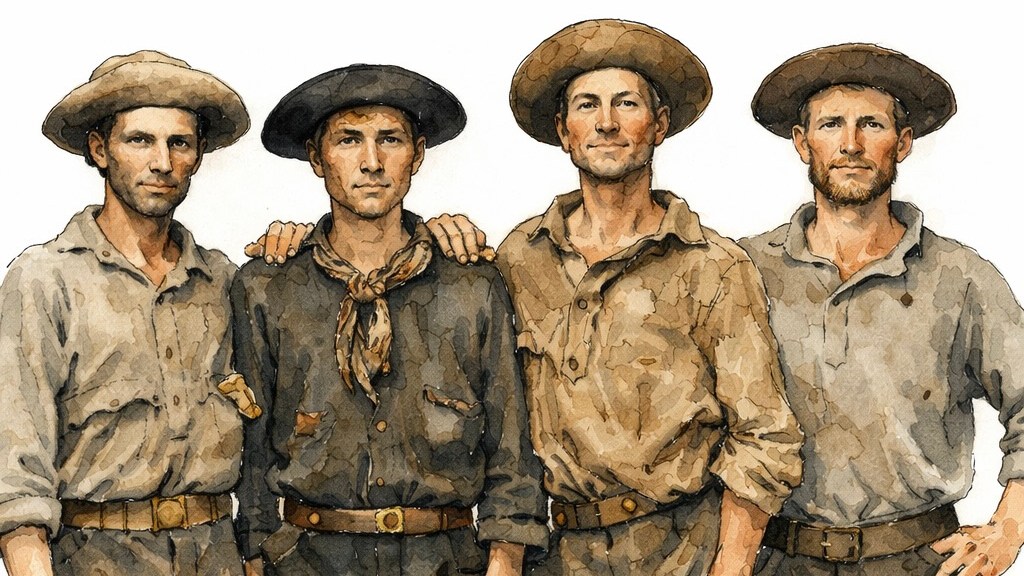
The following letter was written by John Andrew Smith (1826-1863), a native of Virginia, from his temporary home in Grass Valley, Nevada county, California. In the 1850 US Census, we find him lodging with fellow Virginian 28 year-old William Broadwater with whom he made the trip to California, and two other gentlemen, 23 year-old Ohioan Zenus Hathaway Denman, a trader; and 22 year-old Louisianan, Edward Theriot, a miner.
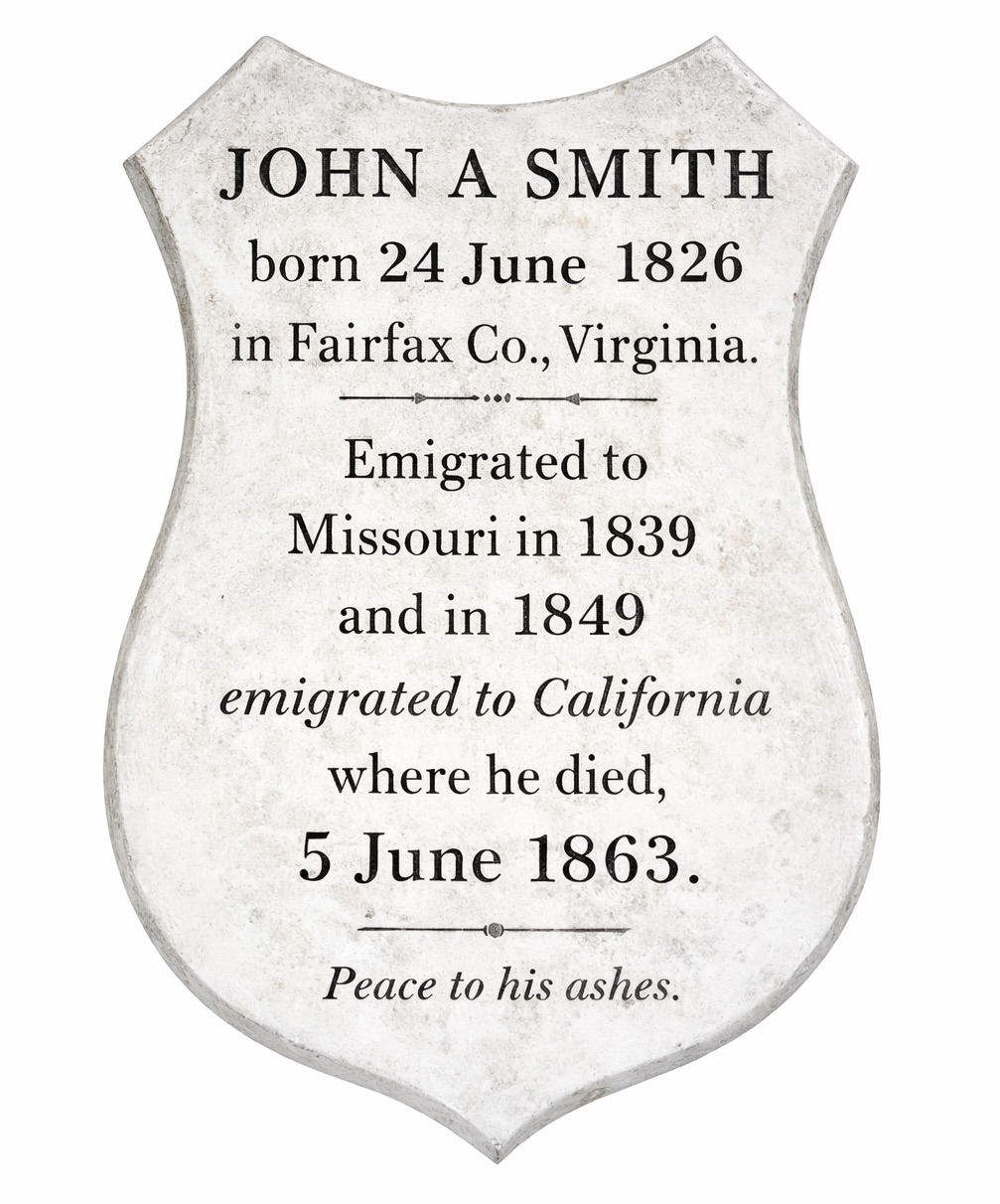
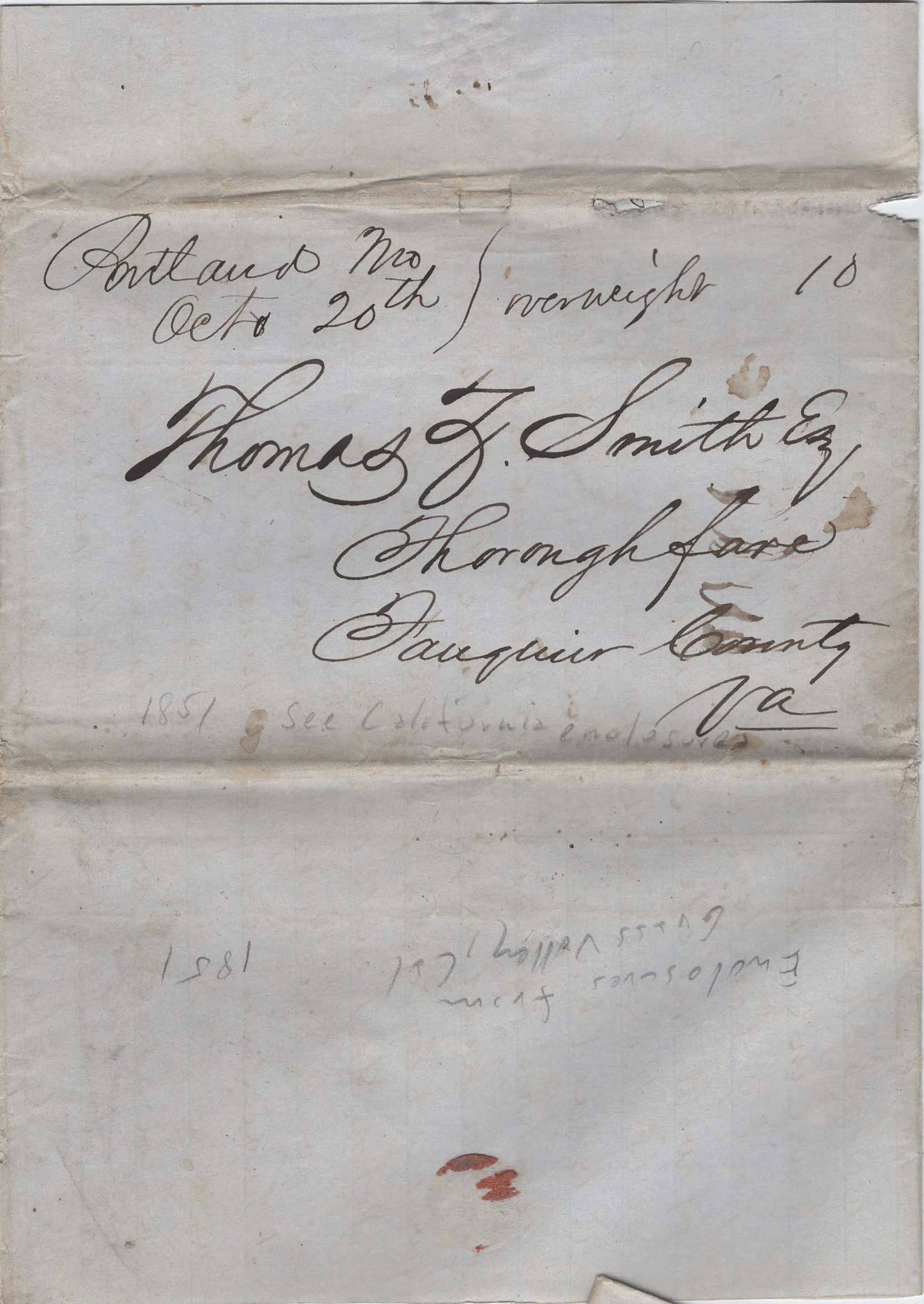
From Find-A-Grave we learn that John was born in Fairfax county, Virginia in 1826. He died on 5 June 1863 in Nevada county, California, and was buried in the Rough & Ready Cemetery, Memorial ID 22611023. John’s parents are not identified on Find-A-Grave but based on the address written on the cover, I believe his parents were Thomas Z. Smith (1784-1868) and Elizabeth Fretz (1795-1871) who were both natives of Bucks county, Pennsylvania but lived in Fairfax county in the 1840s. In 1850, the couple were enumerated in Thoroughfare, Fauquier county, Virginia, but later moved back to Alexandria where Thomas died in 1868. Following her husband’s death, John’s mother moved back to Buck county, Pennsylvania where she died in 1871. John’s parents were Quakers.
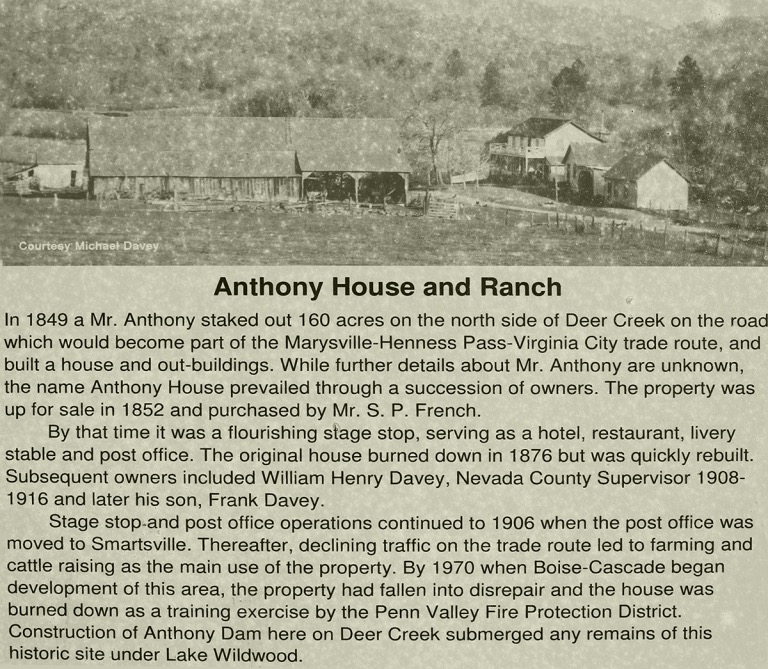
A search of the California newspapers revealed that John died tragically. “Sad Accident. A man named John A. Smith, late proprietor of the Anthony House in Nevada county, was thrown from his horse lately near Rough and Ready, and was so badly injured that he died in a few hours.” [Sacramento Daily Union, 11 June 1863] The Anthony House was built about 1850 and it was up for sale in 1852 and purchased by Mr. S. P. French. By that time it was a flourishing stage stop, serving as a hotel, restaurant, livery stable and post office. The original house burned down in 1876 but was quickly rebuilt (see newspaper clipping below).
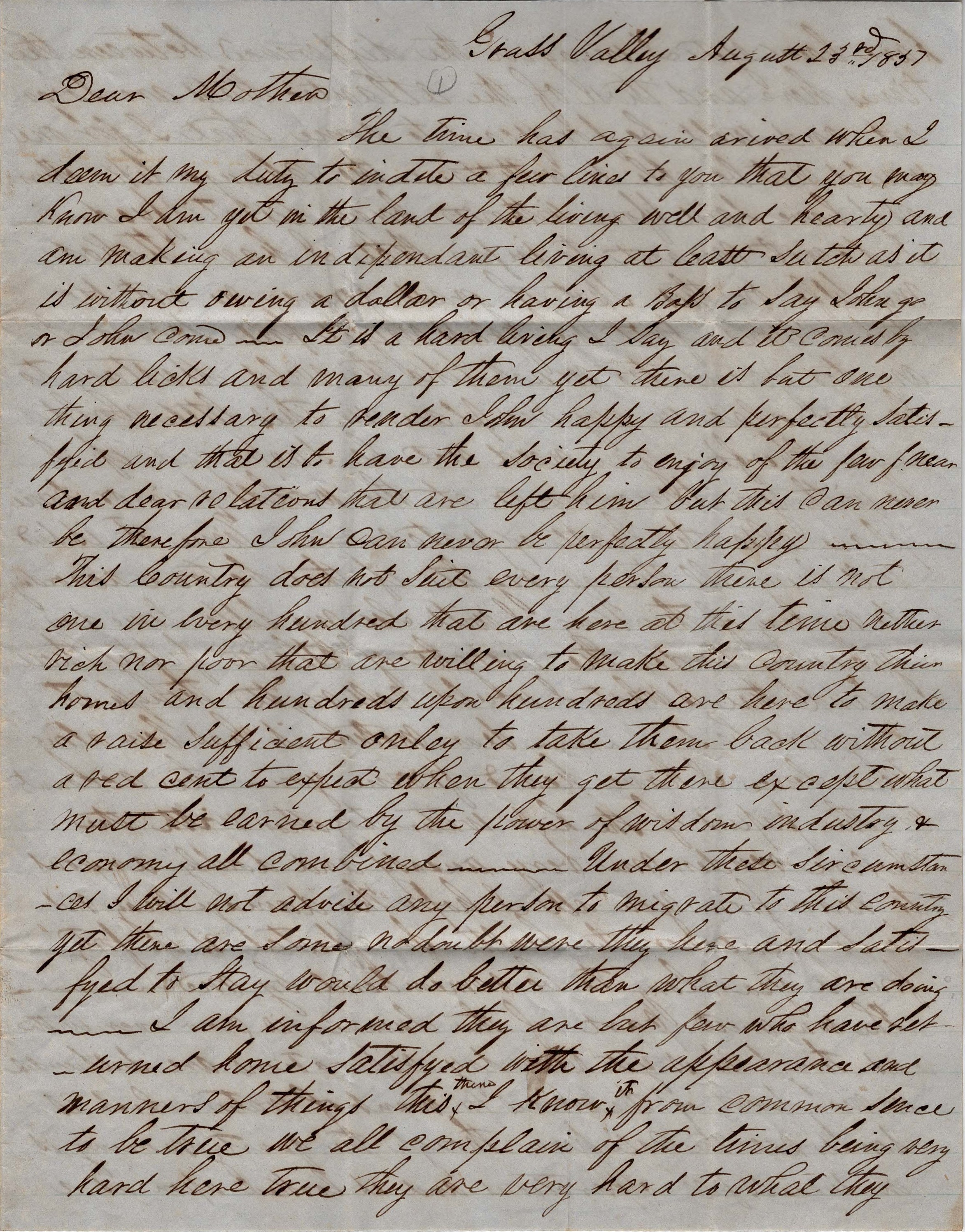
T R A N S C R I P T I O N
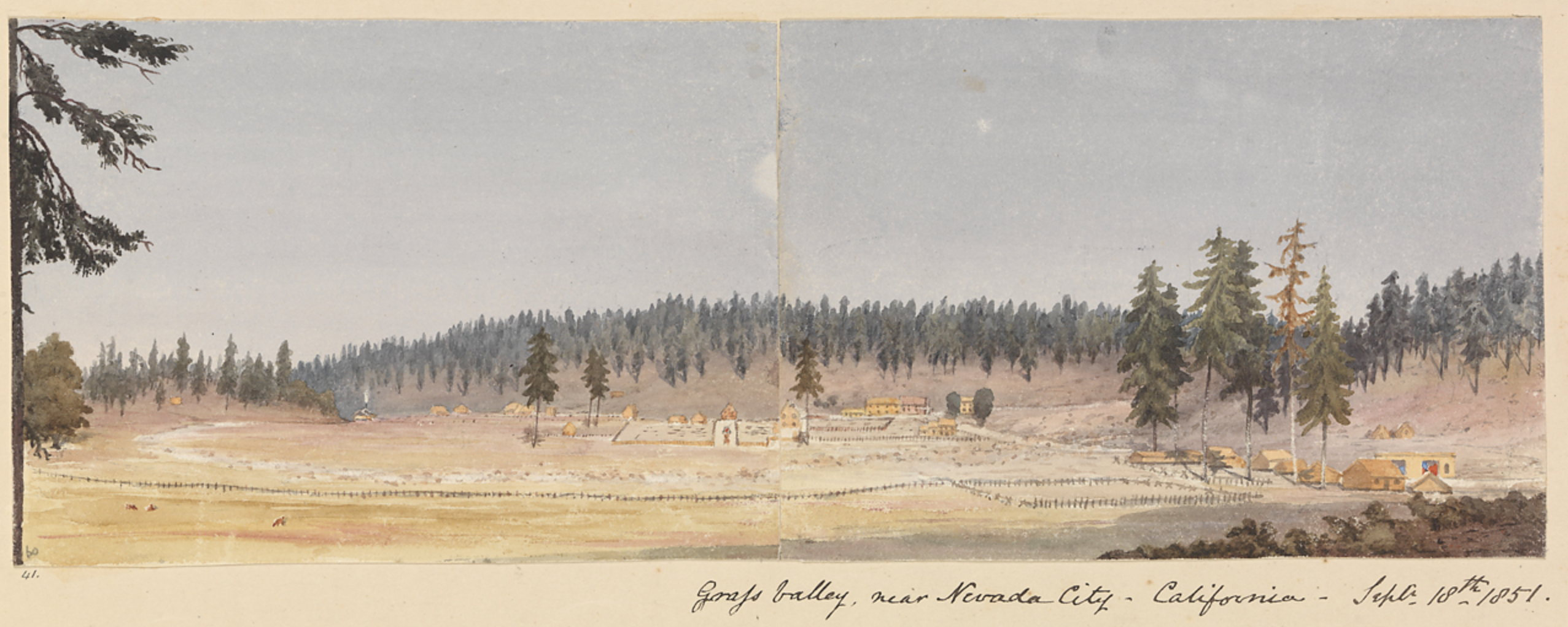
Grass Valley [California]
August 23rd 1851
Dear Mother,
The time has again arrived when I deem it my duty to indite a few lines to you that you may know I am yet in the land of the living, well and hearty, and am making an independent living at least—such as it is—without owing a dollar or having a boss to say, “John, go…,” or “John, come….” It is a hard living, I say, and it comes by hard licks and many of them, yet there is but one thing necessary to render John happy and perfectly satisfied and that is to have the society to enjoy of the few near and dear relations that are left him. But this can never be. Therefore, John can never be perfectly happy.
This country does not suit every person. There is not one in every hundred that are here at this time neither rich nor poor that are willing to make the country their homes and hundreds upon hundreds are here to make a raise sufficient only to take them back without a red cent to expect when they get there except what must be earned by the power of wisdom, industry, and economy all combined. Under these circumstances I will not advise any person to migrate to this country, yet there are some no doubt were they here and satisfied to stay would do better than what they are doing.
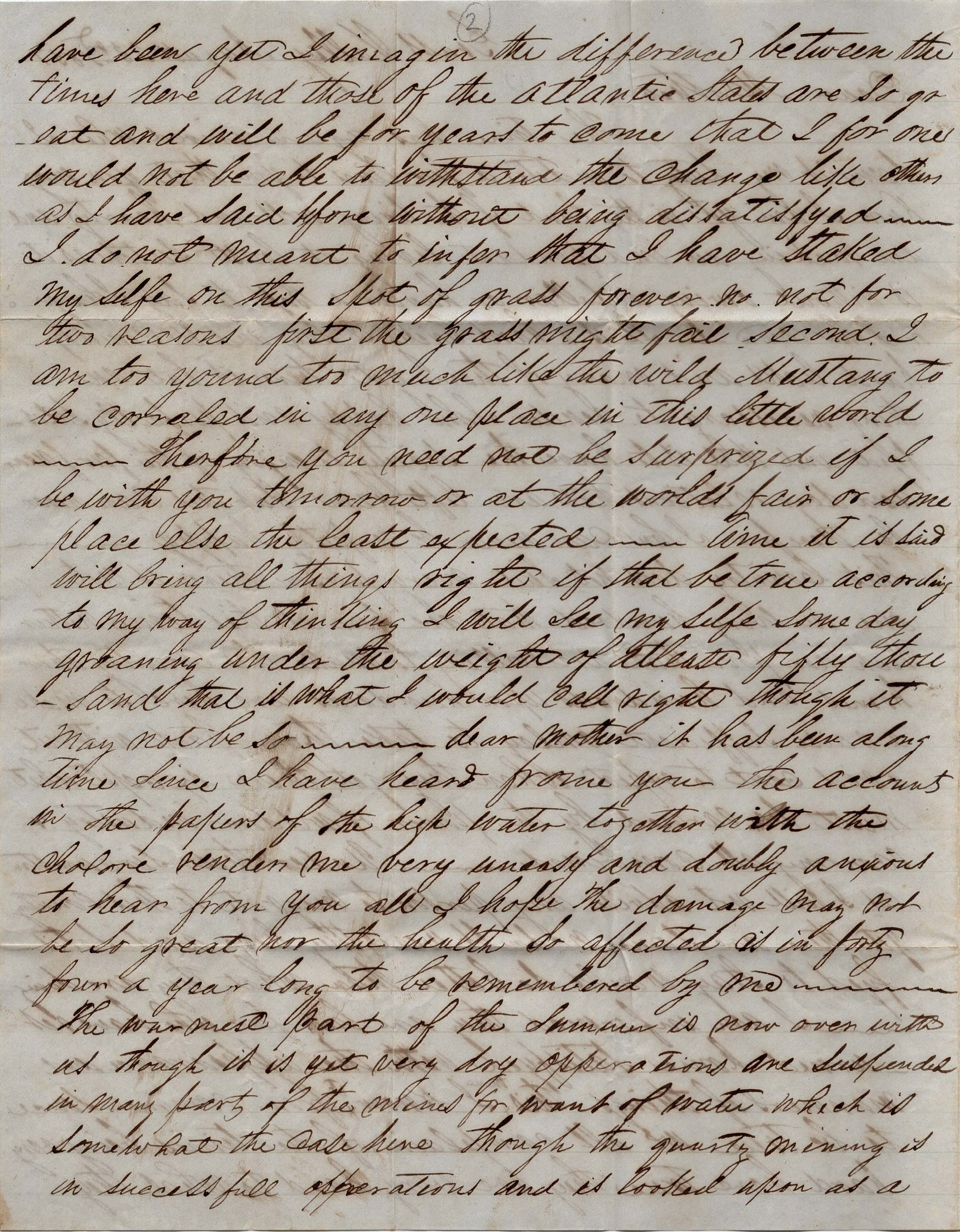
I am informed there are but few who have returned home satisfied with the appearance and manners of things. This I know from common sense to be true. We all complain of the times being very hard here. True, they are very hard to what they have been. Yet I imagine the difference between the times here and those of the Atlantic States are so great and will be for years to come that I for one would not be able to withstand the change like others as I have said before without being dissatisfied. I do not mean to infer that I have staked my life on this spot of grass forever—no, not for two reasons. First, the grass might fail. Second, I am too young [and] too much like the wild Mustang to be corralled in any one place in this little world. Therefore you need not be surprised if I be with you tomorrow or at the World’s Fair, or some place else the least expected.
Time it is said will bring all things right. If that be true according to my way of thinking, I will see myself someday groaning under the weight of at least fifty thousand. That is what I would call right though it may not be so.
Dear mother, it has been a longtime since I have heard from you. The accounts in the papers of the high water together with the cholera renders me very uneasy and doubly anxious to hear from you all. I hope the damage may not be so great nor the health so affected as in ’44—a year long to be remembered by me.
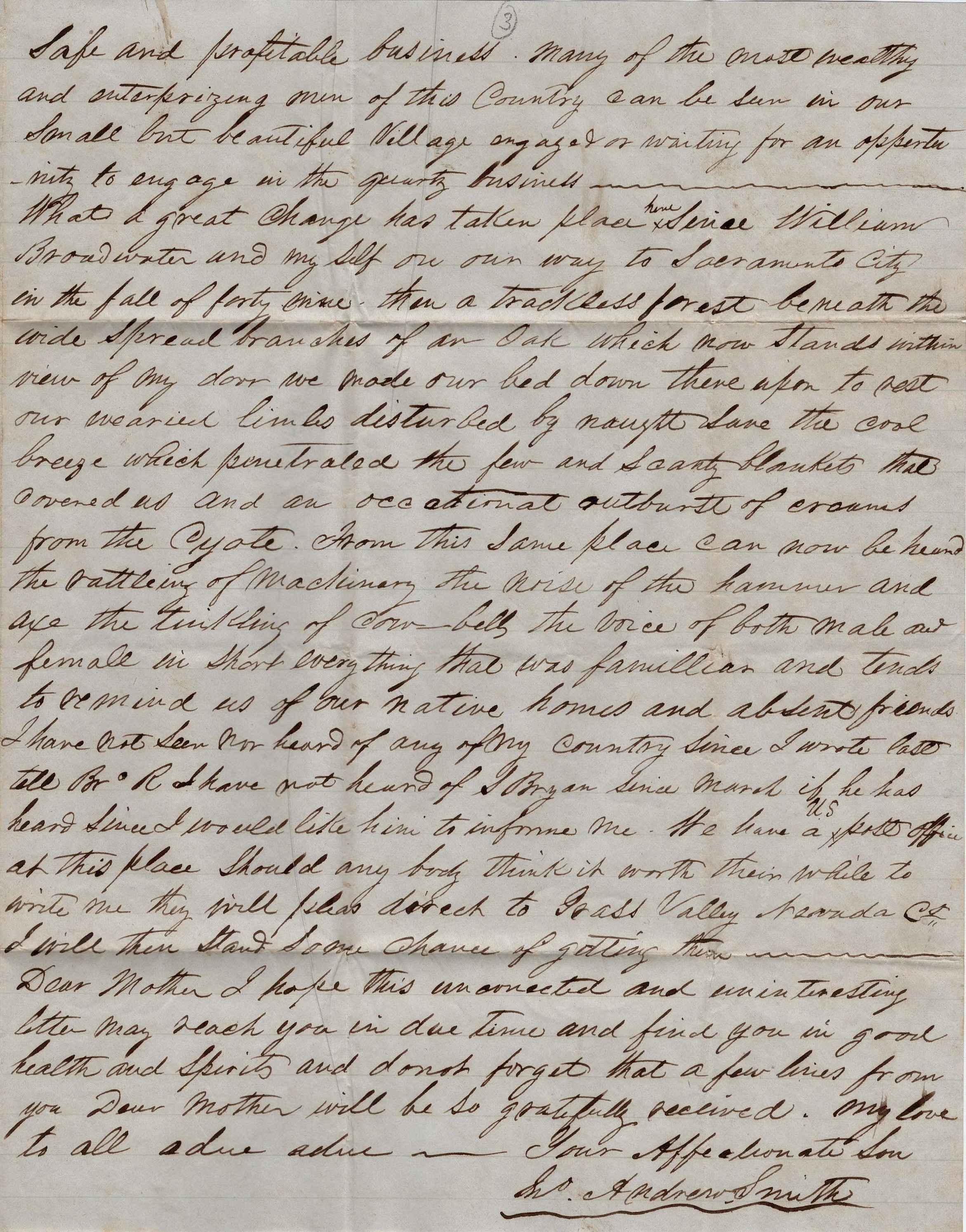
The warmest part of the summer is now over with us though it is yet very dry. Operations are suspended in many parts of the mines for want of water which is somewhat the case here though the quartz mining is in successful operations and is looked upon as a safe and profitable business. Many of the most wealthy and enterprising men of this country can be seen in our small but beautiful village engaged or waiting for an opportunity to engage in the quartz business.
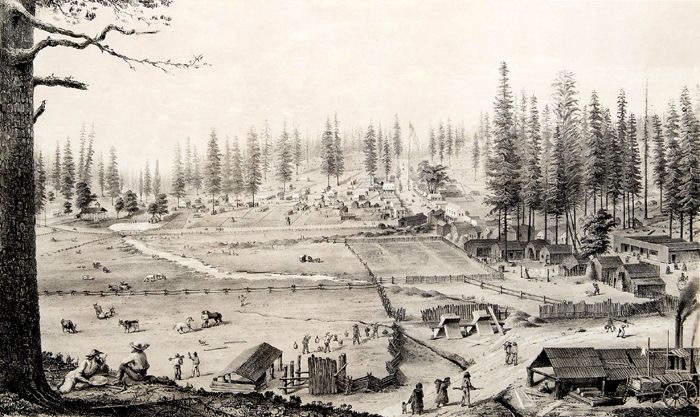
What a great change has taken place here since William Broadwater and myself on our way to Sacramento City in the fall of ’49 then a trackless forest beneath the wide spread branches of an Oak which now stands within view of my door. We made our bed down there upon to rest our wearied limbs, disturbed by naught save the cool breeze which penetrated the few and scanty blankets that covered us and on occasional outburst of screams from the coyote. From this place can now be heard the rattling of machinery, the noise of the hammer and axe, the tinkling of cow bells, the voice of both male and female. In short, everything that was familiar and tends to remind us of our native homes and absent friends. 1
I have not seen nor heard of any of my country since I wrote last. Tell Bro. R. I have not heard of S. Bryan since March. If he has heard since, I would like him to inform me. We have a US Post Office at this place. Should anybody think it worth their while to write me, they will please direct to Grass Valley, Nevada county, I will then stand some chance of getting them. 2
Dear mother, I hope this unconnected and uninteresting letter may reach you in due time and find you in good health and spirits and do not forget that a few lines from you, dear Mother, will be so gratefully received. My love to all. Adieu. Adieu. Your affectionate son, — Jno. Andrew Smith
1 The Nevada Journal of 19 April 1851 boasted that Grass Valley was already a place of “growing importance.” It reported that “It already contains a population of some 2,000 souls, about 200 houses, and some 59 trading establishments. Two saw-mills and three steam quartz crushing machines are now in operation there—some of them running night and day, and several others are in progress of erection. The attention of quartz rock operators, which was at first attracted to the northern portion of the State, is now fast becoming concentrated in this neighborhood. The gold bearing quartz in this region is almost inexaustible, and is found in every direction for miles around. On gold hill, where the rock was first discovered, several hundred tons have been taken out. Large quantities have also been taken out of other hills. The rock on gold hill we found to be unusually rich.
2 A US Post Office was established in Grass Valley, Nevada County, California, in 1851. The town was named Grass Valley at that time, having previously been known as Boston Ravine since its settlement in 1849.
 Spared & Shared 23
What a fascinating letter, and so well written.
LikeLike