
The following letter was written by Josiah Shick (1832-1872), the son of Henry Shick (1803-1888) and Susan Brown (1804-1884) of Wilkes-Barre, Pennsylvania. Josiah enlisted in Co. G, 119th Pennsylvania Regiment, in August 1862 and mustered out in June 1865. He was promoted from a private to corporal in March 1863.
Josiah wrote this letter to his brother-in-law, Rev. John G. Sands (1834-1916) of Chester county, Pennsylvania—a minister of the United Evangelical church for more than half a century. He was licensed to preach in March 1862 and labored on numerous circuits in Pennsylvania until he retired in 1907. He was married to Josiah’s younger sister, Mary Shick (1839-1917), in the late 1850s.
No comprehensive record of Josiah’s military service is available online; however, it is assumed that he served with the 119th Pennsylvania—often referred to as the “Gray Reserves”—throughout all of their engagements. The reserve brigade was a home guard unit formed in 1861, and in late 1862 many of its members joined the 119th Pennsylvania, seeing extensive service with the Sixth Army Corps. This regiment earned distinction for their exceptional resilience. They notably marched for 37 hours within a 24-hour period to arrive at the Battle of Gettysburg. Their participation extended to several significant battles, including Salem Church (or Salem Heights), their first serious engagement, which was described in detail in the following letter.
For another great account of the role played by the 119th Pennsylvania in the Battle of Salem Church, see “Gulping Down the Disaster: The 119th Pennsylvania at Salem Church“ by Dan Masters on his Civil War Chronicles.
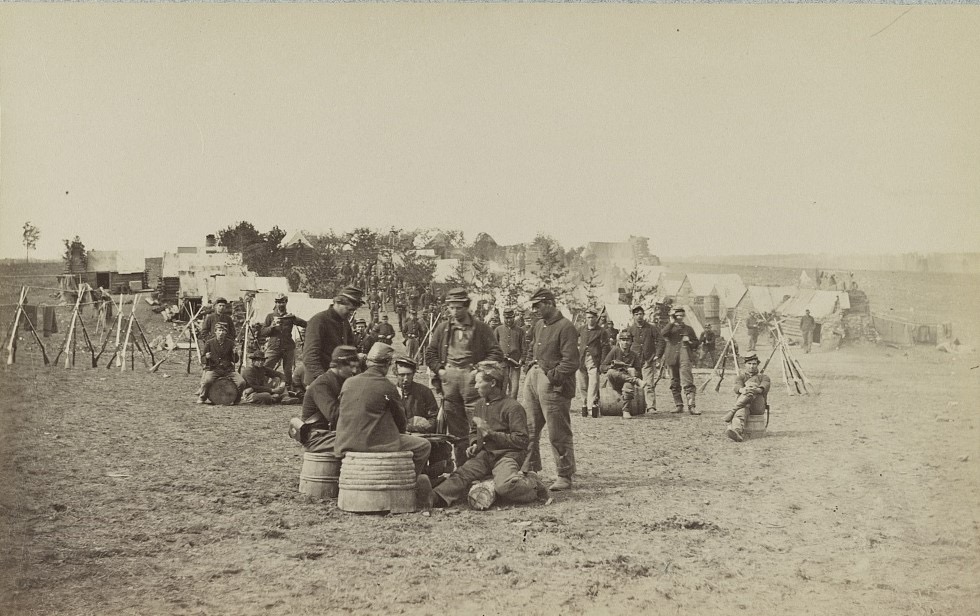
T R A N S C R I P T I O N
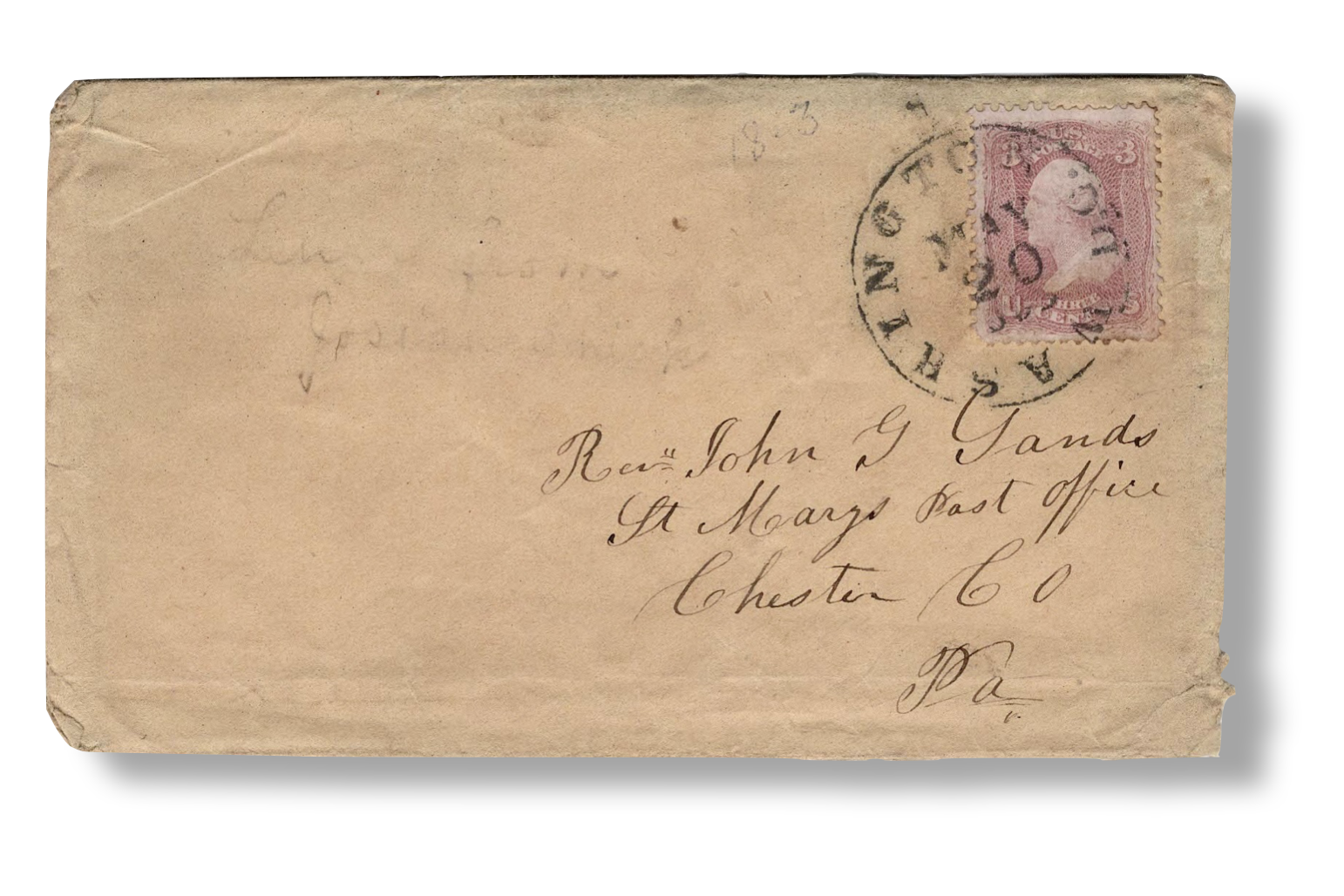
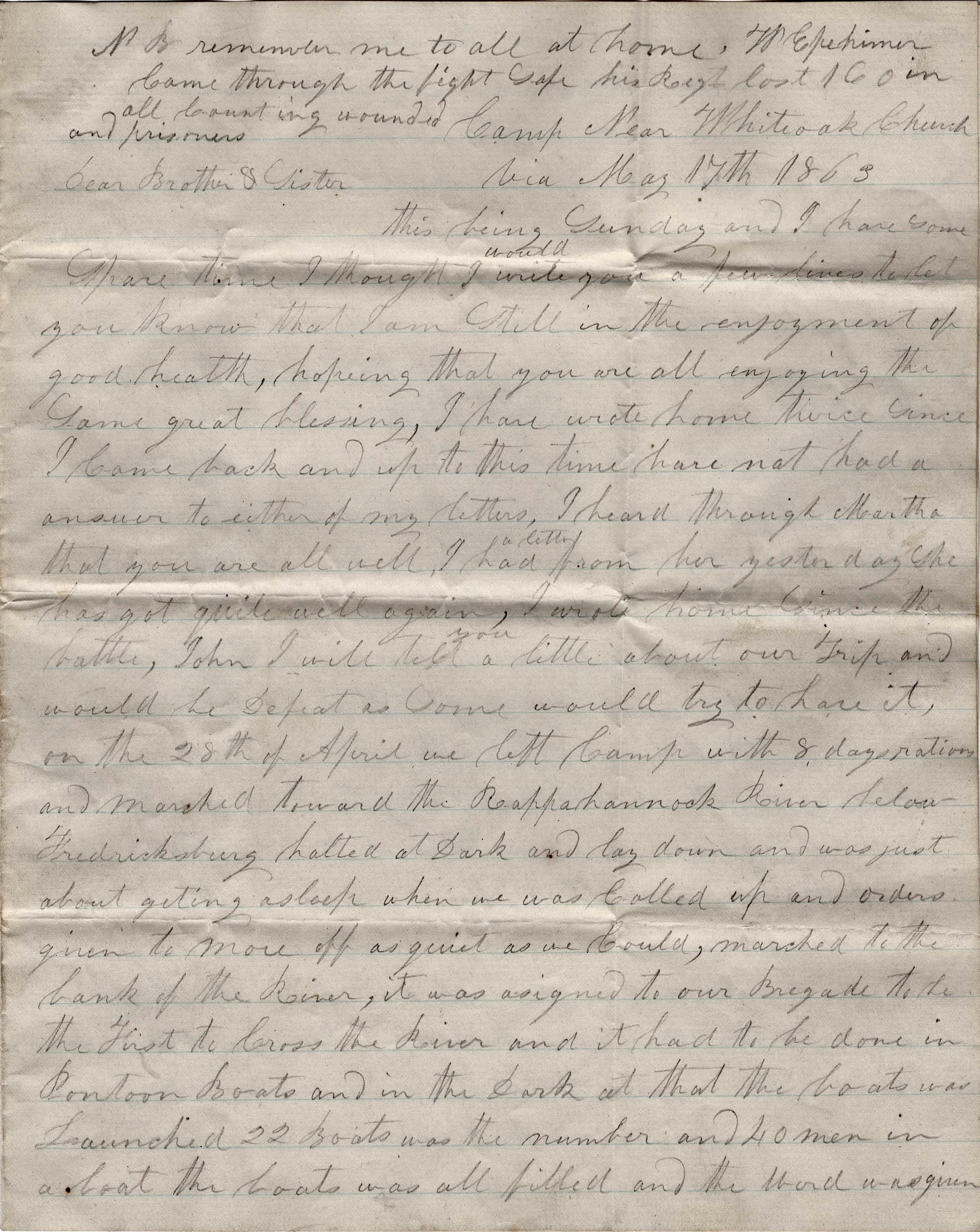
Camp near White Oak Church, Va.
May 17th 1863
Dear brother & sister,
This being Sunday and I have some spare time, I thought I would write you a few lines to let you know that I am still in the enjoyment of good health, hoping that you are all enjoying the same great blessing. I have wrote home twice since I came back and up to this time have not had an answer to either of my letters. I heard through Martha that you are all well. I had a letter from her yesterday. She has got quite well again. I wrote home since the battle. John, I will tell you a little about our trip and would-be defeat as some would try to have it.
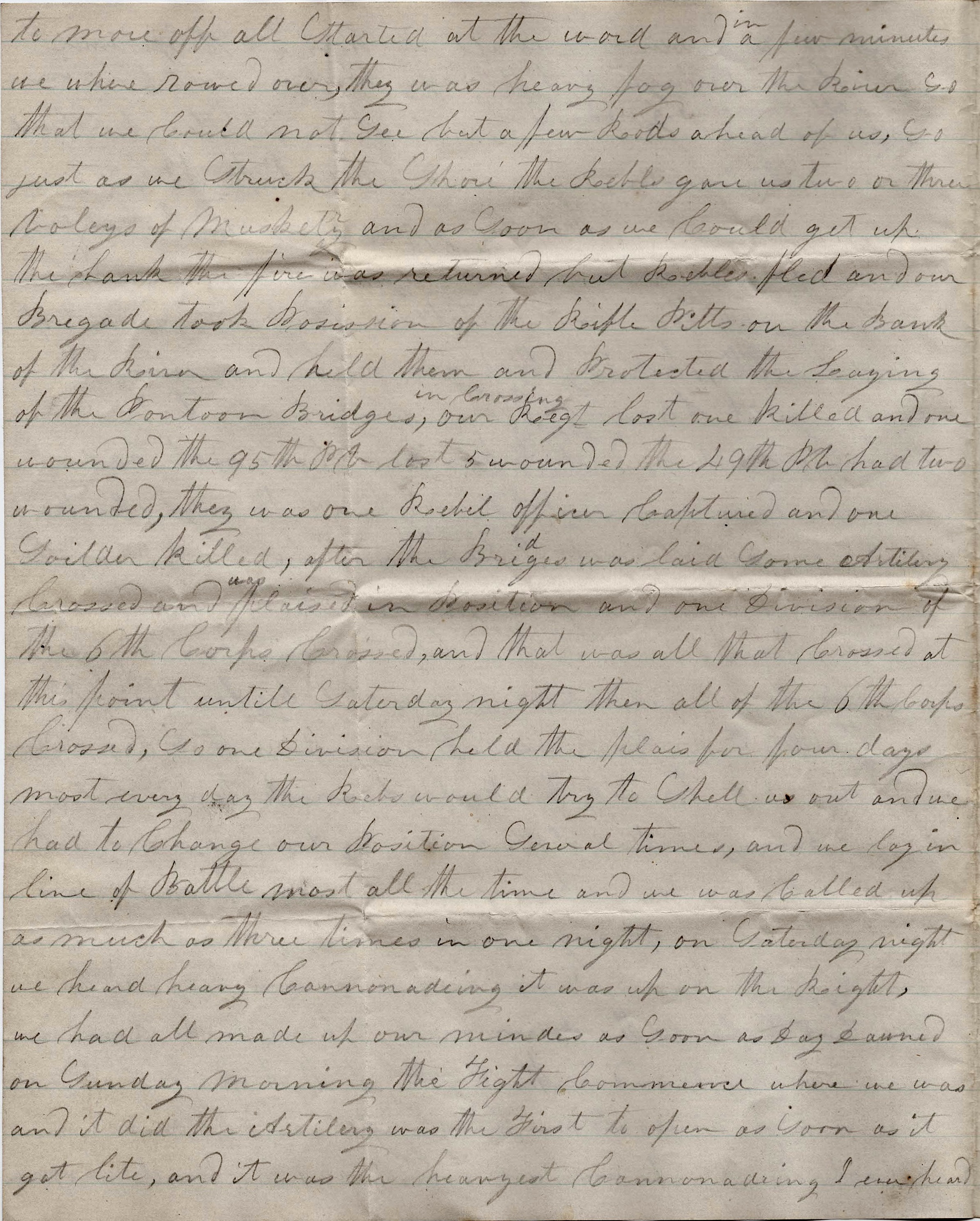
On the 28th of April we left camp with 8 days rations and marched toward the Rappahannock river below Fredericksburg, halted at dark, and lay down and was just about getting asleep when we was called up and orders given to move off as quiet as we could, march[ing] to the bank of the river. It was assigned to our Brigade [Russell’s] to be the first to cross the river and it had to be done in pontoon boats and in the dark at that. The boats was launched—22 boats was the number—and 40 men in a boat. The boats was all filled and the word was given to move off. All started at the word and in a few minutes we were rowed over. They was a heavy fog over the river so that we could not see but a few rods ahead of us so just as we struck the shore, the Rebels gave us two or three volleys of musketry and as soon as we could get up the bank, the fire was returned but [the] Rebels fled and our Brigade took possession of the rifle pits on the bank of the river and held them and protected the laying of the pontoon bridges. 1
In crossing, our regiment lost one killed and one wounded. The 95th Penn. Vols. lost 5 wounded. The 49th Penn. Vols. had two wounded. They was one Rebel officer captured and one soldier killed.
After the bridges was laid, some artillery [Battery D, 2nd US Artillery] crossed and was placed in position and one Division of the 6th Corps [Sedgwick’s] crossed and that was all that crossed at this point until Saturday night. Then all of the 6th Corps crossed, so one Division [Brooks’] held the place for four days. Most every day the Rebs would try to shell us out and we had to change our position several times and we lay in line of battle most all the time and we was called up as much as three times in one night.
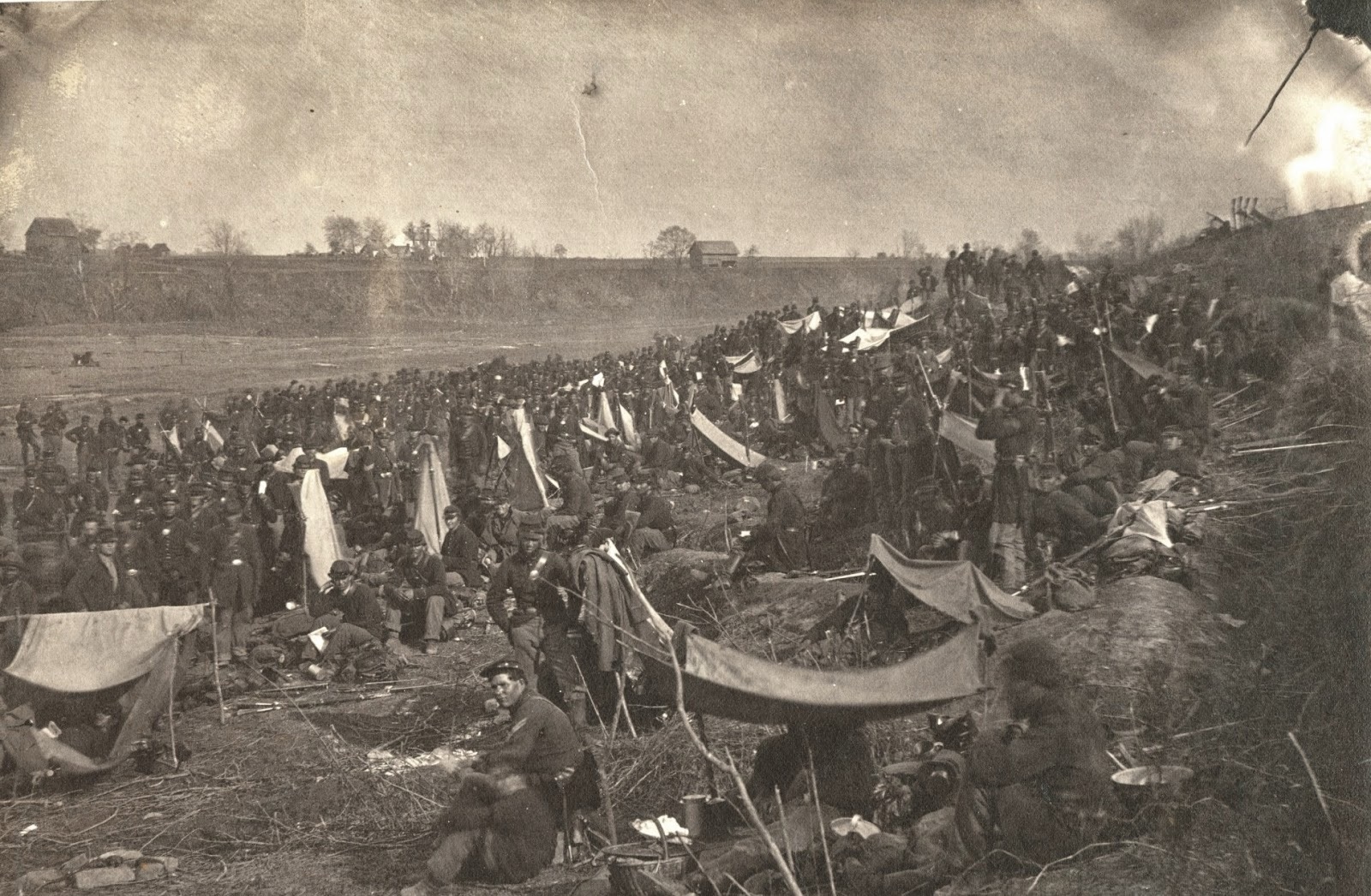
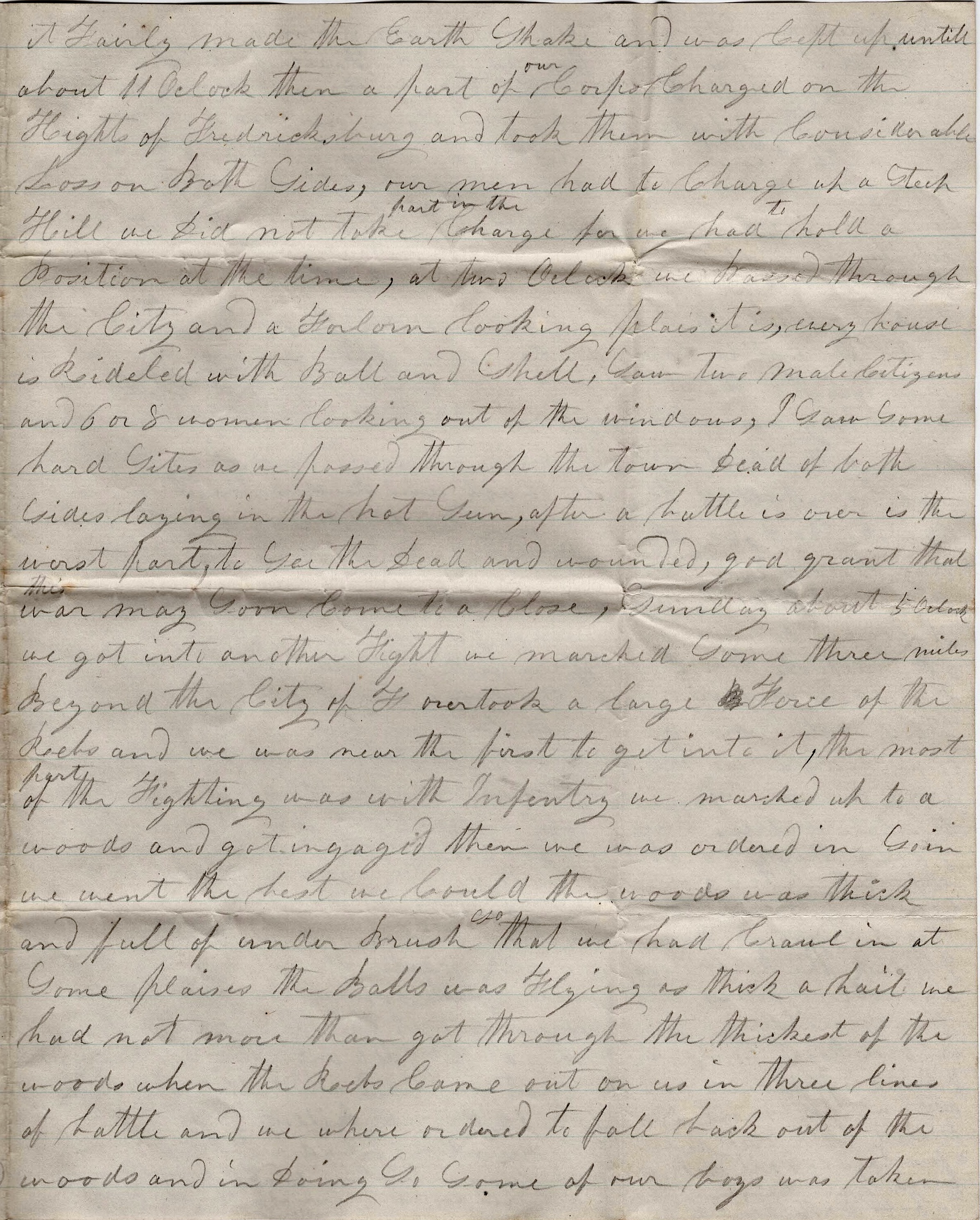
On Saturday night we heard heavy cannonading. It was up on the right. We had all made up our minds as day dawned on Sunday morning [May 3rd] the fight [would] commence where we was and it did. The artillery was the first to open as soon as it got light, and it was the heaviest cannonading I ever heard. It fairly made the earth shake and was kept up until about 11 o’clock. Then a part of our Corps charged on the heights of Fredericksburg and took them with considerable loss on both sides. Our men had to charge up a steep hill. We did not take part in the charge for we had to hold a position at the time.
At two o’clock we passed through the City and a forlorn looking place it is. Every house is riddled with ball and shell. Saw two male citizens and 6 or 8 women looking out of the windows. I saw some hard sights as we passed through the town. Dead of both sides laying in the hot sun after a battle is over is the worst part—to see the dead and wounded. God grant that this war may soon come to a close.
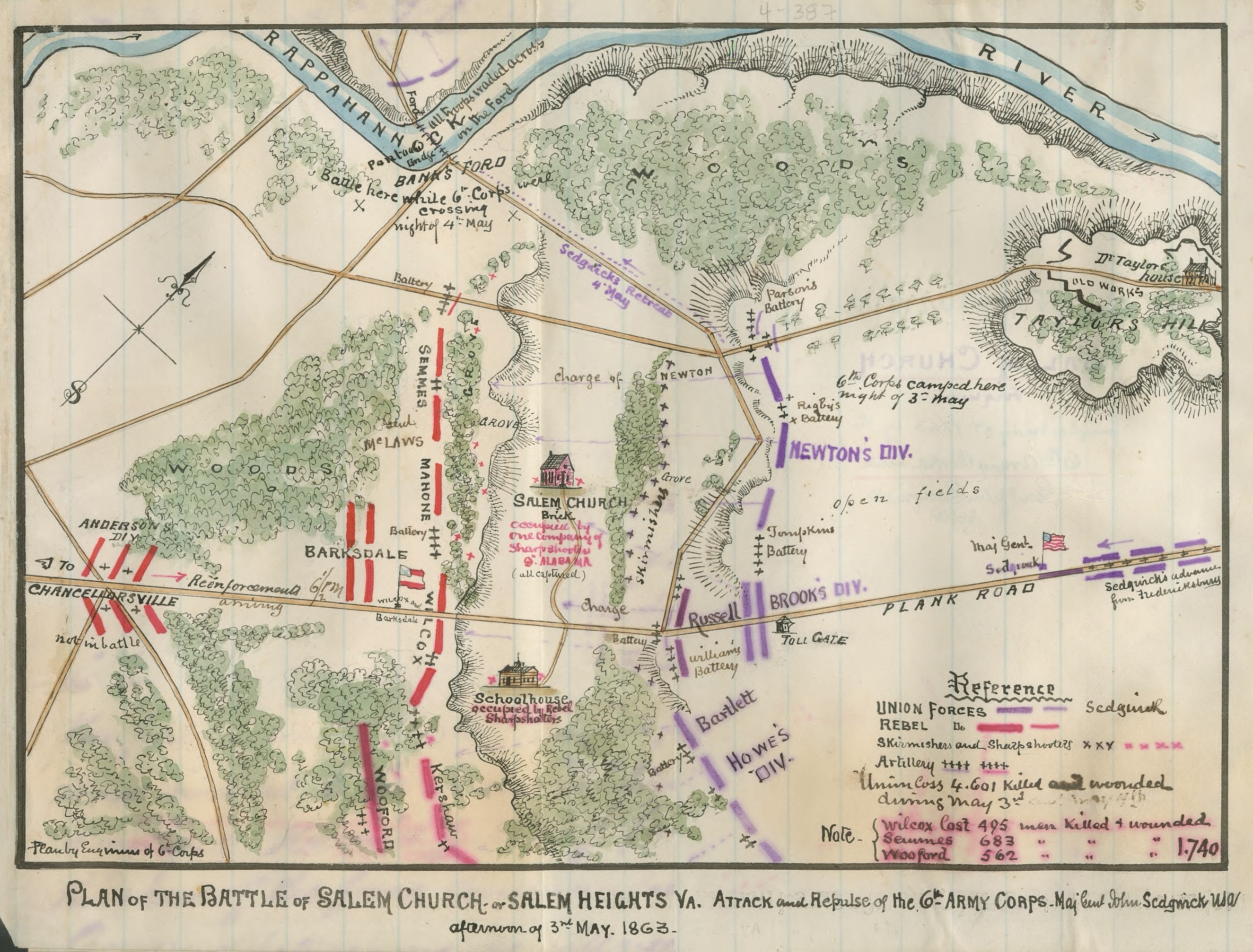
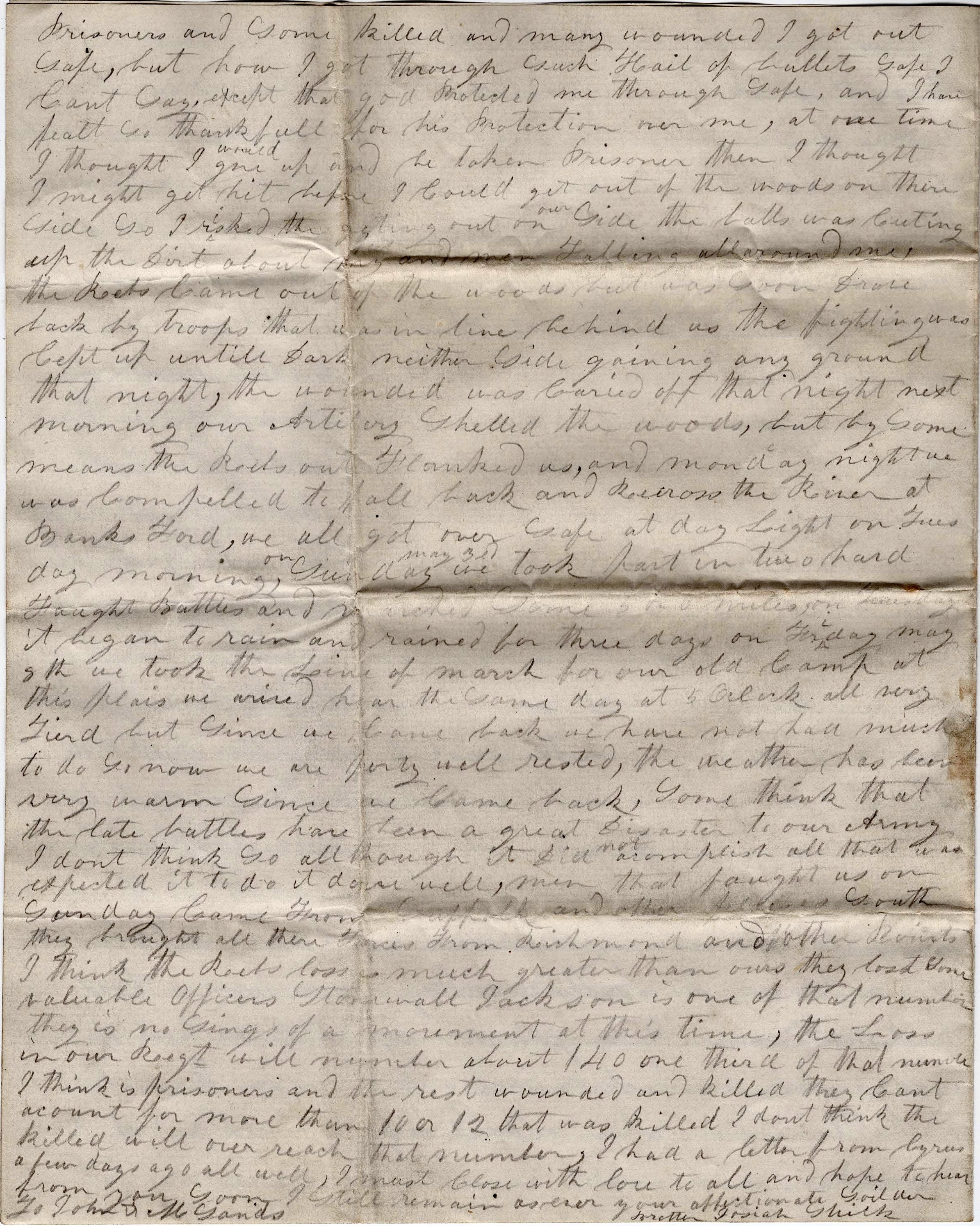
Sunday about 5 o’clock we got into another fight. We marched some three miles beyond the City of Fredericksburg [on the Orange Plank Road], overtook a large force of the Rebs and we was near the first to get into it. The most part of the fighting was with infantry. We marched up to a woods and got engaged; then we was ordered in. So in we went the best we could. The woods was thick and full of underbrush so that we had [to] crawl in at some places. The balls was flying as thick as hail. We had not more than got through the thickest of the woods when the Rebs came out on us in three lines of battle and we were ordered to fall back out of the woods and in doing so, some of our boys was taken prisoner and some killed and many wounded. I got out safe, but how I got through such hail of bullets safe, I can’t say except that God protected me though safe and I have felt so thankful for His protection over me. 2
At one time I thought I would give up and be taken prisoner. Then I thought I might get hit before I could get out of the woods on their side so I risked the getting out on our side. The balls was cutting up the dirt about me and men falling all around me. The Rebs came out of the woods but was soon drove back by troops that was in line behind us. The fighting was kept up until dark, neither side gaining any ground that night. The wounded was carried off that night. Next morning our artillery shelled the woods but by some means the Rebs out-flanked us and Monday night we was compelled to fall back and recross the river at Banks Ford. We all got over safe at daylight on Tuesday morning. On Sunday, May 31st, we took part in two hard fought battles and marched some 5 or 6 miles.
On Tuesday it began to rain and rained for three days. On Friday, May 8th we took the line of march for our old camp at this place. We arrived here the same day at 5 o’clock, all very tired. But since we have been back, we have not had much to do so now we are pretty well rested. The weather has been very warm since we came back. Some think that the late battles have been a great disaster to our army. I don’t think so. Although it did not accomplish all that was expected it to do, it done well. Men that fought us on Sunday came from Suffolk and other places south. They brought all their forces from Richmond and other points. I think the Rebs loss much greater than ours. They lost some valuable officers. Stonewall Jackson is one of that number. There is no signs of a movement at this time. The loss in our regiment will number about 140. One third of that number, I think, is prisoners and the rest wounded and killed. They can’t account for more than 10 or 12 that was killed. I don’t think the killed will over reach that number.
I had a letter from [brother] Cyrus a few days ago—all well. I must close with love to all and hope to hear from you soon. I still remain as ever your affectionate soldier brother, — Josiah Shick.
N. B. Remember me to all at home. W. Epehimer came through the fight safe. His regiment lost 160 in all counting wounded and prisoners.
1 The 6th Corps was kept out of view as they started toward Franklin’s Crossing late Tuesday, 28 April. After dark, the men and pontoons were moved to the river from the cover of the woods 1000 yards back. Once at the river, the soldiers lay on their arms and waited. It was after 4 a.m. before 1200 men of the 95th and 119th Pennsylvania were loaded into the pontoon boats and rowed across the river. There were 45 men plus officers transported in each boat. It took only a matter of minutes for the men to scramble up the bank and into the rebel rifle pits once they landed. [Source: Chancellorsville 1863, The Souls of the Brave, page 98, by Ernest B. Ferguson]
2 It was the 119th and 95th Pennsylvania that were detached from the Brigade and hurried onward to overtaking the retreating Rebels from Fredericksburg on the Orange Plank Road. It was near Salem Church that they encountered Cadmus Wilcox’s 5 brigades of Alabamians and Georgians in force, posted in a woods, hidden from view. The Pennsylvanians were aligned in battle formation to the left of the road and with other troops, placed under the immediate command of General Sedgwick. The advance of Federals up the gradual slope to the red brick church was ordered about 5 p.m. They were quickly overwhelmed by a superior force, twice their number, and fell back with heavy losses, Union artillery firing over their heads as they retreated. [Source: Chancellorsville 1863, The Souls of the Brave, page 278, by Ernest B. Ferguson]
 Spared & Shared 23