
The following letter was penned by Theodore Stone (1839-1906), the son of William Stone (1817-1905) and Rebecca Doliber (1817-1859) of Marblehead, Essex county, Massachusetts. In the 1860 US Census, Theodore was enumerated in his father’s household at Marblehead; his occupation was given as “fisherman.” After the Civil War, he entered the shoemaker’s trade. The 1890 Veterans Schedule informs us that during the war, Theodore enlisted on 6 April 1861 to serve three months in Co. C, 8th Massachusetts Infantry. In early May 1864 he enlisted again, this time in the US Navy where he was assigned to the USS Malvern as a “Master’s Mate.” He was in the navy for one and a half years, leaving the service in November 1865.
In the 1870’s, Theodore was married and had three children but he must have lived a troubled life. A Marblehead newspaper reported that he became despondent after the turn of the century and in 1906 he “took his life by drowning…after pinning his arms to his sides with 40 feet of rope. A suicide note was later found at his place of employment.
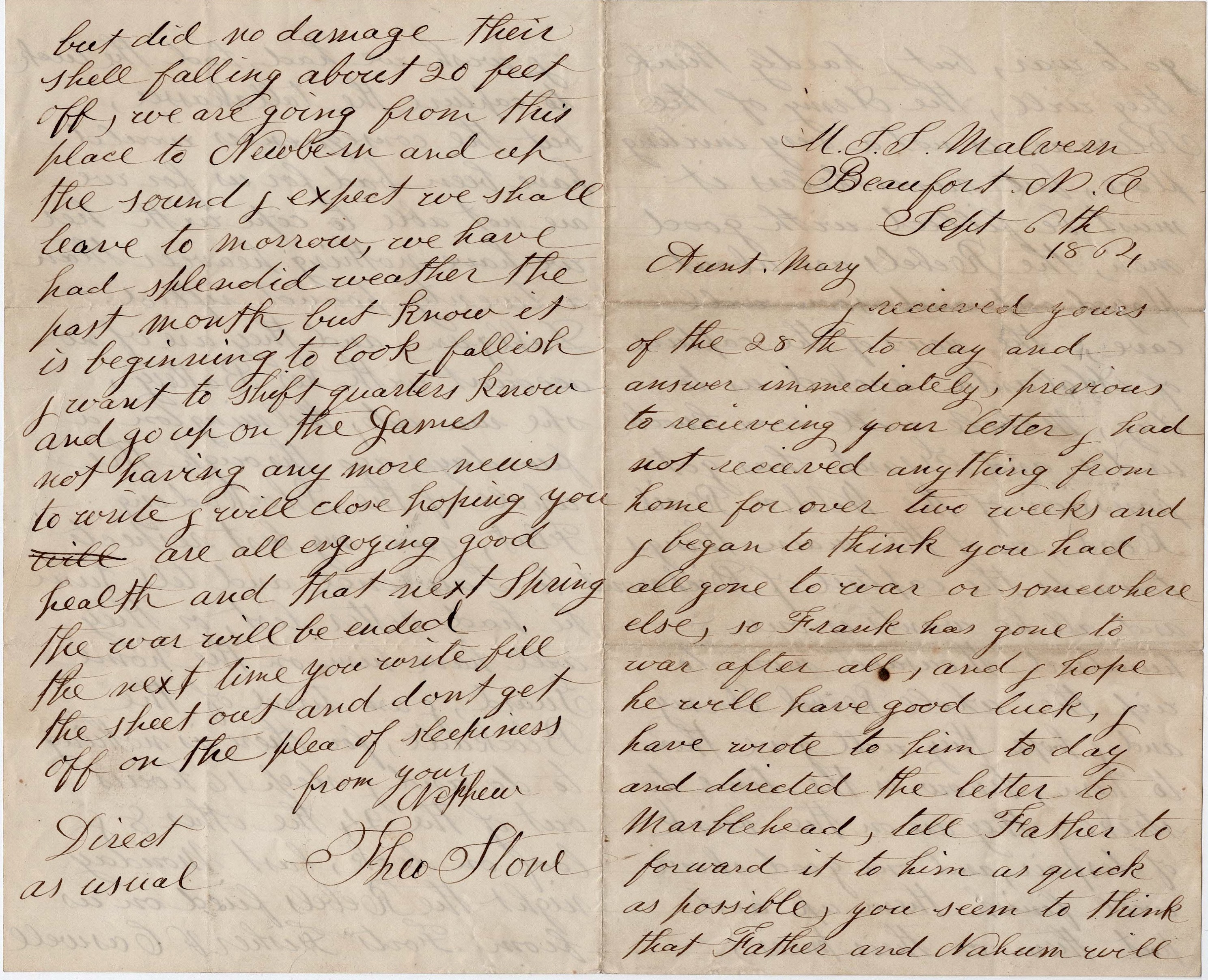
T R A N S C R I P T I O N
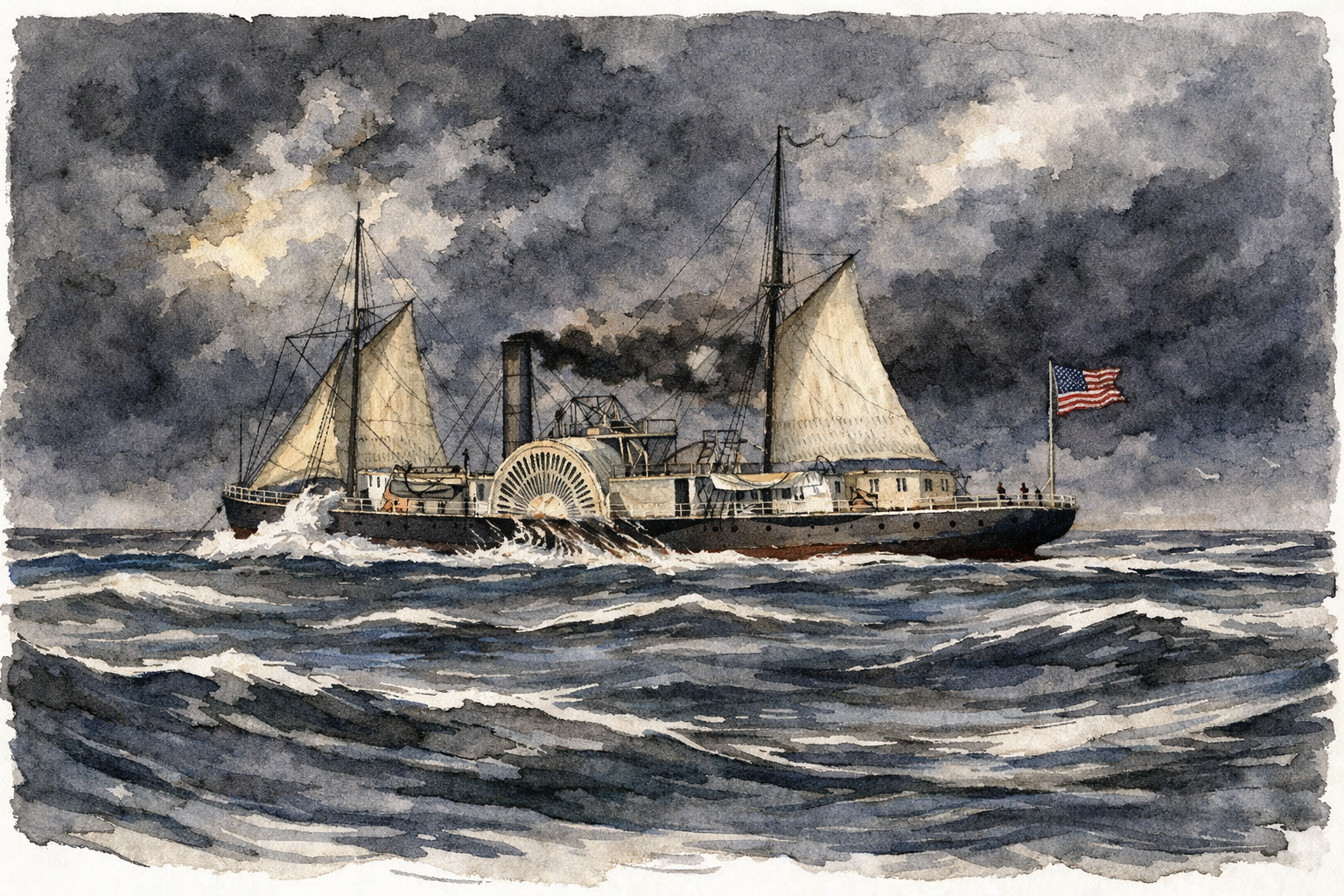
U.S.S. Malvern
Beaufort, North Carolina
September 6th 1864
Aunt Mary,
I received yours of the 28th today and answer immediately. Previous to receiving your letter, had not received anything from home for over two weeks and I began to think you had all gone to war or somewhere else. So Frank has gone to war after all and I hope he will have good luck. I have wrote to him today and directed the letter to Marblehead. Tell Father to forward it to him as quick as possible. You seem to think that Father and Nahum will go to war but I hardly think they will. The Army of the Potomac is not a very inviting place, but nevertheless it must be filled with good men.
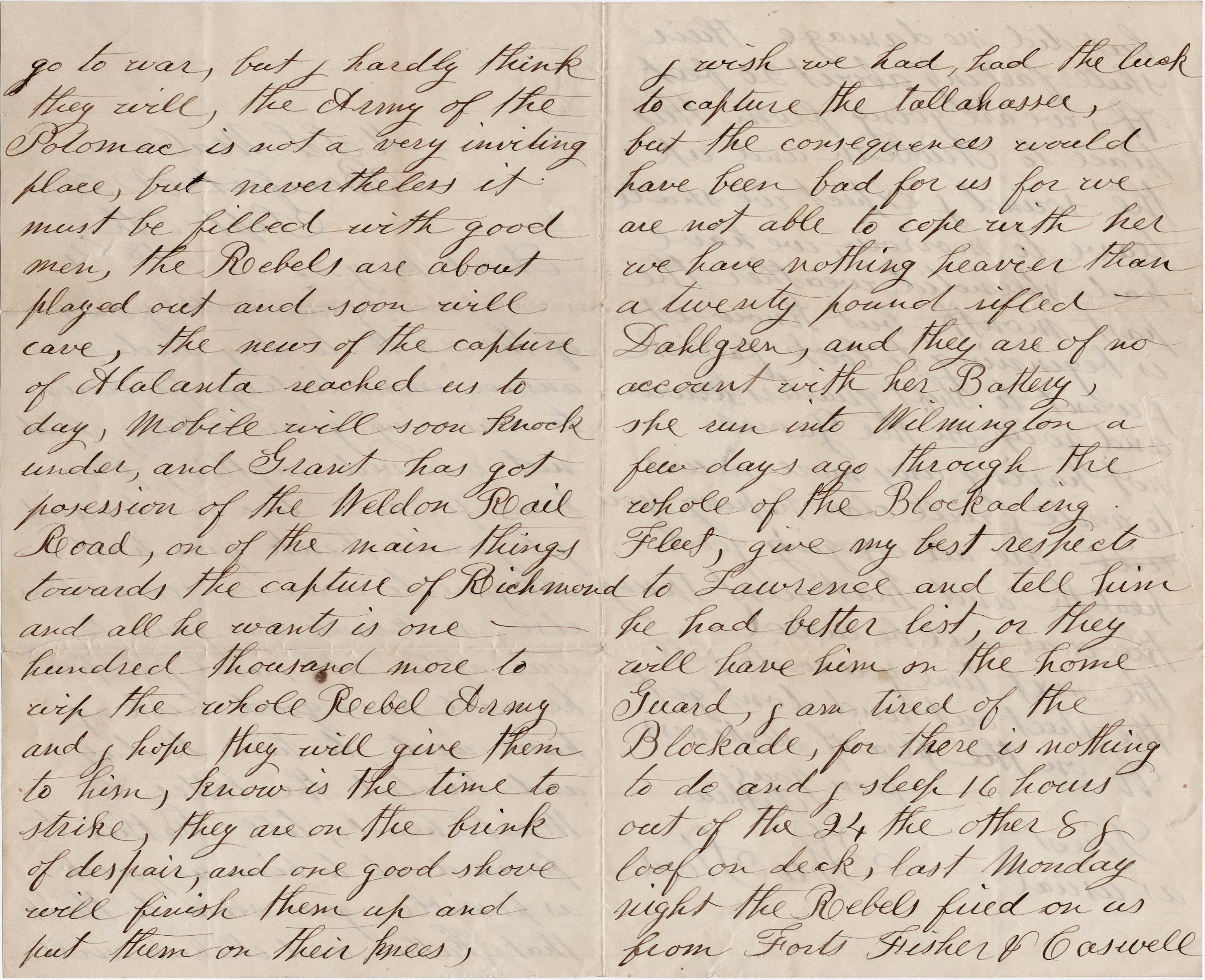
The Rebels are about played out and soon will cave. The news of the capture of Atlanta reached us today. Mobile will soon knock under and Grant has got possession of the Weldon Railroad—one of the main things towards the capture of Richmond—and all he wants is one hundred thousand more [men] to whip the whole Rebel Army and I hope they will give it to him. Now is the time to strike. They are on the brink of despair and one good shove will finish them up and put them on their knees.
I wish we had had the luck to capture [the CSS] Tallahassee 1 but the consequences would have been bad for us for we are not able to cope with her. We have nothing heavier than a 20-pound rifled Dahlgren and they are of no account with her battery. She run into Wilmington a few days ago thruogh the whole of the blockading fleet.
Give my best respects to Lawrence and tell him he had better [en]list or they will have him on the Home Guard. I am tired of the blockade for there is nothing to do and I sleep 16 hours out of the 24. The other 8 I loaf on deck. Last Monday night the Rebels fired on us from Forts Fisher & Caswell but did not damage—their shell falling about 20 feet off. We are going from this place to Newbern and up the sound. I expect we shall leave tomorrow.
We have had splendid weather the past month but now it is beginning to look fallish. I want to shift quarters now and go up on the James. Not having any more news to write, I will close hoping you are all enjoying good health and that next spring the war will be ended. The next time you write, fill the sheet out and don’t get off on the plea of sleepiness.
From your nephew, — Theo. Stone
Direct as usual.
1 The CSS Tallahassee was purchased from England in 1864 and placed under the command of J. T. Wood, CSN, who took her through the blockade on 6 August 1864 and made a brilliant 19-day raid off the Atlantic coast as far north as Halifax, N.S. Being unable to procure enough coal to continue, Cdr. John Taylor Wood was forced to return to Wilmington where he arrived safely on the 26th. During this short cruise Tallahassee destroyed 26 vessels and captured 7 others which were bonded or released. The vessel carried three main guns: one rifled 100-pounder Parrot rifle positioned amidships, one 32-pounder rifled cannon forward, and another heavy Parrott rifle aft.
 Spared & Shared 23