
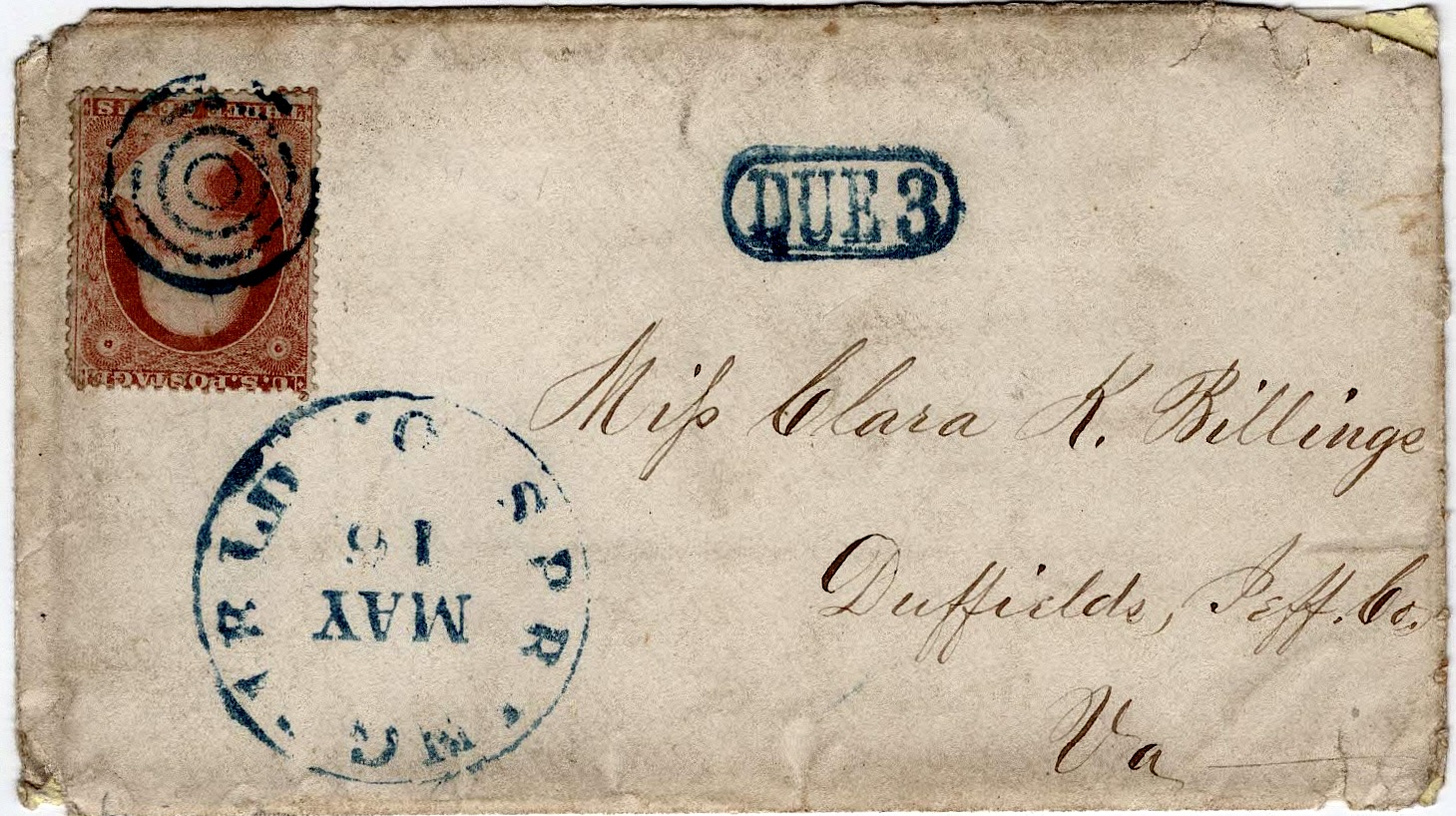
The following letter was written by George Carpenter Shepard (1840-1919), the son of Erastus Shepard (1794-1850) and Eliza Matthews Carpenter (1797-1872) of Rochester, Monroe county, New York.
At the time of the 1863 Draft Registration, 23 year-old George was enumerated in Rochester where he identified himself as a “student” and unmarried. He was married the following year, in February 1864, to Clarissa (“Clara”) Kibbie Billings (1841-1908) in Kenton, Kentucky. In 1870, George was enumerated in South Charleston, Clark county, Ohio, where he was employed as a “Druggist.” George and his son Clarence, conducted Fairfax Hall, a girls school, in Winchester, Virginia, in the 1880s and 1890s. The school was established in 1869 by Rev. Silas Billings, Clara’s father.
Though he claimed in his letter that he would not enlist, Civil War Muster Roll Abstracts inform us that he did so on 10 October 1861 at Rochester for a period of three years. He was mustered into the 8th New York Cavalry as Chief Bugler on 23 November 1861 and was mustered out a year later on 16 October 1862 at Hagerstown, Maryland. His muster roll indicates he was taken prisoner on 14 September 1862 and paroled twelve days later.
T R A N S C R I P T I O N
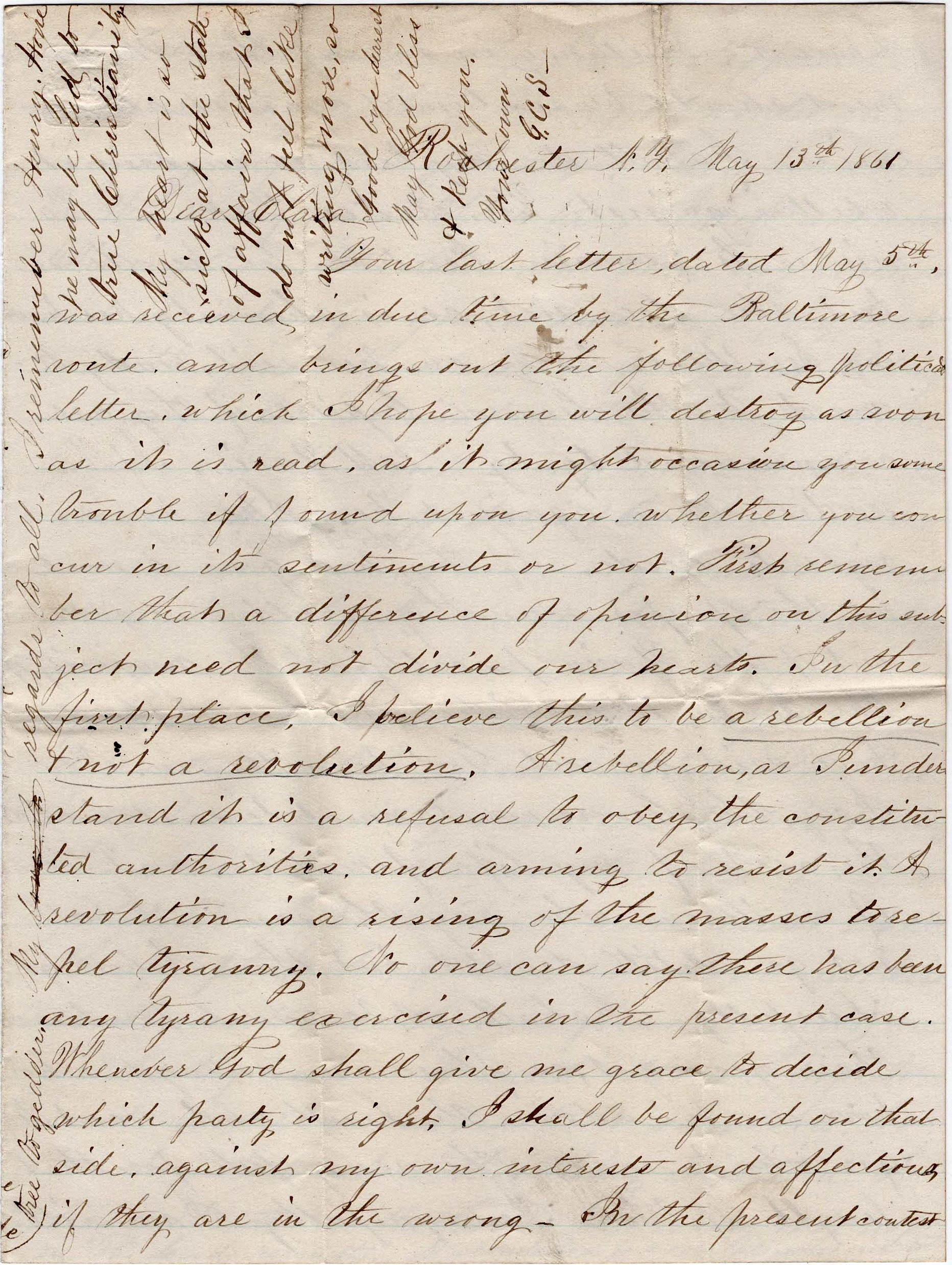
Rochester, New York
May 13th 1861
Dear Clara,
Your later letter, dated ay 5th, was received in due time by the Baltimore route and brings out the following political letter which I hope you will destroy as soon as it is read as it might occasion you some trouble if found upon you, whether you concur in its sentiments or not. First, remember that a difference of opinion on this subject need not divide our hearts. In the first place, I believe this to be a rebellion and not a revolution. A rebellion, as I understand it, is a refusal to obey the constituted authorities, and aiming to resist it. A revolution is a rising of the masses to repel tyranny exercised in the present case. Whenever God shall give me grace to decide which party is right, I shall be found on that side, against my own interests and affections, if they are in the wrong.
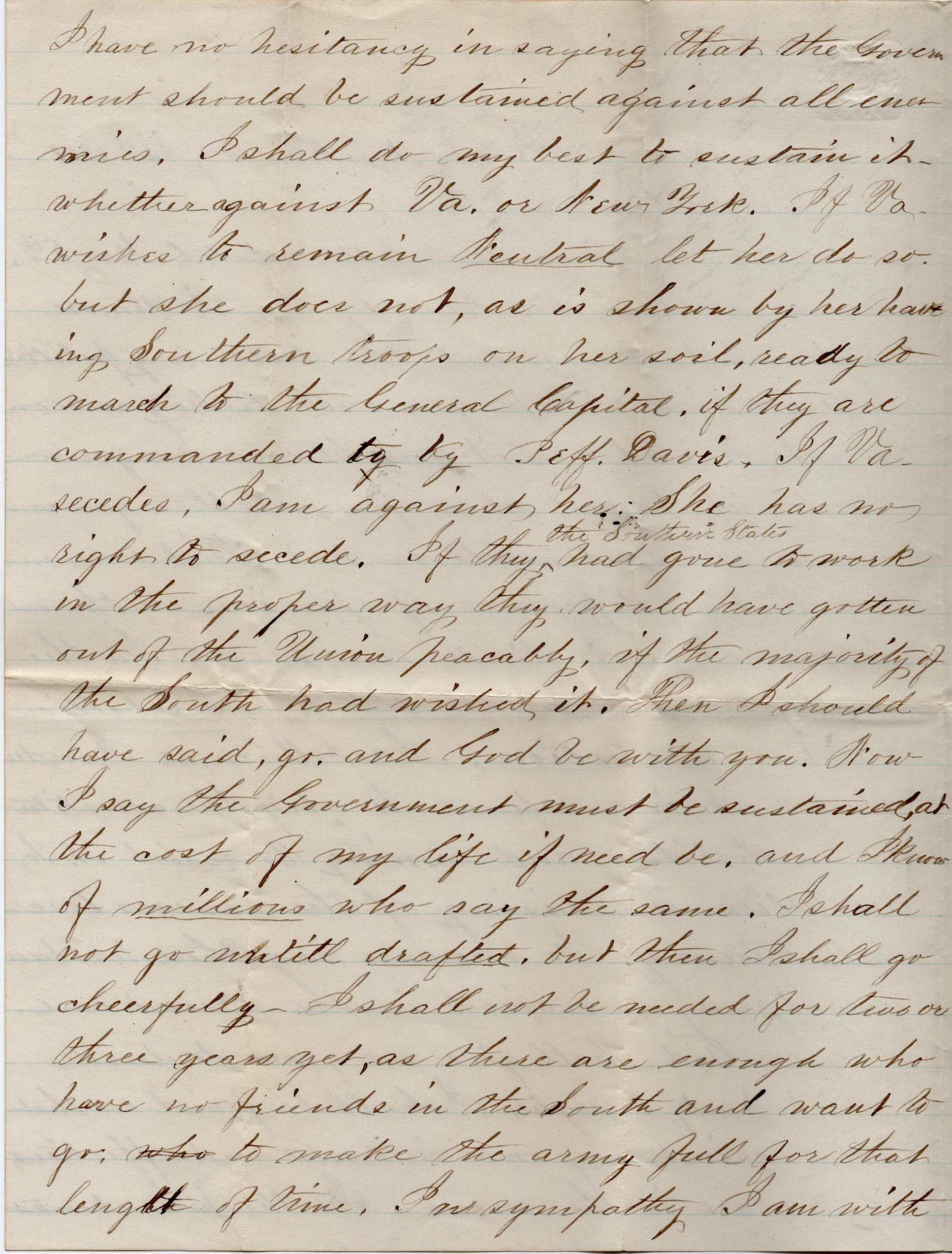
In the present contest, I have no hesitancy in saying that the Government should be sustained against all enemies. I shall do my best to sustain it, whether against Virginia or New York. In Virginia wishes to remain neutral, let her do so. But she does not, as is shown by her having Southern troops on her soil ready to march to the General Capitol, if they are commanded to by Jeff Davis. If Virginia secedes, I am against her. She has no right to secede. If they—the Southern States—had gone to work in the proper way, they would have gotten out of the Union peaceably, if the majority of the South had wished it. Then I should have said, “Go, and God be with you.” Now I say the Government must be sustained at the cost of my life, if need be, and I know of millions who say the same.
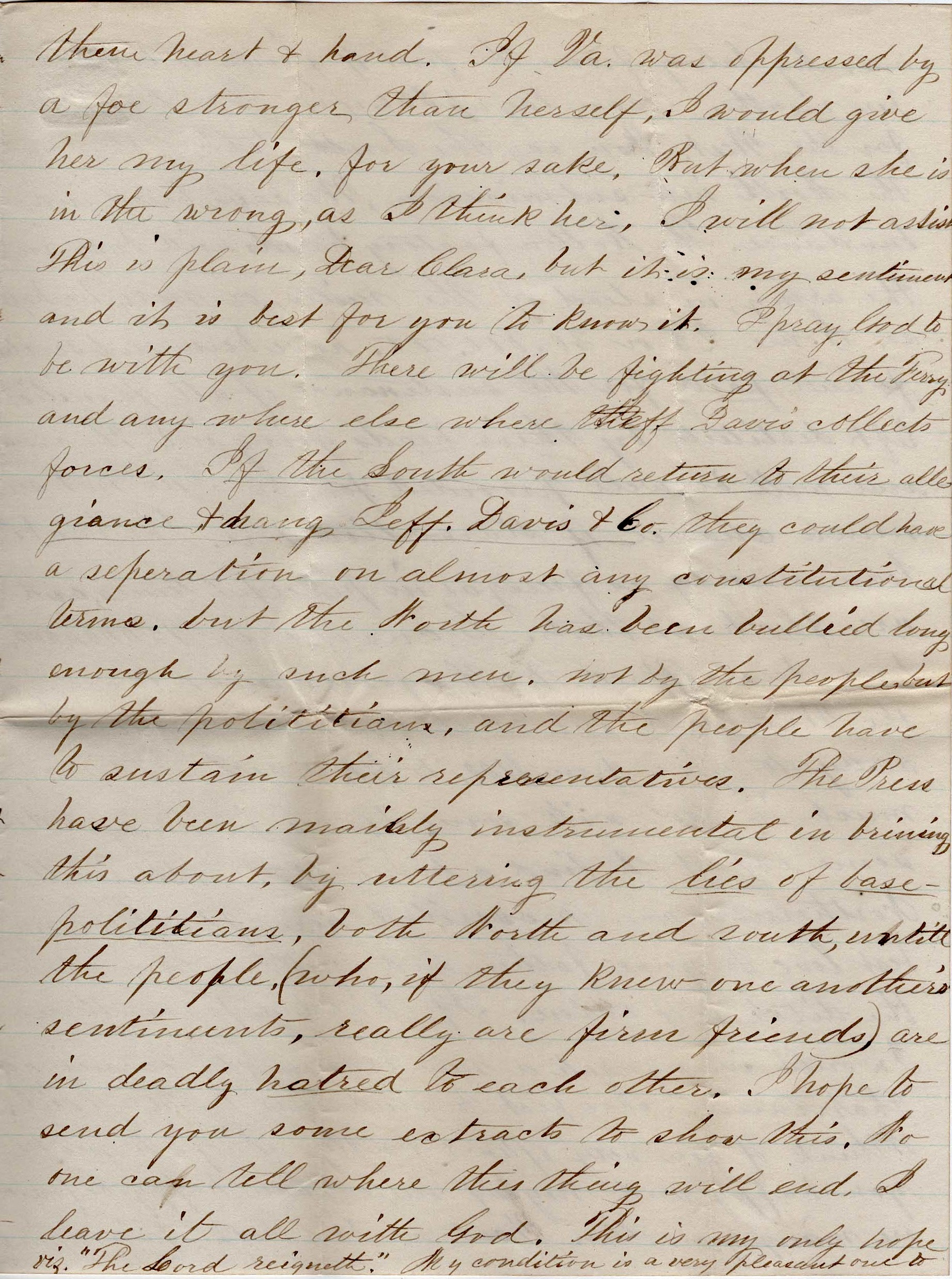
I shall not go until drafted, but then I shall go cheerfully. I shall not be needed for two or three years yet, as there are enough who have no friends in the South and want to go to make the army full for that length of time. In sympathy, I am with them heart & hand. If Virginia was oppressed by a foe stronger than herself, I would give her my life for your sake. But when she is in the wrong, as I think her, I will not assist. This is plain, dear Clara, but it is my sentiment and it is best for you to know it. I pray God to be with you.
There will be fighting at the Ferry, and anywhere else where Jeff Davis collects forces. If the South would return to their allegiance & hang Jeff Davis & Co., they could have a separation on almost any constitutional terms. But the North has been bullied long enough by such men—not by the people, but the politicians—and the people have to sustain their representatives. The Press have been mainly instrumental in bringing this about, by uttering the lies of base politicians, both North and South, until the people (who, if they knew one another’s sentiments, really are firm friends) are in deadly hatred to each other. I hope to send you some extracts to show this.
No one can tell where this thing will end. I leave it all with God. This is my only hope—viz: “The Lord Reigneth.”
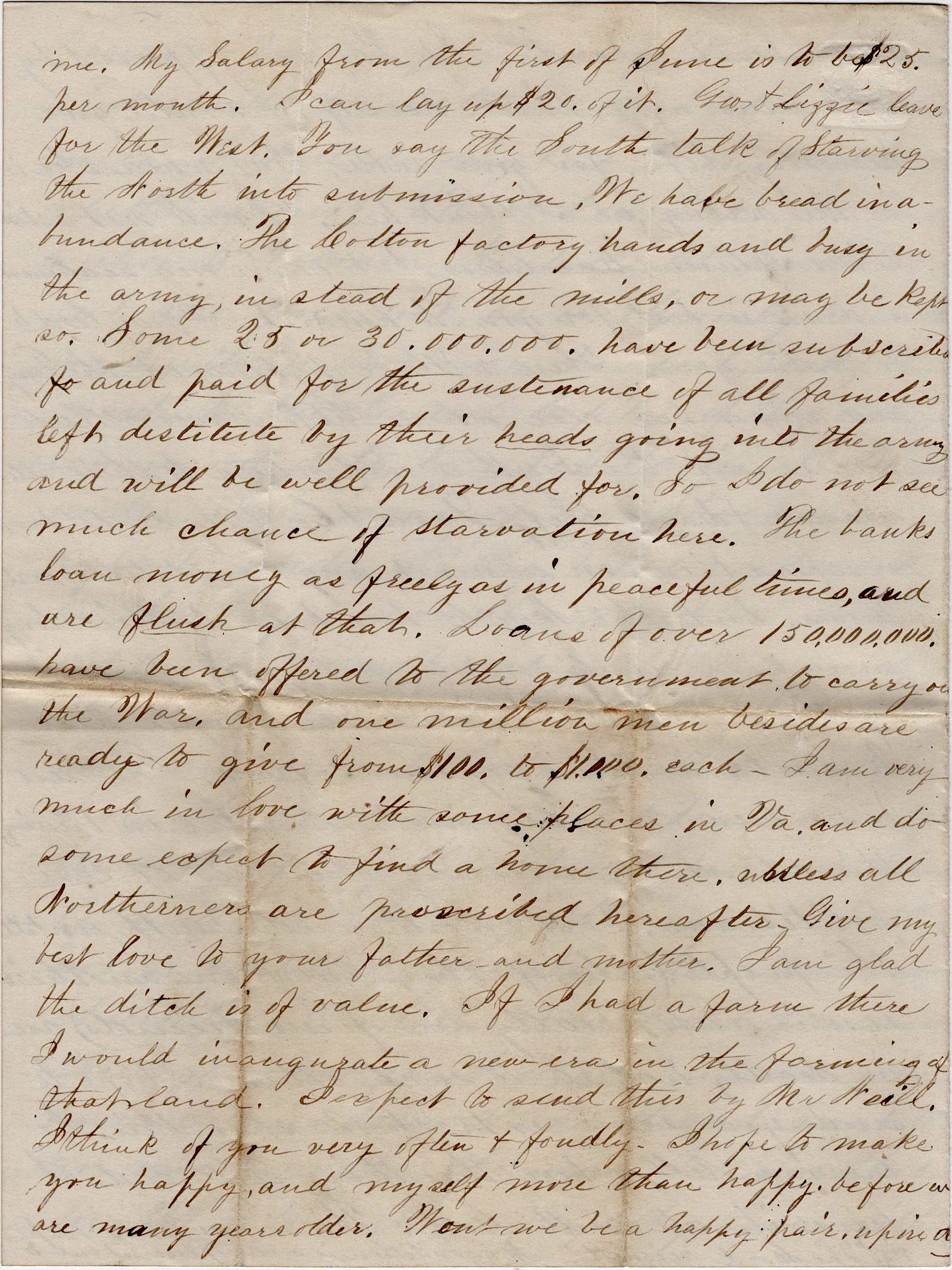
My condition is a very pleasant one to me. My salary from the first of June is to be $25 per month. I can lay up $20 of it. George & Lizzie leave for the West. You say the South talk of starving the North into submission. We have bread in abundance. The Cotton factory hands are busy in the army instead of the mills, or may be kept so. Some 25 or 30,000,000 have been subscribed and paid for the sustenance of all families left destitute by their heads going into the army and will be well provided for. So I do not see much chance of starvation here. The banks loan money as freely as in peaceful times and are flush at that. Loans of over 150,000,000 have been offered to the government to carry on the war, and one million men besides are ready to give from $100 to $1,000 each.
I am very much in love with some places in Virginia and do some expect to find a home there unless all Northerners are proscribed hereafter. Give my best love to your father and mother. I am glad the ditch is of value. If I had a farm there, I would inaugurate a new era in the farming of that land. I expect to send this my Mr. Neill. I think of you very often and fondly. I hope to make you happy and myself more than happy before we are many years older. Won’t we be a happy pair up in a tree togedder?
My regards to all. I remember Henry Hine. He may be led to true Christianity. My heart is so sick at the state of affairs that I do not feel like writing more, so goodbye, dearest. May God bless you & keep you. Your own, — G. C. S.
 Spared & Shared 23