
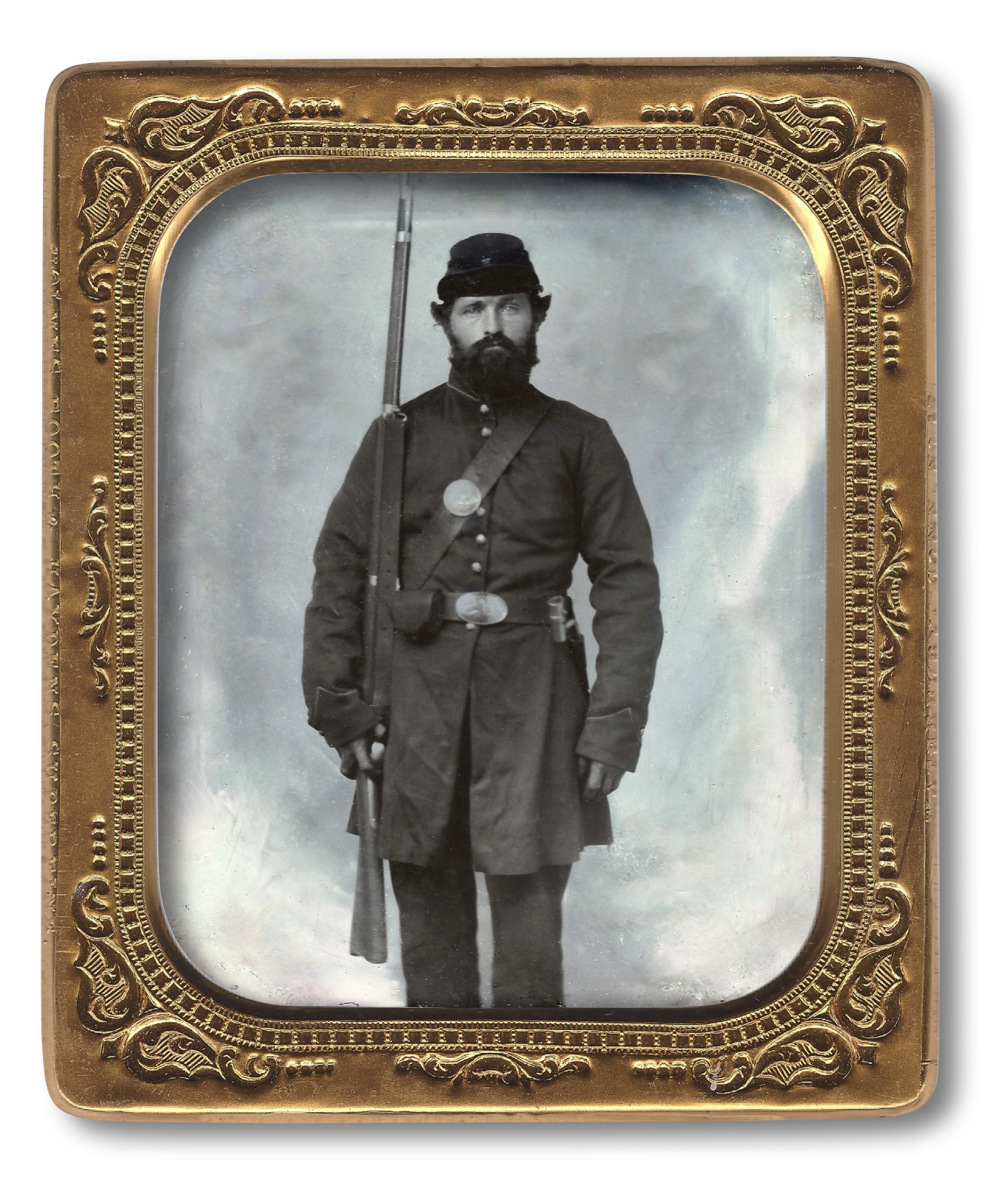
The following archive of 55 Letters were written by Pvt. William J. Dinsmore (1834-1862), of Co. H, 1st Massachusetts Infantry. They are all addressed to his wife, Elizabeth or “Lizzy” (Bryson) Dinsmore (1836-1909). Dinsmore was mortally wounded, shot in the groin on 29 August 1862 in the Second Battle of Bull Run. He died at Centerville, Virginia, on 3 September 1862. Many of the letters have in depth discussions of significant battle events, camp life, picket duty, seeing the USS Monitor and a vast array of other wartime, soldier activities. Dinsmore, a ship joiner by trade, enlisted in May 1861, in Chelsea, Massachusetts. He served with the regiment until his death in September 1862.
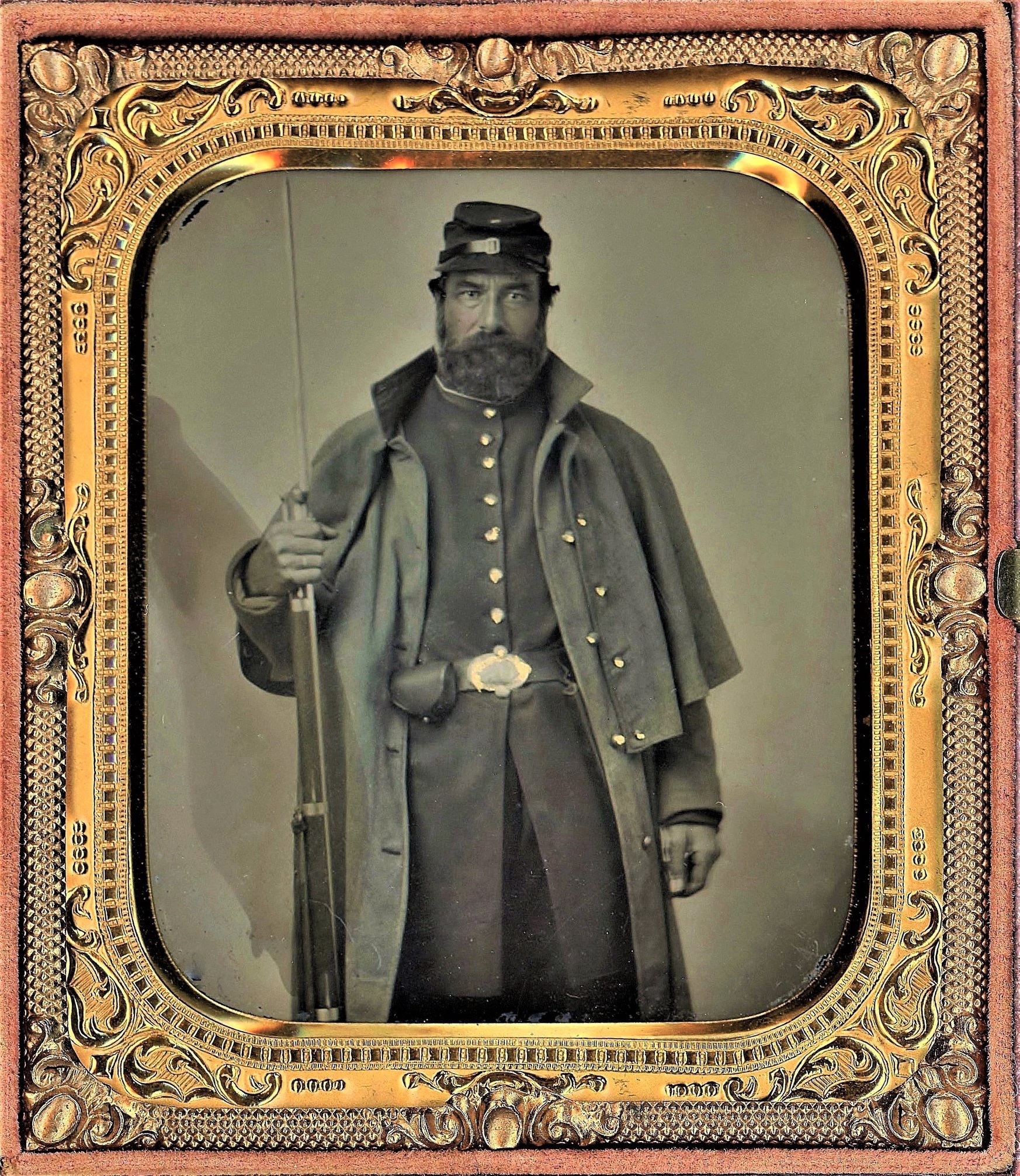
Accompanying the group of letters are four period documents: a pass for Dinsmore and a compatriot; a small, satirical printed, anti-Jefferson Davis cartoon with Dinsmore’s inscription on the back indicating his regimental affiliation and current position “Army of the Potomac in front of Richmond 1862”; a patriotic motif sheet inked by Dinsmore as being sent from Camp Union at Bladensburg, Md. on Oct. 20, 1861; an early 20th century, state of Massachusetts document, perhaps a pension affidavit. Also included in this grouping are two cased images—a 1/6 plate, ruby Ambrotype of Private Dinsmore in uniform, fully accoutered, holding a musket; 1/9 plate daguerreotype of Lizzie Dinsmore.
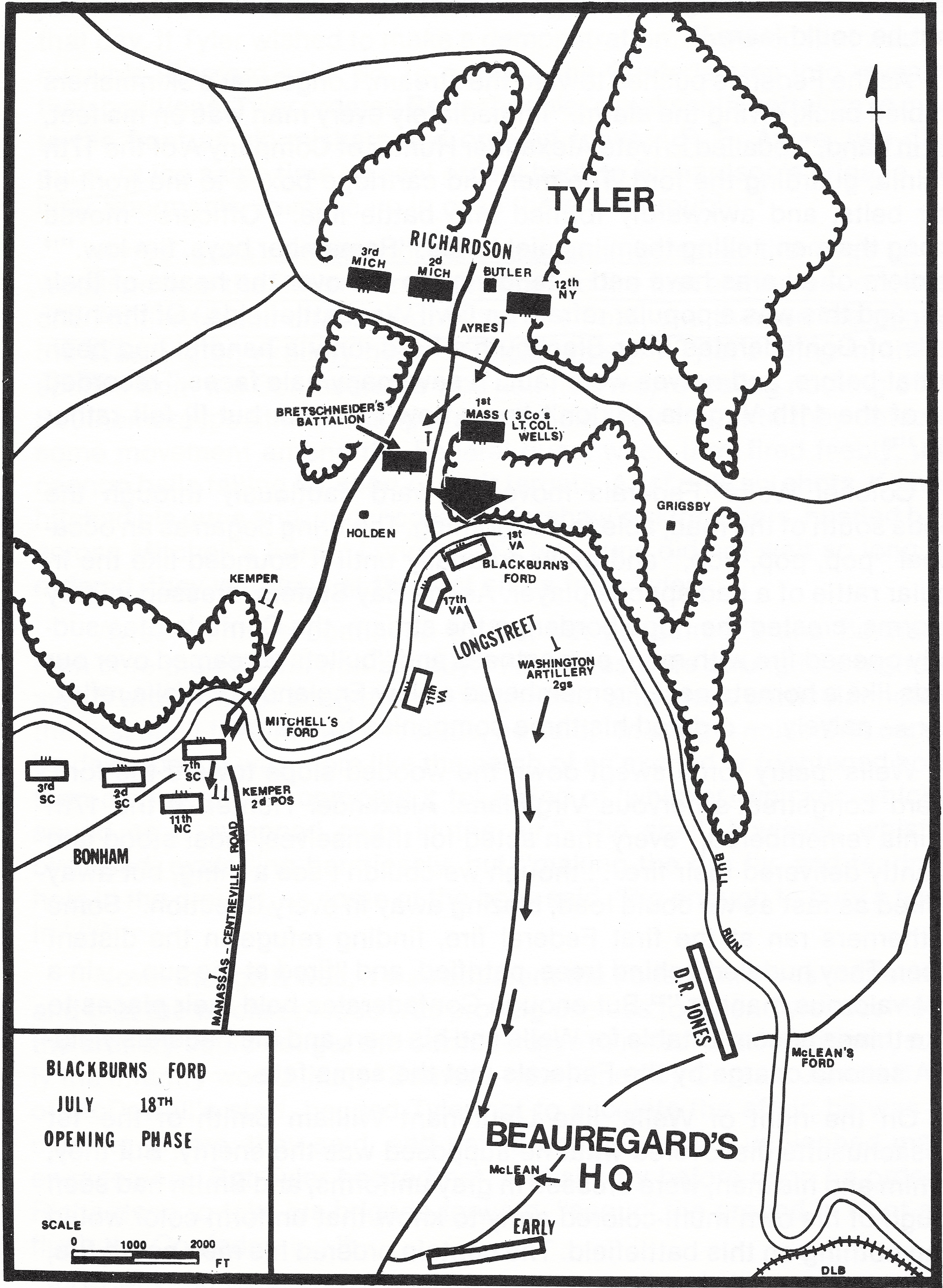
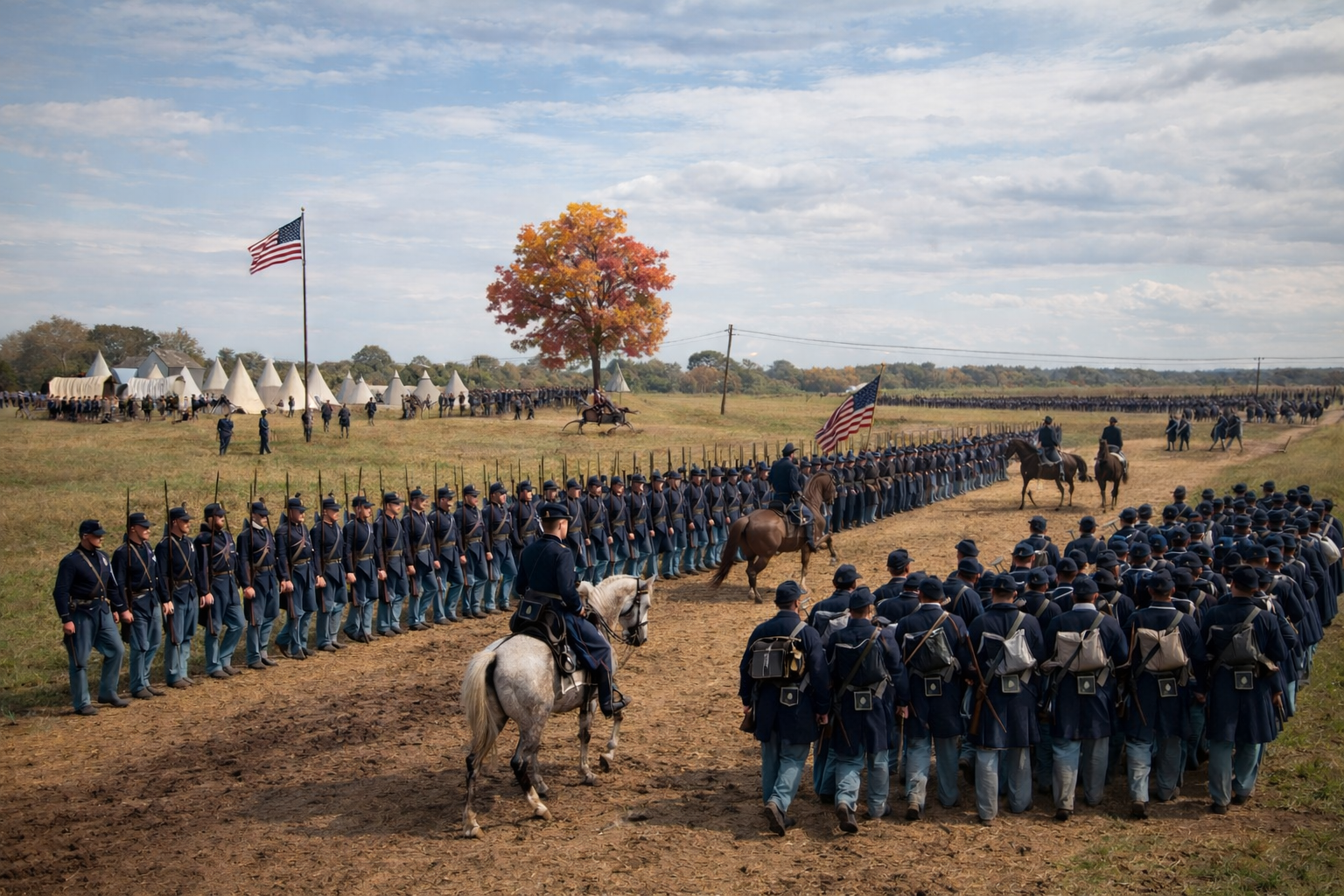
The 1st Massachusetts Volunteers were commanded by Col. Robert Cowdin. To the five companies of the 1st Regt. Mass. Vol. Mil. were added five others of volunteers raised in April, 1861. Four companies were mustered into the service May 23, four others May 24, and one each on May 25 and May 27. On June 1 the regiment assembled at Camp Ellsworth on the banks of Fresh Pond in Watertown. Twelve days later it was transferred to Camp Cameron in North Cambridge. Leaving Massachusetts June 15, on the 17th it reached Washington. Assigned to Richardson’s Brigade of Tyler’s Division, it remained in camp near Washington until the advance to Bull Run where it participated in the battle at Blackburn’s Ford, July 18, three days before the main battle of Bull Run. In August it became a part of the famous Hooker Brigade. During the fall it was encamped for some time at Bladensburg, did duty on the Potomac above Washington, built Fort Lincoln, moved to Budd’s Ferry, and was variously engaged until spring when it became a part of Grover’s Brigade, Hooker’s Division, Heintzelman’s (3d) Corps, and was transferred to the Peninsula.
On April 6 it was in action before Yorktown, and on May 5 it suffered heavily at Williamsburg. It was encamped in the White Oak Swamp region until June 25 when it was engaged with loss at Fair Oaks. During the Seven Days battles it lost heavily at Glendale, June 30, its major, Charles P. Chandler being killed. After the battle of Malvern Hill it retired to Harrison’s Landing where it remained until August when it was ordered back to the defenses of Washington. Joining Gen. Pope’s army near Warrenton Junction., as a part of Grover’s Brigade, Hooker’s Division, it was in action at Bristoe Station, Aug. 27, and again near Groveton (Manassas), Aug. 29, where it assaulted the celebrated railroad embankment and suffered severe loss. After the campaign was ended the regiment remained in or near the defenses of Washington until the last of October.
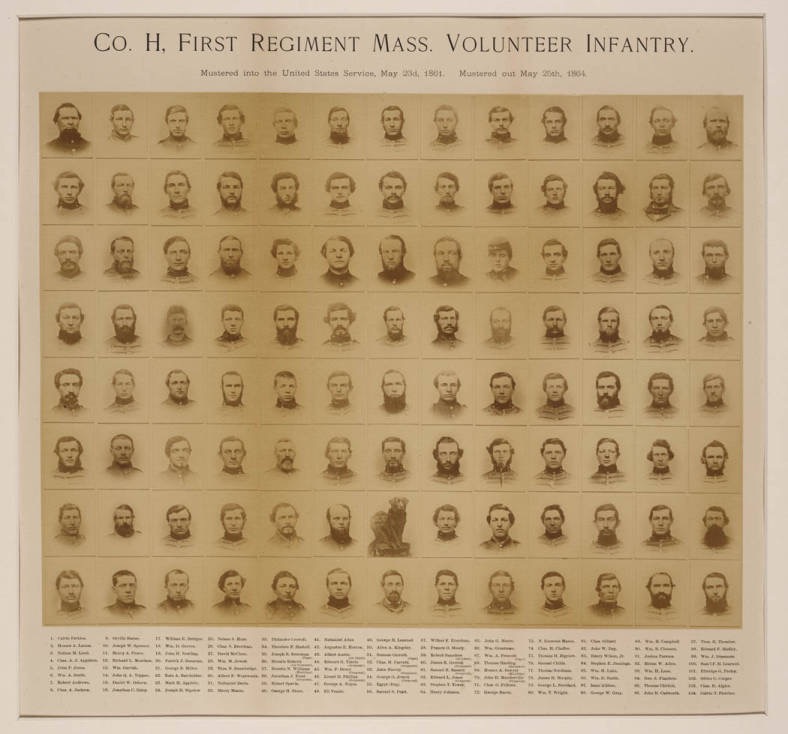
Over the years I have transcribed and published quite a number of letters by members of the 1st Massachusetts Infantry (see below), but this collection is by far the greatest number written by a single member and the first from Co. H.
Joseph Edward Kimball, Co. B, 1st Massachusetts (3 Letters)
Joseph Edward Kimball, Co. B, 1st Massachusetts (2 Letters)
George S. Campbell, Co. C, 1st Massachusetts (1 Letter)
Benjamin F. Mead, Co. C, 1st Massachusetts (1 Letter)
Seth F. Clark, Co. D, 1st Massachusetts (1 Letter)
Charles Augustus Warren, Co. D, 1st Massachusetts (1 Letter)
Joseph H. Caldwell, Co. F, 1st Massachusetts (1 Letter)
Unidentified, Co. B, C, E, F, or I, 1st Massachusetts (2 Letters)
Letter 1
[Editor’s Note: “This regiment, one of the most complete in every respect of any which has yet arrived here, reached the city about six o’clock last evening by the cars. The Massachusetts 1st numbers 1,046 men, exclusive of servants. The uniform is a grey jacket, grey overcoat, drab pantaloons, and grey fatigue caps, trimmed with red cord.” Source: The Boston Daily Advertiser, 4 May 1861]
Camp Ellsworth
3 o’clock June 2nd 1861
Dear Lizzie,
I take this opportunity of writing these few lines to let you know that I am well. We arrived here at 8 o’clock last night. We walked all the way only 6 miles from Boston. I want when you write to let me know of Josiah Gould paid you 5 dollars last night because I gave Pingnee an order on the common to get it from the city of Chelsea for five money and he said he would give it to sis Gould to give to you. When you write, direct to
Wm. J. Dinsmore, Co. H, 1st Reg. Mass. Vol., Care of Capt. S. Carruth
Hoping this letter will find you and Mother and the children all well, I remain yours, &c., — W. J. Dinsmore
I will send you more news in a day or two — W. J. D.
Letter 2
Camp Ellsworth, Cambridge
June 3rd 1861
Dear Lizzie,
When I wrote yesterday, I forgot to tell you how to send your letters to me. All you have to do is to direct them to, care of Captain S. Carruth, Company H, 1st Regt. M. V. and take it up to the City Hall any time before 11 o’clock because there is a messenger leaves the City Hall every day at 12 o’clock and leaves the camp every evening.
We are all well. I am going to try to get in to see you some day before Sunday if I can. We drilled all day yesterday. The drums beat every morning at 5 o’clock. We have to turn out and drill two hours. Then breakfast. Then turn out and [drill] until dinner time. Then after dinner we drill until 5 o’clock. Then have supper. Then turn out and drill about 1.5 hours. Then go to bed if you want to. Some of the fellows grumble because they don’t get feed enough but I have had enough so far but things have not got regulated yet.
It is raining very hard now so we won’t have to drill any today. We march to Lexington and back tomorrow if it is a fine day. We would have gone today, only it rains. We have a good deal better time than I thought we would have.
I want you to send me 6 or 7 sheets of paper and envelopes and one dollar if you have it to spare as I have not a cent of money and I don’t know when we will get our money.
Hoping this letter will find you and the children and Mother all in good health, I will conclude. Give my best respects to all enquiring friends. No more at present. From your affectionate husband, — W. J. Dinsmore
Letter 3
Sunday, June 9th [1861]
Dear Lizzie.
I take this opportunity of writing these few lines to you hoping to find you all in good health as this leaves me. I send a small turtle in this bundle. If you put him in a dish of water one and a while, he will live. He don’t want to be in the water all the time.
We leave here Tuesday or Wednesday. I will be in before we go so you need not come out here because you might miss me as I don’t know what day I shall go in. No more at present. From your affectionate [husband], — W. J. Dinsmore
Letter 4
[Editor’s Note: The 1st Massachusetts Infantry (1,045) was ordered to proceed by the Boston & Providence Railroad to Jersey City, Hudson County, New Jersey, in the morning on 15 June, 1861, and arrived by the New Haven, New London & Stonington Railroad at Groton, New London County, Connecticut, at 3 AM on 16 June, 1861. The regiment was ordered to proceed by the steamer Commonwealth on the Thames River to Jersey City, Hudson County, New Jersey, at 5 AM the same day and arrived on the North/ Hudson River at the wharf, junction of Montgomery and Hudson Streets, Jersey City, Hudson County, New Jersey, at 2 PM on 16 June, 1861. The 1st Massachusetts Infantry was ordered to proceed by the New Jersey Railroad at New Jersey Station, corner of Hudson and Mercer Streets, Jersey City, Hudson County, New Jersey, to Washington, D. C., at 7 PM on 16 June, 1861, and arrived by the Camden Branch, Camden & Amboy Railroad, at Camden, Camden County, New Jersy, in the morning the same day. The regiment arrived by the South Camden Ferry on the Delaware River at Washington Street Wharf, Philadelphia, Philadelphia County, Pennsylvania, at 4 AM on 17 June, 1861, and was ordered to proceed by the Philadelphia, Wilmington & Baltimore Railroad to Baltimore City, Maryland, at 7 AM the same day. The 1st Massachusetts Infantry arrived at President Street Station, corner of President Street and Canton Avenue, Baltimore City, Maryland, at 12.45/1 PM on 17 June, 1861, and was ordered to proceed by the Baltimore & Ohio Railroad at Camden Station, corner of South Howard and Camden Streets, Baltimore City, Maryland, to Washington, D. C., at 3 PM the same day. The regiment arrived by the Washington Branch, Baltimore & Ohio Railroad, at Washington, D. C., via Annapolis Junction, Howard County, Maryland, at 6 PM on 17 June, 1861. In Washington D. C., eight companies of the 1st Massachusetts Infantry were stationed at W Woodward’s building, corner of West Eleventh Street and Pennsylvania Avenue, and two companies at West Sixth Street, Washington, D. C., on 17 June, 1861.]
Washington
June 18th
Dear Lizzie,
I write this letter to let you know that we have arrived all safe and well at Washington. We arrived here about 8 o’clock last night, just 48 hours after leaving Boston. We left Boston at 8 o’clock Saturday evening in the cars and arrived at Stonington about 3 Sunday morning where we took passage in the steamer Commonwealth for Jersey City where we arrived at 2 o’clock Sunday afternoon. We had a good view of New York as we sailed by it. The Massachusetts folks in Jersey City gave us a first rate colation [?] when we came there.
After we got through with the colation, we took the cars for Philadelphia where we arrived at daylight the next morning. We ought to have arrived about 10 o’clock but the ferry boats that we was aboard of in crossing the river to Philadelphia got ashore and we have to lay there three hours until another ferry boat took off five of the companies. We had a good colation in Philadelphia after which we took the cars for Baltimore where we arrived all safe and sound about 1 or 2 o’clock. Got out of the cars, formed ranks of double file of over 900 guns and marched through Baltimore. The band playing different tunes, Yankee Doodle, &c. Everything was quiet. Nobody said a word to us. They did not like the looks of us. Every gun was loaded with ball cartridge and every man had ten round of cartridge in his cartridge box,
After we had marched through the city, we took the cars for Washington, stopping at the Relay House about half an hour. The Massachusetts 6th & 8th are both stationed here (at the Relay House). They have sentries stationed all along the railroad to Washington, about 25 soldiers to the mile as sentries.
We arrived in Washington about 7 o’clock, marched up to a building about a quarter of a mile from the depot, spread our blankets on the floor, and went to sleep—the first sleep we had since we left Cambridge. We can see out of the window the white tents of the Massachusetts 5th where they are encamped in Alexandria, Virginia. There was a fight last night about 20 miles from here at a place called Vienna and at last accounts was still going on. We are going into camp today.
I sent you a five dollar gold piece by Frank Fry Saturday eve. No more at present. I will write again as soon as I get encamped. Direct to:
Wm. J. Dinsmore, Co. H, 1st Mass. Vol. and out it in the City Hall and it will come safe. Your affectionate husband, — W. J. Dinsmore
Letter 5
Georgetown Heights
District of Columbia
June 21st 1861
Dear Lizzie,
I take this opportunity of writing these few lines to you and the children and Mother [hoping you are] all in good health as this leaves me at present.
We are now encamped on the Heights of Georgetown five and a half miles from Washington and on the opposite side of the river from us is the soil of Virginia. The order last night was for every man to have his knapsack packed ready to start for Harper’s Ferry for it was reported the enemy was marching this way. Harper’s Ferry is 35 miles from here in Virginia but our picket guard was out all night and did not hear or see anything so we did not have to march to meet the enemy. We may be encamped here for the next three months with nothing to do or we may leave here within two hours.
But this is a great country. When I was in Washington, I visited the White House and saw Uncle Abraham, the President. Also the Capitol and saw the sights. I was in the Senate Chamber and all through the building. It is a splendid building—the best I ever saw, I also went through the Patent Office and saw all curiosities and models of patents. There is some of the greatest curiosities in [the] United States in there.
June 23rd. Turned out this morning at 5 o’clock, went down in the river and swam across into Virginia. Had a first rate swim. Also stood on the soil of Virginia in my bare feet. Came back to camp and had a company drill at 6 o’clock. Drilled to 8, then had breakfast.
This is a rough country up here. There is over one thousand families live round here where we are encamped. They live in rough board shanties. We have had rough living since we came here but we will have better now we have got settled in camp, I have paid for all my own feed so far but now I am going into eat camp feed. That was the reason I did not send you any more money, because I expected we would have a hard siege to go through and we did have, but I came out all right.
I don’t know as I can write any more at this time. I have nothing particular at present to write about. The hardest time we had was walking from Washington to this place where we are encamped under the hottest sun I ever felt with our overcoats on and knapsacks on our backs. A good many of the boys caved in and lay down on the grass and did not get into camp for over an hour after the regiment.
Direct to Wm. J. Dinsmore, care of Capt. Carruth, Company H, 1st Reg. Mass. Vol., Washington D. C.
Put it in the City Hall and it will come safe. Yours husband, — W. J. D.
The boys that had no money fared bad in Washington.
Direct your letter to Washington and I will get them no matter where the regiment is. Give my best respects to Mrs. [Catherine M.] Corey & [daughter] Charlotte and everybody else.
Letter 6
[Editor‘s Note: “Camp Banks, Georgetown Heights, D. C., Thursday, 29 June – The encampment is about four miles from the city, in a place called Drover’s Rest, Georgetown, on the bank of the Potomac River. It is a beautiful hill, about 150 feet from the water; the air fine, and there is a large number of apple, paech and cherry trees on the ground. Near us [1st Massachusetts], about three-quarters of a mile, is also stationed the Michigan Regiment, and about a mile and a half the Maine Regiment.” Source: American Traveller (Boston, Suffolk County, Massachusetts) , 29 June, 1861]
Camp Banks, Georgetown
June 28th 1861
Dear Lizzie,
I received your letter last night and was glad to hear that you was all well as this leaves me at present. Thank God for His mercy to us. This is the third letter I have wrote to you so you see I have not forgotten you nor never will so long as I draw breath. I wrote a letter to you the night we landed in Washington. That was a week before I wrote to Wells and I don’t know how it was that he got his before you did. And I wrote your second one the same day that I wrote to Tom Corey 1 yesterday before I received yours.
We are all well here at present and we are likely to stay here for some time. In fact, I don’t think the regiment will ever have much fighting to do. This regiment has had a very hard name in Boston papers but folks would not blame them if they knew the facts of the case because they did not have feed enough at the first of their coming here and so some of the men helped themselves to ducks, geese, chickens, &c. that happened to stray round the camp. But they get good feed now and enough of it too.
I am sorry that you are short of money. I have a two and a half dollar gold piece that I have saved but I cannot send it in the letter because the letters has to pass through so many hands, some of them would feel it in the letter and perhaps take it out. But I will try and get it changed and a get a two dollar bill so as to send it to you in the next letter. If you had got my first letter, you would have known all about the money and how much I got which was 11 dollars and 40 cents. I don’t see how it was the Mayor did not call and give you the five dollars because I gave him a 5 dollar gold piece before we left Cambridge and he said he would call the next day and give it to you.
If you have not received two letters beside this one, you had better make enquiries about it. Let me know where you get your letters, whether it is in the post office or at the City Hall. You can send a paper once in a while and if somebody says anything about me, you can believe it [or] not, but I would advise you to pay no attention to them.
Give my best respects to Josiah Gould and all enquiring friends. Tell him I will write to him one of these days soon. Sam Hunt paid a visit to our camp the other day. He is well but would like to be home. Kiss the children for me. I should not wonder if the war was all over before three months. Then I will come home safe and sound. A good many of the boys has been sick but nothing seems to trouble me. We are to get paid off the first of July so you will get 10 dollars then. This paper is too small.
Yours to death, — Wm. J. Denser
1 Thomas Spencer Corey (1822-1884) was a carpenter who also lived in Chelsea, Suffolk county, Massachusetts. At the age of 45, he enlisted as a corporal in the 4th Massachusetts for three months service.
Letter 7
[Editor’s Note 1: “Camp Banks, Georgetown D. C., 15 July, 1861 – Whilst we were enjoying our ‘otium cum dignitate,’ at supper yesterday, a messenger from acting Brig. Gen. Richardson, drove up with an order for all four companies, (two Michigan and two from the 1st regiment,) ro report immediately to our respective camps We started at 9 P.M., on our long weary road, (17 miles,) and came to a halt here at just 4 o’clock in the morning. Twenty men from each of the right and left commands (Capts. Snow and Pearl) have been detached as skirmishers, in connection with details from other regiments in the brigade, and are now being drilled by a U. S. Army officer all the time.” Source: Boston Evening Transcript , 17 July, 1861]
[Editor’s Note 2: “A dispatch to the Times says the US Quartermaster General gas decided to furnish the 1st Massachusetts Regiment with a new regulation uniform forthwith: Col. Cass’s and Col. Clark’s Regiment will also have to be renewed at once.” Source: American Traveller, July 6, 1861]
Camp Banks
Monday, July 8th 1861
Dear Lizzie,
I take this opportunity of writing to you hoping to find you and Mother and the children all in good health as this leaves me at present. Thank God for His mercy to us. I received your last letter Saturday night and was glad to hear that you were all well. I should like to have been to [see the] fire in East Boston because there was some fun there. I suppose there was a good deal of excitement there. Ben Chelle’s shop was burned so I suppose if I had of been home, I should of had my tools all burned.
But I expect we will have some excitement here soon. There was a fight some 15 miles from here last night but we don’t know how they made out, but two of the companies of our regiment had orders to strike the tents and leave so Co’s I and K left here this morning about 6 o’clock with their knapsacks and their cartridge boxes full of cartridges and the rest of us that is left here have orders to be ready to start at a moment’s notice. So we have our knapsacks packed all ready to start at a moment’s notice.
We was examined by the army doctor on Saturday and there is about six in our company that will not pass. They will be home in the course of a week. I believe that Dick Morrison is one of them but I am not sure. He says himself that he did not pass so that is all I know about it. The doctor says if there is anything the matter with me, he cannot find it so there is no chance for me to be sent home.
You can write a letter to Jim yourself. Tell him how I am and where I am &c. We don’t know half so much about the war here as the folks in Boston do. All we know about the war is what we get out of the Boston papers. Give my best respects to all enquiring friends. No more at present. From your affectionate husband, — W. J. Dinsmore
I received a letter from T. Corey yesterday giving a full account of the fire in East Boston & Boston. Tell [15 year-old] Charlotte [Corey] there is a little soldier out here named Jo [who] send her his best respects. Not more at present. — W. J. D.
Letter 8
Bulls Run, Virginia
July 19th [1861]
Dear Lizzie,
I take his opportunity to write these few lines to you to let you know that I am still alive and well after one of the hardest fought battles on record. Our regiment led the van and we was the first company engaged. We charged on the enemy right up to the mouth of their battery. Our company is a good deal cut up but thank God, I was not hurt but still survive to avenge some of my comrades. We are situated now so we cannot write very often so do not be afraid if you do not get a letter from me for a long time. You need not write until you hear from again as I cannot receive ay letters from you until we get back to camp again.
Hoping you will rceive these few lines, I remain your affectionate husband, — W. J. Dinsmore
List of killed in our company:
P[hilander] Crowell
G[eorge] Bacon
T[homas] Harding
J[ames] Murphy
T[homas] Needham
Wounded:
G[eorge] Gray—fatal
W[illiam] Grover—not dangerous
O[rville] Bisbee—ditto
G[eorge] G. Learned—ditto
W[illiam] Grantman—severe
W[illiam] Lane—slightly
A. Wentworth—missing
Nelson Huse—not dangerous
Letter 9
[Camp McDowell] Arlington Heights
Wednesday, 24 July 1861
Dear Lizzy,
I take this opportunity of writing these few lines to you to let you know that I am still alive and well although I have been in the midst of death with men falling all round me. I have to thank God for sparing me.
We are encamped on Arlington Heights in Virginia. How long we will stay here, I do not know. I sent you a few lines after our first fight to let you know that I was well. You can write as soon as you receive this. I received both your letters the same day which wsa last Sunday on the field of battle. The dollar comes in handy and I am much obliged to you for it. I have not received any pay yet from the government although two months pay came due yesterday. I expect we will be paid in a day or two. If we do, I shall send you home the whole of it because I don’t want to carry any money in my pocket except a little change and that you can send me anytime.
Give my love to Mother and the children and to all enquiring friends. Tell Tom Corey to give my best respects & to give G. W. Clark [thanks] for the bundle of papers you sent me which I received the day after the battle. The two papers you sent me I have not received. They were lost on the battlefield.
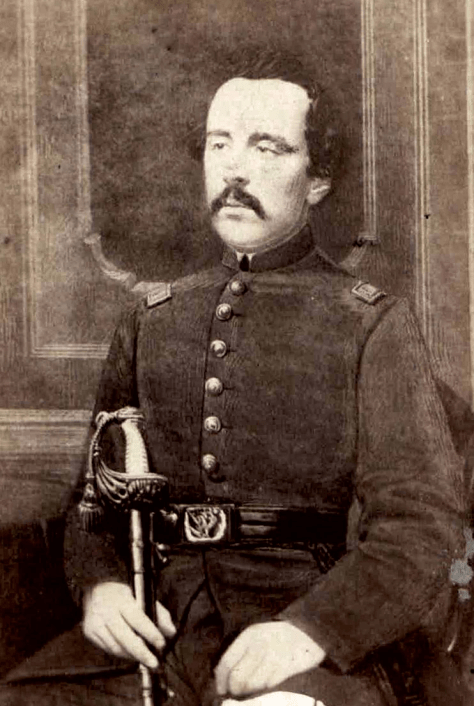
Frank B[righam] Fay, the Major, is in camp with us. He expects to stay here a day or two. I know that I shall live through the whole of the trouble and be safe home with you again. It may not be for a long time but surely will be. I shall have to close this letter. I have plenty to write but I am too sore and tired to write any more at this time. I expect the wounded will be in Chelsea before you receive this. You had better write to my Brother and tell him I am well. Give my best respects to all enquiring friends. The only one in our regiment that was killed on Sunday was Lieut. [Elijah B.] Gill 1 of Co. K [I] but there was some wounded. We had none in our company, however.
No more at present. From your husband, — W. J. Dinsmore
Write as soon as you receive this. The same directions.
1 2d Lt. Elijah B. Gill, Jr. was “instantly killed by a rifle ball through the heart” during the First Bull Run Campaign. On the night of his death, he was buried near Centerville, Virginia, with funeral services by candlelight.
Letter 10
Camp Union
Bladensburg, Maryland
Friday, August 16, 1861
Dear Lizzie,
I take this opportunity of writing these few lines to you to let you know that I received your letter yesterday and was very glad to hear that you are all well as this letter leaves me at present.
We came to this place on Tuesday last. We are now in a different Brigade from the one we were in at the fight. The Brigade we are in now consists of the Mass. 1st, Mass 11th, New Hampshire 2nd, [and] Pennsylvania 27th. The 11th are camped in the next field to us. We are about seven miles from Washington, I believe they calculate to keep us here about two months to recruit and drill and then we are going to advance again and give them fits so I guess I won’t go home until we have another fight anyhow because I want to help pay them off for the loss our company sustained the last time. That is, I will not go home without my eye troubles me. It is very sore sometimes so that I cannot see out of it. I suppose it is brought on by sleeping out in the open fields without any covering when we was to the fight. It is so that I can get y discharge any time by going to the doctor and showing it to him but I have not yet and I don’t think I shall. As for deserting, if I can’t get home without coming that way, I don’t believe I ever will come home. When I go home, I will come home honorably. I ain’y a going to make believe sick either.
I send you the dollar in this letter as I don’t want it. I have two besides it. You can buy Mandy a hat with it. I am much obliged for sending it but I don’t have much use for money now as I cook for the company and I can get plenty to eat without buying much. I only weigh 10 lbs. heavier now than when I left Chelsea.
We have had some new elections of officers lately but they have not got their papers yet. Horatio Roberts was elected 1st Lieutenant and Jack Mandeville was appointed order sergeant in Robert’s place. I suppose if I was about a foot taller, I would get one office myself but I do well enough as high private. You can tell Hinckley that I guess I will not join his regiment this winter. You can tell him the best thing he can do is to join some regiment that is coming out this way and he will have plenty to eat—that is, salt horse and pork.
I received the papers that you sent. I hear that No. 8 is condemned. I am sorry for that. Lieut. Saunders arrived here last night and resigned his office today because he was not elected 1st Lieutenant. Give my best respects to Mr. & Mrs. [Thomas] Corey & [their daughter] Charlotte and all the Engine folks and to all enquiring friends. No more at present. From your affectionate husband, — Wm. J. Dinsmore
Direct as before. Always keep the money I send you and when I get short, I will send for some. I hope you have got that money from the Mayor. I don’t believe I will send any more by him. — W. J. D.
Write early and write often.
Letter 11
Camp Union
Bladensburg, Maryland
August 20th [1861]
Dear Lizzie,
I take this opportunity of writing to you to let you know that I am in good health at present, thank God for His mercy to me, hoping this letter will find you and Mother and the children all in the same.
Things remain the same as when I wrote last and that was only two days ago. We expect to stay here a month or two but then we don’t know. We may have to leave next week but there will not be any fighting around Washington for a month yet without the rebels commence it, and if they do, they will catch it. There is so many forts and batteries that they never can take Washington.

I am going to send you a five-leafed clover in this letter—one I found yesterday. Write soon and tell me what the news is. I have not received Tom Corey’s letter yet. I only write this letter so as to get your [to] answer it because I like to have you write. I would not care if I got a letter from you everyday only that would be too much to expect.
I don’t think our regiment will be in the next battle. I think we will be kept as a reserve force. We are guarding the railroad between the Relay House and Washington. It is the easiest place we have got to yet. It feels like home the most of any place I have been in because the cars go by whistling just the same as they do on the Eastern road. Give my best to Corey’s folks and everybody that enquires about me. I hear that Pingree keeps a grocery store now on the railroad bridge. I wonder if he makes much money. I hope you received the two last letters I wrote to you because there was a gold dollar in each of them. Don’t send me any money without I send for it because you need it more than I do.
It has done nothing but rain for the last 6 days and it has been an awful cold rain. But the sun is out warm now. I heard that No. 3 is condemned but I suppose Tom Corey will tell me all about that. I don’t know as I call Black anymore if this passes this time. So I remain your husband, — Wm. J. Dinsmore
Directions same as before.
Letter 12
Camp Union
Bladensburg, [Maryland]
Saturday, September 7th, 1861
Dear Lizzie,
I received two letter from you—one yesterday and one today—and I am very glad that you are all well as this leaves me at present, thank God for HIs mercy to us.
We still remain at the same place as you can see by the heading of this letter. But how long we will stay here is an uncertainty. We may stop here for weeks and we may leave at half an hour’s notice. But things drag along. News, or rather a rumor, has just reached camp that Gen. Banks has taken prisoners—the Rebel Gen. Lee and 25,000 secession prisoners. How true it is, we do not know, but one thing is certain [and] that is that Banks has surrounded him and given him just so long to deliver himself and men of prisoners or he will shoot every one of them. Lee offered to deliver up all his arms and ammunitions if he would be allowed to leave and go forth but they will not let him do that. Things are coming to a crisis. We will have it before a great while. We are the only Brigade there is round here now. They all left the other night except our Brigade. They are moving int oVirginia slowly but surely and before the end of this month I think the fighting will be all over with.
I am sorry Mr. Day did not arrive before you wrote because you could have given [our daughter] Mandy a little ring for a birthday present. We have not got our pay yet but are to get it on Monday or Tuesday next. I heard the Mayor was coming out here to take the money home. I hope some responsible man will come. If there ain’t anybody comes, why I will send it the best way I can. But then I will send a letter the say day so you will know when it is coming. We have good baked beans about every other day. We have a good oven that the boys built. We are going to have roast beef tomorrow. We will have the oven hot tonight, put our pans of meat in, and in the morning it will be nicely roasted. I tell you, it eats well. We get a hot loaf of bread (that is, each man) every night. It weighs 22 ounces, with as much tea or coffee as they want to drink at supper and breakfast. I don’t know as I have much more to write at present, only I wish you would send me a small fine tooth comb in your answer to this.
Give my best respects to Mother and Corey and family and everybody else. I sent a letter to Corey with a ring in it by John W. Day. Tell me whether he gets it or not. How did Charlotte like her ring? No more at present. From your affectionate husband, — Wm. J. Dinsmore
Kiss the children for me.
Letter 13
Marlboro, Maryland
Tuesday, September 10th 1861
Dear Lizzy,
I received your letter last night and was glad to hear that you were all well. We left our camp yesterday morning at 7 o’clock on a march. We did not know where but after marching 20 miles, we stopped here at dark when we had some hard bread and cold meat to eat. But I happened to be a little better off than the rest for as soon as I heard we were going to march, I put some tea and sugar in a paper and put them in my haversack so I made me a good cup of tea. Our company had to stand guard all night so I don’t feel much like writing. We left Camp [Union] in light marching orders—that is, nothing but our guns and blankets and five days provisions of hard bread and raw pork.
We are encamped in a small piece of woods with tobacco growing all round us. We sleep right in the open air right on the ground. We passed a good many tobacco plantations on the road with the tobacco in various stages of preparation. One place was a tobacco mill with about 50 niggers to work, some spreading it out to dry, others pressing it in bales, &c.
I cannot write much more at present as the Messenger that carried the mail leaves in about 5 minutes. I hope you can read this as it is wrote in a hurry with a pencil unsing my cartridge box for a desk. Tell Willie to be a good boy till I come home and I will take care of the baby for him. Tell him I have a nice little ring for him with his name on it just like yours. I will fetch it to him when I come.
We have not entered the town yet, being encamped on the outskirts of the village. Give my respects to Mr. & Mrs. Corey and Charlotte. No more at present (as the drums are beating). From your affectionate husband, — Wm. J. Dinsmore
Direct same as usual. Tom Drawbridge did not come with us for when the order came to get 5 days provision ready, he was sick but nobody could see anything the matter with him. Don’t say anything.
Letter 14
Lower Marlboro [Maryland]
September 30th 1861
Dear Lizzie,
I received your letter yesterday and was very glad to hear that you were all well. I hope you have received the money ($20) I sent you. Also the letter. I have received all your letters and papers.
We are still in the same place we were a week ago. We have not moved for about 10 days. It is kind of tough to be here without tents, same as we are, and to have such storms as we had the other day and night when the sun crossed the line. I never see such a storm before. I built a little house of brush and spread my rubber blanket over the top. I t makes a very nice place to sleep in when it rains.
I am not very well today. I have the diarrhea but I will get over that in a day or two. Give my best respects to everybody. I don’t feel like writing but as the man that carries the mail is going to camp, I thought I would send a few lines. I have a nice little gold 2 1/2 piece in my pocket that I would like to send you if I had a chance. I think I will send it in the next letter. No more at present. From your husband, — W. J. Dinsmore
Write soon. I will write in a day or two again.

Letter 15
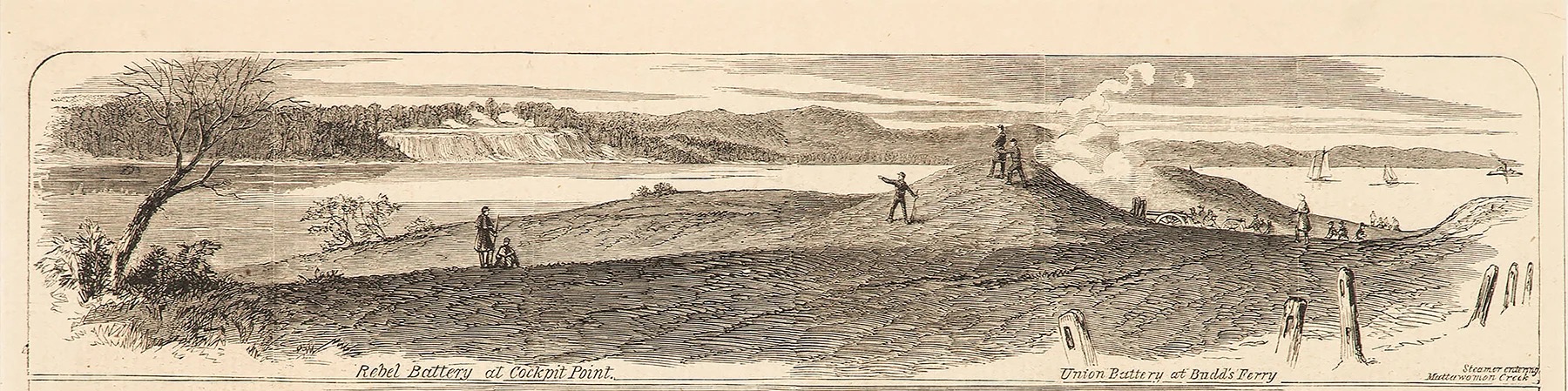
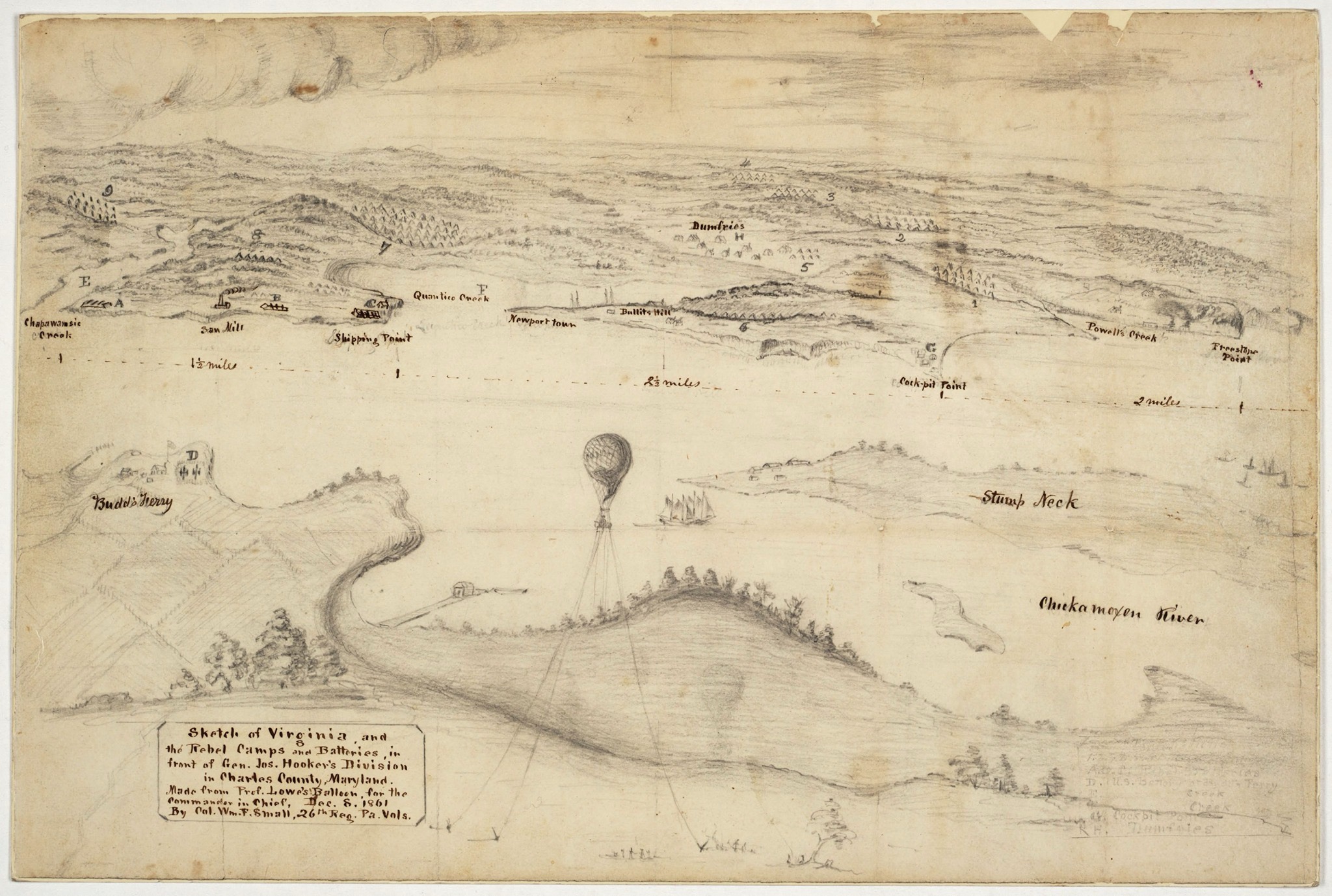
[Editor’s Note: Camp Hooker was located on the Maryland Shore of the Potomac River near Budds Ferry. Under the command of Brig. Gen. Joseph Hooker, it was one of 26 camps stretching from Indian Head to Maryland Point in Charles county.]
Camp Hooker, Maryland
Tuesday, 12th November 1861
Dear Lizzy,
I now take this opportunity of writing these few lines to you to let you know that I am well at present, thank God for His mercy to me, hoping this will find you and Mother and the children all well. I have not received any letter from you for the last week. The mail has not arrived yet. The last letter I got from you was that short one with James’ letter in it. We have received our pay today and I send twenty dollars to you. All our money goes to Mayor Fay and he will pay you the twenty. You had better but a barrel of flour and such other things as you need for the winter. Then if you have any left to spare you can buy a lounge or stair carpet or anything you want but be sure and get your flour and necessary articles first. You can get Mr. Pratt to get you a barrel good over in Boston. Don’t buy it from anyone in Chelsea without you can get Sam Hunt to get one. But I would not ask him. You had better give Pratt the money. Then he can get it in Boston and you can pay him for bringing it over. I don’t know as I have much more to write at present—only the mail gets in tomorrow when I will get your letters.
We are still in the same place. We see a good deal of fun. Yesterday three schooners went up the river when the rebel batteries opened on them fired about 40 shot and shell at them but did not hit any of them. Our battery threw a few shot over into their forts and we could see their soldiers scatter in all directions.
Give my best respects to everybody. Write soon. Your letters will come all right because we are going to have a mail regular three times a week. There is a big fight going on somewhere as we heard cannonading all day yesterday and heavy cannonading going on now in the direction of Bulls Run. Who is getting the best of it, we don’t know as I have not seen but one paper since we got here and that was when we first arrived. No more at present. From your husband, — Wm. J. Dinsmore
Direct as before. I have to send this letter without a stamp as I have none. Tell me if you have to pay for it when you get it. — W. J. D.
Letter 16
Camp Hooker
Friday, November 22, 1861
Dear Lizzy,
I take this opportunity of writing these few lines to you to let you know that I am well at present, hoping this will find you and Mother and the children all in the same. I received your bundle from the City clerk (Sam Bassett, Jr.) and I was very glad to hear from you and to receive the things you sent it was quite a surprise to me and the gloves was just what I wanted. They are first rate. We enjoyed ourselves first rate yesterday. We had a splendid dinner yesterday. A better dinner could not of been got up in any hotel in the City of Boston. We had a big race just before dinner. Two greased pigs were let loose for the regiment to chase. They did not run far before they were caught. We had speeches from Hon. Frank B. Fay, Mr. Mason of Chelsea, Sam Bassett, Mr. Jones of Chelsea, our Captain and others. I never enjoyed myself better.
I received two letters by mail from you yesterday—one with Jim’s letter in it. I don’t think much of his letter, When I go down to see him, I will go so that I shall not be afraid to come back again. Give my best respects to everybody. I am going to send my overcoat home to you by the Mayor [Fay]. You can make a suit of clothes out of it for Willie. It has covered me in rain and shine and the reason I send it is because we got new ones the other day and my trunk—what I carry on my back—ain’t big enough to hold two coats. I don’t know as I have much more to write at present. We were all glad to see the Chelsea folks out here. They have seen the Rebel batteries throwing shot at us. They don’t think much of it.
I hope you have got your money by this time. No more at present. From your husband, — W. J. Dinsmore
Letter 17
Camp Hooker
Sunday evening, January 19, 1862
Dear Lizzy,
I received your letter last night which you wrote on Wednesday eve and I was very glad to hear from you. You think that I have forgotten you but it is not so as you probably think by this time. You say that you sent me 4 stamps at one time and two in a damaged condition but the other two I have not seen although I received your letter which you wrote on Sunday. Did you not forget to put them in? This makes the fourth letter I believe that I wrote to you this week or since last Sunday. After this I am going to number my letters. Then you will know if you receive them. I will put a big figure on the top of each letter. This will be a one. The next letter a two, and so on. Then if a figure is skipped, you will know that you don’t get them all. You can do the same. I have no stamps now but I will send this by Jo Everdean as he is going home for good in the morning. He don’t like sogering.
This is the worst weather I ever saw for rains. It does nothing but rain about all the time. The mud is knee deep all round here—the roads impassable for teams. Our boat started to go up to the landing today which the rebel batteries opened on her with sixty pound shell. They fired over 40 shot at her but did not hit her. I was not on board, being on the sick list. Don’t think by that that I am very bad—only a bad cold which I will get over in a day or two. I only put my name on the list so I would not have to drill for a day or two.
I wish you could send me a little box with some paper and envelopes. Also about a pint of good brandy. You would have to put it in a little box so it would not get broke. I want to take it if I don’t feel well for I don’t like to take fisic. If you send it, you can send it by Phillips when he [comes] by taking it to the City Hall. Don’t tell him what is init. If you send the brandy, pack it round so it will not break.
I will have to stop as the light bulb is going out. Give my best respects to everybody. Hoping this will find you all well, I remain your husband, — W. J. Dinsmore
Letter 18
Camp Hooker
January 23rd 1861 [1862]
Dear Lizzy,
I have just received your letter which you wrote on Sunday and was very glad to hear from you and to know that you were all well. I am in pretty good health at present, only the weather is so wet that I do not go out on duty yet. We have not had a fine day for the last 18 days. it has rained every day, or a part of every day. The mud is about 18 inches deep all round. The camp and in the roads it is deeper—over the tops of leg boots.
I am very sorry that Charlotte felt so nervous about that note that I sent her. I wonder how she would feel if I was to write her a letter as long as her arm. Perhaps she would go right off and do something desperate. But then I guess there will not be any danger of it. I suppose if she writes to me, I will have to answer it. But then, what I write I ain’t ashamed if she shows it to all in Chelsea.
I hope you have received the money by this time. Also the letters sent by Jo Everdean. I don’t know as I have much to write about at this time as things remain about the same. Don’t forget that Tuesday next, the 8th of January, is my birthday. Wish I was home to celebrate it with you, but then I think we will all be home before long. Don’t believe we ever will be in another fight as we are the third reserve army Potomac. There is one thing sure—we cannot have any fight where we are now, but we are in good marching order and could be on the march at a half hour’s notice anytime. We keep ready for a march all the time. There was a report the other night that we had orders to hold ourselves ready to march at a moment’s notice, but I don’t believe it. But we are ready always.
I see in the Chelsea paper that [Lionel D.] Phillips reports that there is not a man in the regiment that would take his discharge at this time. Now that is not true and he knows it. He himself would like to have such an offer. He would take it in a minute. So would a good many others even in this company. Our friend Tom has tried his best and is still trying to getting his. It would be a good thing for the company if he got it. You need not say anything about it though. Walter is well. He was boozy last night but where he got his liquor I don’t know. You need not tell anybody.
We had quite a time on our part of the house on Saturday night. About a dozen got put in the guard house all night. The reason was they would not put the light out when ordered to do so by the officer of the night. Don’t say anything about it to anybody. Probably J. Everdean will tell it all round though but I don’t want to have it said that I wrote anything home about the company. I was not one of them though. I never have missed a roll call or had anything against me since we have been in the army. That is just 8 months yesterday. Leaves two years and four months longer but the 4 months is longer than we will serve. These expeditions is what fixes the South up. Also the battle in Kentucky has frightened them some.
Give my best respect to everybody. Hoping this will find you all well. I am your husband, — W. J. D.
Letter 19
Camp Hooker
February 2nd 1862
Dear Lizzy,
I take this opportunity of answering your letter which I received last night and I was glad to hear from you and to know that you had received the money that I sent and I hope you will not get out of money until next payday which is only 26 days from now. I know that everything is very dear now and that $20 does not go a great ways but don’t stint yourselves for anything you want so long as you have a cent. It don’t make any difference whether you save any or not. When your flour is out, buy another barrel. Never buy any more by the bag if you can help it as it don’t pay.
You want to know if I want any boots. I do not as I have a good pair. I have everything I want in shape of things to wear. Don’t know how I am going to carry them if we have to move. Hope the box will come safe. Expect it will be here about the time you get this. That is about the middle of the week.
We had a serious accident occur here on Friday evening which caused the death of a member of Co. F. Two of the members of that company were fooling with muskets in front of their house when a corporal of Co. F, not knowing his gun was loaded, snapped it at one of them when it went off—the bullet going through the man’s heart killing him instantly. The man’s name that was killed is [Herbert S.] Barlow. He belongs in Roxbury and leaves a widowed mother. It is the first accident of the kind that has happened in our regiment. The same evening one of our teamsters was run over and nearly killed.
I am quite well again, ready for duty, and I hope this will find you and Mother and the children all well. Give my best respects to all enquiring friends. Dan Mears is still in the hospital although he is getting better slowly. I suppose J[oseph B.] Everdean tells some hard stories of camp life since he has got home. I will write again in the middle of the week. No more at present. From your husband, — Wm. J. Dinsmore
I received your paper.
Letter 20
Camp Hooker
Sunday, February 16, 1862
Dear Lizzy,
I received your two letters—one last night with the dollar in it and one the night before. I am glad to know that you are all well as this leaves me at present.
We had a snow storm yesterday when two inches of snow fell. It is the first time it has looked like winter since I have been out here but today is very fine. The snow is fast disappearing and in a day or two there will be none to be seen.
The news that we hear is good Union victories everywhere. I expect we will have to give the rebels a licking somewhere about here before we go home but that will not be hard to do. Burnside’s Expedition has disheartened them. They cannot stand the cold steel and that is what we will give them if we ever get the chance. Powder will not be of any use. We are going to try the bayonet. Keep up good spirits. Don’t fear for me. We may not have a fight and we may have one before you get this. We have orders to be ready to start at a moment’s notice but one thing [is] sure—this thing will be settled soon.
In the dispatch sent by Gen. Hooker to Col. Cowden the other night announcing the Burnside victory, he put at the bottom of the dispatch that if things go on as they are now, this regiment would be on Boston Common before the 4th of July.
I am very much obliged for the dollar. Do as much for you when I get home. I guess than Jim thinks secesh has gone to grass. I am glad that you got the string for Mandy’s neck.
About the back rent you wrote about, don’t pay any until I get home. Just pay as you have been doing. That is enough for him. And about sending Willie to school. I would not send him too early. I think I will be home time enough to send him. I will write soon again. I had to borrow a stamp to put on this letter as I have none. Hoping this will find you all well, I am your husband, — W. J. D.
Letter 21
Camp Hooker
Thursday Morning, February 20, 1862
Dear Lizzy,
I take this opportunity of writing these few lines to you hoping this will find you all in as good health as this leaves me at present. We had a visit from 8 men from North Chelsea last night. They stopped in camp all night with us. They start for home this forenoon, So I had my daguerreotype taken and send it with one of them who is going to give it to you.
There is nothing new out here—only that there is great excitement in camp on account of the late victories [in Tennessee]. Everybody says we will go home soon and I think so too. I hardly think we will move from here until we move on our road to Boston.
Give my respects to everybody. Tell Corey if you see him that I will write to him soon. I will write to you tomorrow to go by the mail. Probably you will get that letter before you do this.
We have a balloon in camp that goes up everyday and takes observations on the other side of the river, They say that the rebels are moving away and I think in a month from now that there won’t be one to be found anywhere except in Fort Warren.
Hoping this will find you and Mother and the children well, I remain your affectionate husband, — Wm. J. Dinsmore
P. S. I will write to Jim one of these days. I wonder what he thinks of secesh now. — W. J. D.
Letter 22
Camp Hooker
Tuesday Eve. February 25th 1862
Dear Lizzy,
I take this opportunity of informing you that I received your letter this afternoon and was very glad to hear that you are all well at present as his leaves me at present.
We still remain here for the rest of the war but there is no knowing the fortunes of war nor what a day may bring forth. But we are all ready should we be called on. The New Jersey Brigade in our Division has ben called on to hold themselves in readiness to march at a moment’s notice but one thing is sure—that there has got to be a force left here where we are and I think that they will keep us as some think we have done our share of the fighting and the New Jersey Brigade has never seen a fight.
We have two of the guns here that was sent out from England to the United States. They were trying the range of them today on the rebel camp and I guess we made them think something was the matter because they tried to fire back at us and their cannon could not reach half way to us. Our cannon only fires seven miles. They are called the Whitworth Gun made in Manchester, England. They are ten pound calibre, throw a 32 pound shot, load at the breach so they can fire them as quickly as we can a musket. They don’t have to use a ramrod.
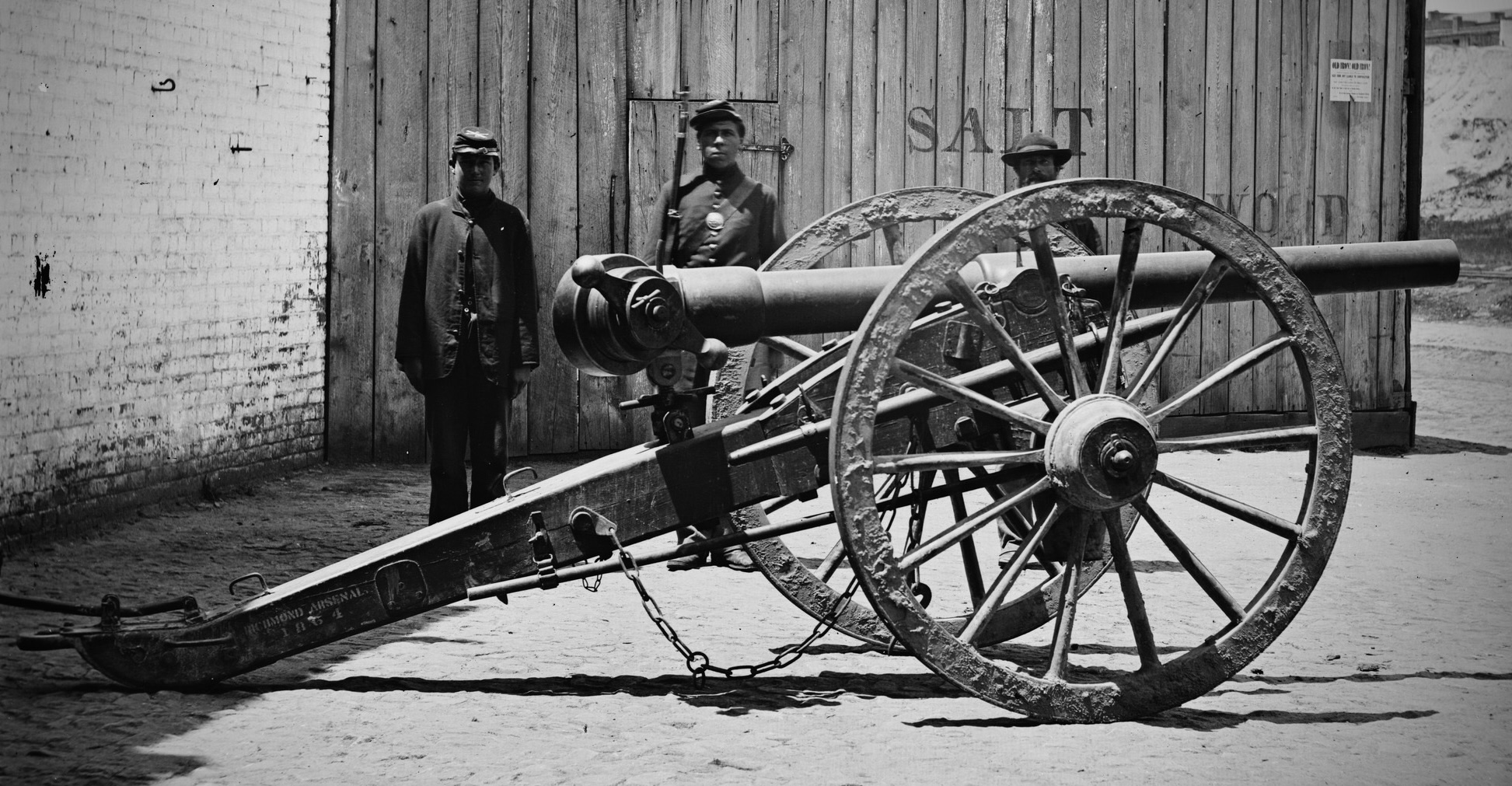
The news of the recent victories have created a great deal of joy and excitement in camp. The band playing, the men hurraying and everything is joyful.
Give my best respects to everybody in general. I have not much to write about—only that it blowed a hurricane yesterday. Blowed the roof off one of the captain’s houses and made a devil of a racket. Home looks nearer than ever now since the fall of Fort Donelson. I hope you received the picture of the soldier all right and I hope you liked it. I think I shall stay in the cook house now as the boys want me to. Hoping this will find you and Mother and the children all well as this leaves me at present. I remain your affectionate husband, — Wm. J. Dinsmore
Letter 23
Camp Hooker
Monday morning, March 10th 1862
Dear Lizzy,
I take this opportunity of writing to you hoping this will find you in good health as this leaves me at present.
There is great excitement here now. The rebels on the other side [of the Potomac] have cut stick and run, leaving everything behind—cannons, powder, shot and shell. They left yesterday in a hurry, setting fire to all their camps, houses, the rebel steamer G. Page, and two schooners they had in Quantico Creek. It is the greatest destruction of property I ever saw. They set fire to their quarters and the boat 3.30 o’clock yesterday afternoon (one of the gunboats had been firing at them for about an hour) and in less than an hour, the fire extended for miles. Their first magazine blew up at 10 minutes past 4 and there has been explosions ever since of mines and magazines blowing up. About 40 of our fellows went over in a boat and hoisted the American flag this morning. Our regiment (with the exception of our company which is on guard) left for the other side of the river to take possession of the arms and ammunition and gain a foothold on Virginia soil. I expect the whole of the Division will go over sometime this week.
I received your letter last Wednesday but I had no stamp so I put it off thinking I would get some every day so I am going to try this one without a stamp. You say that there is a dispute about my shaving. You can settle that by telling them that I have not shaved since I left home. I have trimmed with the scissors once or twice.
I think this fight will soon be settled now. Give my best respects to all, hoping this will find you and Mother and the children all well as this leaves me at present. — Wm. J. Dinsmore
I will write soon again as I find out all the particulars. — W. S. D.
We have not been paid off yet but expect to in about a week. Spend your money for anything you want. Buy your flowers. I will send the money to you as soon as I get some. — W. J. D.
Letter 24
Camp Hooker, Lower Potomac
March 17th 1862
Dear Lizzy,
I received your letter tonight and was very glad to hear from you again so soon.
We are still in the same camp yet although we may have orders to move at any moment but I don’t think we will for go for some time as there is more troops in Virginia now that our generals know what to do with. I have not been on the other side of the river yet nor has any of our regiment for the last four days. But the next time any of our company goes over, I am going with them.
Tom Drawbridge started for home this morning, he having obtained his discharge. The officers of the company are glad to get rid of him as he was of no use to the camp or anybody else. He played sick so long—ever since we had the fight at Bull Run. I suppose he will be one of the heroes when he gets to Chelsea but there is not another man in the company that would take his discharge and go home in the same way (and some of them want to go very bad). I am going to try and stick it out until the company goes home.
I got the six stamps you sent in your letter. The weather is very fine here at present. It looks as if summer had come in reality. We have not got our pay yet. I don’t think we will for some time yet so you had better keep what money you have got and spend it yourself for I don’t think we will get our pay for a month yet and I don’t know as I want any money. I am still in the cook house, It is not hard work. I don’t have any drill to do nor I don’t have to stand guard so I have all night to sleep which is the best thing there is about it.
If you get short of money before I send my money home, go right to the Mayor and tell him you want some more. He has money enough in his hands for that purpose and if you don’t get it, somebody else will give. My best respects to all. I don’t know as I have anything more to write at present.
I suppose that Tom [Drawbridge] will go to see you and tell you some big stories but he never came near me before he started. I guess he thought I knew there was nothing the matter with him so if he comes to see you, you can answer him as short as you please. You need not trouble yourself to go and see him or anybody else that goes home a coward. Hoping this will find you and Mother and the children all in good health as this leaves me at present, I remain your husband, — Wm. J. Dinsmore
Write soon.
Letter 25
Camp Hooker, Lower Potomac
Sunday, March 23, 1862
Dear Lizzy,
I take this opportunity of writing a few lines to you to let you know that I am in good health at present, hoping this will find you and Mother and the children all in the same.
We are expecting to move every minute. Part of the regiment have moved out of their houses and gone into tents as they have taken the houses for hospitals for the sick of the Division. There is about 800 sick in this Division, mostly belonging to the Jersey Brigade and to Sickles’s Brigade. There is only seven men sick in our regiment and they’re not very sick.
I believe we start on Tuesday morning. Where we go, I do not know. We are the Left Wing of Heintzelman’s Corps De Army. We take no tents with us so we will sleep in the open air when we sleep which I think will not be very often. We are going after the rebels now in a hurry. I expect we will fetch up at Fortress Monroe or Fredericksburg before we stop. Don’t feel anxious if you do not get a letter soon as no mail will go again until we get settled. I may have a chance to send a letter and I may not. I will write every time I get a chance. We have not had a mail for 4 or 5 days but expect one before we march, but according to the last papers which I seen, we are cleaning the rebels out in all directions.
Tell Corey I will write to him when I get a chance. I only had five minutes to write this letter as the chaplain came round and says the last mail goes in 5 minutes so I commenced on this. Give my best respects to everybody. I have seen two expeditions go down the river this past week, about twenty steamers in each expedition. Hoping you can read this writing, I remain your husband, — W. J. Dinsmore
Letter 26
Camp Hooker, Lower Potomac
Sunday night, March 23, 1862
Dear Lizzy,

I have just received your letter and I was very glad to hear from you although I am very sorry that your eyes are so sore and I hope it is nothing very serious. Be very careful of them. Don’t sew any until they get better for anybody because it is better that you should go without work for a while than to lose your eyesight. So you had better let [Frederick A.] Steirnefeldt 1 get somebody else to do their work so you can lay still a while and save your eyesight. You have worked too hard and sewing every night is one of the worst things there is for the eyesight. You probably have got cold in your eyes and then not taking care of them, straining them [by] sewing after night has made them sore. So be very careful of them. Let the work go. Better be well without work than sick and not able to do any.
Mayor Fay arrived in camp tonight. He came to see about the money going home to the families of the soldiers. He thinks we won’t get our money until the first of April. The way we are going to do is to sign a paper and then he draws the money in Boston and pays it to the family or whoever it is signed to. I am going to sign for you to receive ten dollars a month so you will get 20 dollars from Mr. Bassett about the last of this month and the same every payday until I get home which I hope will be soon. Oh how I would like to be home with you now so that I could take care of you and cure your eyes. Don’t write any more until you get a letter from me telling you to do so. I should like to get an answer to this but it is impossible as we move on Tuesday morning and there is to be no mail after we move until we get settled again which may not be for five or six weeks. But I will drop you a few lines every time there is a chance. Give my best respects to all.
So you say the Engine Boys did not know me. If that is so, I must of altered some since I left home and I think I have. I am only about 17 pounds heavier but I am in good health and spirits and I want you to keep up a good heart because I will be as safe as though I was at home which I will be before long as this war is going to be settled up quickly and I suppose we have our share to do. But I am going home honorably if I go at all—not like some folks that has backed out and gone home.
Hoping you can read this letter as it is wrote in a hurry. I hope that John Sargent don’t come round to see you too often as some folks might make a story out of it for spite. But I will trust you with anybody. But you know what I mean. I don’t think much of him anyhow. Hoping this will find you and Mother and the children all well. I am your loving husband, — W. J. Dinsmore
I wrote you a letter this morning with a pencil as that was to be the last mail but another one goes in the morning.
P. S. If you get short for money, don’t pinch yourself but go to the City Hall and tell Mr. Bassett that you want some. Tell him your eyes are sore, you can’t work, and you are out of money, and he will see that you have some. I see a likeness of Jedide Small yesterday. Jim Gerrish has it. He showed it to me. He got it from her the other day. I suppose Tom Drawbridge will have some big stories to tell but he don’t know anything about the marches we had all last summer as he was not with us when we were marching through Maryland. Yours &c. — W. J. Dinsmore
1 Frederick August Steirnefeld, b. 1818, was a tailor who lived at 19 Grove Street in Chelsea, Massachusetts. He was a native of Sweden who became a nsaturalized US Citizen in October 1856.
Letter 27
Camp Hooker, Lower Potomac
April 4th, 1862
Dear Lizzy,
I received your letter last night and was glad to hear from you again and to hear that you were all well. The only mail we had this week came last night.
We are still in the same place notwithstanding the papers have us at Fort Monroe. But we have not seen it yet, We have been ready to leave for the last four weeks but when we will go it is impossible to tell. Night before last, orders came to cook two days rations so as to start the next morning. But the next morning came and no start and now it is the next and no more sign of going than there was one month ago. But I should not be surprised to hear the order to start at any hour.
Part of our regiment are living in tents again. And I wish our company was for the house is too warm to sleep in nights. The weather is very warm here—just like the middle of summer in Chelsea. I left the cook house because it got too warm to be comfortable.
You say that Charlotte thinks I did not get her father’s letter but I did. But I have not answered it yet but I will one of these days when I get time and there is any news to write. Give my best respects to everybody and tell them I am doing first rate. But then Tom stretches it a little when he says I am as fat as Pingree. But then whether it is so or not, I can march as far and as fast as the lean ones. There is nothing new to write about. It is very still since our neighbors across the river have left. It is still like Sunday.
Write soon and often as all the letters will come sometime. I will write every time the mail goes. I received three stamps in your letter last night. They came just in time as I did not have any. We have not been paid off yet but the paymaster has promised to pay us this week which I hope he will do. Hoping this will find you all in good health as this leaves me at present. I remain your husband, — Wm. J. Dinsmore
Letter 28
Near Yorktown [Virginia]
Before breakfast Saturday morn, April 12th 1862
Dear Lizzy,
I take this opportunity of writing a few lines to you hoping this will find you and the Children all in good health as this leaves me at present.
We arrived at this place yesterday (Friday) morning after being six days and nights aboard of the steamer Kencheck as we went on board last Saturday morning at Budds Ferry, hauled out into the middle of the river, started Monday morning and Monday night we had to lay to owing to a storm. We laid in St. Mary’s Bay until Wednesday night when we up anchor and started and Thursday morning about 8 o’clock arrived at Fort Monroe which we left again about 10 o’clock. I see the Ericson’s Monitor, the Stevens Battery, and the greatest variety of shipping I ever saw in one place—[an] English Man-of-War, two French Man-of-War, and any quantity of Yankee war vessels from a little one gun boat to a three decker.
We had an awful rough and stormy passage in the Chesapeake Bay. We had two schooners in tow loaded with artillery horses and the rope broke Thursday morning and we had to leave them. But they have arrived since all safe. There is an awful lot of troops here in this place. The rebels only fell back from here about a week since. We are investing Yorktown. We have got it besieged. We have about (140,000) one hundred and forty thousand men here but the rebels have a lot of batteries. But they can’t load their guns very well as our sharp shooters are hid round close to the enemy and fast as an artillery man goes to load a gun, they pick him off.
The weather is awful cold or it feels so to me coming out of our winter houses. We have tents with us. Every tent holds two men. We carry them in our knapsacks, Every man carried a half a tent. We have not had a mail for a week but it will come one of these days. Then I will have a lot of letters to read from you. I expect we march again this morning. We are only five miles from Yorktown now at a place called Ship Point on the York River. We are going to have a big fight here if the rebels are good for anything. They have a stronghold here and we have a big army here also.
Gen. McClellan is here in person. He has given them two days to surrender in. Whether they will do so or not, I don’t know, but I will write soon again and give you the news. I see Mayor Fay at Fortress Monroe [but] did not have a chance to talk to him. Only eight hundred of us on the boat. Accommodations for about two [hundred] but we arrived all safe. Some was sea sick. I was not. Give my love to all. Write on as usual from your husband, — W. J. Dinsmore
Letter 29
Near Yorktown
Sunday, April 13th 1862
I take this opportunity of writing a few lines to you hoping this will find you and Mother and the children all in good health as this leaves me at present.
We are resting today and we need it. This is the awfullest country I ever saw—all swamp, but we [will] probably be in Yorktown before you get this. We have not got our position yet but I presume it will be somewhere on the advance. The Southerners are getting desperate. We have them hemmed in on all sides. We are now doing what in future history will be known as the Siege of Yorktown. We are within 4 or 5 miles of it but will be nearer in a day or two.
There is skirmish[ing] going on now. I can hear the cannon booming quite plain. We have skirmishing every day (that is, some of our regiments). We have not fired a shot yet but our regiment are all eager. We have an old debt to pay them for what they done to our dead at Blackburn Ford (Bull Run) where they dug them up and boiled the flesh off the bones. We are bound to pay them up in full.
We had a rough time of it before we got here and I think we will have rougher before we leave. There is no roads here—nothing but swamp. We have about twenty thousand men building corduroy roads for the artillery. It is stated we have 200 cannon here besides siege guns and mortars. What the news is at other places, I do not know as we have not had a mail nor seen a paper since before we left Camp Hooker which was a week yesterday morning.
Our provisions are hard bread and raw pork—that is, a pound of pork and a pound of bread a day, with a dipper of coffee in the morning and a dipper full at night. I can et raw pork as well as anybody. Like [it] best raw. In fact, [I] grow fat on it. If I eat the same kind of stuff here I would at home. I would not be able to half the work. The 9th Massachusetts Col. Cass had the hardest work of any regiment here. They are away on the extreme advance living on three crackers a day. The roads being so bad, they can’t get the provisions to them. But the road will soon be so that there will be stuff enough. Horses are no good here. They haul all the stuff with mules—eight mules to a wagon, and sometimes you can’t see anything but the top of the wagon and the mules ears, so you can judge of the [mud is this] place.
We expect a mail every day now whenI finish this letter and send it. I may have a chance to send it tomorrow and I may not for a week.
Monday 14th. The sound echoes through the camp. Mail starts at one o’clock so I am going to finish these few lines. Young Walker that lived in Golding’s house was here to see the Chelsea Company yesterday. He is well and looks well. He is a drummer boy in the 19th [Massachusetts] Regiment. They are about two miles from here. We are better off than any other division here as we have tents but we have to carry them, Each man’s piece weighs about two pounds but they are worth carrying. You folks at home get more news than we do here as we don’t get the papers but we are going to have a mail regular in a day or two. Our first mail comes tomorrow.
We have some canon here that throw ninety shots in a minute. They work by machinery as fast as a man can throw the shot into a kind of a basket.
I expect that our forces will have possession of Richmond sometime this week as I think it is part of the plan to take Richmond before Yorktown. Some folks think that taking this place will settle the war as it did in the Revolution. We are within about three miles of where Lord Cornwallis surrendered to Washington. Give my best respects to all. Write soon, Your husband, — W. J. Dinsmore
We have not been paid yet but money is no use here as there is no place to spend it. I expect the Mayor Fay down here to see us before he goes home.
Letter 30
Camp General Scott in front of Yorktown
Friday, April 18th 1862
Dear Lizzy,
I take this opportunity of writing a few lines to you hoping this will find you and the children all in good health as this leaves me at present. Our mail arrived tonight for the first time since we left Budd’s Ferry and I got three letters from you and you may be sure I was very glad to hear from you again. The mail will come regular now that we have got our position which we took on Wednesday. We are on the advance in the center column and we intend to be one of the first regiments to enter Yorktown. We were turned out yesterday morning (Thursday) at 4 o’clock and formed line of battle. What for, I don’t know. And last night at half past 12 turned out again as the rebels had made a sortie on our left but were driven back with great loss. After standing in line of battle an hour listening to the whizzing of shell and the pop of muskets, we were dismissed, the rebels having retired. But at 4 o’clock [we] had to turn out again double quick, the rebels having made another sortie. But [they] were again driven in with great loss. We lost none as they did not stop to fire a shot. Our Brigade has not fired a shot yet, the Division on our left doing most of the shooting.
We are within about one mile of the rebel fortifications. Our sharpshooters keep the rebels in great suspense as they pop them off as soon as they show themselves. They have some heavy guns but cannot load them as the man is popped off as fast as they come to the muzzle of the gun. As an instance, they let them put the cartridge in one gun and the man shoved the ramrod in when he was picked off, and so on. All day yesterday as soon as the man touched the rammer to pull it out, he was shot. So they had to let the rammer stay in until after dark.
I had a good look at the rebel fortifications today and seen a man come out in the field when right in front of me was a sharp crack like the snap of a whip and he dropped to rise no more. Don’t borrow trouble thinking I am in danger because I am just as safe here as I would be at home or anywhere else. A man can’t die until his time comes and I feel certain that I will return safe to Chelsea again to you and the children so take good care of yourself because I think this war cannot last a great while longer as this is about the last place the rebels can make a stand and I don’t think they will make much of a fight here.
Give my best respects to all and tell Corey I will write to him soon. I remain your affectionsate husband, — W. J. Dinsmore, Pvt.. Co. H, 1st Mass. Vol.
Direct same as usual. Write soon.
What does folks in Chelsea think of Tom [Drawbridge’s] coming home?
Letter 31
Before Yorktown
April 25, 1862
Dear Lizzy,
I once more write a few lines to you hoping that you and the children and Mother are all as well as this leaves me at present. I received your letter [last] night, also one from Corey. There is nothing interesting going on here with the exceptions of a little skirmishing between artillery as the shot keep singing in the air almost all the time. We were out at work yesterday afternoon when the rebels threw some shells at us without any damage to anyone although some whistled close to us.
I have been to work on a piece of shin bone of an ox and made a ring out of it for you and I am going to send it inn this letter hoping you will get it safe. If it is not large enough for you, it will fit Willie, but I hope it will fit you. I made it with a knife. I worked about 30 hours on it—that is, put all the time together that I worked on it. I send a letter to Corey today. Write soon as you get this and let me know if it came safe.
Give my best respects to all. If we get the best of Johnny Rebel, this will settle the war in Virginia and we will be home in July. No more at present but I remain your loving husband. — Wm. J. Dinsmore
P. S. I hope you can read pencil writing as that is all there is to write with round here. — W. J. D.
Letter 32
In camp near Yorktown
May 2nd 1862
Dear Lizzy,
I once more write you a few lines hoping to find you and the children and Mother in good health.
We are still in front of the enemy waiting anxiously for the order forward which shall drive the rebels from their stronghold and I firmly believe settle the war as according to deserters from the enemy, the rebels are disheartened and the driving them from Yorktown will be the means of driving them to destruction.
The enemy are keeping up a brisk cannonading all this forenoon—what for? I don’t know, but we have got so used to the whistle of balls and bursting of shell that we don’t mind them without they come very close things cannot last much longer the way they are now as all our works are nearly ready and everything in good order. Keep up a good heart and don’t feel afraid on my account because I feel that I shall be spared to come home to you safe and sound. Mayor Fay is in camp again, he having started from here as soon as he heard of our engagement. Heis doing all in his power for the comfort of the wounded.
We were paid off our two months pay today and will receive the other two months the fifteenth of this month. I suppose you will get your twenty dollars of it before you get this letter as I signed for you to draw ten dollars a month. That is twenty dollars every pay day. So I got the other six this morning and now I have got it, I do not know what to do with it. I have a one dollar bill of Massachusetts money that I will send you in this letter. You can spend it for anything you want.
I have not much to write about at present. Give my best respects to all. I hope you got the ring all right. I expect before this reaches you Yorktown will have surrendered. I see in some of the papers that G. G. S. Norris, Co. I, is reported wounded. It is not so. He got a black eye accidentally as we were marching to the fight. That is all the wound he got. My love to all. No more from your affectionate husband, — Wm. J. Dinsmore
Co. H, 1st Mass Vols.
Letter 33
On Battlefield Williamsburg
Tuesday, May 6th 1862
Dear Lizzy,
I take time now to write a few lines to you to let you know that I am alive and well yet.
The battle is over and we remain in possession of the field. The fight commenced yesterday morning at 6 o’clock and continued all day without interruption until after dark. What the loss was killed and wounded is I do not know. You probably will see it in the papers before I do. Yorktown was evacuated Saturday night and on Sunday we started in full pursuit of them. I have not time to write you much. Our regiment suffered some as we opened the fight in the morning, but our company was lucky this time as there was not one of our company killed or wounded. G. Norris and Dan Mears are both well. I will write again soon.
The battlefield is a horrid looking place. The rebels are in full retreat from here with our cavalry and artillery in pursuit. Gove my best respects to all. From your husband, — Wm. J. Dinsmore
Co. H, 1st Mass. Vols.
P. S. I sent a little parcel by Mayor Fay directed to you. It is a pipe bowl that I made while we lay in front of Yorktown. You can give it to Tom Corey as I made it for him. It is made of Laurel root. You need not tell Fay what is in the bundle as he would not like it perhaps to carry a pipe home. — W. J. Dinsmore
Letter 34
Williamsburg [Virginia]
Sunday, May 11th 1862
Dear Lizzy,
I now write a few lines to you hoping this will find you all in good health as this leaves me at present. Thannk God for His mercy to me.
We are encamped on the outskirts of this town doing garrison duty. How long we shall stop here, I do not know. We may start tomorrow and we may not leave here at all until we are discharged which I hope will be so as I have seen enough fighting to satisfy me and I think the whole of the regiment has.
We was the first regiment to engage the enemy. We came on them before we thought we were near them and the first intimation we had of a fight was their pickets opening on us. We left our camp at Yorktown on Sunday last at noon and marched until about 9 o’clock Sunday night when we lay down in a field to sleep. About two o’clock in the night, it commenced to rain. About 4 we were on the march again. At about 6 the first shot was fired. It rained very hard all the time the fight was going on which was about 13 hours. The reason our regiment lost so few killed was because we fought as skirmishers all day.
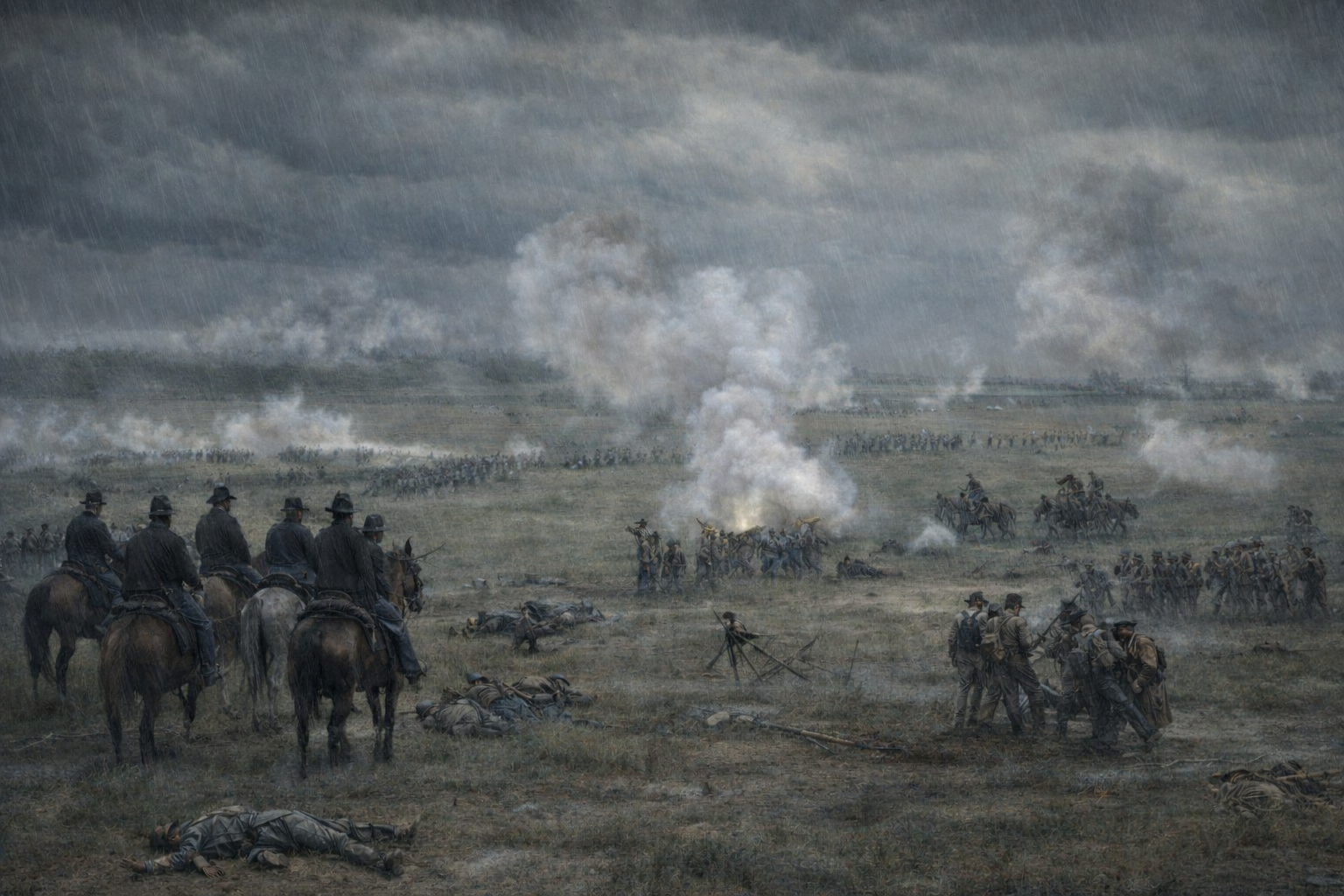
We left camp on Sunday without any dinner and did not have anything but a few crackers until after the fight. We were pretty well used up but I hope this war is about closed up. I am in hopes that the first of July will see us home yet—at least I hope so. Give my best respect to all. Don’t be disappointed if you don’t receive letters oftener than you do it is impossible to tell when there will be a chance to send them. All your letters comes regular as the mail is always sent after the regiment. But it is hard work to get a letter back. But I will write whenever I can.
The battlefield I cannot describe in writing but when I get home, I will tell you what it is like. I send you an old secesh postage stamp in this letter. You can see by it that their letters cost more than ours. No more at present. Your husband, — Wm. J. Dinsmore
Letter 35
Williamsburg [Virginia]
Tuesday, [May] 13th 1862
Dear Lizzy,
I once more take an opportunity of writing a few line to you hoping this will find you and the children and Mother in good health as tis leaves me at present. Thank God for His mercy to us.
We are still encamped at this rebel city keeping guard and report says that our Brigade has seen all their fighting and that we are going to stay and guard this place until we are discharged and sent home.
This is the oldest city in Virginia and it looks so with its old rickety tumble down buildings. It looks as if there had not been a house built in the place for at least 80 or 90 years but there is some very fine buildings here. For instance, the Lunatic Asylum, the College, the Bank Building, and the jail. There is only one church in the place and that was built before the Revolution. It is of brick with a grave yard around it is in the old style. The inhabitants are beginning to come back to the town again. They thought we were all savages but they have found out that it was a mistake of theirs. They say that we behave better than their own soldiers used to.
About that shot that came so close that you heard of, it only went through my clothes right at the side of my left kidney, but did not touch my skin. And I had so many clothes on and was running so that it knocked me down but I did not lay long. I thought I was hit—it felt just so for about a minute. But I was lucky then and have been so in the battle since, although seeing some very horrid sights. You say in one of your letters (two of which I received today) that Charlotte [Corey] wrote to me since she wrote by Dan Mears. If she did, I never got the letter. If I had, I would have sent it to you. About making me mad, that is something I don’t understand. She might of at the time but if she did I have forgot all about it. But enough of that.
There was another fight twenty miles from here on last Wednesday but we were not in it. Our folks lost a good many killed and wounded, the rebels laying an ambush for them, but they had to suffer for it.
We had a hard time the day of the fight, being the first into it and fighting about three hours before our artillery came up to assist us. We expect to be paid again soon, maybe next week. Just as soon as I get paid off, you can go to th City Hall and get twenty dollars more. I hope you have received your other twenty by this time. They don’t charge much for stuff here in town. When we got here, tea was only eight dollars a pound and everything else in proportion. But things are getting a little more reasonable in price which is a good thing for the inhabitants which have to buy such things. I buy some cheese, tobacco, and sweet cake once in a while. Day before yesterday they only asked sixty cents a pound for cheese. Last night I bought some for twenty-five.
Give my best respects to all enquiring friends. I hope you have got that pipe Mayor Fay took home. It was directed to you but I made it for Tom Corey so you can give it to him if you have not done so already. Write soon. I received your papers and stamps. I hope you will be able to read this letter as it is wrote in a hurry and on secesh paper. Your husband, — Wm. J. Dinsmore
P. S. We had nobody hurt in our company in the last fight. Keep on sending The Ledger.
Letter 36
New Kent Court House, Virginia
Sunday eve, May 18th 1862
Dear Lizzy,
I now take an opportunity of writing a few lines hoping to find you and Mother and the children all in good health as this leaves me at present.
We left Williamsburg on Thursday last about six in the morning. It was a kind of a wet, drizzly morning which increased to a regular rain storm but we kept on and after marching about 15 miles, encamped for the night. Starting next morning and marching 14 miles more over the worst roads I ever saw, With knapsack, haversack, and sixty rounds of ammunition which is twenty rounds more that we ever carried before, but at the Battle of Williamsburg we got out of ammunition having fired 40 rounds.
On the second (Friday) night we encamped and stayed until this (Sunday) morning when we came up here marching only 5 miles today. We may stay here three or four days and we may not stop one. We are within 25 miles of Richmond and before tis reaches you, if I am alive and well, I may be in Richmond. This war is drawing to a close fast. The man that lives six weeks longer will see the end of it and I am glad that it is so near an end as I have seen enough fighting and so has every other man in the regiment that was in the last fight where our Brigade of four regiments had to fight against forty thousand rebels for over three hours. We was so far ahead of the rest of the Division, it is a wonder to me how any of us escaped but when the rest of the Division came up, we advanced and got so close under the rebel batteries that they could not bring their cannon to bear on us but shot away over us. But we in return shot their gunner down as fast as they tried to load their guns. One of the rebel prisoners told me that night that the rebels was afraid of our regiment and the 2nd New Hampshire as our rifles made great slaughter among them. He said they would rather face a whole Brigade than to face our regiment because when we sight at a man, he is a goner. And our bullets tear bone and all to pieces so if we hit a man in te leg or arm and he don’t die, he has to lose his limb. Our bullets are just the shape of my long pistol bullets, Give my best respects to all enquiring friends.
If I get to Richmond, the first thing I will do is write you a letter. I have nothing much to write as we don’t know anything—only just what we see. Only I see in the papers that Norfolk has gone up and the Merrimac has gone up and the Merrimac has gone down.
Write often. Direct same as usual. I will write as often as there is a chance to send a letter. I have a ring made out of a horn button that I cut off a dead rebel’s coat. I am going to keep it until I get home. I don’t think this Brigade will be in the next fight but I don’t know. Keep up a good heart.
We are first (Grover’s) Brigade, Hooker’s Division. I suppose the folks in Chelsea will be glad to see what there is left of us when we get home. George Norris and Dan Mears and [William] Boss in Co. I are all well. No more at present. From your affectionate husband, — Wm. J. Dinsmore
Our mail has not arrived yet. We expect it tonight. I will not seal this letter until dark because I expect a letter from you. I send you two pictures in this letter—a picture of the Capitol and a picture of the Insane Asylum. I had to cut them a little to get them in the envelope.
Monday morning. I received your letter last night and was glad to hear that you were all well. I did not print the directions on that envelope on the march. I directed all the envelopes before I started from Camp Hooker. — W. J. D.
Letter 37
Poplar Hill, Virginia
Monday morning, May 26th [1862]
Dear Lizzy,
I write a few lines hoping to find you and the children and Mother all in good health as this leaves me at present. We are pretty close to the enemy. We arrived here yesterday after a march of 4 hours over a swamp. We are encamped in a wheat field on a gentle elevation. We are in a line of battle with six pieces of cannon planted and sighted, all pointing at a little bridge the enemy have to cross should they attack us. We crossed the Chickahominy yesterday at a place called Botton Bridge. We can walk from here to Richmond in six hours. That is, if there was no obstructions in the way in the shape of cannon and musket bullets. We are on the advance on this road although some of our troops on other roads are much nearer Richmond than we are. But we will all be in the city before a week or we will be licked.
I have not much to write about—only we have had some hard marches within a fortnight. On Friday night we had a march of four miles through a swamp which took us seven hours. That is half a mile an hour. On Thursday evening last, we had a violent hail storm—the largest hail I ever saw. It hailed for about half an hour. Some of the hailstones were as large as hen eggs while the general run were like marbles and different from any hail I ever sw as it looked more like chunks of ice than anything else.
I have to bring this letter to a close as the mail starts in five minutes. My best respects to all. I received your letter and the two papers yesterday.
I have just picked a 4 leaf clover which I will put in this letter. My head laid on it all night so I have just pulled it. I also send you a picture that was in a newspaper that G. Clark sent me. It will do for the children. No more at present. Your husband, — W. J. Dinsmore
 Spared & Shared 23