My passion is studying American history leading up to & including the Civil War. I particularly enjoy reading, transcribing & researching primary sources such as letters and diaries.
The following letter was written by Thomas Whiting Cowne (1784-1857) of Turners, Fauquier county, Virginia. Thomas was the son of Robert Cowne (c.1756-1829) and Sarah Whiting of Culpeper. His first wife was Martha H. Buchanan (died 1818). In 1820 he married Susan Latham (born 1787) of Fauquier. Thomas W. Cowne was a merchant in Falmouth. He also operated a school in Falmouth and offered courses such as reading, spelling, penmanship, grammar, geography, history, arithmetic, bookkeeping, and Latin. Tuition was $20 per student (Virginia Herald, Dec. 11, 1816). At the time of the 1850 US Census, Thomas was the owner of ten slaves ranging in age from 10 to 50.
He wrote the letter to his son, Thomas W. Cowne, Jr. (1821-18xx), a merchant in Staunton, Augusta county, Virginia.
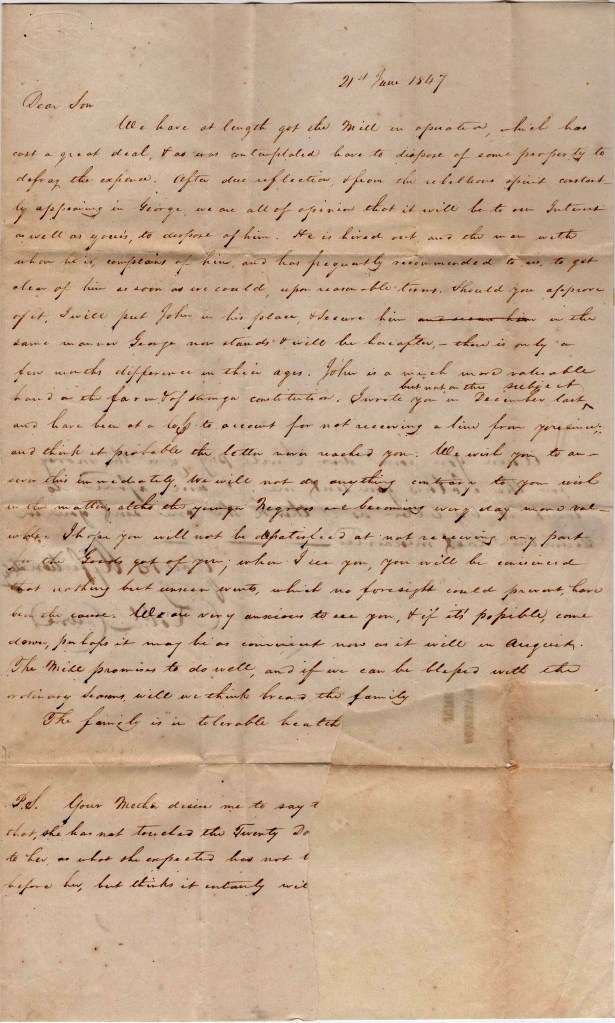
Thomas’ letter speaks of the “rebellious spirit” of one of his negro slaves named “George”—so troublesome that he has decided “to dispose of him” as soon as he could “clear of him” on “reasonable terms.”
T R A N S C R I P T I O N
[Falmouth, Virginia] 21 June 1847
Dear Son,
We have at length got the mill in operation, which has cost a great deal, & as was contemplated have to dispose of some property to defray the expense. After due reflection & from the rebellious spirit constantly appearing in George, we are all of opinion that it will be to our interest as well as yours to dispose of him. He is hired out and the man with whom he is complains of him and has frequently recommended to us to get clear of him as soon as we could upon reasonable terms. Should you approve of it, I will put John in his place and secure him in the same manner George now stands & will be hereafter. There is only a few months difference in their ages. John is a much more valuable hand on the farm & of stronger constitution, I wrote you in December last but not on this subject and have been as a loss to account for not receiving a line from you since, and think it probable the letter never reached you. We wish you to answer this immediately. We will not do anything contrary to your wish in the matter although the younger negroes are becoming every day more valuable.
I hope you will not be dissatisfied at not receiving any part of the goods got of you. When I see you, you will be convinced that nothing but unseen events which no foresight could prevent have been the cause, We are very anxious to see you, & if it it’s possible, come down. Perhaps it may be as convenient now as it will in August. The mill promises to do well and if we can be blessed with the ordinary seasons, will we think bread the family. The family is in tolerable health.
The following letter was written by Isaac Newton (“Newt”) Haldeman (b. 1840), the son of Isaac Haldeman (1812-1885) and Maria Miller (1823-1910) of Wapsinonoc, Muscatine county, Iowa. Newt enlisted as a corporal in Co. F, 22nd Iowa Infantry in September 1862.
Newt wrote this letter some three weeks after the surrender of Vicksburg which was followed quickly by a march to Jackson, Mississippi, and return. See also—1864: Isaac Newton Haldeman to his Sister.
T R A N S C R I P T I O N
Addressed to Minnie Haldeman, Tiffin, Seneca county, Ohio
Vicksburg [Mississippi] July 26th 1863
My dear Sister,
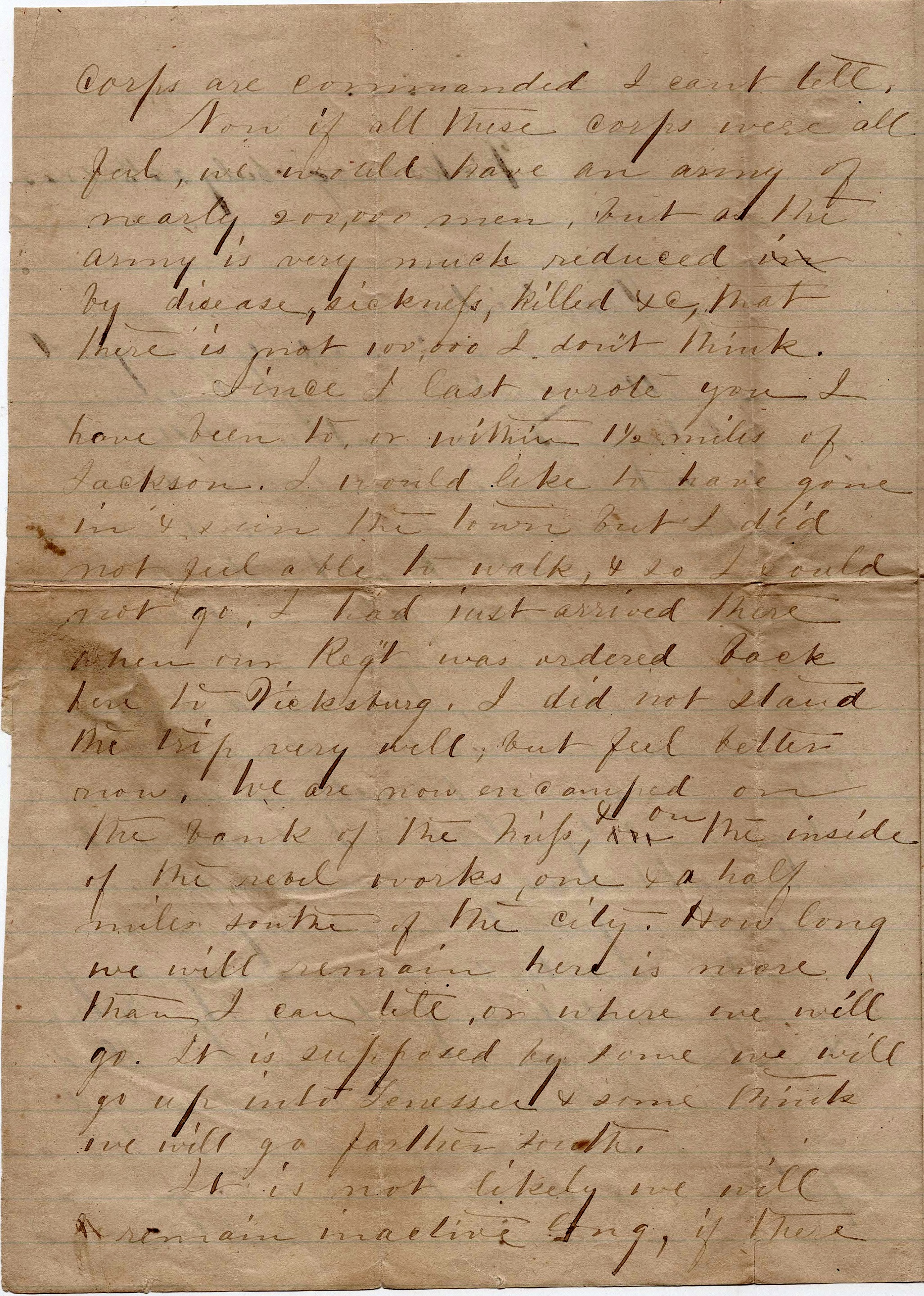
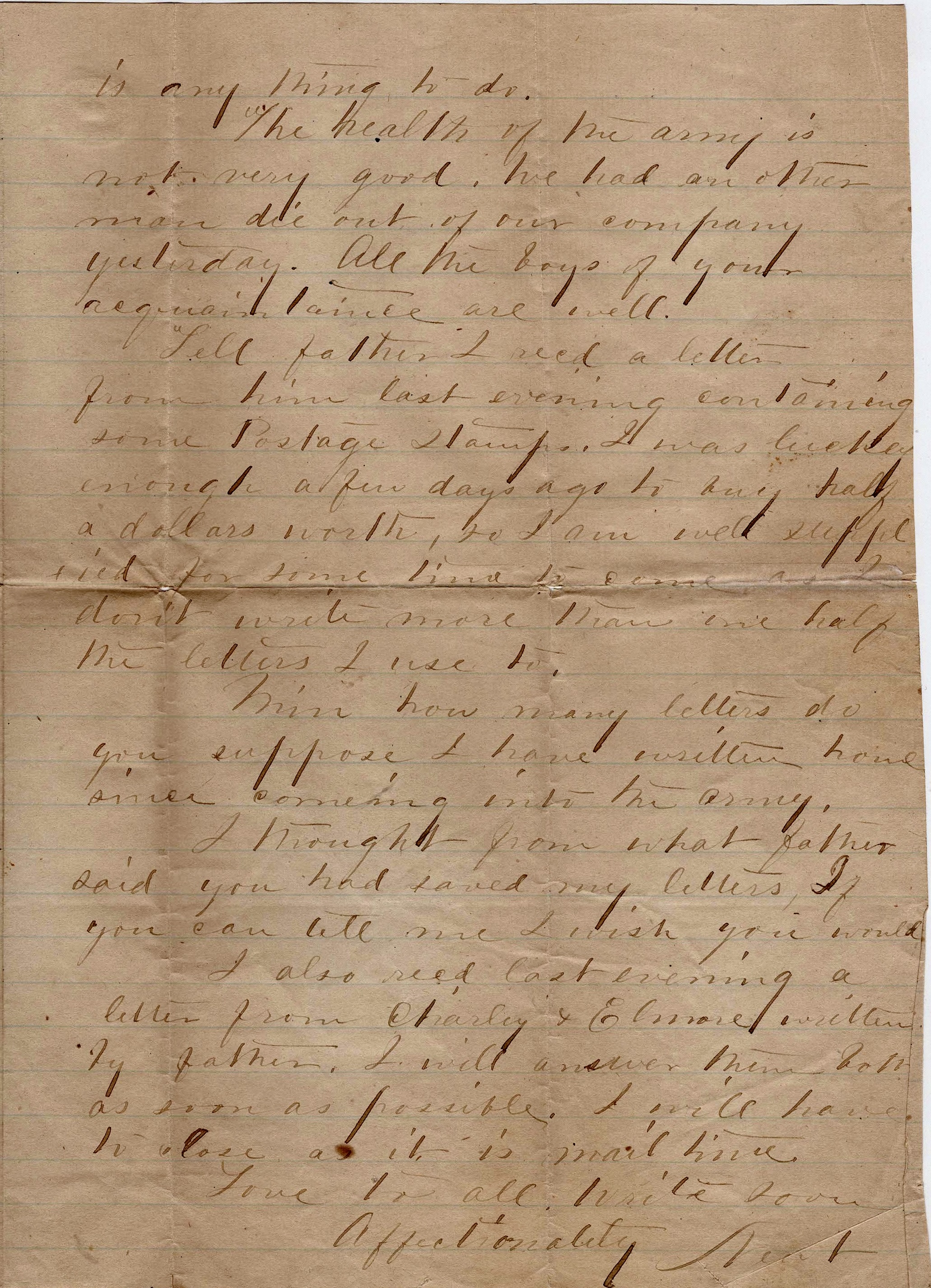
I received your good long letter last evening. I am mistaken—it was father’s letter I received last evening & yours a few nights ago. Since I last wrote you this great stronghold of the Mississippi has at last fallen, which caused the hearts of many a soldier in rear of Vicksburg to bound with joy when the “white flag” was run up over the fortifications surrounding the city. You asked me what I thought was hte number of men that composed this army. It consists of four Army Corps commanded respectively by Gen. Osterhaus, Gen. Sherman, Gen. Ord, Gen. McPherson, and Gen. Burnside’s Corps is also here, together with a portion of Gen. Herron’s Corps. By whom these last named Corps are commanded, I can’t tell. Now if all these Corps were all full, we would have an army of nearly 200,000 men, but as the army is very much reduced by disease, sickness, killed, &c., that there is not 100,000 I don’t think.
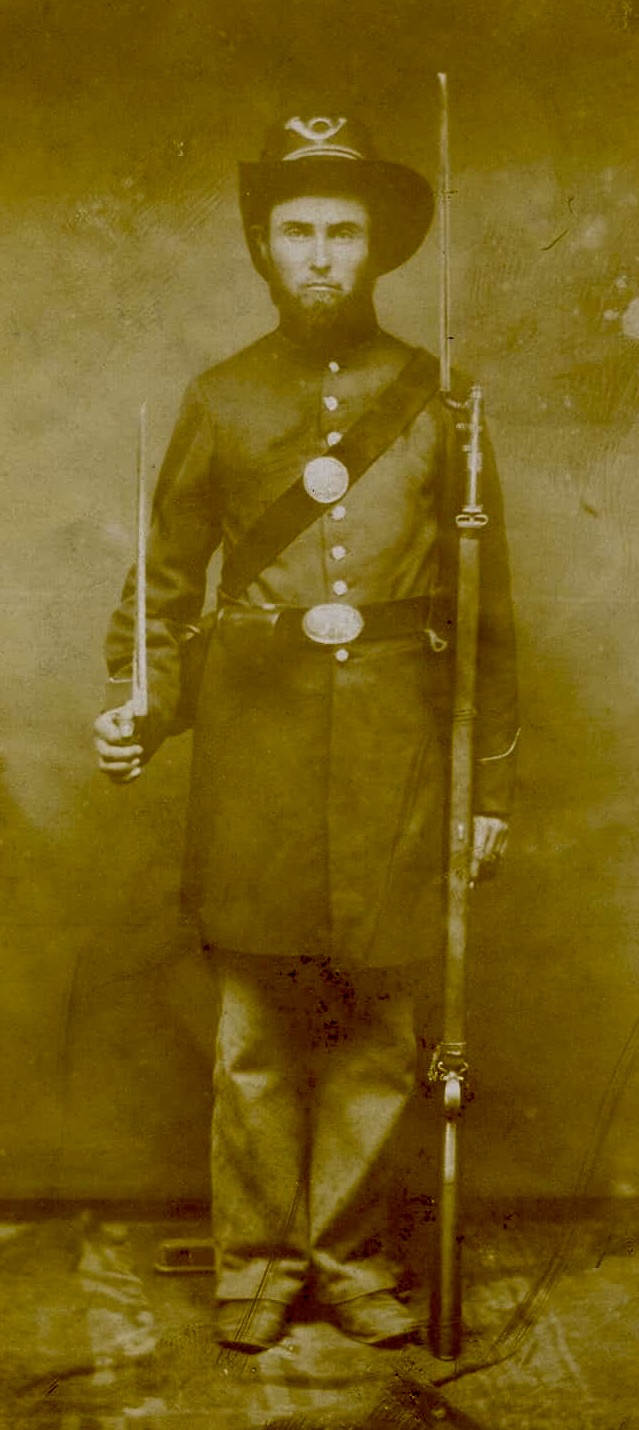
I could not find an image of Newt but here is one of William P. Marvin who served in Co. I, 22nd Iowa Infantry (Iowa Civil War Images)
Since I last wrote you I have been to, or within 1.5 miles of Jackson. I would like to have gone in and seen the town but I did not feel able to walk and so I could not go. I had just arrived there when our regiment was ordered back here to Vicksburg. I did not stand the trip very well but feel better now. We are now encamped on the bank of the Mississippi on the inside of the rebel works one and a half miles south of the city. How long we will remain here is more than I can tell, or where we will go. It is supposed by some we will go up into Tennessee and some think we will go farther south. It is not likely we will remain inactive long, if there is anything to do.
The health of the army is not very good. We had another man die out of our company yesterday. All the boys of your acquaintance are well.
Tell father I received a letter from him last evening containing some postage stamps. I was lucky enough a few days ago to buy half a dollar’s worth so I am well supplied for some time to come as I don’t write more than one half the letters I use to.
Min, how many letters do you suppose I have written home since coming into the army? I thought from what father said you had saved my letters. If you can tell me I wish you would. I also received last evening a letter from Charley and Elmore written by father. I will answer them both as soon as possible. I will have to close as it is mail time. Love to all. Write soon. Affectionately, — Newt
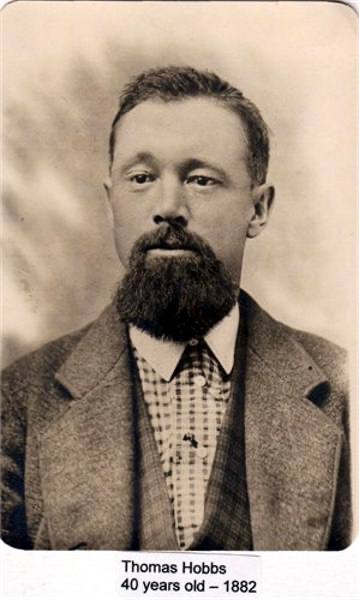
The following letter was written by Thomas Benton Hobbs (1842-1910) of Delhi, Delaware county, Iowa, who enlisted on 17 September 1862 to serve as Commissary Sergeant of Co. G, 6th Iowa Cavalry. He was mustered in on 10 November 1862 and promoted to 2nd Sergeant on 21 February 1864. He mustered out of the regiment on 17 October 1865 at Sioux City, Iowa. His older brother Charles Francis W. Hobbs (1833-1883) also served in the same company.
Thomas was the son of Charles Warfield Hobbs (1805-1878) and Mary Eliza Wilson (1803-1855).
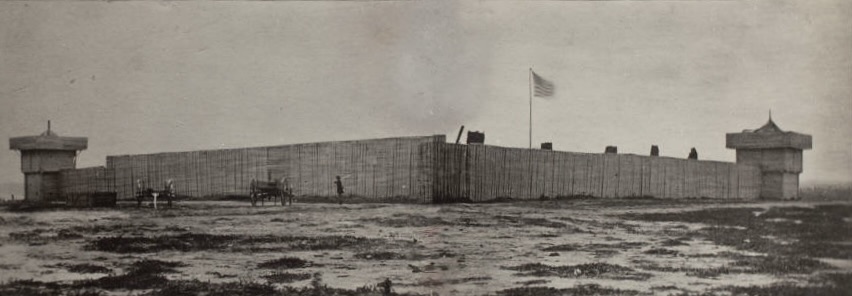
The 6th Iowa Cavalry was organized at Davenport January 31 to March 5, 1863. Moved to Sioux City, Dakota, March 16-April 26, 1863. Operations against hostile Indians about Fort Randall May and June. Moved to Fort Pierre, and duty there till July. Sully’s Expedition against hostile Sioux Indians August 13-September 11. Actions at White Stone Hill September 3 and 5. Duty at Fort Sully, Fort Randall and Sioux City till June, 1864. Sully’s Expedition against hostile Sioux Indians June 26-October 8. Engagement at Tah kah a kuty July 28. Two Hills, Bad Lands, Little Missouri River, August 8. Expedition from Fort Rice to relief of Fisk’s Emigrant train September 11-30. Fort Rice September 27. Duty by Detachments at Fort Randall, Sioux City, Fort Berthold, Yankton and the Sioux and Winnebago Indian Agencies till October, 1865. Mustered out October 17, 1865.
Fort Berthold as it looked in 1865(Newberry Library)
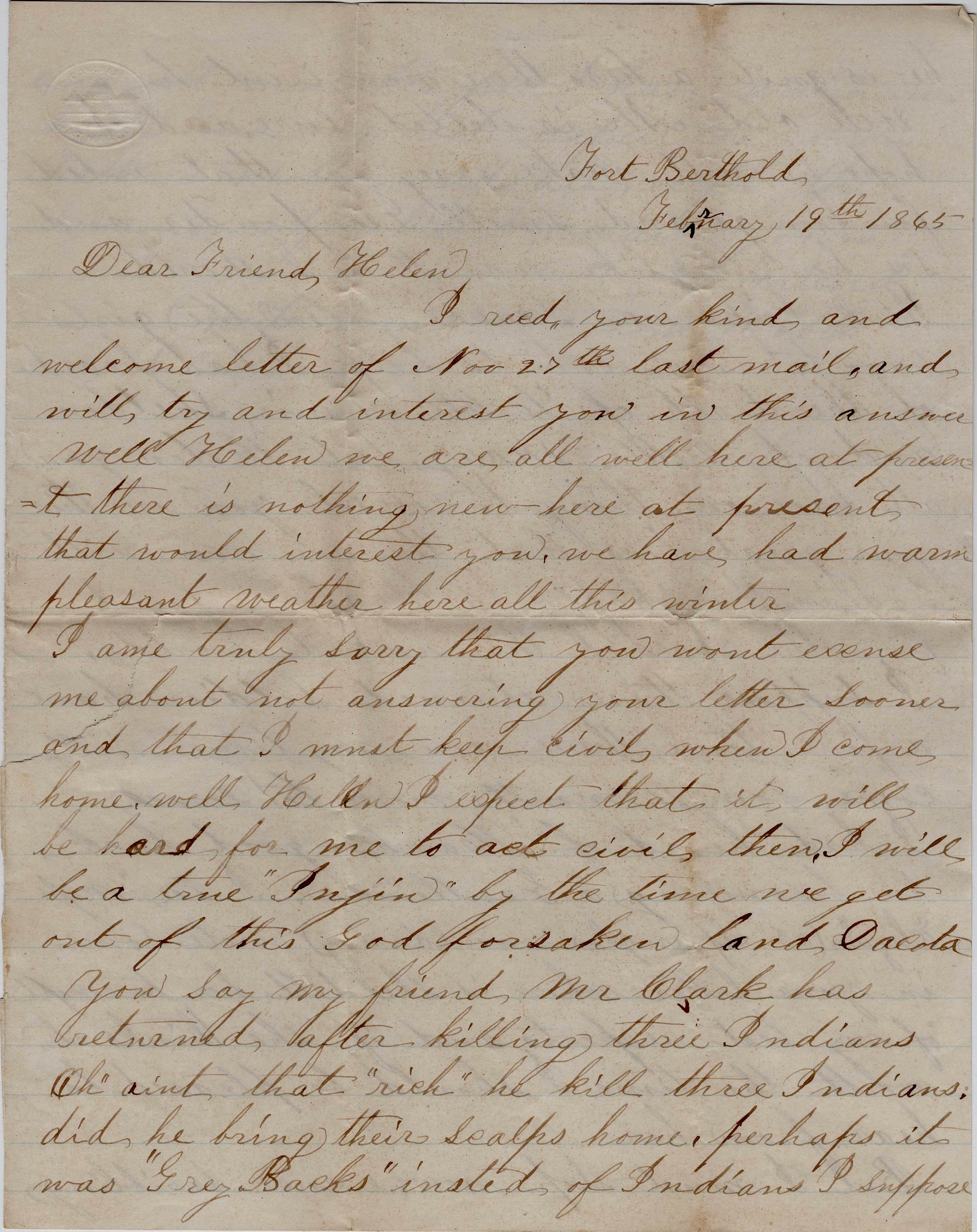
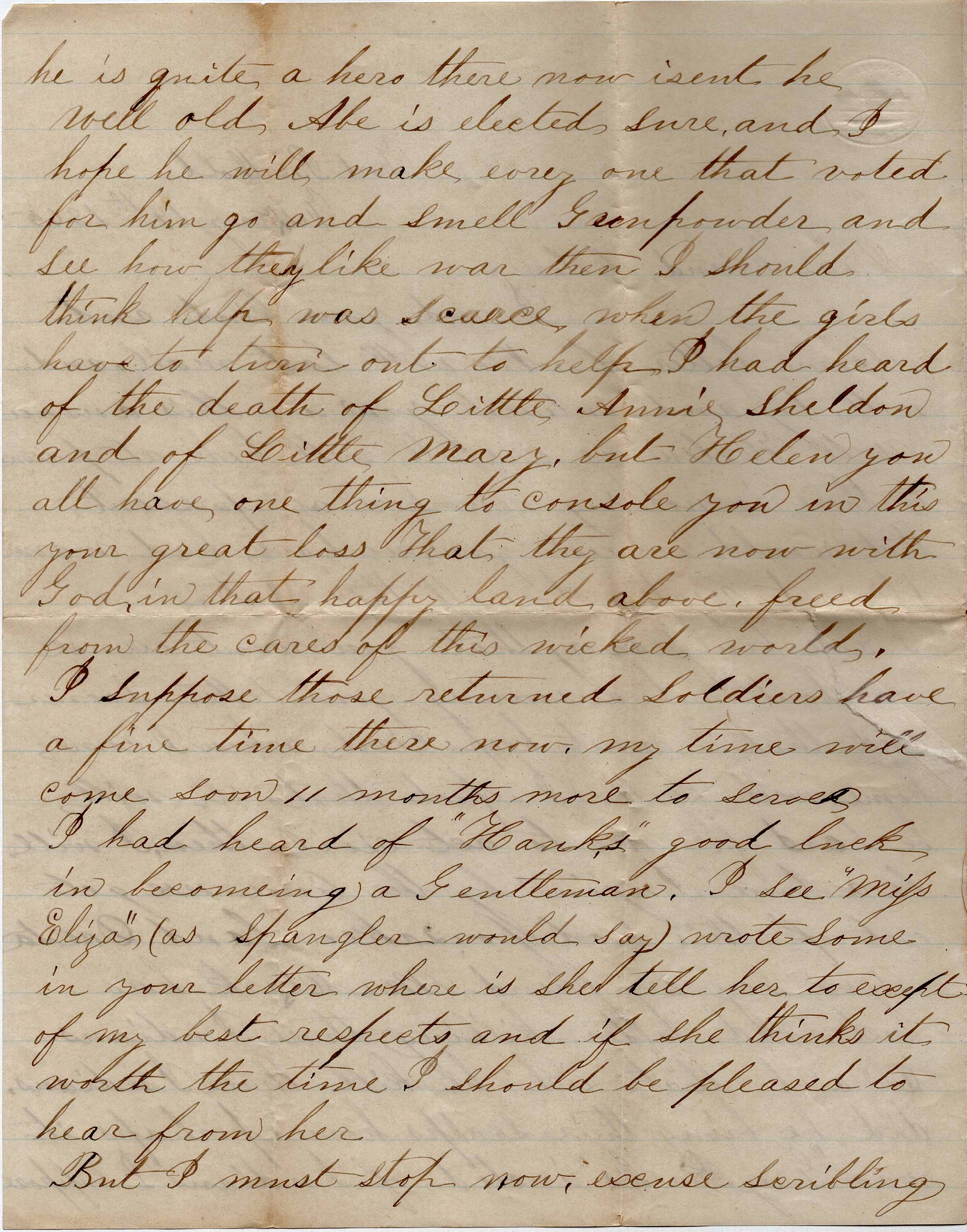
Fort Berthold February 19th 1865
Dear Friend Helen,
I received your kind and welcome letter of Nov 27th last mail and will try and interest you in this answer. Well Helen, we are all well here at present. There is nothing new here at present that would interest you. We have had warm pleasant weather here all this winter.
I am truly sorry that you wont excuse me about not answering your letter sooner and that I must keep civil when I come home. Well Helen, I expect that it will be hard for me to act civil then. I will be a true “Injin” by the time we get out of this God forsaken land Dakota.
You say my friend Mr. Clark has returned after killing three Indians. Oh, ain’t that “rich”—he killed three Indians. Did he bring their scalps home? Perhaps it was “Grey Backs” instead of Indians. I suppose he is quite a hero there now, isn’t he?
Well old Abe is elected sure, and I hope he will make everyone that voted for him go and smell gunpowder and see how they like war. Then I should think help was scarce when the girls have to turn out to help.
I had heard of the death of little Annie Sheldon and of little Mary, but Helen, you have one thing to console you in this your great loss—that they are now with God in that happy land above—free from the cares of this wicked world.
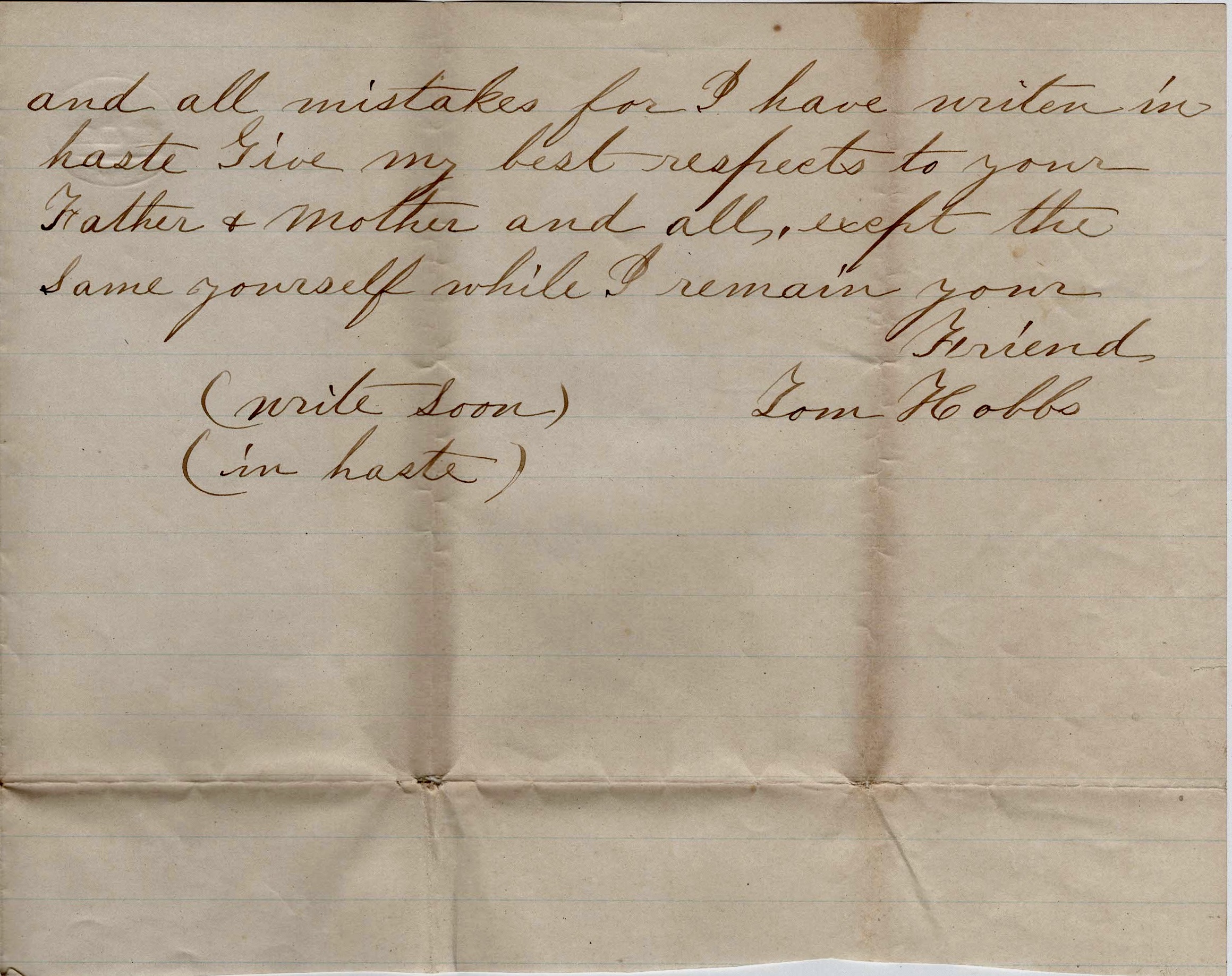
I suppose those returned soldiers have a fine time there now. My time will come soon. Eleven months more to serve. I had heard of “Hanks” good luck in becoming a gentleman. I see “Miss Eliza” (as Spangler would say) wrote some in your letter. Where is she? Tell her to accept of my best respects and if she thinks it worth the time, I would be pleased to hear from her.
But I must stop now. Excuse scribbling and all mistakes for I have written in haste. Give by respects to your Father and Mother and all. Accept the same yourself while I remain your friend, — Tom Hobbs
The following letter was written by James Weller on behalf of himself and his comrade, John Albert, both corporals who enlisted in Co. D, 15th Ohio Infantry in September 1861. This letter was written from Camp George Wood near Munfordville, Hart county, Kentucky.
T R A N S C R I P T I O N
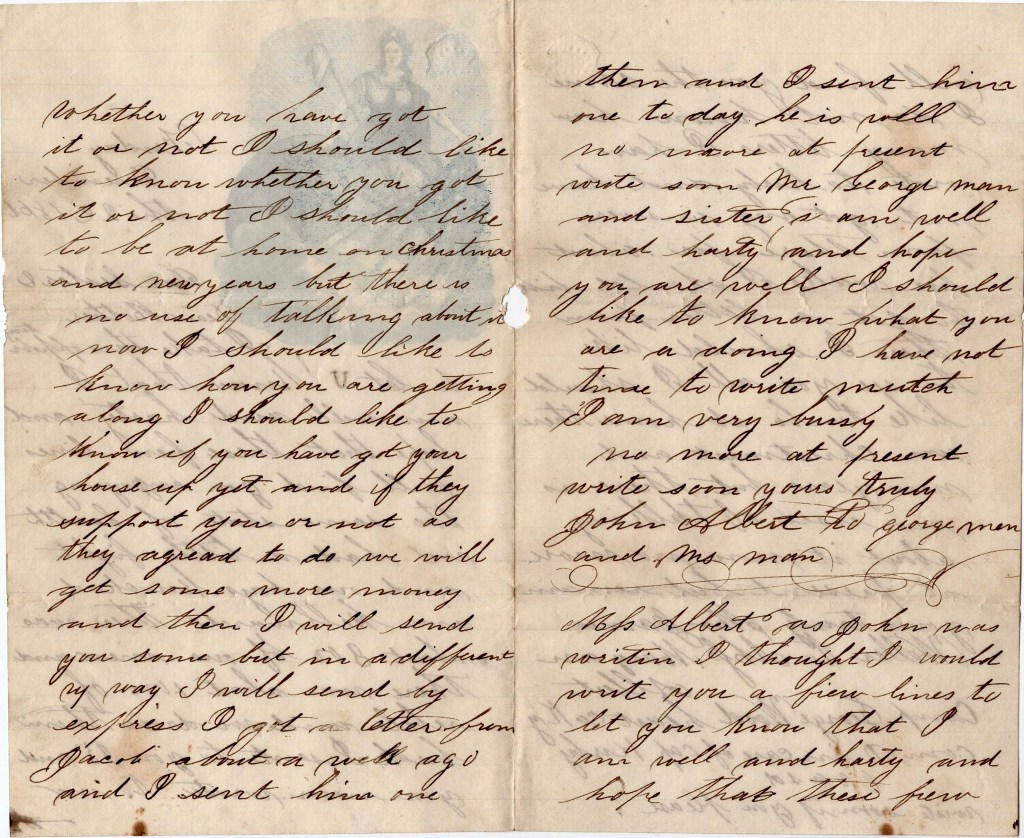
Friday, December the 20, 1861
Dear Sister & Dear Mother.
I take this opportunity to let you know that I am well and hearty and hope that these few lines will find you enjoying the same state of health.
We had a little fight and our boys knocked ’em hellwards. There was about 300 of our men and there was about 1,000 of rebels and we drove them back.
I sent to you $5 and you never wrote to me whether you have got it or not. I should like to know whether you got it or not. I should like to be at home on Christmas and New Years but there is no use of talking about it now. I should like to know how you are getting along. I should like to know if you have got your house up yet and if they support you or not as they agreed to do. We will get some more money and then I will send you some but in a different way. I will send by express.
I got a letter from Jacob about a week ago and I sent him one then and I sent him one today. He is well. No more at present. Write soon Mr. George Man and sister. I am very well and hearty and hope you are well. I should like to know what you are a doing. I have not time to write much. I am very busy. No more at present. Write soon. Yours truly, — John Albert
To George Man and Mrs. Man
Miss Albert, as John was writing I thought I would write you a few lines to let you know that I am well and hearty and hope that these few lines will find you the same. I do not know how many letters I have wrote to Kirby and have not got any answer from there for about five weeks, I should like to get a letter from there. I should like to see you all. I should like to e at home there Christmas and New Years but there is no use talking about it now. No more at present but remain yours truly, — Mr. James Weller
to Miss Mary and Albert
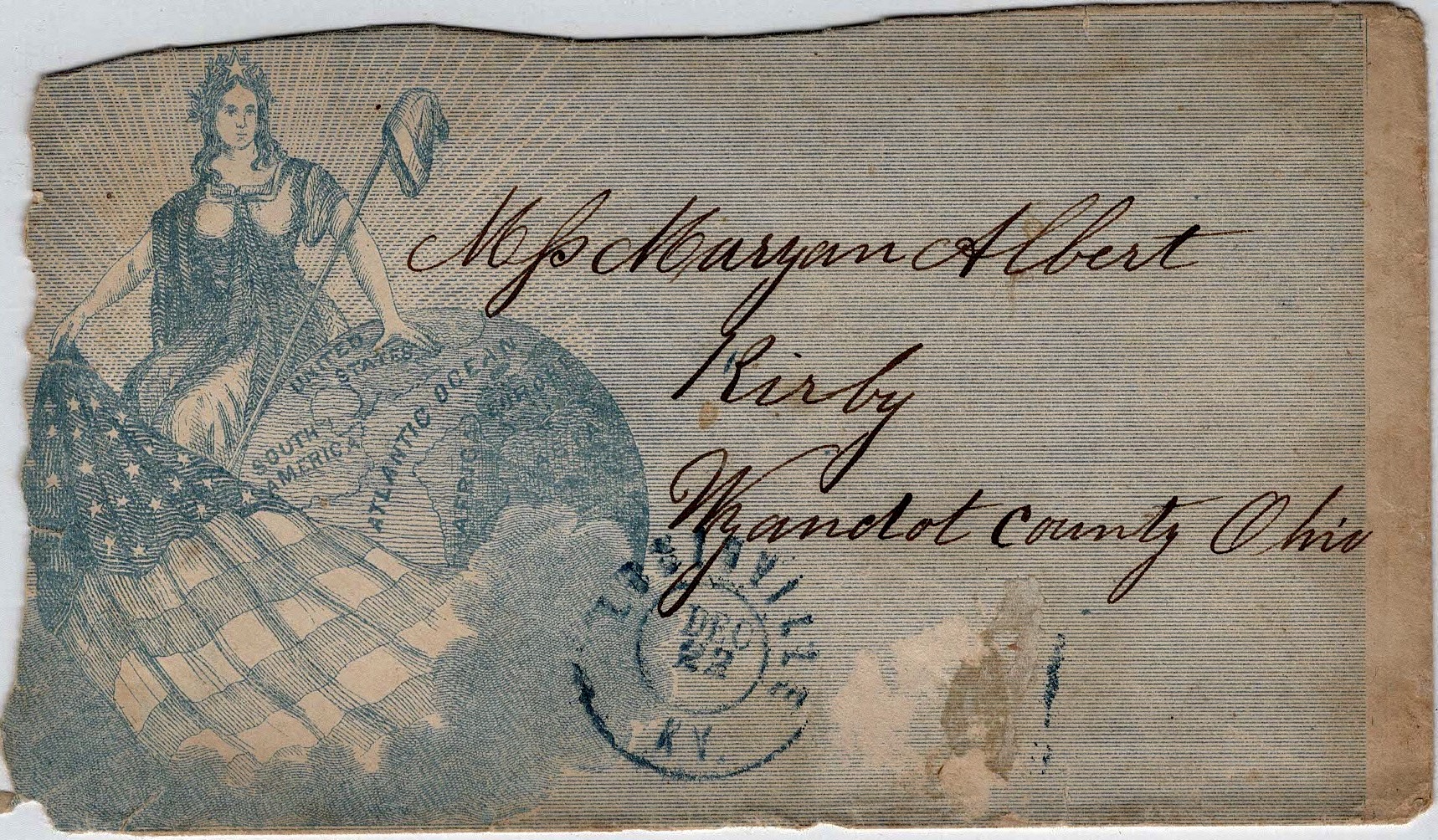
Camp George Wood, Hart county, Kentucky. Company D, in care of Capt. [Isaac Miner] Kirby [15th] O. V. USA
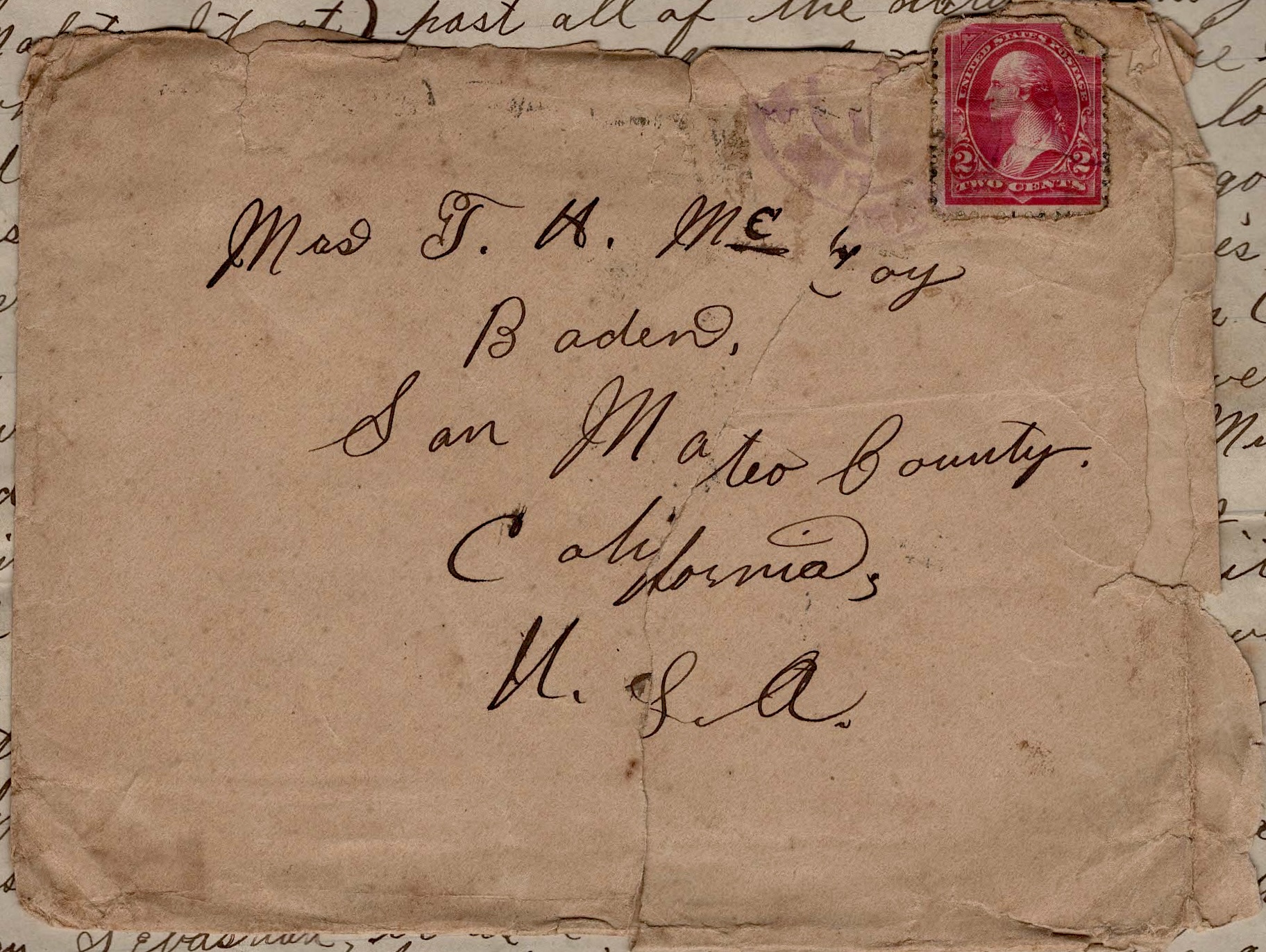
The following letter was written by James Harvey Knight (1877-1899) who enlisted in Co. M of the 14th US Infantry in June 1898 at San Francisco and was killed in action by a gunshot wound at Santa Ana near Manila in the Philippines on 5 February 1899. His remains were brought home the following year for re-burial in the Holy Cross Catholic Cemetery in Colma, San Mateo county, California, Section G, Row 19, Grave 8, but without headstone. He was the stepson of Thomas McCoy, and brother of Clair McCoy.
T R A N S C R I P T I O N
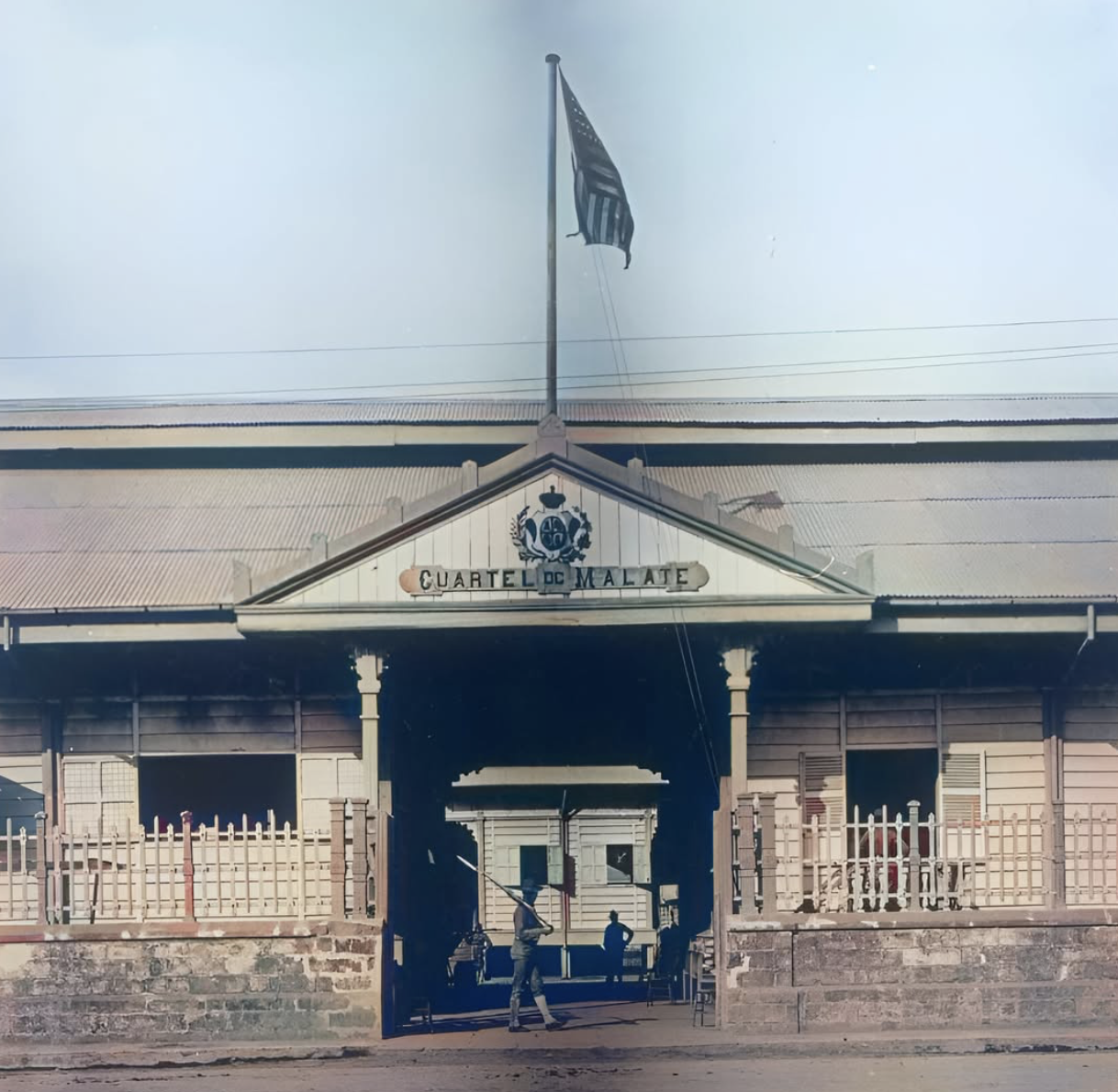
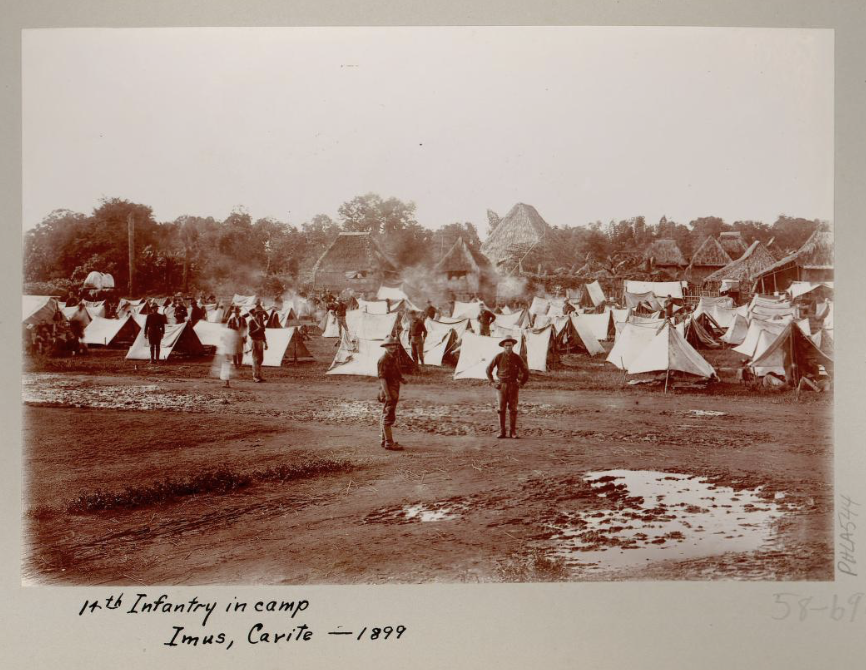
Cuartel de Malate Manila, Philippine Islands Monday, November 7th [1898] In camp 10 a.m.
Dear Mother,
I happen to have an hour or so to spare today so I will tell you about a trip some of my comrades and myself took yesterday. We started from the Cuartel about 7.30 a.m. in the morning and we took it along easy. We went down Calle Malate (Malate Street) past all of the native veno joints, or small whisky shops as we would call them in the States, only instead of whiskey they sell a native drink. It looks and tastes somewhat like Chinese gun, only it is a good deal stronger. Well we walked down past these places and out across the old Spanish parade grounds (which we use now for our dress parades, and we went on over into the walled city, our destination being the Spanish Museum which is in a large building fronting on the Pasiz River. We arrived there after an hour’s walk only to find it closed up for the day. We were told that it would be open to visitors at 4 p.m. on the following day.
Cuartel de Malate (“Barracks of Malate”) where the 14th US Infantry was quartered in 1898
We were disappointed, of course, but we decided to put in the day somehow so we started out to go out to a place called San Sebastion. It is a suburb on the extreme northwest end of the city. It is here that the city prison is located and is it from here that the English Railroad startes. We stopped at a Pilipino Catholic Church on the way over and we stoped at the church while a native priest was saying mass. I can hardly tell you what the inside looked like. It was fixed up like our churches at home are only they don’t have pews. They have pine hardwood floors and the people kneel down on their knees and pray. There is only one thing there that I noticed that seemed out of place and that was large piles of dirt and rubbish that was swept up into the corners and left there to pile up. We stayed to mass—if that is what you call it (I don’t know much about churches so I will have to be excused if I make any mistakes)—and when it was over, we proceeded on our way.
Headstone of Thomas W. Horn, 3rd Artillery, in the San Francisco National Cemetery.
We stopped at the Cuartel de Meisic 1 where the 3rd Artillery is stationed at, and I went in and talked to Tom Horn 2 for a few minutes. He is looking pretty fair, though not as fat and hearty as he did on my last visit about a month ago. I asked him when he thought he would go home and he told me that he expected to be discharged in the course of a couple of months, and that he intends to stay here for a while after he gets his discharge. He said that he and 9 more of his comrades are going to out together $100 apiece and get a prospecting outfit and that they are going back in the hills and have a look for minerals. He said that he hoped he would get some mail pretty soon as he has not heard from home for a long while and I guess we are in the same fix as I have not received any mail since the 19th of October, but by Wednesday we will have our mail as the SS City of Peking arrived at Hong Kong last Saturday, November 5th, and it is tumored that she has over 9 tons of mail on board for the soldiers. I hope so as do all the rest of the boys. It will take a few days to bring it over to Manila from Hong Kong as it takes two days for the steamer to go there and two for her to return. It is a little over 6 hundred miles to Hong Kong.
Well I talked a short time to Tom and he was telling me all about Pat Ferriter getting married and about Della Cameran having a child and all the Baden news that I got from you a long while ago. I didn’t let on that I knew anything about it until he got through and then I told him the balance that he didn’t know. The boys that were with me got tired of waiting for me so we started out for the railroad to see what was to be seen.
We arrived at the railroad depot after a long walk and you would laugh if you could see the cars that they use. The engines are all small—something like the one that they have at the packing house, but the passenger cars and the box cars look like as if they had been built for a kid to play with—they are so small. The passengers coaches are just the same as they are all over Europe. There are four compartments to each car and all they can put in each car is 8 persons, two to each compartment. One enters these cars from the side. The cars have a foot board running along the upper half of each, being a window. When one wants to travel on the railroad, why you buy a ticket to whatever point that you want to go to [and] the ticket agent takes your name and address and assigns you to a certain apartment in a certain car of the train, and you are locked in the car, and when you arrive at your station, why a fellow comes around and lets you out. A guard they call him. One not used to his ways would think that he was president of the railroad. There are 28 stations on the road and it is close on to 200 miles long. It costs $6 Mexican money or $3 in American money to go the round trip. It takes all day to make the round trip. I have not had a chance to make it yet, or take it. I should have said as there are guards stationed at the depot, and they are instructed not to let any American soldiers go out on the trains but this will be changed in a few months and then I will take a trip as soon as I can get a furlough and I will let you know later on what the country looks like.
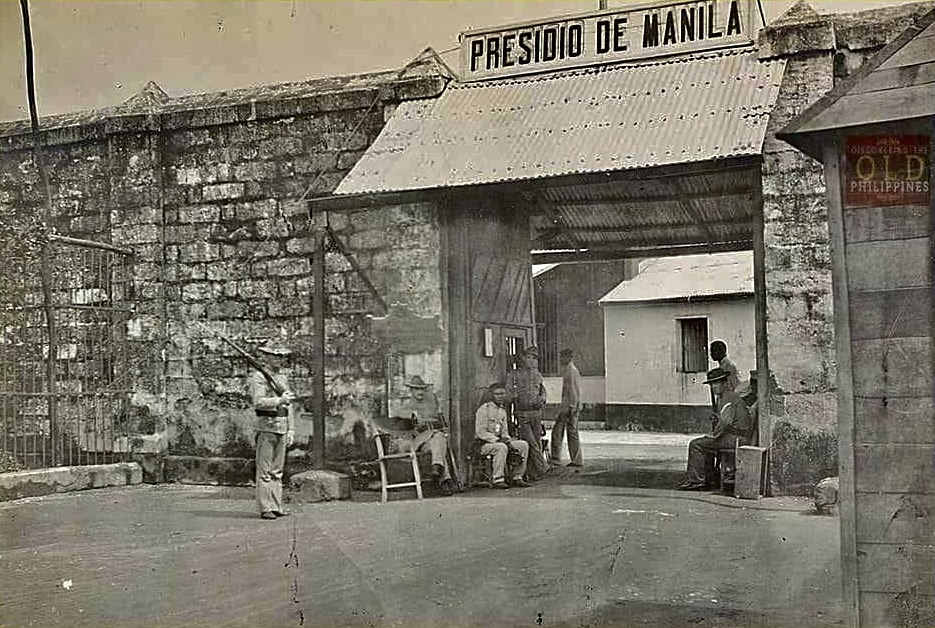
Presidio de Manila commonly known as the Old Bilibid prison in Manila entrance during the American colonization of the Philippines, 1900s.
We saw about all there was to be seen around there and then started out to see the prison. It is about one mile north of the railroad depot and so it did not take a great while to cover the distance. We were admitted to the jail without any trouble and we passed inside, the gate keeper gave each one of us a square brass check with B. P. stamped on one side of it. That was so that he would know us when we came out again. We were met inside the walls by a couple of soldier boys that were sent up for a year apiece. One of them had got drunk and abused his officer and the other had got full and got into a fight on the Escolta (the Main street of Manila). They showed us all around and I must say that it is a dismal place for a human being to have to live in. There is nothing to be seen but filth and misery on all sides. There was four English sailors in there too and about twenty Spaniards and 150 Filipino’s. The Americans and Englishmen were given 30 cents Mexican money each morning, 30 cents apiece I should have said, and that is 15 cents American money. They get that to live on each day and it is given them about 9 o’clock every morning. And there is an old woman there that comes in each morning and afternoon and she takes their money and goes out and she brings them back a handful of rice, a couple of onions, and a few potatoes, and a bit of grease to cook the stuff with. She makes a pretty good profit out of them and they have to pay two cents for little sticks of wood to cook their food with. They are really being slowly starved to death.
They have a horrible means of killing a man when he has been sentenced to die. It is called the Spanish garrote and it is a vise that man put his neck into and there is a screw that winds up like a house-movers jack and it takes only thirty seconds to break a man’s neck. It is a simple thing to look at, but I’ll bet it is a terrible thing to see in action.
We saw about all there was to be seen and then started for home, and, as we were crossing the big stone bridge that goes over the Pasig River over the main part of New Manila, we stopped to see the natives dredging the river. They (a half dozen of them or so) have a large canoe with a step in each side near the water line. They take a common straw basket apiece and dive or drop straight down to the bottom of the river and fill this basket with sand and mud and come to the surface with it and dump it in the boat. They have long poles stuck down along side of their boats so as to steady themselves when they come up with their load. They do an awful lot of work in a day’s time. A stranger would hardly think that they could stay in the water so long and I would not believe it myself if it were not for the fact that I have seen them with my own eyes. And for a day’s work of ten hours, they get the large sum of 50 cents apiece, or 25 cents in our money. They are good workers in the water but are not to be compared with the Kanakas of Honolulu as the natives of that place just seem to make their home in the water.
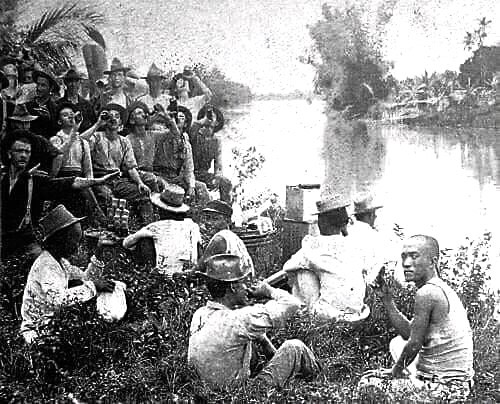
American soldiers and captured Filipino “Prisoners of War” (POWs) share a refreshing “Schlitz beer”alongside the Pasig River in Hacienda de San Pedro de Macati. Philippine Islands. c1899.
We proceeded on our way to our quarters out in Malate and so ended one day’s tramping. Of course I have not put down here one quarter of what we saw, but what to you would be strange. Why, we are used to such sights and don’t take any more notice of them. I can tell you all about these things when I get home—if I ever do—but if I do it will be some four or five years from now as like Tom Horn, I intend to stay here for a few years if the U.S. holds these islands. And there does not seem to be much doubt left now but what they will. This is no country for a white man from a northern country like myself, but I am willing to take my chances if I can make a few thousands dollars down here in a few years time.
As to getting out of the army, why I cannot tell when we will be discharged. I guess it will be a long time from now, though. We hear rumors every day. Some have it that we will be sent home before Christmas and others that we will put in a year more down here, and I think that the latter comes nearer hitting the nail on the head. I will not trouble you or myself in the future when writing as fellow cannot tell whether they are truth or fiction. I will have to carry this letter over for a day or two so that I can write an answer to your letters. I know that there are some in this mail for me and the steamer has just come into the harbor. There is another steamer coming up the straits and she has a large sailing ship in tow. She is about 8 or ten miles down the straits yet, and I guess she will not be in for a couple of hours yet. The first one that came in came from Hong Kong so I guess she has the mail on her. It will take until tomorrow morning to sort it out and then we will get it, so I will lay this aside until after I get mine. This could not leave here before next Friday yet at the earliest as the next steamer to sail is the United States transport Scandia and she leaves for the U. S. next Friday with 250 sick and discharged soldiers. So now I will close this for today.
In camp after Guard Mount, 9 a.m. Tuesday, November 8, 1898 Cuartel de Malate, Manila, P. I.
I am with you once more (on paper). I have not much to say for today. The weather is pretty fair as it always is in the tropics. I have to stay in my quarters from 9 o’clock this morning until 9 o’clock tomorrow morning as I am supernumerary of the guard for today. I am the guy that is called upon to take his place, but then, that is all the better for me, as if I am called upon for the next 24 hours to my duty, why that lets me out of going on guard tomorrow. And if I am not called out, I have to stand guard for 24 hours so from now until tomorrow morning I am not supposed to leave my quarters. I have nothing to do but still I have to remain within easy call.
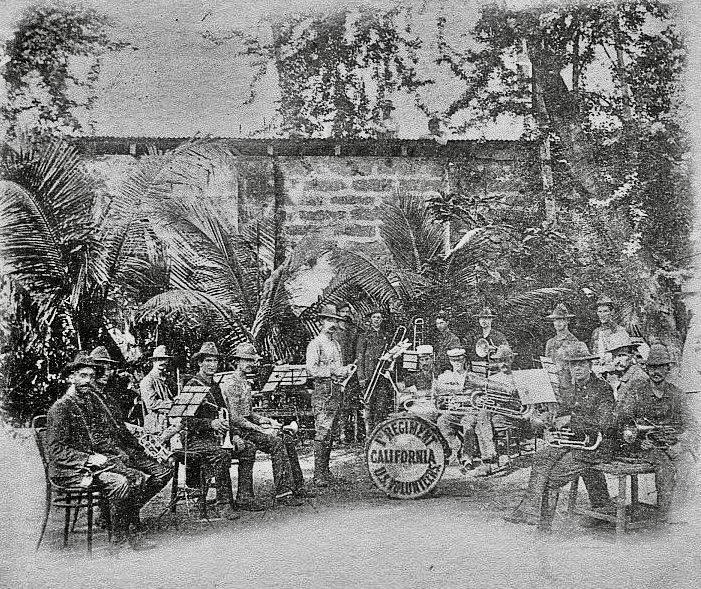
I took a trip down to Lunette last night. It is the Main Park and driveway for the elite of Manila. They gather there every evening in large gangs—Spanish and Americans—and have their carriages drive up to the Park and stop. The driveway extends along the water front about 50 feet back from the beach for a distance of between three and four miles. We have a band stand in the middle of the Park and the regimental bands of our troops play there three times a week—Tuesdays, Thursdays, and Sunday nights. The different bands take turns at playing. The band that is supposed to be the best is the 13th Minnesota Band and there is no doubt but what they are fine. They are great at opera music and National Airs. I wish you could have heard the cheering the soldiers made last Thursday evening when the band played the last time, or rather the next to the last time, as all the bands down here always play the Star Spangled Banner last, and all soldiers have to take their hats off and stand at attention while it is being played. Even the Spanish gentlemen that come out for an airing of an evening with their ladies stand at attention and take their hats off too. But the other night the band played Dixie just before the NationalAir an maybe we didn’t cut loose with our yells and Dewey’s Flag Ship—the Olympia—was lying only about half a mile from the shore and I guess that they must have heard the band stand and kept it turned on steadily for about 2 minutes.
The 1st California Regiment Band in Manila (1898)
I will miss the concert tonight as I have told you the reason that I have to stay in quarters, and that is about all the enjoyment that I get now, except the baseball games that we are always playing. There is a game pretty nearly every day and I am getting tired of watching them. About once a week I go down and visit the boys of the 1st California Regiment. I have a lot of old chums in that regiment that I used to go to school with in San Francisco. I always have a good time when I go down to see them and I always give them the same when they come out where I am.
The steamers that came in to the harbor yesterday did not bring any mail with them but there is one that has just come in and it is said that she came from Hong Kong. She has just dropped her anchor over in Subic Bay, over near Cavite. If she has the mail on her, why, we can expect to get it sometime this evening and I will let you know all about it as to whether or no we get it before I close this for today. The man in the Post Office down at New Manila have put up a sign stating that mail is expected from the U.S. on the 9th or 10th of this month. That would be tomorrow or the next day, although it does come in a day or so ahead of time once in a while. I hear the bugler blowing mess call so as dinner is ready, why I must drop this pen for a while so that I can go out and eat a little.
In camp 7.30 a.m. Cuartel de Malate, Manila, P. I. Friday, November 11th 1898
Dear Mother,
I received 3 bundles of papers from you by the mail yesterday and I also got your letter that was enclosed in one of the papers. It is dated September 25th. I am glad to know that you have heard from me since arriving here. I wrote that letter on the Sunday morning just after we dropped anchor in Manila Harbor. I am sorry to hear that you have the rheumatism, and hope that by the time this reaches you, that it will have disappeared. This country is a bad place for it too. A good many of the boys have it bad. A person not knowing what the climate is in the tropics might think this would be a good country for such ails as that, but they would be sadly disappointed as it is warm here, but a different kind of a heat than that we get in the States. It is a damp heat and a fellow has to be very careful and try and keep away from catching cold as it does not take but very little to bring on a fever as I have learned to my sorrow. I am all right now, but I put in a few days misery with the fever. But I took care of myself in time and now i am feeling good once more.
Things are at a stand still here now—that is, I mean things are very quiet. We have not much to do but take care of our health and that is not an easy thing to do. We have to be very careful. I see by the cablegrams that we got yesterday that [Henry Tifft] Gage is California’s next Governor. I suppose Tom does not like that as I guess that he is still a good 16 to 1 Democrat. We also heard that [Theodore] Roosevelt carried New York. He must be well liked there as New York used to always go Democratic. I thank you for those news items. You don’t know how welcome those newspapers are to a fellow down here. Of course we have newspapers down here, such as they are. I will send you a copy of them, one of each, along with this—that is, in the mail. I hope that you will enjoy reading htem.
We are expecting to get paid today or tomorrow. The mail will leave tomorrow on the Scandia direct for the United States and this will go on her, I hope. I see by a cablegram that we got yesterday that the SS New Port left San Francisco on Tuesday, November 8th for Manila. She will arrive here by the 1st next month or so. I am on old Guard Fatigue today—that is, the day after one comes off guard, why he has to herd prisoners around. THe prisoners are compelled to do two hours work per day. They carry all the refuse away from the Cuartel and dump it in the bay. It is a very disagreeable task, herding them, as some of them are inclined to be very fresh with their guards, and once in a while one of them tries to get away, and that is the mean part of the job as the guard’s orders are very plain—that is to shoot them down at the first break that they make to get away. A sergeant tried to get away from his keeper down here—it is about a month ago that it happened—but the sergeant is dead now and the guard got made a corporal fr the dirty trick. Of course if the prisoners were natives or Spanish, we would not think of shooting them as they are no good. They appear very friendly, of course. Why wouldn’t they? But we are on to them with both feet. They would stick a knife in a fellow’s back if they got the chance. But the fellows that we have to watch are our own men that get put in [the guard house] for getting drunk or fighting, and a fellow hates to have any trouble with his comrades.
I wish you would ask the Niederost’s as to whether or no they know Pete Kyne. He comes from Spanish town. He was raised over there. I have got to know him from hearing him talk about the coast. He knows Donovan and Kearns and all the rest of the people from the coast that we know, including Clocks. Ask Claire if she knows Clocks, or not, and tell her that I have not had time to use up all them kisses that she sent but I thank her ever so much.
Well, Mother, I think I shall have to close this now as my rifle and weapons need a little polishing so I must fix them up as I will be called on for duty in a short while. I will now have to bid you all goodbye, hoping that you are al well and happy. Give Claire a big kiss for me and tell her to be a good girl. So with love for all, I remain your loving son, — Harvey Knight, Co. M, 14th U. S, Infantry, Military Station No. 1, Philippine Islands, via San Francisco, California
P. S. This Pete Kyne that I speak of is in Co. H of the 14th. He has just brought me over three papers called the Coast Advocate.
1 The Cuartel de Meisic was a Spanish-era barracks in Manila, located in the Binondo district (now the site of the Lucky Chinatown Mall area), not within Intramuros like some other cuartels. During the American period, it housed various U.S. Army units, including elements of the 3rd Artillery Regiment, which was stationed in the Philippines from approximately 1900 to 1903.
2 Thomas W. Horn (1873-1937) was born in Redwood, California, where he was mining prior to his enlistment on June 4, 1898 and enrolled in Battery G, 3rd US Artillery. He was discharged August 17, 1899 at Manila. Philippine Islands.
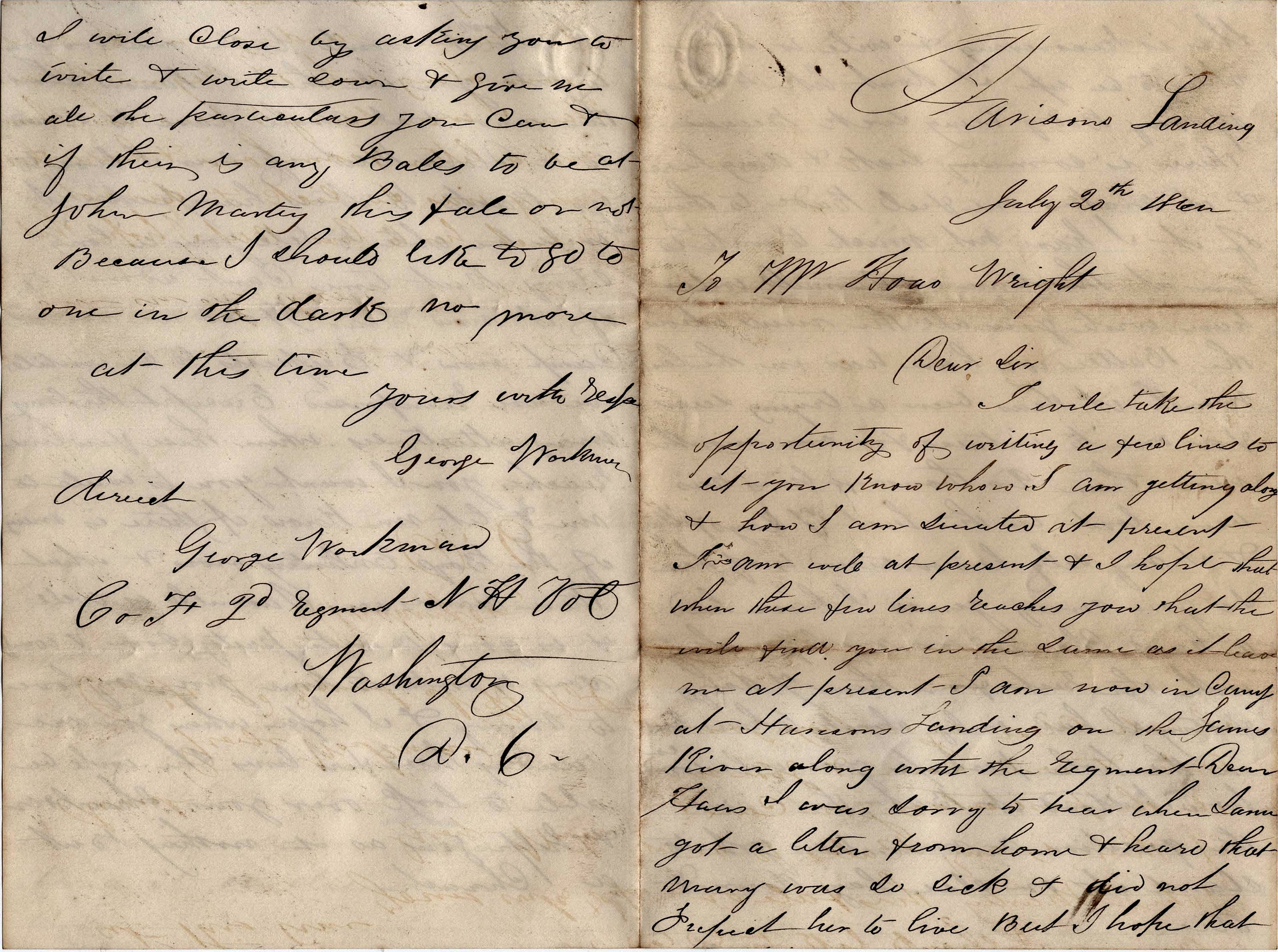
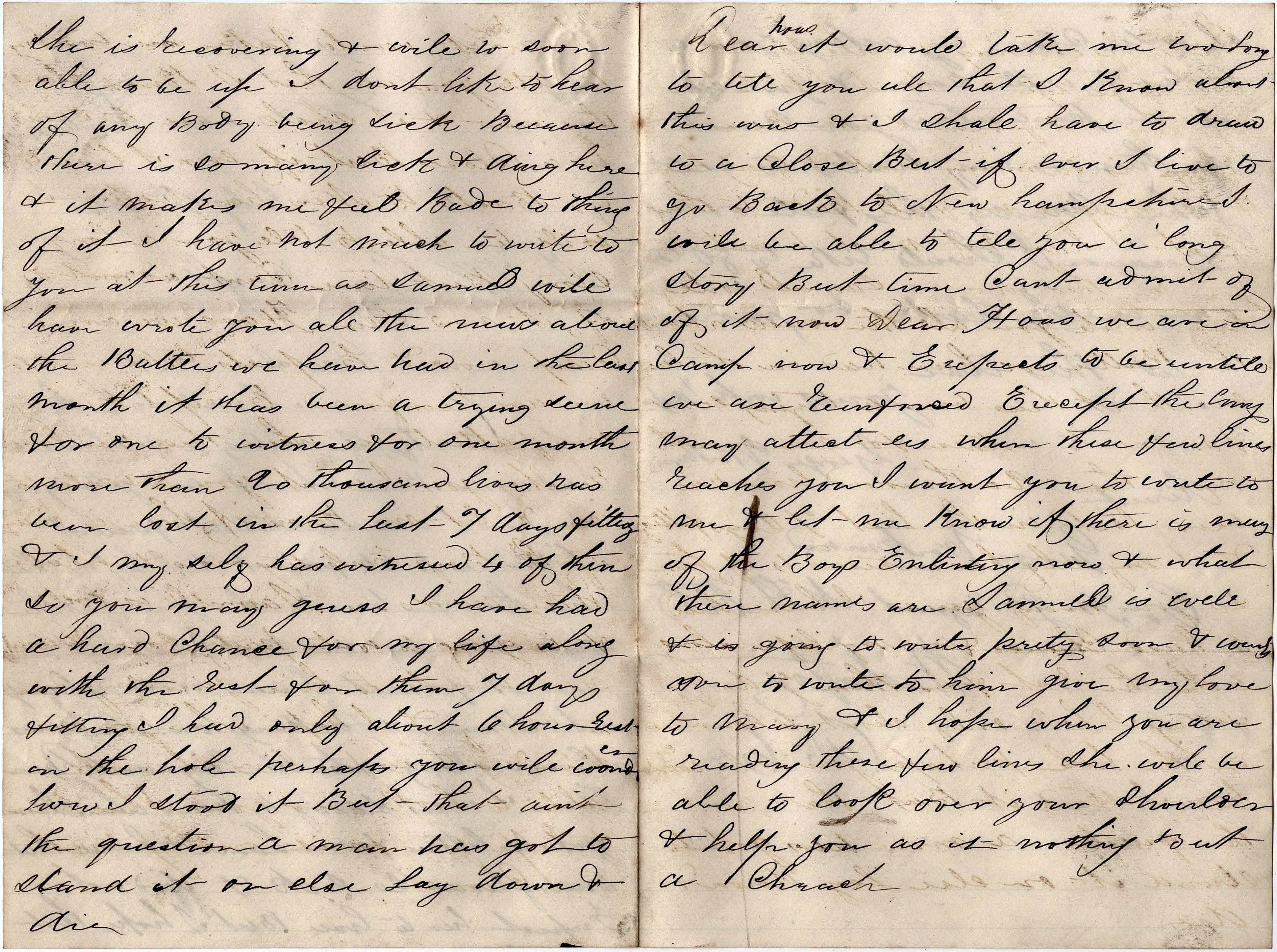
The following letter was written by George Workman (1844-Aft1910) who emigrated from Ireland in 1859 and enlisted on 30 January 1862 at Colebrook, New Hampshire, to serve as a recruit in Co. F, 2nd New Hampshire Infantry. According to muster rolls, George deserted from the service in March 1863. In the 1900 US Census, George was enumerated as a teamster and boarding with the Willey family in Manchester, Hillsborough, New Hampshire. He may very well have been the same George Workman enumerated as an inmate of the Alms House in Coos County, New Hampshire, in 1910.
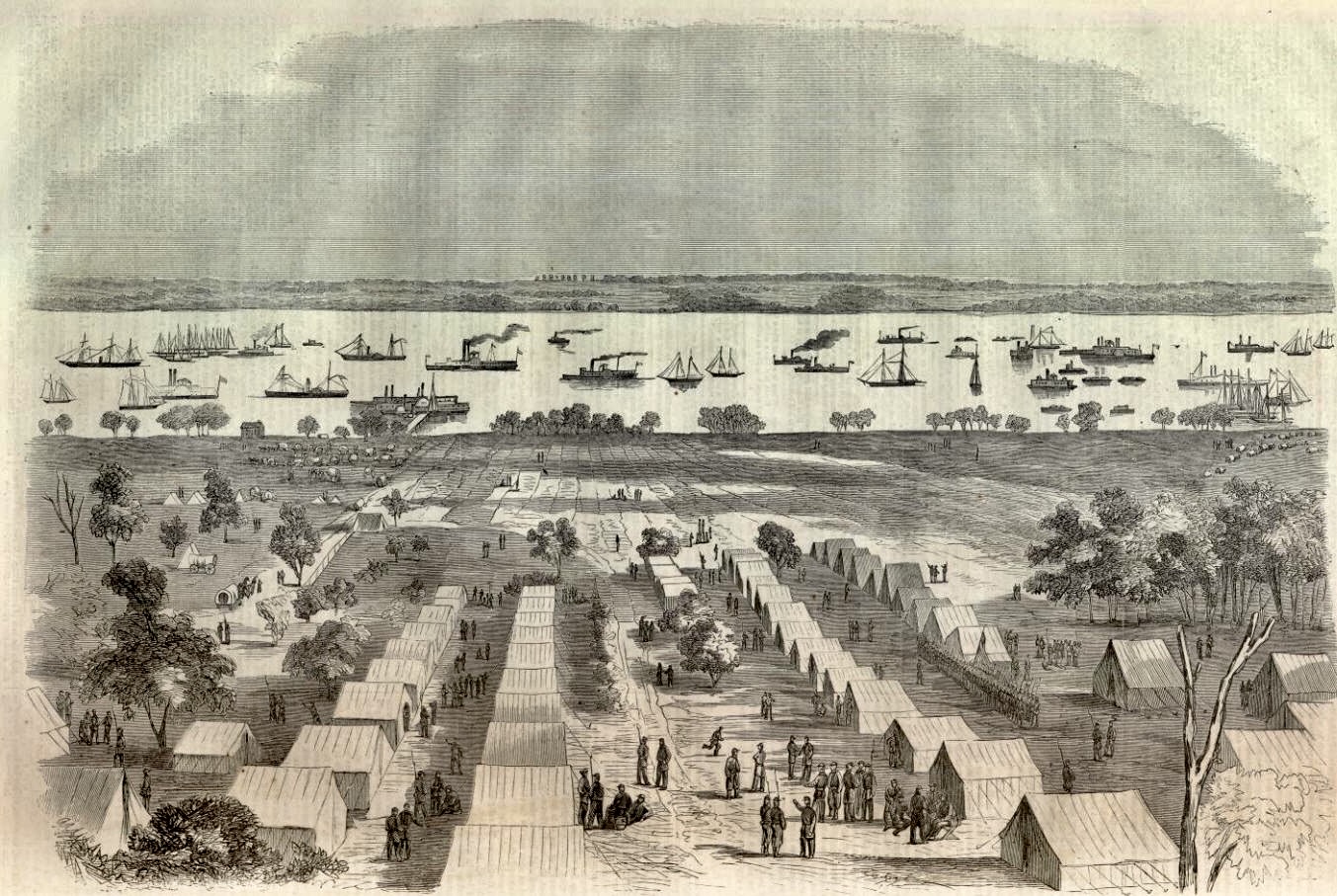
The Army of the Potomac’s encampment at Harrison’s Landing.
T R A N S C R I P T I O N
Harrison’s Landing July 20, 1862
To Mr. Haas Wright,
Dear sir, I will take the opportunity of writing a few lines to let you know how I am getting along and how I am situated at present. I am well at present & I hope that when these few lines reaches you that they will find you in the same as it leaves me at present. I am now in camp at Harrison’s Landing on the James River along with the regiment.
Dear Haas, I was sorry to hear when Samuel got a letter from home & heard that Mary was so sick & did not expect her to live. But I hope that she is recovering & is soon able to be up. I don’t like to hear of anybody being sick because there is so many sick and dying here and it makes me feel bad to think of it.
I have not much to write to you at this time as Samuel will have wrote you all the news about the battles we have had in the last month. It has been a trying scene for one to witness, for [in] one month more than 20 thousand lives has been lost in the last seven day fights & I myself has witnessed four of them 1 so you may guess I have had a hard chance for my life along with the rest. For them 7 days [of] fighting, I had only about 6 hours rest in the whole. Perhaps you will wonder how I stood it, but that ain’t the question. A man has got to stand it or else lay down and die.
Dear Haas, it would take me too long to tell you all that I know about this war & I shall have to draw to a close, but if ever I live to go back to New Hampshire, I will be able to tell you a long story. But time can’t admit of it now.
Dear Haas, we are in camp now & expect to be until we are reinforced, except the enemy may attack us. When these few lines reaches you, I want you to write to me and let me know if there is any of the boys enlisting now and what their names are. Samuel is well and is going to write pretty soon & wants you to write to him. Give my love to Mary and I hope when you are reading these few lines, she will be able to look over your shoulder and help you as it nothing but a crutch.
I will close by asking you to write and write soon & give me all the particulars you can. And if there is any balls to be at John Martey this fall or not because I should like to go to one in the dark. No more at this time. Yours with respect, — George Workman
Direct [to] George Workman, Co. Founder, 2nd Regiment N. H. Vol., Washington D. C.
1 The 2nd New Hampshire Infantry were engaged in four of the Seven Days Battles. These included the Battle of Oak Grove on June 25th, the Battle of Savage Station on June 29th, the Battle of Glendale on June 30th, and the Battle of Malvern Hill on 1 July 1862.
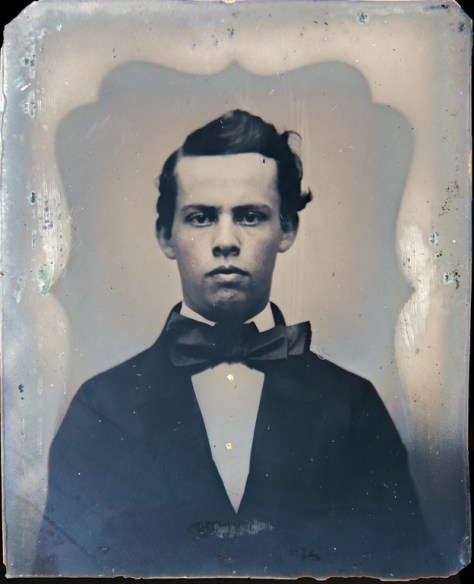
I could not find an image of Warren but here is George Wheelwright Hale who began his service in Co. B, 5th Wisconsin Infantry (Photo Sleuth)
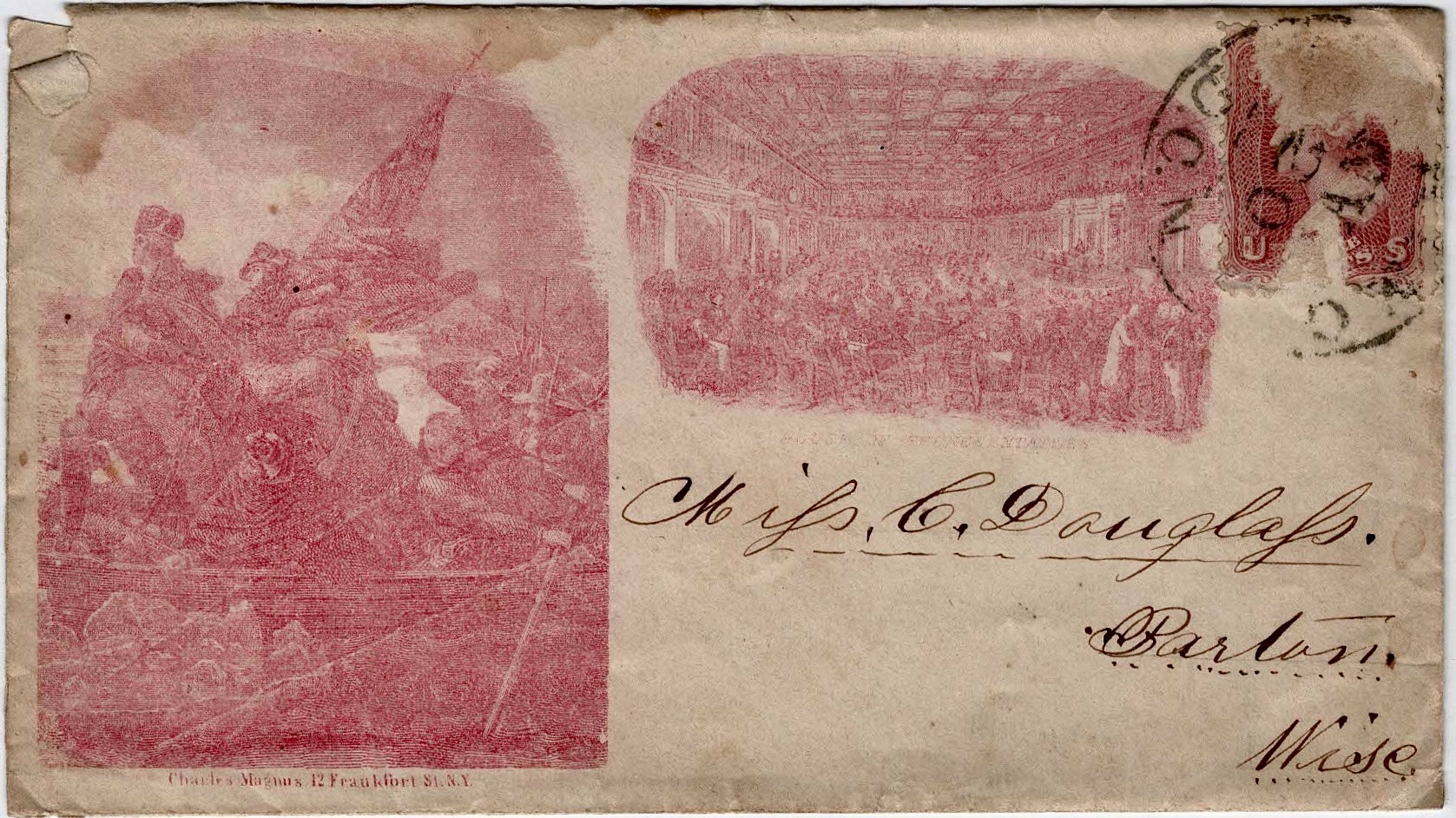
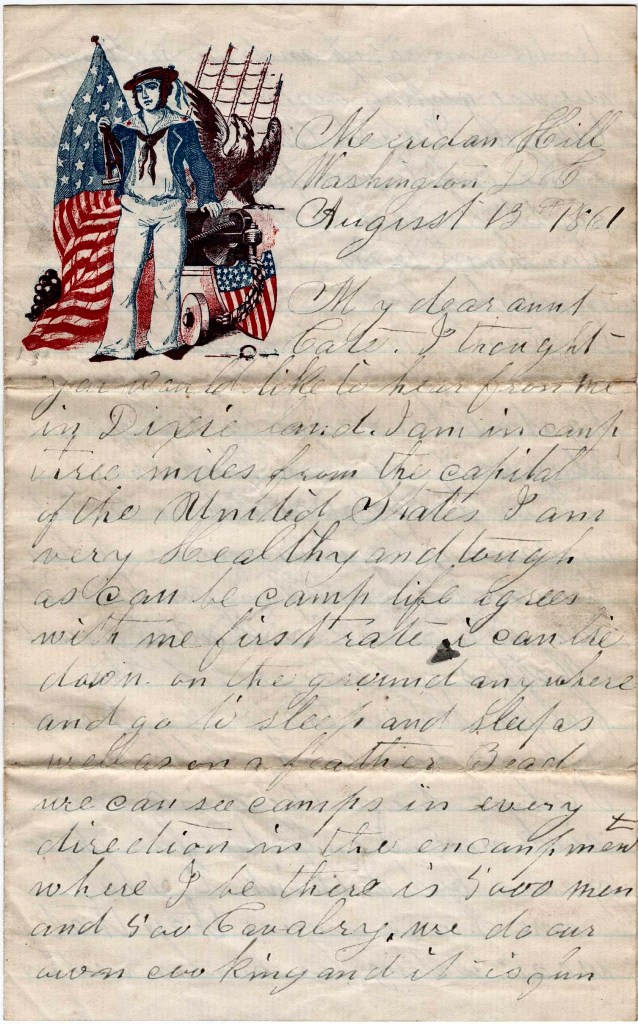
This letter was written by Warren D. Thomson (1844-1862), the son of William Henry Thomson (1819-1900) and Elizabeth Douglas (1814-1892) of Waukesha, Wisconsin. He was under age when he enlisted in Co. F, 5th Wisconsin Infantry on 10 May 1861. The 5th Wisconsin was organized at Camp Randall in Madison and left for Washington D. C. in July 1861. They arrived in Washington on the 8th of August and were assigned to the brigade of General King, going into camp on Meridian Hill. In September 1861, they relocated to Camp Griffin near Lewinsville, Virginia, where they remained until 10 March 1862.
According to muster records, Warren died of disease on 28 November 1862.
T R A N S C R I P T I O N
Addressed to Miss C. Douglass, Barton, Wisconsin
Meridian Hill Washington D C. August 13, 1861
My dear Aunt Cate,
I thought you would like to hear from me in Dixie land. I am in camp three miles from the Capitol of the United States. I am very healthy and tough as can be. Camp life agrees with me first rate. I can lie down on the ground anywhere and go to sleep as well as on a feather bed.
We can see camps in every direction. In the encampment where I be, there is 5,000 men and 500 cavalry. We do our own cooking and it is fun to live in camp and do nothing. We are getting awful lazy, I can tell you.
I wish Uncle John had come out to our house the Saturday night before he did come for I was home then. I saw Dan Mc in Washington today and Duncan too. How is McQueen’s [?] folks and the rest of the folks and girls? I got a letter from father yesterday and one from Waukesha.
It is pretty warm here but not as warm as in Wisconsin. It has been as high as 94 degrees. In Waukesha, it was 104 degrees one day. How is grandmother and the rest of the folks? How is the cra___ there?
I have been sick a little since I came here. There is a few sick now.
I enlisted for three years but I think I shall come home sooner than that. We are waiting for cooler weather and then we start for Richmond. The rebels are 12 miles from here. I am going as teamster for the company, I guess. I have spoken for the place and they said I could have it. No more at present. Write as soon as you can. Direct to Warren D. Thomson, Co. Founder, 5th Regt. Wisconsin Volunteers, Washington D. C.
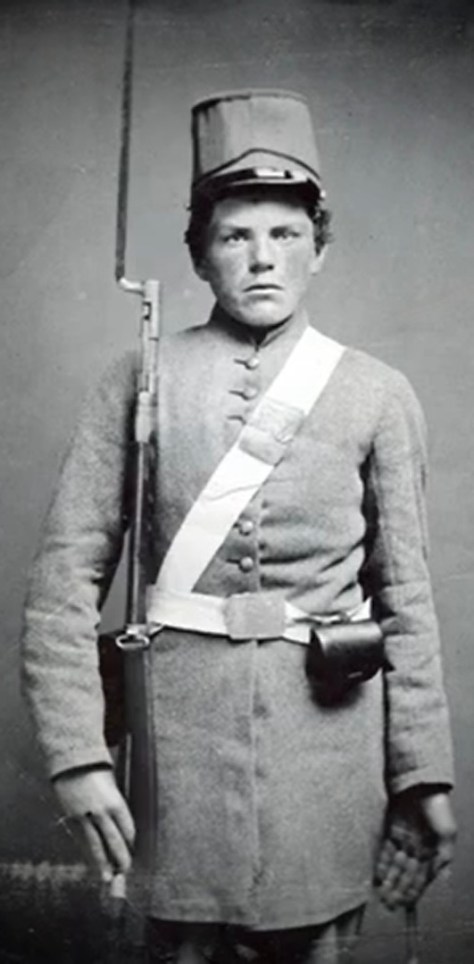
Pvt. Frederick Lythson wearing the early-war gray uniform of the 2nd Wisconsin Infantry.
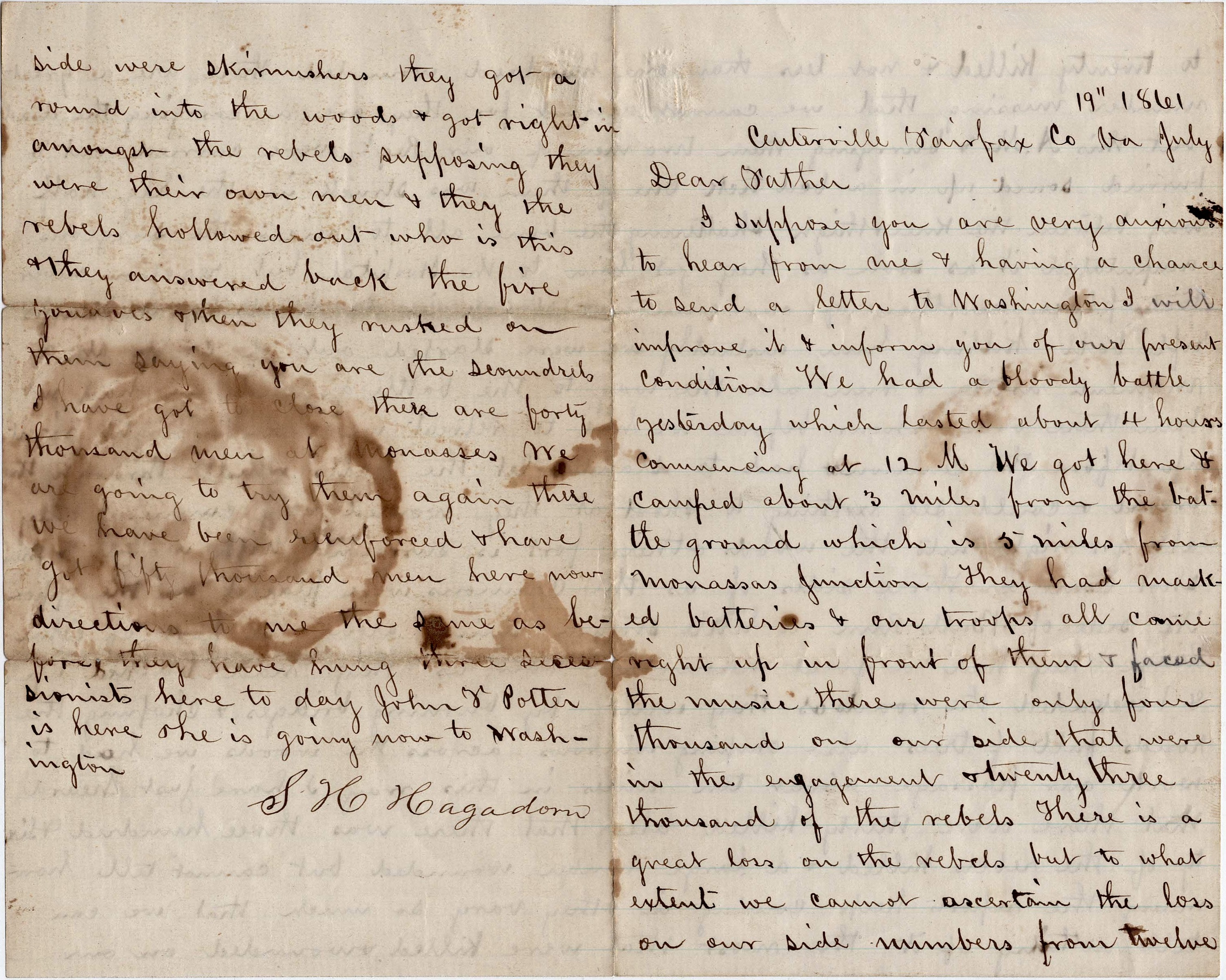
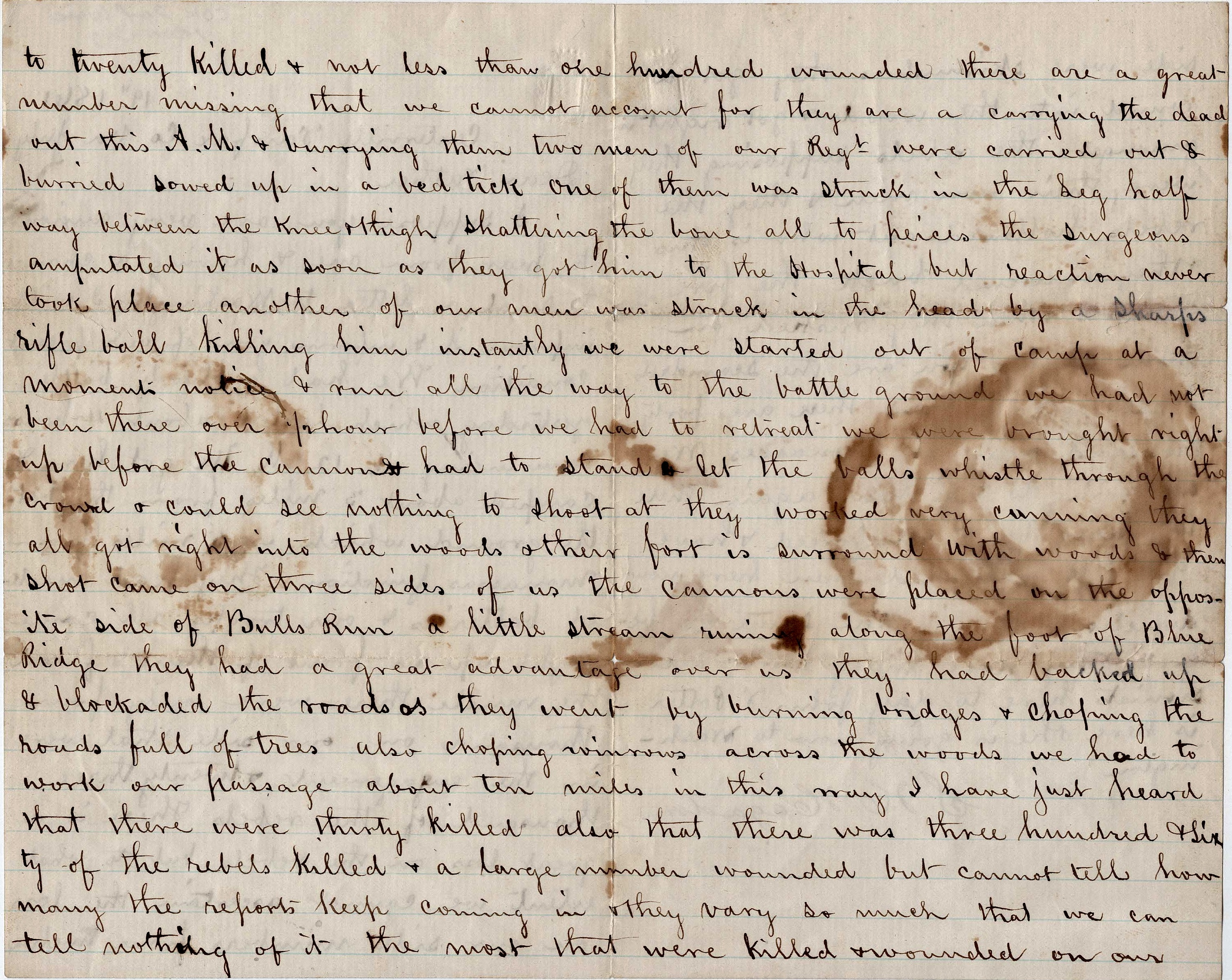
The following letter was written by Stephen H. Hagadorn (1836-1881), the son of Dr. Stephen Hagadorn (1818-1863) and Angeline Hagadorn (1815-1842) of Bath, Steuben county, New York. Stephen left his parents home sometime after the 1860 US Census and relocated to Wisconsin whereupon he was swept up in patriotism and enlisted in Co. K, 2nd Wisconsin Infantry. The regiment was quickly outfitted, the men issued state militia grey uniforms, and sent east in time to participate in the Battle of Blackburn’s Ford and Bull Run. In this letter to his father, Stephen described in detail the 18 July 1861 Battle of Blackburn’s Ford in which his regiment actually played only a minor role as a reserve regiment in Gen. William T. Sherman’s Brigade. Tragically, two days later in the Battle of Bull Run, their grey uniforms inadvertently exposed them to take friendly fire, resulting in Stephen being wounded and captured.
Stephen’s pension record informs us that he served in two different regiments during the Civil War. After he was exchanged as a prisoner of war and recovered from his wound, he transferred on 8 December 1861 into Co. A, 1st Wisconsin Heavy Artillery and served with that unit until 11 February 1863 when he was discharged. After he was discharged, Stephen enrolled as a medical student as the University of Michigan and became a physician, like his father. Stephen took up practice in Portsmouth, Bay county, Michigan, until 9 October 1881 when he died by drowning in the Saginaw river while on his way to make a house call. He fell overboard from the ferry boat transporting him across the river when he suffered an epileptic seizure—a condition that plagued him all his life apparently. He left a wife and 13 year old son.
Ironically, Stephen’s father was also taken a prisoner in the Battle of Bull Run though he was not a soldier. He was held until at least mid November 1861 as the extensive correspondence titled, “The Case of Dr. Stephen Hagadorn” will show, which I summarize by extracting the following statement by Dr. Hagadorn written to the CSA War Department: “I left my home and business on the 17th of July to return as soon as the 27th. Did not come as an invader, having no weapons of any kind. I am in the fiftieth year of my age; am a physician, Stephen Hagadorn by name, and live at Bath, Steuben County, N.Y. I came only to see a son who had enlisted in Wisconsin. Found on Sunday that a battle was being fought. Anxious as a father could be to know whether my son was alive, was too venturesome, consequently am a prisoner. My son is a prisoner here and must of course be held as such until disposed of. I ask mercy at your hands, and a release that I may go to my distressed family. When taken I was robbed of over $100 in money and papers that were valuable to me, and am as unpleasantly sisuated as mortal man can be on account of being detained from my family, who of course must be much distressed on account of my absence. Will you, my dear fellow-beings, let me go I pray you? I have done nothing to offend you therefore I pray you let me go.”
T R A N S C R I P T I O N
Centerville, Fairfax Co., Virginia July 19th 1861
Dear Father,
I suppose you are very anxious to hear from me & having a chance to send a letter to Washington, I will improve it & inform you of our present condition. We had a bloody battle yesterday which lasted about 4 hours commencing at 12 M. We got here & camped about 3 miles from the battle ground which is 5 miles from Manassas Junction. They had masked batteries & our troops all came right up in front of them & faced the music. There were only four thousand on our side that were in the engagement & twenty-three thousand of the rebels.There is a great loss on the rebels but to what extent, we cannot ascertain. The loss on our side numbers from twelve to twenty killed & not less than one hundred wounded. There are a great number missing that we cannot account for. They are a carrying the dead out this a.m. & burying them. Two men of our regiment were carried out & buried, sewed up in a bed tick. One of them was struck in the leg half way between the knee & thigh, shattering the bone all to pieces. The surgeons amputated it as soon as they got him to the hospital but reaction never took place. Another of our men was struck in the head by a Sharps rifle ball, killing him instantly.
We were started out of camp at a moments notice & run all the way to the battle ground we had not been there over 1/2 hour before we had to retreat. We were brought right up before the cannons & had to stand & let the balls whistle through the crowd & could see nothing to shoot at. They were very cunning. They all got right into the woods & their fort is surrounded with woods & then shot came on three sides of us. The cannons were placed on the opposite side of Bulls Run—a little stream running along the foot of Blue Ridge. They had a great advantage over us. They had backed up & blockaded the roads as they went by, burning bridges & chopping the roads full of trees; also chopping winrows across the woods. We had to work our passage about ten miles in this way.
I have just heard that there were thirty killed; also that there was three hundred & sixty of the rebels killed & a large number wounded but cannot tell how many. The reports keep coming in & they vary so much that we can tell nothing of it. The most that were killed & wounded on our side were skirmishers. They got a round into the woods & got right in amongst the rebels supposing they were their own men & they—the rebels—hallowed out, “Who is this?” and they answered back, “The fire zouaves!” and then they rushed on them saying, “You are the scoundrels.” 1
I have got to close. There are forty thousand men at Manassas. We are going to try them again there. We have been reinforced & have got fifty thousand men here now. Direct to me the same as before.
They have hung three secessionists here to day. John V. Potter is here & he is going now to Washington.
— S. H. Hagadorn
1 The four regiments in Col. Richardson’s Brigade which were in the Union advance at Blackburn’s Ford included the 1st Massachusetts, the 2nd and 3rd Michigan, and the 12th New York Infantry, none of which were known as “Fire Zouaves.” It’s suspected that the reputation of the Union “Fire Zouaves” was intended to strike fear much as the Confederate “Black Horse Cavalry.” It was the 12th New York Infantry that swept through the woods on the Federal left who likely encountered the Rebels as described.
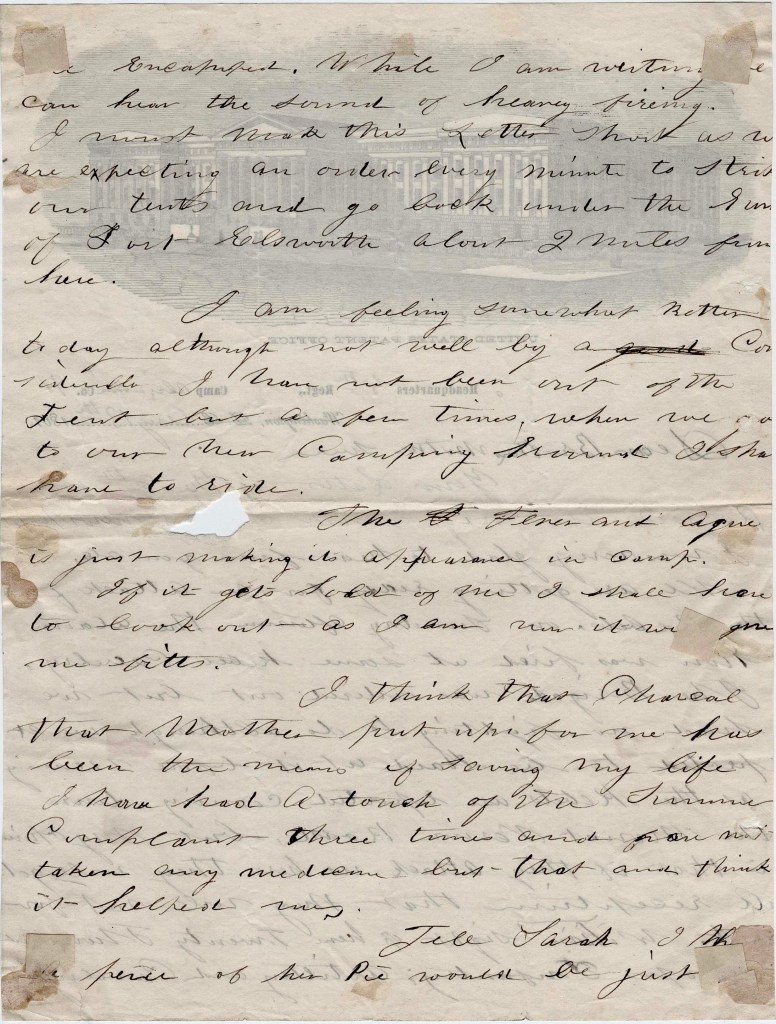
This partial letter is unsigned and contains no names that would help to identify the author but given the location of the regiment described in the letter, I’m inclined to believe that he was member of Co. H, 5th Maine Infantry. Following the Battle of Bull Run, the 5th Maine was assigned to defend Washington and they camped not far from Fort Ellsworth.
In spite of not knowing the author’s identity, I’ve published the letter because it mentions the use of charcoal as a remedy for diarrhea.
T R A N S C R I P T I O N
Headquarters 5th Regiment, Co. H, Camp Alexandria August 13th 1861
Dear Brothers, Sisters [ ]
Your letter of the 8th was received last night with Sunday’s newspaper. I was very glad to hear from you all.
We are getting ready for an attack from the Rebels on Sunday afternoon. The alarm gun was fired at some Rebel cavalry. The Brigade was ordered out but we had no fighting to do although we expected to be hard at it before morning as the Rebels are reported coming down the Mount Vernon Road. But my opinion is that if they attack us here, they will get a reception that they will not forget. Within sight of here twenty thousand troops—infantry, artillery and cavalry—are encamped. While I am writing, we can hear the sound of heavy firing. 1
I must make this letter short as we are expecting an order every minute to strike our tents and go back under the guns of Fort Ellsworth about two miles from here.
I am feeling somewhat better today although not well by a considerable. I have not been out of the tent but a few times. When we go to our new camping ground, I shall have to ride.
The fever and ague is just making its appearance in camp. If it gets hold of me, I shall have to look out. As I am now, it will give me fits.
I think that charcoal 2 that Mother put up for me has been the means of saving my life. I have had a touch of the summer complaint three times and from not taking any medicine but that and think it helped me. Tell Sarah I think a piece of her pie would be just….[end of letter missing]
1 The “heavy firing” reported in this letter remains a mystery. It could not have been from the cavalry skirmish at Lovettsville, Virginia, 60 miles away. Perhaps there were some Rebel guns firing on boats passing up or down the Potomac, which would have been in the direction of Mount Vernon.
2 Among the various home remedies for treating diarrhea (the “summer complaint”) in the mid 19th century, activated charcoal was sometimes used. The carbon produced from burning wood at a high temperature was pulverized into a powder and consumed as a dietary supplement. It was conjectured that the charcoal would adsorb the toxins in the gut that were causing the diarrhea.
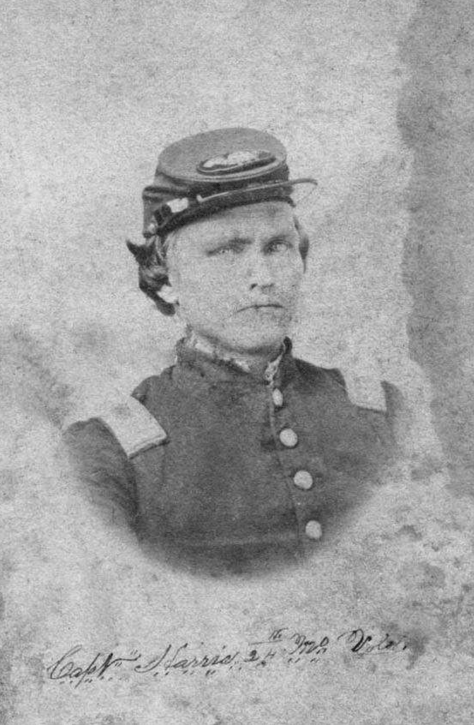
I could not find an image of Howard J. Tyler but here is one of Capt. Wyatt Harris of Co. I, 24th Missouri Infantry (Ancestry.com)
This letter was only signed “Howard” and since he wrote to a young woman in Ingham county, Michigan, I concluded he was from there. However, I could not find any Michigan regiments in the Army of the Southwest at the Battle of Elkhorn Tavern (March 1862) or in the months following. I learned that it was the 24th Missouri Infantry that served as the provost guard for Gen. Samuel R. Curtis and so I concluded Howard must have been a member of that regiment.
Remarkably, the roster of the 24th Missouri Infantry had only one “Howard” among its members, and it was Howard J. Tyler (1846-1864) of Co. H, the youngest son of Isaac Tyler (1800-1872) and Rebecca Rising (1805-1888) of Leslie, Ingham county, Michigan. And who was Howard writing to? He addressed the letter to Almira Longyear (1847-1863), the 15 year-old daughter of Henry William Longyear (1818-1849) and Elizabeth Whitney (1822-1891) of Leslie, Ingham county, Michigan. She died on 3 February 1863; the circumstances of her death are unknown. Almira’s older brother, William D. Longyear (1841-1925) was a drummer boy in Co. C of the 8th Michigan Infantry.
So why would Howard choose to serve in a regiment from Missouri instead of Michigan? It turns out that the Captain of Co. H, 24th Missouri, was Isaac B. Tyler of Cuba, Crawford county, Missouri—probably an uncle. Howard’s death was recorded as 25 May 1864 but I have not learned the cause of death.
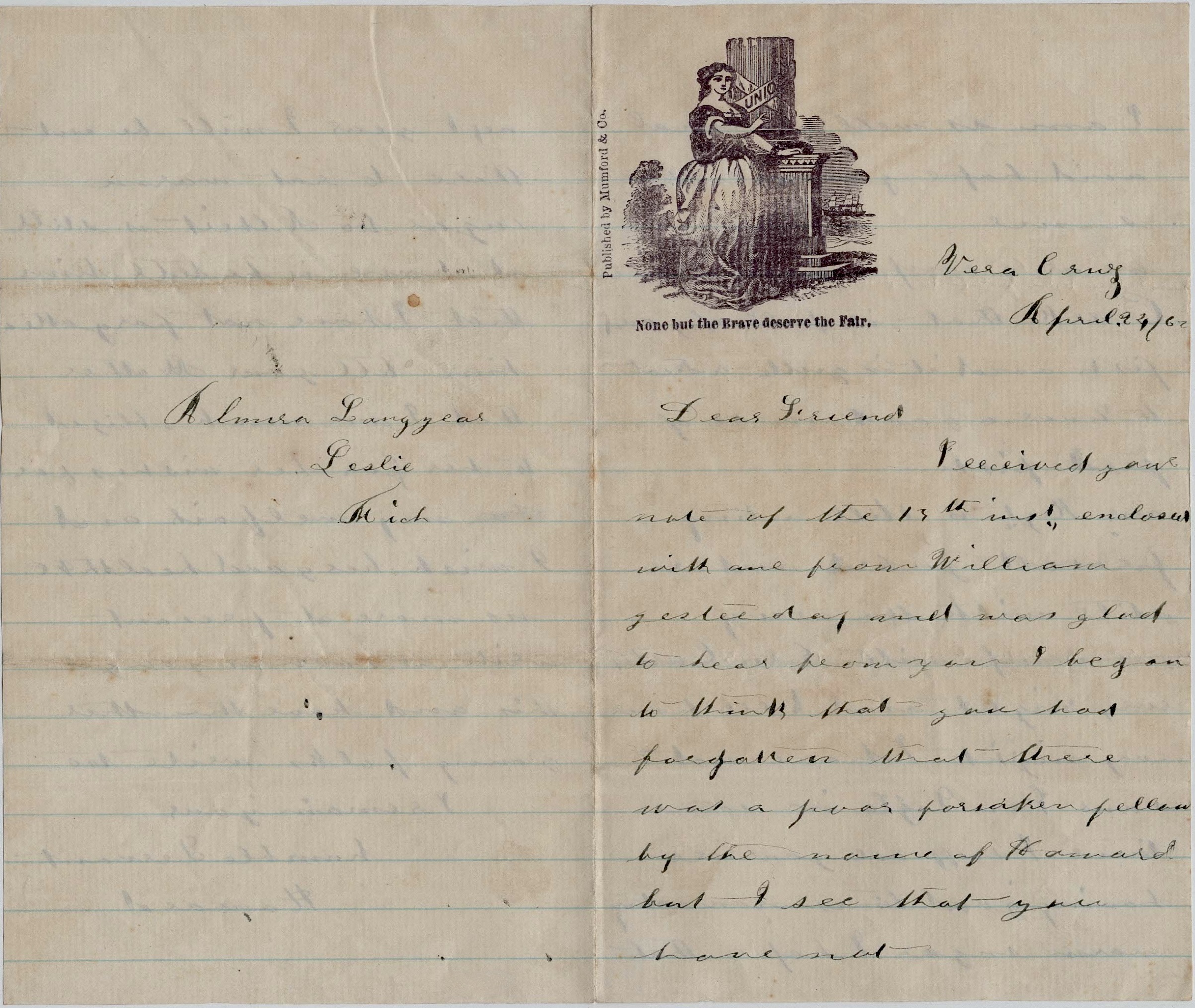
T R A N S C R I P T I O N
Vera Cruz [Missouri] 1 April 24, 1862
Dear Friend,
I received your note of the 13th inst. enclosed with one from [your brother] William yesterday and was glad to hear from you. I began to think that you had forgotten that there was a poor forsaken fellow by the name of Howard but I see that you have not. I am as well as usual and hope you are the same.
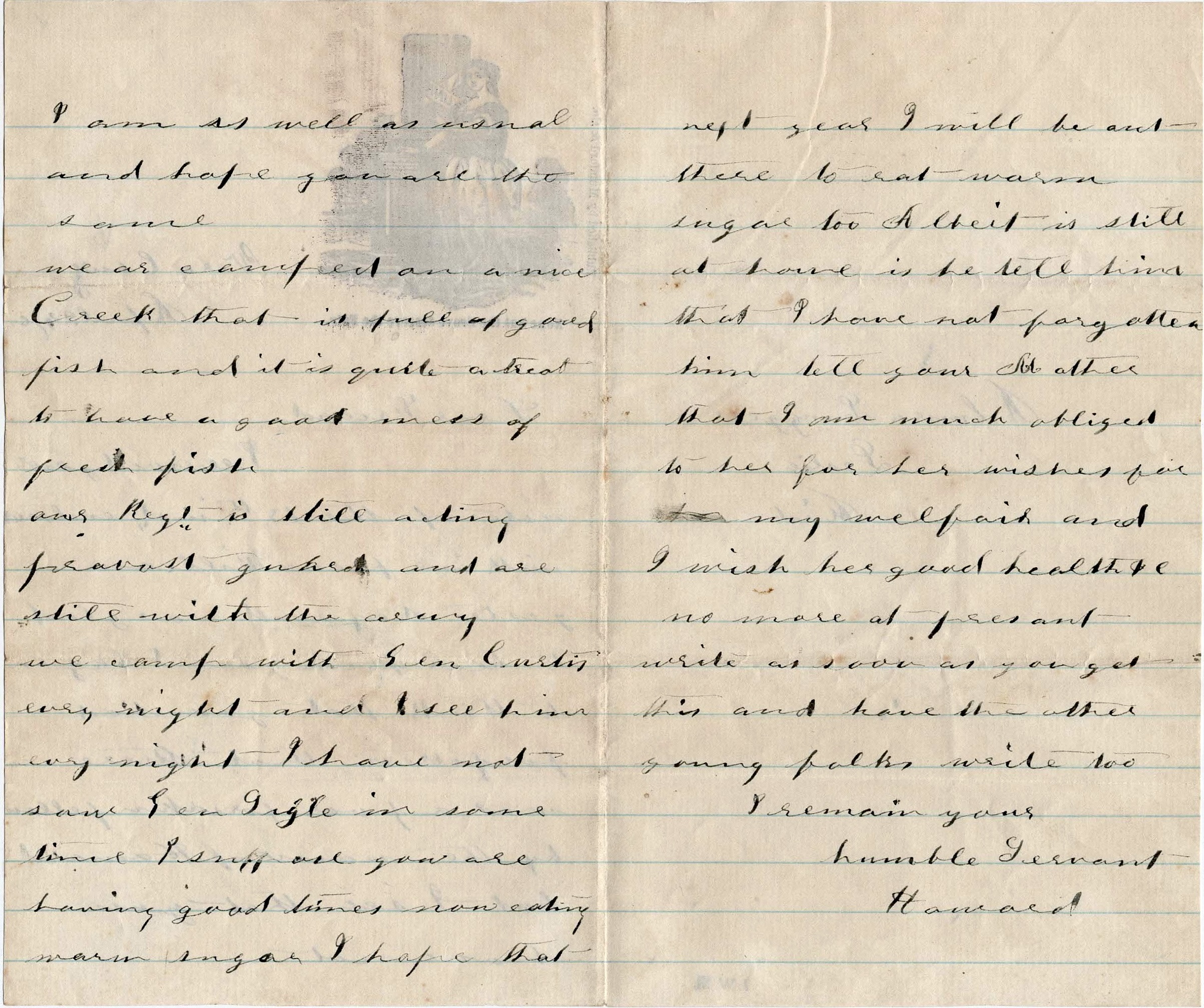
We are camped on a nice creek that is full of good fish and it is quite a treat to have a good mess of fresh fish.
Our regiment is still acting provost guard and are still with the army. We camp with Gen. [Samuel R.] Curtis every night and I see him every night. I have not see Gen. [Franz] Sigel in some time.
I suppose you are having good times now eating warm sugar. I hope that next year I will be out there to eat warm sugar too. Albert is still at home is he? Tell him that I have not forgotten him. Tell your Mother that I am much obliged to her for her wishes for my welfare and I wish her good health &c.
No more at present. Write as soon as you get this and have the other young folks write too. I remain your humble servant, — Howard
1 Vera Cruz was a town located just north of the Arkansas border in Douglas county, Missouri. It was originally called Red Bud but was rename in 1859. It served as the 1st county seat of Douglas county and served as the headquarters of the local Union Home Guard.









 Spared & Shared 23