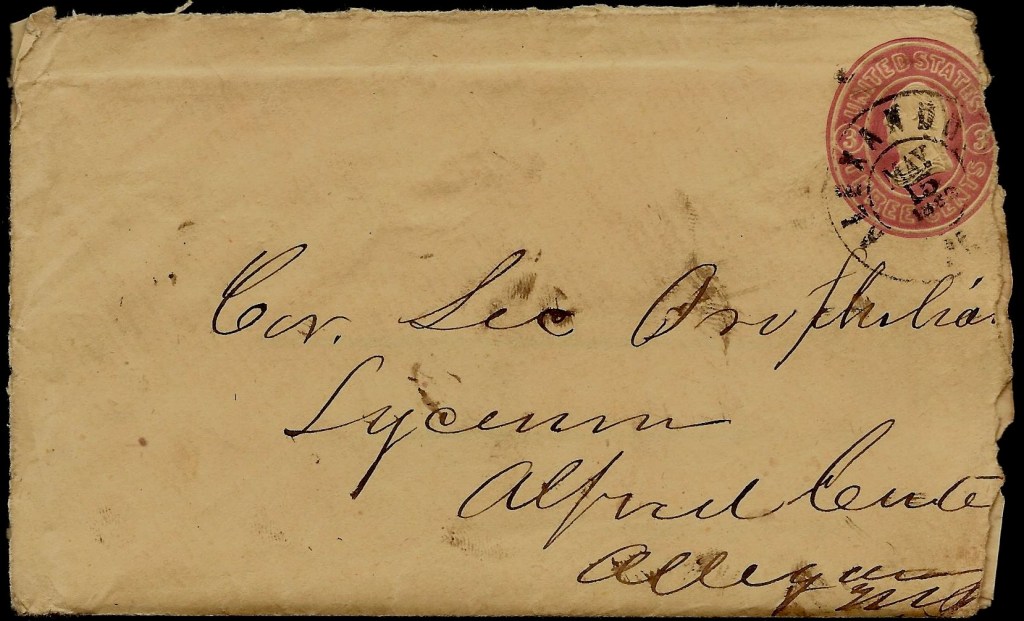
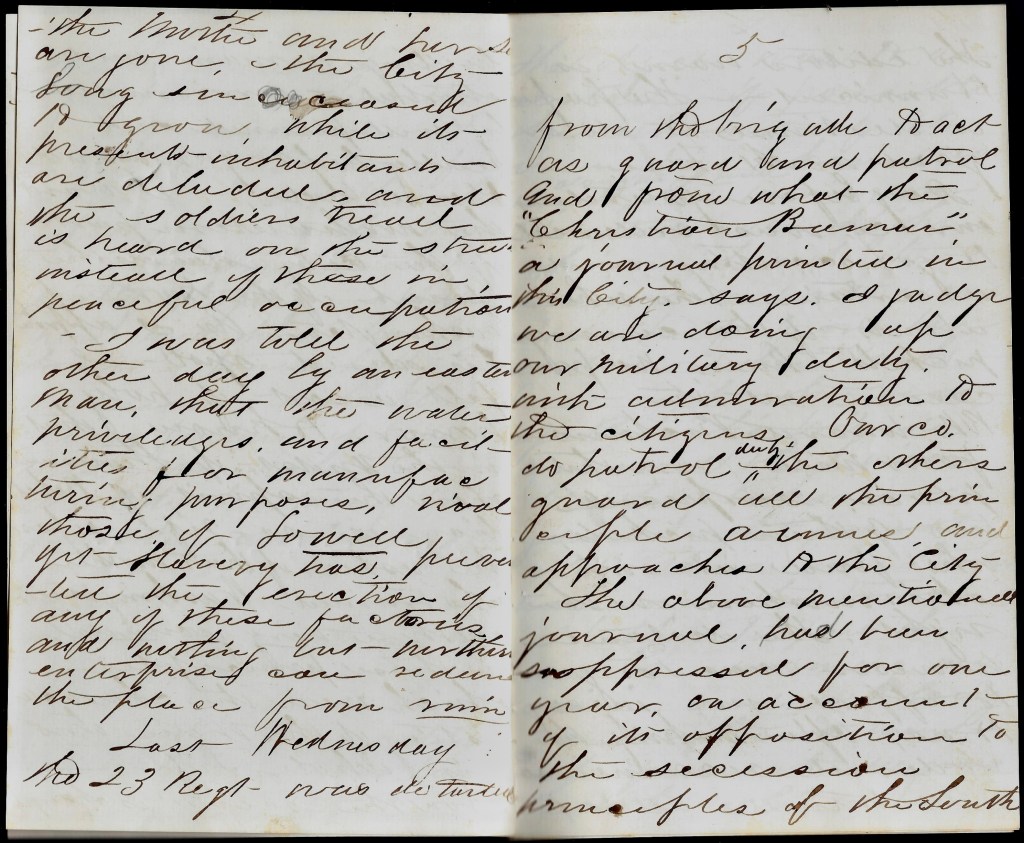
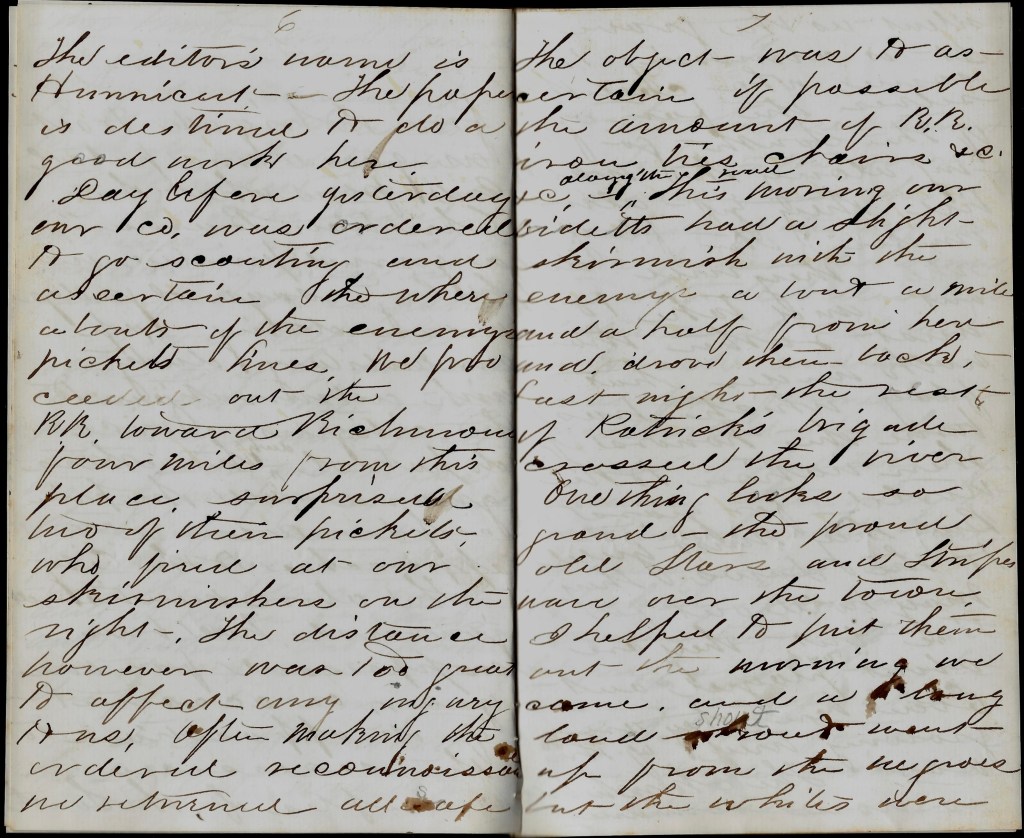
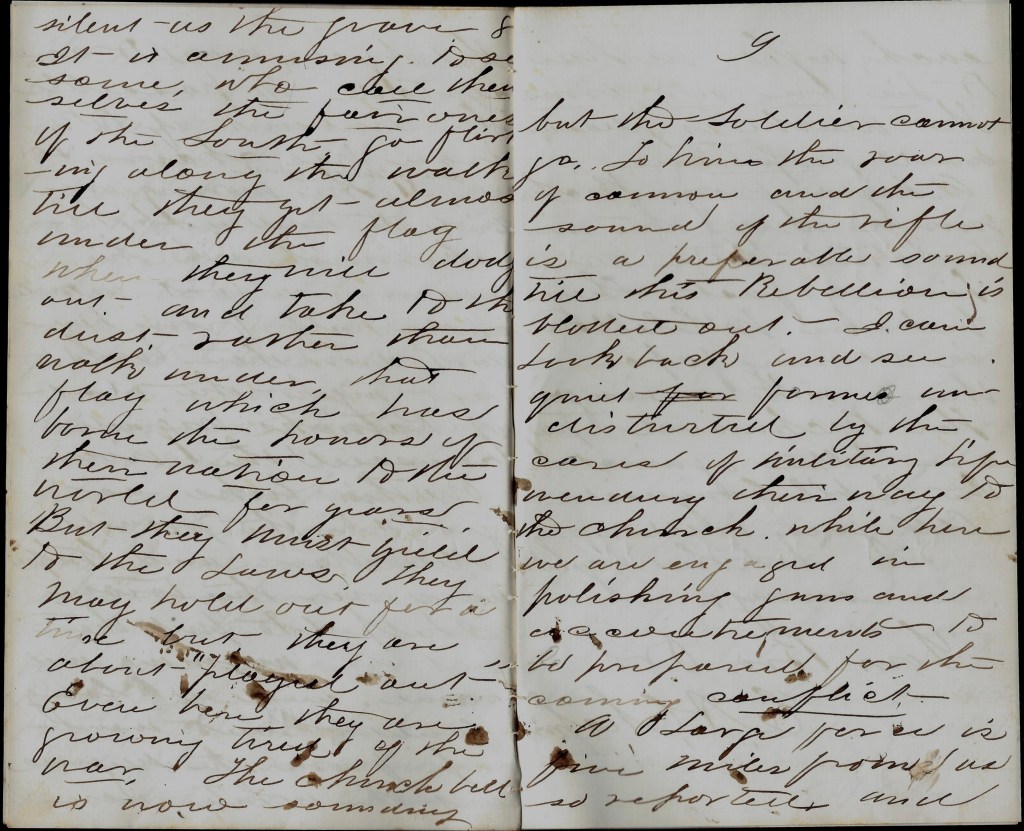
My passion is studying American history leading up to & including the Civil War. I particularly enjoy reading, transcribing & researching primary sources such as letters and diaries.
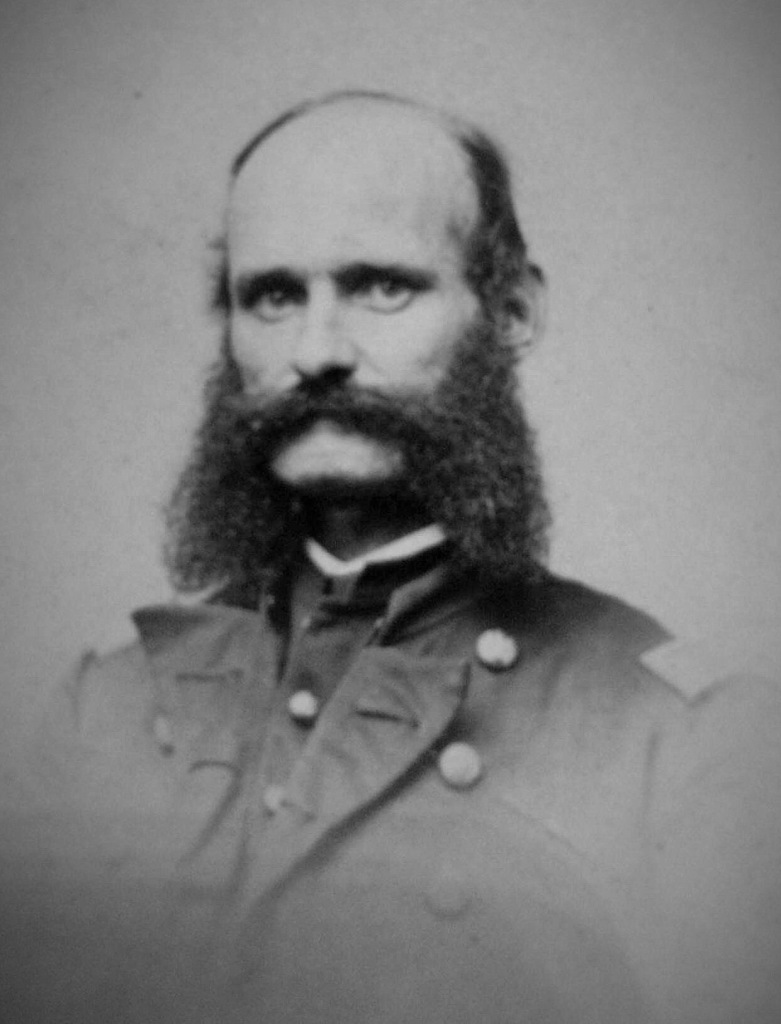
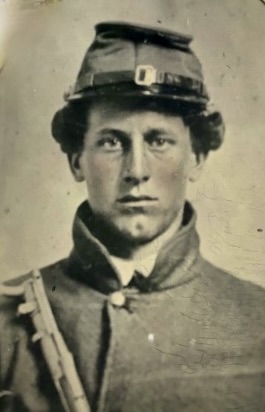
I could not find an image of Eldridge but here is one of Lt. Pierce Neals of Co. B, 4th Delaware Infantry (Photo Sleuth)
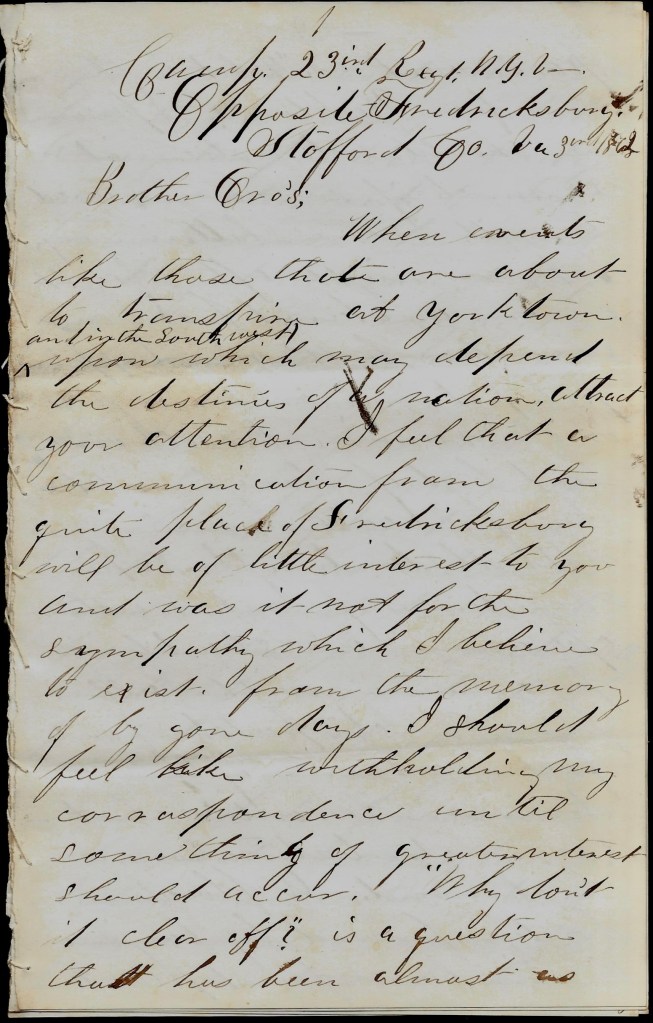
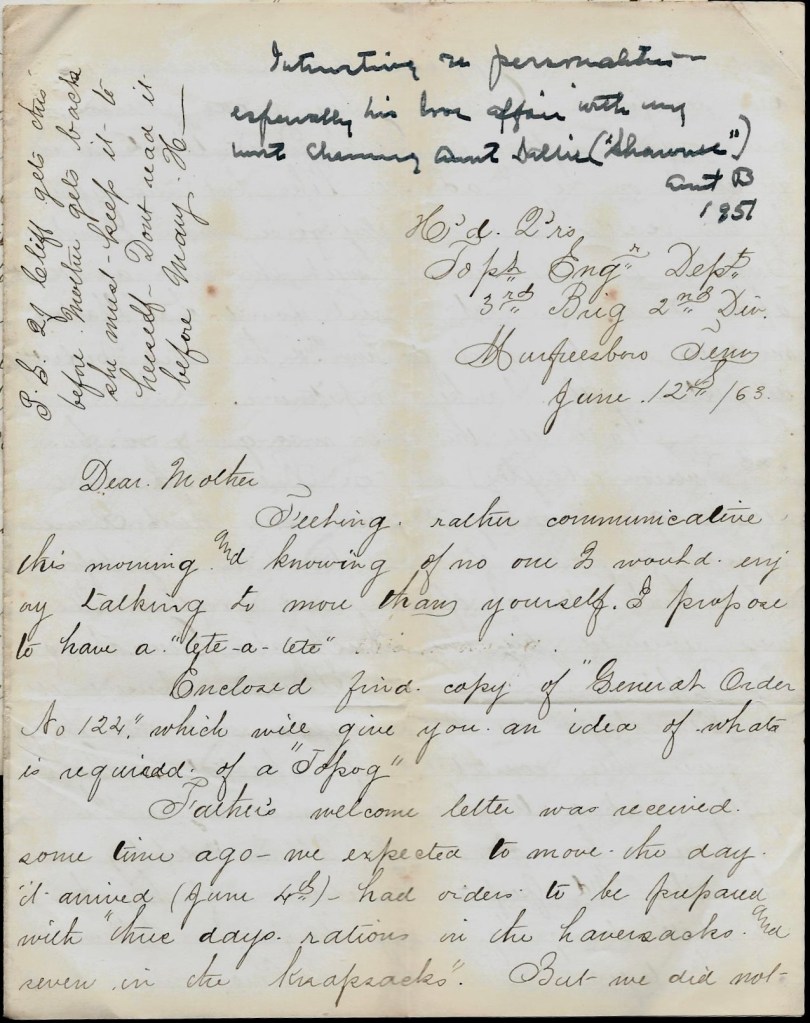
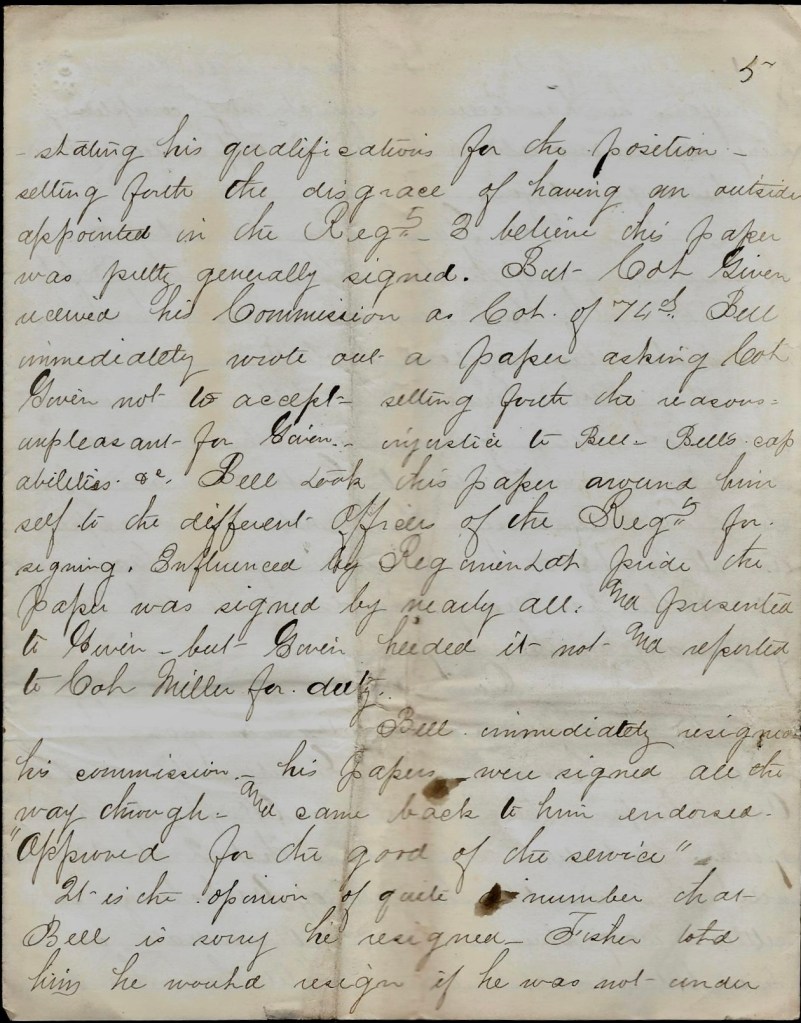
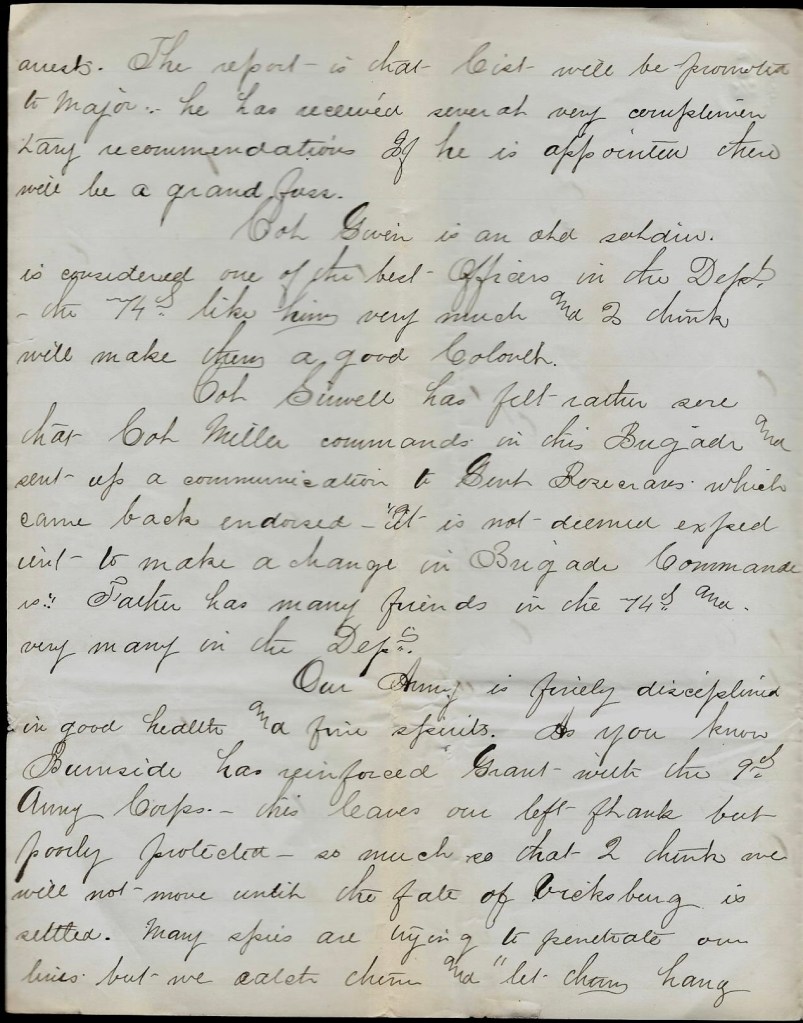
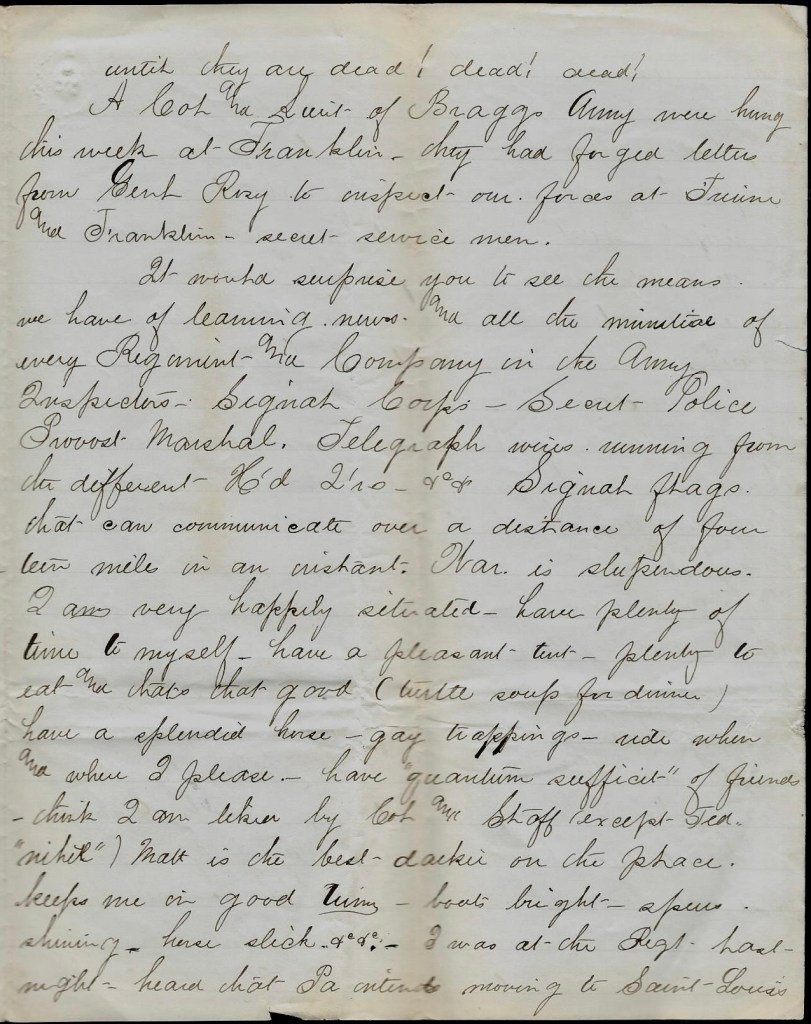
The following letters were written during the Civil War by Eldridge Taylor Hall (1845-1882). Eldridge was the son of Joseph Yardley (1813-1880) and Margaretta Taylor (1817-1875) of Milford Hundred, Kent county, Delaware. Eldridge entered the war in 1862 as a 2nd Lieutenant in Co. K of the 4th Delaware Infantry and left the regiment as a 1st Lieutenant in Co. B.
Eldridge wrote the letters to Clara Wilson Hall with whom he would later marry.
The garrison at Gloucester Point remained a sideshow to the great battles fought in the region. It was classic military camp life, months of monotonous routine punctuated by occasional attacks and forays into the countryside. [Historical Marker, Gloucester county, Virginia]
Letter 1
Delaware House Wilmington, Delaware September 24, 1862
My Dear Clara,
It is with many and strange emotions that I seat myself to write this my first letter to the one I love and as I am not adept in writing love letters, you will excuse me if this partakes something of a practical turn.
It was just one week yesterday since I left—a very short space of time indeed, yet I am beginning to want to see you very much. What a shame it is that I could not place myself within the folds of this letter and unseen by and unknown to my respected commanding officer have one peep at your smiling face and a pleasant chat as of old. But, however, there is a good chance coming and I may someday not far off make you a flying visit, but don’t be disappointed if I should not come.
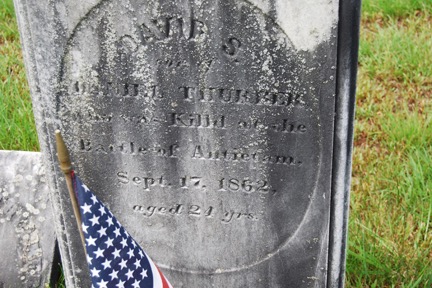
You no doubt have heard ere this that my brother Dave 1 was wounded in the late battle at Antietam Creek, He arrived last evening in Philadelphia. Pap and I were there to meet him. He is now in the hospital corner of 22nd and Wood Streets, Philadelphia. Pa. Pap is with him. He has a painful wound in his left foot—a rifle ball having gone clear through it. He also has a rifle ball just above his left knee. He is very cheerful, upheld by the consciousness of having done his duty. He was wounded while bravely leading his company to the charge and was, I am told, 20 feet in advance of his company when he fell. and about an equal distance from the enemy. How proud I feel in having such a brother—so brave, so courageous, so noble. May heaven help me to perform my duty to my country as he has performed his. It will be some time before he will be able to go into service again. The delay will no doubt be very galling to him.
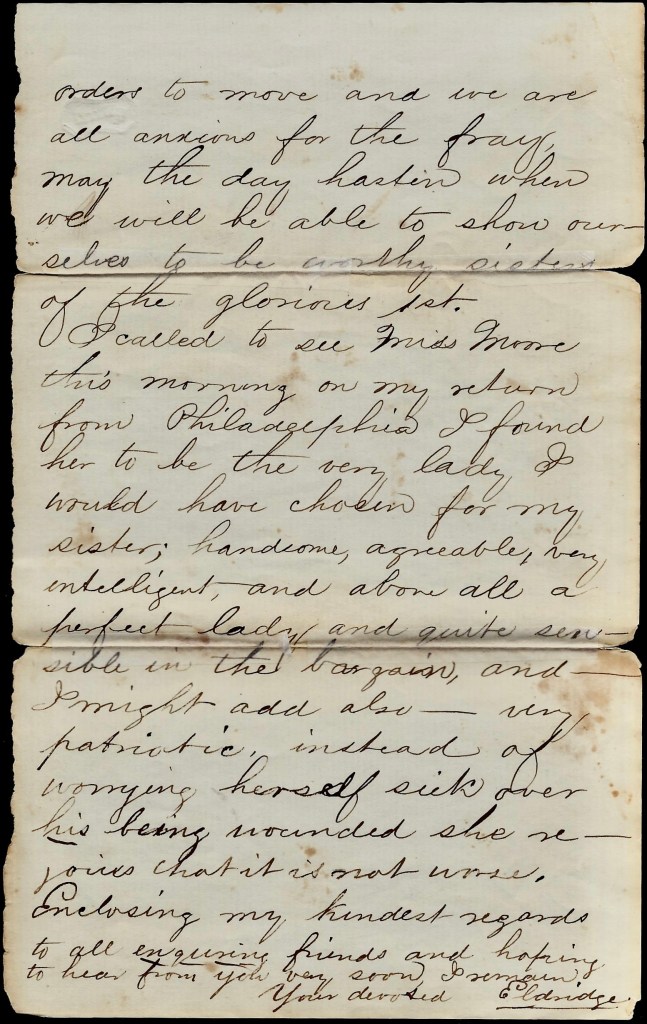
Our regiment is awaiting orders to move and we are all anxious for the fray. May the day hasten when we will be able to show ourselves to be worthy sisters of the glorious 1st.
I called to see Miss Moore this morning on my return from Philadelphia. I found her to be the very lady I would have chosen for my sister; handsome, agreeable, very intelligent, and above all a perfect lady and quite sensible in the bargain, and I might add also—very patriotic. Instead of worrying herself sick over his being wounded, she rejoices that it is not worse.
Enclosing my kindest regards to all enquiring friends and hoping to hear from you very soon, I remain your devoted, — Eldridge
Address: Lieutenant E. T. Yardley, Care of Col. A. H. Grimshaw, Wilmington, Delaware
1 David Sellers Yardley (1842-1866) entered the service in May 1861 as the 1st Sergeant of Co. D, 1st Delaware Infantry. By the time of the Battle of Antietam where he was wounded, he was the captain of Co. D. Capt. Yardley was later discharged for his disabilities and drowned in 1866 while bathing in Lake Harriet in Minnesota. The Battle of Antietam was the regiment’s first real engagement. They entered the fray on 17 September through the Roulette Farm and became heavily engaged in front of the Sunken Road. Bringing just of 700 into the fight, they suffered a 30 percent casualty rate.
Letter 2
Camp —– near Alexandria, Virginia December 12th 1862
My dear Clara,
After a fatiguing march of about 10 miles through the mud and water, we have reached this place where I suppose we will have to remain for some time. I was in hopes that we were on our way to join Burnside, but such is not the case at present, although we may be called upon to leave any moment.
We are in barracks partially completed which will be very comfortable when finished. I am seated in the midst of baggage surrounded by our men who are talking and laughing, apparently unconcerned in regard to the discomfort of the place. I have a bayonet stuck in the ground with a candle init to write by the heavens for my canopy but I feel happy in thinking that I am traveling in the path of duty and that your smile of approval will greet me when I return, should it be my fortune to do so.
Paper is very scarce tonight and pen and ink not to be found. So good night. I promise myself a pleasant night thinking of you. With much love, I remain your devoted, — Eldridge
Address same as usual to Washington.
Letter 3
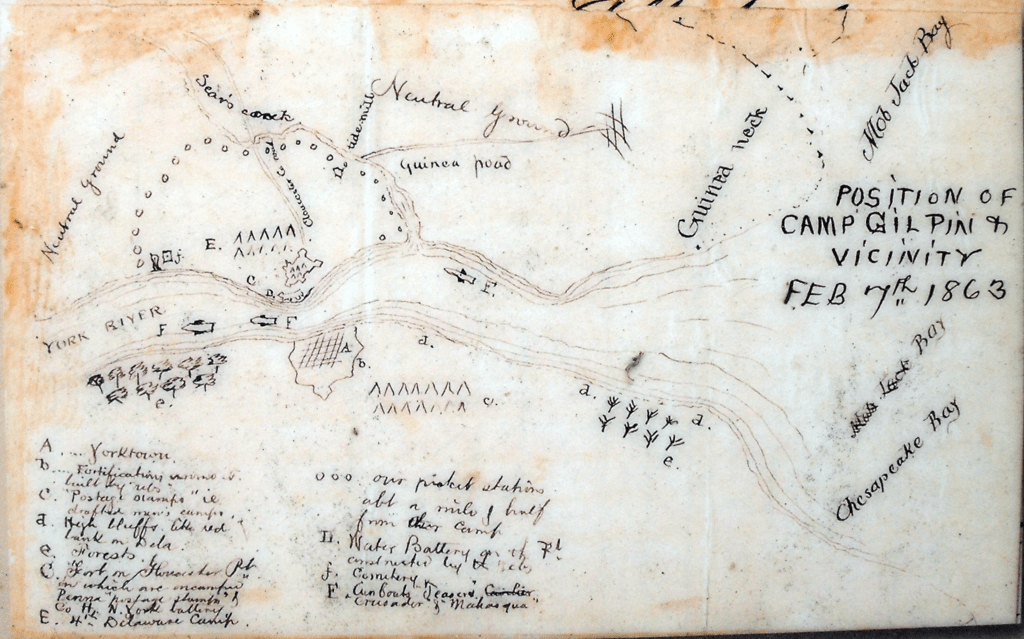
Position of Camp Gilpin & Vicinity on 7 February 1863. Lt. Rodman Smith, 4th Delaware, sent this hand-drawn map of Yorktown/Gloucester Point to his mother in Wilmington, Delaware. His regiment’s camp was marked with an E, then called Camp Gilpin. He was in command of pickets along Sailor’s [Sarah’s] Creek. Courtesy of the Historical Society of Delaware.
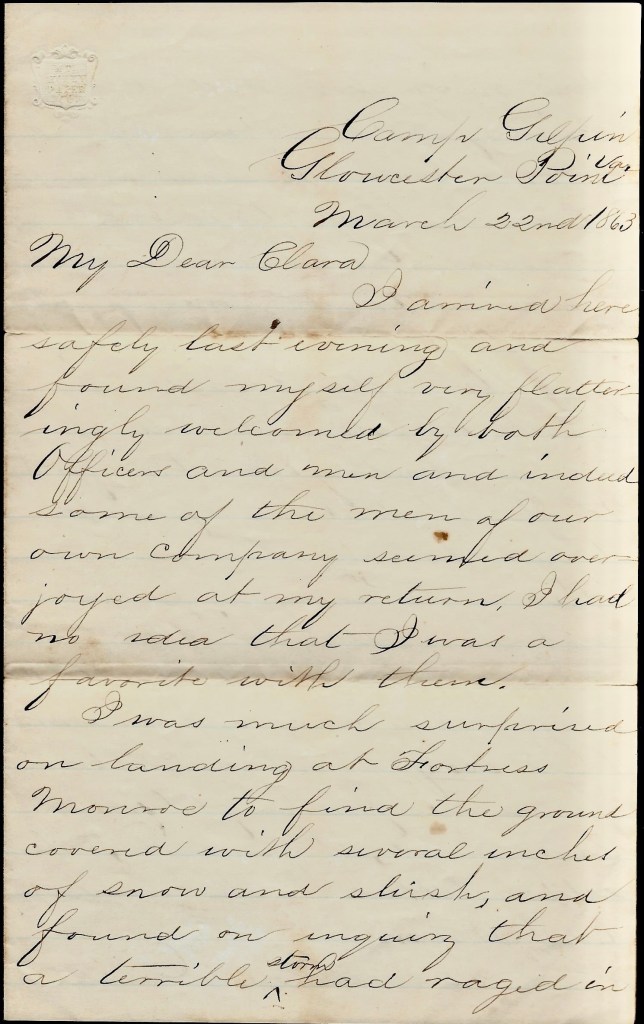
Camp Gilpin Gloucester Point, Virginia March 22nd 1863
My dear Clara,
I arrived here safely last evening and found myself very flatteringly welcomed by both officers and men and indeed, some of the men of our own company seemed overjoyed at my return. I had no idea that I was a favorite with them.
I was much surprised on landing at Fortress Monroe to find the ground covered with several inches of snow and slush, and found on enquiring that a terrible storm had raged in this neighborhood on Friday and Saturday, so fierce was the warring of elements that the boas between Yorktown and Fortress Monroe were unable to make their usual trips for two days and the boat which I came up in yesterday was the first that had been up since the storm.
Those photographs have not arrived yet. I have not time to write any more now but answer this very soon and I will promise for the future long and, if possible, interesting letters. With much love I remain, as ever yours, — Eldridge
Letter 4
Camp Gilpin Gloucester Point, Virginia April 11th 1862
Miss Clara W. Hall,
I would respectfully submit—that this is the third time I have written to you and as yet have received no reply.
I would crave that your most gracious ladyship would condescend an early reply to this, if such be not incompatible with your inclinations. I am most respectfully your obedient servant, — Eldridge T. Yardley, 2nd Lieutenant, Co. K, 4th Delaware Infantry
Letter 5
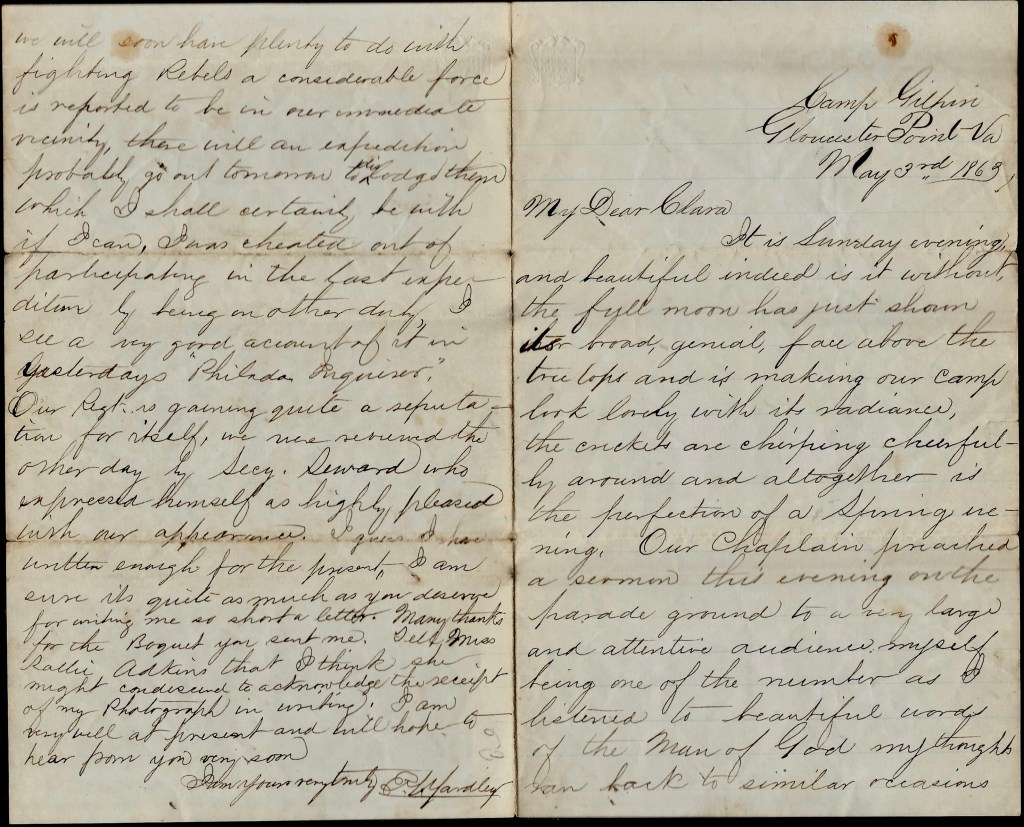
Camp Gilpin Gloucester Point, Virginia May 3rd 1863
My dear Clara,
It is Sunday evening and beautiful indeed is it without. The full moon has just shown its broad, genial face above the treetops and is making our camp look lovely with its radiance. The crickets are chirping cheerfully around and altogether is the perfection of a spring evening.
Our chaplain preached a sermon this evening on the parade ground to a very large and attentive audience, myself being one of the number. As I listed to beautiful words of the man of God, my thoughts ran back to similar occasions in the woods of Old Delaware on last summer. Oh! many a pleasant hour have I spent at Camp Meetings in Delaware and hope to spend many more. How well I remember the Camp Meeting at Bridgeville last summer. It was there that I first met with our noble old Governor and his charming daughter. By the bye, the Governor has been to see us and do you think he seemed to have forgotten me entirely after my taking so much pains to make myself acquainted with him last summer. I suppose his daughter is equally forgetful. Governor Cannon expressed himself much pleased with his reception here and was delighted with appearance and arms of the men of the “Plucky Fourth.” We treated him as well as we knew how, had a review, serenaded him the evening before he left, and had a good time generally. The morning he left we had a dress parade and he delivered quite a neat little speech to us, something quite unusual for him.
And does my Clara get so tired going to school? The poor dear girl/ I am so sorry. Even now her graceful form may be wasting away with hard study and yet she thinks herself selfish for saying so. Why Clara, the life I am living now is perfectly splendid. I really delight in it. In fact, the only fault I have to find with ir is that there is not enough to do. But the good time is coming and from all accounts we will soon have plenty to do with fighting Rebels. A considerable force is reported to be in our immediate vicinity. There will be an expedition probably go out tomorrow to dislodge them which I shall certainly be with if I can. I was cheated out of partaking in the last expedition by being on other duty. I see a good account of it in yesterday’s Philadelphia Inquirer.
Our regiment is gaining quite a reputation for itself. We were reviewed the other day by Secretary Seward who expressed himself as highly pleased with our appearance. I guess I have written enough for the present. I am sure it’s quite as much as you deserve for writing me so short a letter. Many thanks for the bouquet you sent me. Tell Miss Sallie Adkins that I think she might condescend to acknowledge the receipt of my photograph in writing. I am very well at present and will hope to hear from you very soon.
I am yours respectfully, — E. T. Yardly
Letter 6
Camp Gilpin Gloucester Point, Virginia May 12th 1863
My dear Clara,
It is a very pleasant evening—rather warm perhaps, but pleasant anyhow. I have been out sailing on the water. Romantic is it not? How I wished you could have enjoyed it with me. I am sure you would have liked it. I promise many a pleasant sail on the water if we remain here all summer. You have no idea what a pleasant camp e have. It is situated on a broad, level plain which is just beginning to grow green under the genial rays of the sun. It would be pleasant indeed to live here if this unhappy war was ended. But as it is, I cannot but think it a sin for us to remain here, living in comparative ease and luxury while other less fortunate brothers in arms are nobly fighting and pouring out their life’s blood in defense of our country. Oh! how I wish we belonged to the glorious Army of the Potomac that we might put what some call our “Patriotic Cherries” into practice. Would it not be a glorious death to die for the noble cause in which we are engaged? Even now, perhaps, my dearest brother is lying dead or dying on the battlefield. Kind Heaven! grant that it may not be so, but I am sure he would not wish a more glorious death. But enough of this. I suppose I will have to be satisfied with my lot and will endeavor to be as useful as I can in my limited sphere of action.
Hark! the soft sweet notes of a flute come stealing on the still night air. It is our beloved Colonel playing in his tent. How it reminds me of certain impromptu serenades we used to give you in dear Old Milford. Do you remember the last one I participated in? You threw a beautiful bouquet out the windown and John A. being taller than the rest of us secured the prize. How I envied him.
How is Johnny getting along? I have not heard from him since I returned to camp. That beautiful little bouquet you sent me in your last letter (by the bye, it has been so long ago I can hardly remember) has unfortunately met with an accident. I placed it in my portmanteau along with the rest of my valuables and some rogue came into my tent at night and stole the portmanteau, bouquet and all. So you will be a dear girl if you will send me another which I will be certain to take better care of. I would like to have your photograph too very much. Do send it to me won’t you?
I suppose that famous wedding has come off at our house. It will be a great trial to part with Louise. She will miss her so much. I am sure we all shall miss her. She has been so kind and good a sister to us. I wanted to attend the wedding real bad but it was impossible, there were so many others that wanted to go home that hadn’t been at all. I don’t mean to go home until I can go with honor.
We have had quite exciting times here for the last week occasioned by the arrival in our lines of portions of Stoneman’s Cavalry consisting of the 12th Illinois & 20th New York Cavalry, they having accomplished the most daring and successful raid on record. In fact, they have covered themselves with glory and have won for themselves a name that will be honored and revered by posterity.
We have news here this evening that General Hooker has again crossed the Rappahannock and is in pursuit of the enemy who is supposed to be retreating towards Richmond. We also have a rumor that Richmond has been taken by Gen. [Erasmus] Keyes but inasmuch as Gen. Keyes is now in Yorktown, it must be false. I hope that we shall soon be on the march to Richmond and be there to join in the grand attacks which I have every reason to believe will be successful. What a glorious thing it will be to be at the taking of Richmond. It will be something to be proud of the rest of your life.
Hoping that you have now gained your accustomed good health and assuring you that I am very well, I remain with much affection, your as ever, — E. T. Yardley
to Miss Clara W. Hall, Milford, Delaware.
Please write soon.
Letter 7
Camp Gilpin Gloucester Point, Virginia June 1st 1863
My dear Clara,
I have waited patiently for one month to hear from you. Meanwhile I have written twice and as yet have received no word from you. Why don’t you write to me? The suspense is torturing. I fear that you are very ill or something dreadful has happened. Were not U. S. mail carriers so punctual, I might indulge the thought that my letters had miscarried, but as it is, I think it highly improbable. I sincerely hope that you will write as soon as possible and tell me the true reason of your long silence.
I am enjoying excellent health at present. With emotions of sincere regard, I remain as ever yours, — E. T. Yardley
Letter 8
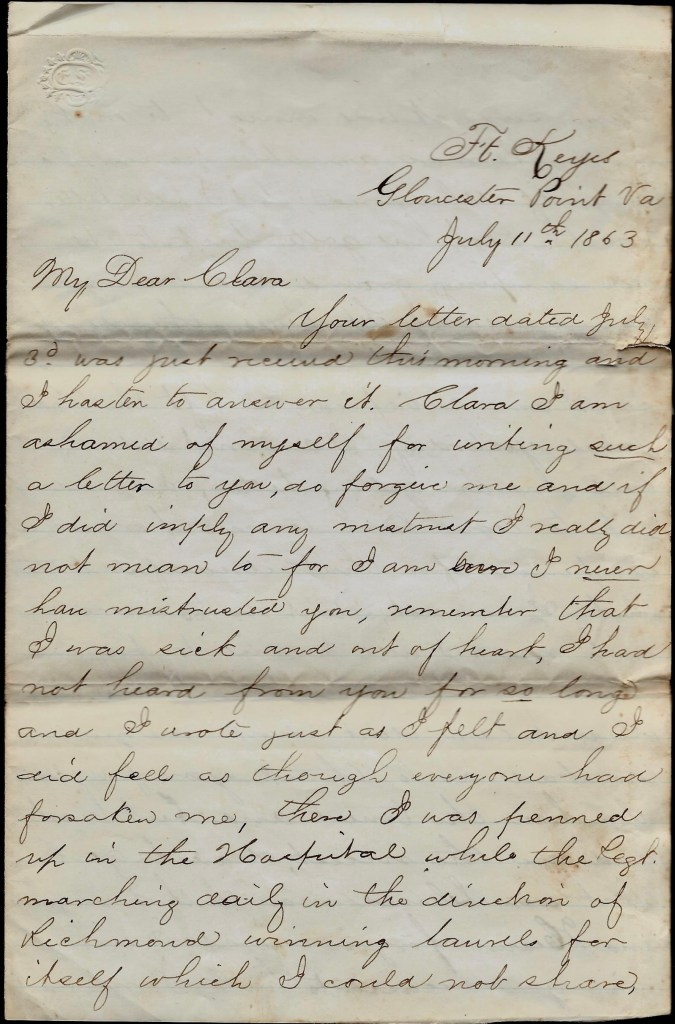
Fort Keyes Gloucester Point, Virginia July 11th 1863
My dear Clara,
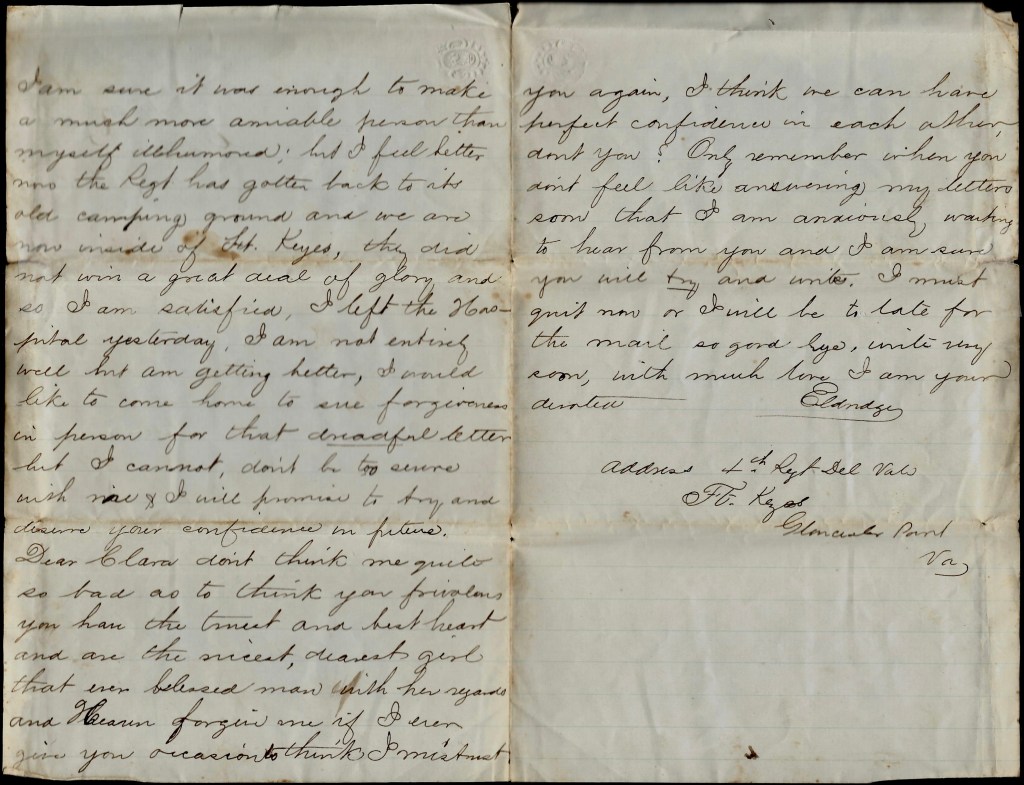
Your letter dated July 3rd was just received this morning and I hasten to answer it. Clara, I am ashamed of myself for writing such a letter to you. Do forgive me and if I did imply any mistrust, I really did not mean to for I am sure I never have mistrusted you. Remember that I was sick and out of heart. I had not heard from you for so long and I wrote just as I felt and I did feel as though everyone had forsaken me. Then I was penned up in the hospital while the regiment was marching daily in the direction of Richmond winning laurels for itself which I could not share. I am sure it was enough to make a much more amiable person than myself ill-humored. But I feel better now. The regiment has gotten back to its old camping ground and we are inside of Ft. Keyes. They did not win a great deal of glory and so I am satisfied.
I left the hospital yesterday. I am not entirely well but am getting better. I would like to come home to sue forgiveness in person for that dreadful letter but I cannot. Don’t be too severe with me & I will promise to try and deserve your confidence in future.
Dear Clara, don’t think me quite so bad as to think you frivolous. You have the truest and best heart and are the nicest, dearest girl that ever blessed man with her regards. Heaven forgive me if I ever give you occasion to think I mistrust you again. I think we can have perfect confidence in each other, don’t you? Only remember when you don’t fel like answering my letters soon that I am anxiously waiting to hear from you and I am sure you will try and write.
I must quit now or I will be too late for the mail. So goodbye. Write very soon. With much love, I am your devoted — Eldridge
Address 4th Regt. Del. Vols, Ft. Keyes, Gloucester Point, Va.
Letter 9
Ft. Keyes Gloucester Point, Virginia July 12th 1863
My dear Clara.
We have marching orders and I suppose are to go to Washington. If any farther, I do not know. Be of good cheer and rest assured if the 4th Delaware does get a chance at Old Lee, she will not disgrace herself. I am much better and will go with the regiment and try and do my duty. And should I fall, I will fall loving you as dearly as ever. So goodbye. Write to me and address to Washington, D. C.
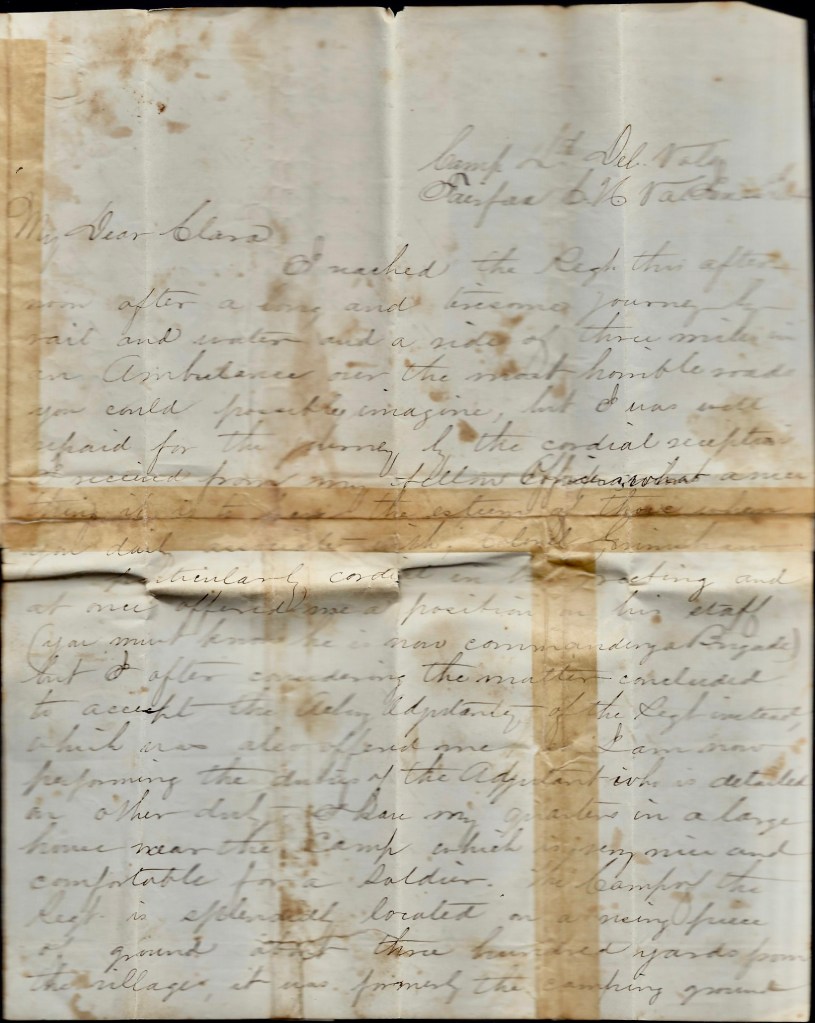
I reached the regiment this afternoon after a long and tiresome journey by rail and water and ride of three miles in an ambulance over the most horrible roads you could possibly imagine. But I was well repaid for the journey by the cordial reception from my fellow officers. What a nice thing it is to have the esteem of those upon one daily associates with. Colonel [Arthur H.] Grimshaw was particularly cordial in his greeting and at once offered me a position on his staff (you must know he is now commanding a brigade) but after considering the matter concluded to accept the Acting Adjutancy of the Regiment instead which was also offered me. I am now performing the duties of the Adjutant—who is detailed to other duty. I have my quarters in a large home near the camp which is very nice and comfortable for a soldier.
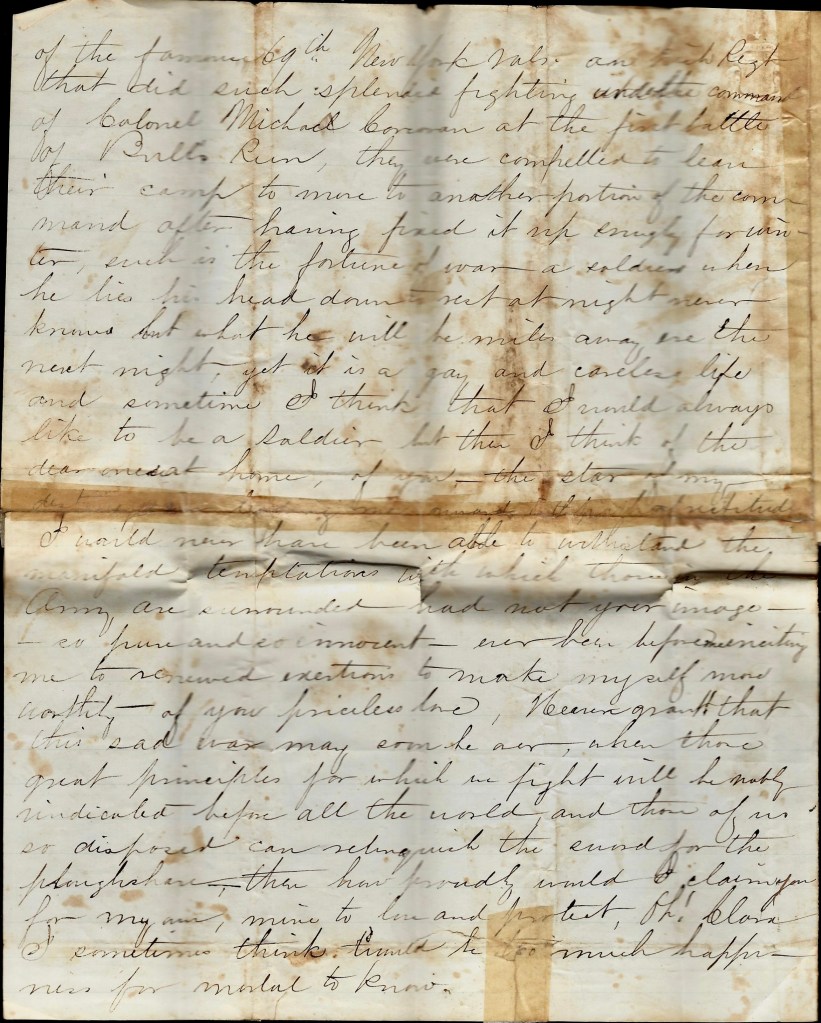
The camp of the regiment is splendid—located on a nice piece of ground about three hundred yards from the village. It was formerly the camping ground of the famous 69th New York Volunteers—an Irish Regiment that did such splendid fighting under the command of Colonel Michael Corcoran at the first Battle of Bull Run. They were compelled to leave their camp to move to another portion of the command after having fixed it up snugly for winter. Such is the fortune of war. A soldier when he lies his head down to rest at night never knows but what he will be miles away ere the next night [comes[. Yet it is a gay and careless life and sometimes I think that I would always like to be a soldier. But then I think of the dear ones at home—of you, the star of my [illegible due to tape]. I would never have been able to withstand the manifold temptations with which through the army are surrounded had not your image—so pure and so innocent—ever been before me, inciting me o renewed exertion to make myself more worthy of your priceless love. Heaven grant that this sad war may soon be over, when those great principles for which we fight will be nobly vindicated before all the world and those of us so disposed can relinquish the sword for the plowshare. Then how proudly would I claim you for my own, mine to love and protect. Oh! Clara, I sometimes think, it could be too much happiness for mortal to know.
It is very late at night. Perhaps even now your thoughts are roaming through the wide expanse of dream land in search of those you love. You may eve at this moment be thinking of me. How I wish I knew if you were. I would be so glad. I will not write any more now but will promise you a real long letter next time—when you have answered this. Please write to me soon. Days will seem like weeks until your letter arrives. Your devoted, — Eldridge
Letter 11
[In pencil written on scrap paper; written during the Battle of Cold Harbor]
Headquarters 4th Delaware Vols. In the field, 8 miles N. of Richmond June 2nd 1864
My dear Clara,
I snatch a few moments to write to you midst the whizzing of bullets and the bursting of shells. We reached this army (Army of Potomac) yesterday after a march ordered from Port Royal on the Rappahannock. We are now in line of battle and throwing up breastworks within 200 yards and in plain sight of the Rebel lines. Our loss has as yet been very small. I am safe.
We have not received a mail for more than a week and I have not heard from you for a long time. I suppose your letters have miscarried for I cannot think you have been willfully so cruel as not to write. I have addressed several letters to you since your last and sent them all to Milford so that I hardly think they can have miscarried.
Longing to hear from you, I am with much love yours affectionately, — Eldridge
Letter 12
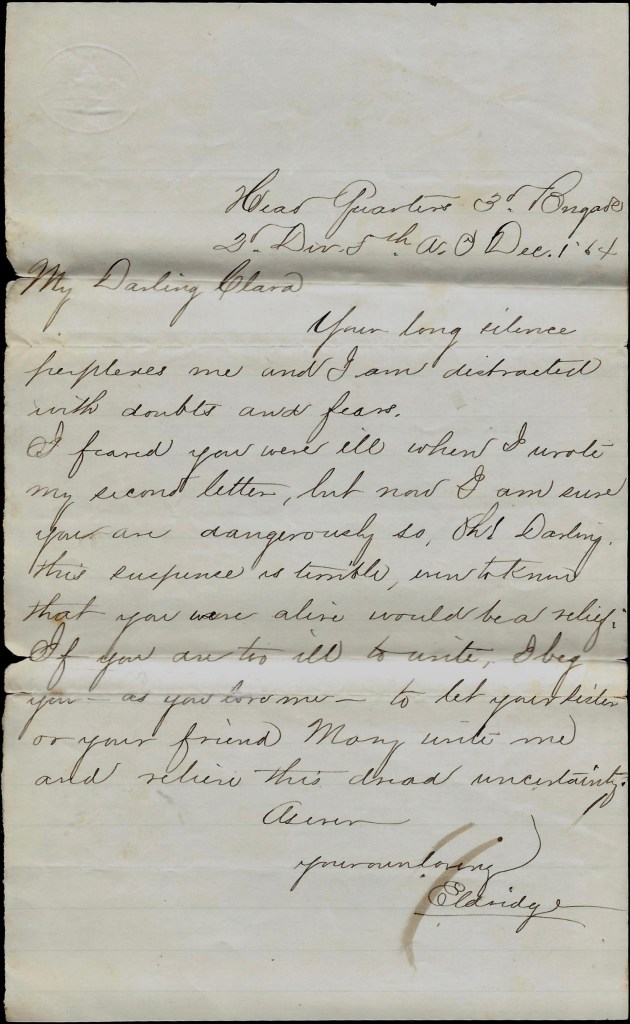
Headquarters 3rd Brigade, 2nd Division, 5th A. C., December 1, 1864
My Darling Clara,
Your long silence perplexes me and I am distracted with doubts and fears. I feared you were ill when I wrote my second letter but now I am sure you are dangerously so. Please, darling, this suspense is terrible. Even to know that you were alive would be a relief. If you are too ill to write, I beg you—as you love me—to let your sister or your friend Mary write me and relieve this dread uncertainty. As ever, your own loving, — Eldridge
Letter 13
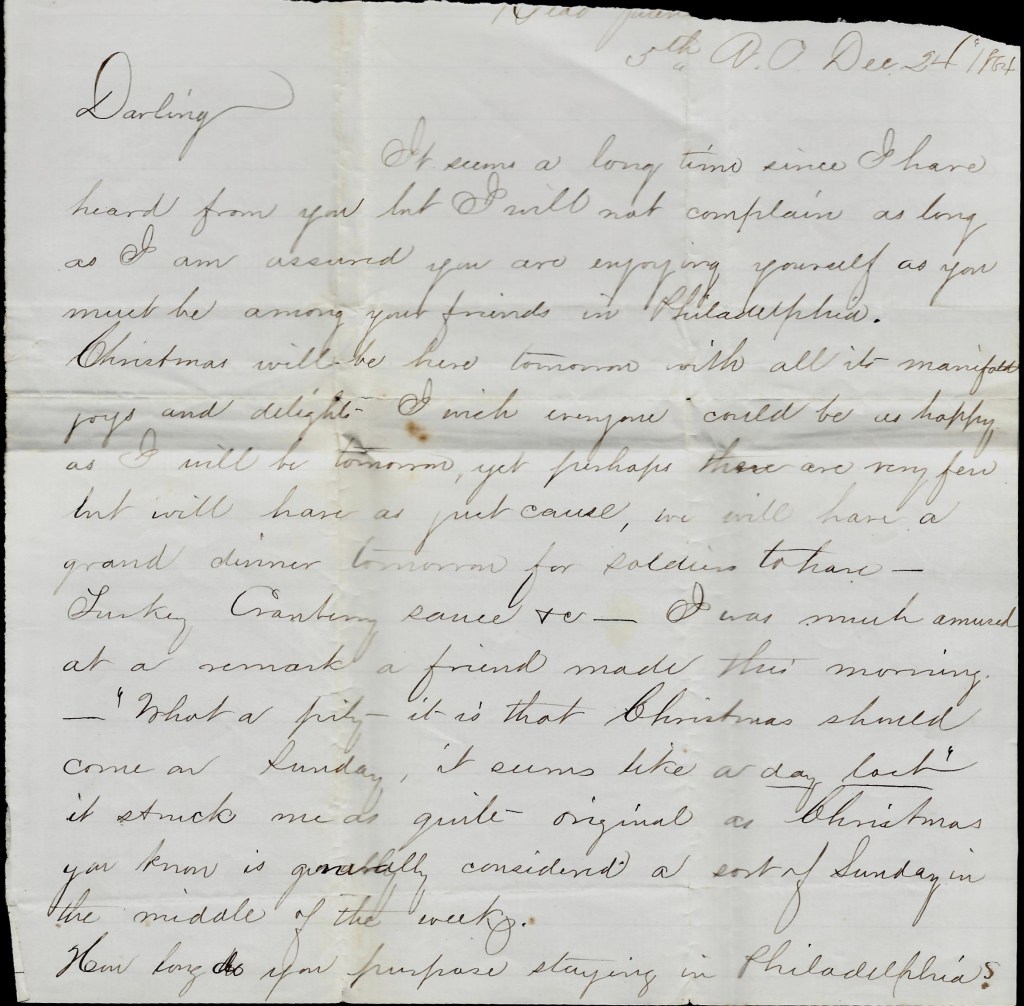
Headquarters 3rd Brigade, 2nd Division, 5th A. C., December 24, 1864
Darling,
It seems a long time since I have heard from you but I will not complain as long as I am assured you are enjoying yourself as you must be among your friends in Philadelphia.
Christmas will be here tomorrow with all its manifold joys and delights. I wish everyone could be as happy as I will be tomorrow, yet perhaps there are very few but will have as just cause. We will have a grand dinner tomorrow for soldiers to have—turkey, cranberry sauce, &c. I was much amused at a remark a friend made this morning. Wat a pity it is that Christmas should come on Sunday. It seems like a day lost. It struck me as quite original as Christmas you know is generally considered a sort of Sunday in the middle of the week.
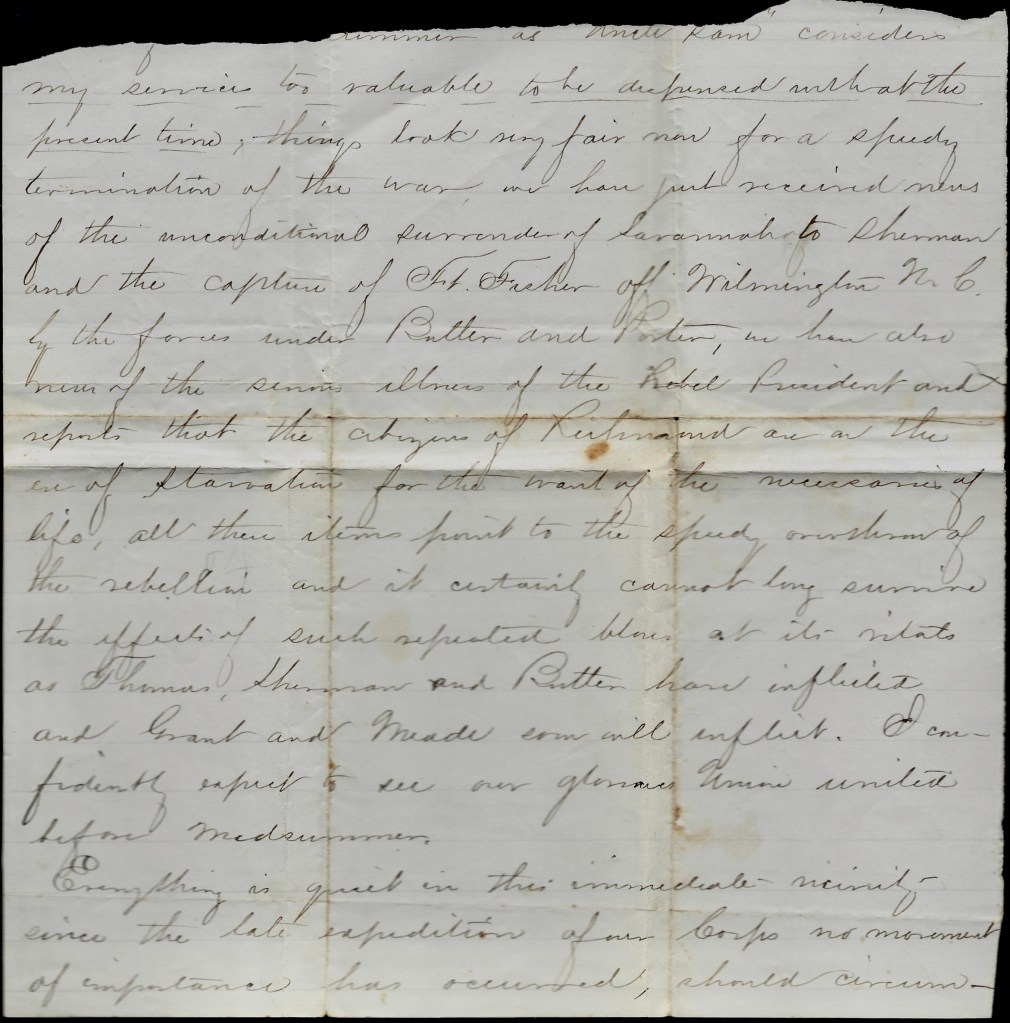
How long do you propose stating in Philadelphia? [portion of letter ripped off]…my service too valuable to be dispensed with at the present time. Things look very fair now for a speedy termination of the war. We have just received news of the unconditional surrender of Savannah to Sherman and the capture of Ft. Fisher off Wilmington, N. C. by the forces under Butler and Porter. We have also news of the serious illness of the Rebel President and reports that the citizens of Richmond are on the eve of starvation for the want of the necessaries of life. All these items point to the speedy overthrow of the rebellion and it certainly cannot long survive the effects of such repeated blows at its vitals as Thomas, Sherman, and Butler have inflicted and Grant and Meade soon will inflict. I confidently expect to see our glorious Union united before mid summer.
Everything is quiet in this immediate vicinity since the late expedition of our Corps [Raid on Weldon Railroad]. No movement of importance has occurred …. [rest is missing]
Letter 14
[In this letter, Eldridge refers to the fighting by the 4th Delaware at Dabney’s Mills, Hatchers Run on 5-7 February 1865.]
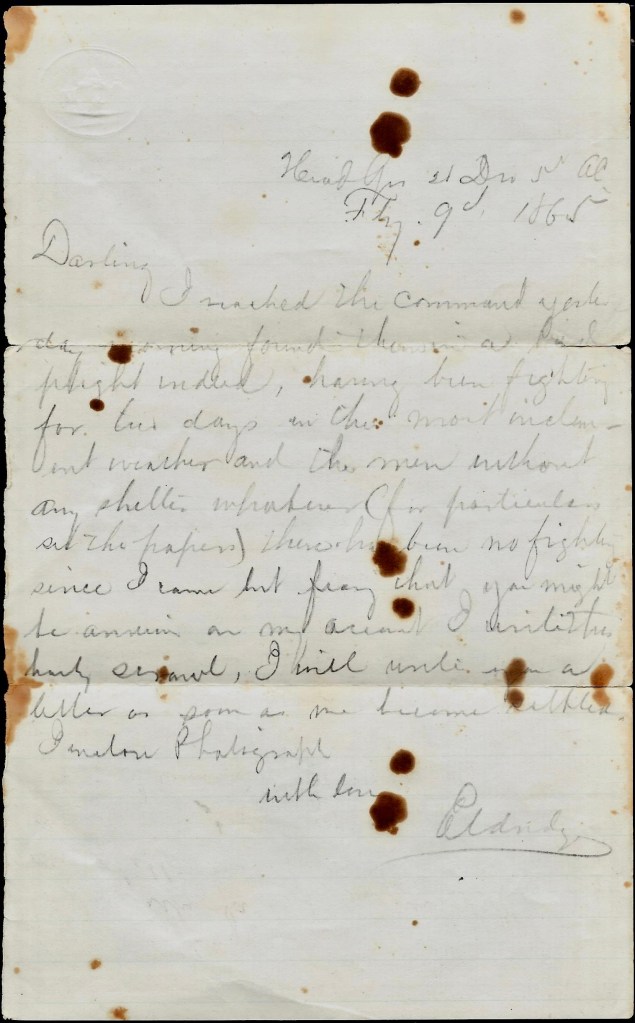
Headquarters 2nd Division, 5th Army Corps February 9th 1865
Darling,
I reached the command yesterday morning and found them in a plight indeed, having been fighting for two days in the most inclement weather and the men without any shelter whatever (for particulars, see the papers). There has been no fighting since I came but fear that you might be anxious on my account, I write this hasty scrawl. I will write you a letter as soon as we become settled. I enclose photograph with love, — Eldridge
Letter 15
Near Moonsville, Pennsylvania June 18, 1865
Darling,
Did you ever feel as though you were melting and being gradually reduced to nothing? No, of course you never did. You always keep surprisingly cool under all circumstances. But I feel as though I was continually melting. You have no idea how warm it is here—as great deal warmer than it ever is at Milford.
I am now at Uncle John Hendrickson’s within sight of the City of Trenton. Have just been up a cherry tree and have eaten of the luscious fruit until I can eat no more. I have had a splendid time and Oh! what a kind reception I have met with. Everybody seems glad to see me and my dear old aunties that I have not seen so long a time welcome me with open arms. Congratulations upon congratulations are heaped upon me for my safe escape from the perils of war and of people keep on, I am afraid I shall become very conceited.
The bridal party that I wrote about came off at the appointed time with great elan but I must say I thought it rather countrified. I never could describe a party and won’t attempt this. The bride looked very sweet and interesting adn anyone who saw her had a faint impression of how charmingly my darling will look some of these days on a like occasion. The last two days of last week I spent at Newtown—a town about the size of Milford. I became acquainted with several young ladies and was quite favorable impressed.
I will go down to Bristol tomorrow and will reach Philadelphia about the last of the week. Don’t think I will get home before the last of next as I have to stop at Wilmington & New Castle. I am sorry Darling I came away without your ring and instructions on the subject. If I remember tightly, you wanted a ring the size of one of your hands. If such was the case , I would like you to enclose them both t me at Wilmington, care of Col. A. H. Grimshaw so that they will get there by Saturday and I will attend to it.
Hope you are well, Darling, and enjoying yourself very much. I long to see that darling face that always smiles on me. Fondly your own, — Eldridge
“God grant that before I fill another diary that us poor, miserable fellows will be enjoying ourselves in peace and luxury.”
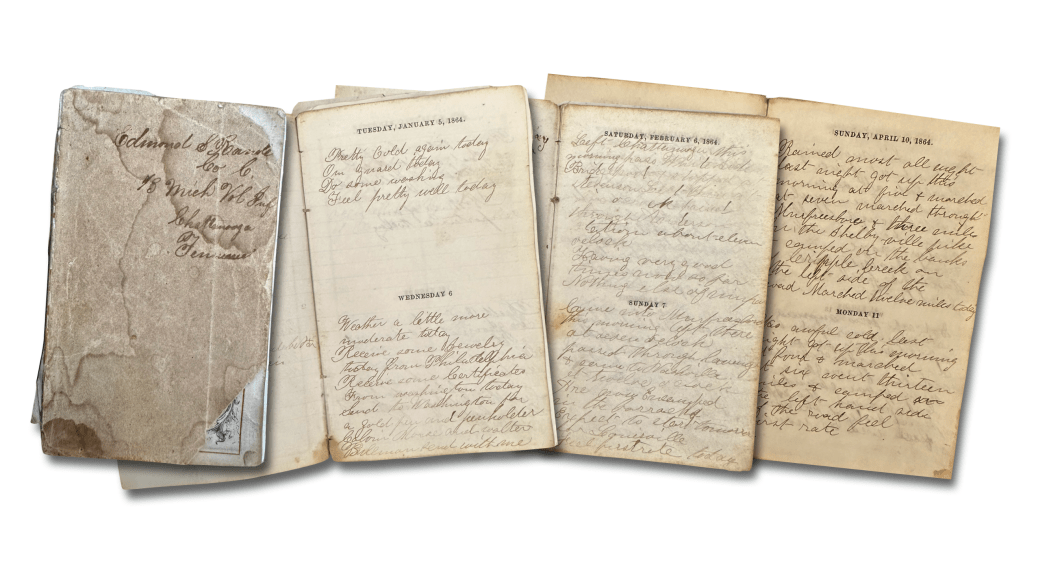
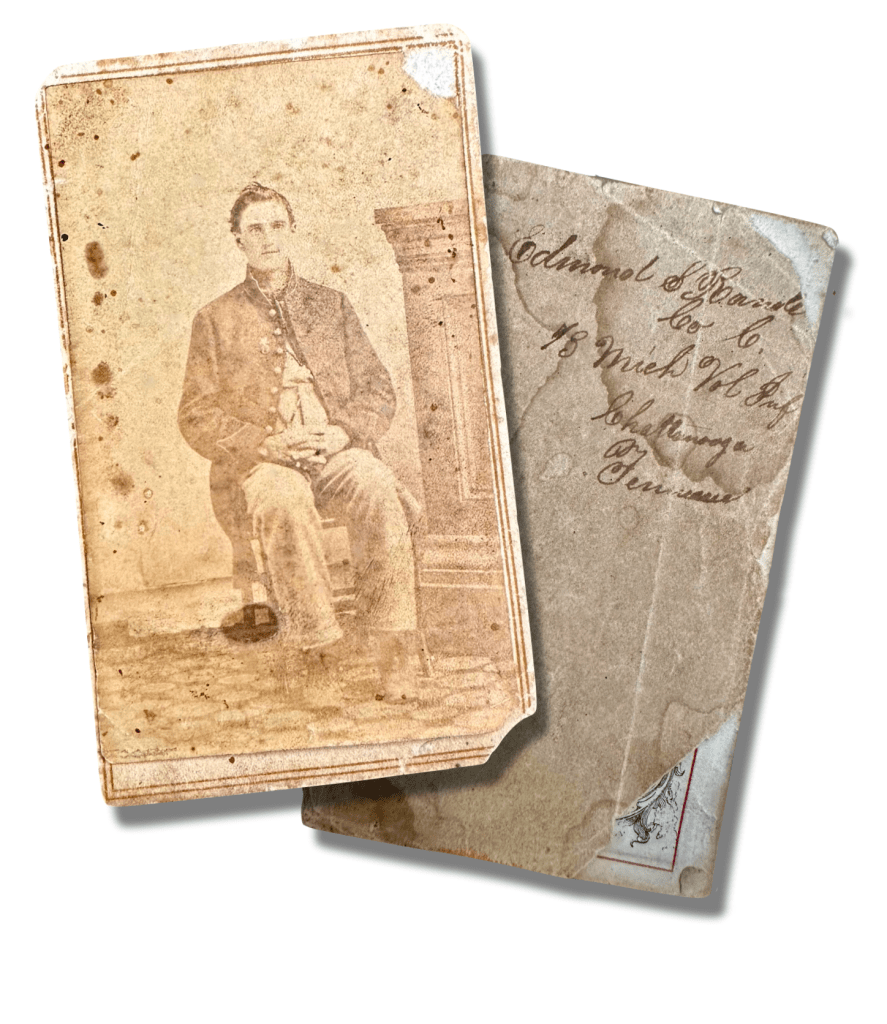
So wrote Edmond Silas Randall (1845-1924) in the final entry of his 1864 diary while serving in Co. C, 13th Michigan Infantry. He enlisted on 19 November 1861 at Oakfield for three years when he was only 16 years of age. He reenlisted as a corporal on 18 January 1864 at Chattanooga, Tennessee and mustered out of the service on 25 July 1865 at Louisville, Kentucky.
Edmund’s death certificate informs us that he was born in St. Lawrence county, New York on 16 October 1845. His father was Silas Randall and his mother was “Not Knowen” (not known). According to Michigan records, Edmond moved to a farm in Cannon township, Kent county, Michigan, with his parents in May 1851. In 1870 he moved to Lawrence county, Tennessee where he farmed and engaged in lumbering. He returned to Michigan in 1884 and settled in Oceana county where he served as township supervisor and county board of supervisors. He served in the 42nd Legislature in Michigan in 1903-04.
During 1864, the 13th Michigan was stationed on the Chickamauga; engaged in picket duty and cutting timber for warehouses in Chattanooga till February 17, 1864. Engineer duty at Chattanooga and stationed at Lookout Mountain constructing military hospitals till September, 1864. Relieved from Engineer duty and pursuit of Forrest into Northern Alabama September 25-October 17. Joined Sherman’s army at Kingston, Ga., November 7. March to the sea November 15-December 10. Skirmishes at Dalton, Ga., November 30 and December 5 (Detachments). Siege of Savannah December 10-21.
Note: This diary was donated to Michigan’s Military Heritage Museum and was offered for transcription and publication on Spared & Shared by express consent. It has never been previously published.John Beeler should be credited with preserving the diary.
Transcription
Union encampment near Chattanooga in early 1864
January 1864
1st—Very cold weather. Wrote a letter home. Officers had a dance tonight.
2nd—Very cold today. Have got a very bad eye. Went to the doctor today—the first time since I was at Shiloh.
Sunday, 3rd—Weather a little more moderate. Eye a great deal better. We had a meeting today in camp. Nothing of any importance today.
4th—Quite warm today. My eye is a great deal better Nothing going on in camp today.
5th—Pretty cold again today. On guard today. Do some washing. Feel pretty well today.
6th—Weather a little more moderate today. Receive some jewelry today from Philadelphia. Receive some certificates from Washington today. Send to Washington for a gold pen and pen holder. Calvin Morse and Walter Bullman send with me.
7th—Rainy today but freezes as fast as it falls. Feel like a fighting cock today. Nothing of any importance today.
8th—Pretty cool today. The ground is covered with snow—the first snow that we have had here yet. I was on fatigue duty today. Cut the end of my thumb pretty bad.
9th—Very fine weather today. Feel pretty well. Thumb is pretty sore. Nothing of any importance occurred today in or out of camp.
Sunday, 10th—Had meeting today. Very warm weather. Receive a letter from C. C. today.
[Missing entries for 11th through 14th]
15th—Was on fatigue duty this morning. Pretty cool weather today. Had charge of a squad of men unloading logs today.
16th—Very pleasant weather today. Was not on duty today. Expect the rebel cavalry in tonight. Nothing else of any importance.
Sunday, 17th—Pretty warm today. Was on guard today. Feel pretty well today.
18th—Cloudy today. My fatigue duty today was to dig a spring and sink a barrel and draw up some wood for headquarters. Great excitement today about reenlisting. I reenlisted this evening.
19th—Cold today but clear. Was put on extra duty today for not turning over my instructions to the new corporal of the guard. Expect the rebel cavalry in again tonight. Great excitement about reenlisting. A great many reenlisting.
20th—Well here I am again this morning and no rebels have come yet. My fatigue duty today was to haul up some wood for headquarters.
21st—Very pleasant weather today. Was sworn in to the Veteran Service today. Expect to go to a spree tonight if don’t get slipped upon it.
22nd—Well, I went to the spree and a hell of a time we had too. Had a very good supper but not very good dance. Broken up at one o’clock.
23rd—Very warm today. Was on fatigue today and it was the laziest day that I ever saw. The rebels are reported within three miles of here drawn up in a line ready for to give the Yankees what they don’t like.
Sunday, 24th—Pretty warm and the prettiest weather that I have seen this winter. There was meeting in camp today. Nothing of any importance today. Receive a letter from N. R. and answer it.
25th—Very warm and pleasant. There was six rebels came into our camp. There is more or less [deserters] coming in every day. There has 44 new recruits came into our regiment today. Three came into our company today and more is coming in when we get back.
26th—Very fine weather. Made a small mistake in my diary. It was today that the new recruits came in and the rebels came in also today. Had a very fine game of ball today and tonight.
27th—Very pleasant yet. Had another fine game of ball today. Had a stag dance in the hall this evening. Had my hair cut today. There is nothing of any importance occurred in or out of camp today. Feel pretty well.
28th—Awful warm and lazy day. Officers had a small evening dance. There was some more new recruits this evening. Expected to muster this evening or it has today but did not. Expect to start for home next Monday [on Veteran’s furlough].
29th—Warm as usual. Mustered into the Veteran Service today. Had a general time in tearing off the sergeant’s stripes. Heard that they was fighting at Knoxville. Nothing else of any importance occurred today.
30th—Cloudy today. Sprinkled this morning. Had a game of ball. Received a letter from home today and a lusty old one it was too. Sent a guard down after the paymaster but he did not come.
Sunday, 31st—Cloudy this morning. Went down to town and saw Lum Bishop and Cal Thomas. Found Captain Yerkees. He came to the regiment tonight. Had to go on guard after I come back. They are keeping a strict guard today. They caught a secesh spy last night.
February 1864
1st—Very fine weather. I have not had any fatigue duty today. I did settle up all my little debts. I received two hundred and six dollars and thirty-five cents. Nothing else of ay importance today.
2nd—Pretty cool and looks very much like rain. Had company drill this morning & battalion drill this afternoon & dress parade this evening. Feel pretty well today. Received some scrap books from Ohio.
3rd—Clear and cold today. Had company drill this morning & battalion drill this afternoon & dress parade this evening at five o’clock. Have not heard anything about coming home. Nothing else of importance.
4th—Made a mistake in my diary. Turned over two leaves. Clear and pleasant today. Had company drill, battalion drill, and dress parade today. Received orders to go to town to leave town next day.
5th—Pretty warm and pleasant. Lou Bickford and H. Clemmons and Frank Atkins came up to our camp today. Brought me a pair of boots from home. We went to town today and get ready to start for home tomorrow. Saw lots of the boys in the Engineers. Pretty cool this evening. Nothing else.
6th—Left Chattanooga this morning. Pass Whiteside, Bridgeport, & stopped at Stevenson. Left there at five o’clock. Passed through Anderson Station about eleven o’clock. Having very good times now do far. Nothing else of importance.
Sunday, 7th—Came into Murfreesboro this morning. Left there at seven o’clock, passed through Lavergne and came to Nashville at twelve o’clock. Are now encamped in the barracks. Expect to start tomorrow for Louisville. Feel first rate today.
8th—Clear and cold. Leave Nashville this morning at seven o’clock & reach Louisville at 6:30 o’clock. Passed through Gallatin, Cave City, Bowling Green, Mumfordville, & Elizabethtown & Scotchville. Boys feel first rate. Knocked over two or three niggers, &c.
9th—Laid in Exchange Barracks No. 1 today. Bought me some new clothes. Having a regular time running around town. Expect to leave for Michigan tomorrow at ten o’clock. Nothing else of any importance occurred today.
10th—Clear and cold today. Crossed over the river this forenoon. Had a grand old time in Louisville. Leave Jeffersonville [Indiana] at eleven o’clock. Had to take second class coaches. The boys feel pretty angry about it. Nothing else of importance.
11th—Still on the cars bound for Kalamazoo. Passed through Franklin, Indianapolis. Got supper at Lafayette.
12th—Reached Kalamazoo this morning at ten o’clock. We met with a very warm reception. Had a very nice dinner. The flags were thicker than flies on a lump of sugar. Are having the best of times. The boys are all in fine spirits.
13th—Was in town today all day & are having the very best of time. Nothing of any importance occurred.
Sunday, 14th—Got our furlough this morning & transportation to Grand Rapids. Stay tonight twenty-one miles from the Rapids & twenty-eight from Kalamazoo. Expect to eat supper at my own home tomorrow night.
15th—Left Chamberlain’s Tavern this morning at daylight and got to the Rapids at twelve o’clock. Left there at two and got to Cannonsburg at five. Left there at six o’clock & arrived hime at eight. Growing pretty cold. Nothing else of importance.
16th—Most awful cold weather now. Went down to Uncle Ward’s & had a good visit. Saw Sid & his woman. He belongs to Co. G of the 40th [48th?] Illinois. He has reenlisted. Wend down to the grandparents tonight. Had a good old visit.
17th—Cold as ever today. Went over to Mr. Bickford’s & to Mr. Smith’s. Had a pretty good visit. Went down to Mr. Closes’ in the evening. Had a very good visit. Stayed to Mr. Closes’ house all night. Was having first rate times.
18th—About as cold as ever. Went up to Hannah Smith’s & went from there to Mr. Bickford’s & had a good visit. Saw Mr. McArthur’s folks & Mr. Climmon’s folks. Went home just before dark and went & took a ride with Judson Bond and girls.
19th—Weather a little more moderate. Went down to Mr. McArthur’s to get some potatoes & some sheep. Went down to Gilley’s [?] and saw all of the folks. Came back and found John Smith’s folks here. Went down to Mr. Brooks in evening.
20th—Made a small mistake in my diary. It was today that John Smith’s was here. I went down to see Sid today. Also he starts tomorrow. Went down to Mr. Cook’s this evening. Had a pretty good time. Nothing else today.
Sunday, 21st—Went up to meeting this forenoon & brought home a whole load of girls—Ludie Cook, Sarah Cook, Ette Cook, Mary Watson, & some more. Went up to meeting this afternoon or rather evening.
22nd—Went down to the rapids today. Pretty warm weather for this time of the year. Went to the theatre and had a pretty good time. Stayed at the Eagle. Saw Albro Atkins.
23rd—Done up our trading today and started out of town about one o’clock. Got up as far as Mr. Brooks’ and stopped and stayed all night. Had a good visit with the boys.
24th—Left Proviso this morning at six o’clock and arrived home at noon. Went over & saw Sam Brooks about going to Greenville Friday next & went over to Mr. Closes’ and around home.
25th—Judson Bond stayed with me last night. We went a hunting today. Did not kill anything. Went up around home & went up to Mr. Abner Ashley’s and stayed in the evening.
26th—Got up this morning and got ready to go to Greenville to the dance. Went over to Bickford’s and Sam came along. Had pretty bad luck. Broke a buggy and hitched on to our wagon. Got into Greenville at five p.m.
27th—Left Greenville at four o’clock and got home at noon almost tired out. Did not go over west to school because we was so late coming home.
Sunday, 28th—Colder than usual. Went up to meeting today and came back home and found John Randall here. Had a good visit & went up to meeting in the evening. Went home with J. R. Calculate to go up Mr. Watson’s Friday night. Nothing else of any importance occurred.
29th—Pretty cool weather. Went down to Mr. Bush’s & had a very good visit. Hear of a dance at Mr. Brown’s next Friday night. Nothing else of importance.
March 1864
1st—A little more pleasant today. Went out on the farm in Cannon and looked at the wheat. Went down to Isaac Bush’s this morning and went down to Cannonsburg today to see the boys & they had gone to Rapids.
2nd—Went down to Mr. Cook’s. Had a roast turkey in the afternoon & warm sugar in the evening. Lydia came back home with us. Had a splendid time. Had music. Joel came up from the corners. Had a skate in the ice before going to Mr. Cooks.
3rd—Went down to Mr. Green’s today and came back home and went up to Mr. Watson’s in the evening. Had a splendid time. Lydia & Jetora, Saphina, Flora, Mary Jardeson, and myself went in the load together. Got back home at twelve o’clock at night.
4th–Laid around home till about noon and then went and took Lydia to Mr. Brooks’ & went down to Cannon to a party to Mr. Brown’s. Had a splendid time. Saw Bill Wall and all of the young folks. Left my horse at Mr. Brown’s.
5th—Started for home this morning at seven o’clock & went up to Mr. Brooks’ & got Lydia and took her up to Mr. Pond’s and came home & then went down to Mr. McArthur’s and had a baked goose. Came back up to Mr. Pond’s & got Lydia in and came up to our house to stay all night.
Sunday, 6th—Pretty warm and pleasant. Went up to meeting this forenoon & Sarah Cook and Detora Reid came home with our girls. Had a pretty good visit. Went to meeting this evening.
7th—Very warm & pleasant this morning. Went up to town meeting today and came back and stopped to Mr. Potter’s and took dinner & then came up to Dick Welles’s & took supper and then came home & I am pretty tired.
8th—Start for the Rapids this morning. Got into town at 3 p.m. Saw Cran Kenyon. Put up at the Bronson House.
9th—Start out of town this morning & go as far as Plainfield. Stop and feed my horse one peck of oats & it began to snow. Have a great time going up to Cannonsburg. Stay to the dance.
10th—Find myself on the floor dancing this morning at daylight. Go up to Henry Broom’s and get breakfast and go to bed sleepy until ten o’clock. Get up them and get out my horse, settle up my bill, and come home. A whole load of young folks came here on visits tonight.
11th—Rained all night most. The young folks stayed here all night. I did not sleep much. Had a first rate visit. They went away this morning at daylight. I went to bed and slept until one o’clock. Got up and went down to Squire Watkin’s & got some money. From there to Tom Reds and from there around home.
12th—Went down to Mr. Caukin’s and to Mr. Welles’ and back to John Davies’ and came around home & then took the horse and went to Mr. Fuller’s and then to Uncle Ward’s & bid them goodbye. Came back home and our folks was gone over to [ ].
Sunday, 13th—Went to meeting today and then went down to Mr. Cook’s and stayed until evening & then went out to meeting and from there home. Bid farewell to all the young ladies. Expect to start tomorrow.
14th—Leave home this morning and bid farewell to the girls—that is, my sisters, and get to the Rapids at two o’clock this afternoon. Find all the boys & they are having a good old time. Stay at Courtright’s.
15th—Pretty cold this morning. Bid farewell to Father and Mother and start for Kalamazoo at six o’clock. Had a very fine time. Nigger got drunk & fell off from the top of the stage coach three times. Reach Kalamazoo at seven.
16th—Started from Kalamazoo last night at twelve o’clock & reached Jackson at four. Stayed in the cars till daylight. Went up to camp, run the guard and went down town. Stayed a spell and came back. Saw Lewis S____.
17th—Got up this morning at nine o’clock & went down town & stayed until quarter to twelve and then came back to camp.
18th—Stayed in camp all day waiting & laid a bed. Had a dinner & supper on Uncle Sam’s expenses—the first meals that I have had since I left home. Wrote a letter to E. T. tonight.
19th—Cold as fury today. Am on guard & they put on more style than a little. Have got two prisoners in the guard house for deserting. Snowed some today. Nothing of any account occurred today.
Sunday, 20th—Cold as ever. Was relieved this morning and laid in camp all day. Wrote a letter to Alice today & wrote one to Mother this evening. A lot of the boys went down town this evening to meeting. Nothing else of an importance occurred in camp today.
21st—Nothing of any importance occurred in camp today, The boys are going down town in hacks pretty freely and I think that I will try my luck tomorrow.
22nd—Laid in camp all day today. Did not go to town today. Getting lonesome here [with] nothing to do. I will desert if we have to stay here a great while.
23rd—Warm and pleasant here today. Received a letter from home. It said there was a good sleighing there & knew there would be as soon as I got away. Well, there is no news to put down.
24th—Pleasant today. Went down and drawed fifty dollars state bounty. Expressed thirty-five of it home. Stayed in town till evening and went to the theatre. Had a fine time.
25th—Laid around camp today. Was on fatigue duty this forenoon and went down town in a hack & bought me things and back to camp. Stayed in camp this evening. Nothing else of any importance.
26th—Was on guard today. Left Jackson at five o’clock this evening. Reached Kalamazoo at eight this evening. Reached Michigan City at three o’clock on Sunday morning.
27th—Left Michigan City at 9:30 o’clock this morning. Pass over a very nice country. Reach Lafayette, Indiana, at eleven. Cars got stuck. Broke and engine & was delayed one hour. Reached Indianapolis at three p.m. Got dinner.
28th—Got to Jeffersonville at ten this morning. Crossed the [Ohio] River immediately and went into barracks. Some talk of our leaving tomorrow. Don’t know whether there is any truth in it ir not. Feel first rate.
29th—Wrote a letter to Sophina today. Do not leave here today. Got a boil coming on my face. Don’t feel very well. Went down town to the Theatre this evening. Did not have a very good time.
30th—Feel pretty hard up. Have orders to leave here today. Stew a cup full of berries and have to throw them away. Face most awful sore. Leave here at ten and ,arch down to Portland seven miles. Get on to the boat to cross over to New Albany/ Stay all night.
31st—Commence to load the boat. Go up town & buy a box of cigars to peddle out. Feel awful hard up. Leave here at dark. Pass by West Point about ten in the evening. Hear that there is some rebels at Smithville, Kentucky. Nothing else of importance.
April 1864
1st—On our route as hard as we can go. Passed several boats today. They holler, “Look out for the Rebels.” Have orders to clean up our guns. Am pretty sick. Was sent up into the cabin yesterday.
2nd—Still on the Ohio river. Still rumors about there being rebels ahead. Pass by Evansville, Indiana. Are now on the Illinois shore. There is nothing going on on the boat & I am getting tired of staying here. Feel pretty bad. Sell all my cigars.
3rd—Very warm today. Made a mistake in my book. Being unwell, I neglected my diary for two or three days & when I came to fill up, I made a mistake. We came into the Cumberland [river] yesterday. Reached Nashville this evening.
4th—Rains a little this morning. I am on guard today. Leave the boat this evening & go up to the barracks. Was dismissed this morning & had to report again. Saw Lewis Thomas [and] Leroy Nesbit today. They beat us to Nashville. They leave these barracks this evening. Report that we are going back to Chattanooga.
5th—Was relieved this morning at nine. Now I have nothing to do but lay around. Saw Robert Howard. He is well. Went to the theatre this evening & had a first rate time. Col. Culver has gone to Chattanooga to get us transportation. Have not heard from him yet.
6th—Very warm & pleasant today. Makes me think of summer. Saw George Howard. I was asleep & he came and pulled me out of bed. He is as fat as a bear. He left & then came back. They are under marching orders. Wrote a letter to Judson B.
7th—Warm and pleasant. Have orders to march on foot to Chattanooga. Nothing else going on in camp.
8th—Leave this forenoon at ten o’clock & it rains like fury. Muddy as the old boy. March eleven miles today and camped on the right hand side of the road. Feel pretty sick. Have not felt well since I left Louisville.
9th—Got up this morning at sunrise. Feel some better. Start on the march at half past seven. March ten miles & then camped on the banks of the Stewart Creek on the right hand side of the road. Feel a great deal better than I did yesterday.
10th—Rained most all night last night. Got up this morning at five and marched at seven. Marched through Murfreesboro & three miles on the Shelbyville pike & camped on the banks of Cripple Creek on the left side of the road. Marched twelve miles today.
11th—Was awful cold last night. Got up this morning at four and marched at six. Went thirteen miles and camped on the left hand side of the road. Feel first rate.
12th—Rainy this morning. Got up at five. Marched at seven. Went eleven miles. Went through Shelbyville & camped in a cedar grove. Had pickets out tonight. Feel first rate.
13th—Got up this morning at five. Marched at six. very fine day. Marched twelve miles through a very poor country. Camped on the right hand side of the road. Feel well as usual.
14th—Cloudy this morning. Reveille at five and marched at seven. Went through Tullahoma this morning. Marched ten miles and camped on the bank of Elk river within four miles of Decherd Station. Sprinkles some this evening. Feel first rate.
15th—Cloudy this morning. Arose at five. Marched at seven. Marched eleven miles and camped at the foot of the Cumberland Mountains. Passed through Decherd Station. Drew rations at the station to last to Stevenson. Feel first rate.
16th—Arose this morning at five. Marched at seven. Marched 14 miles over the mountain & camped on the bank of Crow Creek. Was an awful cold night last night. Mountain was not high where we crossed over.
17th—Very cold last night. Arose this morning at five and marched at seven. Drew rations at Anderson Station. Marched three miles on the railroad. Marched ten miles and camped within two miles of Stevenson. Rains this evening pretty hard.
18th—Rained all night last night. Am on guard today. Crossed over the mountains, Cut off three miles. March through Bridgeport & cross the Tennessee river & camp about two miles from Bridgeport. Was up from ten until two this evening. Pretty cool this evening.
19th—Was relieved this morning. Start at seven and march thirteen miles & camp in Whiteside Valley. Expected to get some mail tomorrow. Only 14 miles to Chattanooga. Saw DeWitt Newton. He is in the 9th Michigan Battery. Feel first rate.
20th—Start this morning at seven. March to the point of Lookout Mountain & stop and get dinner. Then start and climb the mountain. Marched sixteen miles today. Got our mail. I got seven letters. Picked out our camp. Swept it off and pitched our tents. Expect to stay here quite a spell, &c. &c.
21st—Quite pleasant today. Are busy clearing off our camp. Lon and Silas came up here today & I sent some things by them to the boys in the Engineers. Tried to get a pass to go back with them & could not. Feel first rate. Nothing of any importance a going on today in camp.
22nd—Clear and pleasant today. Had four men to drill this forenoon & company drill this afternoon & dress parade this evening at five o’clock. Received three letters today—one from Mother, one from Sabrina, and one from N. R. Write one letter to Father. Nothing else of importance.
23rd—Was on guard today. Was not out on drill today. Drew rations this evening. Maynard Burgess came to the company this evening. Wrote a letter to David Randel & one to H. C. and one to E. T.
24th—Rainy this morning but clears off this afternoon. Was relieved at eight o’clock. Took the camp guard off today. Went to bed and slept until they woke me up to dinner. Went on inspection this afternoon & dress parade this evening at six o’clock. Nothing else of any importance occurred today in camp.
25th—Clear and pleasant this morning. Went out and drilled a squad this forenoon. Drilled two hours & then dismissed the squad. Had company drill at two this afternoon of two hours. Drilled in the flank movement & facings. The new recruits are getting along finely. Went on dress parade this evening at six. Wrote a letter to Nettie Rowlison.
26th—Most beautiful weather. Got a pass this morning and went down to Chattanooga to the Engineers. Saw all the boys. Lon cut my hair. Went over the river to the 21st Michigan and saw Dwight Fitch, Lew Thomas, Leroy Nesbit. Took dinner with Leroy and Lew. Reached camp at half past six.
27th—Very warm and pleasant today. Am on guard today, second relief. Quite a large mail came today but none for me. Drew one day’s rations. Hear that our company is a going to build a sawmill and run it. Do not know whether it is so or not. Feel first rate today but my eyes are pretty weak.
28th—Very fine weather today. Was relieved this morning at eight and had to go on fatigue duty. Cleaned out an old bakery and covered up some dead mules and cleared outa road for the regiment to march out on dress parade. Got done at noon. Had a little more in the afternoon. Fixed up our tent and fixed up a bunk. Drew two days rations. Dress parade this evening.
29th—Very warm and pleasant today. I help the captain make out the muster rolls. He puts a new man in sergeant. The boys do not like it very well. There is nothing of any importance going on in camp. Rainy and windy this evening. Write a letter to Samuel Brooks. Was up till eleven o’clock helping make out the muster rolls.
30th—Rainy this morning and forenoon. Nothing going on in camp today. Wrote a letter to Phin Brooks and one to Flora Bryan. Slept all the afternoon. Cooked a mess of beans this afternoon. Had quite a feast this evening with the Lieut. Williams, George L. Cathey & myself and some other boys.
May 1864
1st—Wet and rainy this morning. Strike tents, our company and Co. A, and go about three miles from camp and relieve. We are going to stay here until some troops move up from Chattanooga. Got a very nice place. Wrote a letter to Sarah Cook. Wrote one to [ ]. Rained this evening. Nothing else of importance.
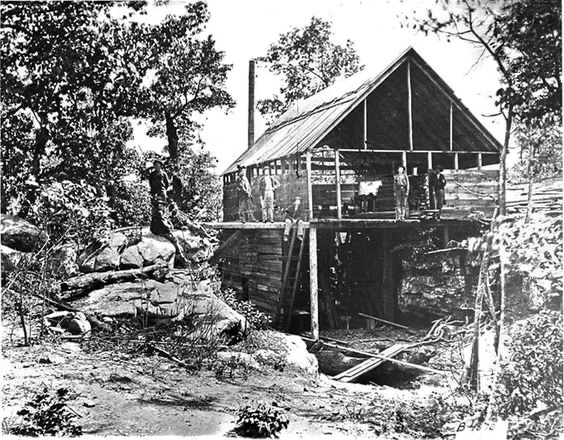
This sawmill was built during the Civil War and it was located on the Glenview branch of Lula Lake Road near the head of present Ochs Highway on Lookout Mountain.
2nd—Am not on duty today. Very clear and pleasant this morning. Had a considerable policing to do around our quarters this morning. Went over to the sawmill this forenoon and ground the axe and sawed out some laurel root to make rings of. Very windy this afternoon and pretty cool this evening. Drew two days rations this evening.
3rd—Clear and cold this morning. Was on guard last night here in camp. Only stood two hours. Some of the new recruits got pretty badly scared last night on picket. Two of them shot their guns off. Received a letter from Judson P. this evening. Went to bed this noon adn slept till supper time. Feel pretty well except my eyes.
4th—Clear and pleasant this morning. Am on picket today. Had some policing to do this morning. Drew two days rations this evening. Abner Martin came to the company today to do duty and George Baker came to the company today. There was no mail this evening. Commence standing post today. Reduced to ranks at my request.
5th—Very warm and pleasant today. Was relieved this morning at eight o’clock and came in and done out some washing. The old pickets shot at the mark today at noon and I made the third best shot. Am having good times wrestling, jumping, and trying tricks. Feel like a fighting cock.
6th—Warm and pleasant today. Am on picket again this morning. Richard Chirgwin went outside of the picket this morning and did not get back today. He may be captured. Troops are on the move now. Seven Corps have went through Chattanooga since last Monday. Everything going on in camp all right.
7th—Warm and pleasant as usual. Was relieved this morning at eight o’clock. Came into camp this morning and went and had a bath and changed my clothes and washed some today. There is nothing going on in camp. Received a letter from David Randel yesterday.
8th—Very warm and pleasant today. Had inspection this morning. Had a talk with the captain about my pulling off my straps. Shot at the mark today an noon with another man’s gun and did not hit the tree. Took a little walk this afternoon. Heard that our mail is to come in five days. Had a fine game this evening in leaping.
9th—Very warm and pleasant today. Went down to Summerville and had a good visit with the boys. Took some letters to put in the office. Got back at noon. Helped Lieut. Flint bring over a bedstead and I shot off my gun at noon [but] did not hit the tree. Had company drill this afternoon and bayonet exercise this evening.
10th—Very warm and pleasant today. Had company drill this afternoon and bayonet drill this evening. Received a letter from Father and one from Mother. They are getting along first rate at present. The letter was dated April 24th. Are having first rate times in camp, jumping, wrestling, pitching quoits, and all the rest of amusements. All quiet on the picket line.
11th—Quite cold this morning. Rained all night like fury. Am on picket today on second relief, No. 3 post. One of the boys saw a man and shot at him this evening. It is as cold as fury. Wrote one sheet to Father today. Had a little fight with John Storing—no one hurt. Hit him on the back with a hickory club. Nothing else of importance today. Hear good news from the front.
12th—Cleared off a little this morning. Was relieved at eight o’clock a.m. Everything going off alright in camp. Fixed up our tent some today. Received a letter from Philadelphia with twelve certificates in it. Had a good game of quoits—Blood and myself beat two of the other boys ten games out of twelve. Had company drill this afternoon.
13th—Very warm and pleasant today. Am on picket today. Had a quiet time in the night. The second relief was on post half an hour over their time. The third relief was on post an hour over time. The corporals got asleep. Everything else is going off alright in camp. The boys feel well as usual today.
14th—Was relieved this morning at eight. Very warm and pleasant today. Drew rations today for two days. Went to sleep this afternoon & slept until four o’clock. Had company drill this afternoon and bayonet exercises this evening. Everything going on alright in camp. Shot at the mark today noon. Did not hot the tree.
15th—Very warm & sultry today. Am on picket today on second relief, No. 1 post. Signed the pay roll this evening. Everything going off alright in camp. Received some butter from home today. Some of the boys was up here from camp today. It is very lonesome here. Nothing going on in camp.
16th—Very warm, pleasant, and lazy day. Drew two days rations today. Received two letters from Michigan—one from Emma and one from Alice. Answered both of them. Nothing going on in camp. Feel pretty well except my eyes are not very well. Was relieved this morning from picket at eight. I sent to New York to get circular for gold pen. Nothing else of importance.
17th—Am on picket today again. Slapping me on every other day. Rained some this forenoon. Clear this evening. Am on second relief, post No. 2. Captain was around this evening & caught me sitting down. Expect to draw pay tomorrow. Received a pair of pants today from government.
18th—Clear and pleasant this morning. Feel first rate today. Was relieved this morning at eight o’clock, the usual hour. Came into camp & done some washing. Cleaned my gun up first rate. Did not draw pay today but am going to draw tomorrow. Grubbed out the parade ground. Had company drill this afternoon and bayonet drill this evening.
19th—Warm and pleasant today. Am on picket today. DRew pay today from government. Rained some today in little showers but cleared off today. Was on second relief, Post No. 1. We are having very good times, raising the old boy in general. There is not a reb in fifty miles of here.
20th—Was relieved this morning at the usual hour. There is some talk of our moving camp. Went to Summerville this morning and bought a box of cigars and straightened up and rode an old horse up here to camp.
21st—Very warm and pleasant day. I’m not on duty today. Lay around camp all day. Peddled out a box of cigars, Made two dollars and change. Sent my coat down to the regiment to a tailor to have a roundabout made of it. Feel first rate. Had company drill this afternoon and bayonet exercises this evening.
[As warmer weather approached, infantrymen had the skirts cut off their frock coats to make a shorter jacket. The roundabout did not meet regulations but it was tolerated by most western regiment officers.]
22nd—Very warm and pleasant. Am on picket this morning. Am having a very good time. Am on second relief, Post No. 2. Three men came into the lines at my post out of the 22nd Michigan this evening at eleven o’clock. Nothing else of importance.
23rd—Very warm and pleasant today. Was relieved this morning at eight o’clock. Moved camp about two miles & a half back toward the regiment. Fixed up camp a little. We are a going to cut timber for the hospitals upon the mountain here.
24th—Some windy this morning. Rained some this forenoon. Went down to the mill and piled out some timber for to fix up bunks of the boys in the company. Did not get a team to draw it up to the company. Went to Summerville this evening.
25th—Very warm and pleasant this morning. Received [ ] this afternoon. Laid around camp. Nothing going on. Got a Faro Board. Fixed up our tents some and got a box of cigars. Peddling out. Started a letter to Mother.
26th—Rainy and cloudy this morning. Was detailed to drive team today and hitched up and went down town. Had a pretty good time although got wet and the mules being green, I had a pretty tiresome journey. Nothing else of importance.
27th—Clear and pleasant this morning. Hitch up and haul loads of timber. Mules get pretty tired. Had a pretty hard day’s work. Got done at about four o’clock. Received a letter from Flora.
28th—Very warm and pleasant. Went down town and hauled up seventeen boxes of hard brick [?]. Feel first rate. Had a very pleasant day. Mules getting broke so that they drive first rate.
Sunday, 29th—Very warm and pleasant today. Went down around the point of the mountain and pulled two sacks of grass and came back. Did not feel very well and went to sleep. Did not wake up until 3 o’clock.
30th—Warm and sultry today. Went down town and hauled up some quartermaster goods and got back at about two. Run off into a gutter and broke the tongue of my wagon. Went over to the company and saw Charles Morse & George Fields. They was take prisoners at Chickamauga.
Silas Allen Yerkes
31st–Pleasant as usual today. Report to Captain [Silas Allen] Yerkes to haul timber. Haul [ ] and one load of lumber. Nothing going on. Don’t hear any news.
June 1864
1st—Haul timber for Captain Yerkes today again. Warm as usual today. Haul five loads of timber and come to camp and turned out and go up to the company.
2nd—Some cloudy this morning. Report to Captain Yerkes and haul two loads of timber and it commenced to rain and so I came to camp and turned out. Went down around the point of the mountain and pulled two sacks of grass and came back. It has not rained any since three o’clock.
3rd—Very rainy this morning. Go down and draw lumber. Haul lumber two loads and come to camp. Had a pretty wet, nasty time. Went down around the point of the mountain and caught a large grey mule and am a going to work him tomorrow in my team. Pulled sack of grass and brought to camp.
4th—Some rainy and wet this morning. Haul timber for Captain Yerkes. Haul three loads of timber and come to camp and raining. Rained all the afternoon.
5th—rained some today. Otherwise very pleasant. Did not do anything today. Went and got some grass for my mules.
6th—Lost one of my mules last night and had to put a convalescent in. Hauled a load of timber and turned out. Very warm and pleasant today.
7th—Hauled timber today. Everything going off very well. I worked four mules today. Feel very poorly today.
8th—Hauled timber today. Worked four mules. Feel very weak and poor today. Rained some today.
9th—Hauled some square timber from the mill today. Feel a little better than I did yesterday.
10th—Hauled timber for Captain Yerkes today. Rained some. Feel very well.
11th—Hauled lumber to Captain Yerkes. Feel first rate and got some wet today.
Sunday, 12th—Wet today. Went down around the point and got some grass for the mules. Went down town.
13th—Rained some this forenoon and did not go out to work until this afternoon and haul one load of lumber and go to camp.
14th—Clear and pleasant today. Hauled lumber.
15th—Haul lumber today. Received some letters today.
16th—Haul lumber today again. Received a letter from home.
17th—Haul lumber today again. Report to headquarters. Leave my team and expect to go to Co. A for duty tomorrow.
18th—Some cloudy today. Report to Headquarters of Co. A for duty. Go back to Bummertown [?] and get my things and return to company.
Sunday, 19th—Very rainy today. Am on picket today, second relief. No 6 Post. There was two letters sent up to me from the company and one was lost. The one that reached me was from New York—a circular giving the prices of gold pens.
20th—Some rain and wet this morning. Was relieved at seven o’clock. Came to camp and cleaned my gun. Wrote a letter to Watson. Went down to company…
21st—Am on picket today again. On third relief, No. 6 post. There was [illegible due to faint ink]
22nd—Very warm and pleasant today. [Faint ink]
23rd—Am on guard today again or rather picket. Feel very poorly. Do not believe that I can stand picket feeling as I do now. Am on third relief, Number one post. Was relieved this evening. Was not able to stand my trick [for] the first time.
24th—Feel pretty weak today. Go down to town and get some paper and pens, envelopes, and cigars to peddle. Took dinner with George L. Cathey. Came around to the company and take supper with the cooks and return to Co. A. Feel pretty tired.
25th—Am not on picket today. Feel pretty sick. Very warm and pleasant today. Good news from the front. Do not think that I will do duty as long as I feel like I do today.
26th—Very warm today. Am not on picket today. I feel very poorly today although better than I did yesterday.
27th—Am on picket today. Feel some better than I did yesterday until this evening. I have got the colic.
28th—Came off picket this morning and I feel awful sick. Get a chance to ride down to the company and stay all night. Had the colic the worst way last night. Rained some this evening.
29th—Cloudy this morning. Feel pretty weak today. Got some medicine and am commencing to take it this evening—the first medicine I have taken since I was at Shiloh. Received a letter from Flora with a few lines from Sabrina. All well at home.
30th—Feel pretty hard up today. Nothing going on in camp today. The boys are all out to work.
July 1864
1st Very warm today. Went down to Summerville. Had a hard time to get back. Very dull times. Feel a little better today.
2nd—A little better today. Some cooler today. Took a walk to where the boys was to work. Rained a little this evening and rained some in the night.
3rd—Went to work today making bunks for the sick soldirs. Worked all the forenoon and then went out this afternoon after supper and worked until dark. I went over to Summertown and around to camp. Nothing else of importance occurred.
4th—Today is the Fourth of July and a dry one too. Went over to Summertown and had a speech or oration delivered by Col. Stanley, the Declaration of Independence read by Lieut. Barton. The officers had a party here on the mountain today.
5th—Very warm and pleasant today. Went to work laying floor in the cook room. Everything going off alright. Do not get any mail. Do not know what the reason is. Guess that they have all forgot me at home. Went over to the sutlers and had quite a spree. There was eight of us went. Nothing more.
6th—Very warm and pleasant today. Put up a tool house this forenoon. Did not feel very well this afternoon and so I did not work. Went and got some berries. Had a good game of Euchre and then sat and read until dark. Everything going on alright.
7th—Sent to New York for some books. Feel pretty hard up this morning. Did not go out to work this forenoon. Fixed some pockets in my pants. This afternoon I went out to work but returned to camp again, being not able to work. Do not get any letters from home. I do not know the reason.
8th—Very warm this forenoon. Feel some better. Go out to work laying floor in the Eating Room of the Field Hospital. Clouded up this afternoon but has not rained any yet today. Blood went down in the valley this morning and has not got back yet this evening.
The hospital on Lookout Mountain that William worked on may have been this one constructed in 1864. It later became Robert’s College which opened in May 1866 and closed in June 1872. The college was also known as Lookout Mountain Educational Institutions and was founded by Christopher Robert. Photo taken from Glenn View Bluff at the rear of the J. B. Pound property. Published in Chattanooga Yesterday and Today, vol. 3, p. 36. Reproduction of National Archives photo no. 165-C-498; stamp on verso. Also in Linn Collection Acc. 129.17; negative in 8 x 10 box. Paul A. Hiener Collection (Acc. 318). Chattanooga Public Library.
9th—Warm as usual today. Go to work this morning over to the Field Hospital in the Eating Room. Making doors and hanging them. Made myself a box to put my things in. Do not get any mail yet. Guess that they are all dead. Grant orders a surrender of Petersburg.
10th—Very warm. Went down in the valley and got a large coffee pot full of black berries and took dinner at one of the houses. Paid twenty-five cents for it. Came back to camp. Got back at five. Rained some this afternoon but clear now.
11th—Very war, this forenoon but some cooler tis afternoon. My going down in the valley yesterday used me up so bad that I could hardly work. Do not hear from home yet. Sent after five books yesterday. Made tables for the hospital.
12th—Very warm today. Finish up the work over to the hospitals making tables. Feel a little better today. Clouded up this afternoon but did not rain any. Did not receive any letters today. Guess I am forgotten.
13th—Some cloudy this morn but it cleared off and was very warm. Go to work down on point putting up roof boards. Feel first rate today. Done a pretty hard day’s work. One of the men is sick tonight from the effects of the sun. He is out of his head.
14th—Most awful war today. Was detailed this morning to do washing for the company. Washed out forty-two pieces. Have got the toothache so that I am almost crazy. Went down to the doctor’s and he could not pull it. Got some stuff to put into it. Stopped it.
15th—Warm as usual today. Received a letter from Alvin Porter last eve. He is in the Convalescent Camp at Knoxville, Tenn. Finish washing today. Will not have anything to do tomorrow. Washed out forty-seven pieces today. Went and picked a few berries for supper.
16th—Very warm and sultry today. Haven’t got anything to do today. Went to sleep this morning at nine and did not wake up till noon and then went to sleep at one and did not wake up till five. Do not feel very well. I am as weak as a cat.
Sunday, 17th—Very pleasant although warm. Go out towards the west side of the mountain and pick some berries and then go and get some green apples and then come back to camp. There was meeting this evening at seven o’clock. Nothing going on more than usual on the mountain.
18th—Warm as usual. Do out a large washing for the company wash. Did half of them today. Looks a little cloudy this evening. Guess that we will get some rain before great while. Received a certificate from Hinsdale, New Hampshire for writing paper.
19th—Some cloudy today. Do out the washing for three bunks. Do not feel very well today. Went to sleep after dinner and slept till most supper time. Do not get any mail from home yet. Do not know the reason. Guess that I am forgotten entirely. Nothing going on today more than usual.
20th—Some cloudy this morning. Finish up washing this forenoon. The mail came in this afternoon and I received some books and some papers but none from home.
21st—Clear this forenoon but some cloudy this afternoon. Rained a little this noon. Bought some sugar this forenoon and peddled out some lemonade this afternoon. Received a letter from Alice Cranston today and answered it as soon as I received it.
22nd—Cloudy and windy today. Peddled out some lemonade and laid around camp. Do not get any letters from home yet. Nothing of importance occurred today in or out of camp. Heard of the fall of Atlanta. The news is confirmed.
23rd—Cold this morning and cloudy. Went down in the Valley and picked a pail of berries. Got back at one o’clock. Am some tired. Feel a great deal better now than I used to a spell ago. Do not get any letters yet. Am afraid they are unwell at home. Very warm this afternoon.
24th—Very warm and pleasant today. Went down to the regiment this forenoon and then back to camp and slept the rest of the day. Received a letter from Flora and Sophina and answered it.
25th—Went to washing this morning and washed the clothes for six bunks. Feel pretty tired. Received a letter from Father and answered it this evening. Went down to the sutler’s this evening.
26th—Clear and pleasant today. Done out the washing for four tents today and then went down to the regiment and stayed a spell and then came back to camp.
27th—Was ordered out in a line of battle this morning at three o’clock. Rainy this forenoon but cleared up this afternoon. Did not finish up washing today. Do not feel very well today. The boys worked this afternoon. I slept all the afternoon.
28th—Rainy today. Went up to the orchard and got some apples and then came back. Everything going off alright.
29th—Warm and pleasant today. Finished up washing today. Mahlon Abby came up from Chattanooga today to see me. He has been wounded and has just got out of the hospital. Nothing else of importance.
30th—Most awful hot today. Laid around camp all day except going over to the regiment this forenoon. I feel first rate now. The mail came in this evening but I did not get any letter. Have been expecting one this long time. Do not know the reason.
31st—Warm and pleasant this forenoon. Rained some this afternoon. Went down to the regiment this forenoon and again this evening. Feel pretty well this eve. Dwight Fitch was here this evening or rather this afternoon.
August 1864
1st—Very wet and rainy today. Washed out the clothes for four tents. Did not get any mail today. Wrote a letter to Clark Church. George Church got a box from home tonight. Feel pretty well today.
2nd—Rained some last night but cleared off today. Done out the washing for four bunks in the forenoon and laid around camp this afternoon. Received a letter from Jetora Reid. All well at home. Nothing else of importance.
Jetora Reid (1848-1919) was the 16 year-old daughter of Thomas Reid (1821-1907) and Malinda King (1821-1897) of Grattan, King county, Michigan. She was married to George D. Smith (1852-1921) in 1875.
3rd—Cloudy this forenoon but cleared off this afternoon. Finished washing this forenoon. Went down to the regiment this afternoon. Did not get any mail today. Wrote a letter to Jetora last evening. Expect to get pay tomorrow. All quiet here.
4th—Rainy this morning but cleared off this afternoon. Drew two months pay from the government today. Received a letter from E. F. today and answered it this afternoon. Wrote a letter to Mother this morning. The boys are all gone off on a bender.
5th—Wet this morning but cleared off this afternoon. Went down o Chattanooga today. Get back at about three o’clock. Nothing going on in town.
6th—Very wet this morning but cleared off some at noon but it is raining very hard this evening. Received a letter from Lucy Watson today. Answered it this evening. Went over to Summerville this evening or rather this afternoon. Nothing else of importance occurred today in camp or out of camp.
Sunday, 7th—Pleasant this morning and stayed so all day. Did not get any mail today. Went over to the 21st [Michigan] Regiment this afternoon. Had a very good visit. Came back to camp and stayed the rest of the day. Expect to have to go to washing tomorrow. Nothing happening.
8th—Clear and pleasant today. Done out the washing for four bunks this forenoon. Went down to the regiment this afternoon. Nothing going on in camp today. Received a letter from David Randel today. He is well. They are at Atlanta now. Answered it this evening. Nothing else of importance.
9th—Some wet today. Done out the washing for four tents and went over to the regiment. Nothing going on in camp. Wrote a letter to Father this evening and sent ten dollars for him.
10th—Very rainy this morning and all day. Went over to town today. Bought a lot of sugar. Everything going off alright in camp.
11th—Wet all day today. Laid in camp today. There is nothing going on in and out of camp. Received a letter from Father today stating that he had sent me a box of eatables.
12th—Cleared off a little more today. Finished washing this forenoon. Laid in camp this afternoon. Nothing going on.
13th—Very pleasant today. Went down to Summerville today. One of the boys was at Chattanooga today and saw a box there for me. Am a going to get a pass Monday and go and get it. Did not get any mail today. Nothing going on in camp today.
Sunday, 14th—Very warm today. Rained some this afternoon. Went up to Co. A and from there around to the lake and then back to camp. Nothing going on in camp.
15th—Went to Chattanooga today. Rained some. Got a box out of the Express Office. Had a pair of boots and some sundry articles in. Got back to camp at four o’clock. Some of the things are spoiled. Dried fruit was alright.
16th—Pleasant this forenoon but rained this afternoon. Done out the washing for four shanties today. Went to sleep today at noon and slept all the afternoon. Don’t feel very well today. Am afraid that I am a going to be sick. Sent to Howell’s for paper this evening.
17th—Most awful warm today. Feel some better than I did yesterday. Done out the washing for four tents. Laid around in camp all the afternoon. Wrote a letter to Father this afternoon. Hear that the rebels are in possession of Dalton.
18th—Warm and pleasant today. Finished up washing. Went down in the point where the boys were at work and then came back to camp. Nothing going on today of any importance.
19th—Pleasant today. Rained very hard last evening. Blood went down in the valley after work and did not get back until three o’clock in the morning. All quiet on the Potomac.
20th—Pleasant today in the forenoon but rained this afternoon. Went down in tye valley today and brought up some peaches. Nothing going on in camp today. Blood went down in the valley this afternoon and brought up about a bushel of peaches.
21st—Wet and rainy today all day long. I went down to the regiment this afternoon and stayed a spell and then to camp. Everything going off alright.
22nd—Pleasant today—the first day that it has not rained this month. Went down to the Point to work today. Quit washing. Unloaded lumber today. Everything going on alright. The mail did not come in today. Heard that the tracks were washed away.
23rd—Pleasant today all day. Go to work down on the point. Unload lumber. Received three letters today—one from Nettie Rowlison, one from Emma Thomas, one from Jetora Reid. Do not have time to answer them today. Nothing else of importance.
24th—Warm and pleasant today. Went down on the Point to work. Scored for them to counter hew. Feel pretty well. Wrote a letter to Jetora Reid this evening.
25th—Hot as fury today. Worked down on the Point today. Scored again. Feel pretty tired this evening. Wrote a letter to Emma Thomas this evening. Heard today that the valley was full of rebels. Do not know whether to believe it or not.
26th—Warm and pleasant today. Went down on the Point to work today. Scored timber today in the forenoon and did not do anything this afternoon. Received a letter from David J. Randell. Also some writing paper and envelopes from New Hampshire. Went over to Summertown this evening. Got back at eight.
27th—Pleasant today but rained very hard last evening. Went down on the Point to work. Shingled all day today. Received a letter from Mother today and answered it. Everything going off alright.
28th—Pleasant today all day. Went up on the Point today—the first time that I was ever up there. Got back to camp at two o’clock. Stayed in camp the rest of the day. Wrote a letter to Miss Nettie Rowlison this evening.
29th—Went to work down on the Point. Feel pretty well. Shingling today. Did not get any mail.
30th—Warm today but some chilly this evening. Went down on the Point to work this forenoon but helped make out the pay rolls this afternoon. Did not receive any mail today.
31st—The weather is dry and windy today. Singled this forenoon. Helped make out the pay rolls this afternoon. Finished up this evening. Went down to the building this evening. The boys are having a little dance down there amongst themselves. The mail did not come in from the North today.
September 1864
1st—Pleasant today. Feel pretty hard up today. Have got a very sore mouth. Wrote a letter to David Randell today. Did not go down to work. The mail did not come in today. The reason I do not know.
2nd—Warm and muggy today. Feel about the same as I did yesterday. Did not get any mail today. Don’t know the reason. Hear that Wheeler is between here and Nashville. Perhaps that is the reason why we do not get any mail.
3rd—Warm this morning but rained some this forenoon and afternoon. Went down on the Point to work. Don’t feel very well. The mail came in today and I got some ink powder. Got a comical photograph from Hunter. Nothing else today except we hear that Atlanta is taken.
4th—Rained very hard last night but is pleasant and very warm today. THe mail came in today but there was not much. Only one letter and one paper. New is conformed that Atlanta was taken. I sincerely hope that it is so but am rather afraid it is a false report. Nothing going on. Had inspection this evening.
5th—Cool today. Rained some at noon. Went down on the Point to work. There was not much to do. Piled up some scantling and helped put up rafters. The mail did not come in. Everything is going on alright.
6th—Pretty warm today in the forenoon but cool this afternoon. Went down on the Point to work. Sawed logs for underpinning to a building. The mail did not come in today. Good news from the front. The mail comes in tomorrow.
7th—Cool today. Rained some. Went to work down on the Point but came up and build a sink and then rested the rest of the day. The mail did not come in today. The railroad is almost done and we will soon have some mail now.
8th—Went down on the Point to work. Carried up shingle. Cool and a good day to work. The mail did not come in today. Hear that there is seven miles of railroad torn up between here and Nashville. Hear that General Wood is severely wounded. He was our old Division Commander.
9th—Cool today and a good day to work. Rained some while we was at dinner. Fixed up some stairs this forenoon and carried shingle on the roof this afternoon. Everything going on alright. We do not get any mail and we will not get in quite a spell. Nothing else worth mentioning.
10th—Very warm today all day. Went down on the Point to work. Shingled today. The mail came in and I received one letter. It was from Sarah Cook. It stated that our folks was not very well. I am anxious to hear from them. There was not much mail came in.
11th—Very warm and pleasant today. Had inspection this morning. After inspection I went over to the 21st Michigan and from there to the regiment and from there around home. Received a letter from Father. He was not very well. There was quite a mail came in today.
12th—Warm today. Went down to the buildings to work today. Shingled. There was a dance in one of the buildings this evening. Went down. Had a pretty good time. Nothing else of importance.
13th—Cold last night and this forenoon until about nine o’clock when it began to get warmer and it was most awful hot shingling in the afternoon. There was some new recruits came to our company today. The mail came in but I did not receive anything whatever.
14th—Warm today. Shingling as usual. Received a letter from David Randell today. There is no news today.
15th—Shingled again today. It was awful hot today on the roof. The mail came in twice today but I received nothing. Guess that they have forgotten me at home.
16th—Most awful hot through the middle of the day. Lyle Ward was up here today. I expect to go to Chattanooga tomorrow afternoon and stay all night—that is, if I can get a pass.
17th—Cooler today than it was yesterday. Singled on the buildings this forenoon. Got a pass this afternoon and went down to Chattanooga and stopped with the Engineer’s, Co. D. The Boys are all well but Parm Stocking. He is not well. Am having a good visit. Received a letter today from Jetora.
18th—Looks a little like rain this afternoon. Clears off some this afternoon. Had a splendid visit today. Started for home at four o’clock. Got to camp at dusk. Am some tired. Found a letter there for me from David Randel. He is well. Saw about one thousand rebels in Chattanooga yesterday.
19th—Pretty cool this morning but awful hot this afternoon. Shingled today. Feel pretty well. Some sore from my journey to Chattanooga and back. Wrote a letter to Jetora Reid this evening. The mail did not come in today. Do not know what is the reason.
20th—Pleasant today. Singled all the forenoon and carried up shingles in the afternoon and then went to camp. Mail came in today and I did not get a letter. Have not got a letter from home in a long time. Guess I am forgotten.
21st—Very wet and rainy today all day. Did not work today. Went over to the regiment today and stood around a spell and then came back to camp. There is a great excitement in camp today or rather this evening about going to the front. Do not know how true it is.
22nd—Very foggy today all day. Wet and rainy this afternoon and evening. Did not work any today. Went over to Summertown this forenoon and from there around to camp. Went down to the buildings this afternoon and piled up some lumber and hewed up some. Nothing else today.
23rd—Rainy today all day long. Run around today till noon and then ate my dinner and went to sleep and slept till half past four and then was ordered to go on guard down in the buildings. There was a dance there in the evening. Everything all in a [ ].
24th—Some clearer today and very pleasant in the afternoon. Was relieved this evening just before dark. Quite cool this evening. I guess that we will have a frost. The mail came in today but I do not know the reason I have not received a letter from home since the 11th.
Sunday, 25th—Most awful cold last night but some warmer today. Had inspection at nine o’clock. There was preaching in this camp today at two o’clock. Then the company was formed at four and marched over to the regiment and had dress parade. Quite a fuss about supper tonight.
26th—Clear and cold this morning but warm through the day and pretty cool this evening. Had drill this forenoon and afternoon. Went over to Summertown between drill ours. Tried to get my boots fixed but could not do it. Nothing else going on in camp today. The mail came in today but I did not receive any.
27th—Was aroused this morning long before daylight by the Orderly with orders to march. Picked up and went down the mountain and camped and about five o’clock came to Chattanooga and got on the cars. I went to sleep and did not know when we left. Received a letter from D. Randell.
28th—This morn found us in Stevenson, Alabama. We got off here and went into camp. Had drill this afternoon. Had inspection. Everything going off alright. We stopped here to guard the station. There was no troops here…
29th—Very warm today. Had drill this morning and drill this afternoon. At Stevenson yet. Nothing going on of any importance.
30th—Had drill this forenoon. There was a train captured this evening on the Huntsville Road and we was sent out but they was gone. Nothing there but the burning train. Got back to town at about nine o’clock.
October 1864
1st—Went out again this morning to where the train was captured and guarded the road while the workmen fixed it. We then came back to Stevenson. Met six trains loaded with troops going to Huntsville to cut off Wheeler’s retreat. We laid in camp the rest of the day. Went down town and got my dinner.
Sunday, 2nd—Had orders this morning to be ready to march in an hour. Got onto the cars and went to Tullahoma and from there to Nashville. From Nashville we started out on the Tennessee and Alabama [rail] road going to Franklin.
3rd—This morning finds us in Franklin, Tennessee. Got off the cars and stayed until the afternoon. Moved out of town and camped about one mile from town. Drew one hundred rounds of cartridges.
4th—Had reveille this morning at two o’clock. Went out on the road and was loaded into wagons. Expect to go on a chase after Forrest. Went to Columbia, twenty-eight miles, and camped. Rained like fury this evening.
5th—Very wet this morning and almost all day. Went about twenty-five miles. Camped and had a pretty hard time getting supper. Everything is so wet. Foraged like fury today.
6th—Clear and pleasant today. Went about 26 miles and camped. There is lots of shooting tonight killing hogs and cattle. Am on guard today.
7th—very warm and pleasant today. Was relieved this morning. Start on towards Florence. The boys have not anything to eat and they are killing hogs and sheep and cattle by the wholesale. Came through Florence at sundown. The 2nd Michigan Cavalry had a fight with the rebels. They lost one Lieutenant and three men killed and two wounded.
8th—Moved out in the open field this morning and stayed until noon and then went down the river about five miles and camped. Stayed there until evening and then moved out and marched down to the river about eight miles. Have had fresh meat and sweet potatoes to eat today.
9th—This morning found us standing in a line of battle. We did not have any fires last night and there was an awful hard frost. We almost froze to death. The pickets kept shooting and giving false alarms all night. Moved out and met the other regiments. Got into the [ ] and went on down the river apiece and then turned around came back to Florence.
10th—Laid in camp today. There was a forage train went out this afternoon and my messmate got some potatoes and fresh pork. Have nothing but potatoes and meat to eat. Have no bread.
11th—Clear this morning. Moved camp today. There is not much going on. Was detailed to go and help shell corn to be ground up in meal for the regiment. Went out this afternoon and got some sweet potatoes and sorghum molasses. Got back to camp at dusk.
12th—Clear this morning but cloudy this afternoon. Went out and got some molasses and sweet potatoes. Got back to camp at two o’clock. Received orders to march tomorrow at five in the morning.
13th—Arose this morning at three o’clock and marched at five. Went through Florence and then packed our things on the way, fourteen to the wagon. We rode all the time. Went till five p.m. and the stopped and fed the mules and then went until twelve o’clock midnight having marched forty miles.
14th—Arose this morning at four and marched at five. Went to Athens, Alabama, and went into camp and stayed until dark and then got onto the cars and I went to sleep.
15th—Moved out of Athens this morning at one o’clock and rode on the cars all day. Came into Chattanooga at dark. Went into camp and drew rations—the first time for twelve days. Received the mail for the first time since we left here. I got five and I was glad to receive them.
16th—Got up this morning at daybreak and got our breakfast and then went to fixing up camp. Lou Bickford came up here and made me a visit. Took dinner with me and then I went home with him and took supper. Got back at dusk. Saw Thomas Watson today.
17th—Pretty cold last night. Pleasant today. Cleaned up my gun this morning and then laid around camp till afternoon. John Baker out of the 25th Michigan came here. He is on his way to his regiment. I went over to his camp with him and saw Purdy and Berry. Wrote a letter to J. R. this evening.
18th—Laid in camp today. Nothing going on.
19th—Today there was not anything going on. Went over to the Engineers this evening. The boys are all well. Received a letter from Alice and one from Emma.
20th—Drew pay today. I expressed fifty dollars home. Run around town a spell and then went to camp. Nothing going on today.
21st—Moved camp about twenty rods today. Edward Howard came to this regiment today. I was asleep when he came and woke me up.
22nd—Packed up today and got in the cars and went to Cleveland, Tennessee and rode on the cars all night. They was afraid to run int the night. Was an awful cold night. Saw Tom Bickford and Ben Story this morning in cars.
23rd—Started this morning and went to Dalton, Georgia, and got something to eat and then marched nine miles and camped. Feel first rate with the exception of my feet. They are some sore.
24th—Very cold last night. Got up this morning before day break, got breakfast, and marched to Tilton Station and camped. Do not know how long we are a going to stay here. Nothing going on…
25th—Very cold last night. Had reveille this morning at day break and our company went out a foraging. Got some beef, pork, mutton, and fodder and then had to divide with the regiment. The boys are pretty made about it. Have not had any bread.
26th—Am on picket today. Looks a little like rain. Amon on No. 1 post today. Saw George Purdy and John Baker. They are going to the front.
27th—Rained all night last night. Was relieved this morning at nine o’clock. Went into camp. Had Battalion Drill this afternoon and got wet as sop. The railroad was finished today between Chattanooga and Atlanta. Nothing else going on.
28th—Pleasant today. Fixed up my tent today. Nothing going on. Drew rations today. Was pretty hungry.
29th—Fixed up my tent. We are under orders to march to Rome. Frew clothing today [illegible].
30th—Started out [illegible]
31st—[ ] this morning at day light and marched fifteen miles [ ]
November 1864
1st—[illegible due to faded ink]
2nd thru 5th—missing pages.
6th—Cloudy today. Had inspection this morning at ten o’clock and then I laid in my tent the rest of the day. Have to go about a mile after water in this camp.
7th—Cloudy today and rained some. Had company drill this forenoon and went and got my boots fixed this afternoon. Went over to the 21st Michigan. [remainder of entry illegible]
8th—Pleasant today all day. Went on company drill this forenoon and battalion drill this afternoon. Made a mistake. Got behind of my time. Today was the great day of election. [Remainder illegible]
9th—Busy ready. Had [illegible.]
10th—Had company drill this forenoon and battalion drill this afternoon. The mail came in today and I received a letter from Flora and Sophina. The folks are all well as usual at home.
11th—Went out on company drill this forenoon but did not [illegible].
12th—Had reveille this morning at four and [ ] at seven went down to the town of Kingston and stayed till one o’clock in the afternoon. Started out and marched to Cartersville twelve miles and camped about eight o’clock in the evening. Drew rations this evening. Expect to go on tomorrow.
Sunday, 13th—Got up this morning at five and started out of camp. Marched 18 miles today and tore up the railroad. I expect that we are going on a raid. Camped in Big Shanty tonight. Feel pretty well. Feel some sore. Awful cold nights now…
14th—Moved out this morning at eight and passed Kennesaw Mountain and through Marietta and stopped and got dinner and then went on to the Chattahoochie River and camped. Marched about 18 miles. Feel first rate except my feet. They are pretty sore. We are now nine miles from Atlanta.
15th—Marched out of camp at six o’clock and crossed the river and went into camp. Just our regiment to guard the bridge. Lay here all day. Are getting the bridge ready to burn. Expect to go to Atlanta yet tonight. Feel pretty well today. Nothing going on besides what I wrote.
16th—Burned the bridge last night. Left at twelve and went into Atlanta and camped. Got in there at four this morning and then drew rations and some clothing and marched at seven and marched twenty miles and camped in a little town. My feet are very sore but I am well otherwise.
17th—Started out this morning at six o’clock and went fifteen miles and camped and went to tearing up the railroad. We are in a good foraging country and we have got plenty of stuff to eat. Feel first rate today. There is bands of guerrillas and rebel cavalry following us and ahead and becoming…
18th—Pretty cold last night but very warm today. Started out of camp at six o’clock and crossed the Okechee river and pass through Covington and go about 12 miles and camp. Some of the Boys went out a scouting and found some arms that belonged to a band of guerrillas—also a keg of powder. Am on picket tonight.
19th—Rained some last night. Was relieved this morning at seven. We left camp at noon and marched 10 miles and got in to camp about eight o’clock. Pretty wet day. Passed through Sandtown this evening. Feel first rate today. Got some potatoes. We do not have any bread. More sweet potatoes and meat and coffee is our living.
20th—Pretty wet today. Marched 18 miles today. Am pretty tired this evening. Feel well otherways. Rains very hard tonight.
21st—Awful wet today but it cleared off some this evening. Today the wagons could not get along very well. Feel first rate today.
22nd—Most awful cold today. We marched ten miles today and camped eleven miles from Milledgeville. Have got plenty to eat. Feel first rate today.
23rd—Had reveille this morning at four and marched at six. Marched into the Capitol of Georgia today without firing a gun. Marched 11 miles today. Went out and got some sweet potatoes and chickens and some meal and some pork.
24th—Marched out of town this morning at six and crossed the Oconee river at the edge of town and marched ten miles and camped. Feel kind of sick today. Guess that I have ate too much.
25th—Laid in camp today till night and then went on picket. Am on with the 69th Ohio. Was taken away from our squad. Feel pretty tired. Have got plenty to eat and drew several hard bread and coffee and tea last night.
26th—Was sent to camp this morning at five and marched at six. Marched very slow today. Crossed Buffalo Swamp. Pretty muddy. Got into camp at ten o’clock. Marched about 8 miles today. Am well as usual.
27th—Moved out of camp this morning and crossed a swamp and marched 17 miles and camped. Passed through Sanderstown. Lots of forage here tonight. Build breastworks in front of our camp tonight. Pretty moderate weather lately. Our brigade is all alone on this road today.
28th—Very pleasant today. Marched out at six and joined the army at noon and camped about 17 miles from the old camp. Crossed a river and swamp. Camped at ten o’clock.
29th—Moved camp this morning at six o’clock about two miles and stayed all day and we were out a foraging. Have got plenty to eat. Potatoes, meat, molasses, and meal. Feel pretty well today.
30th—Most awful warm today. Marched at 6 o’clock. Marched about 22 miles and camped at dark. Was some tired this evening. Have got plenty to eat yet. Got some potatoes this evening. Did not stop for dinner.
December 1864
1st—Marched today at 6 and went five miles and camped about ten o’clock in the forenoon. Went out a foraging and got some flour meal, h___, potatoes, &c. The 20th Army Corps passed us this evening. The Engineers passed. Saw all the boys. Have got plenty to eat and drink. Some of the boys got some silver.
2nd—Very warm today. Marched at six. Marched about 16 miles and camped at dark. Stopped for dinner. Has been some skirmishing through this country. Found a man shot through the head by guerrillas today. Buried him. Feel pretty well today.
3rd—Marched today at six. Marched ten mile and camped about seven o’clock in the evening. Have got a pretty sore foot. Feel pretty well otherwise. Pretty hard up for grub tonight. Rained some this evening.
4th—Wad aroused last night at twelve and went on picket. Rained some but is very pleasant this morning. Guard the men today while they tear up the railroad. Marched at 1 o’clock. Marched 6 miles and camped at 7 o’clock. Have got plenty to eat. Our men had a fight this day.
5th—Marched this morning at six and went about sixteen miles and camped at dusk. Have got plenty to eat. Feel pretty well today. Stopped for dinner today. Pretty country today.
6th—Marched at six as usual. Marched twenty miles and camped at seven o’clock. I went about one mile off from the road and killed a hog and carried half into camp. Am some tired. Feet pretty sore. Feel well enough otherwise.
7th—Pretty wet today. Marched at six. Marched twenty miles and camped at eight o’clock. We are now within twenty-eight miles of Savannah. Feel well enough today but have not for anything much to eat. A great many men fell out today. I stuck through.
8th—Marched at six and went about 3 miles and stopped a spell and then formed a line of battle. Some skirmishing in our rear. Stayed here till nine o’clock and then crossed Ebenezer Creek and camped about 3 miles from the line of battle. Feel pretty well today.
9th—Marched this morning at eight. Marched about 12 miles and camped. Have got plenty to eat tonight. Heard cannon today. The rebels have sent a gunboat up the river to shell us. We are now nearly in the advance. Feel well today. Nothing else of importance.
10th—Marched today at ten o’clock. Marched six miles and camped at dinner and then moved camp about 40 rods and stop for the night. Have not much to eat. Hear some cannon today. Are within about ten miles of Savannah. Rained some this evening. Feel pretty well today.
11th—Marched this morning at eight. Marched very slow. Marched round to the right of Savannah about three miles of town. Relieved the 17th Army Corps in the pits. Are about three-quarters of a mile of the rebel earthworks. Some shelling today. Have nothing but meal to eat.
12th—Left Kingston one month ago today. Opened the ball today about ten o’clock. Shelling some and some picket fighting all day. Got two pretty close calls myself today. Five men wounded in our regiment today. One man in our company with a piece of shell. Drew rations tonight.
13th—Pretty warm today. Some skirmishing today. One man wounded slightly in the hand with a piece of shell today. Nothing else of importance.
14th—Warm and pleasant today. Fort McAllister fell into our hands today. Gen. Sherman went aboard the fleet. Also captured thirty-six pieces of artillery. We gave three rousing cheers for it today. Our men have planted three pieces of artillery out to the skirmish line and shelled the rebels like fury.
15th—Very warm today. Some skirmishing on the line and some cannonading. No one got hurt today. Was called out this evening to dig pits on the skirmish line. Worked till three o’clock in the morning. All quiet this evening.
16th—Got some behind in my diary. Laid in camp all day today. Drew rations of coffee, sugar, beef shoulder, salt, rice. Some picket shooting on the line today. Have orders to go on the skirmish line in the morning at 4 o’clock. All quiet today or rather this evening.
17th—Went on the skirmish line at four and have a fine time. Very warm today. [illegible]
18th—Was relieved this morning and went to camp. Have not got much to eat today—nothing but beef and poor stuff at that. Very pleasant today. Warm as summer. Wrote letter to Jetora last evening. Some skirmishing on the line today.
19th—Was relieved from the trenches this morning at five o’clock. Went for rations across the Oceebee [?] canal and camp. Then went foraging. [illegible].
20th—Laid in camp today and washed my clothes. Have got plenty to eat today—potatoes and rice, beef. Drew a few crackers today. There are rumors afloat in camp today that we are a going to charge the [illegible] tomorrow. Pretty wet and cold all day. Some skirmishing on the line today and cannonading besides.
21st—Woke up this morning and the rebels have gone. Left the town. We went over to the works and saw some artillery. The Twentieth Corps is in town now. Our men had a bridge built. [illegible]
22nd—Leave camp this morning and march within one mile and a half of Savannah and laid out a camp. Expect to stay here some time. Go down to town this afternoon and get some rice. The guard came pretty near getting us in the guard house. Git back to camp at sundown.
23rd—Laid in camp all day. Did not do much today. Got mail this evening. I received one letter from Sarah Cook. All well in Gr_____. Very cold today all day. Nothing going on today of any importance today.
24th—Very warm and pleasant today. Drew rations this afternoon. Two days rations to last four. Wrote a letter to Sarah Cook. Nothing going on in camp of any account.
Sunday, 25th—Had inspection three times today. It looks some like rain today. Had a very rusty gun to clean today.
26th—Fixed up our shanty today. The company had drilled but I did not. Have not got much to eat nowadays. Got plenty to eat of rice but it is a poor living.
27th—Some rain this morning but it clears off in afternoon. Had General Review of our Corps today. Was reviewed by Gen. Sherman in the streets of Savannah. Got back to camp at one o’clock in the afternoon. Wrote a letter to E. Y.
28th—Rained very hard today in the forenoon but cleared off in the afternoon. Laid in camp all day. Drew four days rations to last five. Hard bread, coffee, and salt pork and salt. Wrote a letter to Alice Cranston today.
29th—Very clear and cold today. Have got the toothache pretty bad today. Laid in camp all day today. Saw Dan Spring this morning. Nothing going on in camp today.
30th—Clear and cold today. Laid in camp today. My teeth ache as hard as ever. Saw Ben Tewes and Joe Morse today. Nothing going on in camp today. Two rockets were sent up this evening. The mail came in today but I did not get any.
31st—Today is the last day of what will be long remembered year of 64 and may God speed the time when we will be once more free and happy as times passed by. God grant that before I fill another diary that us poor, miserable fellows will be enjoying ourselves in peace and luxury—Farewell.
I could not find an image of the Hall family but this photograph of an unidentified family looks to be representative of 35 -year old William, 29 year-old Cornelia, 9 year-old daughter Carrie, and 1 year-old Mary Jane.
The letters below were penned by William H. C. Hall (1830-1895), a native of Saratoga county, New York, who, at the time of his drafting in 1865, was married and farming near Owosso township, Shiawassee county, Michigan. In his absence, his wife, Cornelia (Payne) Hall (1836-1895), and his 9-year-old daughter Caroline (“Carrie”) managed the farm of 80 acres with the assistance of a hired hand. William reported to Camp Blair in Jackson, Michigan, where he was inducted into the US Service on 1 April 1865 and eventually sent to his assigned regiment—the 16th Michigan Infantry in Virginia.
William never experienced battle; in fact, he was never even issued a musket. Nevertheless, he endured the hardships of the field and camp, marching long distances with limited rations and inadequate shelter. He survived the ordeal, while sadly many of the late war drafted soldiers—often in their 30s and 40s—were not as fortunate and never returned home to their families.
William was mustered out of the regiment on 8 July 1865.
Note: These letters were donated to Michigan’s Military Heritage Museum and were made available for transcription and publication on Spared & Shared by express consent.
A photograph of the Barracks at Camp Blair, taken shortly after Lincoln’s Death in April 1865.
Letter 1
Camp Blair, [Jackson, Michigan] April 1st 1865
Dear Wife,
I am well & enjoying myself as well as I can, hoping you are all well & not giving yourselves any fears about me. I am getting used to camp life. I now sit in my bunk writing on a little shelf made for that purpose as every bunk here has. Henry Monroe is writing beside me. I think he takes it very hard, but I give up to it, contented with my lot for I can make it better [even] if I do worry. It is impossible to get a furlough of any kind, or pass out of the yard. I have slept on nothing but the floor with nothing but one thickness of blanket under me & knapsack for a pillow since I left you. There is about two thousand in our yard in the same fix that I am in, so you see I am not alone. I cannot be lonesome—only when my thoughts are at home.
There are all classes of people here, from thieves to ministers, whites & niggers (but few). The yard we are in contains about 10 acres of ground fenced with boards about ten feet high & guarded on the inside day & night. We have the privilege of going where we please inside of that with police all over it to keep order. There are about 30 barracks for all kinds of purposes in the yard. I will describe one of them that I sleep in. It is about 100 feet long, 32 feet wide, 10 feet high, divided with a partition lengthwise. In the room I sleep in, 180 drafted men sleeped in last night and as many sleep in the other room. Sears Johnson is in with us too (he says Orton is dead).
I will now describe our way of going to dinner. The building is of the same dimensions of the rest (as above described). It has two doors. When the dinner horn blows, the soldiers all rush for these doors, two abreast for each door. There the cook meets them at & divides the two files—one on one side & the other. There is 4 tables, 100 feet long. We all stand up at the table. No snatching of victuals is going on for there is none to spare. The cook knows just how much every stomach will hold. The victuals are as good as we could expect. For breakfast & supper we have coffee—a pint; one thick slice of bread [and a] chunk of meat. That comprises every thing in the extent of eatables. At dinner we have cold water and beans in place of coffee.
Our yard is all sweeped clean every day with splint brooms by subs detailed every morning, put in wagons & wheelbarrows [and] carried to a hole in the yard. We are 1 ½ miles west of Jackson. I will give the rest of a description of what is going on some other time. (When you write, direct to Camp Blair, Jackson, Mich.)
I cannot tell when we have to go. It may be tonight and may be next fall. When I move I will drop a line. I do not know what to say about things at home for I don’t know what has been done since I left with things on the farm. Do what you think is best. Get along as well as you can. A year won’t be as long with me as it seems to you. I can draw no money until I leave here. Then I get 33 dollars and two months pay, if I stay as long here. Carrie, be a good girl and mind ma. She is all that can see to you now. So goodbye. May heaven protect you all. — Wm. H. C. Hall
This marker describing Camp Blair was created recently using William H. C. Hall’s letter of 1 April 1865 as the source.
Letter 2
Camp Distribution City Point, Virginia April 10, 1865
Dear wife and children,
It is with pleasure I write this morning. Today is our birthday & I hope we both will live to see another.
One week ago today, I was called out on roll call at Jackson at eight o’clock a.m. & there told to shoulder our knapsacks, where to go or when we did not know, but at noon found our way on to Baltimore. Thursday, took the ship Daniel Webster for City Point, 25 miles below Richmond. 175 men come with me. At Baltimore, some 400 more come on with us.
I have not undressed myself yet and probably will not—only to change my clothes. I have a very snug little house to live in, carpeted floor, but no straw under the carpet. I will describe one room that two of us have sole possession, and how we got possession of it. Yesterday we were turned out on a camping ground just left by the other soldiers. The sun was burning hot, not a tree to be seen, nor a board to got hold of. So we got two crotches that stand about as high as the table that Frank often gets under while you eat. Then put a pole on them, then stretched a soldier’s blanket over it, pinning both ends to the ground. I, being lucky, got a deserter’s blanket, coming down here, so that I am a good deal better off than a good many others. Two of us have three blankets to make our roof & carpet & cover us up. The night was very cold. Rained all night & still rains.
Last night 100 guns was fired on our grounds & this morning 600 cannon were fired and some two hundred steamboat whistles blew steady for an hour on the arrival of Lee’s army coming in to our quarters. Some of them were hard looking sights.
We are on [the] James River in Virginia. I have been well most of the time & think I can stand it as well as the most of white folks. It is tough but most put up with it. I do not know as I can get a letter from you till I get to the 16th Michigan Infantry. The talk is now we will not go any further, but be discharged, but I fear that is too good luck for me. You may send a letter to me directed to City Point, Camp Distribution, Va.
We have hard tack, coff[ee] & pork, dealt out once a day. The hard tack is not as hard as I expected—about like soda crackers. About 400 more has just come in from New York. I have no chance to write more so goodbye. My paper gets all wet & dirty writing, part of the time out in the rain. I have got a great deal to tell you when I get home, if my life is spared, which we will continually hope and pray. Goodbye all, including Carrie & Grandmother.
If any change is made, I will write. — Wm. H. C. Hall
Letter 3
Burkeville, Virginia April 19, 1865
Dear wife & Carrie, Mother & all,
This morning finds me on a side hill, somewhere in the south side of Virginia near Carolina At. Gen Meade’s headquarters called Burkeville. Last Friday, 30,000 soldiers of us were marched out of City Point to go to headquarters. We walked 75 miles. Got here last night. Don’t know what we are going to do. The talk is we are to be discharged right away, but fear not. I am growing poor but feel the best I have since I left Flint. In all of our march, we did not go ten miles in road. It was across fields, woods, breastworks, creeks without bridges, wading streams & mud all of the way—men dropping out by the way all along. But I come out as good as the best. They can pick off the whole mass of us at City Point. I help[ed] carry six of our squad of 154 men that left Jackson with me to the Hospital. They were of the ruggedest men we had [yet] they seemed to give out first. Some had fevers, measles, small pox, mumps. I’ve had a chance at all of them, but guess I am fire proof. Was vaccinated at Jackson, but would not work.
Did not see a dozen white women from City Point, or Baltimore, to here. Not a white man’s dwelling left on our march—only those occupied by our officers. Have seen hundreds of two-story chimneys, but no house around them. Seen houses on fire, regiments walking away from them in good order.
Our march was through Petersburg where Lee surrendered his army to Gen. Grant. Petersburg is three miles through it. Most all the buildings have marks of balls of shells and fire in them. The best houses that were left [are] occupied by niggers & the streets filled with them and union soldiers, fed by our government rations. We are not armed yet. Don’t know what regiment I will be put in. Expect 16th Michigan.
Met on our way Sheridan’s Cavalry, 30,000 strong, and as many regular colored troops going home. Divided hard tack with some of them. Said they had had nothing to eat for two days. There is nothing among us to eat today. Expect some tomorrow. There is no village here—nothing but a railroad station. The railroad is used for bringing provisions and carrying prisoners to City Point. Guess I will quit.
Cornelia, if you are all well, try to get along as well as you can. Thinking you are as comfortable as I am. I cannot hear from you yet, nor do not expect to till I get to some regiment or home. If you are in the old brick house, try to suit the folks you live with if possible & keep mother with you all you can. I am out of money and can get along without any if not sick. I must close so as to send this by the sergeant of the guard. Give my respects to all that inquires after me and my welfare. So goodbye Cornelia, Cassie, mother & all. — Wm. H. C. Hall
I write this on my knapsack, my pillow, &c.
Letter 4
U.S. Christian Commission [stationery] April 25th, 1865
Dear Wife & Children,
I can now write to you with better spirits than when I wrote from Burkeville. We had but 9 hard tack to eat since the day that I wrote to you up till yesterday morning—making 5 days, and the last day we marched 28 miles with nothing in our stomachs but poor water & a few kernels of corn that the mules left on the ground. Yesterday’s marching got us to our regiment—16th Michigan, District of Columbia. Direct in that way every time & I will get your letters.
Since I continued to write, we have got orders to march towards Petersburg in an hour. We are within nine miles of it now. I was very sick yesterday, but am most well today. All I want is rest. We have the best of usage now—go where we have a mind to, only when on drill.
If mother is there, I wish she would send me a few postage stamps so that I can write when I want to. I have a two dollar [bill] on the state of New York. It will not pass here, but is good at home. Nothing but greenbacks will go here. Henry Monroe is about the same—situated as myself. But I guess he will get along. So you see we have no time to write anymore. I will write when I hear from you. Our colonel said this morning we would all be home in a few weeks. Goodbye. — Wm. H. C. Hall
Letter 5
Washington [D. C.] May 15th, 1865
Dear Wife & Children,
Yesterday, I received yours of May 4th—the first word I have got from any of you since I left Flint. I was glad to hear you were all well. H[enry] Monroe received a letter yesterday too. We are now in sight of the [U. S.] Capitol & expect to start for home as soon as three or four days. It may take two or three weeks to get home—maybe less. There is so many thousands here that it takes time.
We came through Richmond a week ago yesterday. We have marched about 300 miles in all. Had to throw away all of my clothing, being sick & the weather so hot. Have not been to a table to eat till this morning. I went out to get something to eat & the first house I stopped at happened to be an old neighbor of Sager Pintless and Perkins. They invited me to eat breakfast at a rick table. We talked & I eat some, I guess! Their old cook baked me a loaf of bread & [I] thanked them as well as I know how & went back to camp. I will wait till I get home for the rest.
So goodbye. — Wm. H. C. Hall
Letter 6
U.S. Christian Commission [stationery] Near Washington May 31st 1865
Dear wife,
It is with pleasure that I write you for I am well at present, or nearly so I hope. I have been very sick for some time but stayed in the company. I was taken with diarrhea on the way from Michigan & have not been free from it a minute since—sometimes very bad, then easier. They say I am very poor but feel the best today [since] I have been in Virginia.
Today I sent my overcoat home by express & Henry Monroe’s dress coat too. The rest of the bundle is mine. Tell Geo. R. Mopes to let you know when it comes so that the clothes will not mold. Henry’s coat has got a card in it with his name on it. There is two rings in one of my coats made from laurel on the land belonging to Gen. Lee—or used to. That is all they are good for. I live in his orchard now. Have not moved since we came here—that is most three weeks. Apples are most large enough to stew. The most peaches in Virginia I ever saw all put together and large as hickory nuts now. I think I would like to live here bye & bye.
I was very glad to get that money. It did me good. The most I ever had five dollars do me in the world, but will soon be out. If I stay here long, we have not got a cent yet & the rations are very stunted. A well man cannot live on what little the soldiers get. There is a great many troops going home now. We may have to lay here a month yet before we can go to Michigan, but be patient. We are building bunks in our tents to sleep on now. That don’t look much like moving very soon. Don’t look for me until I write you that I’m coming. If you write, the letter will come to the regiment anywhere we go—if we go to Michigan or Texas.
Last Sunday, Henry Reableman came to see me. He is well and tough. Fred Tick too & Pat Watters. They are in sight of us. Fred is as fat as he ever was. They are the only boys I have seen that I am acquainted with. We can find out nothing on [our discharges]. Job Crapo was here yesterday and told us to be patient as the time would soon come that we would all be home.
I cannot say what about shaving the wool. Most likely will be there in harvest [time]. I guess Mr. Byerly will get somebody to do it right if I am not there. The mail horn is blowing now. I [hope] there is a letter for me from some of you. Laying here so idle makes me think of nothing but home & friends, wife and children. Tell some inquiring one to write me a letter. — Wm. H. C. Hall
Letter 7
U.S. Christian Commission [stationery] Washington [D. C.] June 7th 1865
Dear Wife & Children,
Today I feel pretty smart so I went down to the Christian Commission & got some medicine that is helping me. Tomorrow we start from here, they say to Louisville, Kentucky, but the most of us think we are going to Michigan. Perhaps you know more about where we are going to than we do here as we are not allowed to know anything until the order is given. By the time you get this, you can find out where we are probably in the Detroit papers. Some say we are going the southern route on account of the pressure of travel on the other railroads. It will be a good ways out of our way unless we are going to stay there some time.
We have not been armed yet nor paid anything, and our rations cut shorter every day. I have not got any letter yet since I wrote you requesting more money. I expect to get one today. I do not feel strong enough to write a very long letter. I will let you know as soon as we stop where we are. [Henry] Monroe is well yet. We start tomorrow for sure and I am glad to get out of here for the air and water is so filthy, it being covered (the country) so with soldiers. But it is nearly half thinned out now. The Pennsylvania & New York & Maine troops have left here mostly.
Direct your letters the same as you have and I will get them. So goodbye Cassie, Grandma & all. If there is anything you want to know about things at home, you write & not wait for me to get home. It only takes three days for a letter to come to me. Once more, good bye. — Wm. H. C. Hall
Sears left us in Richmond for Alexandria Hospital. I have not heard from him but once since we have been here. He was sick then.
Letter 8
Near Jeffersonville [Indiana] Midnight, July 5, 1863
Dear wife and Carrie,
I am well tonight. hoping you are all well. I write to keep you from looking for e every day. Tomorrow night our papers for mustering out of service will be done & expect to be mustered out Friday morning and expect to start Friday. But some of the officers want to wait till Monday and have the 5th, 7th, 16th & 1st Regiments all go home together. The 5th and 7th talk of going tomorrow. They are all ready. Our officers have tried to keep us in service [until] our time [was] out and found that would not work. Now they dally along to keep us here as long as they can to draw all the pay they can. We came very near [going] to Arkansas but our regiment rebelled and said they would not go & threatened the colonels’ lives if they took us there. I am so up in end about getting home that I cannot sleep so I write at this hour of the night to kill time.
A great many have deserted & gone home. I could just as well or not but for the name of it, & strength to walk. One of my tent mates—three of us in it, went home a week ago. About that time some 20 or 20 left every night. Now, by waiting a little longer and getting an honorable discharge, it will be a great deal better for me & my family in after years. I have sufferd what no one could expect to endure, have seen great sights, and a great deal of Southern country. I have been through Michigan, Ohio twice—north and south ends, Pennsylvania, Maryland, Chesapeake Bay—the whole length, Virginia, District of Columbia, Washington [City], Kentucky, Indiana, swam in the James river, Potomac [river]—been the whole length of it from the mouth to its source, in the Ohio [river] now every day.
We are in the pleasantest place now we have been in for soldiers since we left home. I manage to get enough to eat here. The farmers are very hospitable to us that behave well & treat them well. I will be glad when I can lay down on a bed of straw again. I have not laid on straw since the night I told you that I probably would not lay on a bed again in a year, but I guess next Wednesday will bring me back to it again if the Lord spared my life which I pray for every night on lying down to rest under my little canvas [shelter], the size of a bedstead now for Henry & me. He wrote to his wife today respecting going home but got it a little too quick. He got a letter today from his wife but I have not got any from home since the 15th of June. It seems a good while. Hope I will get one before I leave here.
Do goodbye for now as it is one o’clock. Do not look for me till you see me a coming and I shall throw off my budget when I go by. — Wm. H. C. Hall
The following letters were written by Seymour Dexter (1841-1904), the son of Daniel Dexter (1806-1891) and Angeline Briggs (1816-1891) of Independence, Allegany county, New York. Seymour received his preparatory education at Alfred Academy and graduated from Alfred University in 1864 (A.M., Doctor of Philosophy). Studied law,1864-1866. He was admitted to the bar at Elmira in 1866 and became the City Attorney in 1872. In that same year he was elected to the New York Assembly.
Carl A. Morrell’s book showcasing Dexter’s wartime diary and letters.
Seymour enlisted in May 1861 at Elmira to serve two years in Co. K, 23rd New York Infantry. He entered the war as a private, was promoted to corporal in Mach 1863 and mustered out of the regiment on 22 May 1863. There was a book published in 1996 by Carl A. Morrell which contained the Civil War writings of Seymour Dexter [See: Seymour Dexter, Union Army: Journal and Letters of Civil War] but I don’t believe that this letter was included. The introduction to that book states, “‘Freedom, the true government, has called upon her loyal sons, and as our response to this call and also to the demands of truth and humanity, seven of us determined on the 26th day of April, 1861 that we would immediately volunteer our services in the defense of the stars and stripes.’ So wrote Seymour Dexter in the opening pages of his Civil War journal. A student at the time of Fort Sumter, Dexter joined Co. K in Elmira, New York. Private Dexter, who would enjoy a distinguished career as a lawyer following the unpleasantness, gives us an unusually keen view of the war, capturing the emotions of the men in the field and the camaraderie of Company K.”
Dexter wrote the letters to Charles Tubbs, the corresponding secretary of the Orophilian Lyceum of Alfred University in Alfred Centre, New York. Founded in 1836, Alfred University was an early-day coeducational college. Tubbs later attended Union College, graduated with honors in 1864, and then attended the law school in Ann Arbor, Michigan. In researching Tubbs, I was surprised to discover a 1996 publication entitled, “Mr. Tubbs’ Civil War” by Nat Brandt. In his introduction. Brandt wrote that, “Charlie Tubbs experienced the Civil War vicariously. He never volunteered nor was drafted in the Union military forces. But many of his friends went to war, and it was through them that the day-to-day experience of the war came alive for him in the most personal way. Throughout the war, Tubbs received more than 175 letters from his friends, ordinary young men, all products of rural New York and Pennsylvania.” Curiously, of the 17 letter writers mentioned in Brandt’s publication, Seymour Dexter is not listed and his letters do not appear in the book. It may be that these letters, which were once part of a larger collection of Tubb’s collection, were separated from the rest at an early date. It may also be possible that Brandt chose not to include these letters in his book for some reason.
Members of the 23rd New York Volunteers. These boys are from Co. A. (National Archives)
Letter 1
Camp 23rd Regt New York Vol. Opposite Fredericksburg, Stafford County, Va. May 3, 1862
Brother Oro’s:
When events like those that are about to transpire at Yorktown and in the southwest upon which may depend the destinies of the nation attract your attention, I feel that the quiet place of Fredericksburg will be of little interest to you and was it not for the sympathy which I believe to exist from the memory of bygone days, I should feel like withholding my correspondence until something of greater interest should occur.
“Why don’t it clear off?” is a question that has been almost as paramount as, “What is the news from Yorktown?” I presume we should not notice it so much if we were ensconced beneath some sheltering roof but now night after night, we are awakened by the rain, dripping pot, pot into our face or else running beneath our bed of boughs until they “feel cool in vice.” Notwithstanding the super abundance of wet weather operations one steadily progressing with all possible dispatch for a further advance of this division towards what seems its destination—Richmond.
A floating bridge formed by laying the timbers and plank upon canal boats lacks but a few rods of completion. A regular pontoon bridge is here also, ready to be thrown across whenever it is deemed necessary. A corps of workmen are engaged in repairing the railroad from Aquia to this place. Two locomotives have been already shipped down the river and placed upon the track. No advance movement will be made from this point undoubtedly until this is entirely repaired and a sufficient number of cars placed upon it to form an abundant means of transportation.
Since the last communication was written to you, our brigade has moved its camp farther down the river and more back upon the hill. The situation is pleasant as well as being convenient. A beautiful wood, principally oak, furnishes us with wood, and their new, robust boughs with a screening shade when, perchance, the sun finds a clear spot in the watery reservoir through which to shoot his searching rays. Springs and rivulets exist in abundance and from our elevated position a fine view is given of the city and surrounding country. A view is about all we can get for a guard of 120 men are stationed around the entire camp, day and night. No one is allowed to pass from his colonel, countersigned by the general. To procure this requires a greater use of the “red tape system” than most are able to manage.
Our General, (M. R. Patrick) is a graduate of West Point and he seems striving to enforce all the severe discipline which is supposed to exist among regulars. Many of his orders seem onerous to a volunteer corps and to speak in soft terms, bitter are the anathemas uttered against him at times.
Gen. Wadsworth paid us a visit last Sunday and the outburst of joy which pervaded the whole brigade when his presence became known could not but have stirred his heart with joy and pride. He had not rode halfway across the parade ground ere almost the entire brigade was around him. Cheer upon cheer echoed upon the surrounding hills and the band played “Hail to the Chief.”
The health of the men is excellent and all are anxious to move forward and meet the enemy if we are to have any to encounter. Thus far they have kept themselves so far aloof that we have not been able hardly to get a peep at them. If McClellan is entirely successful at Yorktown, of which no one seems to entertain a doubt, it is doubtful whether this division will ever meet the boasted chivalry upon the field of carnage. With McClellan moving towards Richmond from the seacoast, McDowell from the north, Banks and Fremont from Gordonsville, it will be as impossible to check their triumphal progress as to hold back the thundering avalanches of the alps. Richmond must today be able to read her doom approaching fast with inexorable certainty.
The Crescent City has already seen the emblem of Columbia hoisted over her treason stained blocks, and Beauregard—the main pillar of their entire army—is surrounded by a coil from which he never will come out until shorn of his power. The columns of the S. C. A. already begin to topple and for ought I know, at this moment the thunder of battle may be heard at the renowned place of Yorktown and in the Southwest, the concussion of which will fell them to the ground, and over their eclipsed majesty shall be raised the standard of the free forever and age. — S. Dexter
Letter 2
Addressed to Corresponding Secretary of Oro. Lyceum. Alfred Centre, Allegany county, N. Y.
Leesborough, Maryland September 9th, 1862
Brother Oro’s:
The labors and fatigues of the last three weeks have made the pen a useless article to the soldier but now some miles nearer the north star than ever before since we landed in Washington one year ago last July. A short interval has been allowed us to rest amid our dancings to “Stonewall Jackson’s” music. On the night of the 18th ult. the “Army of Virginia” with its boastful leader [Maj. Gen. John Pope] began its retreat from the Rapidan and which did not cease until a portion of it was lodged behind the lines of defense about Washington and the other portion of McClellan’s army and also that of Burnside’s. From the 22nd ult. until the 3rd inst., not a day passed but the thunder of cannon was borne to our ears and many of the conflicts were most desperate and bloody. On the 22nd ult., our Division was engaged in an artillery duel across the Rappahannock near the Station, our regiment supporting a section of one of our batteries. From there we marched to Sulphur Springs via Warrrenton where upon the 25th ult. we were again in an artillery fight with skirmishing—our regiment acting as a guard on the left flank with companies K & G thrown out as skirmishers. Here for the first time as a company we fired our guns at real rebels.
From there we took up our line of march for Gainesville and about one mile this side upon the Orange and Alexandria turnpike, upon the evening of the 27th ult., our Division was again engaged in the most desperate conflict [see Brawl at Brawner’s Farm] that I have yet witnessed. Gen. Gibbon’s Brigade stood the brunt of the battle, losing 800 men in killed and wounded in one hour and ten minutes firing and driving a whole division of the enemy from their position with a loss of 1,000. Darkness closed the scene. It was a grand yet terrible sight to behold. The thunder of the cannon and sound of musketry was incessant, while amid the shades of evening their flashes of smoke and fire filled the air with a lurid glow. Cheer upon cheer went up with the groans of the dying and wounded and to one not filled with the excitement of battle or inured to the dangers of a soldier, it would have been a scene too fearful to behold.
The wounded were picked up and about midnight we started for Manassas Junction where we arrived at sunrise. Many of the wounded with mutilated arms, hands and faces had to walk from a lack of transportation. We remained there until noon when we again started for the field of conflict then raging at Bull Run. We arrived on the field at sundown and were immediately sent to the front. Our forces had just driven them from their position but rallying in a commanding position, they were prepared to meet us. We had exchanged but a few volleys with them when the darkness made it prudent for both parties to cease the bloody strife. Our General (Patrick) received a wound in the leg and one of his aides was shot through the lungs. A brigade of the enemy charged upon the battery to which Tommy Sanders was attached and during the fray, he was either killed or taken prisoner. But by those knowing the circumstances, it is thought most probable the latter. Had he been killed we should have found his body the next day.
Our company was out to the front of our regiment as skirmishers and pickets and in our deployment amid the darkness, our left ran in between two bodies of the enemy. Two privates and one sergeant were taken prisoners while two others made their escape with an orderly sergeant of the enemy a prisoner. That day had proved a victory to our arms and all felt confident on the morrow of sending the rebel horde back to the mountains with as great speed as they had come up.
Morning showed the enemy to have fallen back and taken up a new position. Very heavy reinforcements arrived for them during the night and morning. The forenoon was spent in arranging our forces and preparing for the attack. Whoever planned was out generaled by the enemy and the sequence proved most fatal to our cause. McDowell’s Corps began the attack between one and two o’clock with cannon and skirmishing. Our Division had the right of the centre. We advanced in two lines of battle, our regiment being in the second. We had to push through a dense piece of woods beyond which lay the enemy. As soon as our front lines became visible, they opened with battery after battery and infantry, filling the woods with a perfect shower of shell, grape, canister, and musket balls. Still our lines in the centre and right pressed forward and for the moment broke the enemy’s centre but we soon found the enemy were turning the left flank and thus getting an enfilading fire upon us and cutting us off from the position held before the attack.
A retreat was ordered and we fell back in perfect order behind our batteries. The enemy continued to turn the left and not until our whole front had been changed to the left were our forces able to hold them in check. Our position after leaving the woods was one where nearly the whole field of conflict was in view. My pen would prove but a poor portrayer of the reality. The enemy fought with a bravery worthier of a better cause—charging again and again upon our batteries with the desperation of mad men. The slaughter was terrible but greater upon the enemy’s side than ours. Our regiment was most extremely fortunate—but very few were killed or wounded. Our company did not lose a man. We had but 20 muskets in the fight and I am proud to say that 7 of those were borne by Alfred [New York] Boys.
We marched back to Centreville that night and stretched ourselves out upon the ground almost exhausted without any supper. On the next day our regiment with the 21st New York Vols. came back to Fairfax as a guard with a baggage train. On the following morning the remainder of the brigade came up and we were ordered to hold some rifle pits which protected our flank. We remained there until the next day after noon when the whole except the rear guard had passed back. We arrived behind our old fortifications on Upton Hill. We were completely worn out by fatigue, hunger, and the want of sleep.
On the next day the enemy came up and began throwing shell into a body of cavalry near Falls Church. Our brigade was ordered to the front where it remained over night. On the night of the 6th inst. a large portion of the army came back across the Potomac and is now laying north of Washington, ready to be moved either way to confront Jackson if he shall dare to push a heavy force into Maryland or to protect Washington in the front if it shall be attacked there.
Pope—much to our satisfaction—has gone to the Northwest and McDowell, I trust, to his home. The restoration of McClellan to command has given a new confidence to the army. He is their favorite and they will fight under him as under no other man. Marching orders have just come and I must close. Receive this most hastily written correspondence from an old Oro. — S. Dexter
Letter 3
Camp 23rd New York Vol. Near Sharpsburg, Maryland October 14th 1862
Brothers Oro’s:
Over one month has swept by in time’s swift and eventful course since last I attempted to send you a letter. During that time, circumstances have prevented me from doing that which would have given me pleasure—that is, sending you another in regard to the short, but brilliant and most successful campaign in “My Maryland.” Now the facts have become too familiar to you to bear repetition from my pen at least. As regards ourselves, suffice it to say that your [lyceum] brothers here on the bloody fields of South Mountain and Antietam verified by action their fidelity to those principles which so often they have uttered within that well remembered and almost sacred room. Having been spared through those dangers, they are now in good health and prepared for future action in defense of our country’s honor and the cause of freedom.
Since the Battle of Antietam, we have been camped on the gentle bluffs that lie between Sharpsburg and the beautiful waters of the Potomac. Four weeks ago this was a beautiful region—large plantations under the best cultivation with excellent fences extended far and near, while a most bountiful harvest showed their laborer had been paid for his work. Ripening fruits bent low the boughs through the many orchards as if their loads were too heavy for their strength. The scene now is sadly changed. Many of the harvest have been destroyed. The fences have disappeared upon the soldier’s camp fire while the fruits have vanished much to the gratification of the soldier’s palate.
The battlefield still continues to attract many visitors—some through curiosity, but other come to seek the name of some beloved one from among the many hundred head boards that mark the resting places of so many heroes and martyrs to their country’s cause who fell on that terrible and memorable day.
Our future stay at this place is uncertain. We have been under orders for some days to march at half an hour’s notice with two days rations and 100 rounds of ammunition. This to new troops would seem prophetic of deadly work not far in the future, but to us with our past experiences, it bears no such portent.
From the tone of the Northern press, it seems the public are in high expectations of another grand and, they trust, successful campaign being immediately begun which shall once more sweep southward from the Potomac, the hordes of the enemy ever beyond the boundaries of Virginia. Undoubtedly we shall soon cross the river and if the enemy do not retreat. there will be a battle somewhere between the river and Winchester. But you will say we have been idle for one month now when we should have been engaged in a most vigorous campaign. True, we have been idle. But do you know what was the condition of this army when it halted upon the north bank of the Potomac? Since the 9th of August the whole army had been marching and fighting constantly, undergoing fatigue and exposure such only as the soldier undergoes. Our division for illustration, from that date until the 19th of September, stopped but three times over 24 hours in one place and the longest of those halts was three days. We were constantly broke of our sleep while our food was scanty and irregular. When we entered the Battle of [2nd] Bull Run, we had been 60 hours with but 4 hours sleep and starvation really staring us in the face. Pope’s official report was true in that respect.
When we halted here, brigades were but regiments, and divisions but brigades. Our brigade numbered but 825 men for duty and Hatcher’s Brigade of five regiments did not number half that amount. And so it was throughout the whole army. All were dirty and be not shocked, most were lousy. We had not even found time and opportunities to wash our clothes. This remnant of the army was completely worn out like the horse that has lumbered all winter upon scanty fare. Could civilians, unless they believe a soldier is proof against fatigue and exposure, expect that such an army which had so nobly crowned its country’s banners with victory in her darkest hour should immediately, without rest, be sent into another campaign equally laborious? And because it has been delayed thus far already? Yes! Scarcely before the lightning messenger had ceased to transmit the details concerning the victories in Maryland, the northern Republican press began to heap its abuses upon Gen. McClellan because he did not immediately, without a halt, throw his decimated and worn-out columns across the Potomac.
As those expectations have been unrealized so far, so I think they will be in the future to a certain degree. You ask why. It is simple. Because the lateness of the season will not permit it. Four weeks more and it would be inhuman to ask troops to live in shelter tents and should they attempt it, not many weeks would elapse ere over one half the army would be on the sick list or in their graves. Four weeks more and the condition of the roads in Northern Virginia will be such that artillery and baggage trains cannot be moved except upon macadamized roads and these are not in sufficient numbers. Most surely that length of time at this season when no dependence can be placed upon the weather, is not sufficient to warrant the success of a movement as extensive as such an one must necessarily be.
The military authorities know what an army could stand and because they ordered a halt, the radical press of the North with the N. Y. Tribune at the head, began anew to poison and distract the public mind by charging McClellan with incompetency. They belie facts and have belied every act of McClellan’s and that simply because he does not belong to their party politic. The whole race of New York editors would be but little safer in this army than in a rebel camp. It makes the heart of the true patriot in the field fighting for his country’s cause weep to see the public mind thus poisoned and distracted by political intriguers. And were it not for that true patriotism, that untainted integrity, that unswaying judgement that characterizes him who holds the helm of our national ship, I should almost fear for the final issue. But he is the right man in the right place and by him the distracted element may be brought into unison for the common good.
Your brother Oro., — S. Dexter
Letter 4
Purcellville, Va. November 2, 1862
Brother Oro’s:
One week ago today as we sat huddled up in our tents, striving fruitlessly to be comfortable with a cold, windy, autumnal storm sweeping drearily over the land, orders came to march. It was after dark before we got under motion—the rest of the Division going ahead. We supposed we had experienced rough marching before and we expected it that night but it proved to be far beyond any of our former experiences. A constant rain of twelve hours together with the large amount of travel upon the roads had formed a mud pudding over shoe deep in most places, say nothing about the regular mud holes and ruts. The darkness was so great that it was impossible to pick our path. Imagine a column of men marching along under these circumstances, heavily loaded down with their accoutrements, some slipping down, others slipping into some unseen hole or rut, going head long, knapsacks, gun, and all into the muddy bed while others striving to save themselves from the threatened descent accidentally hit their next neighbor over the head with their guns. Some laughing at their comrades misfortune, some cursing the General who had ordered such a move, while all joined in the wish that [newspaper editors] Greeley, Bennett, and their compeers were marching with us.
Unlucky baggage wagons overturned with their contents strewn in the mud, and you will have a faint picture of our attempted march that night. We proceeded about three miles in three hours. Our General came to the conclusion it was next to impossible to proceed further so turning into the fields, we halted for the night. We had orders to proceed to Berlin—a railroad station near the river about 6 miles below Harpers Ferry. We did not arrive there until Tuesday afternoon when we pitched our tents a short distance from the station and remained until Thursday evening. When we once more crossed to the soil of the Old Dominion and proceeded about one mile beyond Lovettsville and bivouacked for the night. It was a beautiful evening and as we once more set foot upon the “sacred soil”, there was a feeling of humiliation to think that fifteen months ago we had crossed the same river for the same purpose and after thirteen months of occupation, we had been forced back by the foe whom we thought to reduce.
On the following morning we were mustered for pay and in the afternoon moved for want about one mile farther. And yesterday moved forward to this place which is a small hamlet situated on the pike leading from Leesburg to Winchester. Snicker’s Gap, the point where the pike crosses the mountains that lay between us and Winchester, is about six miles distant and is said now to be in our possession. Our advance cavalry under Gen. Pleasanton drove the enemy’s cavalry from this vicinity yesterday and took one piece of their artillery.
While we were coming forward, the roar of their guns gave us music to march by. Quite early this morning there was cannonading abour six miles to the front that soon ceased and very distant cannonading could be heard in the direction of Thoroughfare Gap. We suppose that to be Siegel. At present there is very heavy firing I should judge about 10 miles to the front and we judge it to be at Ashby’s Gap.
The long demanded advance seems to have been begun and that in earnest. And before this week passes, Gen. Lee will have been forced to fight or run. The army never was in a better condition or higher spirits. The feeble and those constitutionally opposed to fighting have been pretty well sifted out and those remaining of the old troops can truly be called veterans. The 23rd Regt. is in Hooker’s Division of the army. Gen. Reynolds Corps, Doubleday’s Division and Gen. Paul’s Brigade.
Since the storm at the beginning of the week, the weather has been most beautiful, acting very much like the “Indian Summer.” That portion of Virginia through which we are at present passing is truly grand. Mountains upon either hand stand out in bold relief while intermediate are beautiful valleys. The forests are robed in their richest autumnal tints. The coming events of the present week fill the heart of the patriot with deep anxiety. If the impending battle before us should be a complete victory upon the side of freedom and James S. Wadsworth should be elected Governor of New York, I should have no fears as to the final issue of this civil strife. But if the Empire State should prove recreant to the man whom she helped place in the executive chair in this his most trying hour, I shall feel like disowning her as my native state. Add to this political defeat another defeat in our army now advancing and I should despair of success. Time alone shall be the revelation of the issue which now is known only to Him “who rules the destinies of nations.”
The following letters were written by Charles Anthem Chapin (1841-1900) who enlisted in May 1861 at Elmira to serve two years in Co. K, 23rd New York Infantry. He entered the war as a private, was promoted to corporal and then sergeant before mustering out of the regiment on 22 May 1863.
Charles was the son of David Jewett Chapin (1802-1876) and Alice Glazier (1799-1865). I believe that Charles was slightly wounded at the Battle of Antietam but not so badly he could not fulfill the term of his enlistment.
Brandt’s book on Charles Tubbs’ Collection of Civil War Letters
Chapin wrote the letters to Charles Tubbs, the corresponding secretary of the Orophilian Lyceum of Alfred University in Alfred Centre, New York. Founded in 1836, Alfred University was an early-day coeducational college. Tubbs later attended Union College, graduated with honors in 1864, and then attended the law school in Ann Arbor, Michigan. In researching Tubbs, I was surprised to discover a 1996 publication entitled, “Mr. Tubbs’ Civil War” by Nat Brandt. In his introduction. Brandt wrote that, “Charlie Tubbs experienced the Civil War vicariously. He never volunteered nor was drafted in the Union military forces. But many of his friends went to war, and it was through them that the day-to-day experience of the war came alive for him in the most personal way. Throughout the war, Tubbs received more than 175 letters from his friends, ordinary young men, all products of rural New York and Pennsylvania.” Curiously, of the 17 letter writers mentioned in Brandt’s publication, Charles A. Chapin is not listed and his letters do not appear in the book. It may be that these letters, which were once part of a larger collection of Tubb’s collection, were separated from the rest at an early date. It may also be possible that Brandt chose not to include these letters in his book for some reason.
Letter 1
Addressed to Corresponding Secretary Orophilian Lyceum, Alfred Centre, Allegany county, N. Y.
Camp opposite Fredericksburg, Stafford county, Va. April 1862
Dear Oros,
On the morning of the 18th pursuant to an order that previous night at 6:30 o’clock, General Patrick’s Brigade was on the march en route for Fredericksburg. We had marched to Catlett’s Station two days before—a distance of 10 miles from Bristol on the Orange & Alexandria Railroad. We had two day’s rations in our haversacks and were told we had a hard march before us of about 32 miles which was to be accomplished in two days. Gen. Augur’s Brigade had gone the day before accompanied by a portion of Capt. Gibbon’s artillery.
The morning dawned clear and bright and the merry sound of martial music rose with sweet and cheering melody upon the gentle morning breeze. The harsh command along the line, the careless shout of the soldier, and the rattle of heavy baggage wagons all gave a scene of curiosity to the observing eye and yet to the careless and accustomed, nothing worth of note. Knapsacks were tightened and many a fine overcoat and blanket lay on the campground. Every article not absolutely necessary was dispensed with. General Patrick’s stern and repulsive form was seen here and there along the line directing everything according to his own military notions whether it was for the good and ease of the soldier or not. All concerning him, as a commander may be summed up as follows—he wishes to make no distinction between volunteers and regulars.
On we marched over roads very bad and in some cases impassable. After three or four miles, we halted. The boys’ knapsacks seemed heavier than ever and here another draw was made on the contents. The country for several miles south of the railroad is rough and poor though well watered with clear running streams. The timber is mostly second growth oak and pine. We found a greater number of slaves through this part of the state than in any other through which we have passed. And many were the questions pertaining to the Rebel forces asked them as they followed our train, in some instances by scores. They were, for the most part, illy clad and expressed great warmth of feeling toward our troops and cause. Some of their masters were in the Rebel army; others at home whose sons had gone.
At noon we halted near the line of Prince William county and Stafford county. Here I counted 27 negro men, women and children in squads, running here and there, gathering up everything in the line of clothing they could obtain. The plantations along the southern boundary of Prince William County looked very fine. The fields were green with grass and wheat lying in some instances a foot high. Peach and cherry trees were in full bloom and the first trees just beginning to don their spring attire. But strange to say, I saw but one plow going through a tract of country of 33 miles. Men sat idle and seemed to wait for the results of the Rebellion while their negroes ran here and there as if the day of Jubilee had come. Indeed, I was astonished at the confidence they had that God would set them free.
The day was extremely hot and many of the soldiers were compelled to leave the ranks and seek some shade near at hand while a few fell from exhaustion and had to be carried from the road. One of the 20th Regiment died. I thought the march was illy managed.
At about 5:30 p.m., we had marched 17 miles and had a very good chance to camp for the night, but it was not our worthy General’s opinion to halt us for the night so he gave us orders to march 6 miles further. A heavy rainstorm was fast coming on and already the vivid lightning and hoarse-toned thunder could be seen and heard. Quite a number had already fallen out of the ranks and the rest were tired of the march but at the word “forward” all sprung into the ranks and moved onward with resolute hearts. In half an hour, the rain came down in torrents—yet still the men pushed on through mud and water. Darkness came and on we moved. “A little way further” ran along the line and cheered us for the last mile. When at last the brigade was to camp for the night and at 9 p.m. we had unslung knapsacks and commenced building fires for which purpose a goodly amount of rails were confiscated, contrary to the General’s orders but in accordance with Col. [Henry C.] Hoffman’s.
Soon a thousand fires were flickering through the darkness and the busy hum of voices told that the soldiers were busily engaged at their evening meal. A dish of hot coffee, hard crackers, and pork, gave us a comfort which none but the weary and hungry soldier can fully appreciate. The rain had ceased and the stars began to look once more with pleasant smiles. The next thing on the program was to dry our clothes which was soon done and at 10 o’clock I lay down with my tent mate, S[eymour] Dexter, to seek a night’s repose. Fortunately for us, the night was not very cold and no more rain fell. A sounder sleep I never enjoyed.
During the first day’s march, General Patrick captured a rebel prisoner from the 16th Mississippi Regiment who had fought under him as Major in Mexico. He readily knew the General and called him by name. He was tall and fearless—6′ 2″—armed with a Lancaster rifle & Bowie knife.
The second day our regiment was detailed to act as rear guard to protect the baggage train and bring up all, square in the rear. Before we started, we learned that a severe skirmish had occurred between a regiment of our cavalry and a regiment of Rebel infantry—the details of which I will give below. Our march this day was quite easy as we halted often to wait for the wagons and we had only 11 or 12 miles to go. When we got within about two miles of Falmouth, we came to a pile of knapsacks and some dead horses. General Ruger’s Brigade had marched all night the 18th and ascertained the day before that the Rebel pickets had fled across the [Rappahannock] River to Fredericksburg and so pushed to get here before the bridge was burned. Our cavalry was about a half a mile ahead of the infantry and just at daybreak were surprised by 400 or 500 Rebels in ambush. They had recrossed the river the night before and made a rail fortification across the road, flanked on one side by a house and the other by some trees. Into this our cavalry rode unawares and were fired upon with considerable effect. Some of our men were killed and 20 wounded and 6 of the Rebels—so we were informed by a man near the skirmish ground—were carried back dead. Also quite a number wounded.
The 14th New York Zouaves were ordered up, thus the reason of their throwing off their knapsacks, but our cavalry had routed them so they had no part in the fray. Our forces followed up just in time to shell the Rebels away from the bridge and save about two-thirds of it; the rest having been burned. As near as I can learn from the citizens here, and the contrabands who daily flock into our lines—some being quite intelligent, Fredericksburg contains about 5,000 inhabitants. It is situated on the right bank of the Rappahannock and though quite ancient in style, yet tis a very pleasant town. Two large churches and a courthouse are visible from our camp. I have not been out of camp to take a view of the town in full. Some of our boys have visited the town but contrary to orders and had to do it clandestinely.
I must mention one instance which came under my observation of the readiness some of the negroes manifest n learning. I called into a negro hut while on patrol and began to talk about education to them, and at the same time took out a scrip of a leaf having the alphabet on it. I called upon a little negro girl of seven years who was perfectly ignorant of the alphabet to come and learn it. She readily responded to my request and in half an hour could repeat the whole of it. The same girl could tell the number of each regiment in our brigade and the Colonel’s name from once hearing them told her.
Many of the citizens of Fredericksburg have left at the approach of our troops and there is but little trade going on in the town. A Mr. Woodruff, formerly from Chemung county, New York, who resides here, told me that he knew of a band of Rebels organized near here called the Moccasin Rangers who had permission from the Governor to fight just as they chose and one of them made his brags to him that he had “turned the Yankees loose”—a term used here for the word kill. This same man [Woodruff] is known by several of our company and I can put reliance on what he says. He came over to our camp the other day bringing with him five ladies. They, to show their benevolence, brought to us four or five gallons of milk, a pail of butter, a basket of cooked eggs, and bread and cookies in proportion, making our hearts rejoice once more at the sight of such a luxury—to say nothing about the fair ones of Union sentiments.
The citizens say we Yankees have an awful name, but the Confederate troops never stationed a guard in every house for the protection of property as we have done. Law and order prevail!
We have had no newspapers the last week and are hungry for fresh news. Have rumors of a great fight at Yorktown but this is all. There are three brigades here now—Augur’s, Patrick’s and one, Col. Cutler commanding, formerly King’s—he now commanding the Division. We have had a great deal of rain during the last week and for the last 24 hours it has rained almost incessantly. But now it has the appearance of a fair spell of weather. Our comrades [Mark] Shephard and [Lewis] Kenyon are not with us. I understand they are Alexandria Hospital. The rest of the Alfred Boys are in good health. Your brother Oro, — C. A. Chapin
Letter 2
Corresponding Secretary of the Orophilia Lyceum, Alfred Centre, Allegany county, NY
Fredericksburg, Virginia May 11th 1862
Dear Oros,
The 23rd [New York] Regiment now holds this famous town—famous because it is as old as Philadelphia—because we lay two weeks on the opposite bank of the Rappahannock and did not enter the city while the Rebels had free access to it and removed all the stores and provisions valuable therein—and because tis the place where Washington spent his youthful days from the time he was four years old till he was thirteen. It is by nature a most beautiful place. The valley is sufficiently wide to give ample room for a large city. The chain of hills on either bank is not abrupt but gently sloping, while here and there, back from the river, tower lofty mansions with almost every feature of beauty and grandeur.
The city has many bad features and some good ones. It looks deserted and neglected, which it is, and contains many poor negro huts—a characteristic of all Southern cities—while on the other hand some beautiful dwellings remain undisturbed, surrounded by well-planned and neatly kept gardens and flower beds. Toward the northwestern part of the city stands the Tomb of the mother of Washington. As I approached this sacred spot, I felt a sort of holy horror to know that in the midst of the thousands where the spirit of rebellion is so rife, reposes the ashes of that mother who trained Washington on these very grounds in those principles which even the characteristic of the man through his whole life. Now the scene is changed—the mother and her son are gone—the city long since ceased to grow, while its present inhabitants are deluded and the soldiers tread is heard on the street instead of those in peaceful occupation.
I was told the other day by an Eastern man that the water privileges and facilities for manufacturing purposes rival those of Lowell, yet slavery has prevented the erection of any of these factories and nothing but Northern enterprise can redeem the place from ruin.
Last Wednesday the 23rd Regiment was detailed from the Brigade to act as guards and patrol and from what the “Christian Banner”—a journal printed in this city says, I judge we are doing up our military duty with admiration to the citizens. Our company do patrol duty; the others guard all the principle avenues and approaches to the city. The above mentioned journal had been suppressed for one year of account of its opposition to the secession principles of the South. The editor’s name is [James W.] Hunnicutt. The paper is destined to do a good work here.
The Christian Banner, a weekly newspaper, was edited by James W. Hunnicutt. The paper began publication in 1848 but ceased operations on May 9, 1861, in the midst of the secession crisis, with Hunnicutt bowing to public pressure over his pro-Union views. He resumed publication on May 9, 1862, after the Union army entered Fredericksburg. When the troops withdrew from the city at the end of August 1862, Hunnicutt fled the city. Newspaper Virginia Fredericksburg. Special Collections, University of Virginia, Charlottesville, Va.
Day before yesterday our company was ordered to go scouting and ascertain the whereabouts of the enemy picket lines. We proceeded out the railroad toward Richmond four miles from this place, surprised two of their pickets who fired at our skirmishers on the right. The distance, however, was too great to affect any injury to us. After making the ordered reconnoissance, we returned all safe. The object was to ascertain if possible the amount of railroad iron, ties, chains, &c. &c. along the road. This morning our videttes had a slight skirmish with the enemy about a mile and a half from here and drove them back. Last night the rest of Patrick’s Brigade crossed the river.
One thing looks so grand—the proud old Stars and Stripes wave over the town. I helped to put them out the morning we came and a long loud shout went up from the negroes but the whites were silent as the grave & it is amusing to see some who call themselves the fair ones of the South go flirting along the walk till they get almost under the flag when they will dodge out and take to the dust rather than walk under that flag which has borne the honors of their nation to the world for years. 1 But they must yield to the laws. They may hold out for a time but they are about “played out.” Even here they are growing tired of the war. The church bell is now sounding each night. We have to lie on our arms.
The weather is pleasant and propitious. A negro from Richmond says the inhabitants there are leaving fast. They believe McClellan is coming upon them with a vengeance. The Richmond papers are bitter against the Rebel Congress. All goes well. Let the right bear sway. Your Bro. Oro, — C. A. Chaplin
1 In the New York Herald of 2 May 1862, a war correspondent reported that the women of Fredericksburg looked “as if they could swallow the entire army of live Yankees; they are riling mad and can’t help showing their dislike and hatred to the “mudsills. Their “pouting” and effeminate scowls are amusing to our troops who nearly kill the poor “secesh creatures” with their Yankee smiles and “frolicking.” There are some good looking “Ginny g’hals” here that have already struck the fancy of some of our “Bowled solder Boys,” which, if I mistake not, will in some instances bring about a Union between secesh damsels and our boys. A good chance to get a live Yankee husband will not be allowed to slip through the fingers of these young ladies; for such an excellent bargain they will readily bring their minds to the belief that secesh is a “bad egg” and won’t do to such.”
Letter 3
Camp near Fredericksburg, Va. May 16th 1862
Brothers of the Orophilian Society,
Years ago when all was peace and none [ ] could look beyond the then happy day of America and see the red cloud of war in the distance, gathering deep and dark, my voice was occasionally and feebly heard in the same hall where you now sit. But where are all those who heard it? Do they still fill the same chairs and tread the same halls or walk beneath the same cool shade? Ask the tented fields of the Sunny South. Ask the grave yards and the hospitals. As the man-of-war that plows the ocean. Ask the sentinel that walks the midnight but ask the hotly contested battle field where the clash of arms and the cannons thunder make old earth tremble and the armies of the free meet the demons of desperation to maintain a nation’s honor and a nation’s greatness and a voice filled with patriotic emotions answers, ‘Here!”
None have had brighter anticipation blasted and have sacrificed more upon the altar of their country than those whose names are enrolled upon your book. None are toiling today with a more determined will to never lay off their armor until the last traitor sleeps in his grave forever and the South acknowledges that cotton is no longer king, whose throne is the Gulf States and whose empire is the world, and all little kings and queens on earth must bow down and worship him, than those who once thronged the Orophilian Hall!
There are no braver and better soldiers in the armies of the North than those who have received their education among the free old hills of Allegany, for there they were taught to love freedom as they loved their own life and to hate the cursed institution of slavery which is today the cause of all our national trouble. Yes, it is the fountain of sin, the stream of corruption, and the gulf of wretchedness and misery! No one knows how to hate it until he goes upon the plantations and three sees it as it is and reads from the great book of nature, and from the dark faces of the degraded sons and daughters of Ham their own miserable condition. A traveler through this country meets with many aspects of interest but with very few of beauty.
The history of the country is interesting for in viewing the country today, we behold the forms, the manners, and the habits of those who lived, grew old, and passed away before the days of the Revolution, for these customs all pass down from generation to another as unchangeable as the star that keeps it’s orbit. There are but two grades of society in the South—the rich and the poor, or in other words, the slaves and the masters. The nobobs live a life of ease and a life of indolence, They have slaves to till their farms, slaves to make their clothes, slaves to cook their meat, and slaves to fan them while they sleep. They have nothing to do adn nothing to care for. They always have plenty of money and whenever their purse gets low, they sell one of their children.
The white slaves (for the poor whites are as much a slave as though they were bought and sold) live a life of trickery and a life of immorality. They stand upon the same level with the blacks. They toil by their side and go and come at the master’s bidding as much as though they were one shade darker.
The villages through Virginia “are like angel’s visits to earth, few and far between”—their streets irregular and dusty, and the buildings old and dilapidated and the walls covered with moss and cobwebs and fast going to decay. The architecture is the same today that it was two hundred years ago, without the least improvement. The most of the buildings are of a plain style with the chimney (as the soldier says) turned out door. The son patterns after the father, the grandson after the son, and the great grandson after the grandson. The planters generally select the highest point of ground on their plantation for a building spot without any reference to the road whatever, and if there is a rocky, romantic cliff there, you will find it hid among the giant oaks and shrubbery. Around these mansions, at a distance of from ten thirty yards are generally scattered from ten to twenty little log huts about the size of a Northerner’s hog pen or corn house, in which the slaves enjoy all the luxuries of the house of bondage, which is hie-cake, hard work, and the cat of nine tails. These huts are almost invariably white-washed on the outside—this is white-washing the institution, but they may white wash from now until Gabriel bids old time to end and it will be slavery still!!
This day the Stars and Stripes—the proud emblem of the free—the flag our fathers bought with blood and death—the flag which all nations honor—the flag under which we were born, have lived, and fought and expect to die, was unfurled to the breeze in sight of the capitol of Rebeldom. Wave on, old time-honored flag! May you forever proudly float over us, our children, grandchildren, till the Angels shall stand on the land and ocean and aid the world to halt them. Goodbye. — C. C.
Letter 4
Fredericksburg, Va. May 17th 1862
Dear Oros,
I sit on the shady side of my tent this afternoon playing up soldier as well as I can. The sun shines hot and there is but little energy to indulge in games of quoits or ball to pass away these long monotonous hours. As for reading matter, we have but little and when a late paper comes into camp, it is soon sought out and someone selected to read it to the crowd. We cannot leave camp and stroll about for we have to be on hand at a moment’s warning. Our camp is now about three-fourths of a mile south of the town to which place we came last Monday morning, it being necessary to have a stronger force here than there was before we came. Our frequent encroachments by the Rebel pickets had to be managed without getting out the whole brigade whenever they were so bold as to drive our men from their outposts and so five companies of our regiment now act as picket guard, the other five still patrolling the city. Each company has to go a mile or so to the front and stay 48 hours when it is relieved by another. Co. K came off yesterday morning. It was very rainy all the time we were out and as the Rebels did not make their appearance, I judge they are too delicate to endure exposure.
Last Sunday they made every appearance of an attack but from their quietness for the last few days, I think it was only a feint to cover a retreat. Brig. Gen. Shields is in command of the forces in front of us. I saw his brother-in-law and talked with him while I was on picket near his house and from what I can learn, there are only about 7,000 or 8,000 troops in this vicinity and these a contraband informs me are quietly leaving for Richmond. And from the close proximity of McClellan and his force to that place, this statement looks plausible at least.
A Brigade belonging to Gen. Banks has joined us and I understand some more are to make a junction with part of McDowell’s force at or near Gordonsville. The railroad bridge will be completed across the Rappahannock by Monday next and then the road for the transportation of supplies will be open. 1
The weather is fine and the prospects for an abundant harvest are flattering. I saw a wheat field the other day containing over a hundred acres which will be fit to harvest in a month but all the help the man has is two or three old negroes, the rest having “crossed the line.” The man’s name is Alfred Bernard, brother-in-law to Gen. Shields. His plantation is a splendid one and highly cultivated. The wheat is now being waist high. It was near the field last Sunday that the skirmish occurred. Gen. Patrick had a ball pass between him and his aide, killing his orderly’s horse in the rear of him.
May 18th. Today the camp has been all astir about a flag-of-truce which came in to Gen. Patrick’s Headquarters. A Major of the Rebel force was the bearer of the flag. He was conducted through the town blind-folded. The import of the message has not yet been ascertained. McDowell’s Corps has had orders to prepare themselves with two pairs of good shoes to each man, and as many pairs of socks. This indicates something. The bridge is now completed across the river. The news came tonight that Richmond is in our hands. They boys are all wild with enthusiasm, ready for three times three for the old Union and the success of our brave soldiers when the statement is known to be a sure thing.
The citizens of Fredericksburg are beginning to be somewhat reconciled to the presence of Union men and Union sentiments, though as Parson Brownlow says, “the Devil is in some of them yet.”
This morning at about daylight two pickets of the 35th New York Vols. were taken prisoner by the Rebels. They were careless and wandered from their posts. One day last week, one of the Harris Light Cavalry surprised a Rebel horseman and shot him dead rather than let him get away. It is believed that we go from here in a day or two. Everything is being put in readiness. The troops of this corps are in excellent discipline adn health. Gen. McDowell is highly pleased with them.
The Christian Banner has again made its appearance. It is quite bitter against the Rebellion and although some of the citizens will not patronize this paper, it finds a quite lively sale among the soldiers.
The large foundry which before our appearance here was employed by the Rebels in manufacturing guns and various kinds of machinery is now worked by some of the “detested Yankees” and their workmanship makes quite a striking contrast when compared with that of the Rebels.
A man in town—I have not learned his name—last night offered a negro $200 to fire the railroad bridge just completed and gave him the necessary instruction, but thanks to the black, he had too much honesty to thus be tempted and [ ] so he reported the man who was today arrested and the negro was rewarded. But being on guard tonight, I have not time to write more. Your true Bro. Oros, — C. A. Chapin
1 Newspaper accounts dated 13 May reported that between three and four hundred soldiers under the directions of civil engineers were engaged in building a Trestle Bridge across the river immediately over the ruins of the old Railroad bridge “which the rebels, in their madness, destroyed. This bridge is seventy-five feet in height and six hundred in length. The work progresses finely and will, if nothing happens be completed by the last of this week or the first of next, this bridge connects the Acquia Creek Road with the Richmond and Fredericksburg. When completed, communications by rail from the creek to Fredericksburg will be opened them. We look for an advance of the forces now encamped upon the east side of the river. If the work of repairing railroads and building bridges belongs to this division of the army, it will be sometime before we enter Richmond as the work of destruction along the road we are informed has been quite extensive.”
Letter 5
Three miles west of Fredericksburg, Va. May 26, 1862
I snatch a few moments this morning to write to you, not knowing however that I shall have time to complete this communication. Day before yesterday Co. K was detailed to perform picket duty again on the Bowling Green Road. Accordingly they took their post at about 7 o’clock a.m. As I was stationed on the outpost, I had an opportunity of observing somewhat closely the movements of the enemy. A few Rebel videttes were all that could be seen of the enemy during the day and they were sure to keep a good distance from our horsemen who were in the advance of our infantry lines for they were armed with Sharps carbines.
Along in the afternoon, dense volumes of smoke were visible in several places along their line, as near as I could learn, reaching from the Richmond Turnpike to the Richmond & Fredericksburg Railroad—a distance of nearly 4 miles. It was evident they were evacuating the place. At about 4 p.m.. a captain of one of the companies of the Harris Light Cavalry took his command and started on a reconnoissance. He drove in the enemy’s cavalry and proceeded far enough to ascertain the fact that they were leaving. But this fact was not communicated to the pickets ands guards so they had to keep up another night’s earnest and faithful watch.
When night came, the lights of their fires could be plainly seen not more than three or three and a half miles distant. Col. Lord of the 35th Regiment made a trip toward their camp at 5 a.m. yesterday morning and arrived with his force in sight of one of their camps just in time to witness their departure. He deemed it expedient to follow up as his force was not large enough to make it a safe movement against a superior force.
Yesterday—Sunday—at 10 a.m. the pickets and guard were taken up and orders given to be ready to march at 4. Some more of our cavalry went yesterday to reconnoiter the place and found that the enemy had actually skedaddled, burning another railroad bridge five miles south of Fredericksburg which must delay our progress three or four days—that is, if we stay to repair the road as we go, and stop whenever the enemy stops.
Yesterday afternoon three Rebel deserters came in—one Lieutenant, one Sergeant, and a Corporal. Also several contrabands. The Lieutenant said there were not over 14,000 men in front of us and not the 30,000 or 40,000 as had been stated—under General Anderson. He also stated that one regiment had 350 made to do duty and that all but 15 of his own company would desert if they were sure they could succeed. One contraband came in who had all his captain’s baggage save his tent. He was cook and when the captain started, he followed on until he came to a wood. There he hasten, making an excuse to fix his bundle. As soon as the captain and his troops had passed, he made off in the other direction and succeeded in reaching our lines.
About 3 p.m., General Gibbon’s Brigade passed our camp on the Bowling Green road accompanied by the 1st Rhode Island Battery. Yesterday morning at about half past three, Gen. Shields who had a few days before come from Gen. Banks’ column to reinforce McDowell was ordered back as it was reported that the Rebels had been working some severe mischief on Gen. Banks’ baggage train and had torn up several miles of the railroad. I have no particulars on this point—merely make mention of it. Gen. McDowell’s force before Gen. Shields left was estimated at nearly 70,000 men. Last Thursday President Lincoln was at Fredericksburg and reviewed at portion of the troops in that vicinity. The way the people’s eyes stuck out in Fredericksburg may well be imagined. They had hoped to see his head born through there as they had some of the victims of Bull Run, but that “were a delusive hope” to them. 1
“The top of cap worn by William March who was killed in civil war at Falmouth, Va., 1862 while on guard at an arsenal. The building was blown to pieces and William with it. John sent this top to mother, — E. M. M.”
Yesterday a building used by the Rebels as an arsenal near the railroad depot was blown up by means of a torpedo which was left there by them when they evacuated the town and one of Co. A, 23rd Regiment was killed. His name was [Pvt. William] March. 2 Some of the “Ladies” expressed much joy at the killing of one Yankee and up to this day the 23rd Regiment’s band has never played one of our National airs in the City. Bravo men! to be so observant of the feelings of the people of Fredericksburg!!
Five companies of this regiment are now doing guard duty in the City. The other five came to this place on the road to Gordonsville last night, three miles out of the town.
The weather is fair and pleasant yet what we are to do aside from picket and guard duty at the approaches of the city is wholly unknown to me. I do not intend to criticize the moments of this Corps but I do believe we might have given the enemy battle and routed him before he retreated to Richmond to join the force opposed to McClellan. The health of the troops here continues extremely good. — C. A. Chapin
The following letters were written by William (“Will”) Hickman Harris Moody (1842-1864), the son of Rev. Granville Moody (1812-1887) and Lucretia Elizabeth Harris (1818-1886). When he was 19 years old, William enlisted on 4 January 1862 as a private in Co. H, 74th Ohio Infantry—a regiment commanded by his father. He was immediately elevated to the rank of 2nd Lieutenant. We learn from the letter that William was taken prisoner by some of Gen. John Hunt Morgan’s men in Tennessee in early September 1862. He was paroled but was waiting to be exchanged when this letter was penned on 21 September. Mostly likely William had returned to his regiment in time to participate in the Battle of Stones River three months later. William died of typhoid fever in September 1864 at Marietta, Georgia.
Unlike his son, Granville Moody would have a long and interesting career:
“A later history described him in some detail. ‘He was of Puritan stock, born in Portland, Maine, January 2, 1812…He settled in Muskingum County, Ohio, when eighteen years old, and engaged in mercantile pursuits. While teaching in a Methodist Sabbath school, he was converted…He joined the Ohio Methodist Conference in 1833.
The Methodists had been given a lot for a church on the north side of Town Street between High and 3rd Streets (now a part of the site of John F. Wolfe Columbus Commons) by the Proprietors of Columbus. Other denominations had been given other lots. The Methodists began with a small, one-room church, and built, built and rebuilt as the congregation grew larger. By 1845, there was a brick church of some size on the lot. It was to this church that Granville Moody came as pastor.
“He served it two years, from the fall of 1845 to that of 1847. He had great success and reported a membership of 644 the first year and 600 the second year. Encouraged by this growth, the society felt strong enough to divide. William Neil gave them a lot on the west side of High Street between Gay and Long Streets … on which Wesley Chapel was built. The location was then considered the northern part of the city. A colony of 190 members went out of Town Street” to this new site.
After leaving Columbus in 1847, Granville Moody continued to grow in influence and position in the Methodist Church in Ohio and the Midwest. And then came the Civil War.
At the outbreak of the war, Gov. William Dennison offered Moody command of the 74th Ohio Volunteer Infantry, whose duty soon became guarding several thousand Confederate prisoners at the Camp Chase Confederate Prison Camp five miles west of Columbus. Moody was considered to be a firm, but fair, administrator.
When the rebels later learned that he was leaving, they promised him the same treatment if he were to become a prisoner of the Confederacy. “Should Colonel Moody, at any time become a prisoner of our [Confederate] government, we hereby earnestly request for him the highest consideration and treatment, as a proper acknowledgment of his kindness and care for us.” But some wondered how well he might fight.
The doubters soon found out.
Col. Moody led the 74th Ohio into the Battle at Stones River (Dec. 31, 1862- Jan. 2, 1863) near Murfreesboro, Tennessee. A later account noted that “his horse was shot from under him, he took a bullet in his right calf and he narrowly escaped a fatal wound when one or more bullets shattered a revolver he carried in his right breast pocket, more bullets shredded his uniform so much that one man called him the ‘ragged colonel.'”
As a practicing Methodist minister, Moody continued to preach to his men and others while in uniform in the Union Army. But as one account put it, “the rigors of campaign and camp took a toll on the 50-year-old Moody and prompted his resignation in May, 1863. It was accepted with regret.”
Moody continued to preach and serve as a Methodist minister through the rest of the Civil War and after. The “Fighting Parson” closed a long career of service to church and society with his death in 1887 in Mt. Pleasant, Iowa. He was buried nearby. ” [Source: Ed Lentz, The Columbus Dispatch, 16 April 2023]
[Note: The 1st letter is from the private collection of Greg Herr and was transcribed and published on Spared & Shared by express consent.]
Letter 1
Springfield, Ohio September 21st 1862
Col. G. Moody,
Dear father, I have delayed writing because I knew that there was no communication between Louisville and Nashville. I fully understand your feelings as set forth in your letter to Ma received yesterday.
After my capture (4th September), I did all in my power to let you know my condition. As soon as released, we started for Bowling Green and reported to Col. Bruce. The Colonel told us that our paroles would not be recognized—referring to Gen. Buell’s orders—which order I never saw. Col. Bruce told us to leave Taylor (the teamster) in Bowling Green as he expected our regiment in a few days and told us to go on home to recruit.
We arrived at Cincinnati September 9th and per Gen. Buell’s order, reported immediately at Columbus. Capt. [Austin] McDowell [of Co. D] and myself went to see the Governor. He was glad to see us but “sorry we were prisoners.” The Gov. told us that we could not recruit as long as we were prisoners. He graciously gave us a leave of absence for a week at the end of which time we had to report at Camp Chase as “paroled prisoners.” I found [Ma] quite sick with the “typhoid fever: but my coming home seemed to make her better.
I returned from Camp Chase last night having been there one week. I have written from Camp Chase to Washington concerning my “parole” and asking that it might not be recognized but, if the government does recognize it, I asked that my name might be put upon the list of “paroled officers” at Washington so that I can be the sooner exchanged. I have been put in command of a company of paroled prisoners in Camp but do not have much to do except sign provision returns.
[Brother] Cliff[ord] has gone to Columbus to see what can be done for me. She took your letter with her to show to the Governor. I am very sorry I cannot at once return and take the position proffered me. Perhaps if you write to the Governor, it will help the matter. If you say so, I will return to the regiment for I do not consider my parole binding, a copy of which I send:
Hartsville, Tennessee September 4th 1862
2nd Lt. ——– captured by our forces under Gen. John H. Morgan is hereby given a parole of thirty days at the end of which he will report to the Provost Marshal at Knoxville, Tennessee (by letter) to be held as a Prisoner of War until exchanged. By order of Gen. John H. Morgan, — J. C. McCann, Lt. Col., commanding Morgan’s Regt.
I did not sign this nor did I swear to anything except secrecy. If this is legal, I am willing to abide by it. If not, I am not.
I miss you so much. I should like to be with you above all things. I like the service and think that I might be able to make my mark. I will give you a synopsis of my trip in my next. Capt. [Austin] McDowell wrote you a few days since. I will say that I have not met with a person who blames us in the least. The rebels treated us very well with the exception of plundering. I hope you can make some arrangements for my speedy return to the regiment. Ma is a great deal better. Was up nearly all day yesterday.
Granville Moody, the “Famous Fighting Methodist Preacher” (Military Images Digital)
You received the appointment of Asst. Chaplain by the Conference and you are a member of Morris Chapel. There was a very pleasant piece in the [Cincinnati]Commercial of this week about you written by the Sergeant Major of the 69th Regiment. It related those incidents of the secesh stealing your horse &c., whipping the man that called you a liar, &c.
I wish affairs were such that I could take my new position. Do all you can in the matter. My respects to all the officers of the regiment; also Col. (Gen.) Miller. You are very much missed at Camp Chase. Things are terrible loose. Gov. Tod does not take that interest in Col. [Charles W. B.] Allison he did in you. Twenty-two prisoners escaped this week. The capture of which Allison offers $600.
Write to me soon. I shall act on your advice. I don’t know what word Cliff will bring from Columbus but will write again when I hear. Ma is getting well and has plenty of money. She is living very economical. Hoping to hear from you soon & also to be with you soon. I am as ever your loving son (in affection), — Will
P. S. Tell Lt. Snodgrass to take care of my things. I have lost my trunk. We have some of the men that took me in prison at Camp Chase. — Will
Letter 2
Headquarters 3rd Brigade, 2d Division, 14th A. C. Murfreesboro. Tennessee May 25, 1863
Dear Father,
I received the enclosed letter yesterday. I spent the evening with Col. Miller and Lady Munger and Lady Gabbath May 25th. Col. very kind says he has a letter he intends sending you. He sends his compliments to the friends that made him a life member of the Missionary Society, considering it a high compliment. Mrs. Miller wishes your photograph. By all means send it to me also.
There was a drunken row in the 74th yesterday. All of Co. I engaged in the fight. Lt. McGreavy knocked down. Had his clothes almost entirely torn from his person. Maj. Bell went in on his muscle, knocking down several. Col. Miller I think will investigate the matter.
Send me a field glass and write soon to your loving son, — Wm. H. H. Moody. Lt. and Top. Engineer, 3rd Brigade
to Col. G. Moody, Springfield, Ohio
Letter 3
Headquarters Topographical Eng. Department 3rd Brigade, 2nd Division Murfreesboro, Tenn. June 12th 1863
Dear Mother,
Feeling rather communicative this morning and knowing of no one I would enjoy talking to more than yourself, I propose to have a “tete-a-tete.”
Enclosed find copy of “General Order No. 124” which will give you an idea of what is required of a “Topog.”
Father’s welcome letter was received some time ago. We expected to move the day it arrived (June 4th)—had orders to be prepared with “three days rations in the haversacks and seven in th knapsacks.” But we did not move. The “rebs” supposed that Rosecrans had reinforced Grant and they made a “reconnoissance in force”—drove in General Davis’ pickets—made an attack on the Bradyville Pike but were repulsed by the “videttes” and a “Cavalry force” under General Turchin. Simultaneously with this was an attack upon Franklin, but Forrest found that “Yankee mudsills” were too much for him and he retired, perfectly disgusted with Yankee impertinence.
While all this fuss was going on the 2nd Division (Negly) were on Review. I have seen a great many reviews—saw General Rosecrans’ Division (a portion of it “Regulars”) the day before but I think (general opinion) ours excelled. We were reviewed by the “Inspector General” of this Department—Col. Ducat. There was present all the generals in the departments, together with their “staff” and wives—these constituted the spectators. Gen. Negley wished to show how well drilled “his boys” are so he had the 19th Illinois “deploy as skirmishers” and perform the evolutions of the “skirmish drill.” closing by giving the famous “Ellsworth cheer and tiger.” Then the 18th Ohio were ordered to show themselves adept in the “bayonet exercise” closing with the command, “left rear volt—in high tierce—parrie—thrust—guard.” The whole Division was then formed in “double column” and thence “into square.” After deploying, the command “Repare for Review” was given and then commenced “Review” proper. Pa can show you how it is done.
Our Brigade was highly complimented by the Reviewing Officer. But the grand feature of the day was the banquet furnished by Gen. Negley in the evening. Col. Miller and staff were invited of course. The General has caused quite a number of the “flies of his tents” to fly into position in line of battle which formed a canopy for those assembled. The silver band of the 19th Regulars dispensed “Nation at Air,” “Operatic Gems,” while General Rosecrans, Thomas, Sheridan, Garfield, and lesser lights” paid their respects to the richly ladened tables. Mrs. Gen. Negley, Mrs. Quartermaster Taylor, and many other ladies were present adding much to the appearance of affairs. Old Von was there. He took me off to one side and had quite a lengthy talk with me—spoke highly of Pa. Said “by some means a misunderstanding had arisen—that he hoped Pa would find out some time that he was not the enemy Pa supposed him. Said he never wished the Colonelcy of the 74th. All he wanted was a wider sphere in which to work. He has that place now—does not wish a change. Expressed his friendship for me—said I ought to be his Adjutant. Called me “Billie” &c. &c. I suppose you have before this learned the fate of the 74th Ohio.
Commissions were forwarded to Von—Bell and Fisher. Von would not accept, therefore the other commissions were “null and void.” Lt. Col. Given of the 18th Ohio—the senior Lt. Col. of this department—had a promise from Gov. Tod that he should be promoted to fill the first vacancy. Col. Given telegraphed to Tod as soon as Von refused the promotion. In the meanwhile, Bell started a petition for him (Bell) to be appointed Colonel of the 74th stating his qualification for the position—setting forth the disgrace of having an outside appointed in the Regiment. I believe this paper was pretty generally signed. But Col. Given received his commission as Colonel of the 74th. Bell immediately wrote out a paper asking Col. Given not to accept, setting forth the reasons—unpleasant for Givens—injustice to Bell—Bell’s capabilities, &c. Bell took this paper around himself to the different officers of the regiment for signing. Influenced by the regiment’s pride, the paper was signed by nearly all and presented to Given—but—Given heeded it not and reported to Col. Miller for duty.
Bell immediately resigned his commission. His papers were signed all the way through and came back to him endorsed, “Approved for the good of the service.” It is the opinion of quite a number that Bell is sorry he resigned. Fisher told him he would resign if he was not under arrest. The report is that Cist will be promoted to Major. He has received several very complimentary recommendations. If he is appointed there will be a grand fuss. Col. Given is an old soldier, is considered one of the best officers in the department—the 74th like him very much and I think will make them a good colonel.
John Franklin Miller
Col. [William] Sirwell [78th Pennsylvania] has felt rather sore that Col. [John Franklin] Miller [29th Indiana] commands in this Brigade and sent up a communication to Gen. Rosecrans which came back endorsed, “It is not deemed expedient to make a change in Brigade Commanders.” Father has many friends in the 74th and very many in the Department.
Our Army is finely disciplined, in good health, and fine spirits. As you know, Burnside has reinforced Grant with the 9th Army Corps. This leaves our left flank but poorly protected—so much so that I think we will not move until the fate of Vicksburg is settled. Many spies are trying to penetrate out lines but we catch them and “let them hang until they are dead! dead! dead! A colonel and lieutenant of Bragg’s Army were hung this week at Franklin. They had forged letters from Gen. Rosy to inspect our forces at Triune and Franklin—secret service men.
The Philadelphia Inquirer, 10 June 1863
It would surprise you to see the means we have of learning news and all the minutiae of every regiment and company in the army—inspectors—signal corps—secret police—provost marshal—telegraph wires running from the different headquarters, &c. &c. Signal flags that can communicate over a distance of fourteen miles in an instant. War is stupendous. I am very happy situated—have plenty to eat and that’s that good (turtle soup for dinner)—have a splendid horse—gay trappings—ride when and where I please—have “quantum sufficit” of friends—think I am liked by Col. & staff (except Ted. “nickel”). Matt is the best darkie on the place—keeps me in good trim—boots bright—spurs shining—horse slick, &c. &c.
I was at the regiment last night. Heard that Pa intends moving to Saint Louis, having received the Chaplaincy of that Post. I say go. I also learned (thanks to somebody) that “I am going to resign in September, come home and take to myself a wife.” Just remark to my friends that I am soldiering at present and expect to for some time to come unless health or life should fail. I should like to be home with you over Sunday. I would like some of Grandma’s good dinner.
We had a splendid serenade last week by the “glee club” of the 79th Pennsylvania. One member of which sings the finest “falsetto” I ever heard sing. The staff were invited up to Mrs. Miller’s private rooms and we spent a very pleasant evening.
I am sorry that I can’t hear from sister Lizzie more than I do, nor little Molly. What’s the matter—are they sick? I want you to buy Brother Granville a handsome birthday present (July 2nd or 3rd)—some first rate present and give it to him for me. I will send some money perhaps before long. If not, I have plenty at home.
2 p.m. I have just received your letter of June 7th containing wedding cards. “Long may Annie Wave” and I am sure her shadow will never grow less. I am very thankful for the good motherly letter. I must confess I feel rather queer—to tell you the truth, I have never felt sure I was going to marry. I have been perfectly honest with Sallie but I did not know that the day or month was fixed. One thing I am certain of, I won’t marry anybody until I am able to support them. My expenses here are necessarily heavy. Besides, I have not stinted myself in anything. A staff officer can’t save near as much as a line officer—a servant—a cook—table expenses—servant’s rations—clothes—spending money, &c. &c. When I leave the service, I have no business that I can go into immediately. If I was worth $10,000 I wouldn’t care to marry. It is very uncertain—in fact, improbable, that I can get home in September even should there be a reason for it. I think Sallie is a fine girl. As you say, I am not blinded to her faults. She could improve very much in many things. I have no doubt I have made mention of September to her as the time that I would try to get a furlough and expect I promised to marry her when I came home, but I have not worried about it. If she is willing to marry me and take her chances and you and Pa advise it, I will marry. I prefer waiting until I become settled in business. Don’t show this letter to Sallie but maybe you had better talk with her on the subject. Tell her I don’t see any chance for coming home in September. An officer cannot resign when he pleases. I am rather proud myself. I can see now why Pa was so anxious to get things straight in his business. I would rather remain single all my life than marry and be poor as Lazarus “or any other man.” I know I can always have plenty for myself but I can’t say as to two. Money is all that’s in the way. I wish you would have a talk with Sallie. I think I could break her of most of her bad habits. I assure you I have a due appreciation of my name and family. I don’t consider they condescend much.
While I was in Columbus, I met Beckie and Sallie is not the only person I could marry. Keep this to yourself.
This afternoon at 3 o’clock, two men are to be hung for murder. Great crowds of soldiers are passing here “en route” for the execution. This will be the fifth hung in this department within a fortnight: “Sic semper tyrannus.”
I must close as I wish a nap before Brigade Drill. Tell Pa to write. How about a [ ] glass? Give my love to Aunt Jane. I should like to hear from her. Love to Cliff (answer my letter), Lizzie, Mary, Granville, Charley & Grandma. Tell them all how much I love htem. Love to dear Pa (Col.) and believe me your loving son, — Wm. H. H. Moody, Lieut. & Topographical Engineer
The following letter was written by Thomas P. Mullen (1834-1863), a private in Co. E, 29th Massachusetts Infantry. Thomas was the son of Nathaniel P. Mullen (1808-1881) and Jeanette Tilden (1814-1886). Thomas was residing in Kingston, Plymouth county, Massachusetts, just prior to his enlistment. He died of chronic diarrhea in a Washington D. C. Hospital on 9 January 1863.
Transcription
Map of the area between Fortress Monroe and Newport News, Virginia as of 1 April 1862 when Thomas wrote the letter. (LOC)
Camp Butler Newport News [Virginia] April 1st 1862
Dear Friend,
I received your kind note and I was much pleased to hear from you. There is nothing to write about so you must make this do. You have heard of the Battle at Newport News. I was here and saw all of it and it was a hard sight to see—them coming up so bold and [ ]. The Rebel steamer [CSS Virginia] come out of Norfolk from that day till today, but she won’t come out far because there is two large steamers down to the Fort [Monroe]. There was one came down the river and fired four shells in our camp but she went away quick. 1
It is beautiful weather here. The Union men has planted peas and potatoes and all of their summer vegetables are all up and they look nice. I ain’t broke my pledge yet and I don’t mean to. That is the best way. Give my love to Mary Frittle and to Hattie Frittle and to all of the girls. I don’t know of anymore to write about so I must close by bidding you goodbye. — Thomas [ ] Millen
1 The Battle of Hampton Roads between the U.S.S. Monitor and C.S.S. Virginia occurred off the shore of Newport News March 8-9 of 1862.
I could not find an image of David but here is a tintype of Albert Dyer, Co. C, 13th Massachusetts from the collection of Kevin Canberg. Albert is wearing the early uniform of the 13th Massachusetts, including their originally-issued headgear.
The following letter was written by Pvt. David Sibley Thurber (1838-1862) of Co. D, 13th Massachusetts Infantry. Born in Mendon, Massachusetts, to Daniel and Hannah (Sibley) Thurber, David was 23 years old and working as a clerk in Boston when he enlisted in April 1861. David addressed the letter to Lucy S. Osgood (1823-1902) of Newport, New Hampshire, who may have been affiliated with the Teacher’s Institute in that village. Perhaps David’s sister was a student there.
David was killed at the Battle of Antietam on 17 September 1862, struck down in Miller’s Cornfield. The regiment took 301 men into the fight and brought out 165.
Transcription
Addressed to Miss Lucy S. Osgood, Newport, New Hampshire
Camp Jackson Williamsport [Maryland] Sunday night, December 22, 1861
Dear Sister
I received your short note last night at 12 o’clock while I was on guard and this morning I received the box all right. Was very glad to get the things—all of them. I did not think of having such a large one. All the things were very nice. Tell Alice I am much obliged to her for the [ ] and the shoes and all the like. I think they are gay. I should thought you would made them larger. They are just the size of our stove but then they are nice for all that. I tell you, the fried pies went well—as well as all the things. Tell Metcalf’s wife and him that I am very much obliged to them for the things they sent. I will write to him in a few days.
We have had a good deal of fun here for the last two weeks as the rebels have showed themselves a good deal down to the river. The last week we was called out at 9 o’clock to go down to the river at Falling Waters, about 6 miles, and we was gone 3 nights and two days, sleeping all the time on the stones and under the fence. I tell you it was cold enough. And one day we had a little fighting to do for about two hours. We did not have a man hurt but are sure we killed some of the rebels. There was about 4,000 of them and we had only about 500. But the fighting was all across the river and they dare not try to cross. I tell you, it was fun to hear the balls whistle by your ears. I suppose you have seen accounts of it in the papers. I will tell you more about it in my next.
Give love to Addie, Alice, and all. And write soon. Yours in haste, D. S. Thurber
The following letter was penned by William Andrew Robinson (1830-1902) in December 1862 while serving as the Captain of Co. E, 77th Pennsylvania Infantry. He later rose in rank to Lt. Colonel of the regiment. The 77th was formed in September and October 1861 for a three-year service. It participated in several battles including the Battle of Shiloh, the siege of Corinth, the Battle of Stones River, the Battle of Chickamauga, the Atlanta campaign, the Nashville campaign, and the Battle of Nashville. The regiment was later assigned to Texas and finally mustered out in Philadelphia on January 16, 1866.
William A. Robinson was twenty-nine years old when he enlisted. His family was from the Lawrenceville neighborhood of Pittsburgh. He was captured after the Battle of Chickamauga and was a Prisoner of War in Libby Prison in Richmond, Virginia. After his release from Libby Prison, he was recaptured and sent to Georgia. He was mustered out of the Army on January 15, 1866 and returned to Pittsburgh and civilian life on February 1, 1866.
In this letter, William conveys his response to the intelligence received regarding Burnsides’ loss at the Battle of Fredericksburg. He expresses his profound dismay with the generals who appear to prioritize personal glory over the welfare of their country. William writes, “Stars shine upon too many unworthy shoulders and men crowd around Washington offering advice and urging this policy and that, who, for the good of the country, ought to ‘stretch the hemp,'” he wrote. He also expresses his dissatisfaction with the way President Lincoln is prosecuting the war. “Lives are being sacrificed daily—hourly, one of which is worth ten thousand such miserable knaves and Old Abe who no doubt is honest is too slow and stupid to see it.” He then asks, “Are we drifting to a dictatorship or is the Old Rail Splitter going to try a lone hand and handle the maul himself? The log is large and full of knots. But with good and sharp wedges and a large maul and a vigorous and skillful man hold of the handle, I have faith it can be split.” William closes his 4-page letter with a description of a foraging expedition and his plans for a Christmas dinner.
[Note: This letter is from the private collection of Richard Weiner and was transcribed and published on Spared & Shared by express consent.]
Transcription
In camp on Mill Creek, Tennessee December 23, 1862
My Dear Brothers,
It is with a sad heart that I have been looking over the Northern papers and reading of the terrible loss of life at Fredericksburg. What is the cause or who is to blame is not for us to say, but I sincerely hope that the ones that urged the movement will have their heads taken off. The New York Tribune can see cause for congratulation in the almost one-sided contest. What words of cheer for the soldier in the field. Congratulations for what? Why 15,000 men lie wounded and bleeding upon the battlefield who were rushed upon formidable entrenchments without the aid of artillery to show the people that we mean fight go it blind. Tis only human life we sacrifice. Tis necessary to convince the people that we are doing something for all the immense expense they have so liberally subscribed and some clap their hands and urge our Generals forward while they sit out of all danger and write abusive articles charging treason upon one and imbecility upon another and urge removals.
I am sick and weary of the doings at Washington. Too many Generals and too few who seek the true glory of our country. Too many who are wishing for place & power who are dishonest at heart and wish the glory of a successful campaign but if it fails, they avoid any of the responsibilities. We gain with such men but disgrace to our arms. Some of them are willing to stoop to anything or would walk over our whole army lying dead upon the battleground only so that their wicked ambition be gratified. Others are like owls. They see clearest when tis darkest and when daylight comes to common men, they are blind and talk wisely of the wonderful future and glory of our land when slavery—their hobby—is dead. The present with them is nothing. They are wise and strain their eyes like “bats” to see what they can’t comprehend and know nothing of. We need men who can comprehend the present—who are equal for the occasion. One such man is far better than a dozen such as we are cursed with now.
Quarreling among our Generals has become the whole business of the Nation almost. To save the Nation is only of small importance to who is responsible for the failures of the Army of the Potomac and the campaign of Kentucky & Tennessee by Gen. Buell. Stars shine upon too many unworthy shoulders and men crowd around Washington offering advice and urging this policy and that, who, for the good of the country, ought to “stretch the hemp.”
Lives are being sacrificed daily—hourly, one of which is worth ten thousand such miserable knaves and Old Abe who no doubt is honest is too slow and stupid to see it. Rumors fly thick of cabinet resignations—Seward, Bates, Blair, Stanton. Burnsides and Halleck to be removed. What does it mean! and where does it end? Are we drifting to a dictatorship or is the Old Rail Splitter going to try a lone hand and handle the maul himself? The log is large and full of knots. But with good and sharp wedges and a large maul and a vigorous and skillful man hold of the handle, I have faith it can be split.
We are lying quietly some six miles from Nashville, picketing the front. Yesterday morning the 5th Brigade started as escort to forage train the 4th Brigade of our Division, tried it, and the Butternuts drove them into camp—forage. The General thought if the forage was there, the 5th would have it. We started at daybreak with 140 6-mule wagons. Some 6 miles out, we drove the Reb’s pickets, went about half mile further on the Pike, 77th [Pennsylvania Infantry] in the advance skirmishing, when we discovered a battery commanding the road, then turned off the Pike and went some two miles across fields, through woods, until we found plenty of cribs and stacks. We then advanced upon a ridge of hills in front of the valley and formed line of battle about one and a half miles long circling enough to fill our wagons and threw out skirmishers and set the wagoners to filling up from the different cribs and barns so kindly filled by an old Secesh farmer. The enemy were in full sight of us all the time, sometimes firing at us from one point, then another, but the Boys instead of going away from them, kept working nearer, continually firing, and our guns shot farther than theirs and made them uncomfortable.
We expected a vigorous attack from them but they acted wisely and did not try it for we were bound to fight them if they were anything less than 10,000 strong. In 3 hours we had every wagon loaded full of corn with hay on the top and began to draw in our lines. Then the rats began to come out of their holes and pop—pop, went shotguns, fuses, smoothbores and their horsemen went riding over the hills like dogs with tin pails tied to their tails and one would think they were going to make one grand charge upon us. Some of the boys turned and gave them a volley and it was rich to see them skedaddle over the hills towards home.
Near the picket lines where I was with my company was a barn full of corn. We sent word to some of the wagons to come up and we would protect them while loading. They came up and just as we got them filled, an ugly-looking Butternut came running out of a log house near with his eyes sticking out and badly scared, crying out, “Go way, dar. Dad hainn’t got none dar corn to spare. Go way dar!” Where’s Dad? asks one of the boys. “Over’n dat house dar,” was the answer. Well, sonny, you run over and tell dad we are coming over dar. He was a great big overgrown dunce—a fair specimen of many in this country. Was married and lived on one end of the farm.
I got a fine, large, fat turkey and have sent for oysters and we are going to have a Christmas dinner in camp. Our baker has his ovens up and today furnished us with nice bread. We have some 6 turkeys among the officers and the baker is going to stuff and roast them and I think we will have at least a portion of the enjoyment usual to Christmas. One thing—the pleasantest of all—I shall miss the contented and happy feeling of being surrounded by you all but I have the next best thing; the enjoyment of knowing that I will be missed among you. I am going into Nashville tomorrow and will try and find out where Jimmy is and have him come over and see me.
My health is as usual. I feel lame and tired from our march, so much so that I did not go on picket with the regiment this morning. Tis late and “Taps” have sounded. Love to all. Good night, — Will
I could not find an image of Hiram but here is one of Pvt. Abraham Neidigh of Co. D, 59th Indiana (Photo Sleuth)
The following letter was written by Hiram Elliott (1843-1926), the son of Nathaniel Elliott (1802-1846) and Jane May (1803-1885) of Corydon, Harrison county, Indiana. Hiram wrote the letter in March 1865 while serving in Co. K, 59th Indiana Volunteers. He addressed to the letter to his mother but also included messages to his sister Martha (“Mat”) Elliott (1826-Aft1903), the wife of William A. Davis (1830-1865) and his cousin Jesse.
Jesse was living at home and working as a carpenter/house joiner in Harrison county, Indiana, at the time of the 1863 Draft Registration. He enlisted on 19 February 1864 as a recruit and was mustered out of the regiment on 17 July 1865. Hiram mentions his brother, Pleasant Elliott, who was drafted into Co. G, 9th Indiana Infantry in September 1864. Pleasant was mustered out of the regiment on 8 June 1865.
Transcription
Addressed to Mrs. Jane Elliott. Corydon, Harrison county, Indiana
Barracks No. 1 Louisville, Kentucky March the 11th 1865
Most kind Mother,
I received your kind letter this morning and it [was] read with great pleasure for I am always glad to hear from you. I am well and hearty and I hope this letter may find you well and [with] an appetite like a elephant.
I haven’t got much to write but I was glad to hear that you was getting well for that was all my trouble. I just came from Cairo this morning and we had a good time. we found some pretty cold weather in Illinois and a pretty country too. And me and Tom will go to new York tomorrow so I haven’t much to write and I will bring my letter to a close. I wish you all the good luck in the world and hope this war will be over pretty soon and we can see a good time. Give [my respects to] all enquiring friends, if any there be. I still remain your son and friend until death, — H. Elliott
To his mother, Mrs. Jane Elliott
Kind sister, it is with great pleasure that I answer those few lines that came to hand this morning and that [were] read with great pleasure. I was glad to hear that you and the baby was well. I hope you may enjoy yourself and the pleasure of life till [brother] Pleas[ant] returns home. I know you and mother will have a lonesome time but you must content yourselves as well as you can for I don’t think the time is far off when we will all come home and live in peace till death calls us to part. Then we will have to leave without grumbling. Mat, I wish you and mother all the good luck that heart can wish.
So I will bring my letter to a close. I still remain your brother as ever, — H. Elliott
[to] Mrs. Martha Elliott
Write soon. Goodbye.
Kind Cousin, I seat myself tonight to enclose you a few lines in answer to the one that I received from you this morning. I was glad to hear from you once more and to hear that you was well and hearty. I am happy to say I am well and hearty. I have just come off of guard. I will start for New York tomorrow evening. I think I will have a good time. I haven’t anything of importance to write at present. We have had some right smart water here for the last week. It was clear up in port land but I don’t know that it done much damage. Me and Thomas Alexander has some good times here. We just got [here] from Cairo this morning.
You wanted me to come home. I will do that as soon as I get the chance, you know. As it is getting late, I will bring my letter to a close by saying I still remain your cousin till death. You must write soon and often. — Hiram Elliott
to Jesse Soks
Excuse bad writing & spelling. Goodbye for tonight.
Not sure what to make of this sketch—“For God’s sake, go away!”
The location of Mrs. Jane Elliott’s farm west of Corydon, Harrison county, Indiana.