Category Archives: 101st Pennsylvania Infantry

1863: James Baker to Mary (Millison) Baker

I couldn’t find a photograph of James but here’s a 1/9th plate tintype of a soldier thought to be from Co. C, 101st Pennsylvania Infantry (Ronn Palm Collection)

This letter was written by James Baker (1831-1864) of Co. C, 101st Pennsylvania Infantry. James enlisted as a private on 20 December 1861 for three years. He re-enlisted as a veteran in the winter of 1863-64 and was one among many of his regiment surrendered at the Battle of Plymouth on 18 April 1864 and taken to Andersonville Prison. He died there four months later on 20 August 1864 and was buried in grave 6061. Also mentioned in this letter was John H. Baker who was also taken prisoner at Plymouth and who died at Florence, S. C., on 15 February 1865.

The men in Co. C of the regiment were recruited principally in Lawrence and Beaver counties of Pennsylvania. James was the son of Richard Wesley Baker (1799-1882) and Catherine Thompson (1807-1884) of Beaver county. He was married to Mary Millison (1825-1870) in June 1845 and together they had several children: Samuel Baker (1847-1935), Mandana R. Baker (1849-1900), William Oliver Baker (b. 1853), Catherine Baker (1855-1905), Isabella Baker (1860-1948), and Mary Ann Elizabeth Baker (1862-1878). The Bakers were living in New Castle, Lawrence county, Pennsylvania, at the time of the 1860 US Census.

This letter is from the private collection of Greg Herr and was transcribed and published on Spared & Shared by express consent.

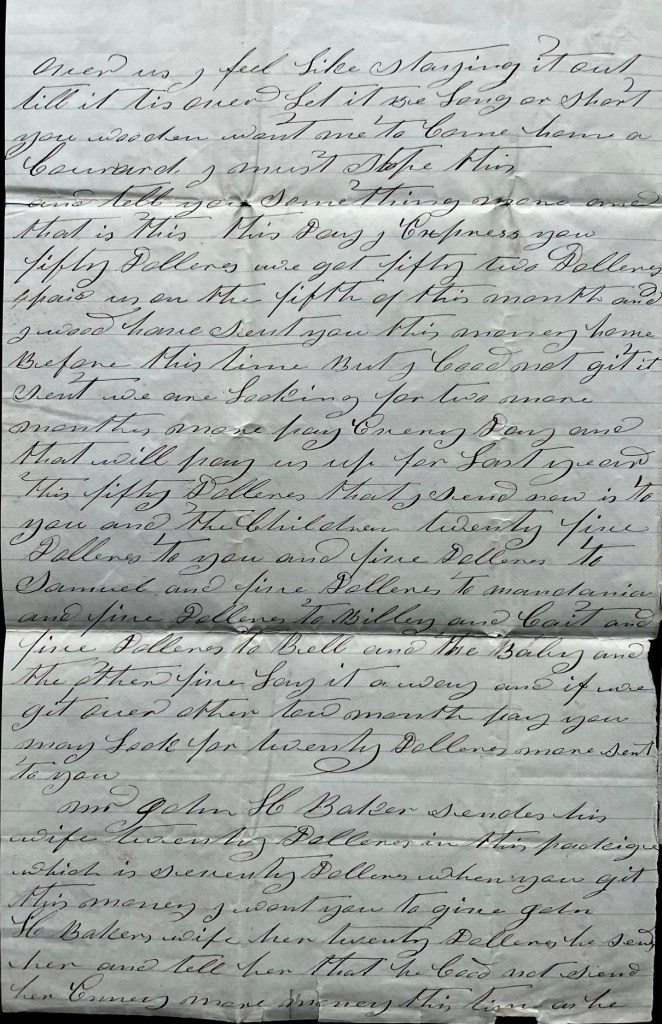
Transcription

Camp near New Bern, N. C.
February 21, 1863

My dear wife and children.

I sit down this morning with my pen and paper to write you a few lines to let you know that I am well as can be expected and hope that these few lines will find you enjoying the same. I received on the 16th inst. one pair of mittens and three papers and one letter from you. I was so glad when I got them. you. say in your letter that you have had hard getting along this winter. you say you have had to carry all your wood this winter. I am sorry to hear this. I am away here in North Carolina far from you enduring the hardships of a soldier. We have to lay on the ground every night and the hardships that we have to endure you at home know nothing about but I thank God that He has spared me till this time. Thank God that He protected me in battle when the bullets flew around us like hail. But what is to become of us in the future, I can’t tell. I had thought we would get home this spring but it is doubtful as there is a very dark cloud hanging over us. I feel like staying it out till it is over, let it be long or short. You wouldn’t want me to come home a coward.

I must stop this and tell you something more and that is this. This day, I express you fifty dollars. We got fifty-two dollars paid us on the fifth of this month and I would have sent you this money home before this time but I could not get it sent. We are looking for two more months more pay every day and that will pay us up for last year. This fifty dollars that I send now is to you and the children, twenty-five dollars to you, and five dollars to Samuel and five dollars to Mandana and five dollars to Belle and the baby and the other five lay it away and if we get our other two months pay you may look for twenty dollars more sent to you.

Mr. John H. Baker sends his wife twenty dollars in this package which is seventy dollars. When you get this money, I want you to give John H. Baker’s wife her twenty dollars to send her and tell her that he could not send her any more money this time as he has been wounded and it costs a wounded or a sick man something here to keep him. He can’t live on the rations that we get here. A well man can hardly live on it so you want to tell her that is the reason he did not send her more money home htis time. Tell her that we are looking for two months more pay every day and when he gets it he will send her twenty dollars more.

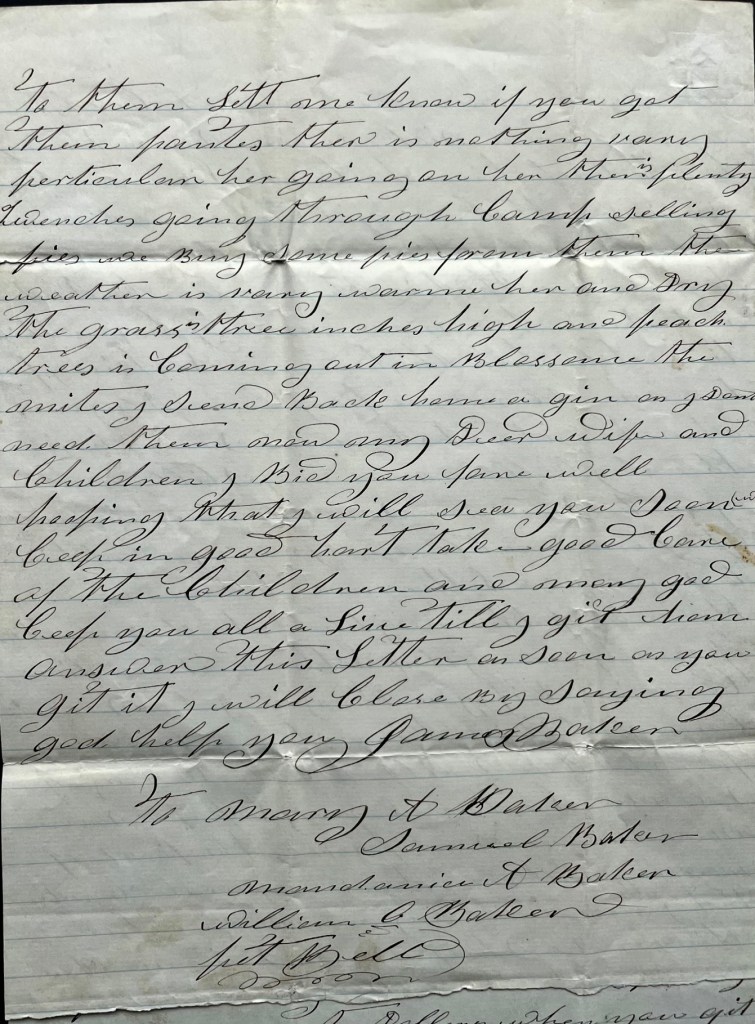
I still want you to send me some more New Castle papers and tell Mr. Granis I want him to send me a letter and let me know the news of the neighborhood. I want to know of you if you got a letter with a fine comb in it. If you did, you got a secesh comb. I got it in Kinston when we fought the battle on the 14th day of December last. You may look for some more things sent to you the first of March. I will send home my great coat that I wore that day and some other things. Be sure and send me them names so as I can send them grape [paper torn] to them. Let me know if you got them pants.

There is nothing very particular here going on. There is plenty of wenches going through camp selling pies. We buy some pies from them. The weather is very warm here and dry. The grass is three inches high and peach trees is coming out in blossom. The mittens I send back home again as I don’t need them now. My dear wife and children, I bid you farewell hoping that I will see you soon. Keep in good heart. Take good care of the children and may God keep you all alive till I get home. Answer this letter as soon as you get it. I will close by saying, God help you. — James Baker

To Mary A. Baker, Samuel Baker, Mandana Baker, William O. Baker, and Pet Bell

1863: David Kime to E. Schultz

The following letters were written by 17 year-old David Kime (1845-1916), the son of Abraham Kime (1815-1902) and Barbara Noel (1816-1904) of Gettysburg, Adams county, Pennsylvania. David and his older brother, Franklin Levi Kime (1839-1918) both served in Co. K, 101st Pennsylvania Volunteers with their father, Abraham Kime (1815-1902).

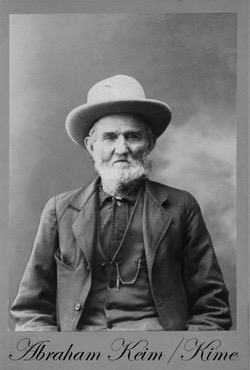
A post war image of David’s father, Abraham Kime.

Abraham was in his upper 40’s when he enlisted and was discharged on a surgeon’s certificate of disability in September 1862 after he was shot in the left elbow at the Battle of Fair Oaks. He was an older brother of Jacob Kime whose farm was three miles north of Gettysburg was overrun by Confederates in July 1863 and used as a Confederate hospital. There are even some Confederate soldiers buried there. Abraham made his home several miles north of Gettysburg in Menallen township.

In April 1864, the 101st Pennsylvania was a garrison that defended Plymouth, North Carolina, along with the 103rd Pennsylvania, two North Carolina units and three regiment of U. S. Colored Troops. Most of the 101st Pennsylvania were taken prisoner by Confederates when they overran the Union defenses at Plymouth on 20 April 1864, both David and Frank among them. Both were transported to Andersonville Prison where they remained over ten months, until late February 1865. Both survived to come home.

Letter 1

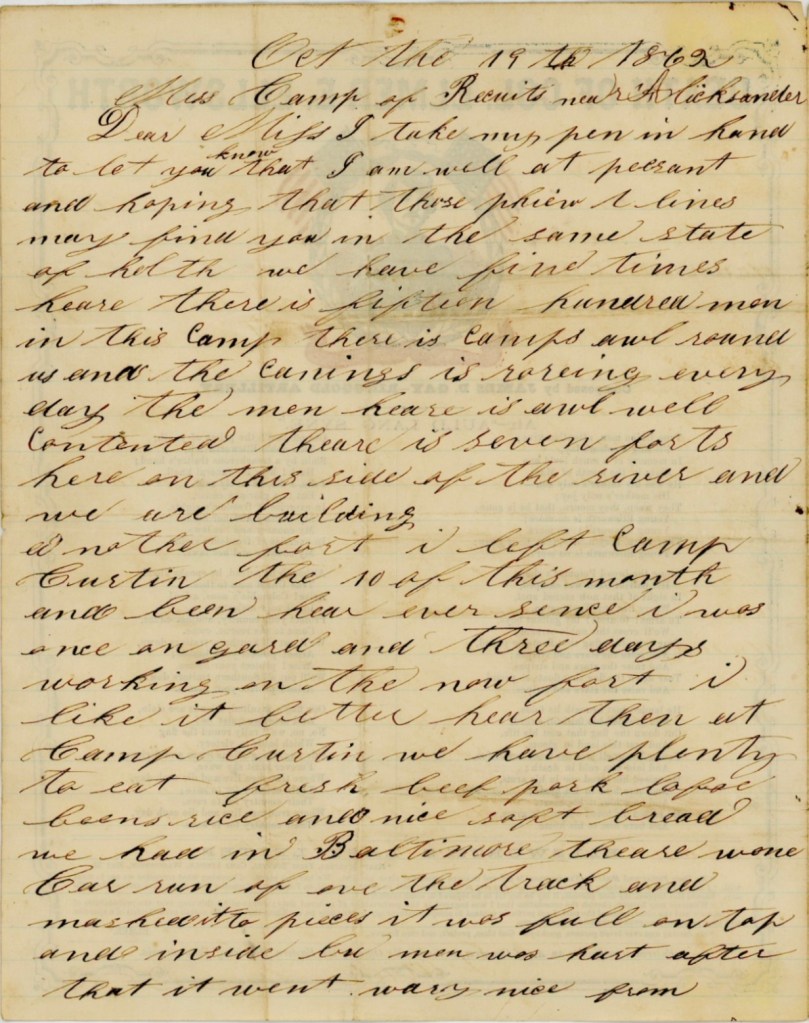
Mess Camp of Recruits near Alexandria
October the 19th 1862

Dear Miss,

I take my pen in hand to let you know that I am well at present and hoping that these few lines may find you in the same state of health. We have fine times here. There is fifteen hundred men in this camp. There is camps all around us and the cannons is roaring every day. The men here is all well contented. There is seven forts here on this side of the [Potomac] river and we are building another fort.

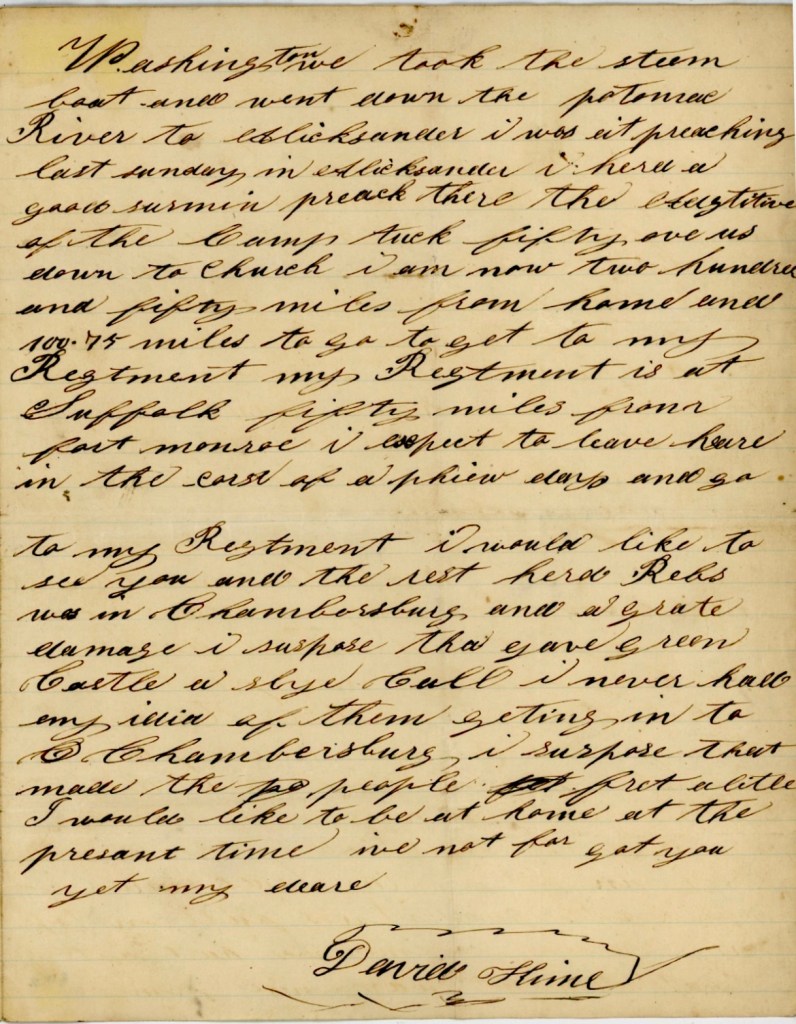
I left Camp Curtin the 10th of this month and been here ever since. I was once on guard and three days working on the new fort. I like it better here than at Camp Curtin. We have plenty to eat, fresh beef, pork, coffee, beans, rice, and nice soft bread. We had [an accident] in Baltimore. There one car run off of the track and mashed into pieces. It was full on top and inside but [no] men was hurt. After that it went very nice. From Washington we took the steamboat and went down the Potomac River to Alexandria.

I was at preaching last Sunday in Alexandria. I heard a good sermon preached there. The [ ] of the camp took fifty of us down to church. I am now two hundred and fifty miles from home and 175 miles to go to get to my regiment. My regiment is at Suffolk, fifty miles from Fort Monroe. I expect to leave here in the course of a few days and go to my regiment.

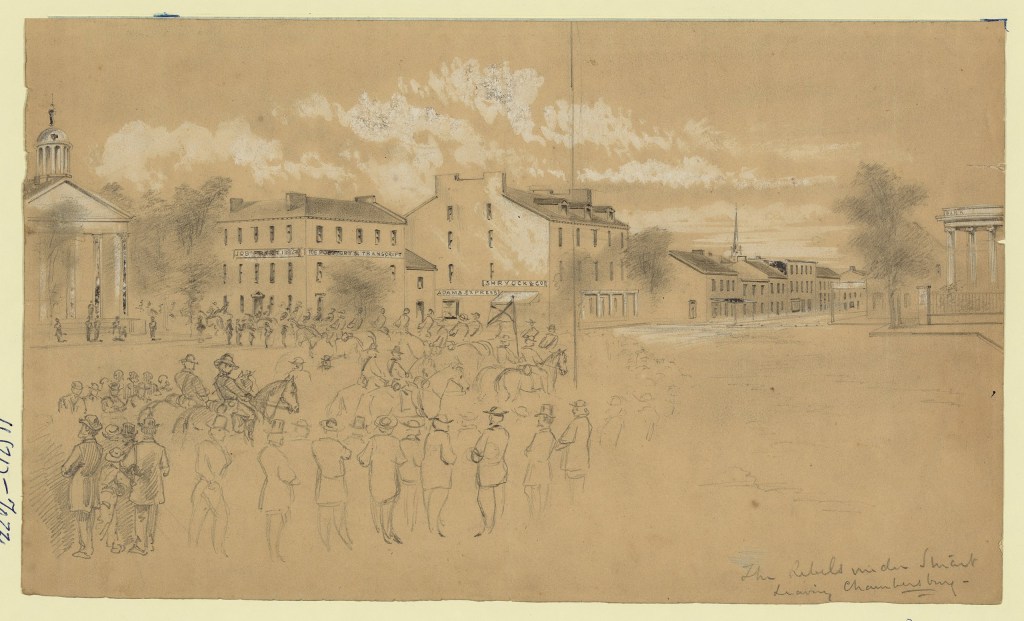
I would like to see you and the rest. Heard the Rebs was in Chambersburg and a great damage [done]. I suppose they gave Greencastle a sly call. I never had any idea of them getting into Chambersburg. I suppose that made the people fret a little. I would like to be at home at the present time. I’ve not forgot you yet, my dear. — David Kime


Letter 2

[Note: I transcribed the following letter just as David wrote it, with poor spelling and a total lack of punctuation.]

Newburn, [New Bern] North Carolina
101st Regt. Co. K
April 9th 1863

Dear Miss,

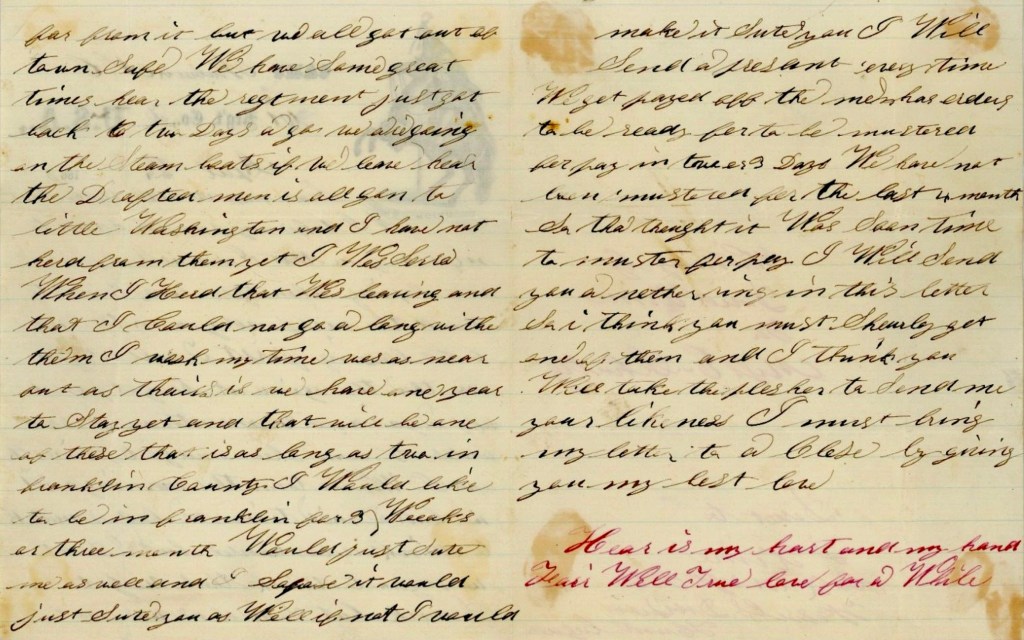
It’s with plesher that I take my pen in hand to inform you that I am well at present and hoping when these lines comes to hand tha will find you in the same blessing first I will let you no tha the regiment has got payed off a gain for a month and we have orders to come hear and go to plimeth [Plymouth] and I was in town this morning and we had a ince time we had as mutch to drink as we wanted but I dont want you to think that we got Drunk but some of us was not far from it but we all got out of town safe We have some great times hear the regiment just got back two days ago we are going on the Steam boats if we leave hear the Drafted men is all gon to little Washington and I was serra [sorry] When I herd that Wes leaving and that I could not go a long with them. I wesh my time wes as near out as thairs is we have one year to Stay yet and that will be one of these that is as long as two in franklin County I would like to be in franklin for 3 Weaks or three month Would just sute me as well and I Sepose it would just sute you as Well if not I would make it sute you I will send a present eney time We get payed off the men has orders to be ready for to be mustered fer pay in two or 3 days We have not been mustered fer the last 4 month So tha thought it Was soon time to muster fer pay I will send you a nether ring in this letter So i think you must Shurly get one of them and I think you Will take the plesher to send me your likeness I must bring my letter to a close by giving you my best love

Hear is my hart and my hand Fair Well True love for a While

Writing by David Kime to Miss E. Schultz

Direct to D. Kime, Co. K, 101 Regt. P. V., Wessels Division, Hunt’s brigade