

This letter was written by Dr. William Merwin Smith, Surgeon of the 85th New York Infantry, relaying to a friend at home in western NY his experiences and his analysis of the Battle of Fair Oaks on May 31 where the 85th took heavy losses. Born in Patterson, NJ, the son of a physician, Smith was already a twice widowed general practitioner living in Elmira, New York with his two young children when he enlisted as surgeon on 10/29/61. Smith remained with the 85th until 17 June 1863 when he resigned.
Fair Oaks represented the first significant battle experience for the 85th. As he describes in his letter (and consistent with what appears elsewhere), the 85th (at the time part of Casey’s Division) heroically held off a much larger Confederate force until they were forced to retreat, in the process losing most of their camp possessions, along with 34 killed or wounded. A substantial portion of the letter deals with Smith’s frustration and anger with top leadership, particularly McClellan, who he despised (for reasons similar to those expressed by other Union soldiers at the time).
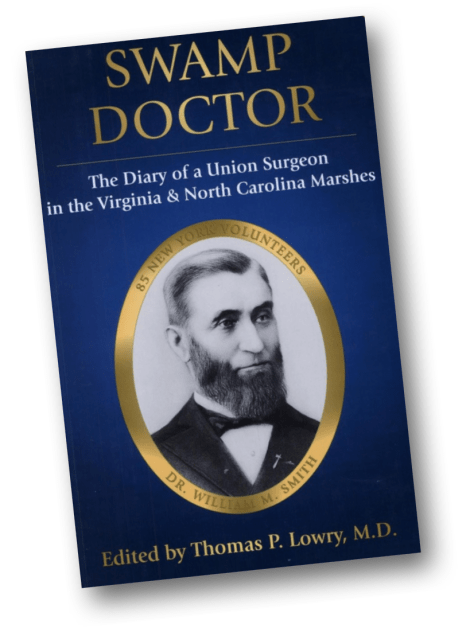
Dr. Smith’s annotated diary, actually his second diary—the first being lost at Fair Oaks, was published in 2001 by Dr. Thomas P. Lowry (Stackpole Books). This highly detailed and very thoughtful diary begins in the aftermath of Fair Oaks (several days after the present letter was written). This letter, the only one cited in the book, is included within Appendix A, because of its contextual importance to the diary’s early content (as far as I know, the letter has so far never been posted on the web).
[Note: This letter was provided to me from a private collection (RW) for transcription and publication on Spared & Shared by express consent.]
T R A N S C R I P T I O N

Camp near Long Bridge, Virginia
June 11th 1862
My dear sir,
Your favor of the 20th ult., came to hand in due time. Since that time you know we have had a terrible collision with the rebels. Much has been said of Casey’s Division by the jealousy of generals chiefly, & correspondents who are the hangeron’s of these generals & who were not on the battle ground of Casey’s Division, nor indeed dare be, with one exception—Bulkley of the Herald, & he gives a very different story to the public. It is sufficient for imported men to know what they will know despite misrepresentation, that the battle commenced between 12 and 1 p.m. and that the less than six thousand men of Casey’s command held a force, never estimated less that forty thousand men, until nearly four o’clock p.m.; certainly three hours & without a regiment to reinforce & sustain them, although Couches line of battle was less than 200 rods behind us, sustaining a loss in killed and wounded of fully one fourth the number with which they went into battle.
I remained under fire in the immediate vicinity of the ranks, dressing the wounded until the overwhelming force of the enemy had out flanked right and left our line of battle and wounded men were struck a second time while being dressed and several horses had been shot down near the orderly who was holding my own. Consequently I know the tenacity & bravery with which most of the regiments of this Division fought. The 103rd Pennsylvania broke early in the action 7 rushed pell mell on Couch’s line. They did not receive or give a single volley. Their conduct gave character to the whole. The 85th [New York] in particular fought until enveloped by the columns of the enemy. The character of the remarks by the Press and McClellan’s first telegram has greatly discouraged the brave men in this and other regiments composing this Division. No Division has suffered half as much since they landed at Fortress Monroe from neglect & exposure as this. They landed with 13,000 men. Today cannot bring into line 5,000 effective men. If ever a truthful history of the campaign shall be written, a dark responsibility and disgraceful neglect will be laid at the door of some of the managers.
My health is very poor. I have worked myself threadbare in trying to keep my Department shipshape amid all the disadvantages of my want of means, help, &c. And now, after struggling with my ailment through the dank swamps, pestiferous malaria, weary marches, long days and nights of labor with the sick and wounded, my health does not improve within a few days, I shall return for a short time to see if the free bracing air of my native hills will not restore me to myself.
McClellan waits for reinforcements. Unless the gunboats achieve a signal and unexpected success, the battle of Richmond yet remains to be fought. Give my regards to friends. Yours truly, — W. M. Smith
[to] Mr. W. Van Nostrand


 Spared & Shared 23