The following letter was written by 17 year-old Andrew Crozer Reeves (1844-1868) who served as a corporal in Co. K, 104th Pennsylvania Infantry (a.k.a. the “Ringgold Regiment”). This regiment was organized in Bucks County under Colonel William V. H. Davis. They trained at Camp Lacey, established on the west side of Doylestown, and shipped out for Washington, D.C. that November. They served in the Peninsular Campaign of 1862, spanned the winter and spring of 1862/1863 near the seige of Charlestown, and fought in the crucial Valley Campaigns of 1864. Over the course of the Civil War, out of about 1,000 men, 46 were killed in action, 3 missing in action, 62 taken prisoner, and 104 died in service. Reeves was discharged from the regiment on 12 September 1862 due to wounds received in action.
Andrew was the son of Elisha Boudinot Reeves (1806-1879) and Mary Ann Anderson (1807-1879) of Lower Makefield, Bucks county, Pennsylvania. After he was discharged from the service, Andrew returned home and married Mary Jane Moon (1845-1926) in June 1867—almost one year before he died at age 24. A son was born to the couple on 3 December 1867 named Andrew Crozer Reeves, Jr.
Headquarters Ringgold Regt. Co. K. November 9, 1861
Dear Sir,
We started from Camp Lacey on Tuesday morning at half past six o’clock and marched to the [Doylestown] depot and the cars started at eight o’clock and arrived at town [Philadelphia] about twelve o’clock and marched to the [Volunteer Refreshment Saloon in the vicinity of the old] Navy Yard at half past two and had a fine dinner of sliced potatoes and round, pickled cabbage, roast beef, boiled ham, bread and butter, coffee. We started from Philadelphia at five o’clock, arrived at Baltimore at daylight and marched through to the Baltimore and Washington station. We saw some few flags in Baltimore. We gave each one three cheers and did not see many people in Baltimore but no one said a word. Negroes were plenty. We saw about four negroes to a white. It was about eight o’clock when we started from Baltimore. 1
There were encampments about every two or three miles and then the companies are divided from one to two miles. We arrived in Washington at half past one and the first thing I saw was a government team running away. There is no end to teams here—mostly mules. The horses look very rough—that is, the most of them. Our team is the best looking team that I have seen but they have not got used to Uncle Sam’s stables yet, the large one. We have not got but one yet.
We [do] not expect to stay here. The Colonel is not satisfied as there is not room for artillery to drill. The Colonel has gone to Washington today. I forgot we stopped at the depot. We got up here too soon. We got our dinner at Washington—bread and beef and coffee. We started from Washington at five o’clock and arrived here at half past seven and stacked arms and laid down. Tim Rice and I laid together. We laid one gum blanket down on the ground and put our two government blankets and the other gum blanket over us and the capes on our overcoats we pulled over our heads and in the morning when awakened, everything was white with frost. We had crackers and coffee for breakfast and coffee and crackers for dinner.
We pitched our tents in the forenoon and filled our tents with leaves in the afternoon. Georgetown is about a half mile from here. We can see the Potomac, Alexandria, Georgetown and a flag on Munson’s Hill, and the name of this place, I believe, is Kalorama Heights. There is woods all around us. We can [go] out anywhere around here providing [we] get in at roll calls and must look out for the regulars as they will take us and keep us until our Captain comes after us. The 60th New York is encamped about three hundred yards from us. We slept very sound last [night] on our feather bed made out of leaves. I had fresh bread for my breakfast; so had Captain and the Major. We bought [it] off a black woman. We are all well, happy as a lark. There is a good view here. — Andrew C. Reeves
1 The regimental history of Durell’s Battery which was initially attached to the Ringgold Regiment describes the march through Baltimore: “The regiment had not proceeded far upon the march through the streets of that city before it was noticed that there was a sad lack of enthusiasm for the Union soldier, compared with that exhibited in Philadelphia the day before. The colored people appeared to be almost the only class to cheer the regiment and the Union cause, while crowds of whites stood sullenly at the street corners, and some of the small boys cheered for Jeff Davis. The march to the Washington depot was unmolested, however, and the men were again packed into cars. The skies had cleared and the men were in good spirits.” (page 21)
The following letters were written by Calvin Thomas Crane (1839-1905), the son of John Calvin Crane (1807-1895) and Emiline D. Burt (1809-1893) of Berkley, Bristol county, Massachusetts. He wrote the letters to his sister, Sarah (“Sallie”) E. Crane (1844-1920). A younger brother, Levi Lankton Crane (1842-1928) is mentioned in the letters. Levi later served in Co. C, 22nd Massachusetts Infantry until he received a leg wound at Fredericksburg which led to his discharge for disability.
According to military records, Calvin enlisted as an ordinary seaman at New Bedford on 20 May 1861 and he was mustered out of the Navy on 15 March 1862. He served first on the receiving ship USS Ohio and then was assigned to the USS Massachusetts. He was described as standing 5’11” tall, with blue eyes, chestnut hair, and a ruddy complexion.
According to Calvin’s headstone inscription, he only served in the US Navy in 1861-62 but he remained a mariner. He eventually became a ship’s master and was captain of various vessels, including the schooner M. M. Merrimon of Taunton, Massachusetts. He was married to Charlotte M. Burt of Berkley in 1870.
The 1864 letters included in this post reveal that Calvin served for a few months during the summer of 1864 as an assistant to the sutler of the 104th Pennsylvania Infantry while they were on Morris Island in Charleston Harbor. It appears that he would have stayed longer but became so ill that he decided to return to Massachusetts.
Letter 1
Off Brooklyn Navy Yard February 23, 1862
Dear Sister,
Have been within two hundred miles from you and have not heard a word from Berkley yet and have laid here 9 days now and possibly may as much longer and if possible, please write a few lines. Luther got a word or note from John last week that if we were to be paid off, I should be at home by the latter part of the week and you ought to have wrote for father wrote to me that we would not be discharged. But we shall. But how soon I do not know. It may be this week. All that is wanted is the money.
There is plenty of rows on board caused by liquor and 6 men are in irons for drunkenness. The officers do not do the first thing for our good with the exception of Capt. Godfrey who is ridiculed by the rest for his interest in the “Boys.” We have not had a bit of fresh meat or vegetables since we have been here. Wormy rice and flour are served out to us twice a week. I will [not] write anymore about our troubles—they are too numerous to mention. But the end is ahead.
Last Friday they got a stove which is very comfortable to what it was. I am very anxious to hear from home and hope you will write so that I can get a letter this week. Direct as heretofore to Naval Lyceum. I have sent two letters to Levi. The answers will come to Berkley. Please keep them.
I have nothing more to write but hope you will write soon. From your brother, — Calvin T. Crane
to Sallie E. Crain
P. S. Excuse this pencil writing.
Letter 2
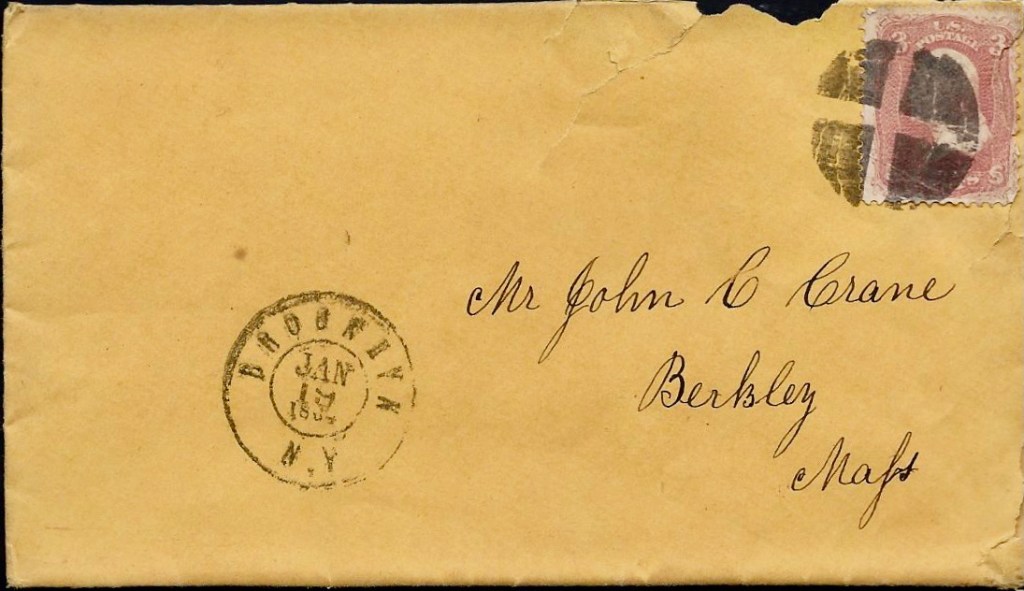
Addressed to John C. Crane, Berkley, Mass.
New York Sailor’s Home February 27, 1862
Dear Mother,
I am agoing to write this letter to you as I have written to Father & Sarah without getting an answer although in the first place I did not ask them to write. We got released from the ship yesterday about noon after striping ger to a “gauntling.” We got in a fret before we left on account of a story that we were to be put on board the North Carolina to wait until pay day as there was not a man that wanted to go there. After we left the ship at the earnest request of the officers, we gave three cheers for the ship and then three for Capt. Godfrey with a good heart.
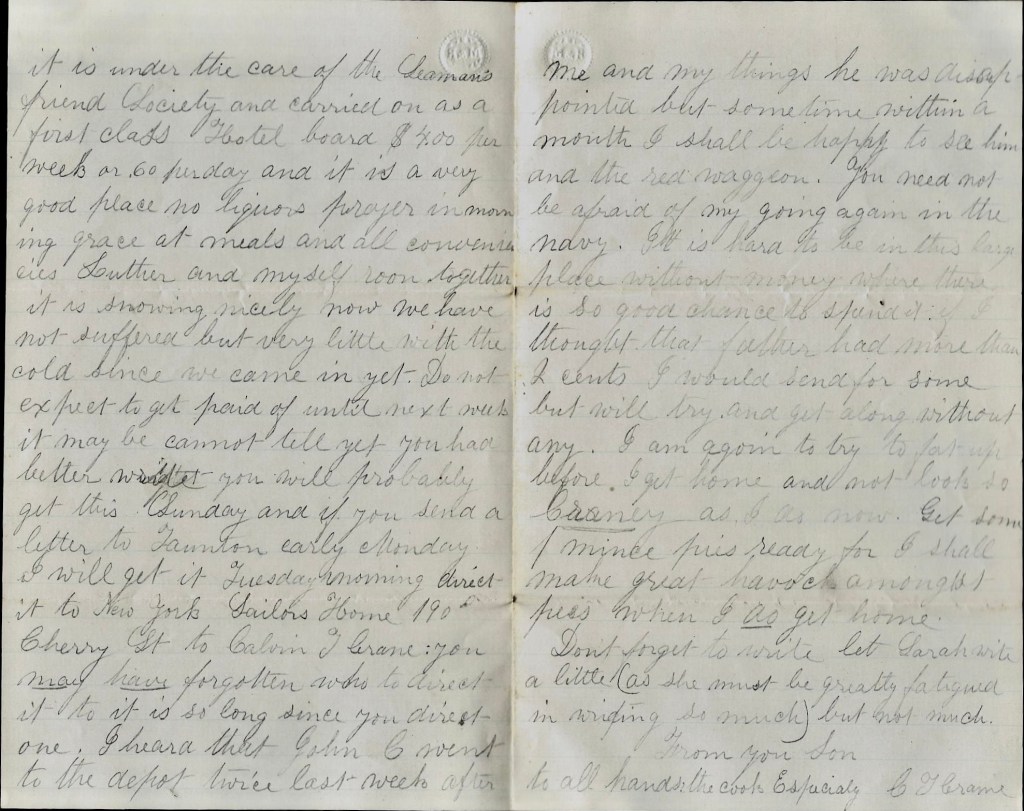
Most of the Taunton boys came to this place. It is under the care of the Seaman’s Friend Society and carried on as a first class hotel. Board [is] $4 per week or 60 cents per day and it is a very good place—no liquors—prayer in morning—grace at meals—and all conveniences. Luther and myself room together.
It is snowing nicely now. We have not suffered but very little with the cold since we came in yet. Do not expect to get paid off until next week. It may be—cannot tell yet. You had better write. You will probably get this Sunday and if you send a letter to Taunton early Monday, I will get it Tuesday morning. Direct it to New York, Sailor’s Home, 190 Cherry Street to Calvin T. Crane. You may have forgotten who to direct one.
I heard that John G. went to the depot twice last week after me and my things. He was disappointed but some time within a month I shall be happy to see him and the red wagon. You need not be afraid of my going in the Navy. It is hard to be in this large place without money where there is so good chance to spend it. If I thought that Father had more than two cents, I would send for some but will try and get along without any. I am going to try to fat up before I get home and not look so craney as I am now.
Get some mince pies ready for I shall make great havoc amongst pies when I do get home. Don’t forget to write. Let Sarah write a little (as she must be greatly fatigued in writing so much) but not much.
From your son, — C. T. Crane
To all hands—the cook especially.
Letter 3
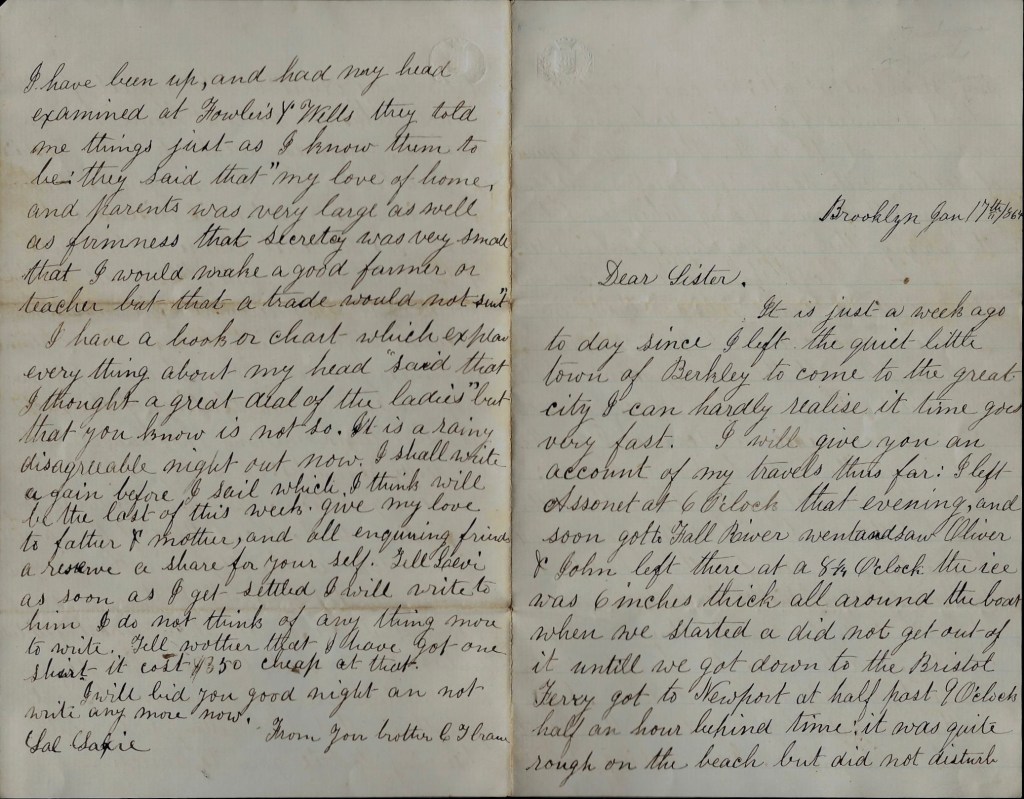
Brooklyn January 17, 1864
Dear Sister,
It is just a week ago today since I left the quiet little town of Berkley to come to the great city. I can hardly realize it—times goes very fast. I will give you an account of my travels thus far.
l left Assonet at 6 o’clock that evening and soon got to Fall River. Went and saw Oliver and John. Left there at 815 o’clock. The ice was 6 inches thick all around the boat when we started and did not get out of it until we got down to the Bristol Ferry. Got to Newport at half past 9 o’clock, half an hour behind time. It was quite rough on the beach but did not disturb my slumbers at all. We cane into ice about 35 miles from New York and arrived there at 11 a.m. There was a guard of soldiers with some 36 deserters and bounty jumpers that were being taken back to the army. They were a hard-looking set.
As soon as I got here, went up and found Capt. White without any trouble. Went over and saw my men and made all arrangements that we could. I am to have $40 per month, time to commence as soon as I get there, and to get there the best way I can. There is a vessel going down there the last of this week with sutler’s goods and I am to go in her if nothing happens to the contrary. This $40 is for 4 months and then it is it be raised. They want me to try and be able to “run the 52 Penn. Regt.” by myself after that time. I am rather impatient to get down there and make a beginning. I am stopping aboard of the “Oaks Ames” at the request of Capt. French although he is at home now on business.
Yesterday went up to Dr. [Henry Ward] Beecher’s Church to hear him. I wish you could have gone. It was a splendid discourse. The text was the last clause of the 9th Verse of the 6th Chapter of Matthew: “Hallowed be thy name.” It was delivered in his own peculiar style which I cannot explain. At times you could have heard a pin drop so intense was the feelings of the people. At other times bursting into laughter at his witty remarks. He is very poetic in his imagination.
You must collapse your crinoline to about one-third of the largest size as that is the style in the city. You would hardly know that there was any hoops at all on, to look at the most gented ladies. Dark velvet bonnets with some dark blue ones are worn most. Don’t you think that I am getting to be quite observing to tell you so much.
I have been up and had my head examined at Fowler & Wells. They told me things just as I know them to be. They said that “my love of home and parents was very large as well as firmness that secrecy was very small—that I would make a good farmer or teacher, but that a trade would not suit.” I have a book, or chart, which explains everything about my head. Said that I though a great deal of the ladies but that you know is not so.
It is a rainy, disagreeable night out now. I shall write again before I sail which I think will be the last of this week. Give my love to father and mother and all enquiring friends and reserve a share for yourself. Tell Levi as soon as I get settled I will write to him. I do not think of anything more to write. Tell mother that I have got one shirt. It cost $3.50—cheap at that.
I will bid you good night and not write any more now. From your brother, — C. T. Crane
Letter 4
Morris Island Feb 3d 1864
Dear friends at home,
As I must write before i get a letter, I commence one tonight which will be some time before it can go.
I left New York at half past one o’ clock p.m. in tow of the Steamer Atlantic on the Schooner E. R. Bennett the 24th with the wind to the southward, and cloudy but not very rough. But the next day it breezed up some and made it quite rough. And Thursday morning at two o’clock a.m., we got off the light boat off Port Royal all right with a smooth passage for the season. You would laughed to have seen me feeding the cattle as I worked my passage down as cattleman. It would have been almost impossible for me to have got down any other way. But Mr. Eager gave me a letter to the man that shipped the cattle to give me a chance to work my way down and although they had men engaged, he put me in as extra man. The captain tried to make some objections, but he—that is, Mr. Starr—made it all right, so along I came, ate my meals in the cabin, and slept in the hold with the rats which were as thick as you can imagine. I slept one night with my boot in my hand and thrash that awhile, then go to sleep and rest until they waked me up, then thrash again, and so on, but lived through it.
Thursday about 9 o’clock, cast anchor off Port Royal harbor and went ashore and was disappointed in the look of the place. The sand is just like a deep snow all around. It is mostly built up by the war but a few houses of the old planters are there. Sutlers and storekeepers make the most show. Got my pass and transportation and then had to look up a chance to go up to Morris Island. Got aboard of the Steamer Mary Benton about 10 p.m., slept on some logs until morning, and got to see who were my fellow passengers. Found there were some 52 Darkies [coming] to join the 54 Mass. Regt from Vermont. Got up to the island about 10 a.m. at high water so as to cross the bar, went down to see Mr. Webb—the one I was to report to. Found him without any trouble and went to work that afternoon.
The island is like all southern coast—low and sandy, but it is quite lively now. They are firing at the rebels all the time, night and day. Tuesday night a blockade runner ran in and got in as far as Fort Moultrie and got aground, and the next morning as soon as the fog lifted, three moniters and Wagner, Gregg, and other batteries opened on her and kept up a fire all day—and the rebels firing too. They have knocked the steamer into a “cocked hat.” They think no more of that here than we would of going to Taunton although there was one killed, and several wounded on our side.
The weather has been quite warm. In fact, as warm as summer with us. But today it is very much cooler with the wind to the westward. The work is not hard that I have to do—the same as any shopkeeper has to do. We board with the Quartermaster and a Capt. & Lieut. of the 104 Regt. Penn. Vol. and the living is par excellent with milk and the best of coffee and all kinds of preserves, fresh meat, soft hack, and everything that is good.
I got one meal down to Port Royal. It was a cup of tea and two biscuits and they charged me 25 cents. Got a very good breakfast on the Mary Benton for 50 cents but everything is dear out here. Butter 45, potatoes 4 cents per pound, and everything in proportion.
You will please direct letters to me in care of H. M. Webb, Sutler to the 104 Regt. Penn. Vol. Morris Island, S. C. and as soon as you can conveniently. I wish, Sallie, you could come down here this evening and go up on the sand hill just back of our tent and see how splendid it looks to see the tents all lighted up and to hear the band playing and to look off in the harbor, and see the calcium light that is on the Ironsides. It is a pleasant position. I do not know of anything more to write tonight, but will close and retire to my bed which is a mattress such as I lost in the “Ames” and two boxes under it and sleep like a major. Write all the news and oblige your brother and son, — C. T. Crane
Camp of the 104th Pennsylvania Infantry on Morris Island (1864)
Letter 5
Morris Island April 17, 1864
Dear Sister,
I received your long letter a week ago yesterday but not in time to answer it by that steamer and have been too busy until now to write an answer. I will give you a description of my writing desk. It is a barrel with a board across the head and Frank Leslie’s [newspaper] on that. Then for a seat, I have a camp stool with a board across that to make it high enough and you will have a complete writing desk for this country.
You may think that “Order addressed to this office” dies not receive as prompt attention as yours but the fact is that I have been full of business for the last week. We have been moving camp which was hard work for us to pack up everything, then to move our tent. We have a large, splendid (for this country) building 24 by 16 and 8 feet high fitted up in store style. We moved our camp about a mile to a healthier location and shall probably move down to Beaufort within a short time as all the white troops are to leave the department with the exception of some 6 regiments and the rest to be Colored regiments. The regiments that leave here go to Yorktown and “On to Richmond” by way of James River. It looks as if it was going to be dull this summer in this department. But if we go to Beaufort, it will be pleasanter than here. You may tell my maternal not to worry about me. I am only a little spleen and am not afflicted with none of those aches that you mentioned.
I can congratulate you on your school’s being out now. You have had a tedious time of it. I know you can look back after it is all past and it does not look half so hard, and will wonder why you was so perplexed about such little things. That little item, I presume, is gone with the accustomed velocity as all items do with you but never mind. There is plenty of greenbacks in the country.
I think that Berkley is about played out to put such men or lunatics as Oliver French in as school committee—a man that is afraid of his own shadow. I have not found out who the veterans are in Berkley yet. Is Bradford Hathaway in Berkley yet or is he gone back to the 7th? He went away with Capt. Williams into New Orleans. From there he got to Providence and was there when I came south. I should think William Warren was spreading himself considerable in buying a horse. There must be plenty of horses in the neighborhood now. Everything must be very high at home now. They are almost as cheap here as there now. Butter is 55 cent, cheese 25, raisins 35 cents, other things in proportion.
I may possibly see Drises White when we go down to Beaufort. I will try to see him. The draft may have taken place but I do not think that there will be any.
Levi is very tardy about writing. He is my debtor for a letter which is due some time. Am very obliged to Bessie for her kind regards. Send mine in return. “But do not see the point” that you spoke of as it is very uncertain that we shall stay in any place long. I would like to see William Henry. Could set him agoing into a fighting mood in a short time by stating facts. Give my respects to all the girls. And you will oblige your friend and brother, — C. T. Crane
Dear parents. As I am writing to Sarah and have some blank room, will write a few lines to you. The weather is very cool down here for the season of the year. Today is a fine day but the sand is blowing like a snow storm. You have probably planted your potatoes by this time. You had better plant all you can and more too as things will be very high indeed if the war goes on another year. Plant all you can of corn as it will be high. If you want some money, send me word. Will send you some. Yours in haste, — Calvin
Hope you are all well.
Letter 6
Hilton Head May 12th 1864
Dear Sister,
I received your two ladened epistle of the 19th April & another of May 4th last night. Was truly of the impression that you was leaving “the earth and climb a tree” from the tone of your first letter but the second one was more cheerful. You seem to think that you were a gone goose but never give up. There is more than one person in the world by the name of Charles too. I would have nothing more to do with him if I could help it more than as an acquaintance. His disposition must be very singular if he has no more provocation than you speak of and would not be very likely to improve with age and if nothing has passed between you that is binding, I would let him flirt as much as he chose. You will feel better as times passes away. Time cures a great many such diseases but not all.
You will have to be smart if you want that school in the district and speak in time as schoolmarms will be plenty. I am very sorry to hear that Mr. Davis is to leave our church as he was worth all the Baptist & Methodist preachers around. I think that if some were to be truly reconverted that it would make a better state of affairs in that society. It seems as if they were making religion to suit themselves and discarding the original pattern altogether. The church is in a poor state and no pastor will please them. True religion is the best of all things but all other kinds are worse than none.
You must have written a letter that I have not received yet as I did not know that Levi was sick until your last but we have not got all of our mail as yet, it may come. Levi will not reenlist I hope as it is a slave’s life. I would not be a common soldier for nothing that I can think of yet. It is a degrading slavish life. A man that is a half fool would make a good soldier.
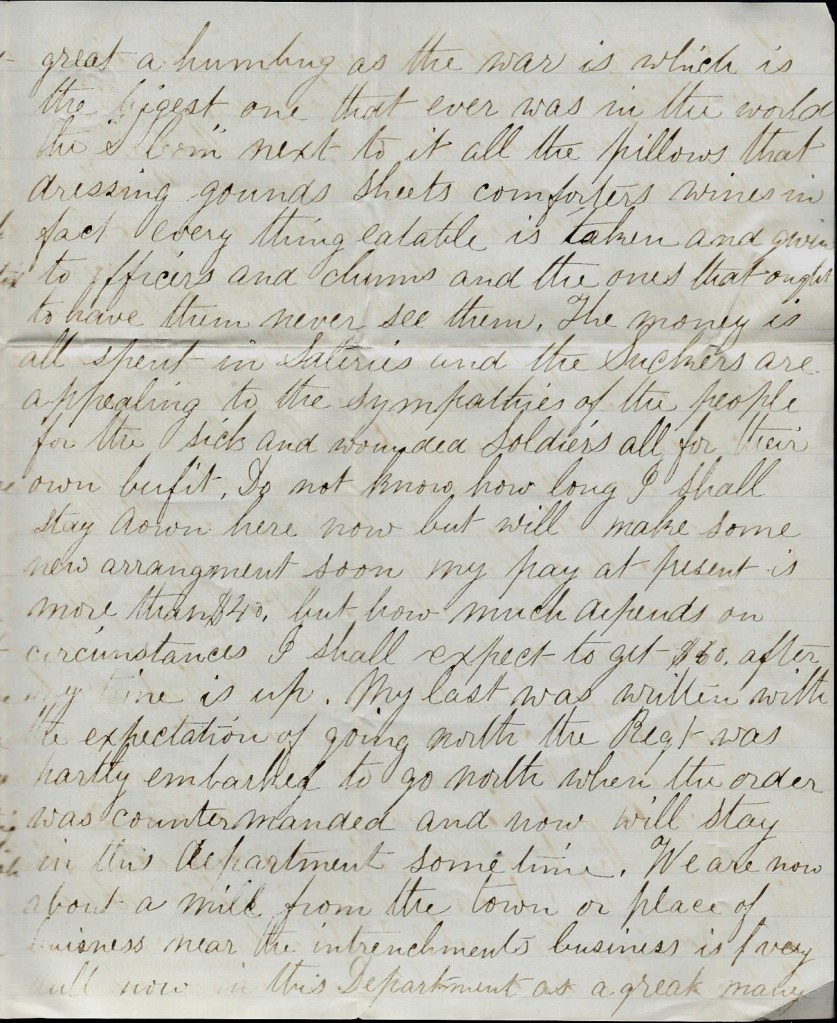
The noble Sanitary Commission that is talked so much about is almost as great a humbug as the war is which is the biggest one that ever was in the world. The Sanitary Commission next to it. All the pillows, dressing gowns, sheets, comforters, wines, in fact everything eatable, is taken and given to officers and chums and the ones that ought to have them never see them. The money is all spent in salaries and the suckers are appealing to the sympathies of the people for the sick and wounded soldiers all for their own benefit.
Do not know how long I shall stay down here now but will make some arrangement soon. My pay at present is more than $40 but how much depends on circumstances. I shall expect to get $60 after my time is up. My last was written with the expectation of going North. The regiment was hastily embarked to go North when the order was countermanded and now will stay in this department some time. We are now about a milt from town or place of business near the entrenchments. Business is very dull now in this department as a great many of the troops have gone North to the Army of the Potomac.
The weather has been very warm down here but today it is quite cool. The mail got here Tuesday and is not all distributed yet. It was a very large mail. Indeed, it was three weeks gathering in New York. About that money, let father have it until you hear from me again. Tell him not to spend it as I may want it down here.
Has Capt. White paid father that $20 that I gave him in New York. If not, he may have paid Capt. French as I owe him $30, thinking that I should be short. Who goes with Andrew Pierce as mate this summer? Get your picture and letters from Saxie and tell him plainly what you mean. Nothing like the truth is such matters.
May 13th. The mail closes today. There is nothing new today. Enclosed you will find a leaf from Morris Island and a picture of a friend of mine that was in the [USS] Massachusetts—Robert Morrison, an assistant engineer in the Navy. Write soon. Be of good cheer, Sal. Yours in haste. — Calvin T. Crane
Letter 7
Provost Hospital Hilton Head August 8, 1864
Dear Friends at home,
It is after 9 weeks sickness that I am able to scribble a little. I was taken sick first by my stomach getting out of order, then with a slight fever in the head and loss of appetite which grew worse until the regiment moved. Did not follow it for a week. Stayed at the 104th [Penn.] Regiment. Went and saw the doctor. Said better go in hospital. Did so. Grew worse. Lost all sense. Do not remember anything for some days.
A week ago the regiment had to move and this was the only place that I could find where I could get in. I was very sick. They thought that I would not be any better when I was the sickest but now I have got quite well. Now can get all around without help. I shall try to get North as soon as I can. U have but $15 now and when taken sick had about $90 which someone has borrowed. But my wits must get me home. Shall try to find Capt. French as I have [either] dreamed or someone told me that he is here.
It is a rainy day or I would go down to the dock to see if I could find a vessel bound North of if I can raise $50, I would come on a steamer. But if nothing happens, will be at home sometime or other. Would like to be there now.
Father, wish you would raise $50 and send it by express to W. D. Mangam’s, 92 Broad Street, New York so that it will be there when I arrive there as I may want to pay my passage after getting there. Yours in haste, — Calvin T. Crane
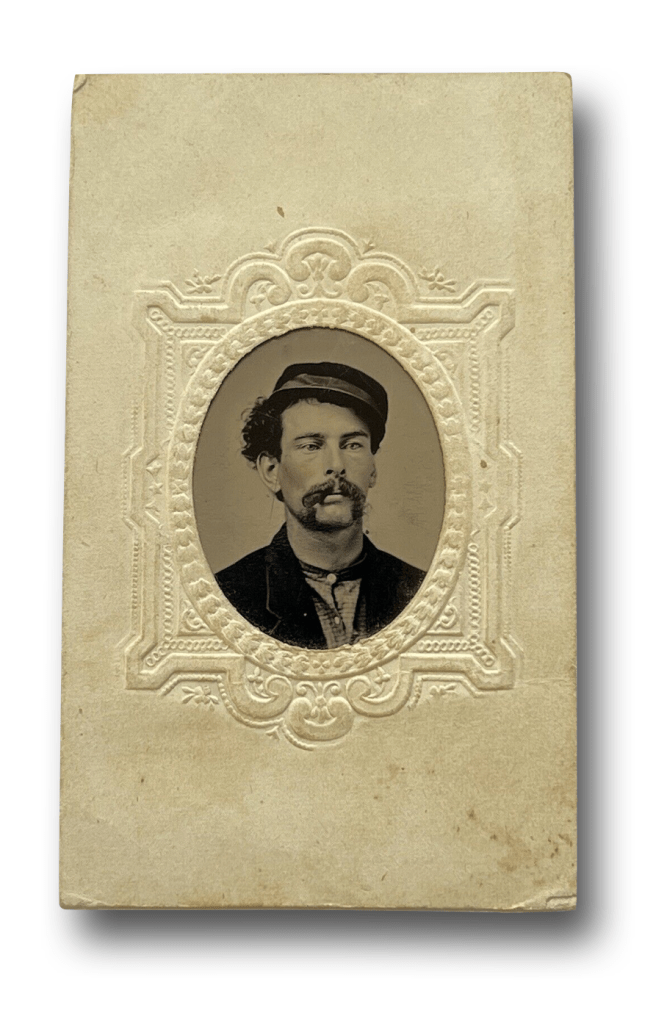
I could not find an image of Christian but here is a cdv of David B. Prosser who served with him in Co. D, 104th P. V. (Photo Sleuth)
The following letter was written by Christian B. Grossman (1838-1913), the son of a pottery maker of Rockhill, Bucks county, Pennsylvania named Christena Grossman and his wife Catharine.
According to muster records, Christian Grossman enlisted on 17 September 1861 in Co. D, 104th Pennsylvania Infantry and he was promoted to Hospital Steward on 15 October 1864. He was discharged from the service on 25 August 1865 at Portsmouth, Virginia.
After the war he married and moved to Philadelphia where he initially also worked as a potter like his father. Then, by 1880, he entered the restaurant business.
Christian’s letter includes a description of the Battle of Trent’s Reach which took place between 23-25 January 1865 on the James River. In that battle a powerful flotilla of Confederate warships attempted to break the blockade on the James River and attack Grant’s supply base at City Point, but they were foiled and withdrew back up the river to Richmond.
[Note: I have only transcribed approximately two-thirds of the letter as the ink has faded and it is difficult to make it out.]
Transcription
Bermuda Front January 28, 1865
Dear Friend,
Having waited for a letter from you in answer to my last written in the Valley and not getting any, I thought I would try again. It may surprise you to see such a long but as I have nothing much to do, I thought I might as well pass my time away with writing as anything else.
In the first place, I will admit a mistake I made in my last to you. I wrote that we had a snow 8 feet deep. I intended to say 8 inches deep for that is all it was but that was deep for that part of the country.
Since that letter was written we have made a change in our residence. We now reside at Bermuda Front on the James River within 9 miles of Richmond in what used to be Butler’s Department & in close proximity with the Johnnies. We are so near that on picket, we can see each other & talk together. There is a sort of contract entered into by our men, or our pickets and the Reb pickets, not to fire on each other while on picket so they stand out and talk to each other for quite a spell at a time.
For a week or two back, we heard their bands play & drums beat but now it seems to be quiet. It’s generally thought that they have taken some of their force away from here to work on the Danville Railroad that was damaged so much from the last heavy rain but whether they took their force away or not, I take notice they tried to show themselves. Last Sunday and Monday night they made an attack on our picket line from the James River down till the point of our camp which is but a few thousand yards from the picket line. They made several charges but every time bravely met by our pickets and sent back in a hurry feebler than they came. I have since heard that they were short in wood and tried to advance their line to take a strip of woods. Our pickets held but they could not [ ]….
It is a most awful hard thing when a man must stand out all night at them breastworks to keep watch to see that the enemy does not surprise & the nights so dark that you cannot see any distance ahead of you & then so cold that you almost freeze & every once in awhile a ball going over you with its song, “zip, zip.” I do not need to take a gun nor do I need to fight. My business is in the rear of the fight, to help to dress the wounded. Last time when the Rebs made the attack, the regiment was out to the breastworks all night. I lay in a tent by the fire sleeping & have made up my mind to take it easy & stick to the boys by the breastworks for there is as much or more danger going to the rear as there is staying here.
It is now bed time. The drums are beating all around so I will finish it tomorrow. My man just put pork on to cook for breakfast so I thought I would write awhile while it is cooking. I have now been writing a half of an hour. It is a rather slow process to write this way. A have a small book on my bunk on which I have to pull the paper along to keep it on the book so to make it easier to write. But a good night to you all and hoping I may sleep as well as you and not be molested by the rebs.
Sunday, 29th, one o’clock pm. I will now resume my writing again. I can not bid you a good morning for its too late so I will bid you a good afternoon. In the first place, I must say I had a good nights sleep. The Johnnies did not try anything. They behaved themselves well. I hope they will continue to do so in the future.
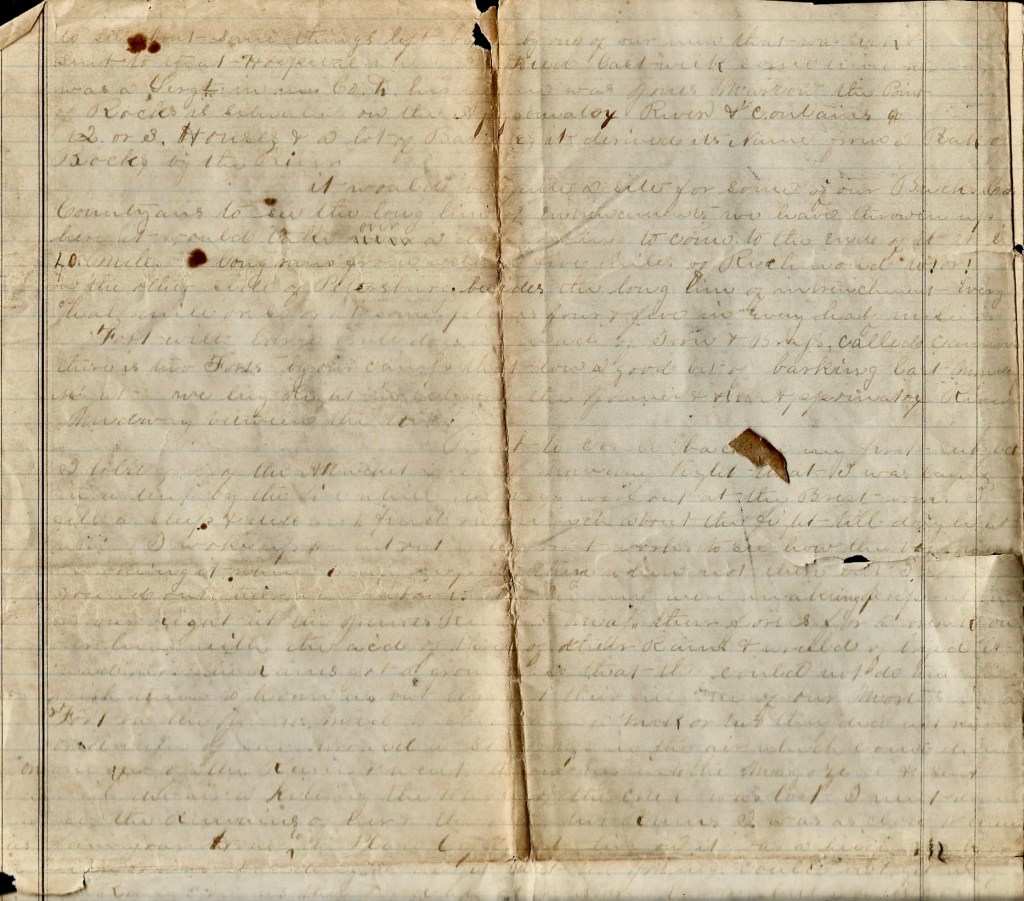
I have just been down to the Point of Rocks Hospital about two miles from here to see about some things by one of our men that was sent to that hospital last week some time. He was a sergeant in Co. D. His name was Jonas Marton. 1 The Point of Rocks is situated on the Appomattox River and contains two or three houses and a lot of barracks. It derives its name from a Peak of Rocks by the river.
It would be quite a sight for some of our Bucks countyans to see the long lines of entrenchments we have thrown up here. It would take over a days walking to come to the end of it. It’s 40 miles long. Runs from within 5 miles of Richmond to the other side of Petersburg. Besides the long line of entrenchments, every half mile or so, or in some places four and five, in ever half mile is a fort with large Bull dogs made of iron and brass called cannon. There is two forts by our camp that done a good deal of barking last Monday night. We lay right in [ ] the James & Appomattox River midway between the two.
But to come back to my first subject, I told you of the attack we had the very night that I was laying in my tent by the fire while our boys were out at the breastworks. I fell asleep & did not find out much about the fight till daylight when I woke up….
…I was standing along side of one of our guns–a 30-pound Parrott gun that was shelling the other two Rams….but not doing them much harm for the iron coat on them was too much for it. The shell would splinter to pieces on her just as though they were pumpkins. The rams…both got off and started back to Richmond…..that ended the fight. There was four or five wounded on our side and quite an artillery loss to the enemy. I was telling you that I found our men or regt. gone from the camp. I found they had gone up to the James River to meet the rebs…When they come, they seen the boat go up and also seen a man go up in the smoke. I heard it when it went up and seen the smoke and afterwards the wreck. I got some papers off of it that blowed over where I was standing. There is a report that they are going to try us again soon brought in by a deserter from their army who came in last night. We have had quite a lot of them come in. Sometime back over 30 came in. They are fine looking young men.
If the Johnnies want to try us again, they are welcome to come. They take the daytime for it. I think we will show them a modus operandi. They little think of our men in line every morning at 5 o’clock ready…Our regiment drawed new guns last week and turned in the old ones. They now have the latest, improved rifles called the Springfield Rifle made in ’61.
You will please excuse me if this incompetent writing don’t seem to meet your approbation. I will now chance the subject again.
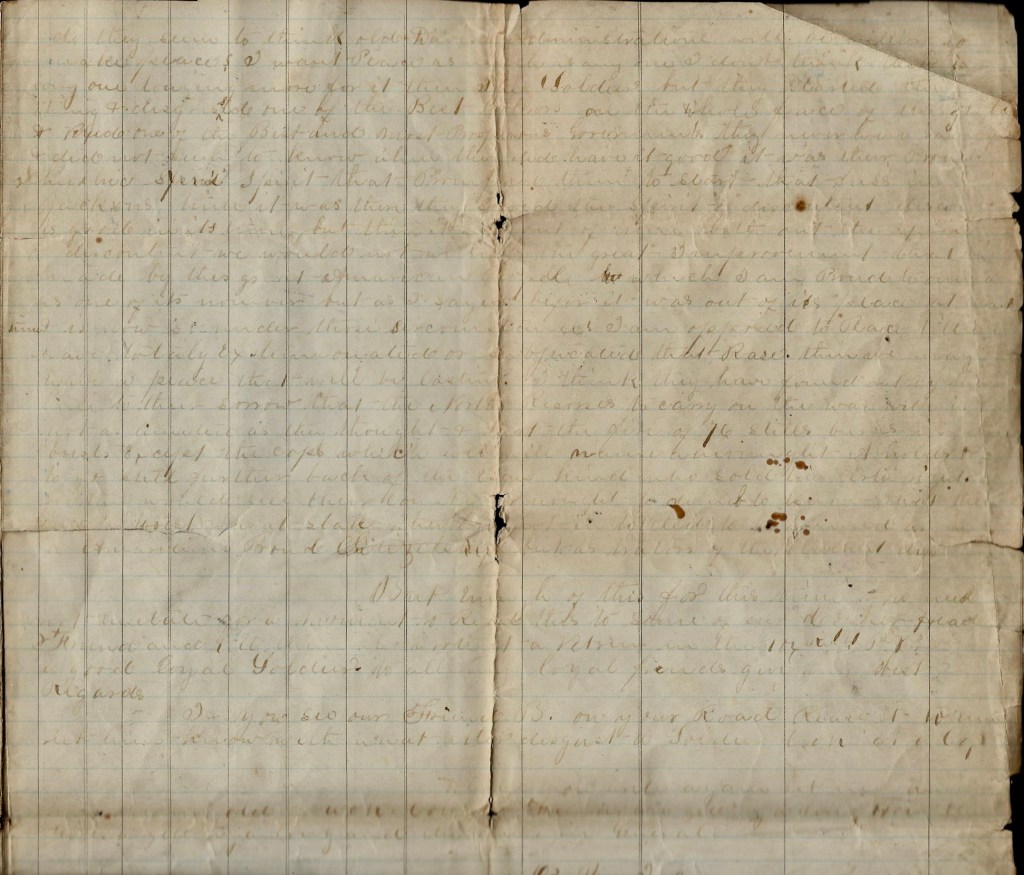
What do the people in Old Bucks county seem to think of the Blair Peace Initiative? Do they seem to think Old Davis’s Administration will be willing to make peace? I want peace as much as anyone. I don’t think there is anyone longing for it more than the soldiers, but they started the thing and disgraced one of the best colors on the face of the globe and ruined one of the best and most prosperous governments. They never were [ ] and did not seem to know when they did have it good. It was their proud, chivalric spirit that provoked them to start that fuss in Jackson’s time. It was then they started the spirit of discontent…I am opposed to peace till we have totally exterminated or subjugated that race. Then we may be a place that will be lasting. I think they have found out to their sorrow that the North’s resources to carry on the war was not as limited as they thought and that the fire of ’76 still burns in their breasts, except the Cops [copperheads]…to dumb to know what was at stake…But enough of this for this time.
Oh yes, I came near forgetting to tell you we just got through building a house…of logs and plastered with mud. It is 8 by 11 feet and 7 feet high, tile all around, and I have a little warm stove in it. The chimney is made of logs and plastered inside with a [ ] on the top. The roof of my house is canvass. Today we made a table. Our bunk is made of staves also split out of pine logs. We live gay for to be so close to the Johnnies…I can say with safety better than any other Nation on the globe for there never was any better.
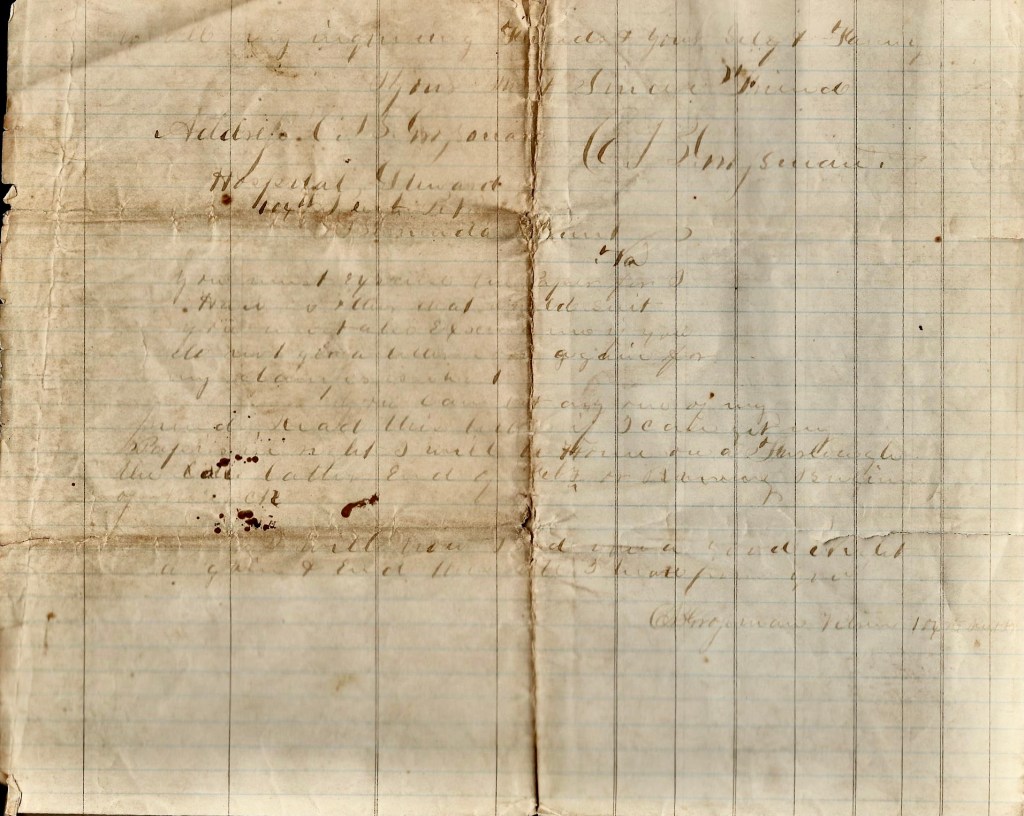
But I must come to a close hoping this may find you well. Just excuse poor writing and blunders that I could not avoid….Give my love love to all my enquiring friends and yourself and Fannie. Your most sincere friend.
—C. B. Grossman
Address: C. B. Grossman, Hospital Steward, 104th regt. Penn. Volunteers, Bermuda Front, Va.
1 Sergt. Jonas Martin died at the Point of Rocks Hospital on 24 January 1865. He was buried in the National Cemetery at City Point, Section F, Division 1, Grave 138.










 Spared & Shared 23