

These letters were written by George W. Phillips (1843-1862), the son of Andrew R. Phillips (1809-1877) and Margaret E. Roberts (1815-1883) of Chagrin Falls, Ohio. George enlisted in Co. E, 105th Ohio Infantry on 5 August 1862. Upon mustering the regiment, officials quickly ordered the 105th to Covington, Kentucky, with the regiment arriving at this location on August 22, 1862. Three days later, the 105th advanced to Lexington, Kentucky, where the organization prepared to defend the city against General Kirby Smith’s Confederate army. On August 30, 1862, the regiment departed Lexington for Richmond, Kentucky but soon returned to the departure city upon learning that Confederate forces were in possession of Richmond. On September 1, 1862, Union forces, including the 105th, in Lexington withdrew to Louisville, Kentucky, arriving at this new destination on September 5, 1862. At Louisville, officials assigned the 105th to the 33rd Brigade, 10th Division of the Army of the Ohio, and were soon to engage in the Battle of Perryville.
It isn’t known if George was with the regiment in the Battle of Perryville on 8 October 1862. Clearly he became ill rather quickly in the service and could not endure the rigors of camp life. In his letter of 21 November 1862, written from General Hospital #10 in Louisville, George tells his parents of his treatment and says his “lungs have been growing worse.” Less than a month later, George died of pneumonia on 18 December 1862. He was buried in Bainbridge, Geauga county, Ohio.
See also—1862: Andrew Phillips to George W. Phillips on Spared & Shared 22.
Letter 1
Camp near Lexington [Kentucky]
August 28, 1862
Dear Father and Mother,
I thought that I would write you a few lines before I leave. The prospect is now that we leave today for we heard cannon firing heavy last night from 8 o’clock till 1 o’clock. And they are most all in now & they are issuing 40 rounds of cartridges apiece & things are all in a stir. But enough about this.
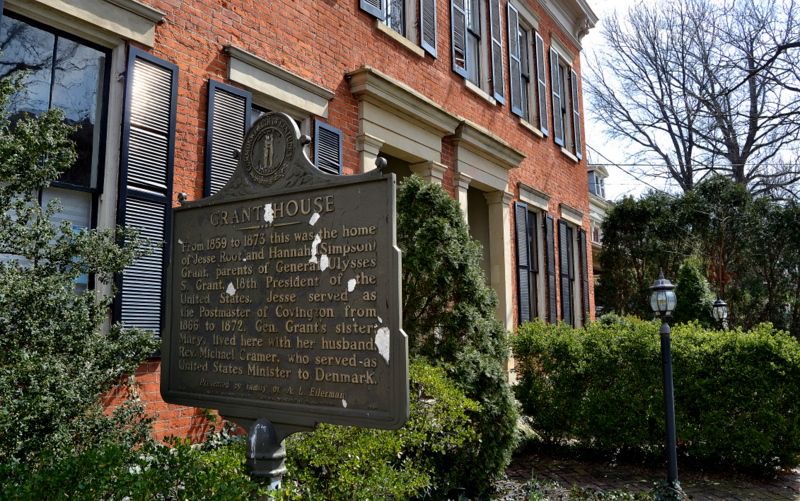
I am well & tough. The Colonel is just going up to headquarters. When we was in Covington, we stayed in front of Gen. Grant’s father’s house. 1 I had a long talk with him.
I think that we shall have something to do before long but I must stop and go and clean my gun. Write soon. From your affectionate son, — G. W. P.
Direct to Lexington, Kentucky, Co. E, Care of Capt. B[yron W.] Canfield, 105th Regt. OVI
1 Jesse Root and Hannah (Simpson) Grant lived in a two-story brick home at the corner of 6th and Greenup Street in Covington from 1859 to 1873.


Letter 2

November 21st, 1862
Dear father, mother, sister & brothers,
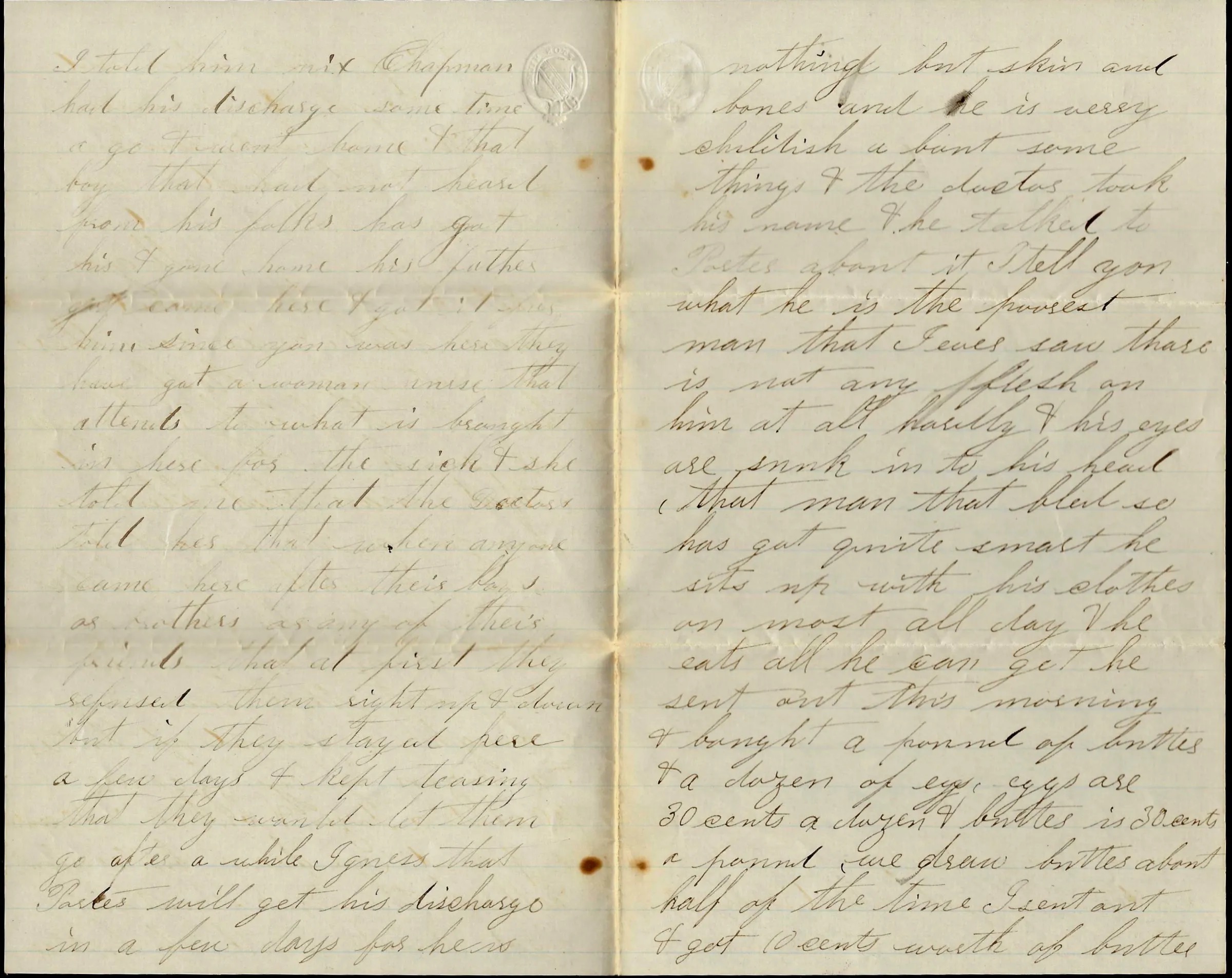
I received your letter of the 13th today and was glad to hear from you once more & to hear that you are getting along so well with the work. I have had to have another fly blister ¹ on my breast. My lungs have been growing worse for some time but I am in hopes that they may get better. I am so deaf that I cannot hardly hear common talk close by. The doctor thinks that those fevers that I had is what causes it but he [said] that he cannot do anything for it. He wanted to draw a fly blister behind each ear to cure it but I told him nix.
Chapman had his discharge some time ago & went home & that boy that had not heard from his folks has got his & gone home. His father came here & got it for him. Since you was here, they have got a woman nurse that attends to what is brought in here for the sick & she told me that the doctors told her than when anyone came here after their boys or brothers or any of their friends, at first they refused them right up & down. But if they stayed here a few days & kept teasing, that they would let them go after awhile. I guess that Porter will get his discharge in a few days for he is nothing but skin and bones and he is very childish about some things & the doctors took his name & he talked to Porter about it. I tell you what — he is the poorest man that I ever saw. There is not any flesh on him at all hardly & his eyes are sunk into his head.
That man that bled so has got quite smart. He sits up with his clothes on most all day. He eats all he can get. He sent out this morning & bought a pound of butter & a dozen of eggs. Eggs is 30 cents a pound. We draw butter about half of the time. I sent out & got 10 cents worth of butter that was sweet nice butter & 5 cents worth of apples. I got 6 pretty good sized apples for it. I have drawed me a pair of blue pants & I can draw a dress coat if I thought that I would need it but I can buy a new one off one of the boys for $5 & if I draw one, it will cost me $6.73. Which had I better do? I have not got me a pair of boots yet & shall not pass some time yet if I stay here in the hospital. I want you should send me my watch if anybody comes down here from that way that you can send it by for it is so much company for me. You need not send it unless you get a good chance to send it by someone that is coming down here.
I will get my letters sooner if you do not write the numbers of the regiment nor the company on the envelope. I am a going to get transferred on to one of the gunboats as soon as I get well enough & I will not have to carry my knapsack there. I can get a transfer if I want, I think. Don’t you think that I had better for I never can stand it to march & carry a knapsack.
Write soon & tell me what you think about it. From your son, — G. W. Phillips
¹ A fly blister was a cantharidal blister caused by the vesicating body fluid of certain beetles. It was occasionally used to treat pneumonia under the notion that it increased the peripheral circulation, thus decreasing the congestion in the lung beneath its site.







 Spared & Shared 23